

A child watches a puddle shrink in the sunshine and asks, “Where did the water go?” You might not know the answer straight away, and that's fine. The important thing is the question: it gives your child a reason to notice, wonder and look for evidence.
That kind of thinking sits at the heart of Key Stage 2 science. A report label can tell you something about progress, but it can't tell the whole story of how your child thinks, what they can explain or what support helps them join in.
What Key Stage 2 Science Asks of a Child
You could start with the puddle. Your child might say the water went into the ground, or that the sun “drank” it. Rather than rush to correct them, ask what they've noticed. Is the puddle smaller than it was? Is the ground damp? Has the sun warmed the path? Their answers help turn a passing observation into a scientific question.
In England, Key Stage 2 covers Years 3 to 6, usually from around age 7 to 11. Children learn biology, chemistry and physics alongside working scientifically, which means asking questions, exploring ideas and making sense of evidence. Think of science facts as a torch beam: they help a child see, but the child still has to decide where to point the torch and what to look for.
This is the English curriculum, not a shared national programme for Scotland, Wales and Northern Ireland. Schools can arrange the topics in different ways during the key stage, but children should know, apply and understand the specified content by the end of Year 6.
The evidence comes from across the subject
Science is assessed differently from English reading, mathematics, and grammar, punctuation and spelling. At the end of Key Stage 2, teachers assess science using one standard, “working at the expected standard”, rather than an externally marked national test with scaled-score bands. The Department for Education's national curriculum guidance explains that teachers make this judgement using evidence from pupils' work across the programme. Accurate observations, explanations, practical records and conclusions can all contribute.
That matters if your child feels anxious during timed tests. They may still show strong scientific thinking in an investigation, an explanation or a discussion. A single difficult worksheet isn't the whole measure of what they know.
Many parents fear that one wobbly topic means their child “isn't a science person”. Set that worry aside for now. A gap is a place to begin, not a verdict on your child's ability. The useful question is what they can show, what they're still learning and what would help them make the next connection.
Science Topics from Year 3 to Year 6
Start with the row for your child's year. Use it as a simple map of the English curriculum, not a checklist to race through. The “enquiry emphasis” column gives you a clue about the kind of scientific thinking your child may practise alongside the subject knowledge.
| Year | Biology | Materials and Earth | Physics | Enquiry emphasis |
|---|---|---|---|---|
| Year 3, about age 7–8 | Plants; animals, including humans | Rocks | Light; forces and magnets | Relevant questions, simple fair tests, standard units |
| Year 4, about age 8–9 | Living things and their habitats; animals, including humans | States of matter | Sound; electricity | Systematic observation, classification, tables and keys |
| Year 5, about age 9–10 | Living things and their habitats; animals, including humans | Properties and changes of materials | Earth and space; forces | Variables, accuracy, repeated readings, bar and line graphs |
| Year 6, about age 10–11 | Living things and their habitats; animals, including humans; evolution and inheritance | No new chemistry unit; materials mainly in Year 5 | Light; electricity | Causal relationships, scatter graphs, judging trustworthiness |
The table groups content from the English national curriculum for science. Schools can teach topics earlier or later within the key stage, provided pupils cover the programme by the end. For an online British-curriculum pupil living abroad, the same subject content applies even if the local school year begins in a different month.
Each year has a knowledge aim that makes a useful conversation starter. A Year 3 pupil might compare how objects move on different surfaces. In Year 4, a child could group materials as solids, liquids and gases. In Year 5, they might describe how the Earth and Moon move. By Year 6, they could explain how adaptation may lead to evolution.
Use one row tonight
Pick one topic in your child's row and ask what they remember doing, not just what they remember reading. If they're learning about plants, for example, ask what happened when a plant had less water or light. A resource on how plants absorb water can help you explore the idea together, then invite your child to describe what they'd look for in a simple observation.
Don't treat the year labels as strict deadlines. A school may teach a topic at a different point, and a child may need more time to feel secure. If your Year 5 child loves rocks, that interest still has a place: rocks are the Year 3 materials topic, not a separate Year 5 unit, but your child could compare how different rocks behave when rubbed or soaked, with an adult supervising. That lets curiosity support current learning about material properties without pretending the topic belongs to a different year.
If you're looking ahead to secondary science, the Key Stage 3 science curriculum can help you see how learning develops beyond primary school. For now, highlight a topic your child can explain confidently and one they find harder. That gives you a better starting point than racing on to the next year's content.
How Working Scientifically Grows with the Child
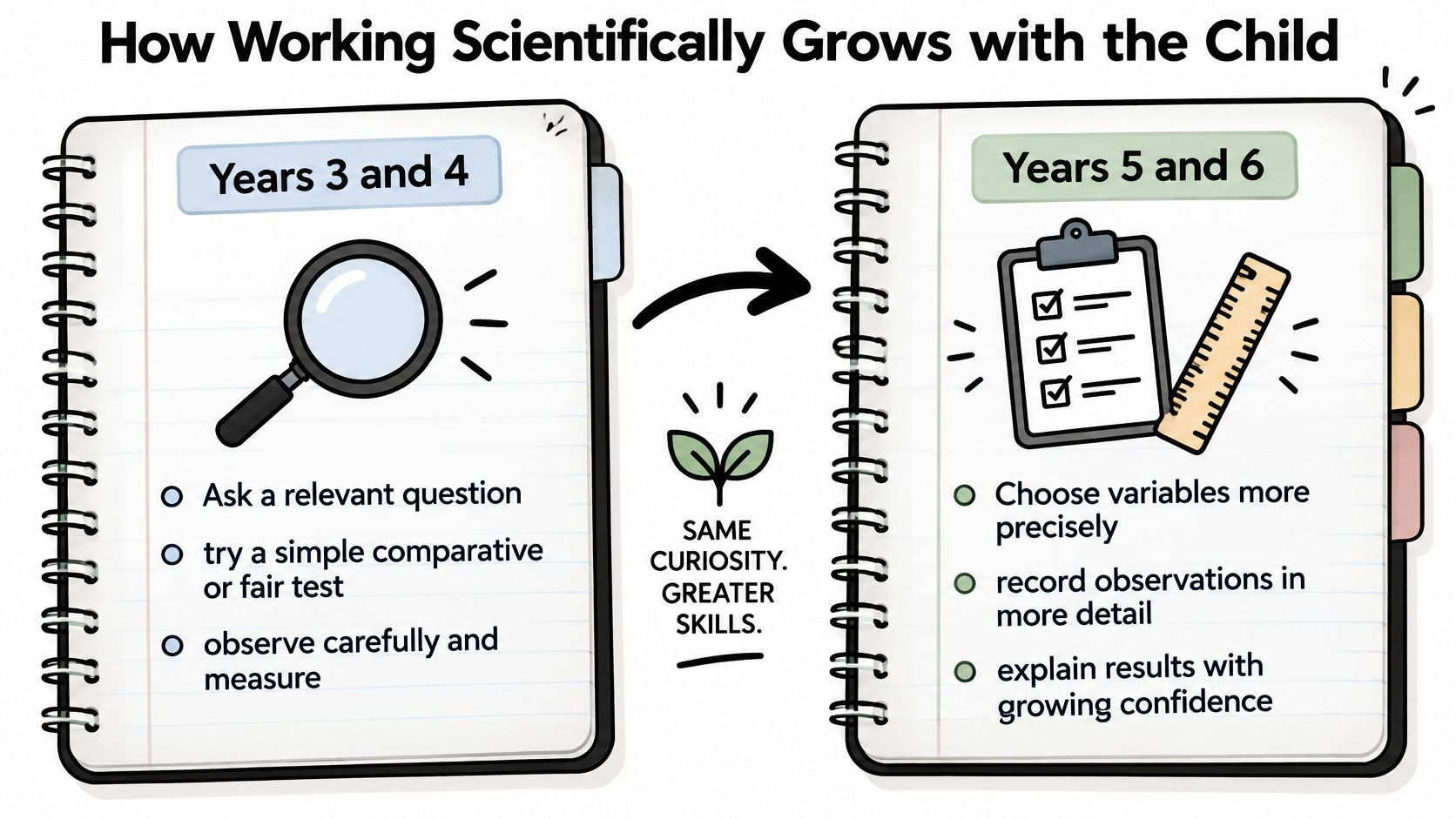
Think of a child's science notebook as a detective's notebook that gets fuller over time. In Years 3 and 4, pupils learn to ask relevant questions, try simple practical enquiries and comparative or fair tests, observe systematically and measure using standard units. They might record what they find in drawings, tables or classification keys.
A central idea is to change one thing at a time. If a child changes the amount of sugar and the water temperature in the same test, they can't tell which change affected how quickly the sugar dissolved. That isn't a reason to feel cross. It's a chance to notice what would make the comparison fairer next time.
| Phase | Questions and tests | Measurements and records | What a strong conclusion sounds like |
|---|---|---|---|
| Years 3–4 | Ask a relevant question and run a simple comparative or fair test | Standard units, thermometers or data loggers, drawings, tables and keys | We changed one thing and the pattern in the table answers the question |
| Years 5–6 | Plan the enquiry type and control variables | Greater accuracy, repeats when needed, bar, line and scatter graphs | The result supports or challenges the idea, and we can say how trustworthy it is |
By Years 5 and 6, pupils are expected to plan different kinds of enquiry, recognise and control variables, measure with increasing accuracy and repeat readings when appropriate. They also learn to choose ways of recording increasingly complex results, use findings to make predictions and judge how trustworthy their evidence is, as set out in the primary national curriculum requirements.
Follow a sugar investigation from question to conclusion
Suppose a younger pupil asks whether sugar dissolves faster in warm or cold water. They predict which cup will be quicker, use the same amount of sugar in each and time how long it takes to disappear. They could write the results in a small table and say which water seemed to dissolve the sugar faster.
An older pupil can make the comparison more precise. They identify the water temperature as the independent variable, the time taken as the dependent variable, and the amount of sugar and stirring as control variables to keep the same. They repeat the test if a result looks unusual, choose a graph that fits their results, and say if one odd reading makes the conclusion less certain.
The full evidence chain is: question, prediction, variables, method, measurements, table or graph, conclusion, evaluation. In an online lesson, a child can photograph the setup and share the table with a teacher. They don't need a classroom bench to explain what they changed or why they think the result supports their idea.
Different roles can still lead to the same learning. One child might set up the apparatus, another record measurements, and another build the graph or explain the pattern. The useful test of progress is whether your child can say what they think would happen if one variable changed, and give a reason grounded in their evidence.
Online Lessons That Still Feel Like Real Science
A child can investigate at home without owning a specialist kit. The aim is to give them something to observe, record and explain, rather than watch an adult demonstrate and then try to remember it later.
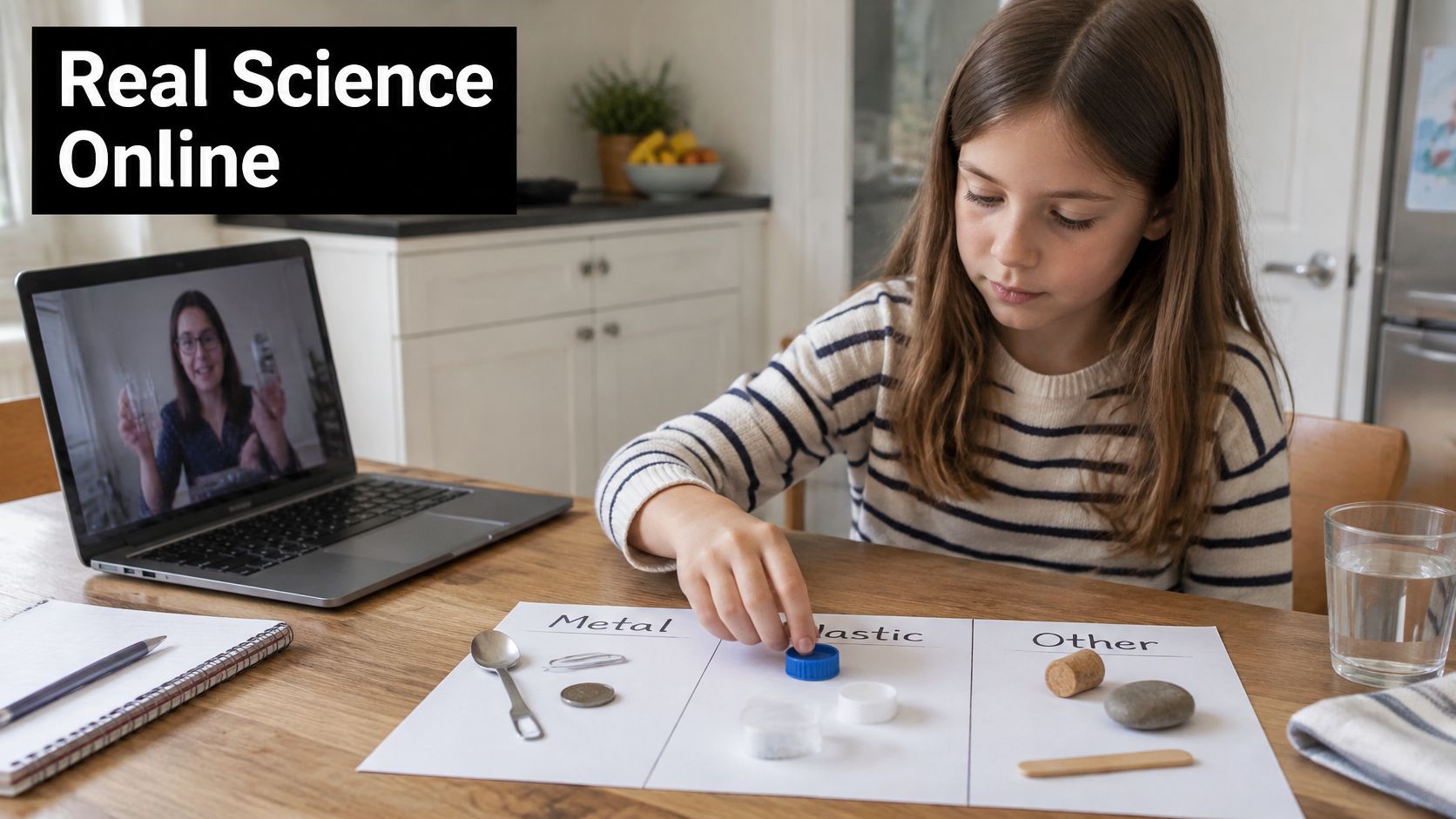
Use the same simple rhythm for a live session: five minutes for a question and prediction, ten minutes for the practical, five minutes to share a table, then five minutes to reach a conclusion. The point isn't to hurry a child; it's to leave them with a record they can revisit. A photograph or table they made themselves is more useful than a memory of someone else's experiment.
Four investigations with everyday materials
Year 3, forces and magnets. Ask which household objects a magnet will attract. With an adult's permission, gather a few safe objects such as a coin, key, wooden spoon and piece of foil. Test each one, then record “magnetic” or “not magnetic”. The child's work to keep is the results table and a sentence noticing that not every metal object is attracted to the magnet.
Year 4, states of matter. With an adult managing the heat, observe chocolate softening in a warm bowl. Ask what changed and how the chocolate's state changed from solid towards liquid. Don't eat the experiment. The child can keep a labelled drawing or short description showing what they saw before and after warming.
Year 5, Earth and space. On a sunny day, mark the position of a shadow at regular points through the day. If the lesson is after dark or the weather doesn't cooperate, keep a Moon diary instead. The child can record observations and suggest how a pattern relates to movement in space.
Year 6, electricity. If you have a cell, bulb, wires and switch, make and break a simple series circuit with an adult checking the equipment. If you don't, draw the circuit and predict what will happen if there's a break in the loop. The evidence can be a labelled diagram and an explanation of why the bulb lights only when the circuit is complete.
A working bulb can bring a flash of pride because the child's own prediction has turned into an observation. A bulb that doesn't light can be frustrating, but it's useful evidence: the child can check connections and explain what they changed. Keep heat and batteries under adult supervision, and choose activities that suit your child and the materials available. These are examples, not a shopping list.
The same principle applies when choosing online learning for Key Stage 2: a child needs chances to do the thinking, not just watch someone else do it. A teacher can ask for a prediction, look at a results table and help the child explain a conclusion. If you want to see the sort of discussion a practical can prompt, start with this short video.
What the Expected Standard Really Shows
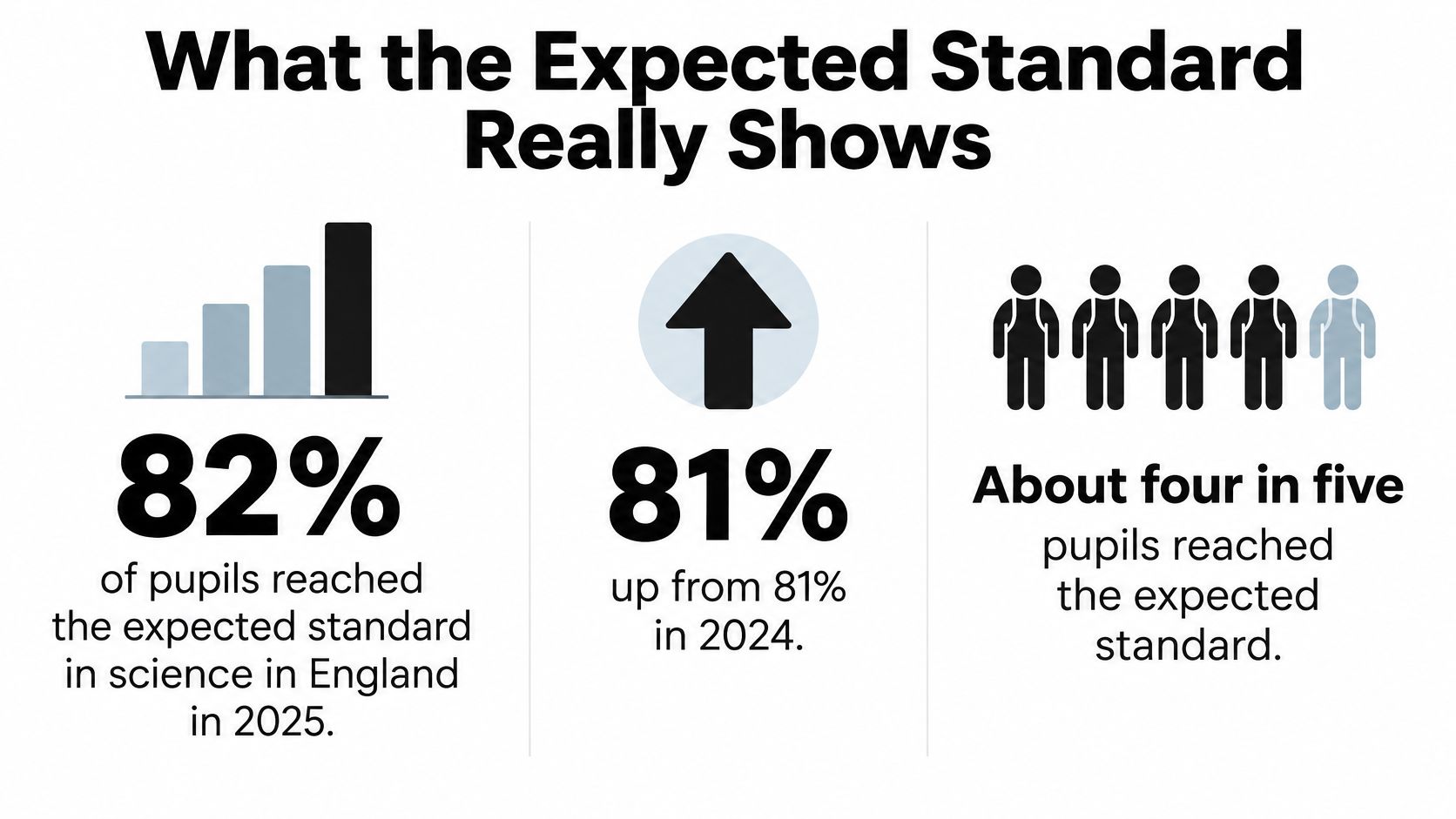
In England, 82% of pupils reached the expected standard in science in 2025, up from 81% in 2024. That's about four in five Year 6 pupils judged to have the knowledge and understanding expected at the end of primary school, according to the Department for Education's revised Key Stage 2 attainment statistics.
That is a useful national reference point, but it's not a direct comparison with reading or mathematics results. Science is judged by teachers using evidence from pupils' work, rather than a nationally administered science test. The percentage is also an England figure, not a UK-wide result.
A label can't reveal every kind of understanding
The headline number can sound reassuring, but the judgement can't reliably show whether an individual child can explain an idea independently, apply it in an unfamiliar situation or identify a misconception. A child might confidently repeat “evaporation” yet struggle to explain what happened to the puddle. Another might understand the change but find it hard to put their thinking into words.
The assessment framework changed in 2019, so older family memories of levels don't provide a straightforward comparison either. A result can help start a conversation, but it shouldn't end one.
Ask for the evidence behind the judgement: Which investigation, explanation or record shows what my child can do, and where are they least secure?
A child who reaches the expected standard may still need help to deepen their reasoning. A child who doesn't reach it may still be a careful observer or a thoughtful problem-solver whose writing, attention or language made that thinking harder to see. Neither outcome defines the child's potential.
At home, you can make a short conversation more revealing than a quiz of memorised facts. Ask, “What evidence supports that?” or “What would happen if we changed one variable?” Then give your child time to think. Their answer might be hesitant or incomplete; listen for how they connect it to an observation, not just whether they use the right vocabulary.
If your child's result worries you, ask the teacher to show you a practical record, graph or explanation and name the topic where your child would benefit from more support. That gives the family something useful to work on, without treating a national headline as a prediction of what one child can achieve.
Science That Keeps Every Child Inside the Lesson
Start with the child who wants to join in but can't yet show what they know in the expected way. They might lose their place in a long instruction, avoid speaking on camera or understand an investigation but struggle to write a paragraph about it. The science goal can stay the same while the route into the task changes.
The national result is an average for pupils in England, not a forecast for any individual child or subgroup. Official reporting includes breakdowns by pupil characteristics such as disadvantage and special educational needs, but a headline can't tell a parent what a particular child needs. The Department for Education's Key Stage 2 attainment statistics provide that broader reporting context.
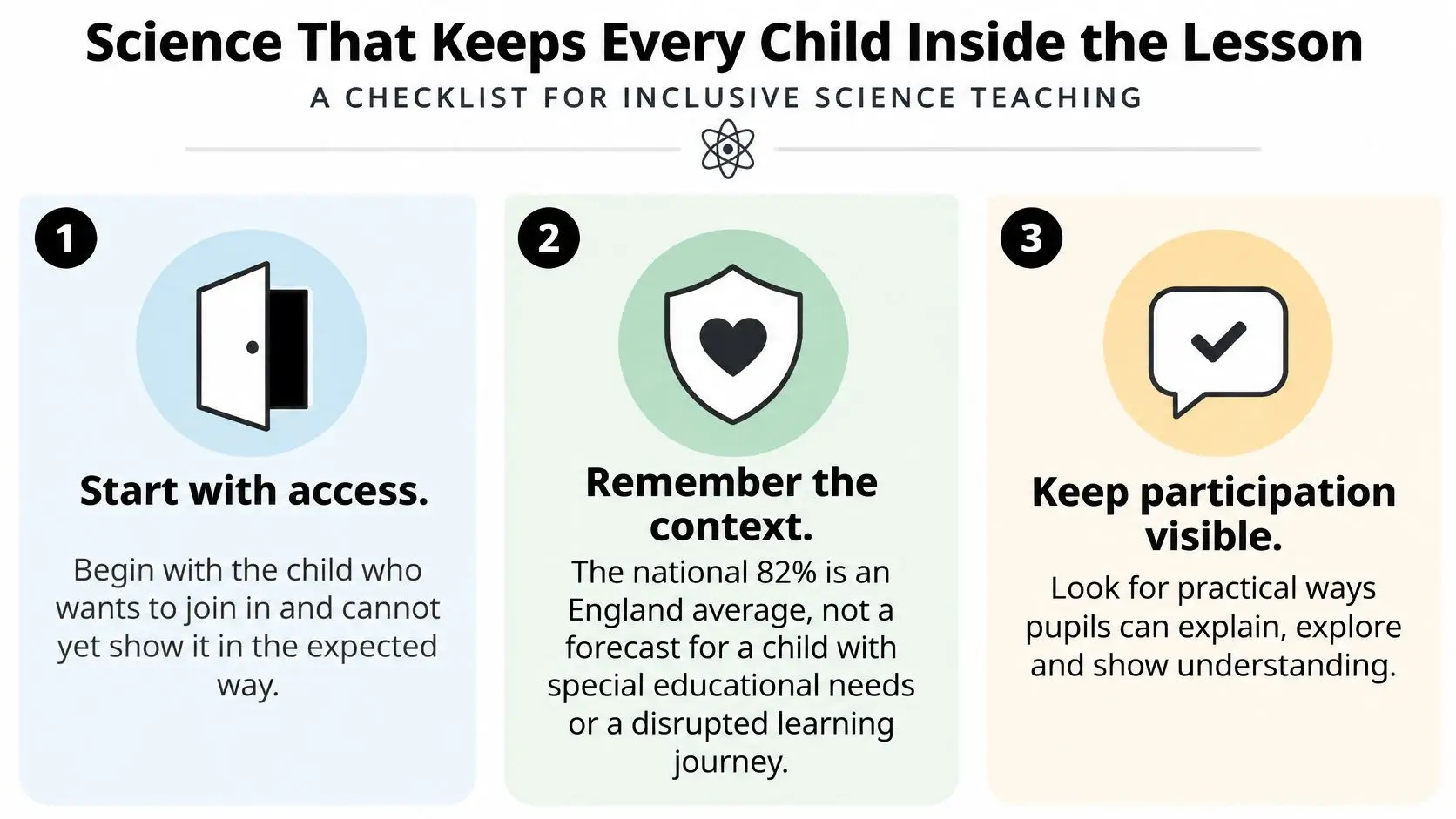
Keep the scientific goal, change the route in
For a child whose working memory is stretched, put the evidence chain on a visual card: question, prediction, test, record and conclusion. Keep each instruction short and visible, rather than giving several steps aloud and expecting the child to hold them all in mind.
If language processing is a barrier, place one question on the screen and offer a small word bank, such as variable, result and conclusion. A sentence starter can help: “I think this happened because…” When teaching control variables, use an object to represent the thing that stays the same, so the idea is concrete.
Children can show observations in different ways. One pupil might take a photo, another might make a voice note or use symbols, and another might ask an adult to write down their sentence. These are different ways to capture evidence, not different expectations of what science means.
A child's route into the task can change without lowering the scientific goal.
Make participation predictable and possible
Agree roles before a group investigation. One child can organise the apparatus, another read measurements, another complete the table, and someone else explain the pattern. This helps children take part without forcing everyone to do every part in the same way.
For a child who feels anxious about live discussion, let them rehearse an answer with a trusted adult or teacher before speaking to the group. Camera-off listening can be a planned first step, provided the child has another way to share their record or reasoning. For sensory needs, warn before a sudden sound or a video showing a change, and offer headphones or a quieter alternative.
A predictable practical routine can also reduce uncertainty. Tell your child what they'll do, what they'll record and how the activity will finish. Then look for participation in the reasoning, not speed, handwriting or a polished spoken answer.
Ask the teacher which adaptation is already helping and which topic still needs a different route. If your child is struggling, that doesn't mean they have less potential. The next step is to find out what lets them notice, test, record or explain in a way that makes their thinking visible.
Ten Minutes of Science Beside Your Child
A small routine can support scientific thinking without turning your kitchen into a laboratory. Set aside ten minutes, notice what your child is curious about, and ask three questions: What evidence supports that? What would happen if we changed one thing? Can you explain it without the memorised word?
Let the child lead from something ordinary: a shadow on the wall, a puddle, a balloon, a pet or a light that won't switch on. If they say a plant grew because it wanted to, enjoy the idea, then ask what they might measure or observe next. You don't need to supply the “correct” explanation straight away.
Keep the routine light
Use a scrap page rather than a workbook. Write down the date, the question and one result, or take a photo of an observation. Praise the careful look, the repeated try and the honest “I'm not sure”. A wrong prediction that a child reviews is often more useful than a definition they recite without understanding.
If a family outing helps your child notice nature, you might explore outdoor summer activities for Florida kids as a way to find ideas for time outside. A walk can lead to questions about shadows, plants, animals or changing weather without needing a formal lesson.
You can also find practical prompts in these science experiments to try at home. Choose activities that match your child's interests and comfort. Heat, sharp objects and mains electricity need adult supervision; curiosity doesn't require taking risks.
Forgetting a word after a break is an ordinary wobble. But if your child refuses every practical, or says that science proves they're stupid, speak with their teacher about what they're finding hard and whether they can access the activities. Adding more worksheets may not address the barrier.
When you look at a school graph together, ask your child to teach it to you. Let them describe what the axes show and what they notice in the results. That small reversal gives them a chance to lead, and it shows you how they're making sense of the evidence. If the day has already been heavy, it's fine to skip the routine and try another time.
Choose the Support That Fits Your Child
Choose support from what your child can show, not from worry about one label. If they're meeting the year's topics, can attempt a fair test and have recent work the school can share, stay with their class and keep the short home routine. If there's a clear topic gap, ask the teacher which investigation could help revisit it before adding random videos or worksheets.
Live online teaching may suit a child who needs a specialist teacher, a smaller group, a timetable that works around travel or health, or adjustments that aren't working well in a crowded classroom. For international families, a British curriculum can also make it easier to follow English primary science while living abroad. The right choice depends on the child, not the format alone.
Queen's Online School offers Key Stage 2 within a British curriculum, with live interactive classes, subject-specialist teachers, small groups and support for learners who need a different route. Its provision includes recorded sessions, which can help a pupil revisit a lesson they missed. It may not suit a family looking only for occasional worksheets, so be clear about the kind of regular teaching and support your child needs.
Before you speak to any provider, note three things: your child's year group, one topic they feel secure in and one that drains their confidence. Ask how the provider assesses working scientifically without a science SATs paper, and how a child who struggles to write can still show a conclusion.
The right next step is one where your child feels safe enough to make a prediction, learn from getting it wrong and try again with an adult who understands how they learn.
Queen's Online School provides live, interactive British-curriculum teaching for Key Stage 2 learners, with subject-specialist teachers, small groups and support for different learning needs. If you're exploring whether that approach could help your child take part more confidently in science, visit Queens Online School to find out more.