


Your child lights up watching seeds germinate or asking why a heart beats faster after running. Then you picture a noisy laboratory, a timetable they can't keep, or another morning when anxiety stops them leaving the house, and you wonder if online GCSE Biology is a real qualification or a hopeful compromise. It's real, but only when the teaching, the practical preparation and the exam entry are planned together. The name matters less than this question. Can your child learn the full specification, handle the required practical skills with support, and sit the papers at an approved centre without the process overwhelming them?
What Your Child Studies and Sits
Online GCSE Biology at a glance
| Part of the course | Done in live online lessons | Still done away from the screen | Parent check |
|---|---|---|---|
| Specification content | Cells to ecology taught against the named board spec | None; the spec is not optional | Which board and whether Biology or Combined Science |
| Required practicals | Method, variables, risk, data and evaluation | Hands-on practice the school can evidence | Who supplies equipment and checks the method |
| Written exams | Past-paper practice and timed mocks | Sat at an approved centre, not at home | Centre name and entry deadline |
| Access arrangements | Need identified and evidence gathered early | Centre applies; extra time is not automatic | When evidence will be shared with the centre |
| Pacing | Live lessons plus replay for missed sessions | Entry year chosen with the centre | Year 10, Year 11 or a later sitting |
Say your child loves living things but dreads a crowded lab, the smell of disinfectant, and being watched while they fumble with a microscope. That dread doesn't reduce what they must learn. Online GCSE Biology is the same regulated subject as a school course, not a lighter substitute, and feeling calmer at home doesn't make any topic optional.
What the rows mean for your child
Specification content comes first. Live lessons should follow a named board specification from cells and organisation through infection, bioenergetics, homeostasis, inheritance and ecology. If a lesson is just an interesting talk about animals, your child may enjoy it and still miss the exact wording an examiner rewards.
Required practicals sit inside that content. In live lessons a teacher can unpack the method, variables, hazards, measurements and evaluation. Away from the screen, somebody must still make sure your child has handled equipment or worked through supervised practical activity that the school can evidence, because confidence with apparatus doesn't grow from watching alone.
The official provisional entry data tables for England's summer 2024 series recorded 183,370 provisional GCSE Biology entries across the listed awarding organisations and centre categories. That's why a general science playlist isn't enough. Your child is preparing for a large, regulated qualification with a set specification and set papers.
Exams, arrangements and pace
Written exams are practised online through past papers and timed mocks. The actual sitting happens at an approved centre, with other candidates, invigilators and the same rules as any school hall. For a child who panics in unfamiliar rooms, knowing the centre early and visiting the route beforehand can turn a frightening unknown into a manageable plan.
Access arrangements and pacing need the same early honesty. A need should be spotted in lessons, evidenced over time and shared with the centre well before entry. Replay helps after a missed session, but you still need an agreed entry year, because drifting without a series in mind leaves a child studying hard with no finish line.
Parent check: Name the awarding organisation, confirm separate Biology or Combined Science, and ask who enters your child and where they'll sit.
Combined Science suits a child who wants breadth across biology, chemistry and physics, while separate Biology gives more depth in living systems alone. Don't choose from a leaflet. Choose from the board, the centre plan and whether your child can sustain the work week after week.
Required Practicals Without a School Lab
A practical lesson is often the moment a child either feels capable or decides they're going to fail. Their hands shake over a measuring cylinder, the class moves on, and shame does the rest. Online learning can slow that moment down, but it can't remove the practical demand.
Use this checklist to picture what preparation should look like before your child meets an unfamiliar method in a paper.
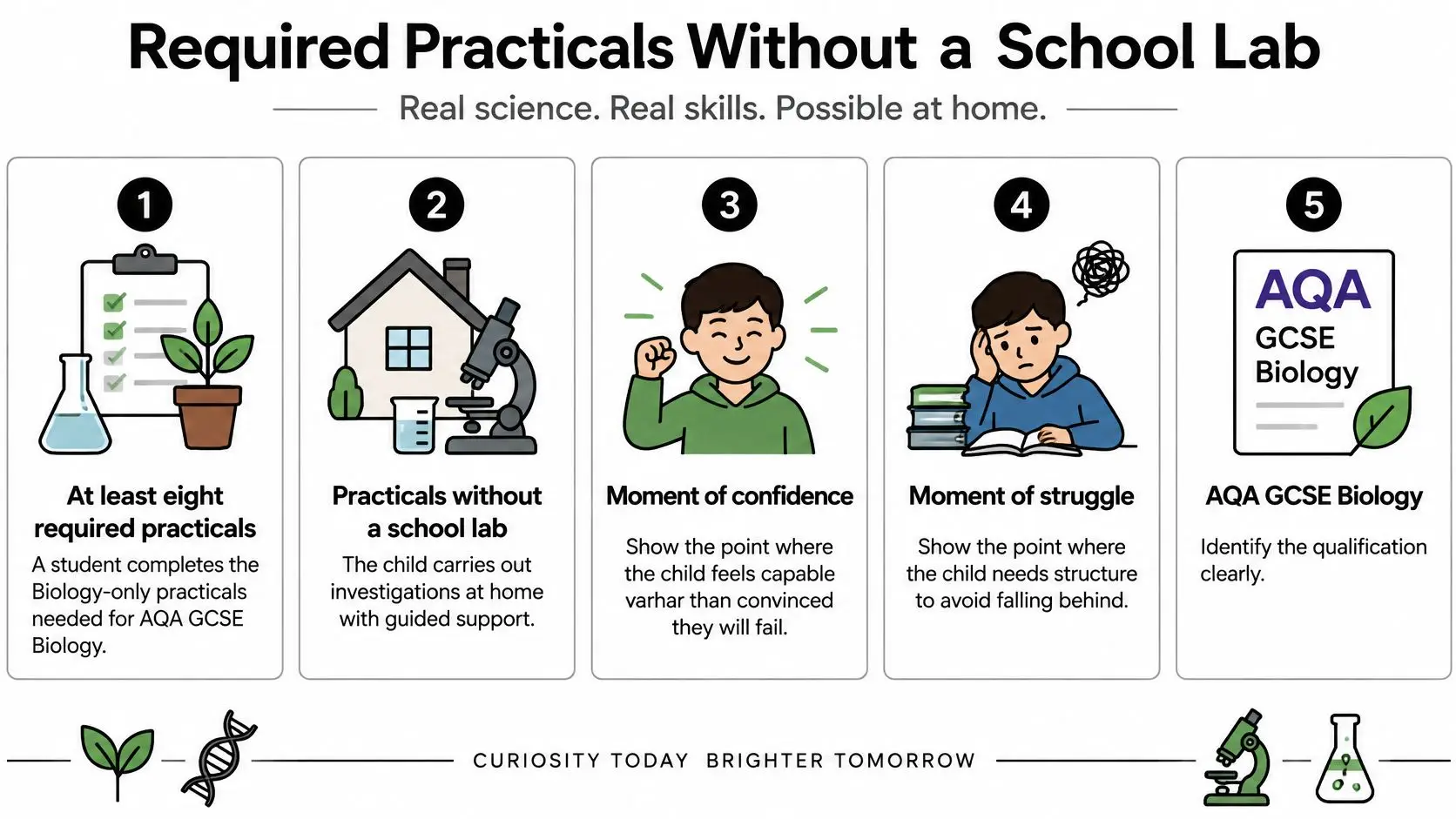
The AQA GCSE Biology practical assessment specification states single-science students must complete at least eight required practical activities, while the Biology-only course includes ten named practicals, with practicals 2, 8 and 10 not shared with Combined Science. Those activities build distinct skills. Your child measures a rate from gas production, water uptake or an indicator colour change, uses a microscope and produces a labelled biological drawing, works safely with living organisms, and samples organisms in an ecosystem.
One practical in full
Take osmosis with potato cylinders. Your child cuts cylinders as evenly as they can, records start mass, places each cylinder in a different sugar concentration, leaves them for the same time, blots them, then records end mass and calculates percentage change.
- Independent variable: the sugar concentration your child changes.
- Dependent variable: the change in mass they measure.
- Control variables: cylinder size, volume of solution, time in solution and temperature, kept the same so the comparison is fair.
Now the human part. One cylinder in a strong sugar solution gains mass, although it should lose water by osmosis. Your child may want to hide that result. Teach them to explain it instead. If they didn't blot that cylinder properly, surface solution added mass. That's an anomaly with a cause, and naming it calmly is exactly what an evaluation needs. You can compare how this preparation fits within our GCSE science courses when you're checking what a provider supplies.
Watch a demonstration like this before handling kit, so the sequence feels familiar rather than sudden.
What a screen can and cannot do
A teacher demonstration, simulation or shared data set can teach the order of steps, the graph shape and how to calculate a rate. It can't prove your child can focus a microscope, measure a volume at eye level, or keep a living organism safe. A video alone does not prove competence.
For an anxious learner, sequence the work gently. Watch first. Read a one-page method. Practise the calculation on sample results. Then handle the equipment with a teacher or trusted adult present, where a spill becomes instruction rather than humiliation.
Ask who verifies the preparation, what evidence is kept, and how your child will practise an unfamiliar practical scenario before it appears in the paper.
How the Exam Entry Is Planned
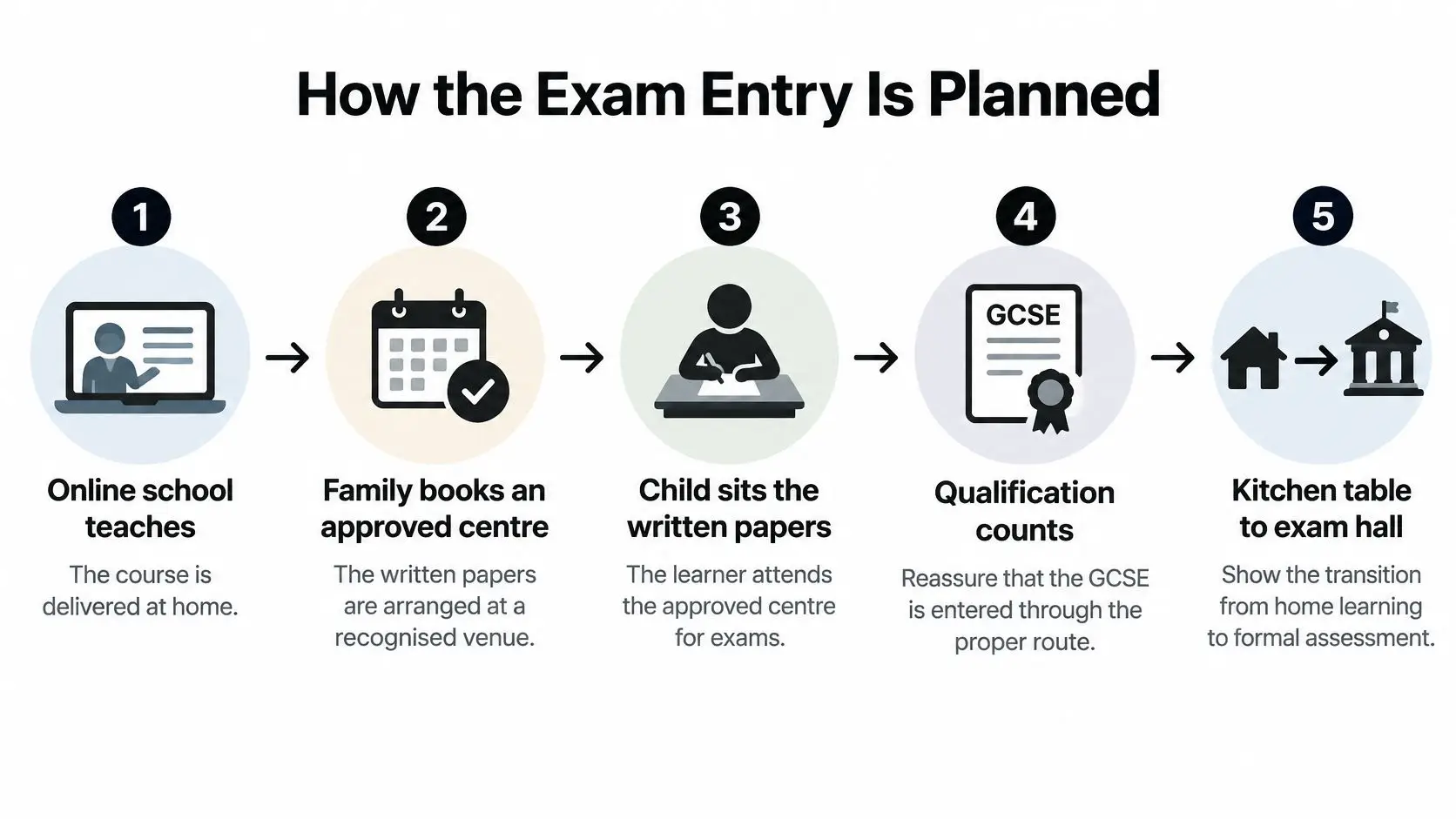
Many parents carry a quiet fear that work done at the kitchen table won't count. It counts when the route is formal. We teach online, and your child sits the written papers at an approved centre that your family books and can reach on the day.
This flow shows the move from home learning to the exam hall.
Summer 2025 GCSE entries in England by year group
| Year group | Provisional entries | Share of total |
|---|---|---|
| Year 11 | 5,212,910 | about 90.2% |
| Year 10 and below | 92,435 | about 1.6% |
| Year 12 and above | 471,675 | about 8.2% |
| All year groups | 5,777,020 | 100% |
The provisional entries for the summer 2025 exam series recorded 5,777,020 provisional GCSE entries in England, a fall of 0.6% from 5,811,595 in summer 2024. These totals cover all GCSE subjects, not Biology alone, so read them as the national timing pattern. It is stable, and Year 11 remains the usual sitting point.
Three children, three timings
A 15-year-old follows the standard two-year Key Stage 4 path and sits in Year 11 with most candidates. A younger learner who's ready in one science may sit early, provided the centre entry is agreed and the pace doesn't steal confidence from other subjects. A 17-year-old returning after illness may sit later, rebuilding stamina without pretending the lost year didn't happen.
Our GCSE online exam information helps you separate teaching arrangements from the formal sitting. Keep both in view from the start, not in the final term.
Your five actions
- Confirm the qualification: check the exact title and awarding organisation in writing.
- Agree the series: fix the intended series and the entry deadline with us.
- Book the centre: choose an approved centre your child can reach calmly and reliably.
- Practise the conditions: sit mocks under similar timing so the hall feels less strange.
- Keep the paperwork: store the statement of entry somewhere the whole family can find.
Travel problems, a health change or a possible resit can alter the plan. Tell us first, and we'll help you approach the centre early rather than leaving your child to absorb adult uncertainty as personal failure.
When Flexibility Is Not the Same as Support
Your child understands enzymes during a calm conversation, but a timed paper brings a different challenge: the clock feels loud, and a six-mark answer remains unfinished. That gap is not laziness. It may show that flexible access to lessons needs to be matched by support for the child's specific barriers.
The checklist below focuses on the difference between logging on and being able to show what you know.
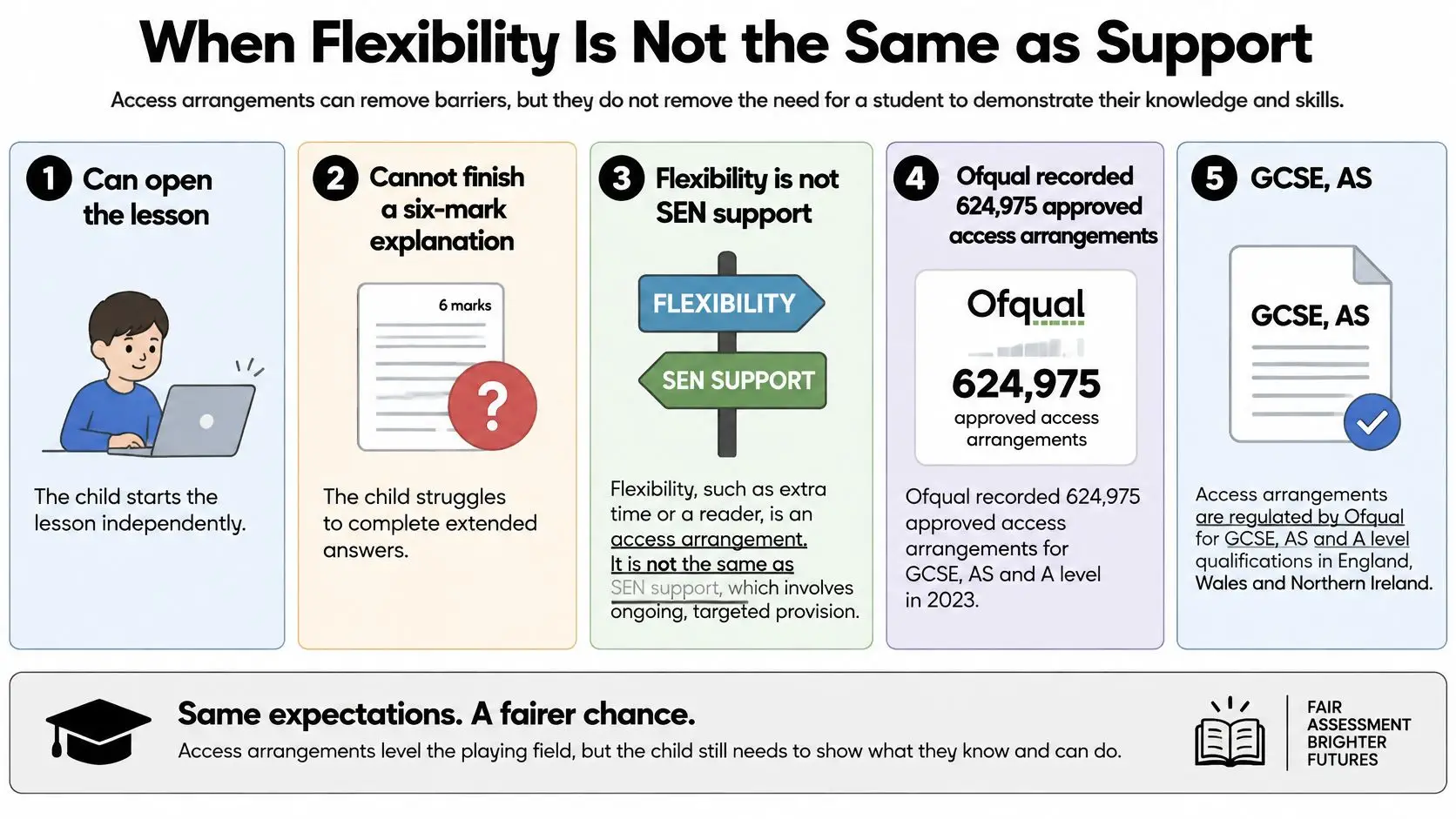
Ofqual's access arrangements statistics for the 2023 to 2024 academic year recorded 624,975 approved access arrangements for GCSE, AS and A-level candidates, an increase of 12.3% from the previous year. These totals show that arrangements are part of exam access across a wide range of subjects. They do not determine what any one child needs.
An arrangement must fit the individual child, be supported by evidence and assessment, and be applied through the exam centre. A parent's wish to reduce distress is understandable, but it cannot replace the evidence the centre needs.
A Biology-specific support checklist
- Chunked explanations: teach cell transport in small steps, check each one, then connect them for a child who finds it hard to hold several ideas in mind.
- Replay without penalty: let your child pause a graph explanation and return to it before the next live lesson.
- Chat before speaking: offer a typed answer first if speaking aloud feels exposing.
- Camera-off agreements: agree when the camera can stay off and how the teacher will check understanding.
- Dyslexia-friendly slides: use clear spacing, uncluttered diagrams and key terms the child can revisit.
- Movement breaks: include short breaks in longer study sessions rather than treating stillness as proof of effort.
- Graph-reading routine: practise identifying the title, axes, trend, values and conclusion until the sequence feels familiar in timed work.
A learner who panics when time runs out may feel ashamed as well as worried. Support can help them practise explaining the same Biology, while evidence and assessment establish whether an exam arrangement is appropriate. The exam rules still apply; the aim is to remove a barrier that is not part of the Biology being assessed.
Recorded lessons cannot spot avoidance on their own. A named teacher who notices missing quizzes, silence in chat or answers becoming shorter can ask what is getting in the way while the problem is still manageable.
Ask early how needs are identified, what evidence will be gathered and who liaises with the centre. Good support helps a child show what they know while preserving the qualification's standard.
A Week That Keeps Biology Recoverable
On Monday, a medical appointment wipes out the live cell transport lesson. By lunch your child has decided the whole topic is lost and everyone else is ahead. A recoverable week answers that fear with a route back in the same few days, not a pile of unmarked videos waiting for a braver mood.
Sample online Biology week
| Day | Session | What the child does | If they cannot attend |
|---|---|---|---|
| Monday | Live cell transport, small group | Answers a teacher question in chat or aloud | Watches the recording the same day |
| Tuesday | Replay and low-stakes quiz | Checks one misconception from Monday | Completes the quiz before Wednesday |
| Wednesday | Practical data workshop | Plots potato-cylinder masses and names variables | Uses the shared data set with the method sheet |
| Thursday | Small-group problem | Explains one anomaly to a peer | Sends a voice note or chat explanation |
| Friday | Six-mark practice and feedback | Writes under a short timer, then reads comments | Rewrites one paragraph using the feedback |
The Education Endowment Foundation's evidence review on remote learning for pupils examines systematic reviews and meta-analyses of distance and online learning for pupils unable to attend classrooms. In a Biology week, that points to a predictable rhythm. Live teaching comes first, a short recording stays available for replay, the teacher questions during or after the lesson, and a low-stakes quiz returns feedback while the idea is still fresh.
How the recovery actually happens
Your child watches Monday's explanation later that day, perhaps privately at first because speaking in front of peers feels too much. On Tuesday they answer five low-stakes questions and discover they've confused diffusion with osmosis. That one correction matters more than rewatching everything in a panic.
Wednesday keeps the week concrete. In the potato-osmosis data workshop, your child plots percentage change in mass against sugar concentration and names the variables aloud or in chat. On Thursday, a small-group anomaly task asks them to explain one odd result to a peer. If speaking is still hard, a voice note lets them contribute without disappearing.
Friday closes the loop with a short timed six-mark write and teacher comments. Your child rewrites one paragraph, not the whole answer, so improvement feels possible. Planned peer contact runs through the week as well, because flexibility that becomes isolation drains belonging.
The emotional test
If confusion meets silence, avoidance grows. A child stops opening feedback, then stops opening lessons. If enzymes or homeostasis returns with a question, a reply and a small success, the topic becomes difficult but recoverable.
Read any proposed week through your child's eyes. Is there a named teacher, a visible deadline, and one human check-in each week? If not, replay is being asked to do a person's job.
Accreditation, Enrolment and Support
Exam day can feel far away when your child is focused on learning Biology. Still, knowing who awards the qualification and where the exam takes place helps make the route feel clear. GCSE, International GCSE and A Level exams are sat at approved exam centres, not at home, in line with UK examination board requirements.
Queen's Online School is a Pearson Edexcel Approved Centre and a registered UCAS centre. Its recognised GCSE, International GCSE and A Level qualifications are accepted by universities, colleges and employers in the UK and internationally. You can read more about Queen's Online School's accreditation.
Before enrolment, ask which qualification and exam board your child will study, and how the exam-centre arrangements are planned. A clear answer gives your family time to consider the journey and any arrangements your child may need.
Enrolment in five steps
- Enquire and talk: Discuss your child's needs, learning history, current level and what has made school difficult.
- Confirm the route: Agree the qualification and exam board before lessons begin.
- Review the week: Ask for a timetable showing live lessons, replay access and practical sessions, so your child can understand the shape of a usual week.
- Plan the exam sitting: Confirm the exam series, entry arrangements and approved centre in good time.
- Read the written terms: Check that fees and any additional costs are set out in writing before you commit.
Support to ask about before you sign
Ask who your child can contact when anxiety or absence interrupts learning, and how teachers will check in. Clarify what practical equipment your family needs to provide and how activities are explained and supervised. Clear instructions help a worried child know what to expect before starting.
Ask how mock exams are arranged and marked, and what feedback your child receives. Practice papers are most useful when the comments show what to improve next. If your child may continue to A Levels or apply to university, ask how the Guidance Team supports UCAS applications. Queen's Online School is a registered UCAS centre.
Bring your questions to an enrolment conversation. Start with the one that may matter most to your child: Who will notice when my child goes quiet? Look for a named person and a clear way for your child to ask for help.
Choose the Setting Your Child Can Sustain
Compare your child's day, not the marketing claims. A setting can look impressive and still exhaust the particular child in front of you by period two. Judge travel, noise, friendship, equipment and recovery after absence by whether your child can keep going next week.
This comparison puts the daily pressures side by side.
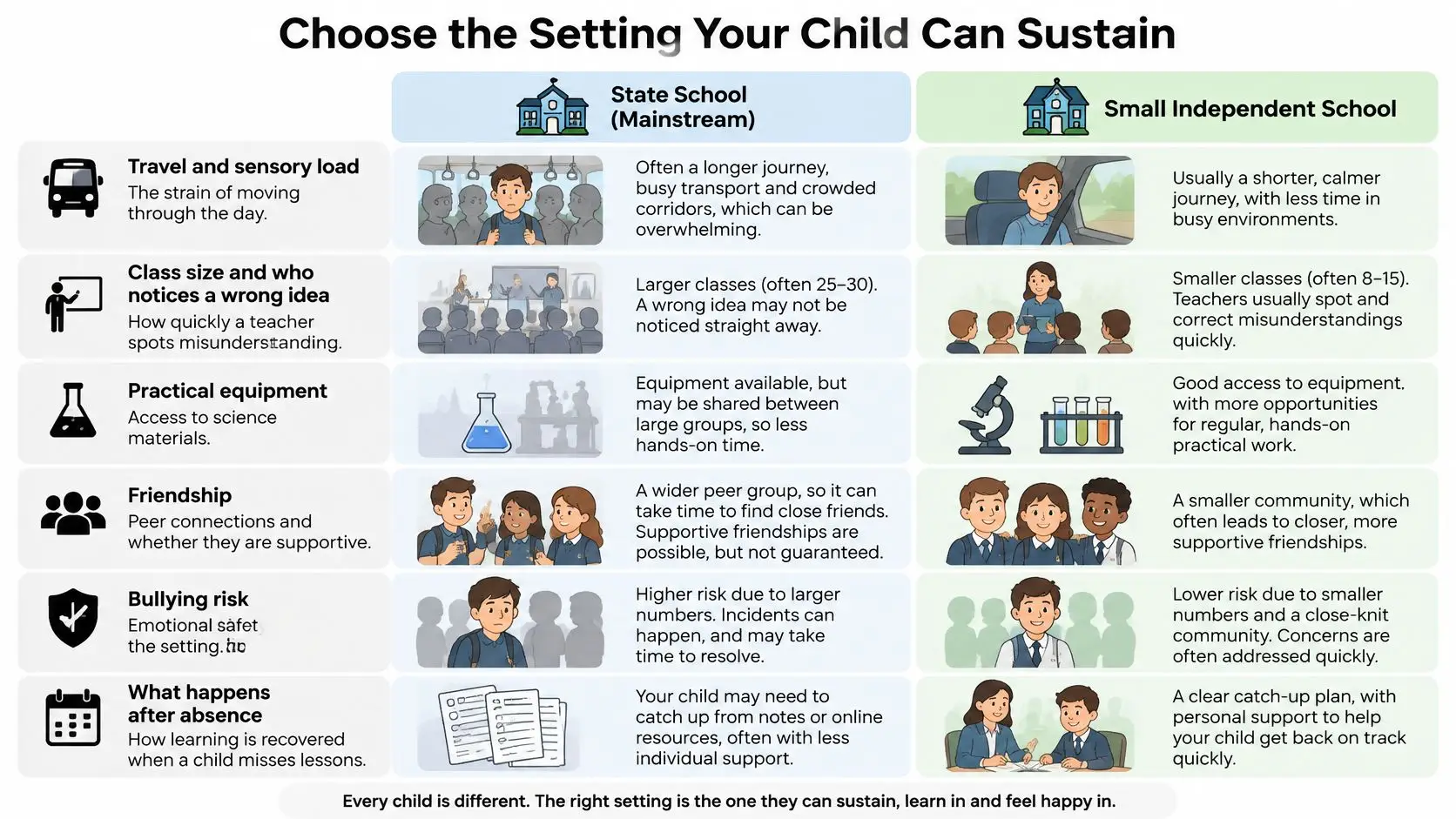
Online Biology and a school week
| Daily pressure | Traditional school | Live online lessons | Fits better when |
|---|---|---|---|
| Getting there | Commute and crowded rooms | Learns from home | Travel, illness or sensory overload makes attendance exhausting |
| Being noticed | Larger classes, less airtime | Small live group and direct questions | The child shuts down unless someone sees the mistake |
| Practical work | Staffed lab on site | Planned demos, supervised kit, data skills | The child can access real equipment; video alone is not enough |
| Belonging | Daily peers in person | Clubs, chat and scheduled social time | Contact is planned; a recording is not a friendship |
| After an absence | Catch-up depends on notes | Replay plus a deadline the same week | Health or anxiety causes missed lessons |
| Safety | Site policies vary | A stated anti-bullying culture that still needs action | The child has been avoiding school because of fear |
A school lab fits better when your child thrives on daily hands-on work, enjoys a large peer group and has no attendance barrier. There's no failure in choosing that. A staffed laboratory gives immediate equipment, technicians and the buzz some children need to stay curious.
Live online lessons fit better when school refusal, medical appointments, mobility needs or sensory overload keep interrupting attendance. Replay and a small group can help a child who needs to hear an explanation twice without feeling exposed. Planned demonstrations, supervised kit and strong data work can build method, measurement and evaluation. They cannot fully replace the feel of focusing a microscope, judging a meniscus or reacting when a living sample behaves unexpectedly in a staffed lab.
Accreditation is one criterion, not the whole decision. GCSE, International GCSE and A Level exams are sat at approved exam centres rather than at home, in line with UK examination board requirements. We're a Pearson Edexcel Approved Centre, and the recognised GCSE, International GCSE and A Level qualifications we offer are accepted by universities, colleges and employers in the UK and internationally. A recognised GCSE still depends on the named board and the approved centre, however the teaching reaches your child.
The decision in plain sight
- First signal: the qualification and board are named.
- Second signal: practical preparation is evidenced.
- Third signal: access arrangements are discussed before the entry deadline.
The warning sign is a library of videos with no teacher, no centre plan and no check on your child's worry. Choose the setting where this child will still attempt the hard question next week, then use the enrolment questions you've gathered to test whether that setting can prove it.
If your child needs live teaching, replayable lessons and a clear plan for practical work and approved-centre exams, Queens Online School offers online GCSE Biology within a British curriculum taught by specialist teachers in small groups. Talk to us about your child's board, practical preparation, access arrangements and intended exam series before you enrol. Visit Queens Online School to start that conversation.