


It's Sunday evening, and your child's homework folder contains maths questions, a science worksheet and a reading log that still needs signing. They're worried about getting something wrong; you're wondering how much help to give, what school expects and whether everything now revolves around SATs.
You don't need to turn your kitchen into another classroom. You need a clear picture of what your child is learning, which difficulties need attention and how to protect their confidence while preparing for secondary school.
Year 6 Subjects at a Glance
In England, Year 6 is the final year of Key Stage 2, usually for children aged 10 to 11, and its curriculum extends well beyond the subjects tested at the end of primary school, as outlined in the national curriculum framework.
The easiest way to understand the curriculum Year 6 pupils follow is to separate what children learn from how schools assess it. Reading, grammar, punctuation and spelling, and mathematics have externally marked national tests. Teachers assess writing and science through classroom performance and evidence collected over time.
The remaining subjects don't have national end-of-Key-Stage-2 tests. That doesn't mean teachers ignore progress in them. A child's painting, programming, discussion or performance can still help their teacher understand what they know and what to teach next.
What children actually do in lessons
These ten grouped subject areas give you a practical overview. Schools choose particular books, projects and topic sequences, so the table is a conversation starter rather than a promise that every class studies identical material.
| Subject | Core Year 6 focus | Assessment type |
|---|---|---|
| English reading | Comprehension of fiction, non-fiction and poetry; retrieval and inference | National test |
| English writing | Narrative and non-fiction composition; accurate, cohesive structure | Teacher assessment |
| English grammar, punctuation and spelling | Passive voice, relative clauses, subjunctive and spelling patterns | National test |
| Mathematics | Four operations, fractions, decimals, percentages, ratio and basic algebra | National test, with arithmetic and two reasoning papers |
| Science | Working scientifically, classification, circulatory system, light and electricity | Teacher assessment |
| Computing | Programming, algorithms and online safety | Not nationally assessed |
| History and geography | Local and British history units; map skills; physical and human geography | Not nationally assessed |
| Design and technology, art, music, PE | Practical making, creative work, music performance and sport | Not nationally assessed |
| Modern foreign language | Spoken and written language skills | Not nationally assessed |
| Religious education and relationships education | Locally agreed RE syllabus, where applicable; healthy relationships and health | Not nationally assessed |
In reading, your child might explain why a character seems nervous even though the author never uses that word. That's inference, using clues instead of just finding an answer on the page. In writing, they might organise an explanation into paragraphs and revise sentences so that the reader can follow the ideas.
A practical subject offers a different opportunity to succeed. A child who struggles with spelling might explain a design clearly, contribute confidently to music or spot an error in a computer program.
Practical rule: Keep asking what your child understands and enjoys, not just which test questions they can answer.
Check the whole school plan
Ask for the school's curriculum overview and compare it with every row above. If creative subjects appear to disappear during test preparation, ask how pupils will retain access to them.
Scotland, Wales and Northern Ireland use their own frameworks, so families outside England should check the local equivalent. Your next move is simple: ask your child's teacher which topics are coming up and choose something your child is looking forward to discussing at home.
How to Plan Around the 2026 Year 6 Test Week
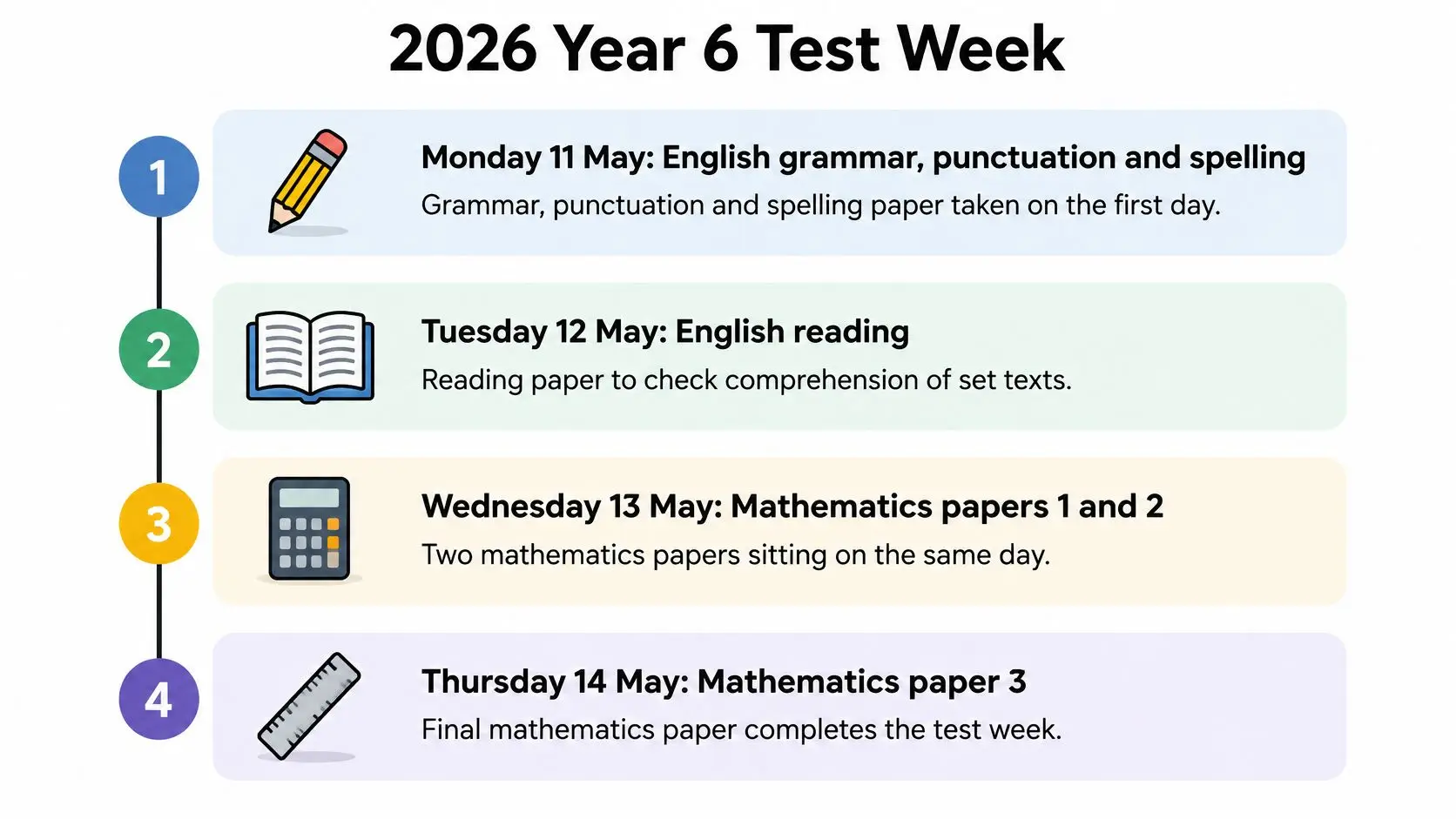
The 2026 test timetable schedules grammar, punctuation and spelling for Monday 11 May, reading for Tuesday 12 May, mathematics arithmetic and the first reasoning paper for Wednesday 13 May, and the final reasoning paper for Thursday 14 May, according to the official parent information booklet.
Those fixed dates give families something concrete to plan around. For a worried child, knowing what happens next can be more useful than another unexpected revision task.
Put each assessment in its place
The timetable below separates the test papers from teacher-assessed subjects.
| Assessment | What it covers | 2026 date |
|---|---|---|
| English grammar, punctuation and spelling test | Grammar, punctuation and spelling | Monday 11 May |
| English reading test | Reading comprehension | Tuesday 12 May |
| Mathematics arithmetic paper | Four operations and calculation | Wednesday 13 May |
| Mathematics reasoning paper 1 | Reasoning and problem solving | Wednesday 13 May |
| Mathematics reasoning paper 2 | Reasoning and problem solving | Thursday 14 May |
| English writing | Teacher assessment of writing | No national test date; school-managed assessment |
| Science | Teacher assessment of science | No national test date; school-managed assessment |
The tests take less than four hours in total, with results usually issued in July, as explained in the government's Key Stage 1 and 2 assessment guidance. Writing and science don't suddenly become important after test week; teachers need classroom evidence alongside the tested work.
Arithmetic requires accurate, efficient calculation. Reasoning asks children to select a method, apply it and sometimes explain their thinking. A child who calculates confidently but misreads a problem needs help unpacking the wording, not more sums.
For a broader explanation of the assessment process, the Key Stage 2 SATs guide can help you prepare questions for school.
Build a manageable family routine
Suppose your child becomes exhausted by consecutive formal tasks. Rather than completing a full practice sequence at home, agree a manageable timed activity with their teacher, then stop and discuss what helped.
- Mark the dates. Put the timetable somewhere your child can see it without making it the centre of family life.
- Protect the mornings. Plan sleep, travel, breakfast and familiar snacks. Prepare anything needed the evening before.
- Define a good day without a score. Your child might aim to ask for help appropriately, attempt an unfamiliar question or use a calming strategy.
The tests measure performance against national curriculum standards, not your child's overall ability. Your next move is to agree the morning routine together, including what you'll say if they come home convinced they've made a mistake.
What 2025 Attainment Results Mean for Year 6 Gaps
Only 62% of pupils met the expected standard in reading, writing and mathematics combined in 2025. The same official revised Key Stage 2 results report subject outcomes and scaled scores shown below, providing a benchmark rather than a verdict on an individual child.
The combined measure matters because strength in one subject doesn't cancel out a gap elsewhere. A fluent reader may still need substantial help with mathematical reasoning, while a confident mathematician may find organising a written explanation difficult.
Read percentages and scaled scores differently
A percentage tells you how many pupils reached the expected standard. A scaled score describes attainment on the test scale; it isn't a percentage mark.
| Measure | Met expected standard | Average scaled score | Expected scaled score |
|---|---|---|---|
| Reading | 75% | 106 | 100 |
| Mathematics | 74% | 105 | 100 |
| Grammar, punctuation and spelling | 73% | 105 | 100 |
| English writing, teacher assessed | Not included in this summary | Not applicable | Not applicable |
| Science, teacher assessed | Not included in this summary | Not applicable | Not applicable |
| Reading, writing and maths combined | 62% | Not applicable | Not applicable |
On the official scale, scores run from 80 to 120, with 100 representing the expected standard, as specified in the results publication linked above. Read each tested subject separately before looking at the overall picture.
Reading has the highest percentage reaching the standard in this table. Mathematics and grammar, punctuation and spelling have matching average scaled scores, but that doesn't mean every child has similar strengths in those subjects.
The writing and science entries need particular care. Their absence from this summary doesn't mean they're unimportant or unassessed; ask for the school's teacher-assessment information rather than expecting a comparable test score.
Turn the profile into a teaching decision
Consider a hypothetical example, not a reported pupil outcome: reading 108, grammar, punctuation and spelling 101, and mathematics 92. Mathematics would be the immediate priority because it's the only tested subject below the expected threshold.
Even then, the score doesn't identify the lesson your child needs. Ask whether the difficulty concerns place value, fractions, calculation, reading the question or explaining a method.
A useful assessment conversation ends with a teachable next step, not a label.
A cross-curricular task can keep strengths involved while addressing the gap. For example, your child could read information about a science investigation, calculate from its results and write a short explanation.
These are national figures, not your school's averages or a prediction of your child's future. Ask the class teacher for a subject profile, including classroom evidence, then agree which gap deserves attention first rather than trying to improve everything at once.
Everyday Maths and Writing Skills Year 6 Demands
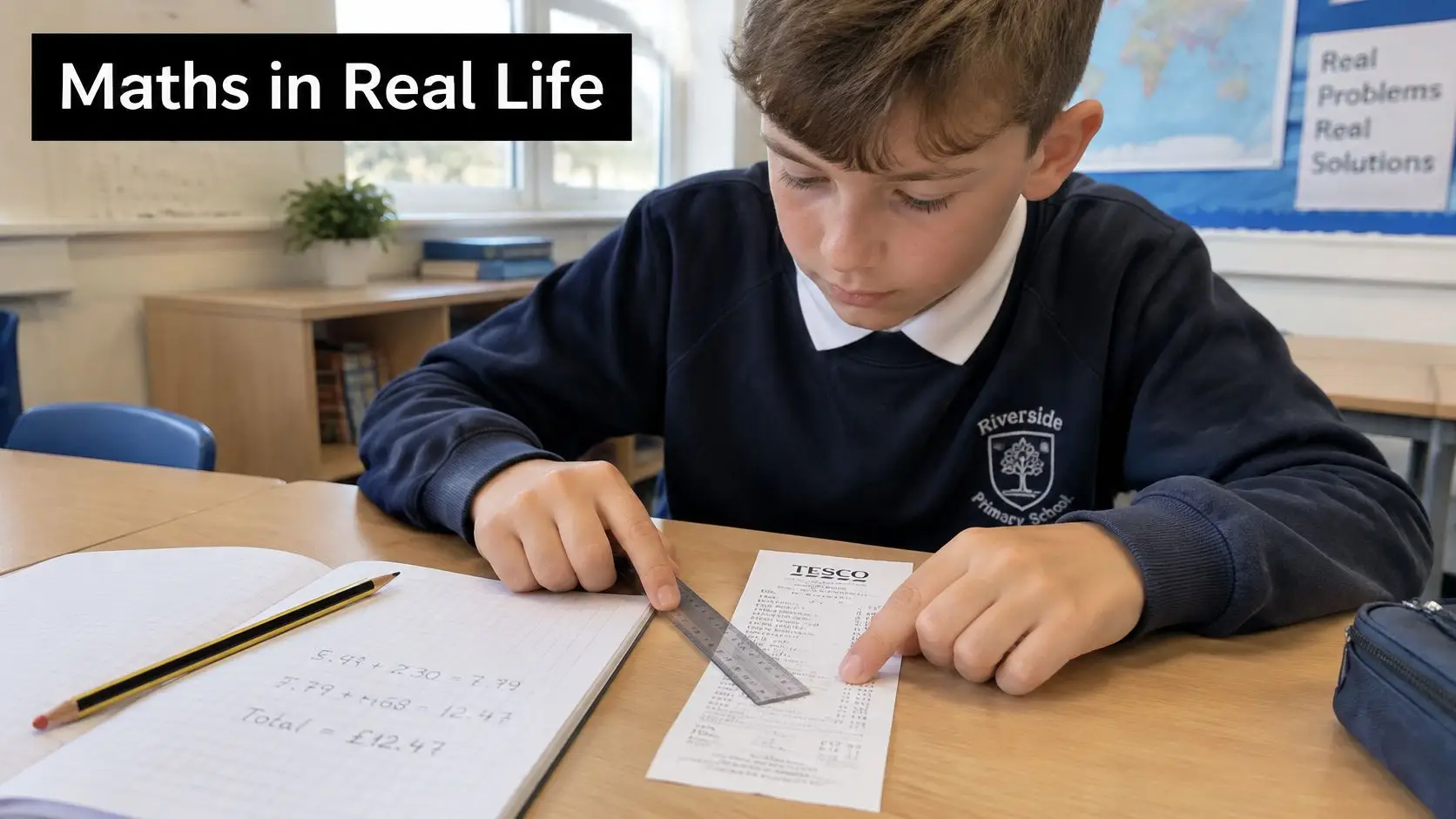
Put a shopping receipt on the table and ask your child to help compare purchases. They can explain which item offers better value, work out a percentage discount, divide a quantity between people and consider whether rounding would change the decision.
That's purposeful practice, not a surprise test. If your child hesitates, ask them to show their thinking with drawings, coins or a written calculation before you offer a method.
Notice the thinking behind the answer
The Year 6 mathematics programme of study expects fluent written methods for all four operations, including long multiplication and division, alongside fractions, decimals and percentages. Pupils also read, write, order and compare numbers up to 10,000,000, round appropriately and use negative numbers in context.
You don't need to cover all of that during a shopping conversation. Choose an activity that reveals a particular difficulty.
- Family budget: Ask your child to compare prices and explain a discount. A sketch or concrete objects may make the quantities clearer.
- Weather chart: Compare temperatures below zero. A number line can help your child explain which temperature is warmer.
- Across midnight: Work out the time between an evening departure and an early-morning arrival. Let your child mark the stages on a timeline.
Notice whether they need a visual model, more processing time or a repeated explanation. A correct answer reached with support is useful information, not something to dismiss.
Connect writing with practical work
For writing, try a short letter or diary entry that your child actually wants someone to read. Practise a passive sentence, such as “The parcel was delivered”, and a relative clause, such as “The parcel, which arrived late, contained my book.”
Reading the paragraph aloud can help your child notice missing words or an unclear sequence. Grammar should help them communicate, not become a reason to interrupt every sentence.
Try this optional 15-minute weekly routine, shortening it if your child becomes tired:
- Solve a budget problem using a receipt or shopping list.
- Write a short explanation of the choice.
- Check a grammar feature together, then finish.
Skills can travel between subjects: science results become a bar chart, geography maps offer scale and coordinate practice, and history timelines invite calculations between events. A science report can also reuse passive constructions from the writing task.
Your next move is to choose an everyday activity your child cares about. Aim for accurate, flexible thinking and a child who feels capable, not a race to the answer.
Adapting Year 6 for SEN and Anxious Learners
A child who understands a lesson but struggles to show that understanding on a timed paper may need a different kind of support, not just more practice. The government's information for parents about Key Stage 2 tests and results explains how the tests and results work. For families, the practical starting point is to identify what gets in the way of learning, then plan support across lessons, tests and the move to secondary school.
The aim is access to the full curriculum, with appropriate support. A child should still have opportunities to learn science, enjoy reading and take part in creative subjects while receiving help with tested work. Support should make learning more accessible, not narrow Year 6 to test preparation.
Match the adjustment to the barrier
Use the examples below to prepare a conversation with school. They are options to discuss, not automatic prescriptions based on a diagnosis. Formal test arrangements depend on the child's needs and the rules that apply.
| Need or barrier | Typical Year 6 difficulty | Practical adjustment to discuss | Everyday example |
|---|---|---|---|
| Dyslexia | Slow decoding and written output | Coloured overlays if helpful; eligible extra time or scribed answers | Pre-teach vocabulary before reading a passage |
| Dyscalculia | Number sense and place value | Number lines, counters and concrete models | Work out change using real coins |
| ADHD | Sustained attention across long tasks | Short blocks, movement breaks and checklists | Try ten-minute maths blocks with a stretch between |
| Autism | Changes in routine and sensory load | Visual timetable, quieter workspace and warning before changes | Use a picture schedule for test mornings |
| Anxiety | Fear of timed papers and mistakes | A manageable timed activity and a calm morning routine | Practise breathing before a short reading passage |
| Hearing or visual impairment | Access to spoken information or small print | Adapted materials, suitable seating and large print where needed | Agree accessible maths papers with the school |
Choose adjustments for the actual barrier. Large print can address difficulty seeing small text, but it will not resolve difficulty hearing instructions. A scribe may help with written output, though it is not automatically suitable or permitted for every assessment.
Ask the school which adjustments can be used during everyday lessons and which may be allowed in formal tests. The guide to reasonable adjustments in education can help you prepare for that conversation. Agree arrangements with school rather than assuming that a classroom adjustment will automatically apply in a test.
More tutoring isn't always the answer
A child who becomes more anxious with each practice session may need the task or support changed before another session is added. For example, they could try a short comprehension passage with a breathing routine instead of completing a full timed paper. Discuss the frequency of practice with the teacher, and stop if it starts to dominate mornings.
Watch the response: An adjustment is useful when it helps this child participate, not simply because it appears on a support checklist.
The next practical move is to ask the special educational needs co-ordinator, or SENCO, for a written plan that names the barrier, the adjustment and a review date. Agree any formal access arrangements in advance. Include your child's view of what feels difficult and what helps, so the plan supports both learning and confidence as secondary school approaches.
How Year 6 Works in a Live Online Classroom
Your child places paper towels beside a measuring container while a teacher asks what must stay the same for a fair comparison. This is a possible live science lesson, with the child investigating which towel absorbs the most water rather than merely watching a demonstration.
A live lesson can make the child's decisions and working visible to the teacher.
The investigation draws on the upper Key Stage 2 science curriculum: planning enquiries, controlling variables, taking measurements, repeating readings where appropriate, recording results and explaining conclusions. Your child keeps the water volume and test area consistent, repeats the test, records a table and creates a bar chart before checking whether the results support their prediction.
Make the learning visible
In a well-planned live model, the teacher can ask the child to show their table on screen or explain why a result seems unexpected. The teacher can then adjust the task, clarify a step or ask a question that reveals whether the child understands the comparison.
The activity can be adapted with larger print, accessible equipment, a visual sequence or an adult scribing observations. Agree the adult's role beforehand so that support helps the child express their thinking rather than replacing it.
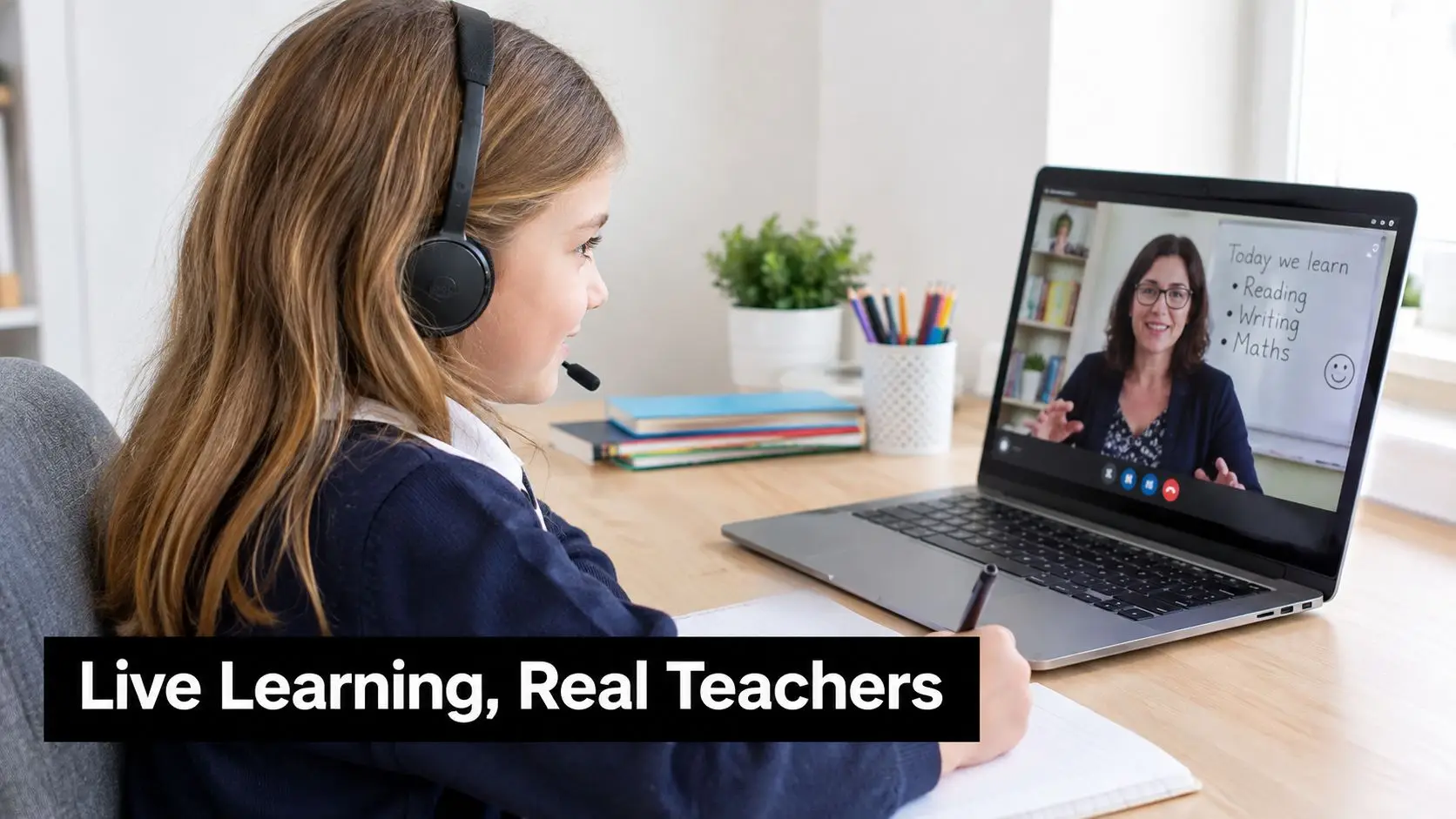
Online Year 6 needn't mean recorded videos watched alone. A teacher-led model may combine live small-group teaching, subject-specialist feedback and recordings for review.
Queen's Online School is one option within this model. Part of the Cambridge Online Education Group, it offers the British curriculum from Key Stage 2 online, with live interactive classes, small groups, subject-specialist teachers, recorded sessions and support for SEN and social, emotional and mental health needs.
The video below offers another way to explore the provision.
Ask providers practical questions
Before choosing any online provision, ask:
- Teaching format: Which lessons are live, and what happens if a child needs a recording?
- Class size: How does the teacher check each child's understanding?
- SEN support: Who agrees adaptations and reviews whether they work?
- Reporting: How often will you receive feedback about progress and difficulties?
- Participation: When can your child ask questions privately or during class?
Your next move is to describe a task your child currently finds difficult and ask the provider how its teacher would approach it. Good online teaching should make the learning understandable to both the child and the adult supporting them.
Preparing for the Move to Year 7 Without Losing Confidence
The first week at secondary school can feel like trying to follow a new map while the route is still unfamiliar. A child may understand the work yet feel overwhelmed by the bus journey, crowded corridors or meeting several teachers. If attendance becomes difficult after the move, ask what is making school hard before assuming a lack of motivation.
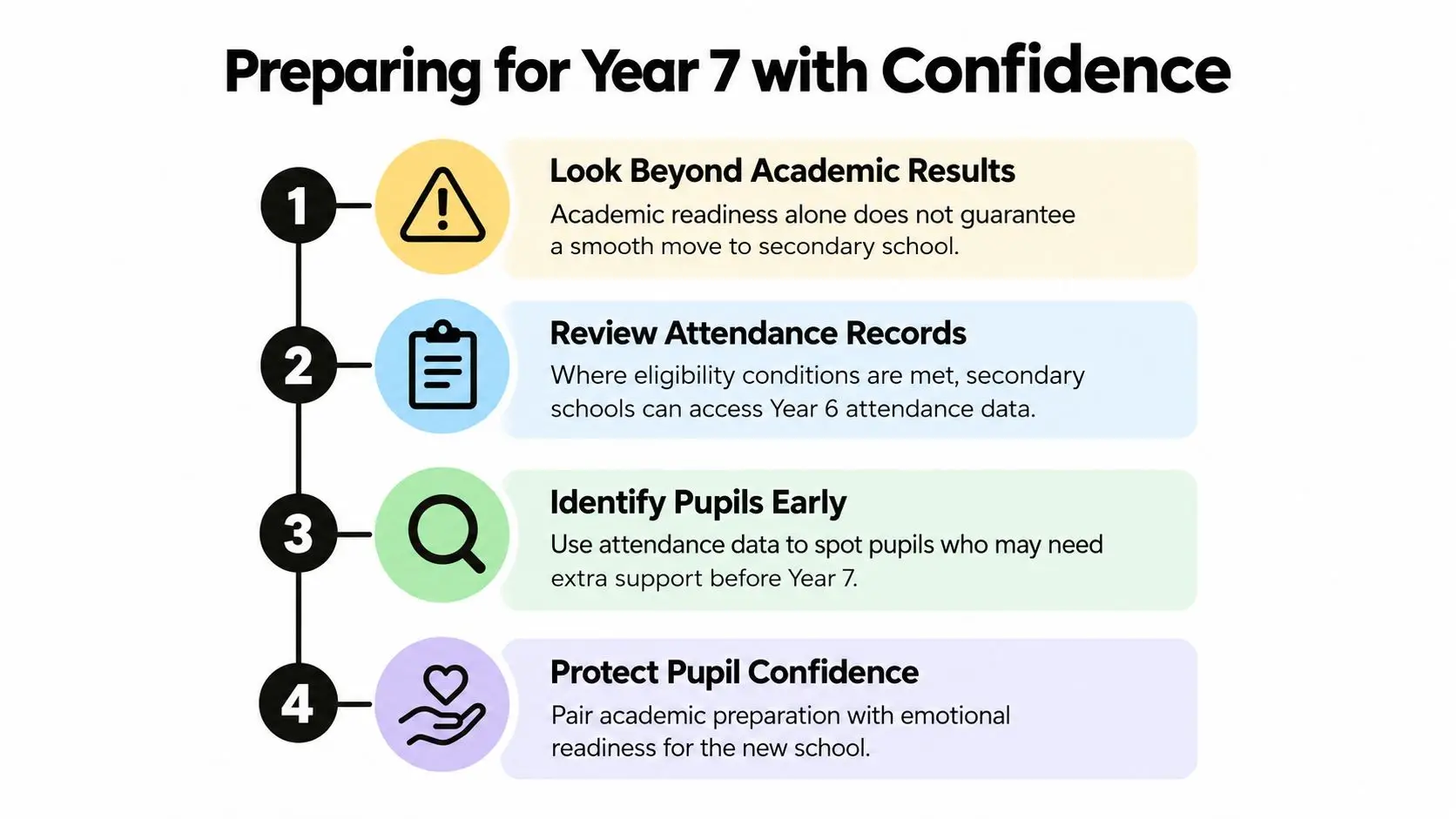
Schools can monitor attendance and use that information to follow up with families, as set out in the government's school attendance monitoring guidance. Talk with your child's current school about any attendance barriers and ask how relevant concerns can be raised with the receiving school.
Rehearse what feels unfamiliar
A child may be confident in lessons but unsure how to find a classroom. Another might manage the timetable yet worry about noise, changing for PE or finding an adult when upset. These are different problems, so start by naming the part of the day that feels hardest.
Ask, “Which part of the school day would you like to practise?” That gives your child a more concrete way to explain a worry than “Are you worried about secondary school?”
In spring, rehearse the journey, including the walk from the bus stop and what to do if transport is delayed. In summer, practise packing a bag, reading a timetable and preparing PE kit. Treat these as supported routines, not tests of whether your child is already independent.
Readiness includes knowing where to go, whom to ask and whether you belong.
Agree a shared transition plan
Ask the Year 6 teacher what learning needs securing before September, and discuss which helpful adjustments or attendance barriers should be shared with the receiving school. Information should be shared appropriately and with the right permissions.
The guide to Key Stage 3 can help you understand the next curriculum stage and prepare questions. There is no need to start teaching secondary content early out of fear that your child will fall behind.
The infographic's four steps can be put into practice through three stages:
- Spring preparation: Identify unfamiliar routines, practise the journey and tell school about existing worries.
- Summer preparation: Rehearse everyday organisation and agree which relevant learning and support information should transfer.
- Before September: Confirm a named contact, revisit the routine and show your child how to ask for help.
If attendance becomes difficult, contact the school early and explain what happens before an absence. Stomach aches, sensory distress, friendship worries or uncertainty about lessons all deserve attention.
Your next move is to choose one transition task your child finds difficult and practise it together. The aim is not perfect independence on arrival, but confidence that help is available.
Decide the Right Year 6 Support for Your Child
Choose support by asking where the gap is, how your child feels and what environment helps them learn. Before committing, confirm that the curriculum remains broad, test-week arrangements are organised and any SEN support plan names the barrier, adjustment and review date.
The right next step should address a specific need rather than just add more schoolwork.
Choose the smallest useful intervention
- A narrow gap and a settled child: Start with targeted help inside school. Ask what the teacher will teach differently and how you'll know it has helped.
- A specific gap and a child comfortable with extra sessions: Consider individual tutoring for an agreed, limited period, with a clear review point.
- A need for structure, specialist feedback or a quieter setting: Explore live small-group online teaching alongside other suitable options.
Watch your child's response. Dreading sessions, reporting stomach aches beforehand or no longer talking about school are reasons to pause and investigate, not proof that they need stricter practice.
Review pressure as well as progress
For example, if a child cries before tutoring, don't automatically book another session. Discuss the barrier with the class teacher and SENCO; a short weekly small-group lesson with a visible plan might be an alternative to trial, not a guaranteed solution.
Your next move is to arrange a focused conversation with school, bringing a work sample and your child's own words about what feels hard. Agree a manageable change and a review point, then protect time for the activities that help your child feel like themselves.
Year 6 should build understanding, confidence and readiness for the next step, not make a child feel that their worth depends on a result.
Queens Online School offers live, teacher-led British curriculum lessons in small groups, with subject-specialist teaching and support for learners with SEN and SEMH needs. Visit Queens Online School to discuss Year 6 provision, explain your child's current barriers and ask how lessons and feedback could support their move towards secondary learning.