

Moderate learning difficulties are a UK special educational needs category for pupils whose attainment stays significantly below age-related expectations across much of the curriculum, especially literacy, numeracy and understanding concepts, and who need provision additional to ordinary classroom differentiation. The label isn't defined by an IQ score alone.
It's half past seven, the tea is going cold, and the worksheet is still on the table. Your child followed the story when you read it aloud. The moment the same ideas sit in a paragraph, they go quiet. They can tell you how a maths idea works, then lose it when three instructions arrive together. You're wondering whether this is a bad week, tiredness, or something school should look at properly.
What Moderate Learning Difficulties Look Like at Home
Start with the evening you already know. The book is open. Your child laughs at the picture and answers when you ask what happens next. You hand them the page and the voice drops. They aren't refusing the story. Reading the words, holding the sentence, and answering at the same time is a heavier job than listening.
The same pattern shows up in number work. They explain "sharing fairly" with sweets on the table. Then the sheet asks them to read the question, choose an operation, and write a sentence. One step was manageable. Three steps together weren't. Moderate learning difficulties describe learning that stays well below what you'd expect for the child's age across much of the curriculum, especially reading, number, and new concepts, even after good teaching. One difficult week isn't the same thing. A persistent barrier is the pattern that returns in different subjects, after sleep, after extra practice, and after a teacher has already tried ordinary classroom adjustments.

What the marks don't show
Under the unfinished page there's usually a feeling. Classmates finish first. A hand stays down because another try might bring another correction. Some children joke. Some say the work is boring. Some cry in the car and look fine at the school gate. That embarrassment is part of the picture, not a side issue.
Worth raising with school:
- Across subjects: Reading, number, and new ideas are all hard, not just one topic.
- After good teaching: Extra explanation at home hasn't closed the gap.
- In the body: They tire quickly, go quiet, or rush to be done.
- Over time: The same barrier shows up for weeks, not one bad Monday.
A single low score doesn't tell you what your child needs. A repeated scene, listened to aloud and stuck on the page, does.
If reading aloud at home is where they still feel capable, keep that route open while you ask school for a fuller look. Families who want calm, short routines for language at home can use English guidance for less confident parents without turning the kitchen into a second classroom. The rest of this piece separates that everyday pattern from effort, from an IQ number, and from the idea that one diagnosis explains every child.
What Moderate Learning Difficulties Mean in UK Schools
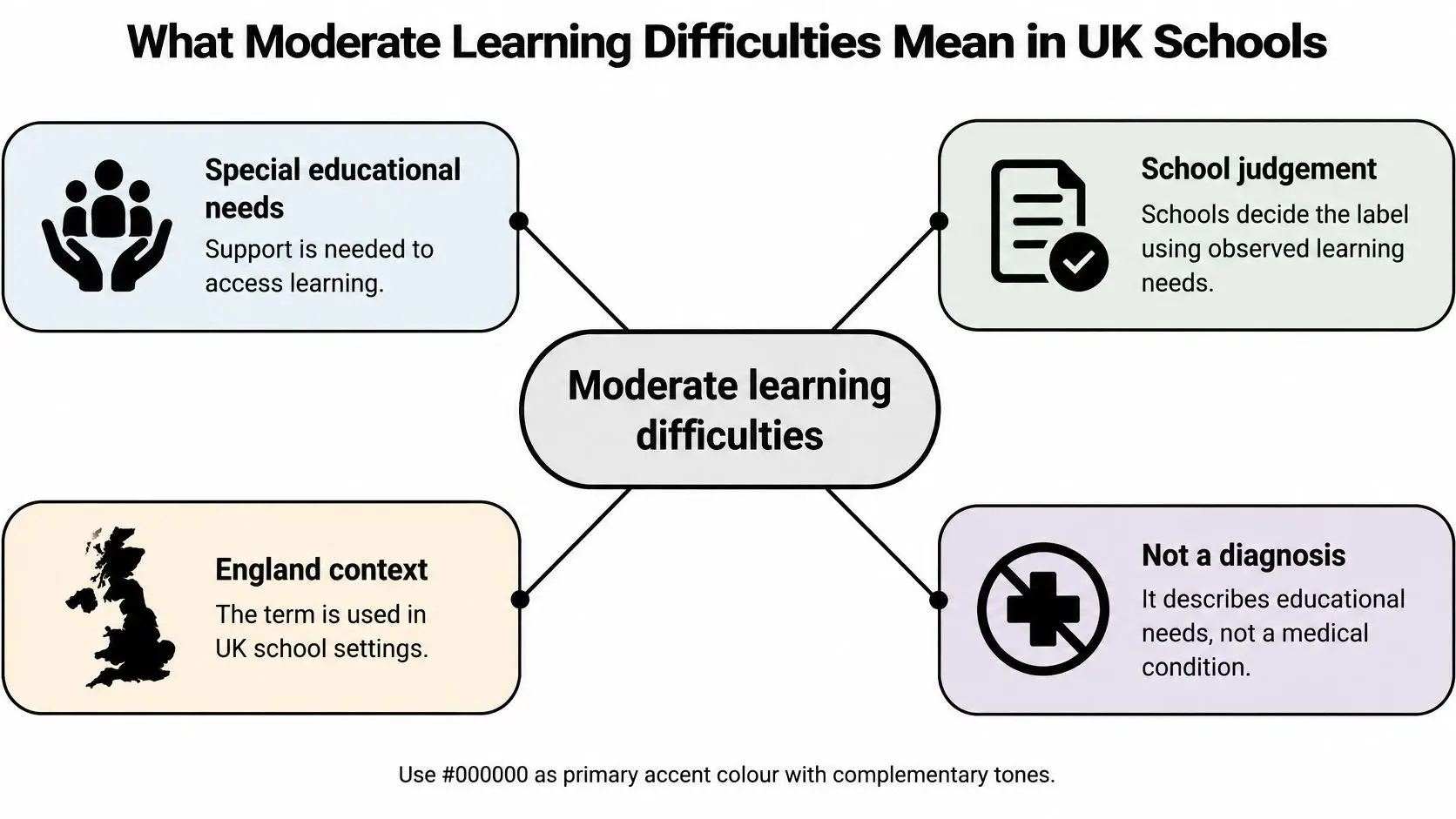
Families notice the homework. Schools have a different job, which is deciding whether the label fits. In England, moderate learning difficulties (MLD) are a special educational needs category, not a medical diagnosis, and not a description of one kind of learner.
A pupil is generally recorded as having MLD only when attainment is significantly below age-related expectations across much of the curriculum, particularly in literacy, numeracy, and understanding concepts, and when they need teaching that is additional to or different from the support normally available through classroom differentiation, as set out in government learning disability guidance. Ordinary low attainment, on its own, isn't enough. The question is whether usual differentiation still leaves the child unable to reach the learning.
Why a test score isn't the decision
An IQ score doesn't define the category. UK education research has sometimes linked the label with scores of about 51–70, but school identification rests on how the child functions in lessons and on the extra provision they need. Abilities, communication, independence, and support requirements vary considerably. Two children with the same recorded need can look nothing alike in a classroom.
The wider learning-disability description, set out by the Department of Health and Social Care in 2001, is different again. It refers to a significantly reduced ability to understand new or complex information, to learn new skills, and to cope independently, beginning before adulthood, and ranging from mild or moderate to severe or profound. That health framing helps services talk to each other. It still doesn't replace a picture of how your child reads a worksheet, follows a maths explanation, or manages a transition between lessons.
This short film is a useful companion if you want to hear how cognition and learning needs are talked about in schools, rather than only reading a definition.
A number on a report can't stand in for a description of how your child learns on a Tuesday morning.
Ask the school what they saw across subjects, what ordinary differentiation they already tried, and which extra provision they think is now required. If they can answer those three points, the label is doing educational work. If they can only quote a score, the picture isn't finished.
How Moderate Learning Difficulties Affect Everyday Learning
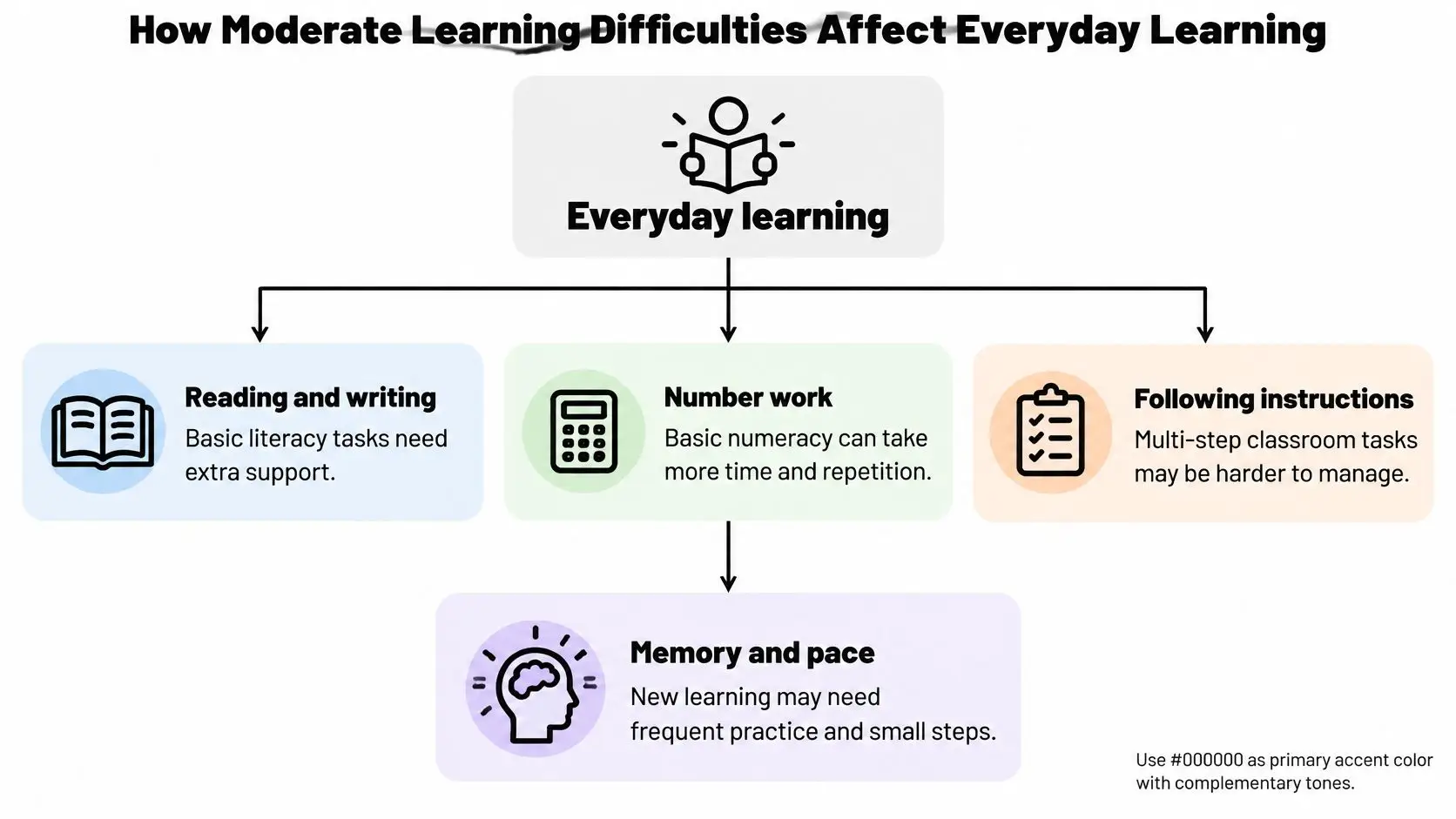
In the lesson itself, the difficulty shows up as time, memory, and load. Attainment stays substantially below age-related expectations across most or all curriculum areas even after high-quality teaching and appropriate intervention. The strain is especially clear in basic literacy, basic numeracy, and understanding new concepts. Associated needs can include delayed speech and language, shorter concentration, weaker memory or processing, low self-esteem, and social skills that are still developing, as a local SEND definitions guide sets out.
The group isn't one profile. A UK research review found considerable variation, with about 17% of pupils identified with MLD scoring below the second percentile on one assessed cognitive measure. That spread is why a single classroom stereotype fails the child in front of you.
One barrier at a time
Reading. A short paragraph can take much longer than it does for classmates. Decoding, holding the sentence, and knowing what the question wants may not happen together. The child isn't "not trying". The page is asking for several jobs at once.
Number. Place value can look secure on Monday and slip by Wednesday. They may count correctly with objects, then lose the idea when the same question uses only symbols. New concepts need more returns than a scheme of work usually allows.
Instructions and memory. A multi-step explanation overloads working memory. "Open your book, find question four, and explain your method" is three tasks. Slower processing and difficulty holding ideas together raise cognitive load, so work stays unfinished even when the child understood the first step.
Confidence and friendship. Repeated public correction teaches a child to stay quiet. Low self-esteem and social skills that are still growing can look like rudeness or withdrawal. The feeling and the learning are tied together.
Describe the barrier in functional language when you talk to school. Say what takes longer, what is forgotten between lessons, and where confidence drops. "They're behind" doesn't tell a teacher what to change. "They lose the third instruction and then won't put their hand up" does.
Moderate Learning Difficulties Are Not One Diagnosis
Parents usually reach the comparison next. A child who finds reading, maths, memory, language, processing speed, and independent learning all hard doesn't automatically have one diagnosis. MLD means achievement well below expected levels across most curriculum areas, not a difficulty confined to one skill. A Bromley SEND needs assessment uses that local-authority distinction, and it matters at the kitchen table. Struggle in one isolated skill, such as decoding in dyslexia, is a different pattern from a barrier that runs through most subjects.
The category is also not a forecast. Needs vary considerably, and strengths belong on the record beside the barriers. A child may explain ideas beautifully in speech, draw accurate diagrams, or remember a practical science investigation long after a written test has gone badly. That strength is evidence, not a consolation prize.
Outcomes aren't fixed
Local evidence shows movement is possible even where scores stay well below national figures. In Bromley, the 2025 Attainment 8 score for pupils with EHCPs rose from 15.6 to 18.0, while the overall England score was 33.7. The gap is still large. The rise is still real. A label that treated every pupil as the same, or as stuck, would miss both facts.
| Label | Where difficulty shows | Evidence to gather | What it does not mean |
|---|---|---|---|
| Moderate learning difficulties | Across most curriculum areas, especially literacy, numeracy, and new concepts | Work samples over time, response to good teaching, language, memory, and independence | An IQ cutoff, one uniform child, or a fixed future |
| Specific learning difficulty, such as dyslexia | Mainly one skill area, for example decoding, while other learning may be stronger | Targeted literacy assessment and a check that other subjects aren't similarly affected | A general difficulty with all learning |
| Broader learning disability | Understanding new or complex information, learning skills, and coping independently, from childhood | Health and education information read together, including how much support daily life needs | A school recording decision made from a score alone |
Before support is agreed, ask what was assessed across subjects, which strengths were written down, and what the school is explicitly not claiming. Reject any explanation that treats every pupil with this need as identical.
Classroom Support That Protects Confidence
Most of this teaching happens in ordinary rooms. National evidence indicates that 92.9% of pupils with MLD as their primary need attend mainstream primary or secondary settings, so support has to live inside classroom and online teaching rather than assuming a specialist school, according to a rapid evidence review of cognition and learning needs.
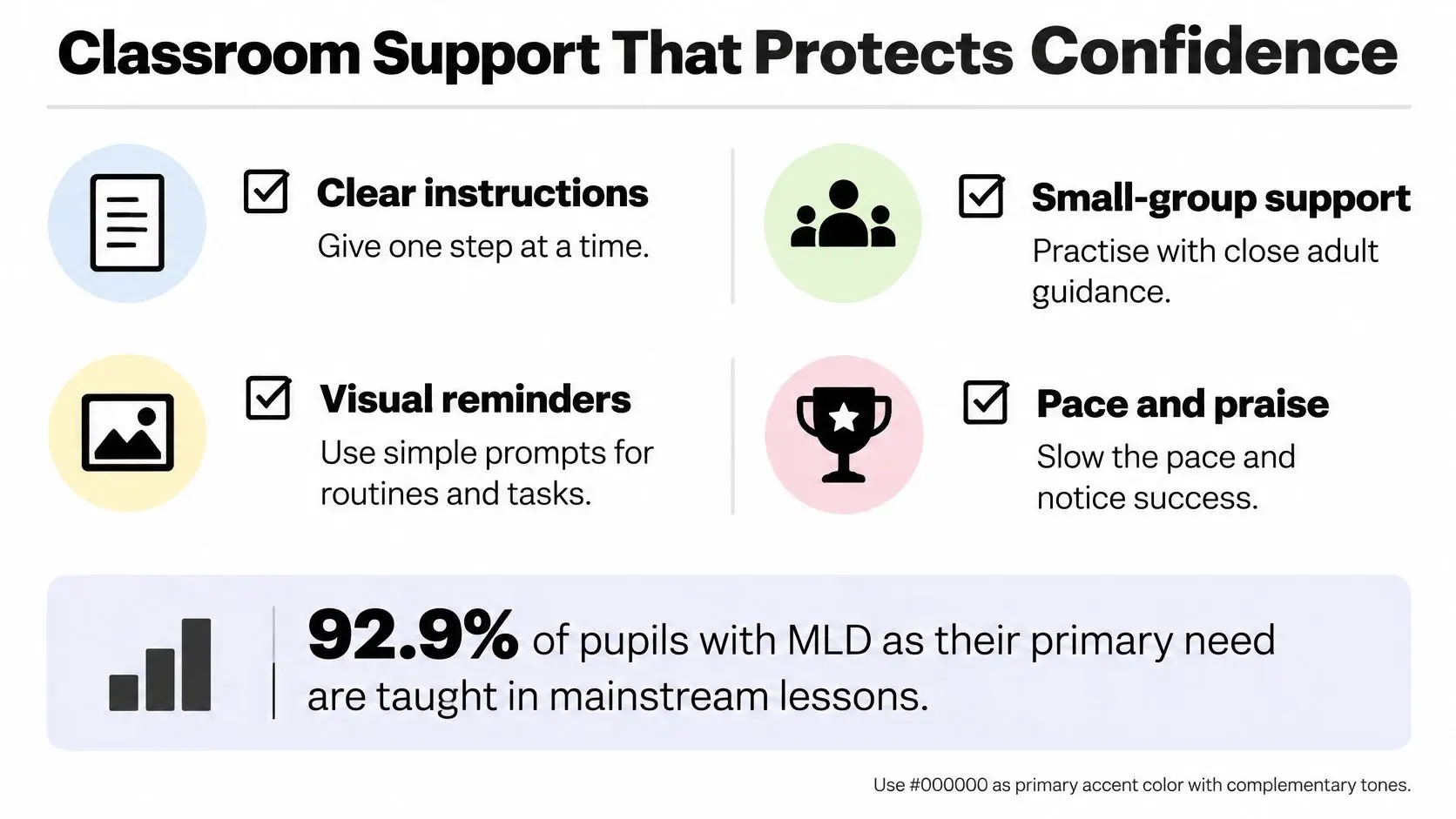
Effective provision is systematic, targeted, and sustained. That means explicit teacher modelling, a lighter processing load, short sequenced instructions, frequent retrieval and feedback, and visual, verbal, and physical representations. The child also needs chances to use a skill in more than one context, or it stays stuck to one worksheet.
What the lesson can look like
Literacy work that helps covers phonological awareness, decoding, fluency, vocabulary, and comprehension. It isn't a longer reading race. In English, the child might rehearse an answer aloud before writing a single sentence. The speaking is the thinking, not a delay.
Mathematics that helps uses explicit instruction, peer-assisted learning, and technology-supported practice. Counters or a number line come before symbols. A teacher might set three addition problems, check understanding privately, and stop while the child still feels the success.
Science can use the same logic. If a labelled diagram makes the idea clear and the worksheet doesn't, give an accessible version, model the first answer, and allow extra processing time. That is a different route to the same goal, not a watered-down one. Families comparing this with ordinary classroom changes can read how differentiated learning works, then ask what goes beyond it.
When distress is the clue
Low self-esteem is a recognised associated need. Private feedback matters as much as the academic target. A child who becomes angry when an online lesson speeds up may be showing processing strain, unclear instructions, or fear of being wrong.
Adults can note what happened just before the distress, shorten the next instruction, offer a visual timetable and a planned pause, and teach a calm request such as "please repeat that". Small, named successes, like explaining a new word or finishing three problems alone, protect dignity.
Ask which strategy is in place, how progress will be measured, and how your child feels about the help. If they only hear corrections, the plan isn't finished.
Choosing Online Support for Moderate Learning Difficulties
When ordinary differentiation isn't enough, families are really choosing between ways of organising help, not between "more work" and "less work".
Support inside a mainstream class keeps friendships and the usual school day. It works when teachers change pace, chunk instructions, and check understanding without an audience. It strains when the room stays fast and the child spends the hour copying or waiting.
Separate school and health conversations leave you as the person who joins the dots. You repeat the same story to a SENCo, a GP, and a therapist. Appointments don't share a plan, so classroom adjustments and health advice never meet.
A small live online class changes the pace and the audience. Live interaction, short instructions, extra processing time, and recordings for later retrieval matter more than a library of videos. Adults should read withdrawal or anger as communication. Tools can help a child revisit a task without more shame, and roundups of the best productivity apps for students are useful only when the app serves that quieter second look.
Disadvantage and absence
Don't treat a low score or a missed day as laziness. In 2023/24, only 7.5% of pupils eligible for free school meals who had an EHCP achieved grade 4 or above in both English and mathematics, compared with 17.3% of EHCP pupils who weren't eligible, in Sutton Trust analysis of double disadvantage. Attendance was 86.3% for pupils with EHCPs, 93.1% overall, and 89.4% for pupils eligible for free school meals. Absence can signal unmet need, anxiety, unsuitable provision, or fatigue.
Queen's Online School is one concrete version of the third route. It teaches a British curriculum from Key Stage 2 to A Level, live, with subject specialists in small classes, personalised pace, real-time feedback, and recorded sessions. Targeted support covers SEN and SEMH needs, with Pearson-approved GCSE and A Level examinations, mindfulness and community activities, and a zero-tolerance approach to bullying. Families comparing that kind of provision can look at online courses for SEN against the barriers you've already described, and judge whether the setting lowers load and protects belonging.
What to Do Next If You Suspect MLD
You don't need a perfect file before you speak to someone. You need a short, honest record and a few precise questions.
A short record, then one conversation
For two weeks, note what takes longer, what is forgotten by the next day, and when distress appears. A few lines are enough. "Lost the third instruction in maths. Cried after English. Fine when I read the science aloud." That record keeps the meeting on your child rather than on a general label.
Ask the school SENCo which evidence of literacy, numeracy, language, memory, and independent learning will be reviewed before support is agreed. You're asking for a picture of functioning, not a rush to a category. If health is part of the story, ask a GP or health visitor how education and health information will feed one plan. NHS guidance on learning disability diagnosis says services should work with the family and child from birth to 25. The plan should hold communication preferences, strengths, barriers, classroom adjustments, and the name of the person who reviews progress.
If you're also wondering about attention, and you live in British Columbia, a clear explanation of ADHD assessment costs in British Columbia can stop that question swallowing the school meeting. It doesn't replace the educational evidence.
Questions to take, including the child's
Put the child's own goals on the page. Finishing a task alone, joining a favourite lesson, or having a friend at break are real measures. Then ask any provider:
- What already works: Which adjustments has the child responded to?
- How you'll know: What will be measured, and how often?
- How feedback is given: Will correction be private?
- How it feels: Does the child feel safer, or only more watched?
A practical next step is to set those questions beside both your current school and a live small-group option. How to identify learning needs walks through observation and curriculum-based evidence you can bring to that conversation. You can also talk with Queen's Online School about whether its live small-group British curriculum, recorded lessons, and SEN and SEMH support match the plan you're building. Leave the first meeting with questions for the SENCo and one concrete alternative to explore, so the decision isn't made in a rush or in the dark.
Queen's Online School teaches a British curriculum live from Key Stage 2 to A Level, with small classes, recorded lessons, and targeted support for learners with SEN and SEMH needs, including pupils whose barriers match moderate learning difficulties. If you want teaching that slows the load without lowering the goal, visit Queens Online School and ask how a class would be paced around your child.