

Your child has just started secondary science, and everything feels bigger at once. There's new vocabulary, new apparatus, longer questions and a quiet worry that one missed idea will make the next lesson impossible. You're not alone in feeling that pressure, and you don't need to decode statutory language alone. The Key Stage 3 science curriculum becomes far less daunting when you see it as a journey built around your child, not a race through topics.
Why KS3 Science Belongs Around the Child
A Year 7 pupil watches a virtual experiment on dissolving. She can explain aloud why the sugar seems to disappear, she spots that the water temperature matters, and she's proud of herself. Then the written question appears, dense with unfamiliar wording, and her shoulders drop. She whispers that she's "bad at science", even though her scientific thinking was sound seconds earlier.
That moment matters because it shows what curriculum delivery really involves. A child needs knowledge, but she also needs confidence, accessible language and a fair way to show what she understands. Watching content passively isn't the same as learning science, and ticking off topics isn't the same as building a scientist.
More Than a Checklist of Facts
In England, the Key Stage 3 science curriculum is governed by the statutory national curriculum introduced through the 2013 framework, applying to pupils in the third key stage from 1 August 2014. By the end of Key Stage 3, pupils are expected to know, apply and understand the specified knowledge, skills and processes, rather than recall isolated facts.
Children arrive with different experiences, reading strengths, communication preferences and support needs. A child-centred approach doesn't lower the science. It asks better questions about access.
- What's been taught: Which ideas has your child met, in what depth?
- How is learning landing: Can she explain it, or only recognise it?
- What's helping: Which scaffolds, routines or formats rebuild her confidence?
- What's next: Which single step will move her forward without overwhelming her?
When families and teachers ask those questions together, the curriculum stops feeling like a wall of content. It becomes a map, and your child can see where she stands on it.
Understanding the Core Science Requirements
A Year 8 pupil can name the parts of a cell yet freeze when asked why a leaf cell is packed with chloroplasts. That gap is the point of the core requirements: KS3 science expects knowledge to travel from recall into use, across biology, chemistry and physics.
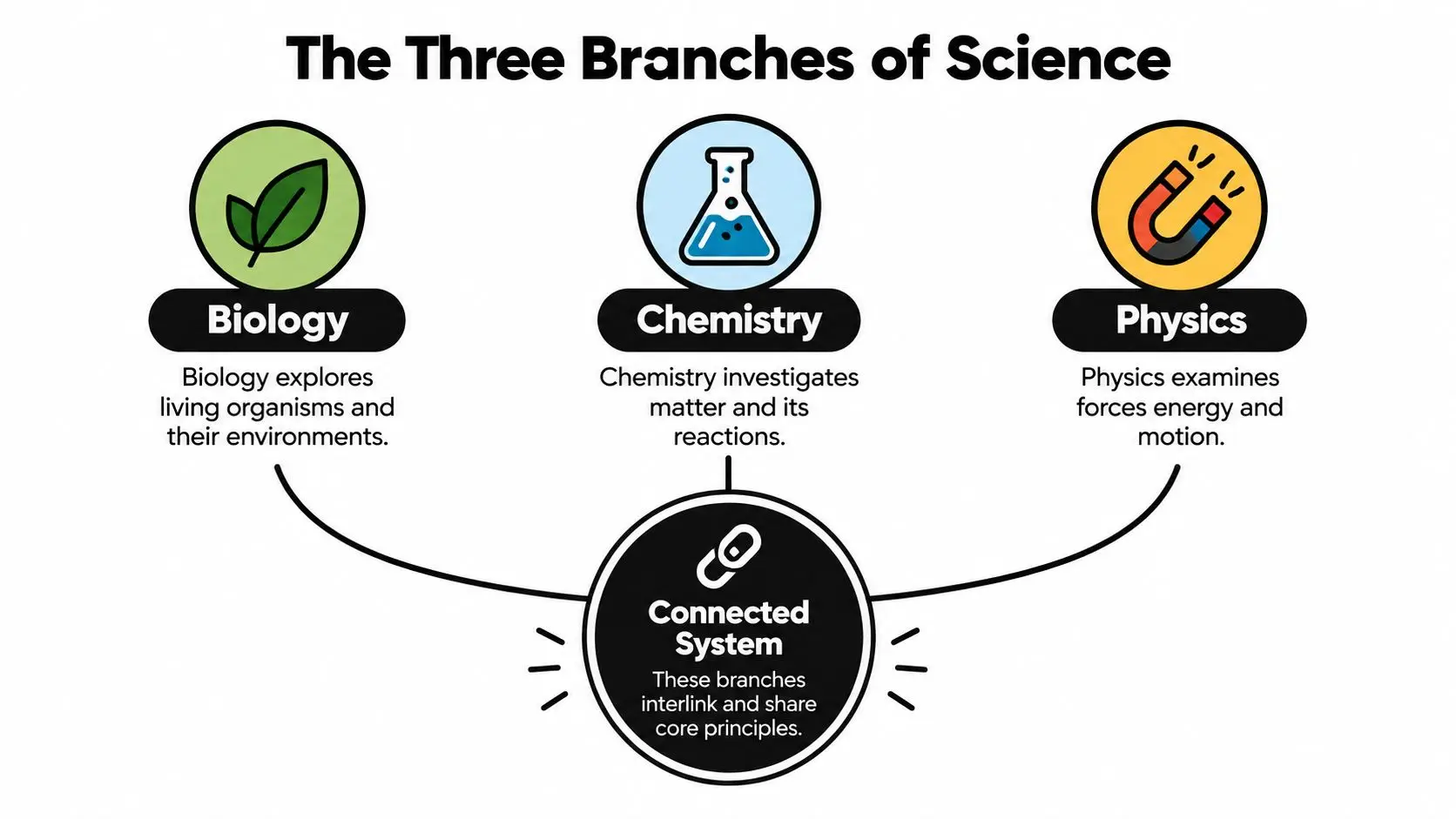
Biology asks how living things are built and survive. Chemistry follows matter as it changes. Physics tracks forces, energy and motion. The connective tissue is scientific enquiry: pupils learn how questions become predictions, how measurements become evidence, and how claims are tested. If your family is still finding its bearings, what Key Stage 3 means across the school years gives useful context before individual topics feel urgent.
The statutory verbs are easier to read as three rungs rather than three labels.
| Rung of understanding | What it can look like at home |
|---|---|
| Know | States that gas particles move freely and spread out |
| Apply | Uses that idea to explain a new observation, such as a smell crossing a room |
| Understand | Justifies the explanation with particle movement and evidence |
Three ideas keep resurfacing through the branches. Structure and function links a red blood cell's shape to its job. The particulate model explains dissolving, diffusion and changes of state. Energy resources and transfers connect burning fuels, warming rooms and chemical reactions.
When a child spots one of those threads inside an unfamiliar question, coverage has become understanding.
Following Science Progression Across Years 7 to 9
A Year 8 pupil stalls on a homework question about diffusion. She met particles last year. She will meet them again next year inside chemical reactions. That circling back is the design of KS3 science, and recognising it changes how you read every homework sheet and report.
The pattern works like walking the same hillside path in different seasons: the route is familiar, but your child notices more each time and travels further with less help. Early on, pupils name things, labelling parts of a cell or identifying pushes and pulls. Later they connect ideas, using particle arrangement to explain behaviour or forces to explain changing motion. By Year 9 they carry those models into unfamiliar territory, weighing whether evidence supports a conclusion.
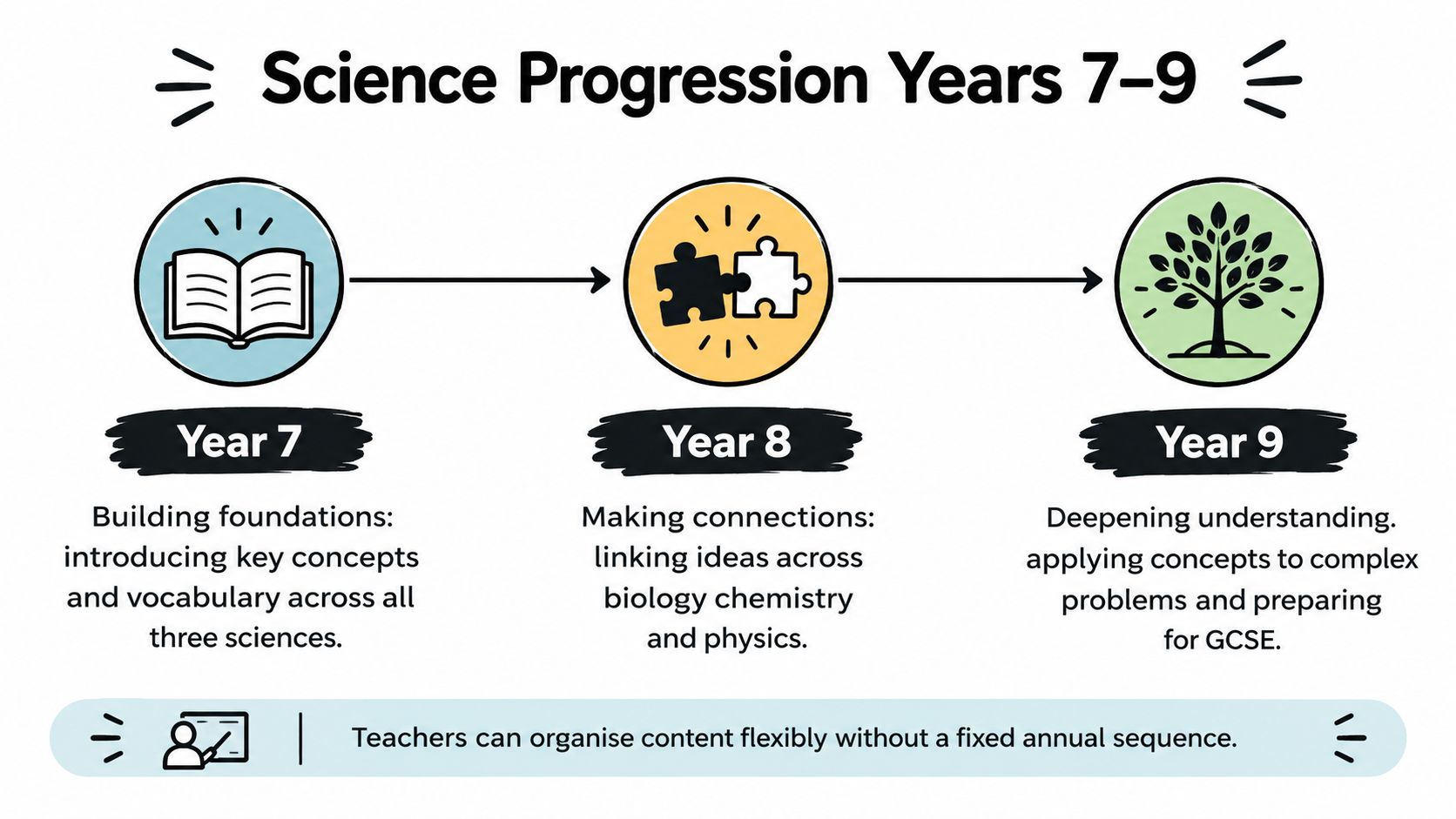
The national curriculum framework on teaching by the end of the key stage asks schools to teach the relevant programme by the end of the key stage. It does not demand an identical weekly sequence. Teachers can therefore return to foundational ideas such as particles, forces or cells whenever assessment shows the ground underneath is shaky.
That freedom protects children emotionally as much as academically. A pupil asked to interpret chemical reactions before her particle model is secure hits the same wall every lesson, and each stumble happens in front of her classmates. A teacher who calmly returns to particles and changes of state first is clearing the barrier that has been tripping her for months.
Growth leaves traces you can spot at home. When your child explains a model in her own words, transfers it to a kitchen or garden example, and can say what a diagram leaves out, you are watching secure understanding take shape in real time.
Deepening answers mean progress, whatever order the topics arrived in.
Exploring Biology Chemistry and Physics Topics
The statutory breadth can look overwhelming as a flat list, so organise it around the questions each discipline teaches your child to answer. That simple shift turns a daunting document into something you can raise at the dinner table.
Biology asks how living things are organised and function. Pupils study cells and organisation, digestion, skeletal and muscular systems, reproduction, health and disease, ecosystems and genetics. A typical application links structure to function, such as explaining why a root hair cell's shape helps it absorb water. Using light microscopes to observe cells gives that idea a concrete anchor.
Chemistry asks how matter and materials behave. Content includes the particulate nature of matter, atoms, elements, compounds, chemical reactions, acids and alkalis, materials and Earth chemistry. Application means using the particle model to explain, for example, why ice melts or why a reaction produces a gas, rather than memorising the observation alone.
Physics asks how forces, energy and physical phenomena explain change. Pupils cover energy, motion, forces, electricity, magnetism, sound, light, space and pressure. Mathematical application is woven in, including comparing food energy in kilojoules, appliance power in watts and kilowatts, and energy transfers in joules and kilowatt-hours.
The Three Disciplines at a Glance
| Discipline | Central question | Representative topics | Connected application |
|---|---|---|---|
| Biology | How are living things organised and how do they function? | Cells, digestion, ecosystems, genetics | Explain diffusion into a cell using particle movement |
| Chemistry | How does matter behave and interact? | Particles, elements, reactions, acids and alkalis | Use particle ideas to explain a change of state during heating |
| Physics | How do forces and energy explain change? | Forces, electricity, light, pressure, space | Compare appliance power in watts and kilowatts before judging energy use |
Notice how the applications cross boundaries. Particle ideas underpin diffusion in biology, changes of state in chemistry and pressure in physics. That connectedness is deliberate, and it's why coverage should be judged across the whole key stage, not by whether a particular topic appeared in a particular term.
If you're checking provision, ask whether all three disciplines appear regularly and whether your child revisits shared concepts in new contexts. Breadth by the end of Key Stage 3 is the entitlement. The route can flex around the learner.
Working Scientifically and Assessing Understanding
A Year 8 class is finishing a reaction rate investigation, and two books land on the teacher's desk. The first contains a polished conclusion copied from a worked example. The writing is tidy, and nobody can tell whether its owner could design the test herself. The second is messier. Its owner chose which variable to change, kept the others controlled, recorded results in a table she built herself and circled one anomalous reading with a question mark beside it. Only one of these children has demonstrated science.
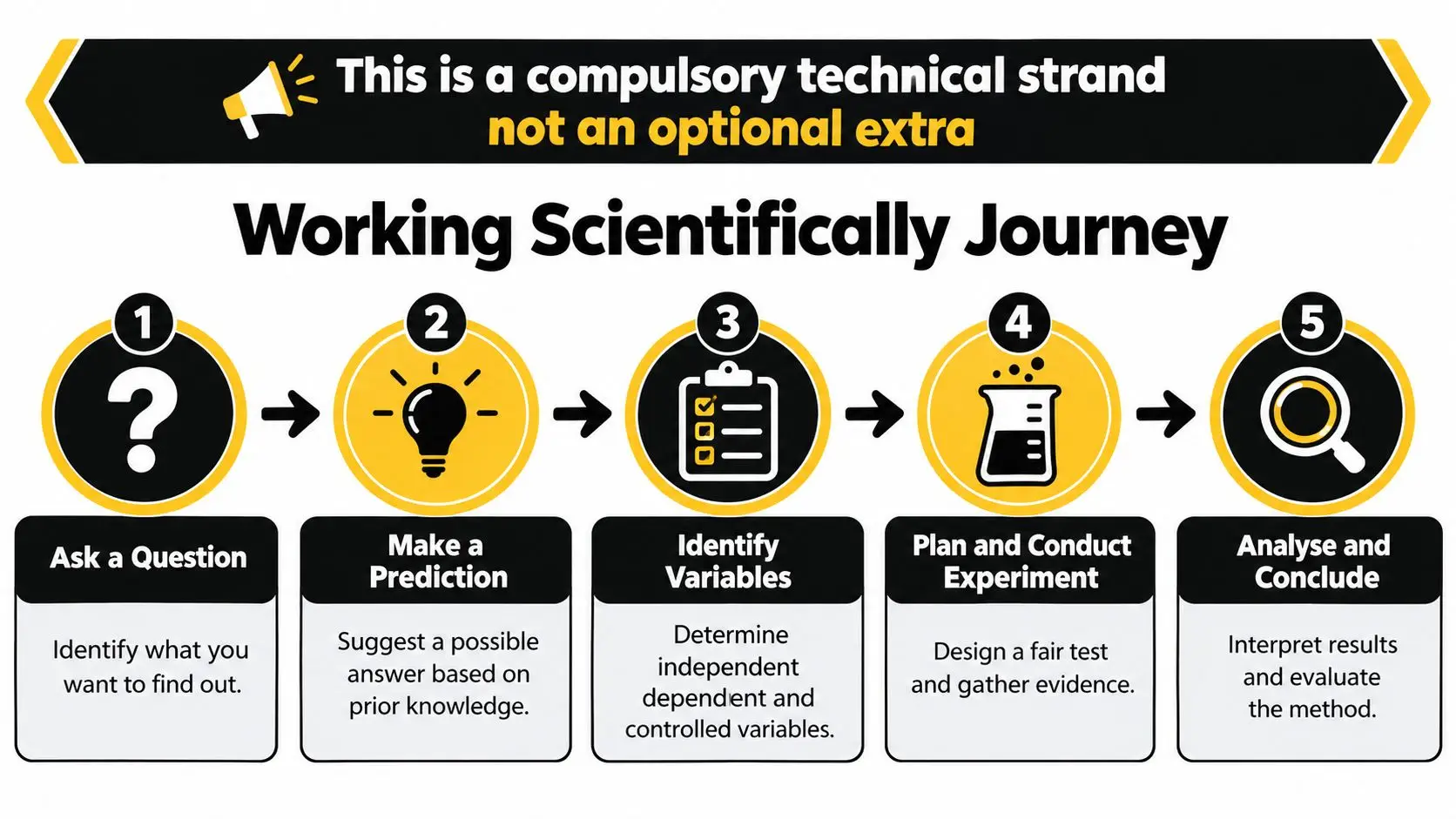
That distinction explains why working scientifically sits in the curriculum as a compulsory strand carrying the same weight as the biology, chemistry and physics content. The statutory science programme on working scientifically requires pupils to formulate questions and predictions, identify independent, dependent and control variables, select enquiries, use apparatus safely, sample, record and represent data, interpret patterns, evaluate reliability and suggest methodological improvements. It also names accuracy, precision, repeatability and reproducibility, which gives families a concrete benchmark for judging any lesson, online or in a lab.
What Good Assessment Looks For
A child-centred judgement pulls four threads together instead of marking the final paragraph alone. The teacher asks whether her pupil recalls the relevant concept, whether she can apply it somewhere unfamiliar, whether she can identify variables and plan a fair test, and whether she can handle numbers, read graphs and decide how much to trust her results. These are separate capabilities. A child can be secure in some while still shaky in others, and honest assessment shows her exactly where she stands without denting her confidence.
Assessment principle: Score the conclusion and the thinking behind it. A pupil who designed a fair test and evaluated it honestly has demonstrated real science, even if her final sentence needs work.
Short, low-stakes retrieval questions reveal which threads are secure without turning every lesson into an exam. Igneous AI on testing effect explains why recall practice strengthens later performance when it's used supportively, which is why confident teachers revisit earlier ideas as routine rather than as a test to dread. Scaffolds such as sentence starters or partially drawn axes widen access to that thinking. They hold the expectation steady, and your child shouldn't feel they mark her work out as lesser.
Adapting KS3 Science for Online Learning
Online science fails when it shrinks to watching videos and answering quizzes alone. It succeeds when teachers deliberately rebuild the interaction, decision making and feedback of a good classroom lesson in a virtual space. Your child should still feel like a participant, not an audience.
A Lesson Journey That Keeps Pupils Active
Strong online lessons usually follow a rhythm families can recognise. Pre-teaching introduces key vocabulary and checks equipment or materials in advance, so nobody panics mid-lesson. The teacher models a technique live, perhaps focusing a microscope image or setting up a circuit, thinking aloud as she works.
Pupils then observe in pairs or small groups, make their own records in shared documents and answer real-time questions. The teacher responds to individual work during the lesson, not days later. A short reflection closes the loop, asking each child what she's now confident about and what still feels fuzzy.
Mathematical rigour needs explicit attention on screen. Before comparing power readings, a teacher might pause and ask everyone to check unit consistency, converting watts to kilowatts so the comparison is fair. When interpreting a graph remotely, pupils can annotate the trend directly on a shared copy, making their reasoning visible instead of hiding behind a final answer.
Practical study habits matter too, and guidance on how to improve online study productivity can help families build routines around focus, breaks and organisation that support live lessons.
Protecting Participation and Belonging
Camera fatigue, a dropped connection or a sibling walking in can unravel a child's confidence quickly. Normalise these moments rather than treating them as misbehaviour. Private response options, such as typing an answer to the teacher only, let anxious pupils contribute without public exposure.
Realistic pacing helps as well. Recorded explanations let an absent or overwhelmed learner revisit a concept calmly, then rejoin live discussion without a gap. The goal is simple to state and worth defending. Same science, same ambition, more flexible routes in.
Supporting SEN Learners and Building Confidence
Good SEN support starts with the barrier, not with a generic list of add-ons. One child struggles to hold multi-step instructions in working memory. Another processes language slowly, manages sensory load carefully, or finds handwriting physically demanding. Each barrier calls for a different response to the same scientific idea.

Practical adjustments keep the thinking intact while changing the route in. Chunked instructions break an investigation into single steps a child can tick off. Annotated diagrams of cells reduce the load of copying labels under time pressure. Data can be presented as a bar chart, a table or a spoken explanation, and understanding can be shown by pointing, typing or recording a short audio note.
Emotional safety deserves equal planning. Predictable routines, low-stimulation slide design and quiet ways to contribute reduce the pressure to perform publicly. A child who answers through chat today may speak aloud next month, and that gradual growth is worth celebrating warmly.
The short film below explores how thoughtful support changes a learner's experience of lessons, and it's worth watching together if you're weighing up provision.
Digital delivery doesn't automatically meet individual needs, so support should be chosen with your child, monitored and adjusted as confidence develops. Families comparing options will find it useful to review what a structured SEN support plan should contain before enrolment conversations.
Ask providers three direct questions. How will access barriers be identified for my child specifically? How will progress be monitored beyond test scores? How do you balance challenge and support so my child feels stretched but safe? Vague answers are a warning sign. Specific, child-level answers build trust.
Practical Virtual Classroom Science Activities
Abstract principles become real when you see them inside actual activities. The three examples below work in live online teaching, blended learning or supported home study, and each keeps genuine decisions in your child's hands.
Virtual Microscope Investigation
The enquiry question is simple. How does the structure of this cell suit its function? Pupils use a virtual microscope themselves, choosing magnification and deciding which features to observe rather than watching the teacher drive. They draw and annotate the cell, then justify each label in discussion.
The deeper step matters most. Pupils discuss limitations, noting that a prepared slide shows a flat, still image of something three-dimensional and alive. Recording options stay flexible, from a photographed drawing to a labelled screenshot with typed annotations.
Energy Investigation With Unit Checks
Pupils compare how different materials insulate a warm container, or compare appliance labels at home. They identify the variable they change, what they'll measure and what must stay the same. Before drawing conclusions, they check units carefully, converting between watts and kilowatts or recording energy consistently.
Evaluation goes further than spotting mistakes. Pupils consider whether repeated readings agreed and whether their comparison was fair. Families who enjoy extending this at home can explore more science experiments at home that use everyday materials safely.
Particle Model Discussion Across Topics
Start with a change of state, such as ice melting in a warm room. Pupils use particle diagrams to explain what's happening, then transfer the same model to a new context, perhaps perfume spreading or gas pressure in a sealed container. That transfer is where understanding proves itself.
A useful test for any activity: did your child make a decision, handle evidence and explain her reasoning? If she only watched, the science happened to someone else.
Simulations supplement practical handling rather than automatically replacing it, especially where manipulating apparatus is central to the objective. Treat simulation results cautiously too. They're models built on assumptions, not conclusive evidence about the wider world, and saying so teaches healthy scientific scepticism.
A Calm Checklist for the Whole Journey
- Breadth: Are biology, chemistry and physics all present across the key stage?
- Progression: Do particles, cells, forces and energy return at greater depth?
- Enquiry: Does your child design, record and evaluate, not just observe?
- Mathematics: Are units, tables and graphs handled explicitly?
- Assessment: Can teachers show you evidence of application and evaluation?
- Access: Do online routines and SEN adjustments keep your child participating?
- Well-being: Can your child contribute safely and name what she needs next?
Completion should be judged by the end of Key Stage 3, not inferred from a rigid year-by-year schedule. Providers should make progression and support visible to you, particularly where learning develops unevenly. Ambitious science, careful adaptation and emotional awareness aren't competing priorities. Together, they're what a strong curriculum experience feels like for the child living it.
If you're looking for Key Stage 3 science taught live online with small classes, specialist teachers and support shaped around your child's needs and confidence, take a closer look at Queens Online School. You'll find a full British curriculum for Years 7 to 9, flexible access to recorded lessons and a welcoming community where your child can belong and progress. Visit today to explore admissions and book a conversation about the right next step for your family.