


Home education is lawful in the UK when parents provide efficient, full-time education suited to their child, but the exact duty differs across England, Scotland, Wales and Northern Ireland. In England, local authorities reported 111,700 children educated at home on the autumn 2024 census date, equal to 1.4% of the comparable population, according to official English statistics.
Perhaps your child is coming home from school exhausted, anxious or increasingly withdrawn. You may be relieved that a different route exists, yet worried that one wrong letter or missed requirement could create a legal problem. The central question isn't whether you can recreate school at the kitchen table. It's whether your child receives a suitable education and remains safe, supported and visible.
When Families Choose to Educate at Home
A parent may reach the decision after months of difficult mornings. Their child might be distressed by noise, struggling with friendships, falling behind in literacy or unable to manage the pace of a large classroom. Another family may be moving frequently, recovering from illness or looking for a calmer way to combine learning with the child's interests.
Consider a child who spends every evening recovering from school and refuses to talk about the day. A home programme could begin with short maths activities, reading connected to a favourite subject and regular time outdoors. The purpose is not just to remove pressure. It's to create an education that responds to the child while still building knowledge, confidence and independence.
Many parents search for UK home schooling laws only after the decision feels urgent. The law can sound intimidating because it combines education duties, school records, local authority responsibilities and safeguarding. In practice, the starting point is straightforward: understand which nation you live in, identify who carries responsibility for education, and make a plan that fits your child's needs.
A reassuring starting point: home education isn't an escape from responsibility. It's a different way of meeting it.
You don't have to teach every subject exactly as a school does. You may use books, museums, tutors, online lessons, practical activities or a mixture of approaches. Families needing more individual teaching can also explore a private tutor for homeschooling while they establish a routine.
Before withdrawing your child, read a practical explanation of how to be homeschooled, then consider what would make the transition emotionally safe. Ask what your child finds difficult, what helps them concentrate, which relationships matter and what support must not disappear.
What the Law Actually Requires
In England, section 7 of the Education Act 1996 places the main duty on parents. They must cause their child to receive efficient, full-time education suitable to the child's age, ability and aptitude, including any special educational needs, either at school or otherwise. The Education Act 1996 is the key statutory reference.
This principle has older roots. The Elementary Education Act 1870 preserved a route for parents to educate children at home, the Elementary Education Act 1876 refined duties concerning reading, writing and arithmetic, and the Education Act 1944 established the broader principle of suitable full-time education at school or otherwise. The current English duty is therefore not a temporary loophole. It treats home education as a lawful parental choice with continuing obligations.
The four nations in plain language
The broad principle is shared, but the practical rules aren't identical. Use this table as a starting point, not as a substitute for advice from the relevant education authority.
| Nation | Core parental duty | Key consent requirement |
|---|---|---|
| England | Parents must provide efficient, full-time education suited to age, ability, aptitude and special educational needs. | A child can generally leave a mainstream school without local authority permission. Consent is generally required before withdrawing a child from a special school. |
| Scotland | Parents remain responsible for education, but the process for withdrawing a child who has attended school is different. | Parents generally need consent from the relevant education authority if the child has already started attending school. Consent isn't normally required if the child has never started school. |
| Wales | Parents must arrange suitable education under the Welsh legal and guidance framework. | Families should follow the relevant Welsh local authority process and current Welsh statutory guidance. |
| Northern Ireland | The English framework doesn't apply automatically. Families must follow Northern Ireland's own education arrangements. | Check the relevant Northern Ireland authority before withdrawing or changing provision. |
Section 9 of the Education Act 1996 also directs English local authorities, where reasonably practicable, to respect parental preferences concerning education. That doesn't remove the parent's duty to provide suitable learning. It means the legal framework recognises parental choice while keeping the child's education at the centre.
Withdrawing a Child from School Lawfully
Deregistration should be treated as a planned handover, not a dramatic break. Before writing to the school, identify who will organise learning, how your child will receive support and what evidence you'll keep from the first day at home.
In England, the usual pathway for a child in a mainstream school is:
- Make the decision in writing. Tell the headteacher that you're taking responsibility for your child's education at home.
- State the intended start point. Keep a copy of the letter and any reply.
- Ask for relevant records. Request information that will help you understand current attainment, pastoral needs and effective strategies.
- Start the programme promptly. The child shouldn't disappear from education while adults work out the next steps.
- Build a record from the beginning. Note learning aims, activities, reading, work samples, progress and adjustments.
A child can usually be withdrawn from a mainstream school in England without local authority permission, even where the child has SEN or an education, health and care plan. The important exception is a child attending a special school, where council consent is generally required before withdrawal, as explained in the government guidance on home education.
That distinction matters emotionally as well as legally. Leaving school may reduce daily panic for a child who feels overwhelmed, but it can also mean losing school-based therapists, equipment, trusted adults and familiar peers. If your child has an EHCP, contact the local authority SEN team before or during the transition so communication, sensory, medical and learning needs remain visible.
Before deregistration: ask not only “Can we withdraw?” but also “What will replace the support my child depends on?”
Flexibility Within Legal Boundaries
Home education doesn't require you to reproduce a school timetable in your home. In England, the law doesn't prescribe a national timetable, particular subjects, one teaching method or use of the National Curriculum. Families may shape learning around a child's pace, interests, health and emotional wellbeing, provided the education remains efficient, full-time and suitable, as set out in government guidance for parents.
That creates genuine freedom, but not an absence of responsibility. You choose the route. You still need to provide the direction, resources, regular learning and appropriate support.
Freedom of method
A child with severe school anxiety might learn through quiet sessions, practical tasks and gradual social opportunities. A child fascinated by animals could develop reading through wildlife books, mathematics through measurement and data, and science through observation and research. A teenager may prefer structured online lessons, while another may work better with a tutor and independent projects.
The law doesn't require a particular number of hours. “Full-time” relates to the substance and consistency of the education rather than a fixed timetable. A short lesson can be valuable when it is carefully matched to the child's ability, while an apparently busy day can still be unsuitable if the child isn't learning or receiving needed support.
Qualifications are a separate practical choice
Families don't have to follow a GCSE or A-level pathway at home. If recognised qualifications are important, however, parents usually need to plan subject sequencing, specialist teaching, examination entry and payment for public examinations. An online school may arrange teaching and examination access, but parents should confirm whether the provider is a registered school and who holds each responsibility.
The safest question is simple: what does this child need to learn, and what evidence will show that the approach is working? That keeps flexibility connected to purpose rather than allowing an unplanned gap to develop.
Choosing an Approach That Fits Your Child
A child may freeze at the school gate, tire quickly during conversation, or lose focus after a short task. Those reactions should shape the starting point. Ask what makes learning difficult, then adjust the setting, pace and type of support around that need.
A child who needs a teacher's voice and predictable routines might suit live online lessons, with peer contact away from a busy school building. Another may gain confidence through a private tutor, independent reading and practical activities. A project about animals, cooking or local history can connect several subjects, provided the parent can show steady learning across the core areas.

England's autumn 2024 figures recorded an increase of 19,700 children compared with the previous autumn term. That growth suggests that some families make this change during the school year, when a calm transition plan may matter as much as choosing lessons. The figures cover England and children known to local authorities, so they do not provide a complete UK-wide count.
Match the provision to the child
- Structured online schooling: suits a child who benefits from a timetable, subject teachers and recorded lessons.
- Tutor-supported learning: gives individual explanations, close feedback and a gradual route back to academic confidence.
- Independent study: works for a self-directed learner when a parent organises resources, reviews progress and offers regular guidance.
- Blended provision: brings together live lessons, tutoring, practical work and family-led activities when one method cannot meet every need.
For children with SEND or social, emotional and mental health needs, plan the change in stages. Record what currently causes distress, which adjustments help, who will provide support and how the child will show progress. A quiet workspace, shorter sessions and planned breaks may be more useful than copying a school timetable.
A UK curriculum for homeschooling can help families organise subjects and stages, even when the final programme is flexible. The right approach is one the child can access, sustain and benefit from. Review the child's experience regularly, and change the method when the evidence shows that it is not working.
Monitoring, Records and Safeguarding Duties
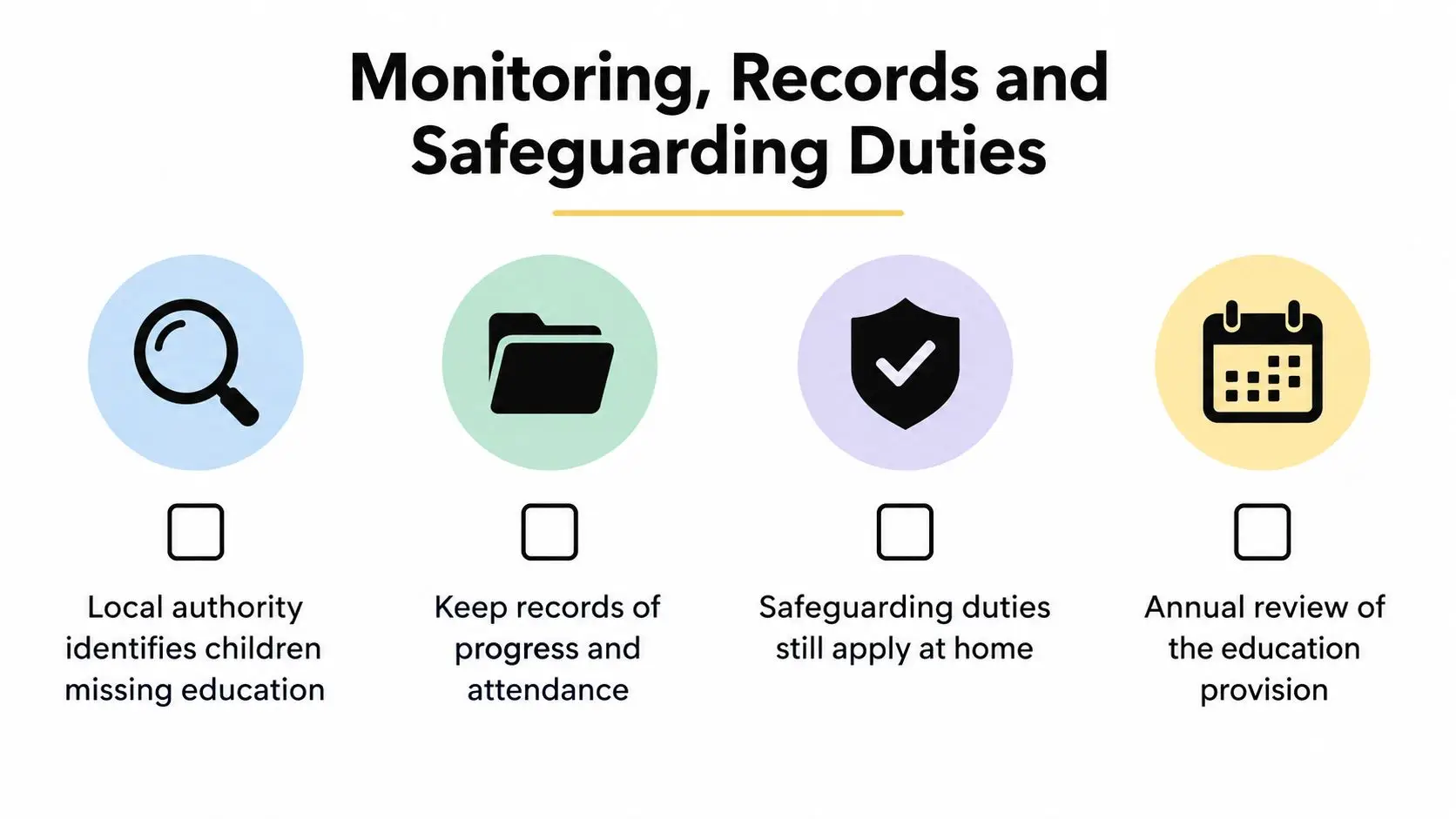
Home education doesn't mean that a child becomes invisible to public services. English local authorities must make arrangements under section 436A of the Education Act 1996 to identify children who may not be receiving suitable education. If evidence suggests that education isn't suitable, section 437 allows intervention, which can begin with a written notice requiring parents to demonstrate that suitable education is being provided. The relevant local authority guidance explains this accountability framework in practical terms.
This isn't the same as routine inspection of every home. The model is risk-based. Parliament reports that the Department for Education recommends local authorities make contact at least annually, but that recommendation isn't the same as compulsory annual inspection or automatic registration.
Keep evidence that tells the child's story
A simple folder can reduce anxiety if the local authority asks reasonable questions. Include:
- Learning intent: what your child is working towards and why.
- Study pattern: a calendar or notes showing regular learning.
- Work samples: writing, photographs of practical projects, completed exercises and reading records.
- Progress evidence: informal assessments, tutor feedback or reflections on what has changed.
- Adaptations: adjustments for dyslexia, autism, anxiety, communication, sensory needs or medical conditions.
Safeguarding duties continue at home. Agencies must act where there is evidence that a home-educated child may be at risk of significant harm, and a safeguarding enquiry may follow where there are reasonable grounds to suspect such harm. A child who learns online or independently still needs trusted adults, safe social opportunities and access to appropriate help.
Visibility protects children. Keep your records organised, answer reasonable safeguarding questions promptly and make sure your child has safe relationships beyond the immediate learning routine.
This short video can support a wider conversation about education, records and safeguarding:
Planning a Compliant Home Education Pathway
A workable plan can fit on a few pages. Begin with a child profile that records strengths, barriers, interests, communication preferences and signs of distress. Then set learning aims that are ambitious but reachable, explain how you'll teach them and decide what evidence will show progress.
The needs of children with SEND or SEMH deserve particular care. Official English data shows that 16% of children in elective home education had additional SEN support and 7% had an education, health and care plan, according to autumn 2025 government statistics. Those figures underline why home education shouldn't be treated only as a lifestyle decision. A child may need specialist teaching, communication support, therapy coordination, accessibility adjustments or a carefully managed re-entry option.
A practical planning checklist
- Start with the transition: record why the current arrangement isn't meeting your child's needs and what must improve.
- Define the programme: note curriculum intentions, subjects, resources, teaching roles and the pattern of learning.
- Adapt deliberately: explain how you'll support regulation, attention, communication, mobility, literacy or mental health.
- Collect evidence: save work, feedback, assessments and notes about changes in confidence or independence.
- Plan qualifications early: families pursuing GCSEs or A-levels should investigate examination entries and access arrangements through an appropriate exam access arrangements guide.
- Keep options open: review whether your child might return to school, move to another setting or continue at home.
Practical administration matters too. If childcare or family support connects with your wider arrangements, use reliable guidance for services such as the gov childcare login, while keeping that separate from the education duty itself.
Frequently Asked Questions for Parents
Do parents arrange public examinations?
Usually, yes, when a child is educated at home and wants recognised qualifications. Confirm the examination centre, entry deadlines, subjects, coursework requirements and access arrangements well before the intended sitting.
Does online schooling change the legal position?
Not automatically. A child enrolled with an online provider may still be educated otherwise than at a registered school. Ask whether the provider is a registered school, who records attendance, who holds legal responsibility and who arranges examinations.
What should I do if the local authority contacts me?
Respond calmly and keep your learning evidence ready. Explain the programme, your child's needs, study pattern and progress. If the authority raises concerns, ask what information is missing and seek specialist advice promptly.
What happens if we move between UK nations?
Recheck the rules before the move or withdrawal. Scotland, Wales, Northern Ireland and England don't operate under one identical process, so contact the relevant education authority and retain copies of school and learning records.
Can home education work for a child with SEN or SEMH needs?
It can, but flexibility doesn't automatically replace school-based support. Before withdrawal, identify how specialist input, therapies, equipment, communication support, examination arrangements and safeguarding contact will continue.
Queens Online School offers live online British-curriculum teaching from Primary through Sixth Form, with subject-specialist lessons, recorded sessions, support for learners with SEN and SEMH needs, and access to GCSE and A-level examination pathways. Visit Queens Online School to explore whether its structured online provision fits your child's learning, wellbeing and qualification goals.