

Your child brings home a GCSE options form, and suddenly a simple question feels surprisingly heavy. Should they choose Combined Science, or Biology, Chemistry and Physics separately? Does “combined” mean less demanding? Will the choice affect A levels, university plans or your child's confidence over the next two years?
These are reasonable concerns. GCSE science courses aren't only about labels, timetables and exam papers. They need to fit the learner sitting at your kitchen table, including how they revise, how they respond to pressure, what kind of practical work motivates them and what support they need when science feels difficult. A child who enjoys asking questions but struggles with dense written instructions may need a different course structure from a confident memoriser who wants maximum subject depth.
The most useful decision rarely comes from choosing the route that sounds hardest. It comes from matching the qualification, teaching model and practical arrangements to the child.
A Parent's First Look at GCSE Science Choices
At the kitchen table, one teenager may say, “I'm good at biology, but I hate physics.” Another may worry that Combined Science will close doors. A parent may be trying to compare school brochures that use “double award”, “Trilogy”, “Triple Science” and “separate sciences” without explaining what any of them mean in everyday terms.
The first reassurance is that there isn't one universally correct route. Combined Science can be a strong, demanding qualification, while separate sciences can be rewarding for a learner who enjoys sustained depth and has the time and motivation to manage a broader examination programme.
The decision should begin with the child rather than the course title:
- Interests: Does your child enjoy living systems, materials and reactions, forces and energy, or a mixture?
- Learning habits: Do they retain ideas through experiments, diagrams, discussion, repeated questions or independent reading?
- Confidence: Will a larger amount of content energise them, or make revision feel unmanageable?
- Future direction: Do they already have a clear interest in medicine, engineering or another science-heavy route, or are their plans still open?
- Wellbeing: How do they cope with timed work, unfamiliar questions and several exams close together?
A Year 9 learner who enjoys all three sciences but becomes anxious when work piles up may flourish with Combined Science and carefully planned revision. A curious student who spends weekends reading about cells, chemical reactions or space may welcome the extra depth of separate sciences. Neither child is making a lesser choice.
A useful question: “Which route gives my child the best chance to understand science, retain confidence and show what they know?”
Families also need to ask questions that many course comparisons leave until too late. Where will practical activities take place? Who will support a child with additional needs? Which exam board is used? Can the learner access an approved examination centre? The right course is the one that answers those questions clearly before enrolment, not after problems appear.
What GCSE Science Courses Actually Cover
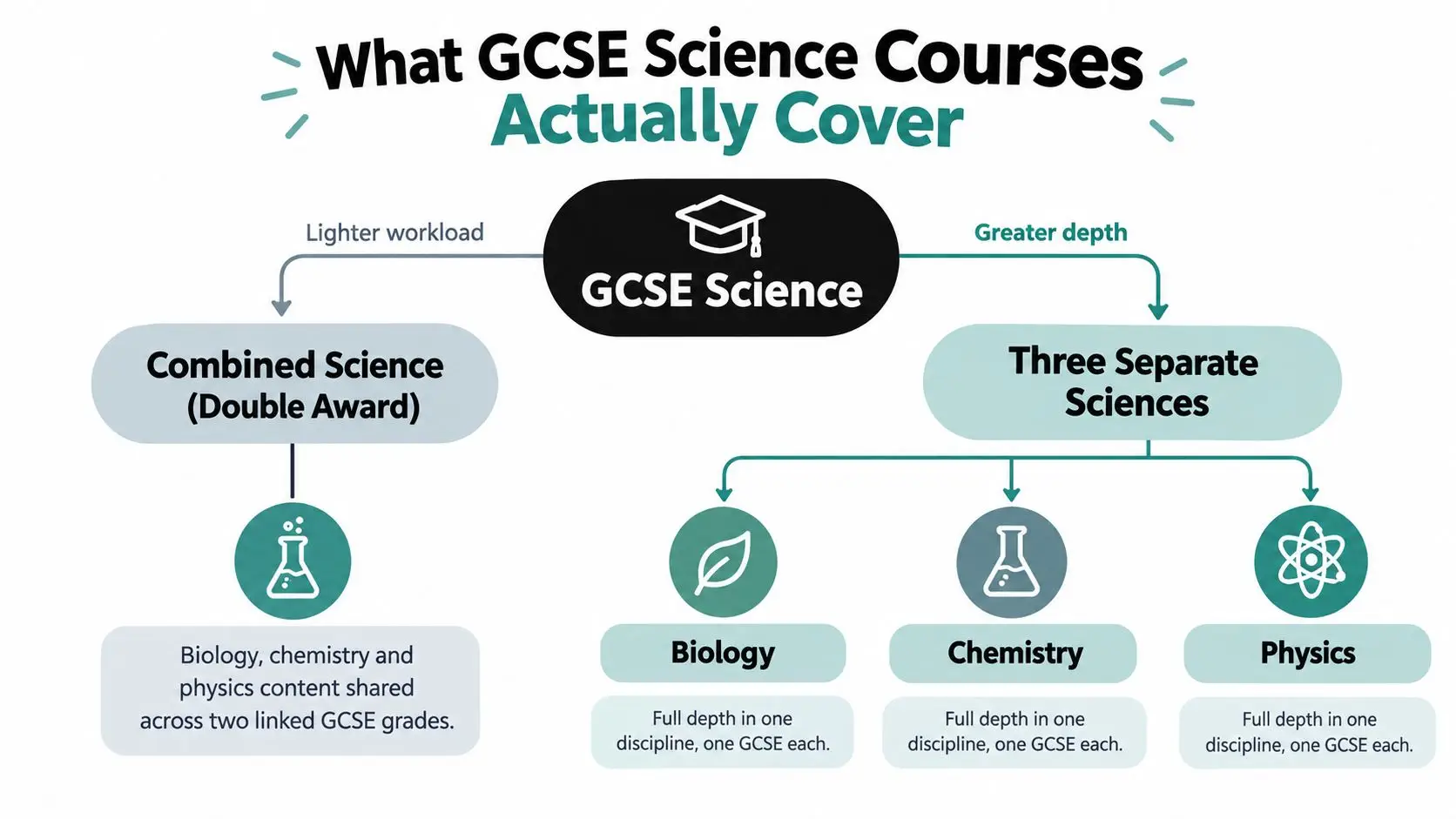
Start with the qualification structure. Combined Science is a double award, meaning it counts as two GCSEs. It brings together biology, chemistry and physics, and the final result is reported as a paired grade rather than as three separate subject grades.
Separate sciences, often called Triple Science, lead to individual GCSEs in Biology, Chemistry and Physics. They allow more detailed study of each discipline, but they also require the learner to manage three distinct specifications and their associated assessments.
Combined Science is not a reduced version of the three sciences. England's national subject-content criteria require at least 30% representation from each discipline, so biology, chemistry and physics all need protected curriculum time. The specification builds from Key Stage 3 science and supports progression to A level, as set out in the national requirements for GCSE Combined Science.
Breadth and depth in practice
Consider two learners. Maya enjoys ecology, acids and electricity equally. She doesn't need to become a specialist in one field to benefit from science, so a balanced Combined Science course may suit her well. Her teacher can connect energy transfers to chemical processes and biological systems, helping her see science as a set of linked ways to understand the world.
Daniel wants to study engineering. He enjoys physics calculations and is also comfortable with chemistry and biology. Separate sciences may give him more room to develop detailed knowledge, although his suitability still depends on his attainment, workload and the options available through his school or examination centre.
The difference isn't just “easy” and “hard”. Combined Science offers breadth across three disciplines within a double-award structure. Separate sciences offer greater depth in each discipline, with a larger overall subject commitment. A learner who dislikes one science may still do well in Combined Science because the course continues to include all three areas. A learner aiming for a science-rich post-16 route may value the extra depth of separate qualifications.
Parents looking for broader teaching ideas can also consult health education lesson plans for 2025 when discussing how scientific knowledge connects with health, evidence and everyday decisions.
How Many Students Take Each Route and What Results Look Like
A parent comparing science routes often wants a simple ranking. The national picture is useful, but it needs reading with care.
In England, Combined Science is the route most pupils enter. The government's provisional GCSE entry data for summer 2025 recorded 934,500 combined-science entries, alongside 171,690 Biology entries, 174,088 Chemistry entries and 173,227 Physics entries. That makes Combined Science far more common than any single separate science.
There is an important catch. Combined Science is a double award, so the entry totals reflect qualification volume rather than a headcount of individual pupils. In other words, the figures show how often each qualification was entered, not how many children sat in the exam hall.
The 2025 grade profile adds more context:
| Route | Entries, England 2025 | Grade 4/C or above | Grade 7/A or above |
|---|---|---|---|
| GCSE Science, Double Award | 925,606 | 57.6% | 9.1% |
| Biology | 183,539 | 89.4% | 43.5% |
| Chemistry | 174,088 | 91.5% | 46.1% |
| Physics | 173,227 | 90.9% | 45.2% |
These figures come from the 2025 GCSE results tables published by the Joint Council for Qualifications.
Families sometimes see this pattern and assume separate sciences must be the stronger route. That is too quick. Separate-science groups are often shaped by prior attainment, option policies, school setting, confidence in exams, and plans for post-16 study. A higher national grade profile can reflect who takes the course, not just the course itself.
A better question is whether the route fits the child in front of you. Most learners take Combined Science, and both routes can lead to good outcomes when teaching is clear, practical work is properly supported, and the course setup suits the pupil's needs, including accessibility and the way they learn best.
Understanding How GCSE Science Is Assessed
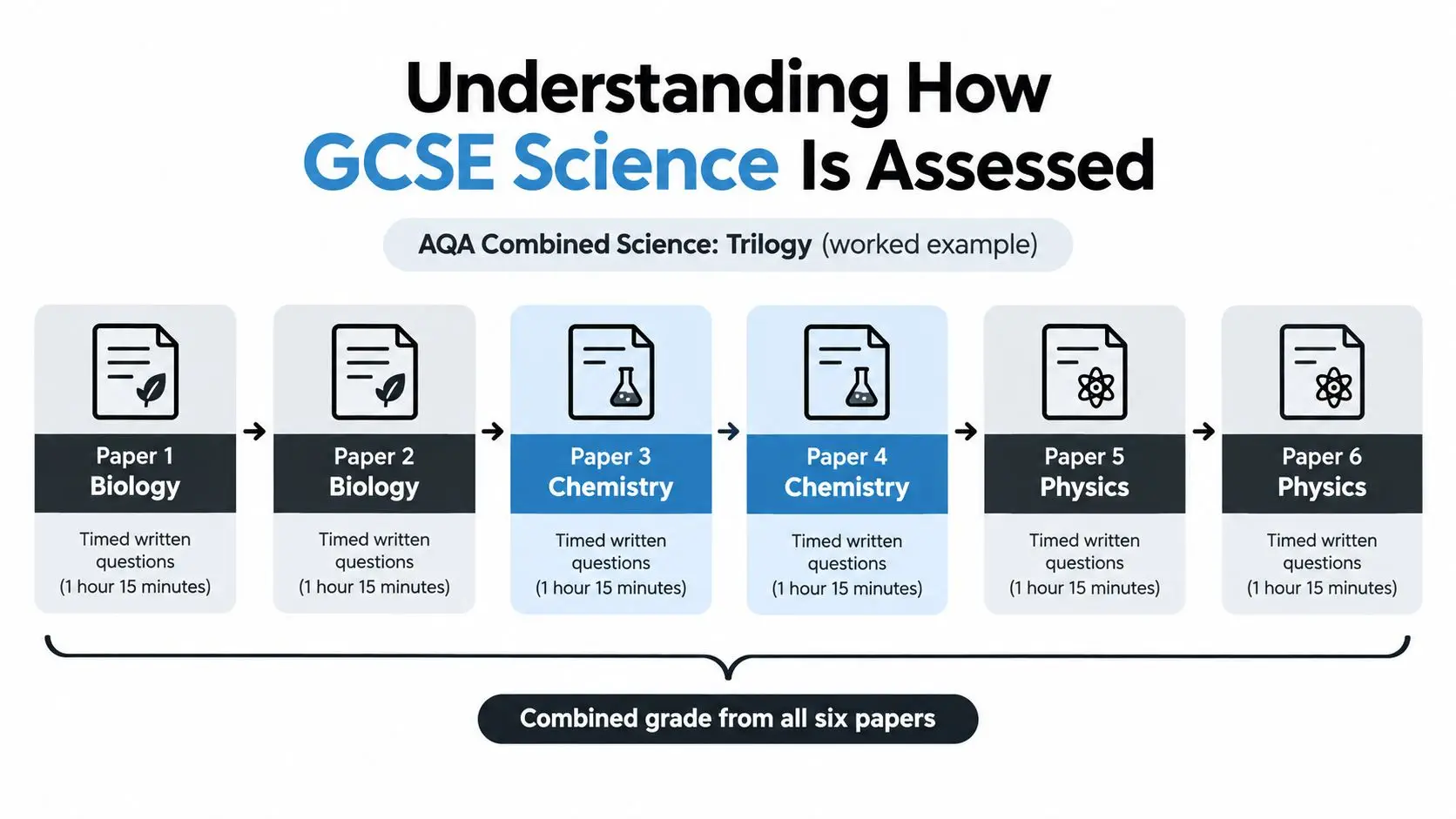
Exam-board language can make science assessment sound more complicated than it is. AQA GCSE Combined Science: Trilogy provides a helpful example because the qualification is divided into six written papers. There are two Biology papers, two Chemistry papers and two Physics papers, and each contributes 16.7% to the final qualification.
The approximate assessment balance is:
- Knowledge and understanding: 40% tests whether the learner knows scientific ideas, terminology and equations.
- Applying knowledge: 40% asks the learner to use those ideas in a new context, calculation or scenario.
- Analysis and evaluation: 20% tests how well they interpret evidence, judge methods and justify conclusions.
These proportions are specified in the AQA scheme of assessment for Combined Science Trilogy. They explain why memorising a revision guide rarely delivers the whole result.
What a question might demand
A question about an investigation into insulation could begin by asking the learner to state the equation for energy transfer. That tests knowledge. It might then provide unfamiliar measurements and ask the learner to calculate a value or compare materials, which tests application. Finally, it could ask whether the method produces reliable evidence and request an improvement, which tests analysis and evaluation.
A child who knows the equations but loses marks on graphs doesn't necessarily lack scientific ability. They may need targeted practice with data interpretation. Another learner may understand an experiment when discussing it aloud but struggle to write a conclusion using evidence. Marked questions can reveal that specific barrier.
A short revision cycle works better than telling a worried teenager to “revise science”:
- Identify whether the lost mark involved recall, application or evaluation.
- Practise a small group of questions targeting that skill.
- Review the mark scheme and rewrite one answer.
- Return to the topic later through retrieval rather than rereading the whole chapter.
A parent can help by asking, “What kind of mark did you lose?” rather than “Why didn't you know this?” That change keeps the conversation focused on a teachable skill.
For families comparing different assessment approaches, the methods of assessment used in online education can provide useful context. A short overview of the exam structure may also help a learner understand what awaits them:
The Practical Science Requirement Families Often Miss
A science course isn't complete because a learner has watched lessons about experiments. In England, students must complete or observe exam-board-specified practical activities and keep a record of practical work. Single-science GCSEs require at least eight activities, while Combined Science requires at least 16, and at least 15% of total assessment marks must test knowledge, skills and understanding drawn from practical experiences, as explained in the government consultation on assessing practical work in GCSE science.
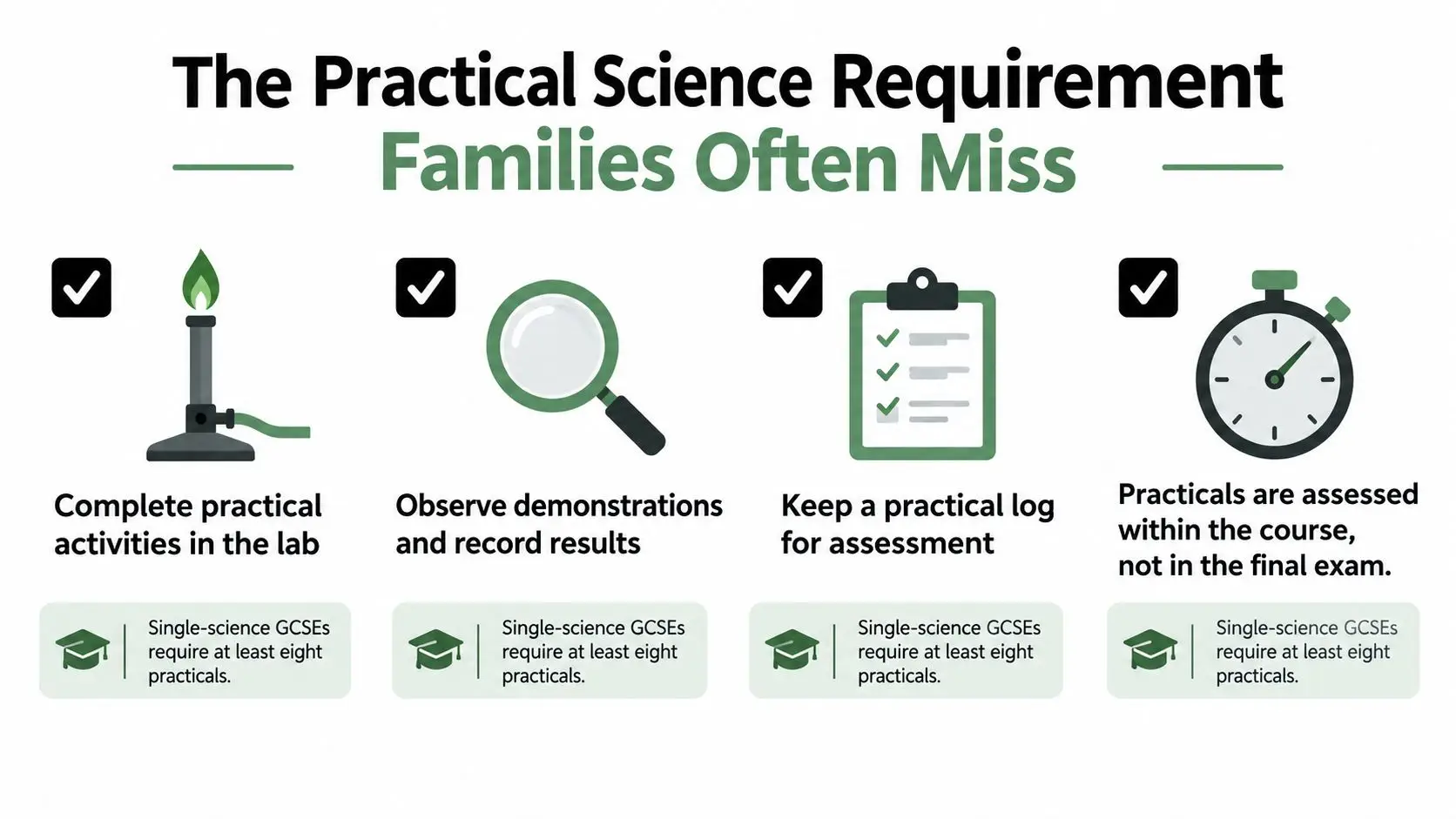
The final exams test practical understanding through written questions. A learner may need to identify variables, select suitable apparatus, interpret a results table, explain uncertainty, evaluate a method or suggest a safe improvement. They may never receive a separate practical grade, but weak practical knowledge can still cost marks on the written papers.
Questions to ask before enrolment
For an online, home-educated or internationally based learner, practical arrangements need to be explicit. Ask:
- Which activities are included: Does the course map every required practical to the relevant exam-board specification?
- Where will they happen: Will the child attend a laboratory, work with a partner centre or observe approved demonstrations?
- Who supervises them: Is a qualified science teacher present to explain variables, safety, measurement and evaluation?
- How is the record kept: Will the learner maintain a practical-work log that supports later revision?
- What will it cost: Are laboratory sessions, materials, travel or private-candidate arrangements charged separately?
A demonstration can be valuable, but it isn't automatically the same as a learner completing an activity. The course provider should explain exactly what the examination board requires and how each activity is covered.
Private candidates may need to find a school or college willing to provide the practical work. That can be difficult for a family outside a conventional school setting, especially when the learner has access needs or lives away from the examination centre.
Practical rule: Before paying for an online GCSE science course, ask for a practical-completion map. If nobody can show where every required activity fits, the course plan isn't complete.
The right delivery model gives a child repeated opportunities to explain what happened, why the method was chosen and how the evidence supports a conclusion. That preparation builds confidence for the exam, rather than leaving practical questions as a last-minute surprise.
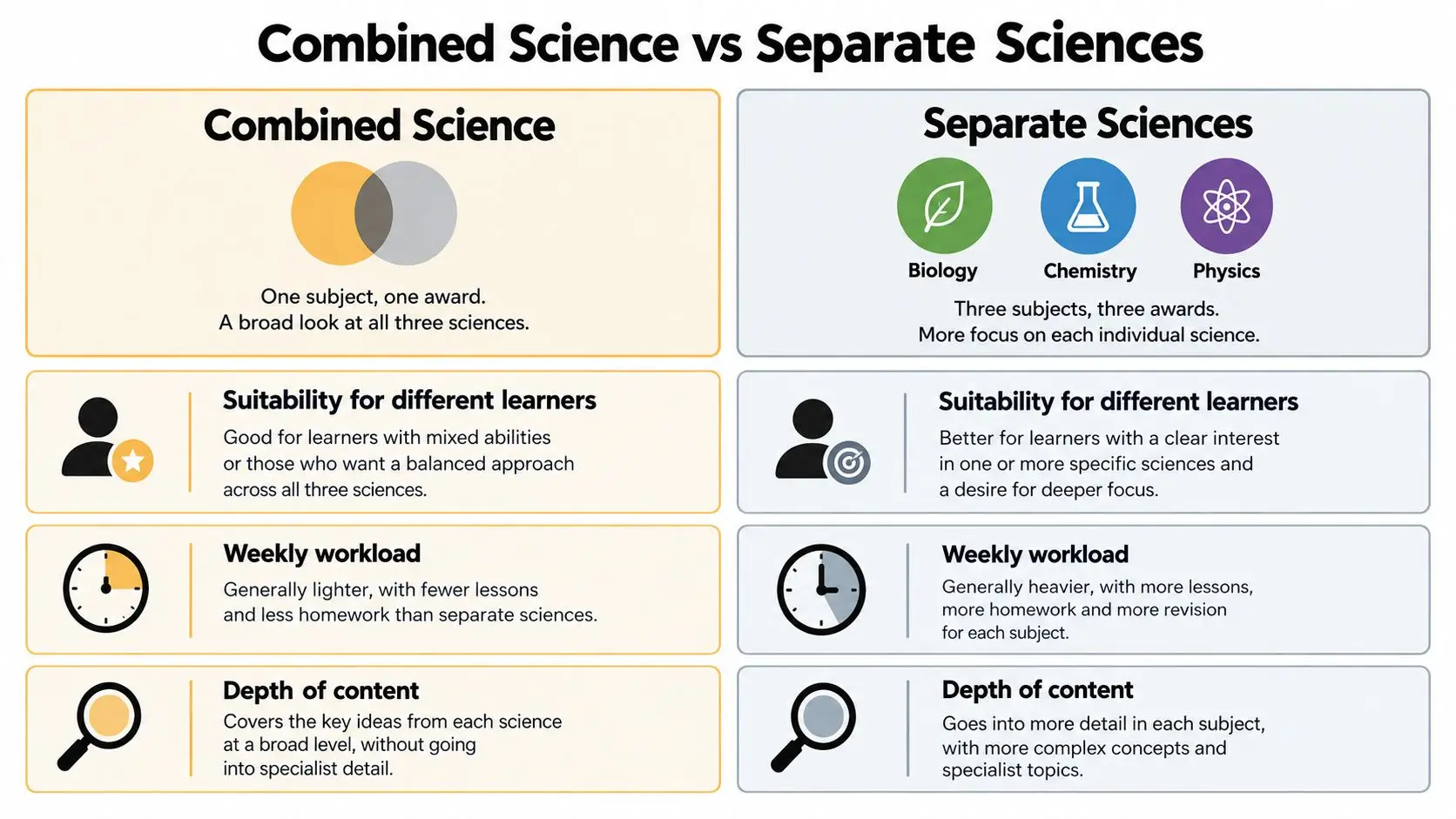
Combined Science vs Separate Sciences
The choice becomes clearer when families compare the routes against the child's actual profile rather than against an abstract idea of prestige.
| Decision point | Combined Science | Separate Sciences |
|---|---|---|
| Subject structure | Biology, Chemistry and Physics within a double-award qualification | Individual GCSEs in Biology, Chemistry and Physics |
| Best fit | Learners who want a balanced science education with a more contained route | Learners who enjoy depth and can manage a broader subject commitment |
| Workload | Broad content across three disciplines | Greater detail across three separate specifications |
| Assessment outcome | One paired result | Separate grades for each science |
| Progression | Supports many post-16 pathways, subject to entry requirements | Offers deeper preparation for learners targeting science-heavy progression |
Combined Science results use two equal or adjacent grades, such as 9-9, 9-8, 8-7 or 5-5. The scale runs from grade 9, the highest grade, to grade 1. A learner whose performance varies across biology, chemistry and physics might receive 6-5, rather than three individual subject grades. The government explanation of the GCSE 9 to 1 grade scale sets out how the paired result works.
For some children, that format feels reassuring because one weaker area doesn't appear as a separate result. For others, three individual grades feel more transparent and allow a particular strength, such as Chemistry, to stand out. Talk through the emotional response as well as the academic one. A teenager who worries about “losing” a subject may need to understand that Combined Science still counts as two GCSEs.
Matching the route to the learner
A learner who needs a manageable revision load, enjoys several branches of science and is still exploring future options may find Combined Science a sensible fit. A learner who wants to study each subject in greater detail, enjoys independent work and has the stamina for a wider assessment programme may prefer separate sciences.
Neither route should be selected solely because friends are choosing it or because a label sounds more impressive. Ask the science teacher how your child currently performs in each discipline, how much support they need to organise work and whether the intended sixth-form route has specific entry expectations.
The best course is the one your child can engage with consistently, complete practically and revise without losing their sense of capability.
Supporting SEN and SEMH Needs in GCSE Science
A promise of “support” isn't enough for a child with special educational needs or social, emotional and mental health needs. National primary data recorded 22% of pupils in England as having a special educational need in 2025, including 6% with an Education, Health and Care Plan and 17% receiving SEN support, according to the 2024 to 2025 revised education statistics.
Science can create specific barriers. Dense technical vocabulary may make a page feel inaccessible. A multi-step practical may overwhelm a learner who needs instructions broken into smaller units. Timed calculations, unfamiliar diagrams, noise, smells, bright laboratory lighting or fear of making a mistake can affect performance in ways that aren't visible in a standard lesson.
Recorded lessons can help a learner pause and replay an explanation. They can't replace live supervision during practical work, structured retrieval practice or formally approved examination arrangements. Access arrangements may require coordination between the examinations officer and SENCo, including arrangements connected with practical assessment materials.
Parents should ask for concrete examples:
- How will teachers identify whether the barrier is vocabulary, working memory, processing speed or anxiety?
- Can instructions be provided in adapted steps without removing the scientific challenge?
- How will the child practise calculations and practical methods gradually?
- Who will coordinate evidence and applications for examination arrangements?
- What happens if a learner becomes distressed during a live lesson or practical session?
A family supporting a learner with ADHD may also find practical guidance on how to study effectively with ADHD useful, particularly when adapting study routines around attention, breaks and retrieval.
A written SEN support plan should describe what teachers will do in lessons, practical sessions and examinations. Flexible online learning can improve access, but accessibility comes from deliberate design, responsive adults and early preparation.
How Queen's Online School Delivers GCSE Science Online
A good online science course has to work in real life, not just on a prospectus. Parents usually need clear answers on three points: how teaching happens week by week, how practical work is completed, and who takes responsibility for exams if a child is learning outside a conventional school.
Queen's Online School offers GCSE and International GCSE science in Biology, Chemistry and Physics, with Combined Science and separate-science routes. Teaching is live and led by subject specialists, so pupils can ask questions in the moment rather than storing up confusion. Class sizes are kept small enough for discussion, and recorded lessons give pupils a second pass at difficult ideas. That matters in science, where one missed step in bonding, forces or equations can wobble the next topic like a loose brick in a wall.
Practical science is treated as part of the course, not an afterthought. The school supports the required practical activities and coordinates arrangements for pupils who are not studying in a mainstream setting. As noted earlier, families should still ask exactly where each practical will take place and how attendance, supervision and evidence will be handled. As a Pearson Approved Examination Centre, the school also manages formal examination arrangements through its own centre.
Families comparing providers can use the national picture mentioned earlier as useful context, then ask how any school tracks attendance, progress and exam readiness. For a fuller outline of the course structure, see online GCSE Science.
Before enrolling, ask five direct questions:
- What route fits my child's interests and workload?
- Which exam board and specification will they study?
- Where will every required practical take place?
- How will exams and access arrangements be managed?
- What will SEN or SEMH support look like in an actual lesson?