


The results envelope sits unopened on the kitchen table. Your child knows one grade is missing, but not yet what that means for college, an apprenticeship or the subject they hoped to study next. You're both asking the same urgent question: can an online GCSE retake fix the problem quickly, and what must be booked first?
The answer is practical rather than glamorous. Online learning can provide lessons, revision materials, tutor feedback and a flexible routine. It doesn't replace the regulated examination. The written paper must be taken in person at an approved exam centre, so the centre booking should come before you pay for an online course.
The Moment a Retake Becomes the Right Next Step
A child misses the grade needed for their next course, while the autumn start date keeps approaching. The immediate response should not be buying an online GCSE retake course. First, establish whether a retake is needed, which exam series fits the timeline and which approved centre can accept the entry.
A missed grade can affect a conditional college offer, an apprenticeship application or the subjects available on a post-16 programme. It does not close every route, but delay can remove practical choices. Families should check the result slip, identify the exact subject and specification, and contact exam centres before committing money to tuition.
Suppose a student needs a higher maths grade for a college course beginning in autumn. Online lessons can refresh algebra, provide problem-solving practice and allow tutor feedback around the student's schedule. The final GCSE still requires a private candidate entry through an approved centre, with the examination taken there under formal conditions. Guidance on GCSE resits confirms that online study supports preparation, while the assessment is completed in person at a registered centre (guidance on GCSE resits and exam-centre requirements).
Three decisions, not one purchase
An online GCSE retake involves three connected decisions:
- The subject: Is the priority English Language, English Literature, maths, science or another qualification?
- The series: Can the student prepare for an autumn sitting, or does summer provide a more realistic study period?
- The centre: Which approved centre accepts private candidates for the precise specification and paper?
Book the exam route first. Then choose online support that matches the specification, assessment format and confirmed date.
This order prevents a common and expensive mistake. A family enrols on a course, completes lessons and assumes the qualification will follow. The course provider may supply teaching and feedback, but the exam centre manages the entry, venue, invigilation and results process.
The GCSE system uses fixed papers, rules and deadlines. Your child is preparing for a regulated national qualification, not completing an informal online assessment. Ask each centre about the specification, entry deadline, examination date and documents required before paying for preparation.
Use the confirmed sitting to build the study plan backwards. Set weekly topics, schedule practice papers and leave time to address weak areas. This sequence keeps the online work tied to a real examination entry and reduces the risk of finishing a course after the qualification window has closed.
Who Needs to Resit and Why the Grade 4 Threshold Matters
Your child has received the results, missed grade 4 in maths or English, and now needs a clear decision rather than another generic online course. Start by checking the result, the student's age and the qualification previously attempted. A candidate will normally need to have sat the GCSE, or hold equivalent prior attainment, before entering a resit. The exam centre and awarding body must confirm the exact entry requirements, especially if the student is changing specification, tier or qualification type.
For students in England, English and maths remain the priority subjects. Anyone who has not secured at least grade 4 is generally expected to continue studying the qualification after 16, including through a study programme or apprenticeship. The National Careers Service guidance on resits confirms that English and maths can be retaken in either the autumn or summer series. The school or college decides whether an autumn attempt is suitable.
What the grades mean in practice
A grade 4 is the standard pass. A grade 5 is commonly described as a strong pass. For a student with grade 3, the aim is therefore practical. Reaching grade 4 can remove an entry barrier used by colleges, training providers and employers.
A result below grade 4 may restrict progression. A college might refuse entry to a course, an apprenticeship provider may reject an application during shortlisting, and some A level or T Level routes may remain unavailable until English or maths is passed. Requirements differ between institutions. Ask the intended college, training provider or apprenticeship provider exactly which grade it accepts before choosing the retake route.
The pass rate shows why families should plan carefully. In England, only 17.1% of the 206,732 learners aged 17 or older taking GCSE maths in 2025 achieved grade 4 or above (2025 GCSE resit outcomes in English and maths). A repeat attempt needs more than access to lessons. The student must identify the topics and exam habits that caused the previous result, then practise those areas against the relevant specification.
| Question | Answer |
|---|---|
| Does the student need prior GCSE experience? | They should previously have sat the qualification or hold equivalent prior attainment. The selected centre must confirm eligibility. |
| Who is normally expected to resit? | Students in England who have not achieved grade 4 in English and/or maths are generally expected to continue studying those subjects after 16. |
| Is grade 4 the same as grade 5? | No. Grade 4 is the standard pass, while grade 5 is commonly treated as a strong pass. |
| Does every failed subject require a resit? | English and maths carry particular progression requirements. Other subjects depend on the student's goals and the entry rules for the next course. |
| Can an apprenticeship student avoid English and maths? | Usually not if the required grade has not been achieved. The apprenticeship provider will explain the study arrangement. |
Check the intended next step before paying for preparation. Confirm the required grade, the specification and whether the student needs a targeted resit or a longer programme. Then treat online study as preparation for a booked examination, not as the qualification itself.
A low grade can leave a student feeling labelled. Do not present the retake as punishment. Present it as a focused route to remove one barrier, with support matched to how the student learns and what went wrong previously.
Choosing Your Subjects and the Right Exam Series
A student who needs one grade for a near-term college decision may be ready for an autumn resit. A student facing several weak subjects, unfinished foundations or burnout needs more preparation time. Choose the exam series around the student's readiness, then confirm the centre can enter the exact qualification.
| Feature | Autumn Series | Summer Series |
|---|---|---|
| Main use | A targeted English or maths resit | English, maths and a wider range of GCSE subjects |
| Best fit | A student close to the required grade and ready for a concentrated push | A student with larger knowledge gaps or several subjects to prepare |
| Timing | Shorter preparation window and earlier outcome | Longer planning period and the main annual exam series |
| Subject choice | More limited, so confirm availability with the board and centre | Usually broader, but every subject still needs specification checking |
| Planning concern | Entry and readiness must be settled quickly | Delaying the decision can still create deadline and availability problems |
For the November 2026 GCSE resits, the provisional timetable is scheduled for 2 November 2026 to 11 November 2026, with results expected on 14 January 2027, subject to confirmation by the awarding bodies (November 2026 GCSE resit timetable). That defined window can give a student a clear target before starting or continuing college.
Match the series to the child
Choose autumn if your child has a manageable set of gaps, can work consistently and needs the result for a near-term progression decision. Choose summer if they need to rebuild foundations, retake several qualifications or recover from burnout without an unrealistic deadline.
Subject choice affects the exam route as well as the revision list. Foundation and higher maths tiers offer different grade ranges. Science arrangements may include separate practical requirements, while language courses can include a speaking component. A course title does not identify the correct paper by itself.
Before paying for an online course, ask for the exact Pearson Edexcel or AQA specification code, the tier where relevant and every paper included. Confirm the exam centre offers that specification in the chosen series. Families comparing GCSE and IGCSE options should understand the qualification distinction first. This clear explanation of the difference between IGCSE and GCSE provides a useful starting point.
The online course is preparation scaffolding. The booked exam centre and specification determine what the student must prepare for.
A student who needs maths for college may benefit from an autumn attempt. A student who has missed several subjects and feels emotionally exhausted may need summer, a smaller subject load and a calmer plan. The right series is the one the student can realistically prepare for, not just the one that appears quickest.
Booking the Exam Centre First and Building a Study Plan Around It
A retake starts with a confirmed exam route, not an online course. Find an approved centre that accepts private candidates for the exact subject, exam board, tier and series your child needs. The centre's availability sets the deadline around which every lesson and practice session must fit.
Contact Pearson Edexcel and AQA centres directly. Ask whether they accept private candidates, offer the required subject and specification, and provide the relevant practical or speaking arrangements. Request separate prices for exam entry and tuition, and ask what documents or evidence they require before confirming the entry. A centre may advertise GCSE exams without offering every paper or arrangement.
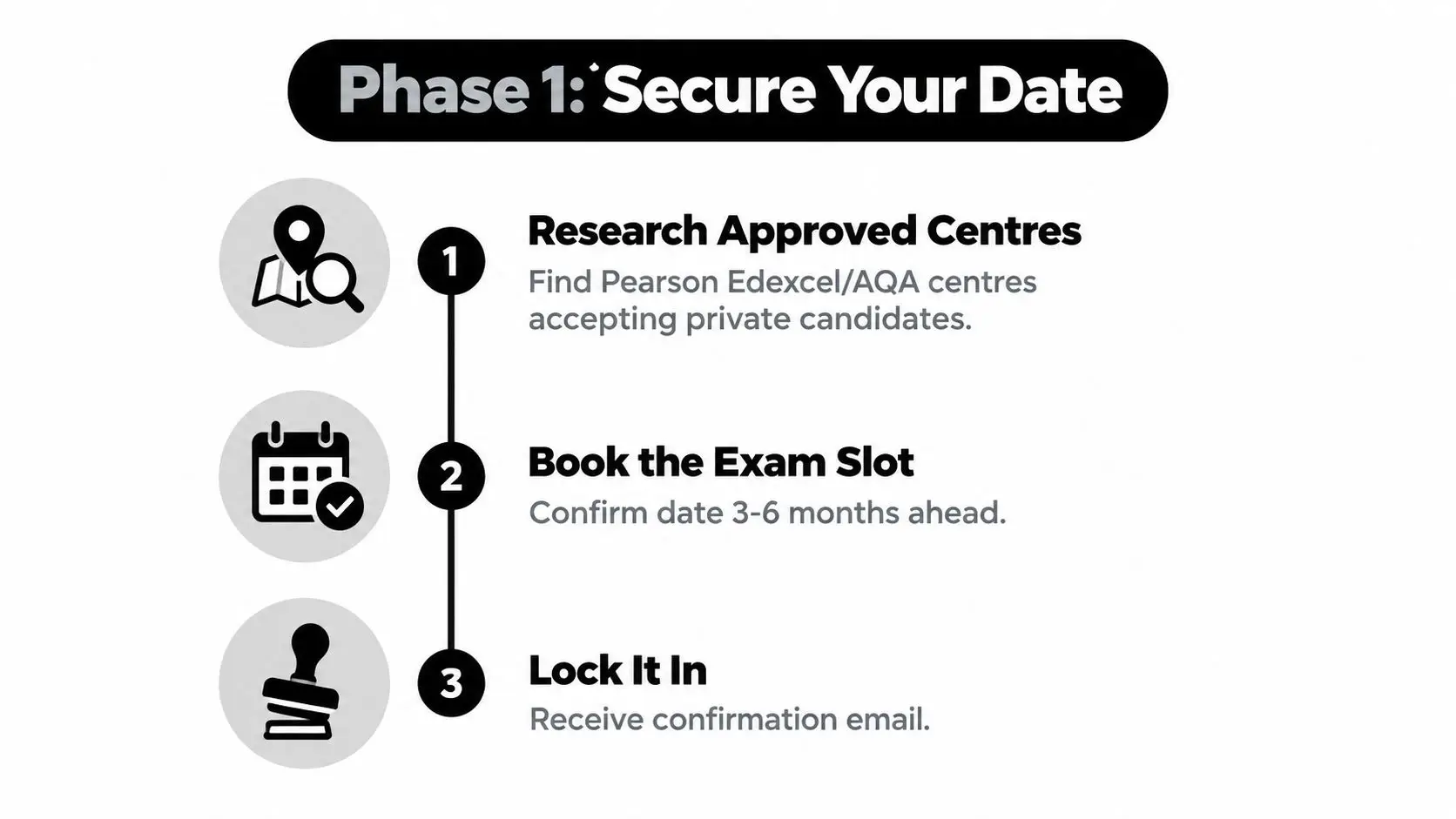
Use a three-stage workflow
First, diagnose the gaps. Put the result slip beside the specification. Use a short diagnostic quiz, a past-paper section or marked questions to identify whether the barrier is knowledge, exam technique, timing or written accuracy. A pupil who understands fractions but loses marks through rushed working needs a different plan from one who cannot yet manipulate equations.
Second, book the centre. Confirm the examination route before setting weekly targets. Once the date is fixed, count backwards, divide the specification into topic blocks and protect time for complete timed papers.
Third, practise under exam conditions. After teaching each topic, use relevant questions and then progress to full papers. Mark corrections against the official scheme. Record why each mark was lost, because a repeated error needs targeted teaching rather than more general revision.
Last-minute cramming is a poor plan for a retake. Your child needs repeated evidence of improvement, not confidence built solely from watching lessons.
The date gives revision a spine. Without it, families mistake activity for progress.
Get these points confirmed by email:
- Specification and board: Record the exact code, tier and paper combination.
- Candidate status: Confirm that the centre will enter your child as a private candidate.
- Exam dates: Ask for each paper date, arrival time and identification requirements.
- Fees: Separate entry, administration, tuition, practical and speaking charges.
- Access needs: State any SEN or SEMH requirements before paying.
- Results process: Confirm how and when the results slip and certificate will be issued.
Use the online course as preparation scaffolding around the booked exam, not as a replacement for the entry. Families organising study alongside other commitments may also find practical advice from Englify useful for planning tutor contact, independent work and manageable routines. The centre's written confirmation remains the authority on the exam itself.
Building a Revision Routine That Actually Moves the Grade
A retake sprint needs structure, but it also needs to protect the child's confidence. A student who failed after months of exhausting revision doesn't need an even longer list of tasks. They need a clear weekly rhythm that makes progress visible.
For a booked exam date, build a 12 to 16 week plan where possible. Start with teaching and repair work, move into retrieval and topic questions, then increase timed-paper practice. The exact balance depends on the subject and the starting point.
A workable weekly pattern
| Day | Activity | Purpose |
|---|---|---|
| Monday | Online taught session and short recall quiz | Introduce or revisit one priority topic |
| Tuesday | Retrieval practice using flashcards or questions | Test memory without looking at notes |
| Wednesday | Tutor-marked questions and error correction | Find out why marks were lost |
| Thursday | Second taught session and interleaved practice | Mix recent and older topics |
| Friday | Light review or rest | Prevent overload and preserve consistency |
| Saturday | Focused weak-area session | Repair the topic the child avoids |
| Sunday | Timed paper or substantial paper section | Build speed, accuracy and stamina |
Use BBC Bitesize, GCSE Pod, Seneca and Maths Genie for explanations and retrieval work. For exam technique, prioritise official AQA or Pearson past papers and their mark schemes. A tutor can explain a difficult concept, but the mark scheme shows what the examiner rewards.
Spaced repetition works better than a single weekend of rereading. Anki can automate flashcard reviews, while paper cards may suit a child who finds apps distracting. Interleave topics rather than completing every easy unit first. A maths session might combine percentages, algebra and graphs, because the exam won't announce which method to use before each question.
Mark the work, not just the effort
Parents should mark a short timed paper each week where possible. Ask the child to classify each error:
- Knowledge gap: The method or fact wasn't known.
- Application gap: The method was known but misapplied.
- Reading gap: A command word or important detail was missed.
- Timing gap: The answer was rushed, incomplete or omitted.
Passive note-reading creates a reassuring feeling without proving recall. Skipping weak topics creates the same problem in a different form. In English, practise command words such as analyse, explain and compare. In French, a targeted resource such as LenguaZen's French tense revision guide can support precise grammar repair rather than vague vocabulary review.
Parents can adapt these revision tips for GCSE to the child's subject and attention span. Keep the conversation factual: “You gained marks on the last paper, but timing cost you on the final question. Let's practise that part next.” That is more useful than saying the child needs to try harder.
Access Arrangements, SEN and SEMH Support for Retake Students
A previous school arrangement doesn't automatically transfer to a private exam centre. If your child previously used extra time, a reader, a scribe or supervised rest breaks, raise it with the new centre before enrolling. The centre must be willing to process the application with Pearson or AQA and must have the capacity to deliver the arrangement properly.
Common evidence includes a current Form 8, a specialist teacher or educational psychologist report, and supporting information about how the need affects examination performance. Where a report is required to be dated within 24 months, families should check its date rather than assume an old school file will be accepted. An updated assessment may carry a separate cost.
Ask the centre these questions
Use a direct email or phone script:
“My child is entering as a private candidate and previously used access arrangements. Can your centre process the required application, what evidence do you need, and by what date must we provide it?”
Ask whether the centre can provide:
- 25% extra time, where approved
- A reader or computer reader
- A scribe
- Supervised rest breaks
- A smaller room or individual seating
- A separate room for an approved arrangement
- Appropriate supervision for SEMH-related breaks
These adjustments aren't comfort extras. They remove a documented barrier so the student can show what they know. A small-room arrangement may reduce distraction, while supervised rest breaks can help a student manage panic without losing control of the exam process.
Plan to submit evidence at least eight weeks before the exam series. The exact deadline may be earlier at the centre, so treat eight weeks as the minimum planning point rather than a safe last-minute target.
Before paying for tuition, gather:
- Previous evidence: Copies of Form 8 or school access-arrangement records.
- Professional report: A specialist teacher or educational psychologist report where required.
- Current impact statement: A short explanation of how the need affects timed exams.
- Centre confirmation: Written agreement that the centre can deliver the arrangement.
- Awarding-body process: Confirmation that the centre will submit the application.
Families can review the practical exam access arrangements guidance while preparing questions for the centre. Don't promise your child an adjustment until the centre confirms approval and delivery. Certainty matters, particularly for a student already worried that the exam will repeat the previous experience.
Costs, Hidden Fees and What Comes After the Result
Parents need a budget that separates tuition from examination entry. Private GCSE exam costs vary by centre and subject. Published 2025/26 examples range from about £200 to £316.10 for many standard GCSEs, with Combined Science around £375 to £523.20 and languages with speaking around £300 to £414.20 (published private GCSE cost examples). Those figures show why a cheap-looking course can become expensive once entry and specialist components are added.
A centre's quote should state whether it covers the exam entry only or includes tuition. Exam hall access, invigilation and secure handling of papers are normally part of the examination service. Tutor hours, mock-paper marking, resource packs, practical attendance days and language speaking arrangements may cost extra.
Costs families often miss
Some charges appear only after the initial conversation. Ask about administration fees, late registration penalties, practical science attendance, foreign-language speaking endorsements and the cost of requesting a re-mark when a result is close to the next grade. Don't assume a tutor's course fee includes any of these.
| Cost Item | Typical Range | Included or Extra |
|---|---|---|
| Standard GCSE entry | About £200 to £316.10 in published 2025/26 examples | Usually exam entry, but centre terms vary |
| Combined Science | About £375 to £523.20 in published 2025/26 examples | Usually extra compared with a single standard subject |
| Language with speaking | About £300 to £414.20 in published 2025/26 examples | Speaking arrangement may be included or itemised |
| Online tuition | Varies by provider and support level | Extra unless the package states otherwise |
| Practical attendance | Varies by centre | Extra where the subject requires it |
| Late entry or administration | Varies by centre | Extra |
| Re-mark request | Varies by board and centre | Extra |
Lower-income families should ask the school, college or training provider about bursary eligibility. Support may depend on the learner's circumstances and the institution's policy, so make the enquiry early rather than waiting for an invoice to become a crisis.
After the result, collect the official results slip and ask the centre how certificates will be issued. Confirm the college or sixth-form place, especially if it was conditional. If an application is affected, update the relevant admissions information, including UCAS details where appropriate. Ask the centre about the deadline and process for appealing or requesting a review of results. A re-mark is a decision to weigh carefully, not an automatic response to disappointment.
Some students should still consider a further English or maths retake after passing if a particular course requires a higher grade. Others should stop and move forward. The right decision depends on the next destination, the grade achieved and the emotional cost of another attempt.
Queens Online School offers online GCSE and IGCSE study with live subject teaching, recorded sessions and access to an approved examination-centre route, so families can combine structured learning with the separate in-person assessment requirement.
Queens Online School can help your child study GCSE subjects online with live teacher support, recorded lessons and a plan built around the exam date you secure. Visit Queens Online School to discuss the right course and examination pathway for your family.