You're staring at a half-finished assignment, the deadline's close, and every paragraph on the screen sounds too much like the article you just read. Your child might be feeling the same pressure, or you might be trying to help them without making things more stressful. That's exactly where accidental plagiarism tends to happen, not because a student is careless, but because they're overwhelmed, unsure, and trying to move fast.
The good news is that how to avoid plagiarism is a teachable skill, not a talent some children magically have and others don't. Once students learn a few simple habits, like tagging sources as they research, paraphrasing from understanding, and citing early rather than at the end, the whole process gets calmer. For anxious learners, including SEN and SEMH pupils, that calm matters just as much as the final grade.
Why Plagiarism Happens and How to Reframe It
A student often doesn't set out to plagiarise. They open three tabs, find a useful paragraph, and then spend ten minutes trying to “change it enough” while the clock keeps moving. By the time they reach the end, they've copied the structure, borrowed the wording, and lost track of what came from their own thinking.
That's why the first shift is emotional as much as technical. Plagiarism is usually a skill gap wrapped in pressure, confusion, and poor systems, not a fixed character flaw. When parents and teachers treat it as something a child can learn to prevent, shame goes down and honesty goes up.
What students are actually struggling with
Many learners freeze because they don't know what counts as original. They may think a fact becomes “theirs” once they've typed it in their own font, or that changing a few words makes the whole paragraph safe. That confusion is common, especially for younger pupils, first-time writers, and students who work better with clear routines than with open-ended instructions.
Online schooling can help because teacher feedback arrives earlier, not just after submission. A live comment on a draft, or a quick correction while the student is still researching, often stops a problem before it spreads through the whole piece. If you want a practical way to organise the process from the start, this note-taking approach can help families build a calmer routine.
Practical rule: if a child is unsure whether a sentence is theirs, they should stop and trace it back to the source before they keep writing.
Reframing the goal
The goal isn't to “fool” a similarity checker. It's to help the child show genuine understanding in their own voice. That's a much healthier target, and it's easier to reach when they know how to collect evidence, separate ideas, and write from notes instead of from the source page.
In a school setting, that also means being honest about support. If a student is using guided feedback, a writing scaffold, or structured research time, that support should make thinking clearer, not hidden. The child still owns the work, but the process becomes much less intimidating.
Building a Source-Tagged Note-Taking System
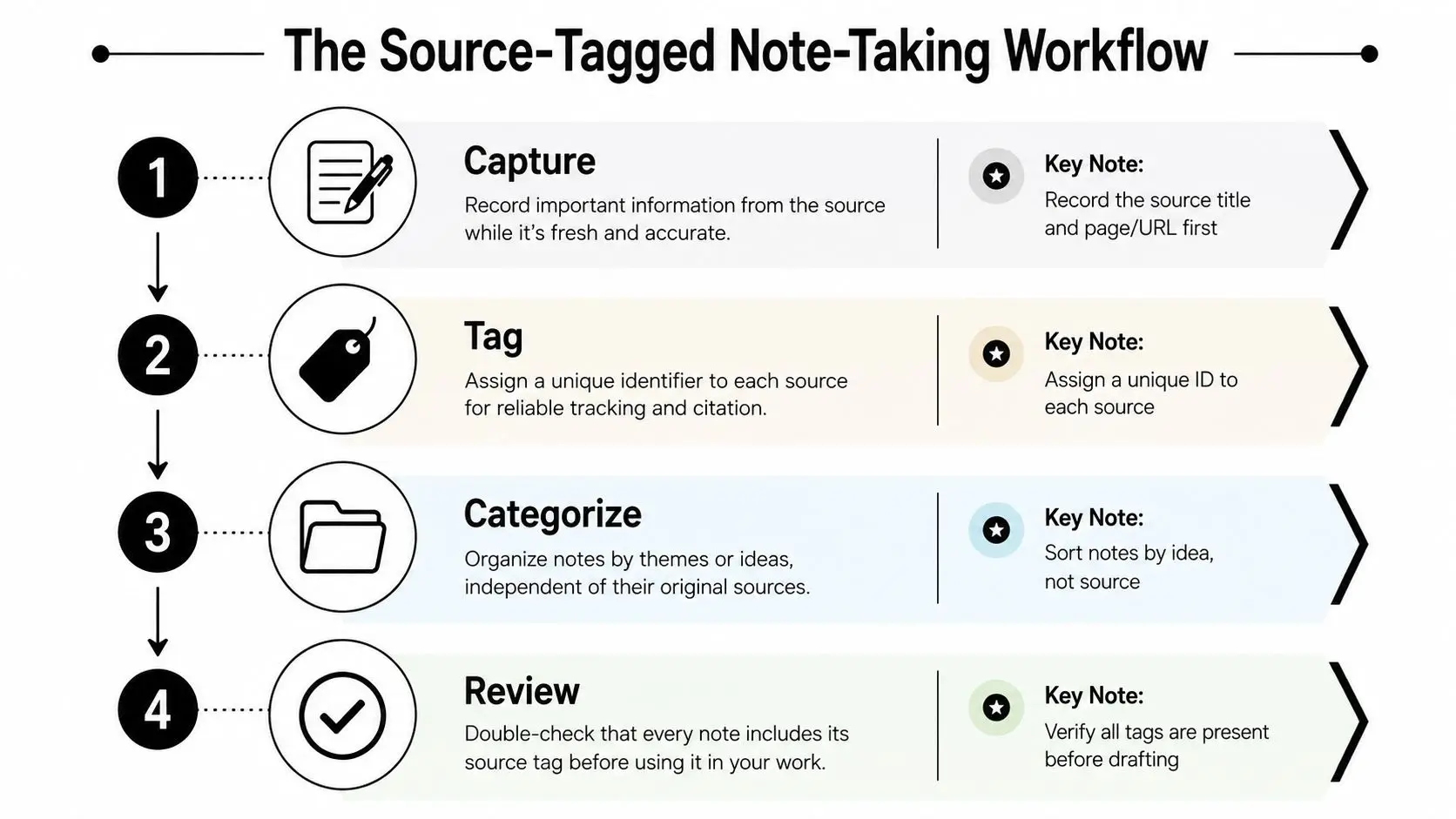
The most reliable way to prevent accidental plagiarism is to stop treating research notes like a scrap heap. Every note should tell you three things at a glance, what the idea is, where it came from, and whether it's a quote, a paraphrase, or your own thought. That one habit removes a huge amount of guesswork later.
Use tags before the writing starts
The safest workflow is simple. First, write the source title, author, date, page number, or URL before you copy any useful point into your notes. Then label each note clearly as direct quote, paraphrase, or my own idea.
That tagging step matters because memory blurs everything together. A student might think they “sort of remember” what was original, but later, when the source is open next to the draft, the wording suddenly looks very familiar. Once that happens, it's easy to slide into patchwriting without meaning to.
A second habit helps a lot, especially for children who need structure. Read the source, close it, and then write the note from memory in your own words. If the source stays open while they draft, the original sentence shape sneaks in far more easily.
Make the system visible and easy to use
You don't need a complicated app to do this well. Coloured highlighters, sticky notes, or simple initials can work just as well for younger children or learners with SEN needs. For example, blue could mean a direct quote, green could mean a paraphrase, and yellow could mean an idea the student has generated themselves.
A history project is a good example. A child researching the Victorian era might keep one section for quotations from a textbook, another for paraphrased facts from a museum website, and a third for their own reflection on what changed over time. That structure helps them separate borrowed material from personal analysis before the drafting even begins.
Good research habits reduce anxiety. When a child knows where each idea came from, they don't have to guess later, and guessing is where a lot of plagiarism begins.
The final check should happen before drafting, not after panic sets in. If the note doesn't show its source, or if the child can't explain whether it's a quote or a paraphrase, it isn't ready to use yet. A brief review at that point saves a lot of rewriting later.
Paraphrasing Techniques That Actually Transform Source Material
A lot of students think paraphrasing means swapping a few words with synonyms. That's patchwriting, and it's one of the easiest ways to stay too close to the original while still feeling busy. The structure remains the same, the logic remains the same, and the final version still depends too heavily on the source.
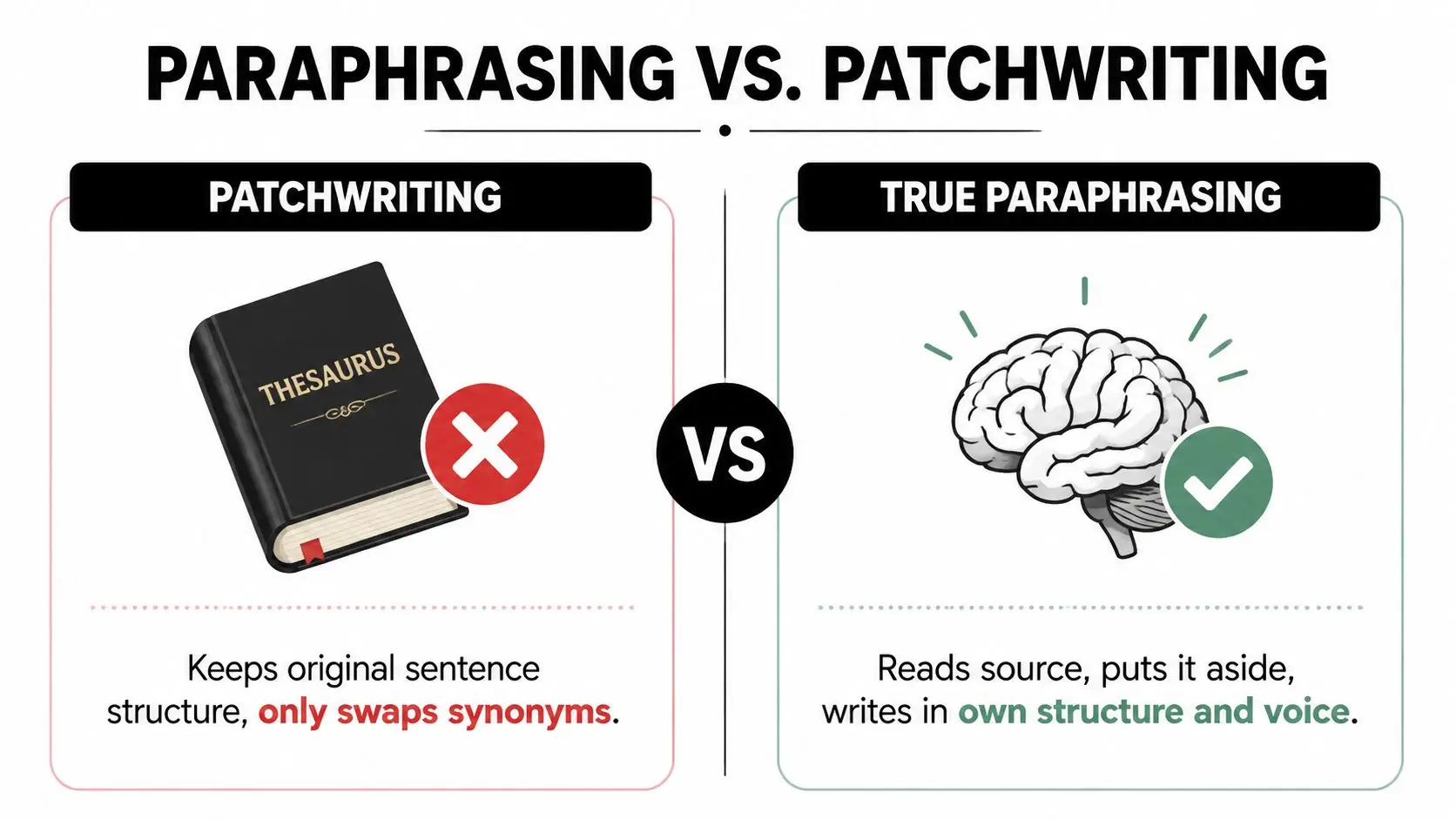
Try the read hide write check method
Start by reading the source until the idea is clear. Then hide it from view and explain it aloud, or write it from memory, in language that sounds like the student. After that, check back only to make sure the meaning stayed accurate.
This works because it breaks the habit of echoing the source sentence by sentence. A child who has fully understood the idea can usually express it in a fresh way, but a child who is still reading line by line often ends up shadowing the original text. That's not a moral failure, it's a sign they need to slow down and separate understanding from wording.
A simple classroom example helps. Suppose a source says climate change is causing more extreme weather. A weak paraphrase might read, “Climate change is leading to more severe weather events,” which keeps the same shape and swaps only a few words. A stronger version might say, “As the climate shifts, storms and heat events are becoming harder to predict,” which changes the sentence pattern and shows the idea through different language.
Why citations still matter
Even a genuine paraphrase still belongs to the original source idea. That's why every paraphrased fact, idea, or finding needs a citation. University College Dublin's academic integrity guidance is explicit that paraphrased information must be cited with an in-text citation and a full reference, and direct quotations need quotation marks plus a page number where relevant. You can read that guidance in the University College Dublin academic integrity guide.
The same rule applies if a student is writing about Shakespeare, a science concept, or a historical event. If the interpretation or fact came from reading, it needs acknowledgement. For a focused grammar reminder that helps students build longer, safer sentences, this compound sentence guide can be a useful support while they practise rephrasing.
A paraphrase is not “different enough” because it sounds polished. It's safe when the child has changed the structure, the wording, and the way the idea is expressed.
For parents, the coaching move is simple. Ask your child to explain the source in conversation first, then write that explanation down. Spoken understanding usually turns into more original writing than staring at a paragraph and trying to edit it word by word.
Citation Quick Reference for MLA, APA, and Harvard Styles
The easiest way to reduce citation anxiety is to remember one rule, when in doubt, cite. That keeps a student safe when a fact feels familiar but not fully certain, and it's better to over-document than to leave a borrowed idea floating without credit. APA-style guidance also makes the same point, even when a source is restated in your own words, the citation still stays.
Different schools ask for different formats, so it helps to keep a comparison at hand. If a child knows which style the teacher wants, they can focus on the writing instead of second-guessing punctuation. For families who are also helping children create presentations, these video creation tips can be useful when the assignment includes spoken or visual material that still needs careful attribution.
| Source Type | MLA Format | APA Format | Harvard Format |
|---|---|---|---|
| Book | Author. Title. Publisher. | Author, A. A. (Year). Title. Publisher. | Author, A. A., Year, Title, Publisher. |
| Website | Author. “Page Title.” Website Name, URL. | Author, A. A. (Year). Title of page. Site Name. URL | Author, A. A., Year, Title of page, Site Name, viewed date if required, URL |
| Journal Article | Author. “Article Title.” Journal Name, vol. x, no. y, Year, pages. | Author, A. A. (Year). Article title. Journal Name, volume(issue), pages. | Author, A. A., Year, ‘Article title', Journal Name, vol. x, no. y, pp. x-x. |
What to quote and what to cite
Direct quotations need quotation marks, and in some styles, page numbers too. Paraphrases still need citations because the idea did not originate with the student. That means a child can write entirely in their own words and still need to acknowledge where the thinking came from.
The “common knowledge” idea can also confuse families. A basic fact that many people know doesn't need the same treatment as a specialist statistic, a technical claim, or a source-specific interpretation. If the student had to look it up, it's usually safer to cite it.
The best habit is to add the citation while drafting, not as a final clean-up job. That way, the reference grows with the paragraph instead of being reconstructed from memory later, when details are easy to lose.
Navigating AI Tools, Self-Plagiarism, and Hidden Risks
AI tools create a new kind of temptation for students who are tired, anxious, or stuck. A tool that summarises a reading or rewrites a paragraph can feel like a shortcut, but it can also hide the fact that the child hasn't really read or understood the source. That matters because the work on the page needs to reflect the student's thinking, not just a machine's wording.
Yale's guidance warns students not to rely on AI tools to summarise or paraphrase sources without reading the original text, and to be transparent about AI use where that use is permitted. Turnitin also advises institutions to be clear about academic misconduct policies and AI writing rules. For a practical discussion of the question, can AI writing be original is a useful read for families trying to make sense of the boundary.
Where AI helps and where it misleads
Used carefully, AI can help with brainstorming, language smoothing, or checking clarity. It becomes risky when a student asks it to do the core thinking, especially if the source text hasn't been read first. In that case, the child may submit text that looks fluent but no longer shows genuine understanding.
That risk is bigger than many families realise because AI can also invent polished-sounding phrasing that mirrors the source too closely or produces references that don't exist. The safest approach is to treat AI as a support tool, not a substitute for research, reading, or citation. If the school allows AI at all, the child should know exactly how it must be disclosed.
Self-plagiarism needs attention too
Students are often surprised to learn that reusing their own previous work can cause problems. Self-plagiarism is a separate issue from copying somebody else, but it still matters when a student resubmits old paragraphs, revisits draft material, or lifts wording from earlier coursework without permission. The Office of Research Integrity's ethical writing guidance treats reused text as something that must be clearly identified and handled carefully, which is why keeping drafts matters so much.
This is especially relevant for revision notes, coursework, and repeated assignments. A child might feel, quite reasonably, that if they wrote it once, they should be able to use it again. The safer answer is to check the school rule first, then either rewrite the material freshly or cite and disclose it where appropriate.
Ask before reusing anything. If the work, wording, or notes came from an earlier task, the child needs to know whether that reuse is allowed and how it should be marked.
For parents, the practical move is to keep a folder of drafts, sources, and teacher feedback. That simple archive makes it much easier to separate fresh work from recycled material, and it gives the student a clear record if a question comes up later.
Creating Supportive Workflows for Home and Online School
A child is less likely to plagiarise when the routine around the work feels steady and clear. The assignment brief should make the task specific, the note-taking method should stay the same from one piece of work to the next, the draft should be checked before it is handed in, and the school's expectations should be known early. If a school treats plagiarism as misconduct, families need that information before a problem appears, not after a warning arrives.
That kind of clarity lowers anxiety because it turns a vague fear into a set of doable steps. A student who knows the rule can follow it. A student who only hears “don't plagiarise” is left guessing where the line is, and that uncertainty can lead to rushed copying or avoidable mistakes. The home learning environment can support this by keeping structure, feedback, and a steady pace in view.
Adjusting support for SEN and SEMH learners
Some learners need the process broken into smaller, calmer parts. A child with working-memory difficulties may struggle to hold a source idea in mind long enough to reshape it in their own words, while an anxious learner may copy quickly just to get the task over with. Visual checklists, short drafting windows, and one-step-at-a-time instructions can make academic integrity feel more manageable.
A simple routine helps. Start with the assignment rules, move to source-tagged notes, draft one paragraph at a time, then finish with a citation check. If the child needs more space to think, give them more time to draft rather than compressing the work into a stressful evening. For SEN and SEMH learners, that slower pace can reduce panic and make careful writing more possible.
Support at home and in online classrooms
Online schooling can help when teachers give quick corrections and students can revisit recordings at their own pace. Small class sizes make it easier for a teacher to notice when a child is paraphrasing too closely, missing citations, or depending too heavily on a source. That feedback is not about catching children out. It helps them build steady habits while those habits are still forming.
A home routine can stay simple and still work well:
- Check the brief first: Ask what the teacher wants, which citation style is required, and whether AI is allowed.
- Keep one source log: Record every book, article, website, and class note the child uses.
- Draft from notes only: Close the source text before writing each paragraph.
- Review before submission: Scan for missing citations, copied phrasing, and reused work from earlier tasks.
If you want a better look at how a structured digital setting supports this, the school's learning environment page shows how online education can keep guidance visible and manageable for families.
The heart of this work is confidence. When children know the rules, can see the steps, and feel safe asking for help, they are far less likely to drift into accidental plagiarism. They also learn something bigger than citation format, they learn how to use other people's ideas while building their own voice.