

A child who used to race through homework now sits at the table in tears. Another child won't speak up in class because the room feels too fast, too loud, or too public. For many families, the problem isn't lack of effort, it's that the setting isn't working for the child's mind, mood, or learning style.
That's where technology enhanced learning starts to matter. Used well, it isn't a shiny layer on top of school, it's a way to make learning more responsive, more humane, and more aligned with the British curriculum your child still needs to follow. The shift after COVID made that clearer than ever, because online and blended learning moved from emergency response into mainstream policy thinking, and UNESCO reported that more than 90% of education ministries put some form of distance-learning policy in place during the pandemic, accelerating that change across systems including the UK, which turned digital learning into part of the wider conversation about resilience and access rather than a temporary fix (UNESCO).
Families don't usually come to this decision because they want more screen time. They come because they want a calmer morning, fewer battles, better focus, or a child who finally feels able to succeed again. That emotional pressure is real, and it deserves a practical answer.
Why Families Are Rethinking Traditional Schooling
A mother might tell me her son is bright, but every school day ends the same way, with exhaustion, tears, and a workbook half-finished. Another parent might say their daughter understands the topic at home, then freezes the moment a classroom gets noisy or the teacher moves on too quickly. In both cases, the child isn't failing because they don't care, they're struggling because the environment is asking for one fixed way of learning.
That's why so many families start looking at alternatives. They're not trying to reject school, they're trying to find a setting where the child can breathe, ask questions, and keep up without constant distress. For some, live online schooling becomes the first time education feels structured and kind at the same time, and if you're weighing different routes, it helps to compare options calmly, including practical alternatives such as different education pathways.
Practical rule: if school is harming your child's confidence day after day, the question isn't whether change is dramatic. The question is whether the current model is still serving their learning and wellbeing.
A national shift in UK schooling has also made this conversation more serious. The Department for Education has published the 2024 to 2025 Technology in Schools Survey Report, which shows that digital tools are now embedded enough in everyday school operations to require national monitoring (Department for Education). That matters because it confirms what many parents are already seeing. Technology isn't a side feature anymore. It's part of how schooling works.
For families, that opens a door. Live online lessons, recorded sessions, and platform-based feedback can now be understood as credible ways to support learning, not experimental detours. The question becomes whether the child is receiving thoughtful teaching through technology, or being asked to stare at a screen and cope alone.
Understanding Technology Enhanced Learning
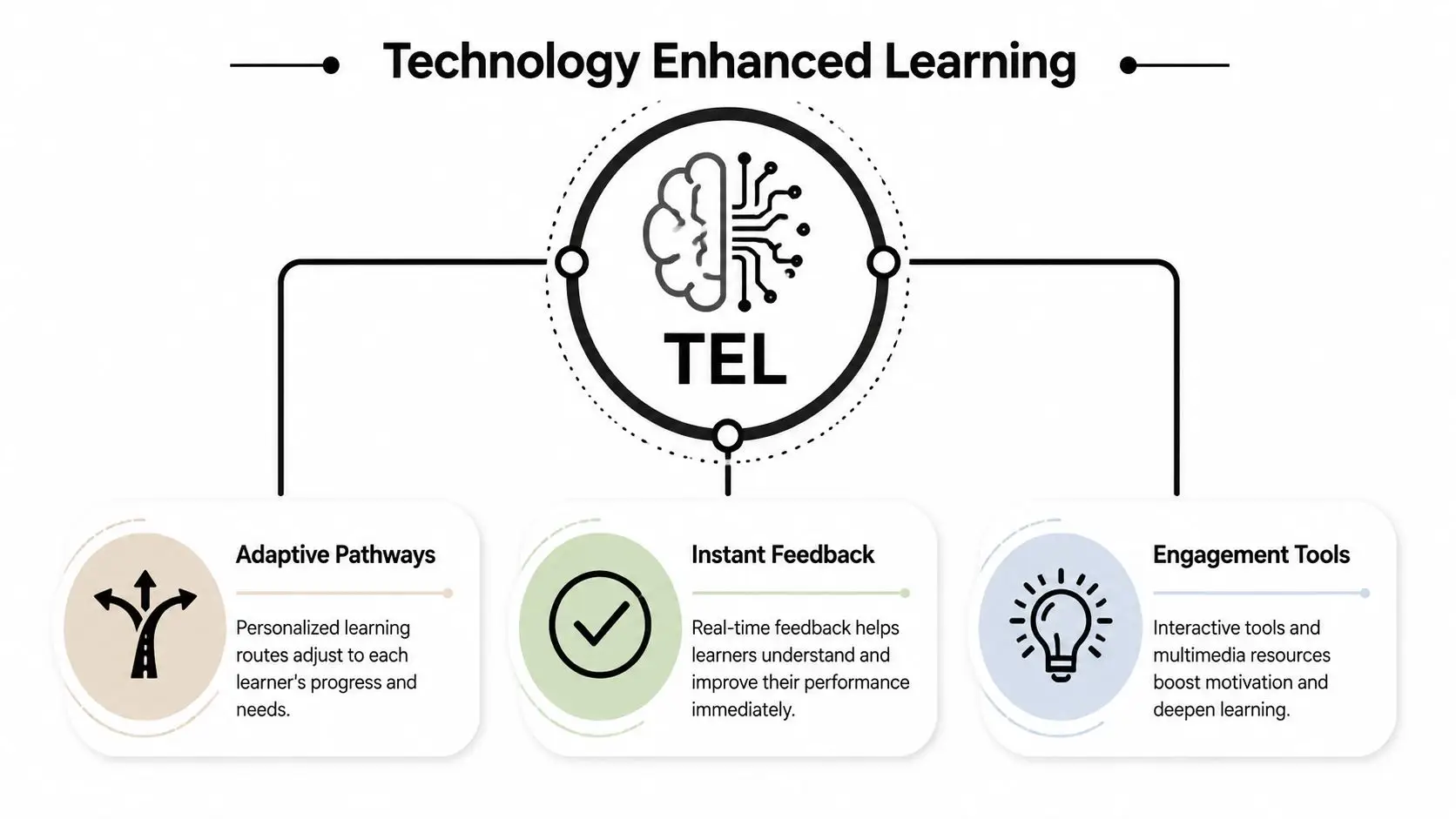
Technology enhanced learning means using digital tools with a teaching purpose, not just adding devices for appearance. A good tutor does this instinctively. They notice hesitation, slow down, repeat a step in a different way, and check understanding before moving on. TEL does the same thing, but it uses platforms, live teaching, and feedback systems to make that adjustment happen more consistently.
If you want a simple mental model, think of TEL as three layers working together. First is the live lesson, where the teacher explains, questions, and responds in real time. Second is the digital environment, where quizzes, recordings, documents, and discussion tools give the child something active to do. Third is the insight layer, where teachers use learner data to spot patterns, gaps, and progress.
The idea of how children connect new knowledge to what they already know is important here, and a useful plain-language resource is Orange Neurosciences' guide on how association shapes cognition. It's helpful because TEL works best when children can link ideas, revisit them, and practise them in different formats, not just receive information once.
If you'd like a broader picture of the platform side, what a virtual learning environment is can make the structure easier to picture. That's the space where lessons, tasks, feedback, and resources live together instead of sitting in separate places.
What the tools actually do
A learning management system holds the lesson materials, assignment deadlines, and feedback in one place. An adaptive platform changes the next task based on how the child performed on the last one. Analytics dashboards help the teacher see who needs support, who is ready for stretch work, and who has fallen behind.
That's very different from uploading a worksheet as a PDF and calling it online learning. Real TEL is interactive, responsive, and tied to teaching decisions. It can include text-to-speech, captioning, pause-and-replay controls, and structured practice, which makes the learning environment more usable for different children without lowering the academic bar.
A good TEL setup doesn't ask the child to become “more online”. It asks the school to become more attentive.
The biggest mistake parents make is assuming all digital provision is the same. A school can use devices and still teach in a static, one-size-fits-all way. TEL only becomes meaningful when the technology changes how the child learns, practises, and receives support.
Research-Backed Benefits for Your Child
Parents deserve evidence, not slogans. The strongest case for TEL is not that children spend more time on screens, it is that digital tools can make teaching more responsive when they are used well. A UK government evidence review found that digital technology works best when it sits inside teaching, rather than being added on as a separate extra, and that the effect on attainment is typically small to moderate across studies (UK government evidence review). That matters because it shows where the benefit comes from. The teaching design matters more than the device.
One clear advantage is immediate feedback. In a GCSE-style maths or science task, a digital quiz can reveal a misconception the moment a child makes it, instead of days later after marking. The teacher can then reteach while the mistake is still fresh, rather than waiting until confusion settles into a gap. For pupils with additional needs, the same review notes that technology can help when it adjusts pace, presentation, or practice opportunities, and that flexibility is often what makes the difference between guessing and understanding (UK government evidence review).
A second benefit is deeper understanding through structured digital activity. A 2024 meta-analysis of 39 experimental and quasi-experimental studies found that technology-enhanced learning spaces are associated with improved learning outcomes, which gives more weight than vague claims about engagement (Taylor & Francis meta-analysis). In a secondary science lesson, for example, a pupil can change variables in an interactive simulation and see the effect straight away. That turns an abstract idea into something they can test, compare, and remember.
A third benefit is better support for children who need different access routes. The evidence review covering digital learning and special educational needs reports that educational technologies have increased achievement in preschool through high school for both regular and special-needs students, and that computer simulations produced significantly higher recall and problem-solving performance for learning-disabled students than traditional instruction in the cited studies (special needs evidence review). That does not mean technology solves everything. It does mean the right tools can widen access in a real, practical way.
For parents comparing programmes, data-driven education is the phrase worth asking about, because progress tracking only helps when it leads to action. A dashboard is of little use if nobody changes what happens in the next lesson.
A Year 8 pupil revising GCSE science through an interactive simulation is not just clicking around for fun. They are testing a hypothesis, watching the outcome, and building a stronger mental model because the feedback is immediate. That is the difference between passive content and genuine technology enhanced learning.
TEL Tools in a Live British Curriculum
A strong TEL lesson doesn't feel like “computer time”. It feels like a teacher doing very careful work with the right tools. In a live Shakespeare class, for example, a teacher might use breakout rooms so pupils can test a line together, then bring them back to annotate key phrases on the shared text. The technology isn't the point, it gives quieter pupils a safer route into discussion.
That same logic applies to maths in Key Stage 2. A Year 6 child who keeps mixing up fractions can work through an adaptive platform that notices the error pattern and offers targeted practice instead of another generic worksheet. The teacher then uses that information to plan the next live explanation. The child gets help at the exact point of confusion, which is much kinder than waiting until the end of term.
How different stages use different tools
GCSE and A-Level learners usually need more independence, but they still need structure. In science, a pupil might revisit a simulation after the live lesson, then use short retrieval quizzes to check what they remember. In English, they might work on collaborative annotation so they can see how evidence and interpretation are built step by step.
Analytics dashboards matter here too, especially when a student is disengaging. A child may look fine on camera and still be missing deadlines, rushing quizzes, or dropping off in the final minutes of a lesson. Teachers who read those signals early can intervene before the child starts believing they're “bad at school”.
The best digital lesson doesn't replace the teacher's judgement. It makes that judgement easier to act on sooner.
This is also where live British curriculum delivery becomes important. Families need to know that the subject content still maps to the right stage, whether that's Key Stage 2, GCSE, or A-Level. Technology serves that curriculum path, it doesn't rewrite it. That's why the same platform can support a younger child who needs more visual scaffolding and an older student who needs exam practice and sharper feedback.
The test is whether the tools make the lesson clearer, calmer, and more usable for the child in front of the teacher. If they do, TEL becomes a practical part of curriculum delivery rather than a decorative extra.
How to Evaluate TEL in an Online School
Parents often ask the wrong first question. They ask whether a school “uses technology”, when the better question is whether that technology changes the learning experience in a meaningful way. A school can have polished platforms and still offer shallow teaching. It can also have a simpler setup and still deliver thoughtful TEL if the pedagogy is strong.
Start with the teaching process. Ask how live lessons, independent work, and feedback fit together. Then ask what the school does with learner data. If teachers use analytics to personalise pacing or spot gaps early, that's a sign the system is working for the child rather than just storing information about them.
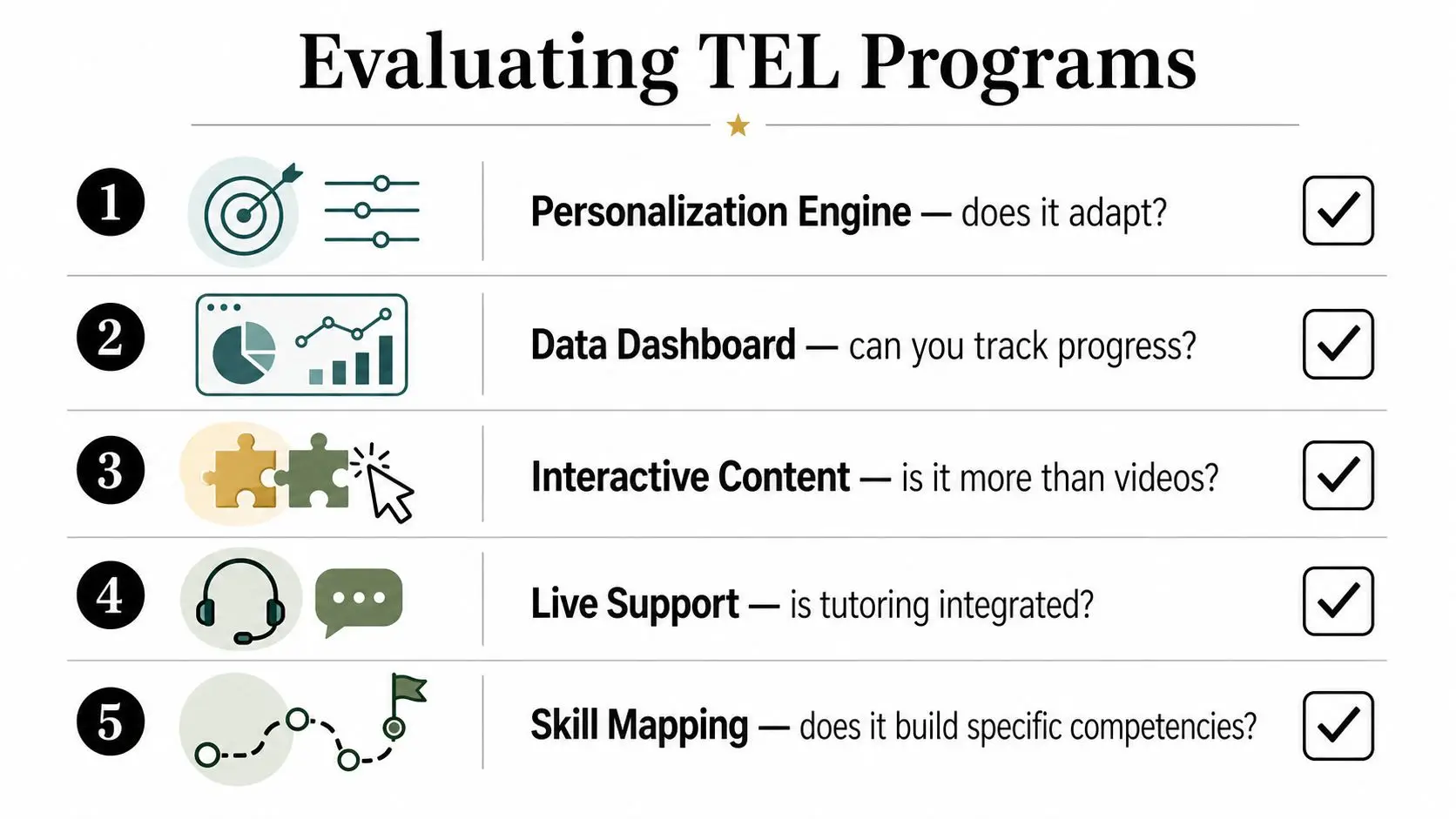
A few questions help you separate substance from presentation:
- Does the school adapt learning? Look for references to personalised pathways, differentiated tasks, or responsive teaching.
- Can you see progress clearly? A parent portal or dashboard should show more than attendance.
- Is the content interactive? Videos alone aren't enough if the child never practises, responds, or gets feedback.
- Are live teachers central? TEL should strengthen human teaching, not hide it.
- Are accessibility features built in? Captions, recordings, and readable interfaces should be standard, not special requests.
If you're speaking to admissions staff, ask what training teachers receive in digital pedagogy. A platform is only as good as the adults using it. Also ask how they support children who need calm, repetition, or alternative ways to respond, because accessibility works best when it's built in from the start.
For families exploring structured online British schooling, Queens Online School is one example of a provider that offers live interactive classes, recorded lessons, personalised learning paths, and real-time feedback within a British curriculum setting. That kind of combination is what you want to hear described clearly, because it shows how the technology and the teaching are meant to work together.
Supporting SEN and SEMH Learners Through Technology
For many SEN and SEMH learners, the actual gift of TEL is not convenience, it's relief. A child who gets overwhelmed by pace, noise, or social pressure can often access the same curriculum more successfully when the presentation is steadier and the expectations are clearer. Recorded lessons with pause-and-replay controls let them revisit a difficult explanation privately, which can reduce anxiety without reducing challenge.
That matters for children who need a different route in. A pupil with dyslexia may benefit from text-to-speech, chunked instructions, or the ability to hear a passage while seeing the text. A pupil with SEMH needs may do better when they can attempt low-stakes digital practice first, then move into a live discussion once confidence has grown. The key point is that support changes the route, not the standard.
Families often worry that online schooling will feel isolating for a child with additional needs. In practice, small live classes can be far more reassuring than a crowded room, especially when the teacher knows the child by name and can respond quickly. The child still belongs to a group, but the group is structured enough that they don't have to fight for every moment of attention.
If you're also navigating wider support around neurodivergence or emotional regulation, a resource like autism counselling in Kelowna can be useful in showing how specialist support and learning support often need to work alongside one another, even though each family's route will look different.
Inclusion works best when the child can keep the same ambition as everyone else, while the method flexes around their needs.
TEL can be powerful without fanfare. It doesn't lower the bar. It gives the child more stable ground to reach it. For a young person who has started to fear school, that difference can restore both learning and self-belief.
Taking the Next Step for Your Family
If your child is thriving in a traditional classroom, TEL may be a useful supplement. If they're shrinking, avoiding schoolwork, or losing confidence, it's worth asking whether a more responsive model would help. The best next step is not a rushed decision, it's a calm look at what your child needs academically, emotionally, and socially.
Start with the basics. Notice when your child learns best, what drains them, and which supports reduce stress without removing challenge. Then ask any school you're considering how they use live teaching, feedback, recordings, and learner data to shape the week ahead. The first few weeks should feel structured, reassuring, and predictable, not overwhelming.
A productive home setup helps too. Keep the workspace simple, the routine visible, and the expectations clear. Children usually settle faster when they know where to sit, what to open, and who to ask when they're stuck.
Technology enhanced learning works best when it still feels human. The screen is only the medium. The job is helping your child feel seen, capable, and steady enough to learn well.
If you're looking for an online British school that combines live teaching, recorded access, personalised learning paths, and real-time feedback, Queens Online School is worth a closer look. It's built around the same child-centred principles discussed here, with support for families who want structure, flexibility, and academic continuity. Visit Queens Online School to explore whether its approach fits your child's needs.