

Three weeks before GCSE results, a family in Cambridge spreads open-day printouts across the kitchen table and finds they're arguing about the wrong thing. One parent is ranking schools by headline results. The other is worried about the bus. The fifteen-year-old has gone quiet, because the question in their head isn't about league tables at all. It's whether they'll cope.
That gap between what parents compare and what students fear is where post-16 decisions go wrong. Choosing a Cambridge sixth form isn't a ranking exercise. It's a matching exercise between a route, a subject set and a young person who has to walk through the door five days a week in January, when it's dark and they're tired.
Post-16 Routes Open to Cambridge Students
Picture a Year 11 pupil in Cambridge with mocks behind them and results still weeks away. Their parent asks the sensible question: which route makes sense? The honest answer starts with a correction. In England, staying in education or training until 18 isn't optional, so the decision isn't whether your child continues. It's which qualification they continue with.
Participation is high but it thins with age. At the end of 2024, 92.2% of 16-year-olds and 85.7% of 17-year-olds were in education or training, an overall 16 to 17 participation rate of 89.0%, according to Department for Education participation statistics. The dip matters, because the students who fall out between 16 and 17 are usually the ones nobody planned a route for.
The reframe that helps: stop asking which Cambridge sixth form is best, and start asking which route your child can actually finish.
Post-16 routes compared
Six routes sit in front of a Cambridge student. They differ far more in what they demand of the learner than in prestige.
| Route | Main qualification | Typical length | Best suited to |
|---|---|---|---|
| Sixth-form college, A levels | Level 3 A levels, usually three subjects in Year 13 | Two years, ages 16-18 | Students aiming at selective universities |
| School sixth form, A levels | Level 3 A levels, subject range set by the school | Two years, ages 16-18 | Students who want continuity with their current school |
| Applied general courses | Level 3 applied general qualifications | Typically two years | Students who prefer coursework and practical assessment |
| Technical courses | Level 3 technical qualifications | Typically two years | Students heading toward a specific technical career |
| Apprenticeship | Paid job with work-based training | Fixed by the apprenticeship standard and employer | Students who learn best by doing and want a wage |
| Online or blended sixth form | A levels with live teacher-led classes | Two years | Students who cannot attend in person every day |
A levels remain the largest single route, not the only one. Of the 384,575 students who completed a Level 3 qualification in 2024/25, 298,713 took A levels, 135,886 took applied general courses and 24,844 took technical-level courses, according to the 16 to 19 performance statistics. The same release shows how much institution type shapes the offer: 88.7% of students in sixth-form colleges studied an approved English qualification and 89.4% an approved maths qualification, against 36.4% and 46.2% in independent schools.
Three checks before you pick a row
- The destination. Name the degree or job your child is aiming at, even loosely. A competitive course with a compulsory subject narrows the route faster than any open-day speech.
- The learning style that has worked so far. A child who has thrived on essays and exams will likely manage A levels. One who has thrived on projects and continuous assessment usually does better on an applied general course.
- The workload your child can carry. A levels assume substantial unsupervised study between lessons. If homework already ends in tears twice a week, that's data, not laziness.
Then read the table again with those answers in mind. If a competitive degree is the goal and your child is steady under exam pressure, start visits with the sixth-form college, A levels row. If coursework deadlines have been a recurring battle, applied general deserves a proper look. If your child lights up doing rather than reading, go through the apprenticeship versus A levels comparison before you book anything else.
How Cambridge Sixth Forms Compare on Results
Government performance tables let you put a Cambridge provider beside regional and national averages on identical measures. It's the closest thing to a fair comparison the published data allows. The figures below are the 2025 results for Cardiff Sixth Form College, Cambridge, drawn from the 16 to 18 performance tables.
| Measure | Cardiff Sixth Form College, Cambridge | Cambridgeshire state-funded | All English schools and colleges |
|---|---|---|---|
| Average A-level result | Grade A (48.93 points) | Grade B- (37.39 points) | Grade B- (36.10 points) |
| Students achieving AAB or higher, including two facilitating subjects | 81.1% (37 students in measure) | 22.9% | 17.5% |
| Students achieving advanced-level maths | 100.0% | 34.7% | 30.0% |
What a points score actually tells you
A points score turns each grade into a number so a whole cohort can be averaged. That's all it does. The college's average A-level result was grade A, equivalent to 48.93 points, against grade B-, 37.39 points across Cambridgeshire state-funded schools and colleges and grade B-, 36.10 points across all English schools and colleges. An average describes a cohort. It doesn't describe your child, who will either thrive in that room or won't.
The measure that matters for selective universities
81.1% of the college's students reached AAB or higher, including at least two facilitating subjects, with 37 learners in the measure. The corresponding figures were 22.9% in Cambridgeshire state-funded institutions and 17.5% nationally. Facilitating subjects are the academic ones selective courses have traditionally asked for, such as maths, sciences, history, geography and languages. The gap between 81.1% and 17.5% tells the story: a school can post respectable average grades and still send very few students into that top band.
Subject-level checks beat headlines
Advanced-level maths is the clearest illustration. 100.0% of the college's students achieved an advanced-level maths qualification, against 34.7% in Cambridgeshire state-funded schools and colleges and 30.0% across England. A figure of 100% on a small cohort tells you as much about who was entered for the qualification as about teaching quality. And the cohort is small: 53 students completed at least one A level or AS level in 2025.
Read all of it with the right caveat. This is one Cambridge provider in the published data, not a verdict on every sixth form in the city, and the city contains state sixth forms, school sixth forms, independent colleges and online providers whose intakes differ enormously.
For any school you're seriously considering, ask for three things the headline never shows: subject-level grade distributions, retention between Year 12 and Year 13, and value-added measures that compare results against prior attainment. A provider that can't produce them is telling you something too.
Choosing A-Level Subjects That Keep Degrees Open
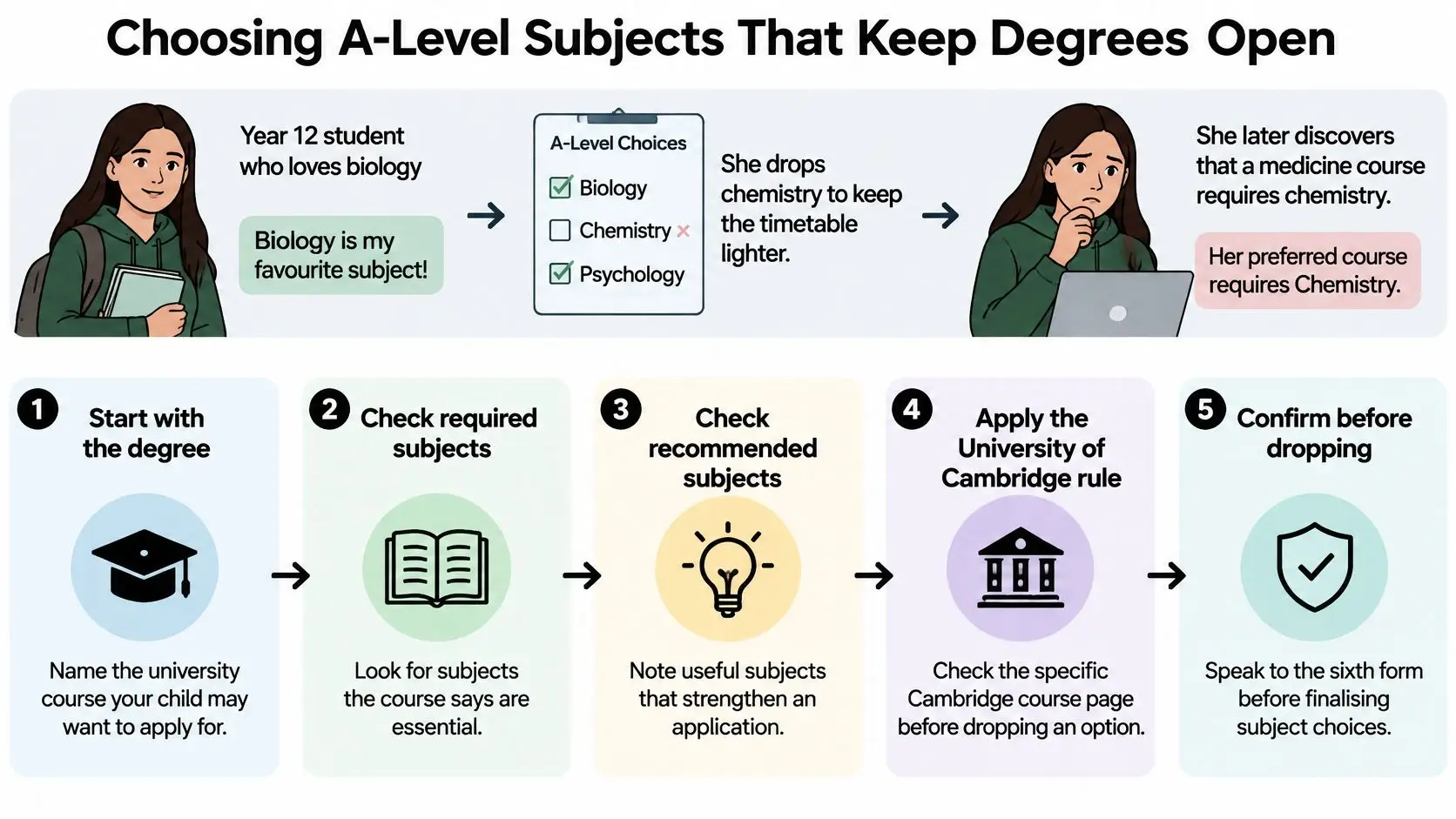
A Year 12 student who has always loved biology decides in September to drop chemistry because the timetable feels lighter without it. In November, while reading around medicine as a possible degree, they discover the subject was compulsory. Nothing about their grades was wrong. They closed a door in September without noticing.
The University of Cambridge is explicit about this. Many of its courses require particular A-level subjects, normally with an A or A in the relevant subject*, and its typical offers are based on three A levels taken together in Year 13, with a fourth A level not normally providing an admissions advantage, as set out in the University of Cambridge qualifications guidance.
That single rule changes how subject evening should feel. You're not collecting qualifications. You're protecting options.
A four-step subject check
- List three to five degree courses your child is drawn to, not the ones that sound impressive at family gatherings. Include one wildcard.
- Open each course page and find the entry requirements section. Look specifically for the words required, essential and recommended, because they're not interchangeable.
- Mark every subject as compulsory, recommended or irrelevant across all of the courses on the list. Patterns appear fast.
- Choose three A levels that satisfy every compulsory requirement and that your child can realistically reach at A or above. Three strong grades beat four mediocre ones every time.
Why depth beats quantity
Selective STEM and professionally oriented courses punish a missing subject even when overall grades are excellent. A student with AAB in the wrong combination can be ruled out of medicine, engineering or economics before an admissions tutor reads a word of their personal statement. The reverse is also true: three well-chosen A levels taken to a high standard satisfy a Cambridge-style offer without a fourth subject adding anything.
That's why the sensible conversation in Year 11 isn't about maximising the number of qualifications. It's about coherence. If you want a structured walk through the trade-offs, this guide to how to choose A level subjects covers the same logic subject by subject. Students completing A Levels or International GCSEs at Queen's Online School can apply to universities in the UK and internationally, supported by the Guidance Team through the UCAS application process, which is the kind of practical help to ask about when you compare providers.
Write the finished list down and take it to the next subject-choice meeting. Admissions staff can work with a plan. They can't work with a shrug.
Judging a Sixth Form Against Your Child's Needs
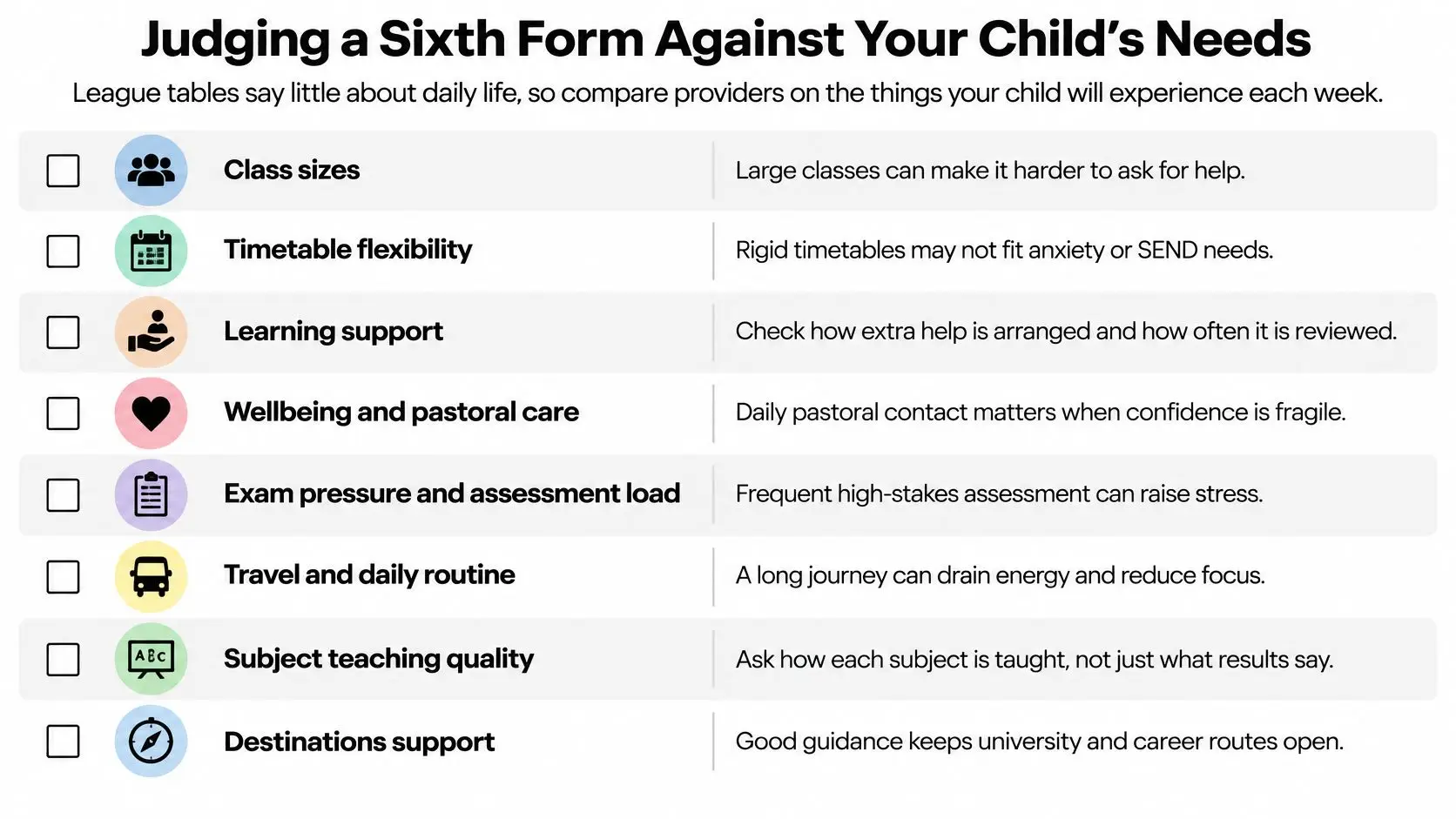
An open day tells you about corridors and coffee. It tells you almost nothing about what your child's Tuesday will feel like in February. League tables have the same blind spot: they measure outcomes for a cohort that already survived the experience, not the daily reality that decides whether your child becomes part of that cohort.
The room and the day
Class size matters because a large room makes it harder to ask for help, and the students who most need to ask rarely do. Ask how many students share a room for this subject, not for the school overall.
Timetable flexibility is the difference between a workable week and a fragile one. Ask what happens when a lesson clashes with a hospital appointment, and whether the child can rearrange without losing the content.
Contact hours and independent study set the overall workload. Ask how many taught hours there are each week and how many unsupervised hours the course assumes, then compare that to what your child currently manages.
The support behind the classroom
Feedback rhythm tells you whether corrections arrive in time to matter. A provider that returns work after mock exams is giving you an autopsy, not a plan.
Progress tracking and the named contact answer the question every parent eventually asks: who notices first if attendance slips? Get a name and a job title.
Learning support and pastoral care need a process, not a promise. Ask how extra help is arranged, how often it's reviewed, and whether the review includes your child.
The route out
Subject range and switching decide whether a change of heart in October becomes a crisis. Ask how many students change subjects after the first term, and whether that's routine or exceptional.
Destinations support covers UCAS guidance, careers advice and work experience. For a student aiming at a competitive course, the school earns its keep here.
One parent I'd want beside you on the visit is the one who notices students sitting in silent study rooms for long stretches. She asks the question others miss: how does a stuck student get unstuck at 11am on a Tuesday?
- If my child falls behind in week three, who is told, and how quickly?
- What does a week of work look like in this subject, hour by hour?
- Can we book a taster day or a trial lesson before we decide?
Then check two practical gates. Find the provider's published minimum GCSE grades for entry to A level, because a child who scrapes in may struggle to stay. And ask whether subjects can be changed after the first term, since a locked timetable turns a small misjudgement into two wasted years.
Here's a short video walkthrough of what to look at on a visit.
Score each provider from one to five against these eight criteria, write the scores down the same evening, and treat any two or below as a question to put in writing before you accept a place. A weak score isn't a rejection. It's information you'd rather have in March than in November.
Support for Anxious and SEND Learners at Sixth Form
Strong results and impressive university destinations do not prove that a sixth form suits every academically able learner. A rigid timetable, a class of thirty and a calendar of high-stakes assessments can dismantle a student whose real barrier is attendance, emotional regulation or executive functioning. The child who needs the most careful placement is often the one who looks, on paper, like a straightforward high achiever.

The national numbers show how much this transition costs. Only 69% of students identified with social, emotional and mental health needs continue into post-16 education, compared with 86% of students with autism, according to Nuffield Foundation research on the post-16 transition for students with SEND. The attainment gap is just as blunt: in 16 to 19 education, learners with an Education, Health and Care Plan were 6.8 grades behind their peers, while those receiving SEN support were 3.5 grades behind.
The same body of evidence describes post-16 SEND provision as mixed, with barriers that will sound familiar to any parent who has fought for support: large classes, too few specialist staff, funding constraints and inflexible curricula. None of those are fixed by choosing a school with better headline grades.
What success looks like: attendance that holds, confidence that recovers after a bad week, and progress you can point to. Enrolment on its own proves nothing.
What a genuinely inclusive transition looks like
- A phased start. Ask whether your child can begin with a reduced timetable and build up, rather than arriving full-time in week one.
- Recorded lessons. If a session is missed through illness or anxiety, recordings keep the subject continuous instead of turning one absence into a fortnight of catching up.
- Exam access arrangements on a timeline. Extra time, a separate room or a reader has to be requested and evidenced well before the exams, and it's worth talking to your child early about managing exam stress before test day so support isn't only logistical.
- A named pastoral contact. One adult who knows the child's plan and answers within a day.
- A missed-work plan. Not "catch up", but a specific process for what gets dropped, what gets prioritised and who decides.
- The child's own voice in reviews. Adults guessing what a teenager can manage is how placements fail.
Take a concrete case. A student with ADHD starts Year 12 well, then attendance drops through October as coursework piles up. The family shouldn't wait for a parents' evening. They should request a review within two weeks, ask what has changed in the workload, and agree one adjustment at a time. Providers that respond to that request quickly are the ones worth choosing. Providers that treat it as a discipline issue are telling you what the next two years will look like.
Cost, Distance and Online Alternatives Compared
A family in a village outside Cambridge works out that the journey to a city sixth form takes nearly an hour each way. Their anxious child manages September, then starts missing the first lesson of the day, then the whole morning. Nobody made a bad choice about teaching quality. The choice was never tested against the child's ability to get there.
Free tuition isn't zero cost. Students still fund transport, equipment, trips and enrichment, and transport problems, poverty, mental health difficulties, paid work and caring responsibilities are all documented barriers to post-16 attendance, as the Children's Commissioner's work on young people missing from learning sets out. Ask about bursary eligibility in the first conversation, not after an offer.
| Option | Main costs | Attendance demand | Check before enrolling |
|---|---|---|---|
| Local sixth-form college | Transport, equipment and trip costs | Five days in person | Bus times and bursary eligibility |
| School sixth form | Transport if the school is not local, equipment | Five days in person | Admissions rules for pupils joining from other schools |
| Independent sixth form | Tuition fees, transport and equipment | Five days in person | Published fee schedule and bursary policy |
| Online or blended sixth form | Tuition fees, equipment and exam centre travel | Live sessions, partly remote | Exam centre location, recording policy and missed-session process |
Where online and blended study actually helps
Flexible delivery can keep a subject continuous for a child who cannot attend in person every day. That only holds if three things are in place: live teacher interaction rather than videos alone, qualifications that universities recognise, and pastoral support with a real person behind it.
Exam logistics need checking before anything else. GCSE, International GCSE and A Level exams are sat at approved exam centres rather than at home, in line with UK examination board requirements, so ask where the nearest centre is and who books it. We are a Pearson Edexcel Approved Centre and a registered UCAS centre, and that kind of status is worth verifying in any provider you compare. If you're weighing up a fully online route, this overview of A level online courses in the UK explains how the structure works in practice.
Practical rule: a long commute is an academic issue, not a lifestyle one. If the journey eats two hours and drains the energy your child needs for revision, the school's results stop being relevant.
Three questions will separate the options quickly. What happens to a missed live session, and how soon is it available? Are lessons recorded, and for how long? And where will exams be sat, with what travel attached? The answers tell you more about the next two years than any prospectus.
Confirm Your Child's Route Before Applying
Decisions beat comparisons. Before the next deadline, aim to leave with a route, a subject set and one booked first step, rather than another shortlist.
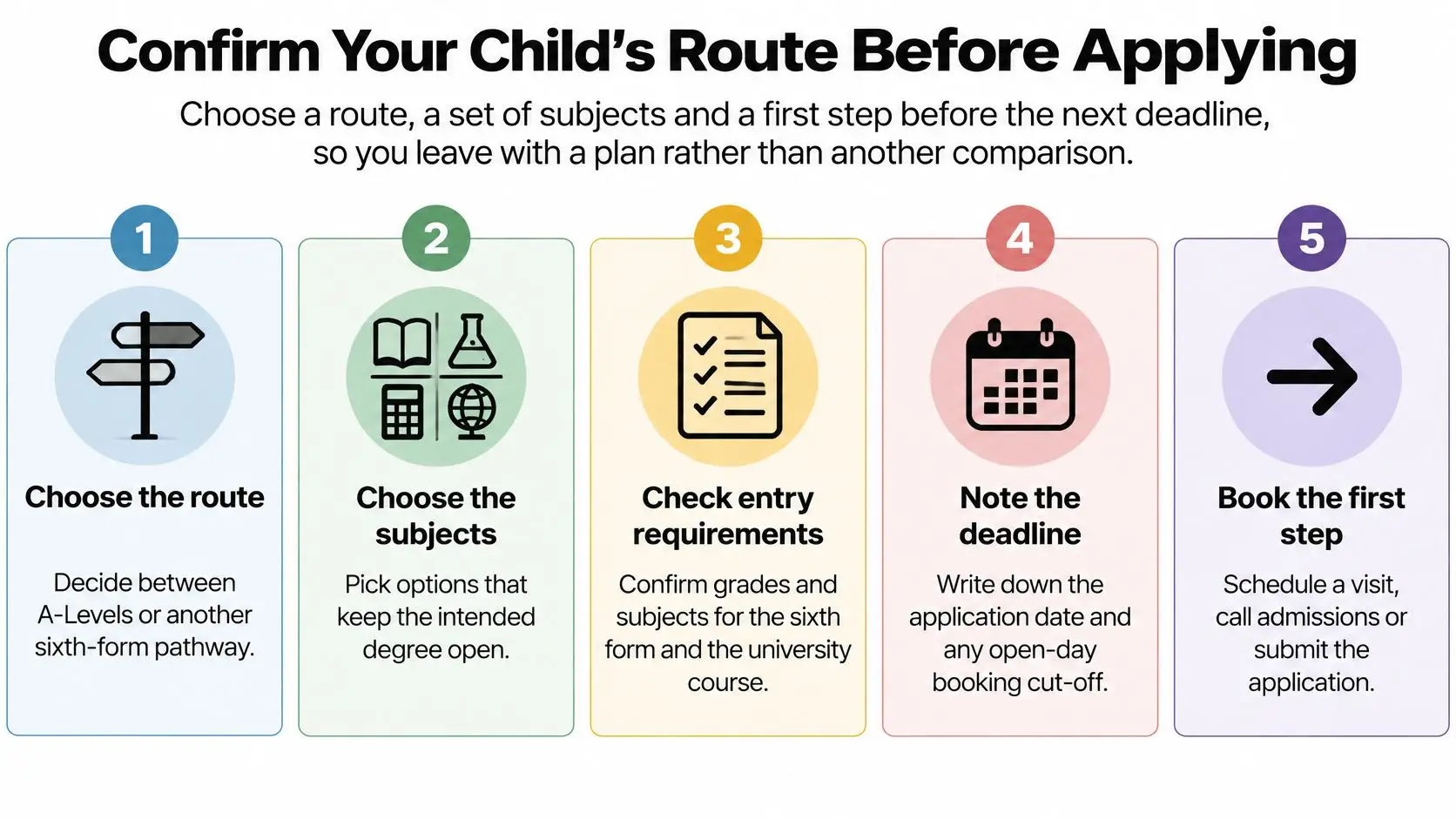
- Choose the route from the table above, based on destination, learning style and workload.
- Map the target degrees to subject rules, and write down which subjects are compulsory.
- Score two or three providers against the eight criteria, using the SEND questions where they apply.
- Book a taster day or trial lesson so your child, not just you, experiences a normal week.
- Book a discovery call and take your written plan to it.
That call should cover your child's strengths, needs, pace and goals, not just availability. Queen's Online School is one option for families weighing live online study: it offers GCSE, International GCSE and A Level qualifications, its Sixth Form covers Key Stage 5 for ages 16 to 18 in English Literature, Biology, Chemistry and Physics, and after the discovery call it designs a customised learning pathway covering subjects, pace and schedule. Confirm that the subjects your child needs are on offer before you commit.
The principle underneath all of it is simple. The best route isn't the most selective one, or the closest one, or the one a neighbour recommends. It's the one your child can attend, finish and progress from.
Choosing a sixth form is easier when you can match a route to a real child rather than to a league table. Queen's Online School teaches GCSE, International GCSE and A Level students in live, small-group classes, with recorded lessons for the days that don't go to plan, and staff who can talk through subject choices and university applications with you. If your family is weighing a Cambridge sixth form against a flexible online route, visit Queens Online School and book a conversation about what your child needs.