

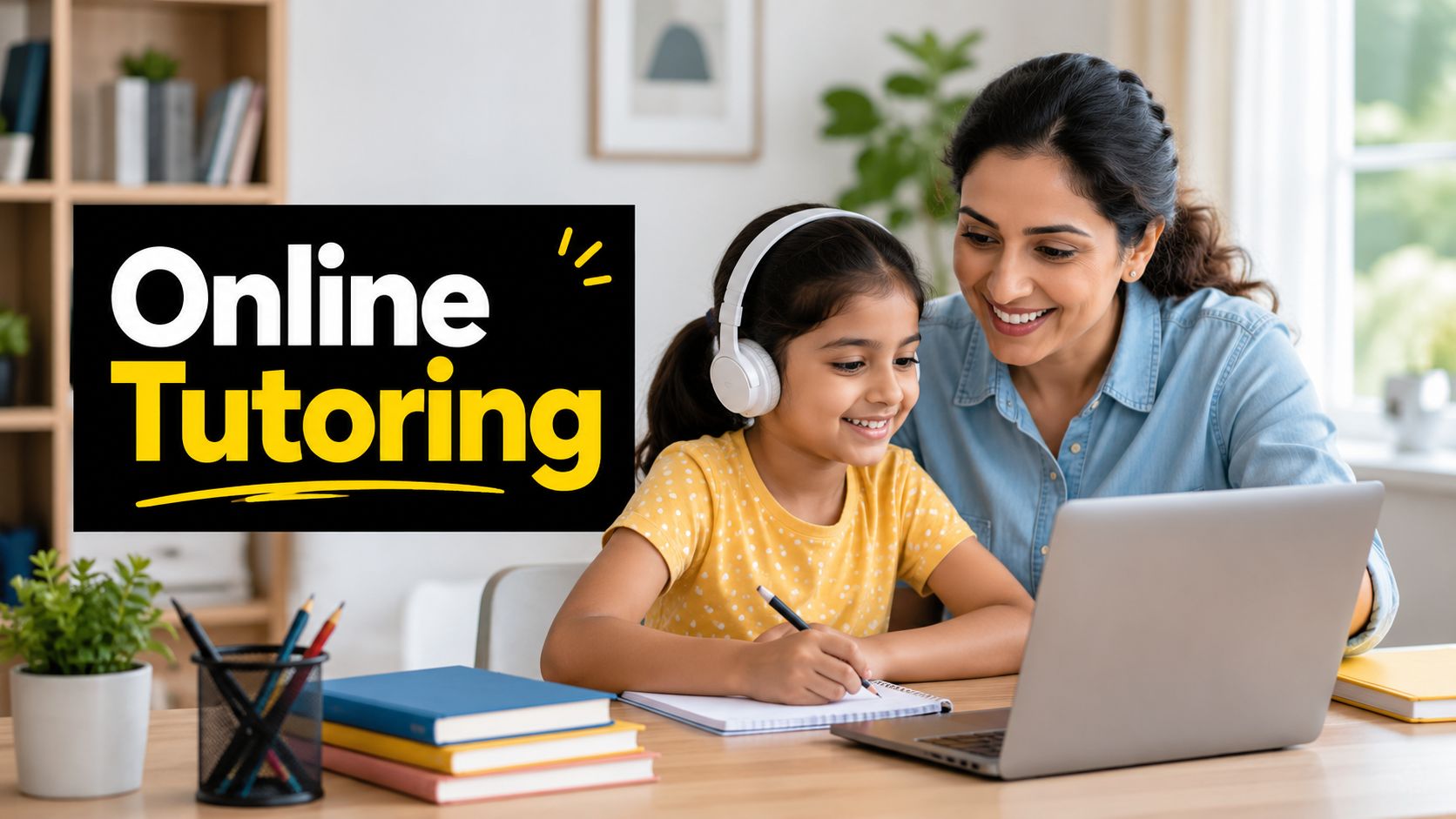
You may be reading this after a difficult parents' evening. Or after spotting another worksheet left half-finished on the kitchen table. Or because your child, who used to chatter happily about school, now says “I'm just bad at maths” or “I don't want to read out loud”.
That worry sits heavily with parents. It often brings guilt with it. Should I have noticed sooner? Am I overreacting? Would extra help make things better, or just add more pressure?
If that's where you are, take a breath. Looking into online primary school tutoring isn't a sign that something has gone wrong. It's often a careful, loving response to a child who needs a bit more time, a different explanation, or a calmer space to learn.
Is This the Right Path for Your Child?
A mother I once spoke to described her son as “still trying, but not believing”. That phrase has stayed with me. Many primary children don't suddenly stop learning. They slowly lose confidence. They begin to expect confusion. They hesitate before answering, rush through work to escape it, or become upset over things they once managed well.
That's often the moment parents start exploring tutoring.

For one child, the need might be obvious. A dip in spelling, shaky reading fluency, tears over times tables. For another, it's more subtle. They're coping in class, but the spark has gone. They've become cautious. They no longer put their hand up. They say “I can't” before they've even started.
Online tutoring can help, but only when the question isn't just “How do I raise attainment?” The better question is, “What does my child need in order to feel safe enough, focused enough, and encouraged enough to learn?”
Signs that extra support may help
Some children benefit from online tutoring when they:
- Need slower pacing: They understand eventually, but classroom lessons move on before they're ready.
- Avoid certain subjects: They may love school generally, yet dread one area such as reading aloud or number work.
- Respond better one to one: A quieter child may show much more of themselves with one trusted adult than in a busy class.
- Need challenge as well as support: A child who is ahead academically can also disengage if work feels repetitive. Parents in that position sometimes look at resources on how to prepare for 1st grade gifted tests because they want to understand whether their child needs extension rather than catch-up.
A child doesn't need to be failing before they deserve support.
What success often looks like first
Parents sometimes expect tutoring to show up quickly as better marks. Sometimes it does. But with younger children, the first signs are often emotional.
You may notice:
- Less resistance: Homework no longer ends in a battle.
- More willingness: Your child has a go before asking for help.
- Small bursts of pride: “I did that myself.”
- Renewed curiosity: They start asking questions again.
That's worth paying attention to. In primary education, confidence and learning are closely linked. A child who feels capable is much more likely to engage, persist, and recover from mistakes.
Understanding Online Primary Tutoring
Parents often hear the phrase online primary school tutoring and picture a child staring at a screen while an adult talks at them. Good tutoring shouldn't look like that.
A more useful comparison is sports coaching. Different children need different kinds of practice.
Three common formats
One-to-one tutoring is like a personal coach. The session revolves around one child's needs, pace, mistakes, and strengths. If your daughter freezes when she sees fractions, the tutor can stop immediately, reteach in a different way, and check understanding before moving on.
Small-group tutoring is more like focused team practice. Children learn alongside a few peers, often with shared tasks and discussion. The Education Endowment Foundation's tutoring guidance describes small-group tutoring as typically involving 2 to 5 pupils, with effective programmes usually delivered 3 times per week for around 30 minutes per session, and the same evidence base reports an average impact of about 4 months of additional progress when tutoring is well aligned with classroom teaching (Education evidence summarised here).
On-demand or recorded learning is closer to a library of training videos. It can be useful for revision or extra practice, but it isn't the same as live teaching. Most primary-age children need interaction, encouragement, and quick correction. They rarely learn best by being left to work through content alone.

What “live and interactive” should actually mean
A proper live lesson is more than a video call. In a strong primary session, the tutor and child should be doing things together.
That might include:
- A shared whiteboard: The tutor writes, highlights, circles errors, and invites the child to join in.
- Immediate feedback: The child answers, the tutor responds straight away, and misconceptions are caught early.
- Visual prompts: Number lines, picture cues, sentence starters, phonics prompts, and worked examples.
- Short, varied tasks: Young children stay engaged better when the lesson changes pace.
Practical rule: If a provider's “online lesson” sounds mostly like watching, listening, or clicking through tasks alone, it probably isn't enough for many primary pupils.
There's also a useful distinction between live teaching and independent study. If you're weighing up models that involve recorded work or flexible access, this explanation of asynchronous learning can help clarify what children can realistically manage by themselves at primary age.
Why tutoring now feels more familiar to schools and families
Tutoring is no longer seen only as private extra coaching. In England, the National Tutoring Programme began in 2020, and by October 2023 it had supported more than 4 million tutoring courses for pupils in state-funded schools, helping normalise both small-group and one-to-one support in subjects such as maths and English (National Tutoring Programme context).
That matters because many parents no longer have to wonder whether tutoring is a strange or excessive step. It has become a recognised way of helping children catch up, rebuild understanding, and regain confidence.
The Real Benefits and Potential Limitations
Online tutoring can be a very good fit for a primary child. It can also be the wrong fit if the setup, timing, or expectations don't match that child's stage of development.
Parents deserve honesty about both.
What often helps children most
The biggest benefit isn't always academic content. It's the feeling of being noticed.
In a classroom, a child may sit with confusion for quite a while. A teacher has many children to manage. In a tutoring session, especially one to one, the adult can spot the pause, the frown, the guessed answer, or the sudden silence. That changes the experience of learning.
A child who has started to think “everyone else gets it except me” may finally have space to ask the question they've been holding in all week.
Some common benefits include:
- A safer place to make mistakes: Many primary pupils are more willing to try when they aren't performing in front of the whole class.
- Personal pacing: The tutor can stop and revisit the exact step where understanding broke down.
- Immediate correction: Errors are dealt with before they harden into habits.
- A routine of small wins: Repeated success often brings back motivation.
Where families sometimes struggle
Online tutoring sounds flexible, but it isn't effortless. For younger children, it rarely works as a “log in and leave them to it” solution.
A seven-year-old may need help getting seated, signing in, finding a pencil, muting and unmuting, and staying with the task when attention drifts. Even older primary children often need someone nearby at the start and end of a session.
The challenge usually isn't willingness. It's stamina.
Some children can manage a lively half-hour online. The same child may become restless, emotional, or vague if the session runs too long.
Other practical limitations matter too:
| Concern | What it can feel like for a child |
|---|---|
| Too much screen time | Fatigue, irritability, or reduced concentration later in the day |
| No quiet space | Embarrassment, distraction, or difficulty hearing instructions |
| Weak tutor rapport | Polite compliance without real engagement |
| Overly long sessions | Fidgeting, zoning out, rushed guessing |
Attendance matters more than occasional effort
Families sometimes assume a longer weekly lesson is enough. The evidence on tutoring suggests otherwise. Research synthesised in virtual tutoring found that pupils who completed at least 20 sessions over 10 weeks made substantially larger reading gains, and it also found that smaller-group online formats underperformed one-to-one delivery when tutors struggled to keep several children engaged at once (virtual tutoring attendance and dosage findings).
That tells us something important. Consistency matters. Shorter, regular sessions often work better than sporadic marathon ones.
The relationship is not a bonus
A child learns from a person, not a platform.
If the tutor can build trust, use humour gently, notice effort, and respond warmly when a child gets stuck, the screen becomes far less important. If that relationship never forms, even polished technology won't do much.
So when parents ask, “Does online tutoring work?” my answer is usually, “It can, if the child feels known, the sessions are well pitched, and the family can support the routine.”
How Personalised Learning Actually Works Online
The word personalised gets used far too loosely. In practice, it should mean that a tutor changes the teaching, not just the worksheet.

A strong online tutor notices what a child understands, what they avoid, how long they can sustain effort, and what kind of feedback helps them keep going. Two children of the same age may need completely different sessions, even when they're both “behind” in the same subject.
Sophie and the child who freezes in maths
Sophie loves stories. She speaks vividly, writes imaginative ideas, and reads with expression. But when fractions appear, she becomes tense. She stares, guesses, then says she doesn't know.
A personalised online tutor wouldn't just present another fractions worksheet. They might:
- Start with talk, not symbols: “If we cut a pizza into equal pieces, what would fair sharing look like?”
- Use visual tools on screen: Shapes, bars, shaded parts, and drag-and-drop pieces.
- Break the task into tiny steps: One idea, one check, one success at a time.
- Give immediate reassurance: “You've understood halves. Let's use that to find quarters.”
For Sophie, the barrier may be anxiety rather than ability. The tutor's job is to reduce threat. That means slower pacing, warm feedback, and careful sequencing.
Leo and the child who struggles to stay with the lesson
Leo is bright, curious, and energetic. He also drifts off, clicks away, fiddles constantly, and misses instructions if too much is said at once.
For Leo, personalisation looks different:
- Clear session structure: A visual plan on screen so he knows what's coming.
- Short activity cycles: Teach, do, respond, reset.
- Movement breaks: Stand up, fetch something, stretch, then return.
- Direct prompts: “Tell me the first step.” “Circle the clue word.” “Read just this line.”
That's where adaptive teaching matters more than fancy software. Some families find it helpful to understand the broader idea through this explanation of adaptive learning, but the heart of it is simple. The tutor changes the route so the child can succeed.
After you've seen a good session modelled, this kind of lesson flow makes much more sense:
Personalisation for children with SEN and SEMH
For some pupils, the online setting can reduce pressure. A child may feel safer learning from home, with familiar sensory surroundings, fewer social demands, and the ability to use tools discreetly.
But this only works when the teaching is properly adapted. For pupils with additional needs such as SEN and SEMH, reports noted by Ofsted stress that online learning is less effective when provision isn't closely matched to the child's age, stage, and specific needs, rather than being treated as a simple replacement for classroom teaching (adaptation matters for SEND learners).
That could mean:
- Extra processing time
- Reduced visual clutter on screen
- Predictable routines
- Alternative ways to respond
- Close liaison with parents
If your child has a physical or communication need alongside learning support needs, resources such as AIDictation insights on AT and CP can also help parents think more clearly about assistive technology and access.
Good personalisation doesn't ask a child to fit the lesson. It reshapes the lesson around the child.
What parents should listen for after a session
The most revealing feedback from a primary child is rarely technical. They won't say, “The pedagogy was well differentiated.”
They'll say things like:
- “She explained it better.”
- “He waited for me.”
- “I wasn't scared to get it wrong.”
- “Can I do it again next week?”
That's often how you know the tutoring is meeting the child, not just covering the content.
Tutoring vs Full-Time Online School
It is 6pm on a Tuesday. Your child has managed a full day at school, but homework ends in tears because reading still feels hard. In that case, an hour of tutoring may help. A full-time online school is a much bigger change. It reshapes the whole week, the home routine, and the kind of support a young child needs from the adults around them.

The clearest difference
Tutoring usually supports a child alongside their current school. It is often used for one subject, one gap, or one confidence wobble.
Full-time online school replaces the child's usual school setting. That means the screen is no longer just a place for extra help. It becomes the main classroom, which asks far more of a primary-aged child's stamina, independence, and emotional readiness.
For younger children, that distinction matters more than many parents first expect. A child may cope well with a lively 45-minute session with a warm tutor and still struggle with several hours of online learning across a full week.
A side-by-side view
| Question parents ask | Online tutoring | Full-time online school |
|---|---|---|
| What is it for? | Targeted help, practice, extension, or rebuilding confidence in a specific area | Full primary education across subjects |
| How much time does it take? | Usually one or a few short sessions each week | A regular school week with a planned timetable |
| What does the child need emotionally? | Enough energy and focus for short, supported sessions | Greater resilience, screen tolerance, and comfort learning online most days |
| What is the parent's role? | Setting up the session, staying nearby if needed, and helping the child follow through afterwards | Supervising routines, supporting attention, troubleshooting practical issues, and often staying more involved day to day |
| What about social life? | Usually limited to the tutor relationship, unless group sessions are included | Wider peer contact if the provider offers live classes, clubs, and community |
When tutoring is often the better fit
Tutoring usually makes sense when the main problem is narrow and the child still has enough in the tank for school.
That might look like a child who is happy in class but has fallen behind in phonics. Or a pupil who understands maths in school but freezes when working alone at home. Or a bright learner who needs more challenge than the classroom can easily provide.
In those cases, tutoring works like a well-placed support beam. It strengthens one weak point without rebuilding the whole house.
It can also be the gentler option emotionally. A child who is already tired, worried, or easily overloaded may cope far better with one trusted adult and a predictable weekly slot than with a complete change of school model.
When full-time online school starts to make sense
Families usually consider full-time online school when the issue goes beyond one subject or one difficult term. The child may be struggling with attendance, health, anxiety linked to the school environment, frequent relocation, or a broader mismatch with local schooling.
At that point, academic provision is only part of the decision. Parents also need to ask practical questions about attention span, supervision, movement breaks, friendships, and how the day will feel for the child at home. Primary children rarely thrive online merely because the curriculum is available. They do better when the adults have a realistic routine and the child feels safe, known, and well-supported.
Daily structure becomes especially important here. Some families find planning tools such as Everblog for managing homeschool routines helpful because home learning runs more smoothly when children know what happens next.
A good test for decision-making
A useful question is this: does my child need extra teaching, or a different school experience?
If they need extra teaching, tutoring is often the more proportionate step.
If they need a different school experience, full-time online education may be worth exploring, but only if the home setup, adult support, and child's temperament make that realistic. The right choice is the one your child can sustain calmly and confidently, not the one that sounds most impressive on paper.
How to Choose a Quality Online Tutor or Provider
The most persuasive website isn't always the safest or most effective choice. Parents need to look past polished branding and ask how the teaching works for a real child on a real Tuesday evening.
A quality provider should welcome careful questions. If the answers are vague, rushed, or overly sales-led, I'd be cautious.
Ask about the tutor, not just the package
Start with the person your child will meet.
Some useful questions are:
- What experience do they have with primary-age children? Teaching a seven-year-old online is very different from helping a sixth former revise.
- Do they understand child development? A good tutor knows when a child is tired, overloaded, anxious, or not following.
- Can they support specific needs? If your child has dyslexia, ADHD, speech and language needs, or SEMH challenges, ask what adaptation looks like in practice.
- How do they build rapport? This sounds soft, but it matters hugely.
Ask how they teach
Parents are often sold outcomes when they really need process.
Try questions like these:
How do you decide what to teach first?
You want to hear about assessment, observation, and careful starting points.What does a typical session look like?
Listen for variety, interaction, and age-appropriate pacing.How do you measure progress?
The best answers include examples of work, tutor notes, and regular parent feedback, not just broad reassurance.What happens if my child is reluctant or upset?
This is especially important for younger pupils and those with low confidence.
A provider who can't explain their teaching clearly probably hasn't thought carefully enough about your child's learning experience.
Ask about the technology before it becomes a problem
Platform reliability shapes the quality of the lesson. Published guidance consistently identifies poor internet connections, outdated hardware, and video-platform glitches as direct causes of lesson interruption, which can break a child's concentration and disrupt the tutor's pacing (online tutoring platform reliability guidance).
So ask practical questions:
- What device works best?
- What happens if the connection drops mid-session?
- Is there a backup plan such as reconnect instructions or an alternative contact route?
- Can the child use the platform easily without constant adult troubleshooting?
A simple parent checklist
Before you commit, see whether the provider can show all of the following:
- A clear tutor profile: Qualifications, experience, and age-group suitability.
- A child-friendly lesson model: Not just worksheets on a screen.
- Regular communication: Short updates that tell you what your child is grasping and where they still need help.
- Transparent systems: Safeguarding, cancellations, technical support, and parent contact.
- A sensible trial process: Enough to assess fit without pressure.
If I had to reduce it to one question, it would be this. Can this tutor help my child feel both supported and stretched? If the answer is yes, you're probably looking in the right place.
Essential Safeguarding and Practical Questions Answered
A parent usually knows the moment online tutoring stops feeling theoretical and becomes real. It is the point where you ask, "Will my child feel safe with this person on a screen, and will this fit into our actual evenings without tears or constant chasing?" Those are the right questions.
For primary-aged children, safeguarding and practicality sit side by side. A lesson can be academically strong and still be the wrong fit if a child feels uneasy, needs more supervision than the family can give, or struggles to build trust through a screen.
Safety first
Start with the human side, not just the paperwork. Your child needs to know who the tutor is, what will happen in the lesson, and how to get help if something feels uncomfortable. Young children learn best when the routine is clear and the adult feels predictable.
Ask direct questions about:
- How tutors are vetted
- Whether sessions are recorded or overseen
- Whether private messaging is limited
- How concerns are reported
- Who a parent contacts if something does not feel right
A good provider answers calmly and clearly. You should not have to decode vague policies or chase basic information.
How much help will my child need?
This is often the question parents underestimate. Online tutoring is not merely a face-to-face lesson moved onto a laptop. For many primary pupils, especially at the start, it works more like guided practice with a trusted adult nearby.
Some children only need help logging in, finding a pencil, and talking through the lesson afterwards. Others need an adult within earshot to keep them settled, refocus attention, or reassure them if the tutor asks a question and the silence feels too long. That is not a sign that online learning has failed. It is part of developmental readiness.
Children with additional needs often need more structure before and after the session as well as during it. If that sounds familiar, this guide to support for children with SEN in online learning can help you judge whether the setup matches your child's profile.
Is your home setup realistic?
The practical side matters because young children have a limited store of attention. If the camera will not switch on, the headphones pinch, or the lesson starts with ten minutes of adult troubleshooting, much of that energy has gone before learning begins.
Research from the Evidence for Equality National Survey highlights that some families faced concerns about internet access and suitable devices during home learning. That is a useful reminder to check the basics before you begin.
Your child does not need a perfect study. They do need:
- A reliable device
- A stable internet connection
- A quiet enough space to hear and be heard
- Simple materials ready before the lesson
The best setup feels calm and repeatable. A small corner of the kitchen can work well if the routine is settled and your child knows what to expect.
One final point matters more than many parents first realise. In primary tutoring, progress depends heavily on the relationship between tutor and child. A warm, attentive tutor can help a hesitant child speak up, stay with a task for longer, and recover after mistakes. If your child seems guarded, drained, or unusually resistant after several sessions, pay attention to that signal.
If you are comparing tutoring with a broader online model, Queens Online School is one option families may wish to consider. It offers live online lessons across the British curriculum, including primary provision, which can help parents compare targeted tutoring with a more structured full-time online school arrangement.