

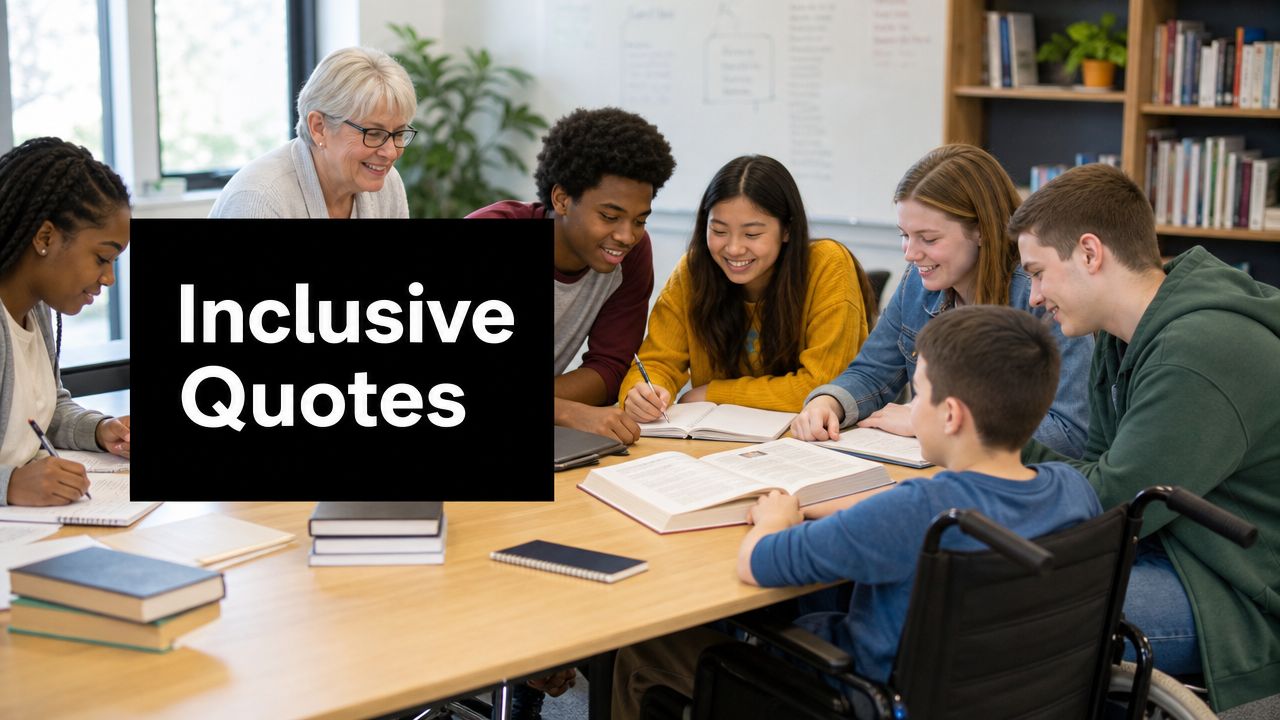
What does inclusion look like when the quote on the wall meets the child who can't face another crowded classroom, the teenager who needs extra processing time, or the family who's exhausted from explaining the same needs again and again?
That's the gap most round-ups of inclusive education quotes miss. They give you warm words, but not much help with admissions, lesson design, support plans, or the daily choices that make a child feel safe enough to learn. In England, inclusion isn't a side issue. By January 2024, there were 1.6 million pupils identified with special educational needs, representing 18.4% of all pupils. That's why families increasingly look beyond slogans and ask tougher questions. Will my child be understood? Will teaching adapt? Will support be consistent?
The strongest inclusive education quotes still matter because they give language to values that can otherwise become vague. They remind adults what school is for, especially on hard days when timetables, assessments, and behaviour policies start to overshadow the child in front of us. Used well, a quote can become a standard for decision-making, not just a poster.
This collection treats each quote that way. Not as decoration, but as a practical lens for teaching, pastoral care, and school design in a modern online setting such as Queen's Online School. If you also care about the emotional climate around learning, these mental health quotes for reflection and support sit naturally alongside the principles below.
1. Education is the most powerful weapon which you can use to change the world. – Nelson Mandela
This quote gets repeated so often that people sometimes stop hearing it. In inclusive practice, its force is simple. Education only changes the world when every child can access it.
For some families, that means finding a school where barriers are reduced before a child reaches crisis point. A pupil with autism might need predictable routines and a calmer learning environment. A learner with SEMH needs might do better when the school day doesn't begin with sensory overload, social pressure, and the fear of being misunderstood. In an online school, live teaching, structured routines, and the ability to learn from home can turn education from a daily struggle into something usable again.

What this looks like in practice
At Queen's Online School, the quote becomes meaningful when access is built into the model. Live, interactive lessons matter because students still need connection and accountability. Recorded sessions matter because not every child can process everything in one sitting, every day, at the same pace.
That's especially relevant in the UK context because the legal framework has shifted from aspiration to duty. The SEND Code of Practice was placed on a statutory footing in 2014 and applies from birth to age 25, setting out joint responsibilities and the graduated approach of assess, plan, do, review. In other words, inclusive education isn't a bonus feature. It's part of how schools are expected to operate.
Education changes lives only when access, support, and dignity are built into the daily experience of learning.
A practical use for this quote is in parent onboarding. It tells families, early, that inclusion isn't being treated as a separate department. It sits inside teaching, communication, and expectations.
- Use it in welcome packs: It helps frame support as part of the school's core purpose, not a favour.
- Return to it in review meetings: When plans need adjusting, the question becomes, “What helps this child access learning more fully?”
- Share it with students: It can help young people see support as a route to strength, not a label.
2. Every student can succeed, but not on the same day in the same way. – William G. Spady
This is one of the most useful inclusive education quotes because it gives parents language for something they already know in their bones. Their child may be capable, bright, curious, and hard-working, but still unable to thrive under one rigid timetable or one narrow way of proving understanding.
A dyslexic student might understand a text thoroughly but need text-to-speech support to access it. A teenager with anxiety might contribute brilliantly in writing, yet freeze in a fast live discussion. A pupil recovering from burnout might need to rebuild confidence through shorter tasks, clear routines, and recorded lesson access before joining everything in real time.

Personalisation without lowering the bar
The trade-off matters here. Some schools hear “different ways” and drift into lower expectations. That doesn't help children. Real inclusion keeps the goal in view and changes the route.
That's where differentiated learning in practice becomes so important. It means adjusting the method, level of scaffolding, timing, or format so that students can work towards the same meaningful outcomes with appropriate support.
A strong online model can make this visible:
- Access options: A student attends live lessons when possible, then revisits recordings to consolidate understanding.
- Response options: One learner shows knowledge through a presentation, another through structured written work, another through guided oral response.
- Pacing options: A family follows a pathway that respects health, processing speed, or emotional readiness without abandoning ambition.
Practical rule: Don't ask whether a child can do the work. Ask what conditions help them do it well.
This quote also reassures families who worry that support will make their child stand out. Good differentiation doesn't spotlight difference. It normalises it. That's one reason this philosophy works well in online education, where varied tools and modes of participation can be integrated into ordinary teaching rather than bolted on afterwards.
If you're discussing this with a reluctant reader at home, it can also help to transform reading into an adventure instead of treating every literacy task as a test of endurance.
3. Inclusion is not about fitting students into the existing system; it's about changing the system to fit the needs of all students. – Diane Ravitch
Some quotes challenge comfort, and this one does exactly that. It asks schools to stop expecting children to absorb all the strain.
That's a difficult shift because changing the system costs time, money, and professional humility. It's easier to tell a child to cope, comply, sit still, join in, and keep up. It's harder to redesign timetables, retrain staff, rethink participation, and choose technology that works for a wider range of learners from the start.
Systems matter more than goodwill
Families often know the difference immediately. A school that says it's inclusive but only offers support after a problem escalates is still organised around the system's convenience. A school designed for inclusion builds flexibility into ordinary operations.
That's the principle behind what inclusion in education means in practice. In an online environment, that can include recorded lessons for students with processing difficulties, small live classes that make participation safer, and communication routines that help parents know what support is being delivered.
A realistic example looks like this. A student with ADHD misses part of an explanation in a live lesson. In a rigid model, the child is behind. In an inclusive model, the lesson is available to revisit, instructions are clear in writing, and the teacher checks understanding before the gap widens.
What doesn't work is treating every adaptation as an exception. Children shouldn't have to earn access by first failing publicly.
- Build support into platform choices: Captions, chat functions, visual structure, and accessible resources shouldn't be afterthoughts.
- Design for re-entry: If a student has a rough week, they need a practical route back into learning.
- Reduce reliance on informal fixes: Inclusion is stronger when it sits in policy, routine, and teaching design.
This quote is especially useful in school leadership conversations because it moves the focus away from whether a child is “suitable” and towards whether the school has designed itself well.
4. The way your employees feel is exactly the way your customers feel. And if your employees don't feel valued, neither will your customers. – Sybil Evans
This isn't an education quote on the surface, but it translates powerfully. In schools, students and families can tell very quickly whether care is performative or real.
If teachers feel rushed, unsupported, and disconnected from decision-making, that pressure reaches children. Feedback becomes thinner. Communication becomes more defensive. Flexibility disappears. On the other hand, when staff are equipped to notice need, respond calmly, and teach with confidence, students experience school as safer and more human.
Belonging is felt before it's measured
For a child with SEN or SEMH needs, feeling valued often comes before academic recovery. A student who has spent months being corrected, compared, or misunderstood may not trust praise straight away. They may test boundaries, withdraw, or expect adults to give up.
That's why simple actions matter. A teacher remembers how the student prefers to contribute. A tutor notices a change in tone. The school replies to a parent's concern with clarity rather than defensiveness. A club leader makes space for a quiet child to join without pressure.
Children usually know before adults admit it whether a school values them as people or only values compliance.
At Queen's Online School, this principle shows up in small class sizes, real-time feedback, subject-specialist teaching, mindfulness work, and a culture that doesn't separate well-being from achievement. Those aren't decorative extras. They shape whether a student feels seen enough to stay engaged.
A few practices consistently help:
- Strengths-based language: Teachers should name what a child can do, not only what needs managing.
- Regular check-ins: Families need a route to discuss emotional patterns, not just grades.
- Visible belonging: Clubs, leadership opportunities, and community spaces matter for students who've felt on the edge elsewhere.
This quote is also a reminder to schools that inclusion is relational. You can't spreadsheet your way to belonging.
5. Universal Design for Learning isn't a special programme for students with disabilities; it's good teaching for everyone. – David Rose (CAST)
Some of the best inclusive education quotes remove the false divide between “support” and “quality”. This one does that cleanly. Good inclusive teaching is often just good teaching that has been planned with more foresight.
A lesson explained verbally, shown visually, and supported by written instructions helps the student with processing needs. It also helps the tired teenager, the international learner working in a second language, and the child who benefits from clarity. A recorded lesson helps the pupil with health needs. It also helps the student revising before an assessment.

Design broadly, support specifically
Universal Design for Learning works best when schools stop seeing flexibility as a specialist intervention. In practical terms, that means giving students more than one way to access content, more than one way to stay engaged, and more than one way to show what they know.
In an online school, that can include transcripts, visual modelling, structured slides, audio explanation, flexible participation in chat or voice, and assignment formats that let students demonstrate mastery without turning every task into the same kind of performance.
There is a trade-off. Broad design doesn't replace individual support. Some children still need targeted adjustments, careful pastoral planning, or specialist input. But broad design reduces unnecessary friction for everyone, which frees staff to focus on the students who need the most individualized help.
A practical pattern that works:
- Start with accessible lesson design: Clear instructions, visible steps, and mixed formats benefit the whole class.
- Layer targeted support: Add individual scaffolds where needed, rather than building every lesson around crisis response.
- Review barriers, not just outcomes: If a child isn't producing work, ask what in the design may be getting in the way.
This quote is particularly helpful when parents worry that inclusion will dilute standards. It usually does the opposite. When barriers are reduced early, students can spend more energy on thinking and learning instead of trying to cope.
6. Diversity and inclusion are not about how different we are. It's about understanding that all of us are different and being accepting of it. – Erin Thomas
Many schools are comfortable with the word “diversity” until difference becomes inconvenient. Inclusion starts where convenience ends.
A child who needs more processing time, a student who lives in another country, a teenager exploring identity, a pupil who struggles with group work, a learner who communicates more confidently in writing. These aren't edge cases to be merely contained. They are ordinary expressions of human variation.
Difference needs more than tolerance
Tolerance is a low bar. It can still leave a child feeling like a disruption. Acceptance goes further. It tells students they don't need to hide core parts of themselves to be welcome.
That matters in online education because global cohorts can widen a student's sense of normal. When children learn alongside peers from different countries, cultures, and learning profiles, the idea that there is one “right” kind of student starts to weaken. That can be profoundly relieving for young people who've spent years feeling unusual in the wrong way.
What works in practice is explicit culture-building:
- Curriculum representation: Students should encounter authors, ideas, and examples that reflect a wider human experience.
- Clear anti-discrimination standards: Neurodivergence, disability, identity, language background, and difference must be protected in everyday school life.
- Structured participation: Teachers should create ways for different personalities and communication styles to contribute meaningfully.
A useful example is classroom discussion. In a less inclusive setting, quick verbal responses become the hidden measure of intelligence. In a more inclusive one, students can prepare, use chat, reflect before speaking, or contribute afterwards in writing. The conversation often becomes richer, not weaker.
This quote is valuable because it helps adults move away from “special treatment” language. The child at the centre doesn't need to become less themselves to belong.
7. The greatest barrier to success for students with disabilities is not their disability. It is the low expectations of others. – Carol Ann Tomlinson
Low expectations are often wrapped in kindness. That's what makes them dangerous.
Adults say they don't want to put too much pressure on a child. They subtly reduce challenge, narrow options, excuse weak teaching, or steer a student away from ambitious goals before the student has had a real chance. It can sound caring. To the child, it often feels like being written off early.
High expectations with real support
This quote matters because it protects dignity. The message isn't that every child should be pushed in the same way. The message is that support should open doors, not close them.
That's especially important in the current English system. The Department for Education's 2022 SEND and Alternative Provision Green Paper says around 15% of pupils in England have special educational needs and 4.3% have an EHCP. As systems become more formalised and needs-led, schools need to show not only that support exists, but that support still leads somewhere purposeful.
At Queen's Online School, that principle is reflected in pathways towards recognised qualifications, subject-specialist teaching, and support that helps students access rigorous learning rather than being permanently sheltered from it. Families exploring SEN support in an online school context often need exactly that reassurance.
A child can need scaffolding and still deserve challenge. Those two things belong together.
A realistic example is a student with dyslexia studying a demanding subject. Inclusive practice doesn't mean reducing intellectual ambition by default. It may mean assistive technology, explicit instruction, extra processing time, and careful feedback so the student can engage with the same serious ideas in a way that's accessible.
What doesn't work is confusing comfort with belief. Children usually rise further when adults communicate, clearly and consistently, “I know this is hard, and I still believe you can do meaningful work.”
8. Be the change you wish to see in the world. – Attributed to Gandhi (Applied to Inclusive Education Leadership)
Whatever the attribution debate, the principle lands. Inclusion is shaped by what adults repeatedly do, not what they claim to value.
A school leader who talks about belonging but ignores unkindness sets one culture. A teacher who says every voice matters but only rewards the quickest speakers sets another. Parents do this too. Students watch how adults discuss difference, frustration, and support. They learn what is safe from what is modelled.
Culture is built through repeated behaviour
In a strong inclusive school, leadership shows up in routine choices. Policies are written clearly and enforced consistently. Anti-bullying language isn't reserved for assemblies. Teachers use respectful language for neurodivergence and disability. Staff respond to difficulty with curiosity before judgement.
Online schools possess both an opportunity and a responsibility. Because communication is more visible, routines can be made explicit. Expectations around chat, feedback, participation, and respect can be taught directly rather than left to social guesswork.
The pressure on the system makes this practical leadership even more important. One recent UK framing of the issue noted that the Department for Education reported 1,635,000 pupils with special educational needs in England in 2024, and 7.5% had an Education, Health and Care Plan. Families living inside that pressure don't need abstract commitments. They need schools that act.
A few leadership habits make a real difference:
- Model inclusive language: Children copy the tone adults use.
- Make safety visible: Anti-bullying and anti-discrimination expectations should be active, not buried in policy documents.
- Create student leadership routes: Inclusion becomes more credible when students themselves help shape community life.
This quote belongs in inclusive education because change doesn't begin with a campaign. It begins in the next lesson, the next email, the next meeting, and the next decision about what kind of school a child walks into.
Inclusive Education, 8-Quote Comparison
| Quote | 🔄 Implementation Complexity | ⚡ Resource Requirements | 📊 Expected Outcomes | ⭐ Ideal Use Cases | 💡 Key Advantages |
|---|---|---|---|---|---|
| "Education is the most powerful weapon…", Nelson Mandela | Low–Moderate: philosophical adoption and messaging integration | Low: communication, orientation materials, marketing | Increased awareness of inclusion and broad accessibility positioning | School vision, parent orientation, marketing to international families | Inspires stakeholders; aligns institutional mission with inclusion |
| "Every student can succeed, but not on the same day…", William G. Spady | High: requires differentiated planning and teacher skill | High: teacher training, assessment tools, tracking systems | Improved individual progress and engagement when implemented well | Small-class personalised programmes, SEN/SEMH pathways, asynchronous learning | Validates personalised pacing; supports diverse learning modalities |
| "Inclusion is not about fitting students into the existing system…", Diane Ravitch | Very High: systemic redesign and policy change | Very High: technology, staffing, ongoing evaluation | Structural accommodation, sustained access and safety | Strategic planning, platform design, whole-school inclusion reforms | Embeds inclusion institutionally rather than as add-on accommodations |
| "The way your employees feel is exactly the way your customers feel…", Sybil Evans (applied) | Moderate: culture and relationship-building work | Moderate: wellbeing programmes, staff development, community events | Higher retention, engagement, family trust and referrals | Student wellbeing programmes, onboarding, community-building activities | Strengthens belonging and student resilience; improves retention |
| "Universal Design for Learning isn't a special programme…", David Rose (CAST) | Moderate–High: upfront curriculum and lesson redesign | Moderate: content creation, PD on UDL, platform features | Broad accessibility, fewer individual accommodations needed | Curriculum design, online course development, teacher PD | Universal benefit across learners; scalable pedagogical approach |
| "Diversity and inclusion are not about how different we are…", Erin Thomas | High: sustained cultural change and practice shifts | Moderate–High: DEI training, curriculum updates, affinity groups | Increased belonging, reduced microaggressions, stronger peer cohesion | DEI initiatives, PSHE, recruitment and policy development | Moves from tokenism to asset-based inclusion; supports invisible differences |
| "The greatest barrier… is the low expectations of others.", Carol Ann Tomlinson | Moderate: mindset work and accountability systems | Moderate: PD on growth mindset, monitoring and support systems | Higher achievement for students with additional needs; reduced self-limiting beliefs | Teacher recruitment/appraisal, goal-setting, SEN support planning | Raises attainment by combining high expectations with targeted support |
| "Be the change you wish to see in the world.", (Gandhi, applied) | Low–Moderate: modelling behaviour and leadership practices | Low–Moderate: leadership time, student leadership programmes | Cultural shifts through example; empowered student advocates | Leadership training, student councils, mindfulness and PSHE | Encourages grassroots action; aligns values with everyday practice |
From Inspiration to Action. Building Your Inclusive Practice
What do inclusive education quotes change when a child is anxious, falling behind, or starting to believe school is not for them?
They give adults a standard to work against. In practice, that means testing whether values show up in timetables, lesson design, communication, and support plans. A strong quote should lead to a practical question. If we say every child belongs, how is that visible on Monday morning in registration, in feedback, in assessment, and in the way staff respond when a student is struggling?
Many schools get stuck. The language is warm, but the systems stay rigid. Families then carry the burden of chasing updates, repeating concerns, and waiting for support after a problem has already grown. Inclusive practice works better when schools identify barriers early, agree adjustments clearly, and review what is or is not helping.
For families, that means looking past polished promises and asking how inclusion operates day to day. How are needs spotted? Who reviews progress, and how often? What happens if attendance dips because of anxiety, illness, or processing difficulties? Can a student revisit recorded teaching, receive adapted tasks, or work to a paced reintegration plan? Those answers usually tell you more than a mission statement.
For educators, the challenge is keeping the child at the centre while still meeting the demands of policy, safeguarding, assessment, and workload. Inclusion is often built through ordinary decisions. A teacher gives instructions in more than one format. A form tutor notices a pattern before it becomes a crisis. A school uses effective classroom management tips that prioritise clarity, predictability, and co-regulation rather than simple compliance. Those choices protect learning time and reduce distress for the whole class.
In an online school, the trade-offs are different, but they are real. Flexibility can help a child re-engage. It also requires strong routines, reliable communication with home, and teachers who know how to maintain high expectations without overwhelming students. That balance matters. Too much rigidity shuts students out. Too little structure leaves them adrift.
Queen's Online School offers a useful example of how these ideas can be put into daily practice. It teaches the British curriculum online from Primary through Sixth Form through live lessons, recorded sessions, subject-specialist teaching, and support for students with SEN and SEMH needs. For some families, recorded access reduces panic after absence. For others, live teaching and clear routines rebuild confidence. Inclusion is not one feature. It is the combination of access, responsiveness, and academic ambition.
Quotes can inspire. Their real value is what they ask schools and families to do next.
If this article leaves you with one test, use this one. Ask whether a school can translate inclusive values into specific actions your child will feel, not just promises you will read. If you're exploring a flexible British education with personalised pathways and support for belonging and progress, Queen's Online School is worth considering.