


A parent's decision about sixth-form study rarely begins with a neat comparison chart. It usually starts after a difficult school year, with a tired teenager asking whether they can learn from home without giving up on a recognised qualification. You may be looking at online AS Level courses because your child needs a calmer environment, has demanding sporting commitments, is managing illness, or hasn't found a suitable local sixth form.
The important question isn't whether lessons happen through a screen. It's whether the course leads through a properly regulated qualification, compliant assessment and a real exam centre. That's where glossy promises about flexibility need to meet the practical details of registration, support and exam day.
What an Online AS Level Course Actually Is
Let's take a familiar example. Your child has finished Year 11 after a difficult experience at school. They're capable and still ambitious, but the idea of returning to a crowded sixth form feels overwhelming. You find an online AS Level course and wonder whether it's a genuine qualification or merely a collection of video lessons.
An AS Level is a regulated Level 3 qualification. In England, A levels sit at Level 3 within the regulated education system, alongside AS levels, T Levels, International Baccalaureate diplomas, advanced apprenticeships and comparable awards and diplomas. The UK Government's National Skills Fund policy explains why this level matters. It recognised that adults without A levels or an equivalent Level 3 qualification could access a first fully funded Level 3 course, with approximately 11 million adults in England identified as eligible and around 400 courses included in the policy.
In practical terms, the online format changes the medium of teaching, not the regulated status of the qualification. Your child may attend a live lesson from a bedroom, study from another country or watch a recorded explanation again before completing an assignment. They still need to follow the relevant specification, register correctly and complete the required assessment through an authorised route.
A useful test: Ask what qualification your child will receive, who awards it and where they will sit the examinations. If the answer focuses only on the learning platform, you haven't yet been given the whole picture.
Families choose online study for different reasons. A teenager recovering from anxiety may participate more confidently from a familiar setting. An elite athlete may need lessons that fit around training. A child with chronic illness may need to manage energy carefully. Travelling families may need continuity, while another student may have found that the local sixth-form environment is a poor fit.
The right course should protect both academic ambition and emotional safety. It should give your child regular contact with teachers, clear deadlines and a route to assessment, without pretending that flexibility means the learner can ignore structure. The rest of the decision comes down to how teaching works, how the qualification is awarded and how well the provider supports your child all the way to exam day.
How Live and Recorded Lessons Work in Practice
Online schools usually use one of two main teaching models, or a blend of both. The difference affects how much structure your child receives, how quickly they can ask for help and how much responsibility falls on the family.
In a live lesson, your child joins a timetabled class through a video platform. A subject specialist explains the topic, uses a digital whiteboard, asks questions and checks understanding through chat or discussion. Breakout rooms can help students work through a problem together. A live class might involve a teacher guiding a student through the interpretation of a biology result, then asking them to explain the reasoning rather than just copy an answer.
A recorded lesson gives the learner more control over timing. They watch a prepared lecture, pause difficult sections and submit work asynchronously. This can help a student whose concentration varies during the day, but recorded study needs dependable follow-up. Weekly tutor contact, marked assignments and progress checks stop flexibility from turning into isolation.
Interactive online classes can be useful for students who need the reassurance of seeing a teacher and classmates regularly. Recordings also matter. A child who becomes anxious during a fast explanation can revisit it calmly, while a student who misses a lesson because of illness can catch up without feeling that the whole course has moved beyond them.
| Feature | Live Lessons | Recorded Lessons |
|---|---|---|
| Timing | Set timetable and real-time attendance | Greater control over when learning takes place |
| Teacher contact | Immediate questions, discussion and feedback | Usually arranged through tutor messages, tutorials or scheduled support |
| Classroom experience | Direct interaction with the teacher and peers | More independent study, with interaction added separately |
| Revision | Lesson recording may be available afterwards | The original lesson can be paused and replayed |
| Best suited to | Learners who benefit from routine, conversation and prompt help | Learners who need pacing flexibility or repeated explanations |
The platform should hold lesson resources, assignment instructions, submitted work and teacher feedback in one organised place. Parents should receive meaningful progress information, not just a login report. If a student stops submitting work, the school needs to notice, contact the family and find out whether the cause is confusion, illness, low confidence or an access need.
Attendance still matters online. Your child may not be travelling to a campus, but they should join on time, participate and tell the school when they're absent. The strongest providers combine a reliable timetable with reasonable flexibility. They don't treat every missed lesson as misconduct, and they don't leave a struggling teenager to slip out of sight behind a screen.
Accreditation Awarding Bodies and Exam Centre Access
The qualification's credibility rests on its awarding organisation and assessment arrangements, not on the appearance of the website or the sophistication of the learning platform. Ofqual regulates qualifications and awarding organisations in England, while awarding bodies such as AQA, OCR, Pearson Edexcel, WJEC or Eduqas and CCEA publish specifications and administer assessments.
Ofqual's official statistics and qualification information show that regulated GCSE, AS and A Level qualifications are monitored through entries, grades, results and centre-level outcomes. Accreditation examines the specification, sample assessment materials, mark schemes and the awarding organisation's assessment strategy. That creates a clear distinction between a regulated AS Level and an informal course described as “AS equivalent”.
A syllabus code, such as AQA 7156, helps identify the specification a student is studying. It isn't enough by itself. A parent should also establish who is responsible for registration, examination entry and the venue where the papers will be taken.
The questions to ask before paying
Use this checklist during an enquiry call:
- Qualification: Which awarding organisation provides the AS Level, and what is the specification code?
- Entry route: Does the school arrange examination entries, or will your child enter as a private candidate?
- Centre: Which examination centre will accept the candidate, and is it available for the relevant subject?
- Assessment components: Does the subject include practical, coursework or other non-exam requirements?
- Access arrangements: Who gathers evidence and discusses arrangements with the examination centre?
- Contingency: What happens if the preferred centre is full, unavailable or unable to offer the subject?
Distance learners often have to secure an accepting school, college or examination centre separately. Centres can choose whether to accept private candidates, and not every centre that accepts them appears on the JCQ list. Where a subject has non-exam assessment, the centre must be able to provide the required components. The Ofqual guide for schools and colleges is useful background for understanding why the assessment route needs checking early.
You can also review information about exam board Edexcel if Pearson Edexcel is being considered. Be cautious with courses that promise an “AS equivalent” without naming an awarding body, or that direct all learners to an overseas centre without explaining how the qualification fits the route your child needs. A course can be academically helpful and still fail to deliver the regulated certificate your family expected.
Subjects Assessment and the AS to A2 Pathway
The subject choice should begin with your child's interests, intended progression and capacity, not with the provider's marketing list. Online AS Level provision can cover sciences, mathematics, humanities, languages, business, psychology, law, computer science, art and design, although less common subjects may depend on sufficient demand and suitable teaching or assessment arrangements.
Assessment varies by subject. Some subjects rely heavily on externally set examination papers, while others can include coursework, practical work or non-exam assessment. Your child studying Biology, for example, needs more than access to online explanations. The provider must map teaching to the relevant specification and explain how any required practical or assessed work will be completed compliantly.
The standalone AS Level is normally the first year of a two-year A Level pathway. A student may complete the AS as a qualification in its own right, then decide whether to continue into the second year, commonly called A2, for the full A Level. That decision can be valuable for a teenager whose confidence, health or career plans are still developing.
| Stage | Duration | Contribution to A Level | UCAS Points (A grade) |
|---|---|---|---|
| AS Level | Usually the first year of study | A standalone Level 3 qualification and possible first stage of the full A Level | Check the current UCAS tariff for the exact qualification |
| A2 or second year | Further study after AS | Completes the two-year A Level pathway when all required assessment is met | Check the current UCAS tariff for the full A Level |
Students often begin with several subjects, then review their workload and goals. One learner may discover that Mathematics is the right challenge but that continuing with a fourth subject would damage their wellbeing. Another may change from an initial interest in Law to Psychology after learning more about university requirements. The ability to review the route can be a genuine strength, provided the family checks how a change affects university applications and examination entries.
Grades and tariff treatment should never be guessed from a provider's sales page. Ask the school to identify the exact qualification and direct you to the current tariff and awarding-body information. Your child deserves a clear answer before committing a year of effort.
SEN and SEMH Support From Enrolment to Exam Day
A student may be bright, motivated and still struggle with long screen-based lessons, unfamiliar routines or the pressure of an examination hall. Good support begins during enrolment, not after difficulties appear. The provider should ask about your child's strengths, previous support, medical needs, anxiety triggers, communication preferences and working habits. An EHCP, school report and family conversation can each add useful evidence, while your child should have a voice in the plan.
The need is substantial. In England, more than 1.7 million pupils were identified as having special educational needs in 2024/25, around 20% of all pupils, according to the Ofsted annual report for 2024/25. Almost 483,000 pupils had an EHCP, while 1.284 million received SEN support without one. Accessibility therefore affects many ordinary learning plans, rather than a small specialist group.
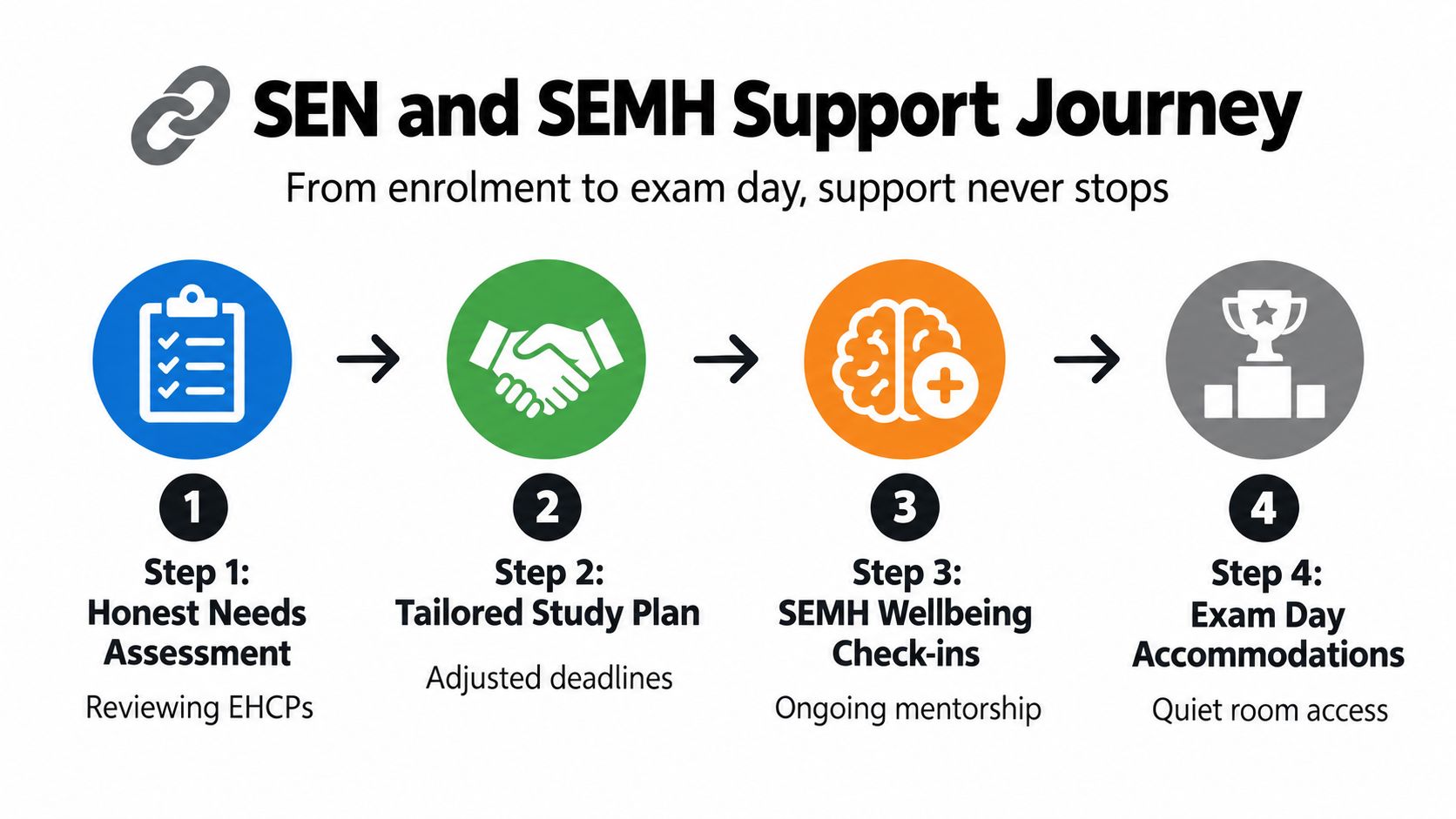
Support needs to follow the learner
A named SENCO should coordinate the plan and tell the family who is responsible for each adjustment. Support may include:
- Accessible teaching: Captions, written instructions, dyslexia-friendly materials and recorded lessons for review.
- Manageable workload: Chunked assignments, clear milestones and adjusted deadlines where appropriate.
- SEMH care: Regular check-ins, a predictable routine, a quiet way to ask for help and sensitive responses to anxiety.
- Social access: Smaller groups or carefully managed breakout rooms for a student who wants connection but finds unstructured interaction stressful.
Consider a student with ADHD who loses track during long explanations. A practical plan could divide a recorded lesson into shorter sections, provide a checklist, schedule a daily tutor check-in and confirm every deadline in writing. Those measures show what personalised support looks like in practice.
Exam support follows a separate process because the examination centre controls implementation. For 2024–25, Ofqual reported approval for 25% extra time for an estimated 16.6% to 25.5% of exam students, compared with a 21.0% SEN rate in relevant centre types. The estimated approval range was 22.4% to 32.1% in independent centres and 14.6% to 22.0% in state-funded secondary centres. DfE-reported SEN rates were 24.1% in independent schools and 16.5% in state-funded secondaries, as set out in Ofqual's access arrangements report.
Ask who gathers the evidence, who submits the application, whether arrangements transfer from the previous school and how rest breaks, a reader, a scribe or assistive technology would work. Read the guidance on exam access arrangements to understand how evidence is gathered and applied. A provider may help prepare the application, but the approved exam centre must be able to deliver the arrangement correctly on the day.
Choosing a Provider and Planning Your Application
The hardest decision often isn't choosing between two lesson platforms. It's securing a legitimate, calm examination route that works for your child's subject and circumstances.
Start with providers that name their awarding bodies, explain their examination arrangements and publish fees clearly. Then move beyond the website. Ask to speak to the SENCO if your child has a specific profile, request a trial lesson and observe whether staff answer difficult questions directly or move quickly back to general promises.
A practical due-diligence framework
Verify the qualification. Record the awarding body, specification code and subjects available. Ask whether the provider's teachers prepare students for the exact specification they'll sit.
Verify the centre. Get the examination centre's name, location and role in the process. Confirm that it accepts private candidates where relevant and can administer every assessment component.
Verify the support. Ask what happens when a student falls behind, who contacts the family and how wellbeing concerns are recorded. Find out whether the SENCO has relevant training and whether teachers receive guidance for SEN and SEMH needs.
Verify the terms. Read the refund policy, withdrawal process, technology expectations and arrangements for missed lessons. A family dealing with illness needs to know what practical help exists before a crisis occurs.
A child who feels unsafe or embarrassed can hide difficulties until the problem becomes visible in missed work and rising distress. During a trial lesson, look for small signals. Does the teacher invite questions without putting a student on the spot? Can your child see the instructions clearly? Does staff communication feel organised and kind?
Plan backwards from the examination series your child intends to enter. Teaching enrolment, exam entry and access-arrangement evidence may have different deadlines. The Ofqual delivery report for 2025 records approximately 814,335 A Level results issued in the summer 2025 series, within around 6.5 million GCSE, AS and A Level results awarded to more than 1.3 million students. It also records 35 instances where results were later found to be incorrect, compared with 24 in 2024. Those figures underline why identity checks, secure submissions, accurate entries and clear escalation procedures matter.
Keep a Plan B. If the preferred centre is full or can't offer the subject, you need time to find another route rather than discovering the problem close to the examination date.
Costs Timetables and Study Tips for Success
Families often ask for one total price, but an online AS Level year has several cost lines. Tuition may be separate from examination entry, centre administration, subject materials and any practical or non-exam assessment support. A provider should give you a written breakdown rather than presenting a low headline fee that excludes the part of the pathway your child still needs.
| Cost line | Typical range (£) | Notes |
|---|---|---|
| Online tuition | Varies by provider and subject | Ask whether live lessons, recordings, marking and tutorials are included |
| Examination entry | Varies by awarding body and centre | Confirm who enters the candidate and when payment is due |
| Examination centre administration | Varies by centre | Private candidates may need to arrange this separately |
| Access arrangements | Varies according to the arrangement and centre | Ask whether evidence gathering or administration carries a separate charge |
| Textbooks and resources | Varies by specification | Check whether digital resources are included |
| Practical or non-exam assessment | Varies by subject and provider | Confirm how the work will be supervised, assessed and submitted |
A workable timetable needs protected teaching time and independent study. Don't assume that a flexible course requires no routine. A student recovering from anxiety might begin with live lessons in the morning, a quiet break, one focused assignment block and a short tutor check-in. Another learner may need to divide work into shorter sessions around training or medical appointments.
Use simple habits throughout the year:
- Take active notes: Record questions, examples and uncertainties rather than transcribing every word. The iScribe Live Transcribe guide to notes offers practical ideas for turning lesson content into usable revision notes.
- Retrieve regularly: Close the textbook and explain a topic from memory, then check what you missed.
- Start past papers early: Use them to identify unfamiliar command words and weak topics, not only as a final revision exercise.
- Rewatch purposefully: Return to a recorded lesson with a specific question, such as how to structure an evaluation or interpret a graph.
- Book the centre early: Don't leave examination arrangements until your child is already deep into the course.
- Apply for access arrangements early: Give the provider and centre time to gather evidence and settle the required paperwork before high-stakes assessments.
- Review progress with your child: Ask what feels manageable, what causes stress and what support would make the next week easier.
The best online AS Level course gives your child more than a convenient timetable. It provides a regulated pathway, responsive teaching, reliable communication and an assessment plan that doesn't leave the family guessing.
Queens Online School offers live, interactive Sixth Form teaching alongside recorded sessions, subject-specialist support and access to Pearson Approved Examination Centre arrangements. If you're comparing online AS Level courses and want to discuss subjects, exam access or SEN and SEMH support, visit Queens Online School to explore the available pathway.