


It's Sunday evening, your child's biology folder is open on the kitchen table, and a page on gene expression still doesn't make sense after the third read. They're not lazy and you're not overreacting. They've missed something, confidence has slipped, and now every new topic feels harder than the last. Choosing the right online A Level biology tutor isn't about finding the cleverest profile. It's about finding someone who'll rebuild understanding at a pace your child can trust, without leaving gaps in practical work, SEND support or cost.
Qualifications and Checks Before You Book
The Department for Education provisional entries release for summer 2025 recorded 66,100 provisional A Level biology entries in England, making biology the third-largest A Level subject after mathematics and psychology. A pool that large produces plenty of polished tutor profiles.
Verifiable teaching quality takes more work.
A Year 13 student who misses two weeks through illness can return to a synoptic essay on respiration and photosynthesis and go silent, because asking for help feels embarrassing. Parents in that position open a dozen tabs and find that every online A Level biology tutor claims exam expertise. A short list of checks separates tutors who know the specification from tutors who write a good advert.
Tutor Credentials and How to Verify Them
| Credential or check | Why it matters | How to verify |
|---|---|---|
| Degree in biology or a related science | Depth for synoptic and extended-response questions | Ask for the degree subject and institution |
| Current teaching of the exam board specification | Mark schemes and wording change between specifications | Ask which board and specification they teach now |
| Qualified teacher status or equivalent UK teaching qualification | Structured teaching and assessment practice | Request the QTS reference number |
| Enhanced DBS check | Required for anyone working with children | Ask for the check date and confirm it is current |
| Experience with SEND or SEMH learners | Ability to adapt explanations and pacing | Ask for a specific example from past students |
| Provider exam-centre accreditation | Confirms alignment with exam-board requirements | Check the provider's approved-centre status |
A degree in biology or a related science gives a tutor the depth A Level marking rewards, where answers earn marks for precise, linked reasoning across topics. Ask for the subject and institution, then ask how they would teach one topic your child finds hard, such as the control of blood glucose. If they can explain why a synoptic answer loses marks for vague wording, the depth is there.
Current specification knowledge outweighs the tutor's own school grades. AQA, Edexcel and OCR phrase questions differently, and mark schemes punish the wrong term even when the underlying idea is sound. I would ask, "Which board and specification are you teaching this term?" A vague answer about covering all boards equally is a warning.
Qualified teacher status signals training in sequencing lessons, checking understanding and assessing work. Request the QTS reference number, and treat reluctance to share it as a warning sign. At Queen's Online School, our lessons are taught by fully qualified UK teachers, and we're a Pearson Edexcel Approved Centre and a registered UCAS centre. Whatever provider you consider, including options you find while comparing a private tutor in London, check exam-centre status against the board's approved-centre list yourself.
An enhanced DBS check is a safeguarding requirement, and its date matters. Ask when it was issued and confirm it is current before your child logs on alone. Safeguarding also covers how lessons are recorded, who can access recordings and how concerns are reported.
Experience That Shows in the Lesson
Credentials get a tutor onto your shortlist. Specific examples keep them there. For SEND or SEMH experience, "I personalise everything" tells you nothing. Ask for one example from a past student and listen for something practical: shorter explanations for processing difficulties, an advance outline for an anxious child, or typed responses for a student who freezes when speaking aloud.
Apply the same test to resources. Ask what materials a tutor uses beyond the specification and textbook. Supplementary material on teaching students lifelong virus prevention skills can support wider health education, while exam marks still come from specification language on immunity and pathogens. Check that anything extra they use serves the mark scheme.
Ten-minute phone screen: Which specification do you teach now? How will you adapt the first lesson for my child's needs? What will the trial cost, in total, and what counts as an extra?
If your child's board assesses practical skills, add one more question: how will they cover required practical content when lessons happen online? A tutor who answers all of these clearly is worth trialling. One who dodges cost, can't name the specification or offers only general reassurance about your child's needs is easy to rule out, and a child who has already lost confidence deserves better than another confident talker.
Choosing a Lesson Format That Fits Your Child
Format decides how much your child speaks, how quickly confusion gets spotted and how they recover after a missed week. There's no best format in the abstract. There's only the format that matches how your child learns when they're tired, anxious or behind.
Lesson Formats Compared for A Level Biology
| Format | Best for | Main limit | What a session looks like |
|---|---|---|---|
| One-to-one live lessons | Students who freeze in groups or need pace set around them | Higher cost per hour and less peer discussion | Tutor-led, with questions answered in real time |
| Small live group classes | Students who learn through discussion and need regular accountability | Less individual time per student | Live teaching with classmates on a fixed timetable |
| Live lessons with recordings | Students who miss sessions or revise in their own time | Recordings can encourage passive watching | Live class, then the recording reviewed before the next lesson |
| Self-paced assignments with feedback | Confident, self-motivated students | Needs strong self-discipline and offers little real-time help | Written tasks marked and returned with comments |
Say a student understands enzymes but goes silent in a group when a graph appears. One-to-one live lessons let the tutor slow down, ask them to describe the trend privately and rebuild the explanation without an audience. That privacy can be the difference between a child asking a "silly" question and hiding the gap until the exam.
Another student learns best by arguing a point about natural selection with peers. A small live group on a fixed timetable gives them discussion, routine and gentle accountability. Our lessons are delivered live, with a qualified teacher present in real time so students can ask questions and take part in discussion. That live presence matters because a misconception corrected in the moment doesn't harden into revision notes.
Live lessons with recordings suit a child who misses a session for a hospital appointment. They watch the recording, pause at the worked calculation and bring two specific questions to the next lesson. All our lessons are video-recorded for easy catch-up and revision, but a recording only helps if it's used actively. Set a short task after watching, such as redoing one exam question from memory.
Self-paced assignments with written feedback suit a confident student who already organises their own revision and mainly needs marking against the scheme. They're a poor fit for a child who's avoiding biology because it feels overwhelming. Written comments won't notice the long pause before a child admits they're lost.
Choose live teaching when your child needs accountability. Use recordings as a safety net, not as the lesson itself.
I would start from your child's behaviour, not your first price comparison. If they hide, drift or panic, they need a live adult watching for it. If they're already self-driven, lighter support may be enough and kinder to your budget.
Supporting SEND and SEMH Needs Online
A child who's repeatedly told they're behind often stops asking questions long before they stop caring. They copy the diagram, nod at the explanation and go home convinced biology is proof they're not capable. For SEND and SEMH learners, the tutor's first job is to make the lesson feel safe enough for honesty, then keep the academic challenge intact.
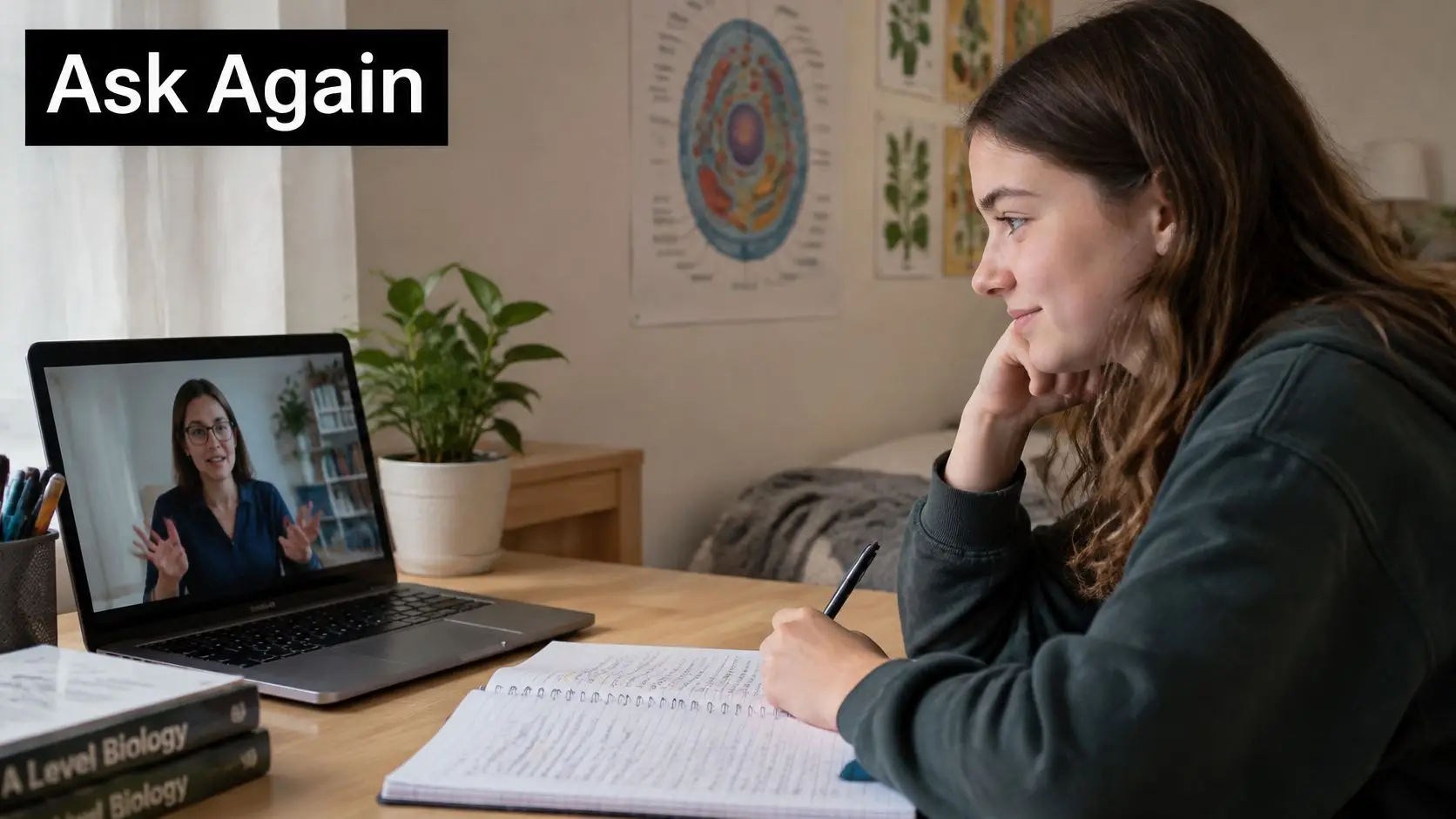
This short visual shows the kind of calm, private setting where a nervous learner can ask without feeling watched.
The need isn't marginal. The Tutor Trust Impact Report 2025 reports that only 31% of pupils with SEND achieved grade 4 or above in both GCSE English and maths in 2024/25, compared with 72% of pupils without SEND. It also reports that the GCSE pass-rate gap narrowed from 41 percentage points among comparable pupils to 23 points for SEND pupils receiving targeted tutoring. Those figures don't promise what any one tutor will achieve. They show why vague reassurance isn't enough and why targeted mechanisms matter.
Online isn't automatically inclusive. Flexibility helps an anxious learner who dreads a classroom, and it helps a medically absent student stay connected. Unstructured recordings can do the opposite, increasing procrastination and cognitive load for a child with executive-function difficulties. The question isn't whether online is good or bad. It's whether the structure matches your child's profile.
Mechanisms a Tutor Should Be Able to Show You
Ask to see how a synoptic topic gets broken down. For respiration, a good tutor teaches one concept at a time, checks it with a low-pressure retrieval question, then links it to the next stage. Accessible diagrams use uncluttered slides, consistent colours for the same structures and labels introduced gradually rather than all at once.
- Autism: A fixed routine, advance notice of changes and explicit instructions for multi-stage questions reduce uncertainty without lowering expectations.
- ADHD: A five-step plan sent before a genetics lesson, covering vocabulary, worked example, independent question, feedback and recap, gives attention a visible path.
- Dyslexia and processing difficulties: Shorter spoken chunks, key terms on screen and extra thinking time before an answer is expected.
- Anxiety and SEMH needs: Typed answers in the chat, private checks for understanding and errors treated as information, not failure.
- Fluctuating health: A recording paired with one short catch-up task, so returning doesn't mean facing a mountain.
Our flexible options include lesson recordings, self-paced assignments and personalised support for students with unusual schedules, learning styles or commitments such as training or performing. Used deliberately, that flexibility protects continuity. Used loosely, it leaves a struggling child alone with a playlist.
The video below is worth watching with one question in mind: could your child follow this pace, pause when needed and still know what to do next?
Arrangements Beyond the Lesson
Ask how the tutor handles exam-access arrangements, assistive technology and communication with you or the school SENCo. If your child uses extra time, a reader, rest breaks or a laptop in exams, tutoring should rehearse biology under those same conditions. Practising a long data question without the arrangement they will have teaches the wrong pacing.
Regular contact matters too. You should know what was covered, what your child can now do independently and what needs another pass. If you're clarifying terminology first, our guide to SEN support and what it means in practice is a useful starting point before you speak to any provider.
Close every enquiry with one direct question: "What will you change in the first lesson for my child's specific need?" A tutor who can answer with a routine, a resource and a checking method is thinking about your child. A tutor who answers with confidence alone is selling a feeling, and your child needs more than that.
Covering Practical Skills When There Is No Lab
Many families assume an online tutor can either teach practical biology fully or can't teach it at all. Neither is true. The Eduqas A Level Biology examiners' report for summer 2025 identified recurring weaknesses in candidates' familiarity with specified practicals, scientific drawing, evaluation of methods and understanding of experimental limitations. Several of those weaknesses are written-paper skills, and a remote tutor can train them well.
Practical Skills What Online Tutoring Covers and What Needs a Lab
| Practical skill | What an online tutor can do | What needs supervised lab time |
|---|---|---|
| Required practicals | Explain method, variables, controls and sources of error | Hands-on technique and equipment handling |
| Data analysis and graphs | Interpret tables, plot and evaluate graphs, check units | Collecting the original data |
| Calculations | Practise rates, magnification and dilutions step by step with worked data | Measuring the values in the first place |
| Scientific drawing | Critique drawings and label diagrams from images | Drawing from real specimens under a microscope |
| Evaluating methods | Identify limitations and suggest improvements | Experiencing the limitation firsthand |
| Practical Endorsement | Check school lab access and practical records | Supervised completion of the endorsed practicals |
Online, a tutor can walk through method, independent and control variables, repeats, units and sources of error. They can teach your child to describe a graph trend with figures, choose a statistical test and explain why a method lacks reliability. Those are marks your child can gain from a laptop, especially with past-paper data and mark-scheme language.
Supervised lab time still matters for handling equipment safely, making authentic observations and developing technique that can't be learned from a photograph. Keep the distinction clear. Written-paper practical knowledge can be taught remotely. The Practical Endorsement needs compliant, supervised hands-on completion and proper records through the school or an appropriate centre.
Say a student has no school-lab access this term. A practical workaround for exam preparation is to complete a scientific drawing from annotated photographs of a dissected specimen, label it under timed conditions, then mark it with the tutor against the scheme. That builds drawing and labelling skill, but it doesn't pretend to replace microscope work. Families who want extra curiosity-led practice at home can also find engaging life science activities to keep observation skills active between lessons.
Before you book, check how any online A Level Biology programme handles required practicals, records and centre access. Ask two questions in writing: what practical provision is included, and how will a child without lab access be prepared so they aren't disadvantaged? If the answer is only "we cover practical questions," you haven't been told enough.
What Online A-Level Biology Tutoring Costs and What Is Extra
The headline hourly rate rarely shows the true total. A family can budget carefully for lessons, then discover that a make-up session, practical marking or an extra assessment sits outside the package. That surprise hurts twice. It strains the budget and interrupts the consistency your child needs.
Cost Items to Confirm in Writing Before Paying
| Cost item | Typical charge | What to ask in writing |
|---|---|---|
| One-to-one live lesson | Charged per hour at the rate agreed before booking | Whether trial and make-up sessions are included |
| Small live group class | Charged per term at the fee agreed before booking | Group size and whether the timetable is fixed |
| Recorded lessons and assignments | Charged per month under the package agreed before booking | Whether recordings stay available after the course ends |
| Extra session outside the package | Charged per session at the rate confirmed before it runs | Notice period and whether a session missed through illness is refunded |
| Practical marking or lab-related support | Charged separately unless the package states it is included | Whether it is included or charged separately |
Say you pay for ten one-to-one lessons and your child then misses one for a hospital appointment. If the make-up session is classed as an extra, you're paying again for teaching you thought you'd bought. A written policy on illness, notice periods and refunds would have prevented that argument at the exact moment your family least needs it.
Compare offers on total cost for the full course, not the first month. Include trial fees, extra sessions, assignment marking, access to recordings after the course ends and any lab-related support. A cheaper hourly rate with paid extras can cost more than a stable package by the end of term.
I would price the plan you can sustain across the whole term, not the most intensive plan you can manage for three weeks. A child rebuilding confidence needs the same tutor, the same routine and no sudden pause because the money ran out mid-topic. Stability is part of the teaching.
Run a Trial Lesson and Book This Week
A trial is the one moment you see a tutor teach your actual child, with their hesitations, strengths and way of explaining an idea back. Don't waste it on a friendly chat about target grades. Run it on a plan, watch for evidence and decide while the impression is fresh.
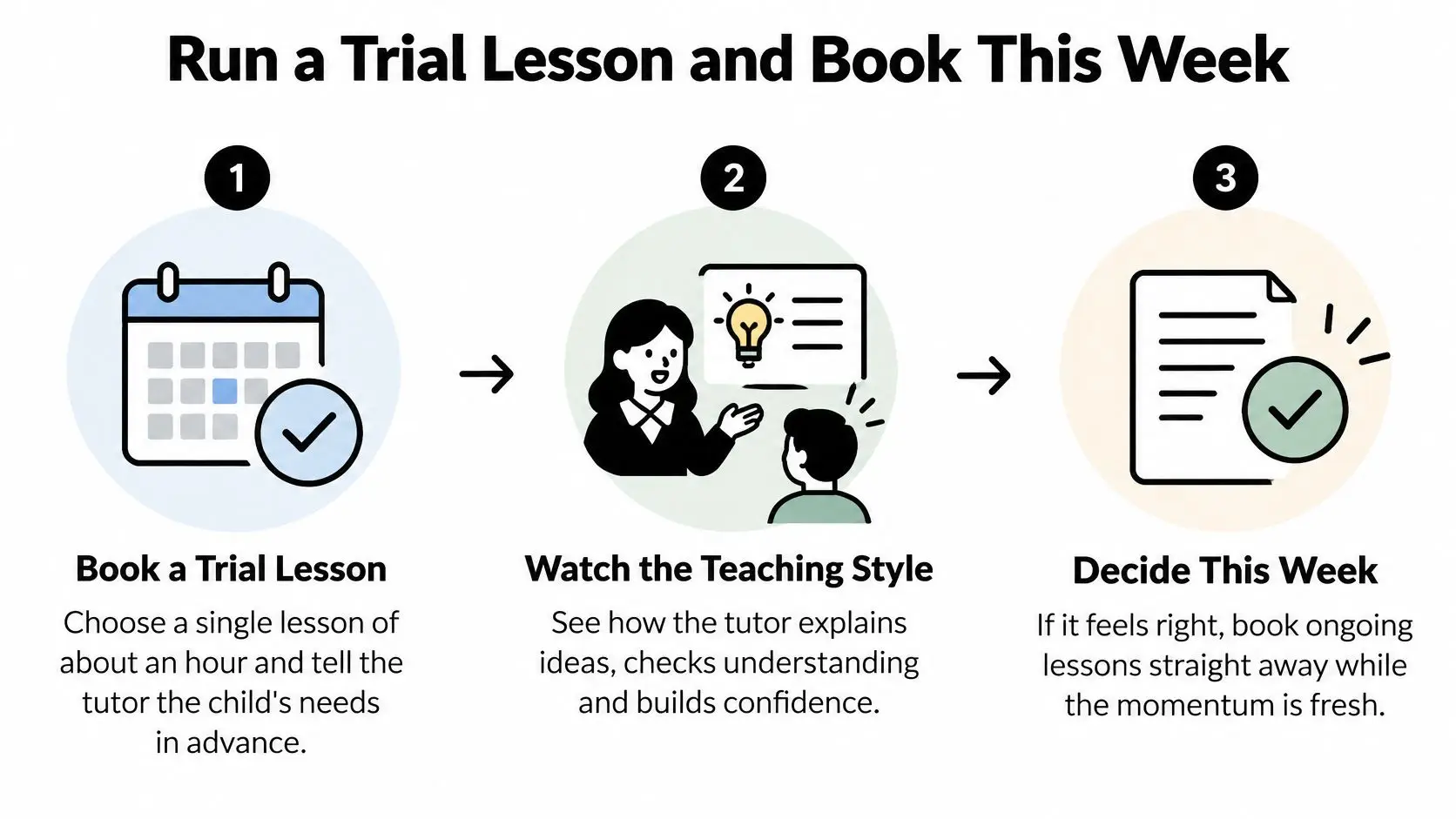
The three steps below summarise the booking process before the fuller checklist.
Six Steps for a Trial That Tells You the Truth
- Book one trial lesson of about an hour. Tell the tutor your child's board, current topic and specific needs in advance, because adaptation you can see is worth more than adaptation promised later.
- Send one real past-paper question. Choose it from your child's exam board, ideally on a topic they find hard, and watch how the tutor breaks it into principle, evidence and mark-scheme wording.
- Watch how understanding is checked. A strong tutor asks your child to explain back, apply the idea to a new example or spot the error in a sample answer, not only "Does that make sense?"
- Ask how progress is tracked. You need to know how often feedback arrives, what happens after a weak assessment and which topic gets revisited first. Coursework, quizzes and other ongoing assessments are typically completed online as part of our regular lessons, so progress evidence should be routine, not a special request.
- Get the package in writing. Confirm what's included, what an extra session costs, the missed-lesson policy and how practical provision is handled before you pay for a block.
- Compare every offer on the same criteria. Credentials, format, needs support, practical provision, feedback and total cost. A tutor who's warm but vague on practicals isn't equal to one who's clear on both.
Stability isn't a soft extra for some learners. The Department for Education outcomes release for children in need and children looked after in 2025 reports that 61.2% of children looked after for at least 12 months had a recorded SEN, compared with 19.2% across all pupils. A young person coping with care changes or disrupted schooling may need one consistent tutor and visible milestones before difficult topics such as homeostasis or gene expression feel manageable.
Start each lesson with a two-minute check-in, set one attainable retrieval task, and end by recording what was mastered and what happens next.
That written record changes the emotional maths for a child who feels permanently behind. They can see a mastered definition of osmosis, a corrected magnification calculation and a clearer essay plan. Progress stops being something adults claim and becomes something they can point to.
Shortlist three tutors, choose the format that fits your child and book trials this week rather than waiting for exam season. Rebuilding confidence, filling practical gaps and correcting exam wording takes several weeks of steady work. Students completing A Levels at Queen's Online School can apply to universities in the UK and internationally, supported by our Guidance Team through the UCAS application process, but the immediate decision is smaller and more personal than university plans.
After the trial, ask your child, not only yourself, how it felt. Did they understand more than when they started? Could they ask a question without dread? Do they know what happens next lesson? A good trial leaves a child feeling capable and clear. If it doesn't, walk away politely and try another tutor. The right match should give your child relief as well as marks, and that relief is often where real learning starts again.
If your child needs live A Level Biology teaching with qualified UK teachers, clear feedback and support that adapts to SEND, SEMH and practical-learning needs, explore Queens Online School and book a conversation about the right format. Bring your child's exam board, one topic they're struggling with and your written cost questions, and we'll help you judge the fit.