

A child is at the kitchen table, drawing with complete concentration while the rest of the room carries on around them. You might be wondering whether to turn that quiet moment into something bigger. Perhaps a school competition, a club activity, an online showcase, or a community event that gives children a reason to create and a safe place to be proud of what they make.
That's where a well-planned kids drawing competition can do something special. It can give shy children a reason to share. It can help a child with big feelings focus on one calm, creative task. It can also reassure parents that success isn't only about winning, but about being included, understood, and encouraged.
Many adults start with the practical questions. What theme should we choose? How do children enter? What counts as fair judging? Those questions matter. But the strongest competitions begin somewhere simpler. They begin with a child feeling that their ideas matter.
From a Spark of an Idea to a Celebration of Creativity
A good kids drawing competition starts long before the first entry arrives. It starts with a child who wants to draw a dragon in trainers, a rainy city in neon colours, or a family picnic on the moon. When adults notice that spark and build around it carefully, children feel seen rather than assessed.
That emotional starting point matters because drawing is already part of everyday childhood for so many families. In the UK, 99.1% of children aged 5–15 engaged with the arts in the last year, according to the Taking Part 2013/14 Annual Child Report. A drawing competition doesn't need to force interest. It taps into something children already do naturally.
A parent might see one child race in with five ideas while another freezes at the thought of being judged. Both children belong in the same creative space. The task for adults is to make that space warm, clear, and manageable.
A child remembers how a competition made them feel long after they've forgotten where they placed.
That's why the best events celebrate process as much as product. A simple display board in a hall, a digital gallery for families, or a printed keepsake can matter just as much as a prize. If children want to turn their artwork into something tangible afterwards, families may enjoy learning how to discover the Draw Scan Print method so a sketch can be prepared for printing in a way that feels exciting and achievable.
What success really looks like
Success might look like a child who usually avoids art deciding to submit one picture. It might be a sibling pair helping each other title their work. It might be a class that talks more kindly about one another after seeing how different everyone's ideas can be.
If you're planning follow-up creative activities, a collection of easy craft ideas for children can help keep that momentum going after the competition ends. That way, the event becomes part of a wider culture of making, not a one-off performance.
Laying the Creative Foundation for Your Competition
The strongest competitions feel simple from a child's point of view. That simplicity comes from careful planning by adults. Children need enough freedom to imagine, and enough structure to feel safe.
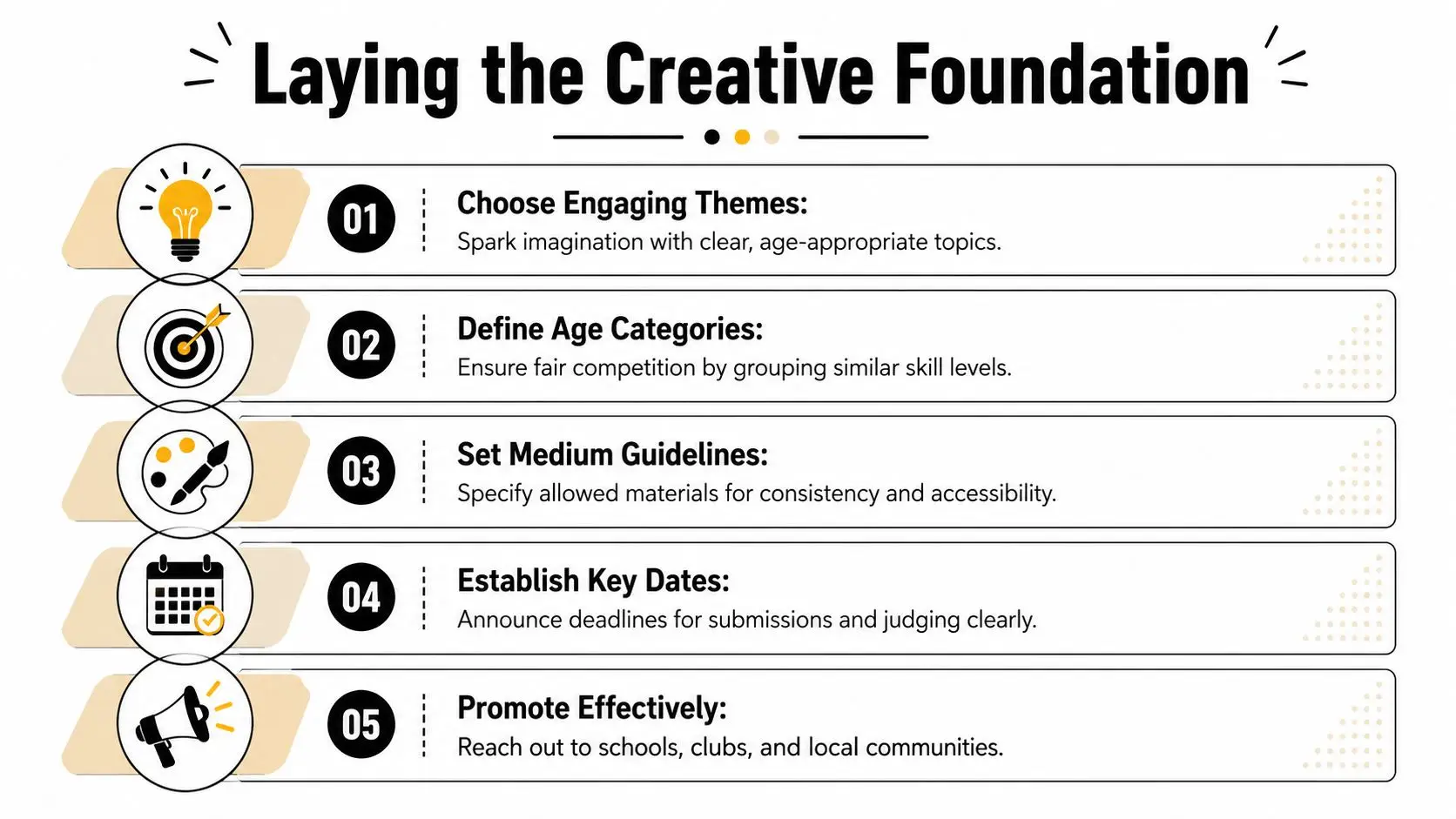
Choose a theme that opens doors
A weak theme shuts children down because it suggests there's a right answer. A strong theme invites many kinds of thinking.
Compare these two prompts:
- Narrow prompt: Draw a cat
- Open prompt: Draw a creature that belongs in your dream world
The second option gives more room for children who love fantasy, storytelling, humour, or unusual colour choices. It also helps children with SEN or SEMH needs because it allows them to work from their own interests, which can lower stress and increase engagement.
Themes that often work well include:
- A World I'd Love to Live In: Children can explore kindness, nature, community, or adventure.
- The Sound of a Colour: This suits children who think in sensory or imaginative ways.
- A Hero in My Everyday Life: A gentle prompt for children who prefer real people and familiar scenes.
- Weather With Feelings: Useful for children who express emotions more comfortably through images than words.
Group children fairly
Age categories should protect confidence. A young child's bold, joyful drawing shouldn't compete directly with the polished shading of an older pupil.
Try categories that reflect developmental stages rather than strict school admin language. For example:
| Age group | What to prioritise |
|---|---|
| Early years and infants | Expression, confidence, storytelling |
| Primary middle years | Theme response, originality, effort |
| Older primary and lower secondary | Interpretation, composition, personal style |
| Secondary | Vision, communication, technical control |
That doesn't mean older children deserve harsher judging. It means each age group should be seen on its own terms.
Use constraints to reduce overwhelm
Adults sometimes worry that rules will limit creativity. In practice, the right kind of rule often helps children start. The Bath Institute of Laughter Cartoon Competition rules offer a strong example. For children aged 7–11, entries must be a 3, 4, or 5-box cartoon strip. That sort of framework can reduce anxiety because the page no longer feels endless.
Practical rule: Clear boundaries often help children who feel stuck. “Use exactly 3, 4, or 5 boxes” is easier to handle than “draw anything funny”.
You can apply that idea in other ways:
- Limit the paper size so children know the task is manageable.
- Offer a choice of media such as pencil, crayons, paint, or digital drawing.
- Give one optional starter question like “Who lives in your picture?”
- Provide a visual example of layout, not an example to copy.
For organisers juggling dates, reminders, uploads, and parent communication, some online event planner tools can help keep the process organised without making it feel bureaucratic to families.
If you're working with children who need more art guidance, a structured Primary Art and Design approach can also help adults pitch themes and expectations at the right level.
Designing Fair and Inclusive Entry Rules
Rules shape the emotional tone of a competition. If they're vague, children feel uncertain and parents worry about mistakes. If they're too rigid, families may decide not to enter at all. Fair rules need to be clear, but they also need to make room for real children with different needs, access levels, and ways of working.
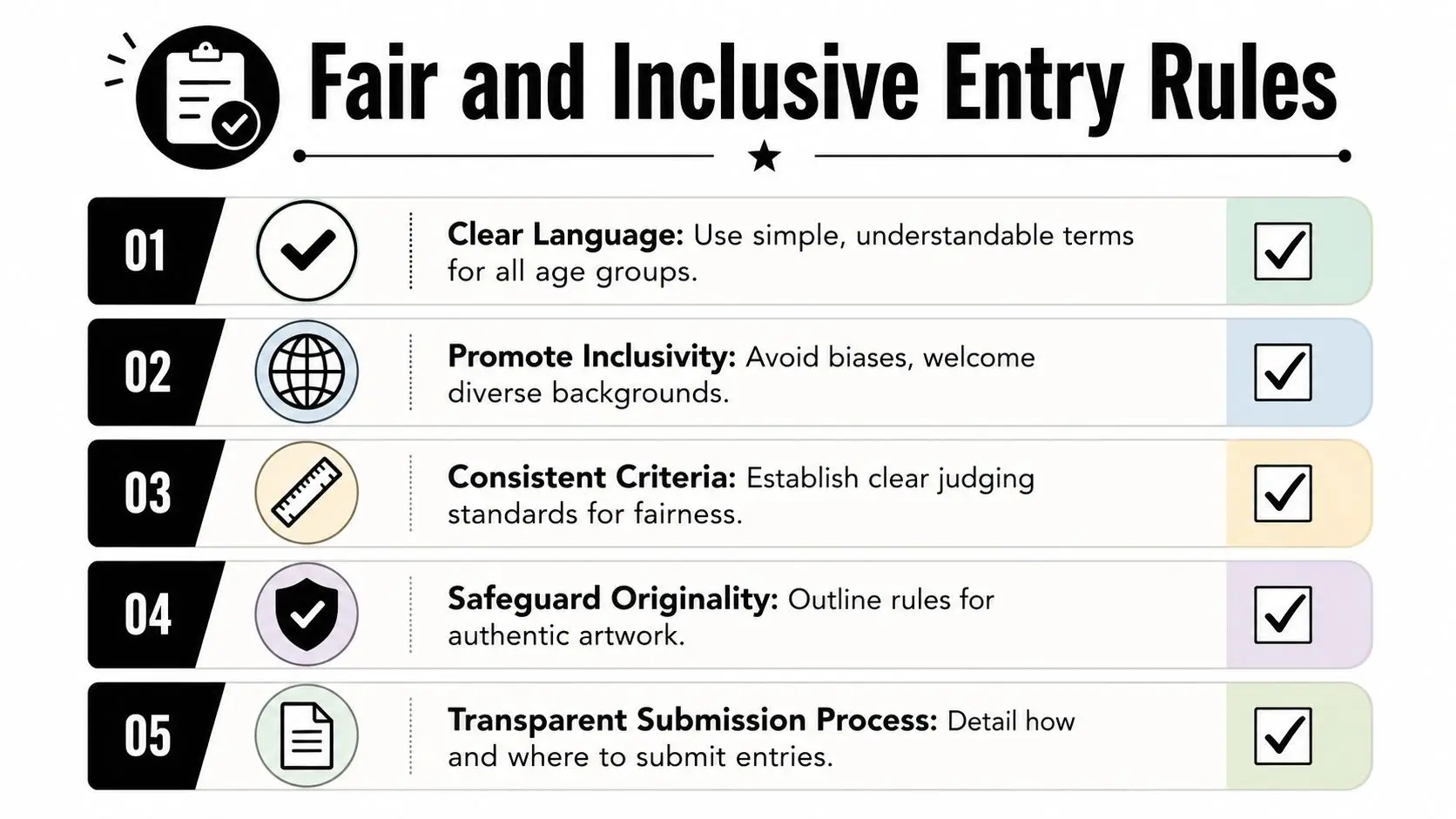
Build rules that prevent avoidable distress
One child may submit online using a parent's phone. Another may hand in a paper entry at school. Another may need extra support because transitions, handwriting, or deadline pressure are hard. A fair system doesn't force all three children through the exact same route if that route only works well for one of them.
There's also a genuine gap here. The Sketch for Survival Junior information reflects a broader issue. There's a critical lack of UK-specific guidance on how children with SEN or SEMH can access drawing competitions, and many competition rules list age and format without offering inclusive submission pathways or disability-friendly criteria.
That gap leaves families doing the emotional labour alone. They shouldn't have to.
What inclusive rules look like in practice
A fair kids drawing competition can include practical options such as:
- More than one submission route: Allow digital upload and physical hand-in where possible.
- Plain-language entry forms: Keep instructions short, concrete, and easy to follow.
- Alternative support notes: Let parents or teachers add a brief note if a child used adaptive tools or needed help with scanning.
- Flexible presentation rules: Judge the art, not the family's access to expensive printers or perfect lighting.
- Clear deadlines with confirmation: Tell families that the entry has been received so children aren't left wondering.
One real-world detail that's easy to miss is file handling. The Art School UK's Arty Animals competition requires a photo or scan by email, and the filename must include the entrant's name, age, and artwork title, with parent or guardian contact details included in the email body, as set out in its competition terms and conditions. Rules like that may seem mechanical, but they can prevent a child's work being misplaced or placed in the wrong age category.
Another fairness safeguard appears in the BioArtAttack 2025 terms and conditions, which require a high-resolution JPEG, reject photographs and poor-quality scans, and limit each participant to one image only. That kind of rule can level the playing field by making sure families with more time or resources don't flood the competition with multiple attempts.
A child-centred entry checklist
Before publishing your rules, test them against this list:
- Can a tired parent understand them quickly?
- Would an anxious child know what happens next?
- Is there a way in for children with SEN or SEMH needs?
- Have you reduced the chance of accidental exclusion?
- Will families receive confirmation that their entry arrived?
If a rule protects fairness but raises barriers, rewrite the process instead of blaming the child.
For organisers who want to think more thoroughly about access from the start, Universal Design for Learning principles are a helpful lens. They encourage adults to offer multiple ways for children to engage, create, and participate without making support feel like an exception.
Judging with Heart and Impartiality
Judging can either protect a child's confidence or bruise it. That's why I don't believe a kids drawing competition should reward technical polish alone. Children need a process that recognises ideas, effort, interpretation, and emotional expression alongside skill.
A fair system doesn't mean lowering standards. It means using standards that fit the purpose of the event. If the goal is to encourage children to create, judges should ask more than “Is this the most polished picture?” They should also ask, “What was this child trying to say, and did they say it in a way that feels personal and honest?”
Use a rubric before you use opinion
The UK benchmark for youth art competitions is a standardized 5-point weighted rubric, with originality 20%, composition 20%, technique 20%, theme interpretation 20%, and presentation 20%, and anonymized first-round judging has increased juror scoring consistency by 34%. That matters because children deserve consistency, not guesswork.
Anonymous first-round review is especially important when entries come from a mix of schools, online learners, home-educating families, and community groups. Judges should focus on the artwork before they know the child's name, setting, or background.
Here's a simple rubric you can adapt.
| Criterion | Description | Weighting |
|---|---|---|
| Originality | Does the artwork show a fresh idea, surprising detail, or personal voice? | 20% |
| Composition | Is the picture organised in a way that guides the viewer's eye? | 20% |
| Technique | Does the child use their chosen materials with control appropriate to their stage? | 20% |
| Theme interpretation | Does the artwork respond clearly and thoughtfully to the theme? | 20% |
| Presentation | Is the entry submitted clearly and in a format that can be judged fairly? | 20% |
Judge effort with intelligence
Effort isn't the same as neatness. A child with motor challenges may work harder on a simple piece than another child does on a highly refined one. Judges need guidance on that point before scoring begins.
That can be done without abandoning objectivity. Ask judges to discuss examples together before the first round. Give them two or three sample entries and agree what originality, theme interpretation, and age-appropriate technique look like in practice.
A judging panel might decide, for example, that:
- a bold idea with uneven line work can score strongly for originality
- a simple but emotionally clear image can score highly for theme interpretation
- presentation should never become a hidden reward for family resources
A child should never lose out because an adult had better scanners, better lighting, or more time to supervise.
Write feedback that keeps children drawing
Even when you can't provide comments on every entry, your public language matters. Avoid phrases that imply some children are “real artists” and others aren't. Use warm, specific wording.
Try lines like these:
- “We loved how many children told stories through their drawings.”
- “The judges noticed brave colour choices and imaginative ideas across all age groups.”
- “Several entries stood out for their warmth, humour, and strong response to the theme.”
If you do send individual feedback, keep it balanced and brief. One thing the child did well. One thing they might try next time. No crushing comparisons.
Celebrating Every Participant and Their Unique Vision
The most meaningful part of a kids drawing competition often happens after the judging. Children then learn what the event was really about. If only one child is made to feel visible, everyone else receives the message that effort matters less than ranking.
That's why celebration should be wider, warmer, and more imaginative than a single winner's announcement.
Move beyond the single-winner model
The 2024 National Numeracy Drawing Competition handled this thoughtfully. It included three runners-up per category, each receiving a £20 gift voucher. That kind of prize structure spreads recognition more generously and reduces the pressure that can build around one top spot.
Children feel that difference keenly. A broader award structure tells them, “There are many ways to be noticed here.”
You can build that spirit into your own event with categories such as:
- Brilliant Storyteller Award for a picture that suggests a full narrative
- Boldest Use of Colour Award for a child who took visual risks
- Kindness in Art Award for work that expresses care, friendship, or empathy
- Curious Imagination Award for a wonderfully unusual idea
- Perseverance Award for a child who kept going through challenge
Give every child something to hold onto
A certificate of participation matters more than many adults realise. It becomes proof that the child showed up, contributed, and belonged. For some children, especially those who often feel overlooked, that's the prize they treasure most.
You can also create celebration moments that don't depend on budget:
- Display every entry in a school hall, online gallery, or printed booklet.
- Read out short judge comments that praise qualities across the whole group.
- Invite families to a viewing event where children can point out details in their own work.
- Let children talk about their picture if they want to. Some children bloom when someone asks, “Tell me about this part.”
Recognition works best when it names what the child contributed, not just where they placed.
Make prizes feel personal, not pressurised
Prizes don't need to be extravagant. They need to feel thoughtful. Art materials, sketchbooks, display folders, and creative experiences often land well because they encourage children to keep making things.
If you want a small physical keepsake for volunteers, school staff, or group winners, even something simple and wearable from Arklavo can help mark the event in a cheerful way, especially for team entries or celebration days. The key is to keep the atmosphere generous rather than competitive.
A child who doesn't win should still go home feeling proud, calm, and eager to draw again. That's the standard worth aiming for.
Promoting Your Competition and Sharing the Joy
A lovely competition won't help children if families never hear about it, or if the wording puts them off. Promotion should feel inviting, clear, and reassuring. Parents need practical details. Children need excitement. Both need to feel that the event is fair.
Start with short messages that answer the questions families always ask first: Who can enter? What's the theme? When is the deadline? How do we submit? What kind of help can a child receive?
Ways to spread the word well
Use several routes rather than relying on one announcement. Different families notice different things.
A balanced promotion plan might include:
- School communication: newsletters, parent emails, tutor notices, and classroom slides
- Community spaces: libraries, youth clubs, cafés, and local noticeboards
- Online posts: simple graphics with clear submission steps
- Teacher and parent groups: a short message that can be forwarded easily
- A child-friendly launch moment: assembly, club session, or tutor-time introduction
Keep your language warm and concrete. “Open to all young artists” sounds pleasant, but “Children can submit one drawing by email or in person, with support from a parent or teacher if needed” is much more useful.
Share results in a way that includes everyone
Once entries are in, don't disappear until the winner announcement. Families appreciate updates such as “Thank you, we've received your artwork” or “The judging panel is now reviewing entries.”
After results are released, think beyond a list of names. You could:
- Publish a digital gallery of selected entries, with permission.
- Thank every participant publicly in one group message.
- Share short notes about what judges enjoyed seeing across the competition.
- Highlight a range of styles so children see that art doesn't have one “correct” look.
This is also where practical questions tend to surface, especially for non-traditional learners.
Frequently asked questions from families
Can a child in online school enter a competition that asks for a school address?
Parents ask this often, and there's still uncertainty. Recent competition information shows growing use of online submissions, but rules often don't explain how virtual school students should handle “school address” fields, as noted in the Place Makers competition coverage. If you're organising the competition, solve this upfront. Allow entries to list an online school name, a home education setting, or “independent entry” where appropriate.
What if my child needs help scanning or uploading their drawing?
State clearly that adult help with submission is allowed. Make it plain that support with photographing, scanning, or sending the file doesn't reduce the child's ownership of the artwork.
What if my child struggles with deadlines?
Use one clear closing time and repeat it consistently. If you can't extend the deadline, say so kindly. Children who feel anxious cope better with certainty than with vague promises.
Can a child work with adapted tools or adult encouragement?
Yes, if the artwork remains the child's own creative work. Say this directly in your rules so families don't feel they're doing something wrong by supporting access.
Should we ask children to put their school name on the front of the artwork?
No. Keep identifying details separate from the judging stage if you want the process to feel as fair as possible.
A competition is promoted well when families don't need to chase basic answers, and children feel excited rather than intimidated.
If you're looking for an online school that understands creativity, flexibility, and inclusive support for different kinds of learners, Queens Online School offers a British curriculum with live teaching, personalised guidance, and a strong commitment to helping children feel safe, capable, and inspired.