

Your Year 3 child comes home asking whether Stone Age people had houses, or your Year 6 child wants to know whether the Romans were good for Britain. You may enjoy the conversation, then wonder what the school is expected to teach, whether your child is learning enough, and how all these separate topics fit together.
The Key Stage 2 history curriculum is more organised than it can appear from a child's weekly work. Between ages 7 and 11, pupils travel through British, local and world history while learning to ask questions, handle evidence and explain how the past changed. This guide translates the statutory framework into the experience your child should have, with practical examples of lessons and simple ways to support curiosity at home.
Why History Matters for Your Child at Ages 7 to 11
History at this age should feel like more than a collection of exciting stories. A child might begin with a photograph of a Roman road, notice the straight lines and solid surface, and ask how anyone knows who built it. That small moment moves learning from “Romans built roads” to a richer question about evidence, purpose and interpretation.
The curriculum became statutory for pupils in Key Stage 2 from 1 August 2014 under the Education (National Curriculum) (Attainment Targets and Programmes of Study) Order 2013, which brought the revised national curriculum into force for maintained schools from that date. You can read the official legislation for the Key Stage 2 history framework, although parents don't need to become legal experts to understand what it means in practice.
Your child should encounter a planned journey through British history, local history and world history. They should also develop chronological understanding, use historical vocabulary and investigate sources. The purpose isn't to make a seven-year-old memorise every date. It's to help them understand that people lived in different circumstances, made choices, faced consequences and left behind evidence that we can question.
A useful parental test: after a history lesson, ask, “What evidence helped you decide that?” rather than only, “What did you learn?”
From stories to independent thinking
At the start of Key Stage 2, a child may need help placing the Romans before the Anglo-Saxons. By the later years, they should increasingly explain how one period connects to another, identify similarities and differences, and support an answer with relevant evidence.
That development can feel emotional. Children often become absorbed in the human side of history, such as the fear of invasion, the excitement of discovery or the unfairness of unequal treatment. Those responses matter. A child who cares enough to ask why something happened is beginning to think historically.
At home, you don't need a shelf of specialist books or a family historian. Listen closely to the question your child brings through the front door. If they ask whether the Romans “helped” Britain, resist giving a quick verdict. Ask what the Romans changed, who benefited, who suffered and what evidence might support different answers. That conversation is already a meaningful extension of school learning.
What the Statutory Programme of Study Actually Requires
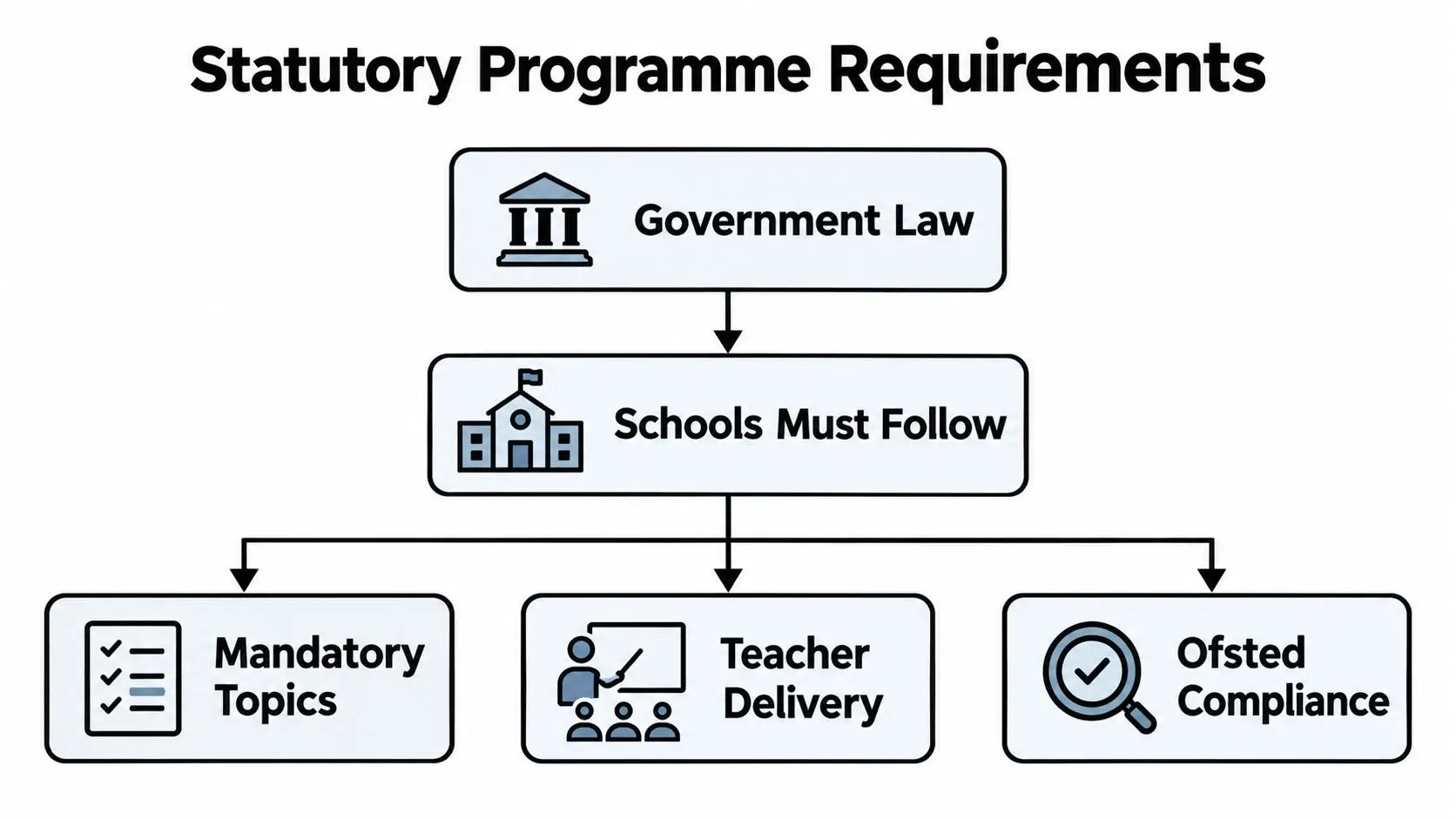
The phrase programme of study can sound distant and bureaucratic. In plain English, it sets out the knowledge and skills maintained schools are expected to teach. The official history programme is issued as law, so schools must follow it unless there's a good reason not to.
The required structure is detailed. Pupils aged 7 to 11 should complete a local history study, three separate British history studies, a study of a British theme extending chronological knowledge beyond 1066, a study of ancient Greek life and achievements, and a study of a non-European civilisation. The possible non-European examples include Ancient Egypt, the Indus Valley, the Maya, Benin and the Aztecs, as set out in the documented overview of the statutory framework.
The framework in parent-friendly language
Think of the structure as a set of destinations rather than a rigid daily timetable.
- Local history connects the past to your child's own streets, buildings, industries or community.
- British history studies create a broad narrative across important periods.
- A post-1066 theme gives pupils a deeper look at a later period or development.
- Ancient Greece introduces life, achievements and ideas from the ancient world.
- A non-European civilisation prevents British history from becoming the whole story and gives children a meaningful contrast.
Schools and teachers decide how to organise these studies, how long to spend on them and which specific examples to use. One school might explore a local mill, another might investigate a castle, port or place of worship. The statutory requirement gives the curriculum its shape, while professional teaching decisions determine how the learning becomes memorable.
You can compare this statutory outline with a practical Key Stage 2 curriculum guide for families. If your child seems to be studying topics in an unexpected order, that isn't automatically a problem. Schools may arrange units differently, provided pupils receive the required breadth and develop the intended historical understanding.
What “must be taught” doesn't mean
It doesn't mean every child will study precisely the same textbook, worksheet or historical figure. It also doesn't mean that learning is successful because a class has ticked off a topic title.
A strong curriculum gives children enough secure knowledge to make connections. It might begin with an overview of a long period, move into a close study of one community, then return to the wider timeline. That combination helps a child see both the broad movement of history and the detail that makes individual lives understandable.
The Journey Through Core Topics From Stone Age to 1066
A child often understands history more easily when it feels like a journey rather than a filing cabinet. In the British strand of the curriculum, that journey begins with changes from the Stone Age to the Iron Age, moves through the impact of the Roman Empire, considers Anglo-Saxon and Scots settlement, and then reaches the Viking and Anglo-Saxon struggle for the Kingdom of England up to Edward the Confessor.
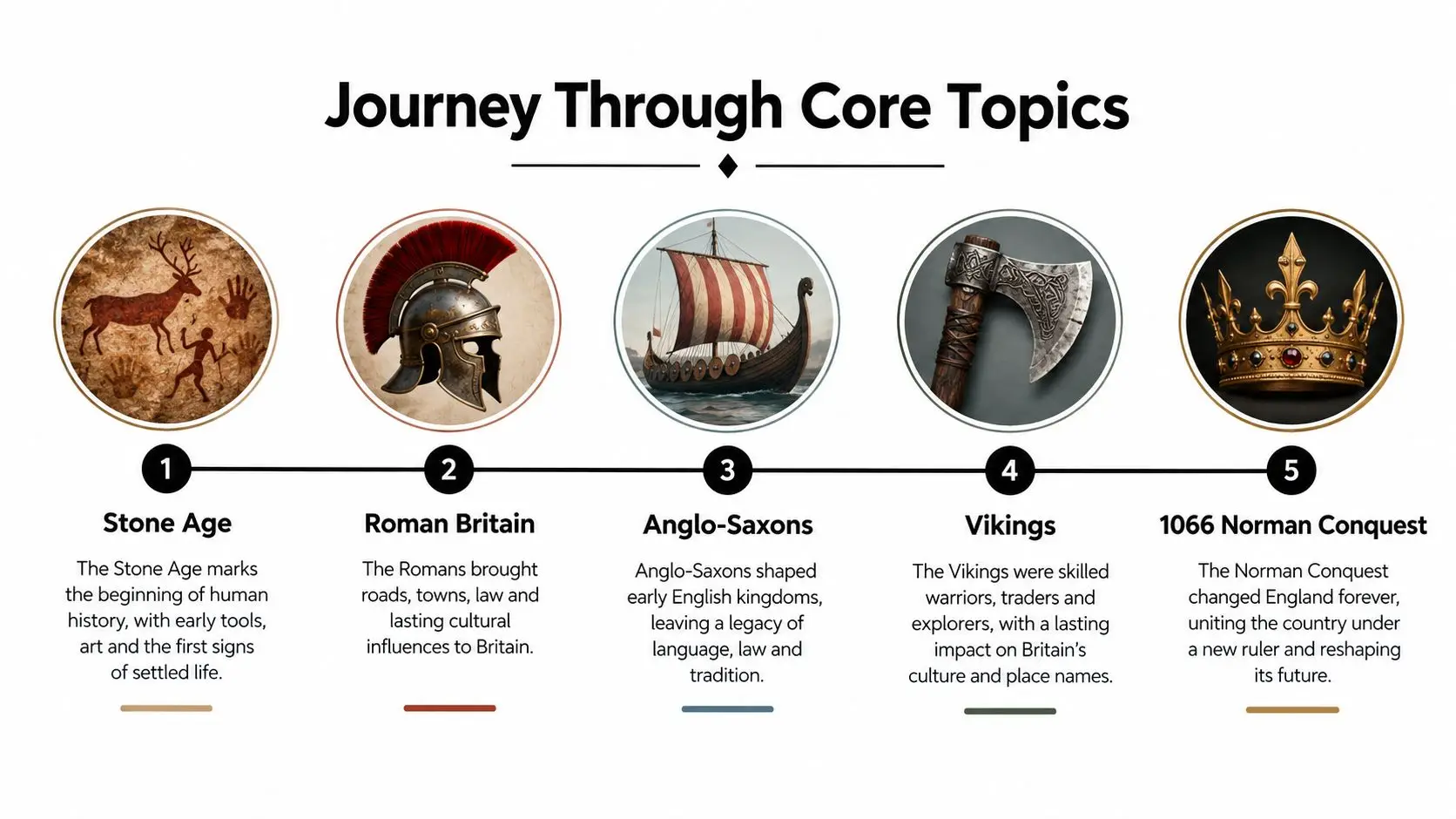
A Year 3 child might first explore how people obtained food, made tools and created settlements. Roman Britain then introduces invasion, power, roads, towns and cultural change. Later, pupils meet the Anglo-Saxons and Scots, followed by Viking raids, settlement and competing claims to the Kingdom of England.
The point isn't for your child to recite a perfect sequence under pressure. Chronology gives them a framework for asking better questions. If a child knows that Roman Britain came before the Anglo-Saxon kingdoms, they can consider what changed after Roman rule weakened and what may have continued.
Beyond the main British sequence
The curriculum also includes a local history study, an aspect or theme beyond 1066, Ancient Greece and a non-European society chosen for contrast with British history. The national curriculum history programmes of study names these content areas and explains the expectation that pupils build connections across periods.
A local study might ask how a nearby town developed, why a building stands where it does or how work and family life changed in the area. Ancient Greece might lead children towards questions about Athenian life, achievements and influence, while a non-European study could introduce the Maya, Benin or Ancient Egypt.
The strongest lessons don't treat these as isolated boxes. A teacher may ask pupils to compare settlement, leadership or daily life across different societies. Your child begins to notice that people in distant places faced some similar needs, while their beliefs, choices and circumstances could be very different.
Chronology with meaning
A timeline on a classroom wall is useful, but history becomes meaningful when children connect sequence to human experience. “The Romans came before the Vikings” is a starting point. “Different groups wanted land, security, influence or control, and their choices changed communities” is closer to historical understanding.
A good lesson leaves room for uncertainty. Children should discover that evidence doesn't always provide one simple answer. That realisation can be unsettling, but it also makes history exciting. Your child isn't only learning what happened. They're learning why people reach conclusions about what happened.
Thinking Like a Historian in Years 3 to 6
Knowing that the Romans invaded Britain is substantive knowledge. Thinking about why they invaded, how we know what happened and whether the invasion affected everyone in the same way is historical thinking.
The national curriculum expects pupils to develop a “chronologically secure” understanding of British, local and world history. It also expects them to identify connections and trends over time and use historically valid questions about change, cause, similarity, difference and significance, as described in the Key Stage 2 guidance from the Historical Association.
A Year 5 enquiry in practice
Imagine a Year 5 class investigating Roman Britain. The teacher doesn't begin and end with a list of Roman inventions. Instead, the children might work through a sequence like this:
- They place selected events and developments on a timeline.
- They examine an image of a Roman fort, a written account and an archaeological object.
- They ask why the Romans built settlements in particular places.
- They compare Roman invasion and settlement with earlier British communities.
- They discuss whether everyday life changed in the same way for everyone.
- They write a response using evidence, not just personal opinion.
A child might conclude that Roman rule brought changes to roads, towns or administration while recognising that those changes had different effects on different groups. The answer doesn't need to sound like a university essay. It needs a clear claim, relevant evidence and an explanation of how the evidence supports the claim.
Ask for the reason behind the answer: “What makes you say that?” encourages evidence-based thinking without turning a family conversation into a test.
Sources are part of the lesson
A source can be an artefact, image, building, map, written account or piece of digital evidence. Children should learn to ask who created it, when it was created, what it might reveal and what it can't tell us.
That doesn't mean pupils must distrust everything. It means they learn that every source has a context. A picture of a powerful ruler may show how that ruler wanted to be seen, but it may tell us less about the lives of ordinary people.
Parents looking for playful ways to encourage questioning can explore Playz inquiry-based learning activities, adapting an activity around a historical object, photograph or family story. For children who need extra support with organising information, research skills development resources can help make the process of finding, sorting and using evidence more manageable.
Progression matters because children revisit the same ideas with increasing depth. They encounter change in one unit, then use that concept again when comparing another period. Over time, “What changed?” develops into “What changed, for whom, how far and why?”
Sample Learning Sequences You Can Picture Your Child In
A well-planned history unit often begins with a question and ends with a response that shows growing independence. The activities below aren't a prescribed timetable, but they show how overview knowledge, detailed study and historical skills can work together.
A Stone Age to Iron Age investigation
The first lesson might display a photograph of an artefact without naming it. Children observe its shape, material and signs of wear. They write questions such as, “What was it used for?” and “How can we tell how old it is?”
The next lesson introduces a broad timeline. Pupils place major developments in order and discuss how ways of living changed. The teacher keeps the focus on explanations rather than a race to memorise labels. A child may notice that changes in tools, homes or farming affected how communities organised themselves.
The class then moves into a depth study of Skara Brae. Pupils examine the settlement layout, household features and available evidence. They consider what the remains suggest about daily life, while recognising that an archaeological site cannot answer every question.
A final task asks each child to write a museum label for one feature of Skara Brae. A strong label names the feature, explains what it may tell us and uses cautious language where the evidence is incomplete. This gives a quiet child a chance to show understanding through writing and gives a confident speaker a reason to edit their ideas carefully.
The best final task isn't always a quiz. A museum label, evidence table or recorded explanation can reveal whether your child understands how knowledge is built.
An Ancient Greece comparison
A second unit might begin with an overview of Ancient Greece and a map showing where communities developed. Pupils then investigate Athenian democracy and Spartan life through carefully selected sources and classroom discussion.
The teacher helps children separate fact from interpretation. They might compare who had power, how children were educated, what daily life involved and which voices are missing from the evidence. The question is not just “Which place was better?” It is “How were these societies organised, and what can the evidence support us in saying?”
The unit ends with a structured debate. One child may argue that Athens offered important political ideas, while another points out that participation wasn't open to everyone. Pupils must listen, respond and refer back to evidence.
At home, you could ask your child to explain one difference between Athenian and Spartan life, then ask which source helped them decide. If they struggle, draw two columns together and add one piece of evidence to each. The aim is not to win the debate. It's to help your child feel that their thinking has value when they can explain it.
Supporting History Learning at Home
Home support works best when it feels like shared discovery, not extra homework. Your child may remember a ten-minute conversation about an old bridge more vividly than a long worksheet because the bridge belongs to their world.
Small activities with real value
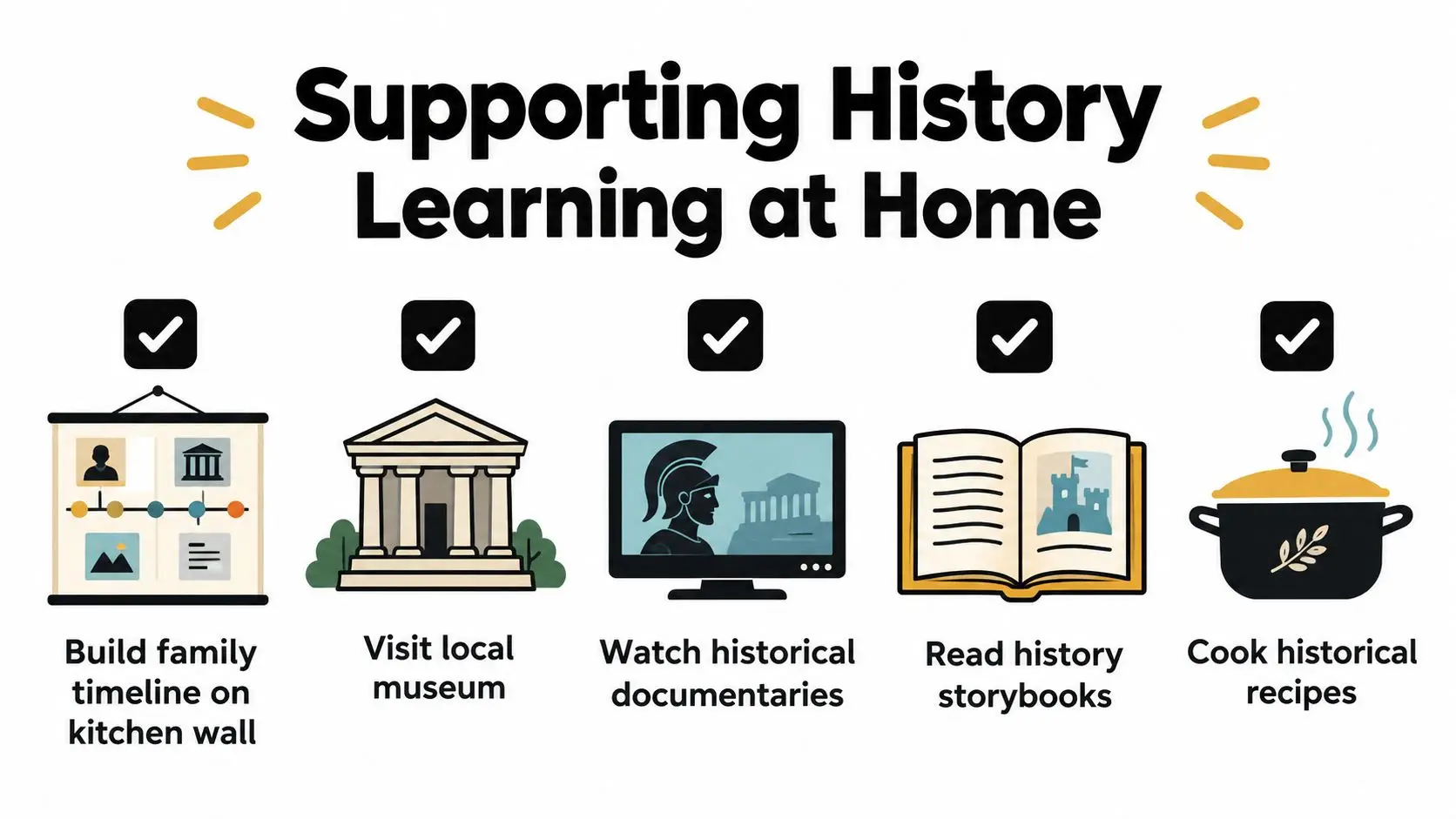
- Build a family timeline: Put photographs, important moves, family stories and memorable events along a strip of paper on the kitchen wall. Your child practises sequence while seeing that history includes ordinary lives.
- Visit a local museum: Ask your child to choose one object and explain what it might reveal. If a museum visit isn't possible, explore its online collection together.
- Watch a historical documentary: Pause when something surprises your child and ask which evidence the programme is using.
- Read history storybooks: Talk about which parts are based on evidence and which parts may be imaginative reconstruction.
- Cook a historical recipe: Use the food as a starting point for questions about ingredients, trade, work and daily life.
A family timeline can be especially comforting for a child who finds distant periods overwhelming. Begin with familiar people and events, then gradually place school topics beside them. The child sees that chronology is a way of organising a story, not a demand to hold every date in their head at once.
Helping a child who feels unsure
Some children need more time to process vocabulary, images or competing explanations. Offer one source at a time, read questions aloud and let your child answer through speech, drawing, typing or audio recording. A simple word bank with terms such as settlement, evidence, invasion, change and significance can reduce the pressure of remembering language while thinking.
Avoid correcting every small mistake immediately. If your child says a Roman road was built “for travelling”, ask what kind of travelling and who might have used it. Gentle follow-up questions keep the emotional connection alive while encouraging precision.
For a creative child who enjoys colouring, a personalised history activity can make a thoughtful gift idea from My Dream Colors. Use it as an invitation to talk about characters, clothing, places and the choices people made, rather than as a replacement for reading or discussion.
The most valuable habit is simple: show interest. Your child doesn't need you to know every answer. Saying, “I'm not sure. Let's find out what the evidence says,” models the curiosity and humility historians use.
How Queen's Online School Brings the KS2 History Curriculum to Life
Online history shouldn't mean watching recordings alone and completing isolated tasks. A child needs opportunities to speak, question, disagree safely and receive helpful feedback. Live teaching can create those moments when the lesson is carefully designed around discussion and evidence.
Queen's Online School, part of the Cambridge Online Education Group, delivers the British curriculum through live online classes led by subject-specialist teachers. Its published background describes experience spanning over three decades in virtual education, while its Key Stage 2 provision includes history for Years 3 to 6, with learning focused on ordering events, exploring cause and effect and investigating local history.
What the child experiences
In a live class, a teacher might place a source on screen and ask pupils to notice details before offering an interpretation. Children can contribute verbally, in the chat or through a shared task. A teacher can then respond to a misconception while the question is still fresh.
Small classes support this kind of exchange. A child who would rarely raise a hand in a large classroom may have more space to explain why they think a source is reliable or why two periods appear different. Real-time feedback also helps the teacher adjust the pace, repeat a term or provide a more challenging comparison.
Personalised pacing matters for children with SEN or SEMH needs. Some learners benefit from clear routines, advance access to materials, visual prompts or additional processing time. Others need extension questions because they are ready to make more complex connections. Flexible online teaching can accommodate those differences without making the child feel singled out.
Flexibility without losing belonging
Recorded sessions can help a child revisit a difficult explanation, while flexible scheduling can support families who move between countries or need an alternative to a traditional school timetable. International families seeking a recognised British curriculum can maintain continuity even when their wider circumstances change.
The social side matters just as much. History discussions give pupils a reason to hear perspectives from classmates with different experiences. A child may discover that an apparently simple question has several thoughtful answers, then gain confidence by contributing their own.
For parents, the useful question is not merely whether a school offers history online. Ask how pupils handle sources, how teachers check understanding, how children receive feedback and how the school supports learners who need a different route into the discussion. Those details determine whether online history feels passive or truly enquiry-led.
Your Child's History Journey Ahead
By the end of Year 6, your child should have travelled through a broad account of the past. They will have encountered changes from the Stone Age to the Iron Age, Roman Britain, Anglo-Saxon and Scots settlement, the Viking and Anglo-Saxon struggle for England, a period beyond 1066, Ancient Greece, a non-European civilisation and the history of their own locality.
The lasting achievement is bigger than remembering a sequence of topics. Your child is learning to ask useful questions, recognise change and continuity, compare societies, consider significance and weigh evidence before reaching a conclusion. Those habits will support learning in Key Stage 3 and beyond, whether the subject is history, science, literature or current affairs.
Some children fall in love with battle stories. Others prefer houses, food, inventions, family life or the mystery of an object left behind. There isn't one correct emotional response to history. What matters is that your child feels invited into the past and trusted to think about it.
You don't need to be a historian to raise a child who loves history. Listen to the question, explore the evidence together and allow room for uncertainty. Curiosity often begins with one ordinary conversation.
Queens Online School offers live, subject-specialist Key Stage 2 classes, recorded learning and flexible support for children who need a different pace or a British curriculum online. If your child would benefit from enquiry-led history in an interactive setting, visit Queens Online School to explore how its online learning model could fit your family.