


You're probably reading this at the kitchen table or on a phone after dinner, with one tab open on internship opportunities and another open on GCSE or A-Level revision. The listings look competitive, the deadlines blur together, and if your child has SEN or SEMH needs, it can feel like everyone else has a head start. That worry is real, but it doesn't mean the search is hopeless.
A good internship search is not about chasing every role you see. It's about finding a placement that is structured, realistic, and supportive for the young person in front of you. For online learners, that can be an advantage, because flexible study patterns can make room for work experience without forcing a child into a setting that drains them before the interview even starts.
Understanding the Emotional Landscape of the Search
At some point, most families hit the same moment. The screen is bright, the listings keep coming, and a parent says, “This one looks good,” while the student thinks, “There's no way I'll get it.” That gap between hope and panic is where a lot of internship searches stall.
For many children, especially those already managing anxiety, sensory overload, low confidence, or burnout, the search can start to feel personal. Every rejection seems to say something about them, even when it doesn't. Parents feel it too, because they're trying to support without taking over, and that balance is hard when the stakes feel high.
Practical rule: if the search is making your child shut down, the process needs changing, not the child.
The best first move is usually to shrink the task. Instead of treating internship opportunities like one giant competition, break the search into manageable choices, such as whether the role is real, whether the structure works for your child, and whether the day-to-day environment sounds humane. That shift matters because a child who feels understood is far more likely to keep going.
A parent once described the process to me as “trying to help with a marathon while the child is still at school.” That's exactly why the emotional tone matters. If the search becomes another source of pressure, it stops being preparation and starts becoming another barrier.
Navigating the UK Internship Competitiveness
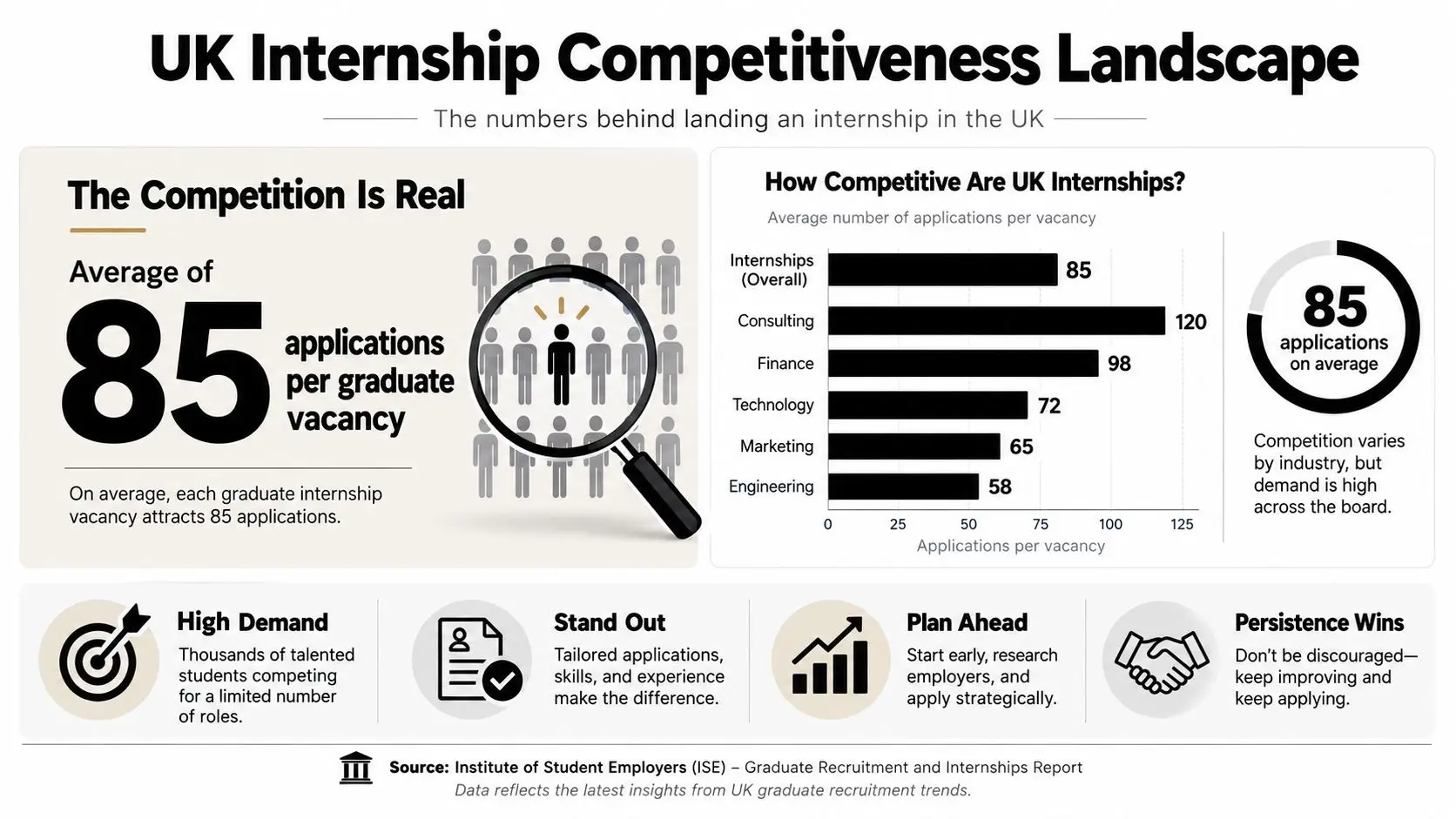
Families need a clear view of how crowded the field is before they start sending applications. The Institute of Student Employers reported an average of 140 applications per graduate vacancy in 2023 to 24, and employers filled 96% of their graduate vacancies. That points to steady demand and to the pressure that sits around the more structured routes, including internships and placements. ISE graduate labour market data for 2024
A high application count changes the strategy. Scattergun applications usually waste time, drain energy, and knock confidence, especially for students who already find change or uncertainty hard to manage. A better approach is to focus on fewer roles that fit the student, apply early, and pay attention to employers that show a clear recruitment process.
What the access gap means in practice
The Sutton Trust found that around one in four 16 to 30-year-olds had done an internship, and access is still shaped by family background. Families feel that gap quickly. Some students are competing on talent alone, while others are also dealing with travel costs, unpaid time, and the practical problem of being free at the right moment. UK internship access and affordability overview
For SEN and SEMH students, that gap can feel sharper because the cost is not only financial. It can include fatigue, sensory strain, transport stress, and the anxiety that comes with unfamiliar settings. Online learning can help here rather than hold a student back, because it can make routines steadier, reduce travel demands, and open access to roles that would otherwise be out of reach.
That flexibility still needs to be used deliberately. A student who studies online, or who has a calmer home base, may be able to target employers outside their immediate area, protect energy for the parts of the process that matter, and keep a more manageable rhythm through the search.
Why structured routes matter more than casual ones
The strongest internships are tied to a clear next step. Employers use them as part of a recruitment pipeline, so the placement should do more than fill a line on a CV. Parents and students should ask whether the role teaches a usable skill, offers proper support, and leads somewhere that makes sense for the young person.
A casual-sounding opportunity can be tempting, especially when a student feels under pressure to say yes to anything. In practice, vague experience is rarely as helpful as a role with defined duties and a clear supervisor. For families, that difference matters because the right placement can build confidence, while the wrong one can leave a young person more anxious than before.
In a market this tight, the emotional pressure is real. So is the chance to make a good match. When the role fits the student, the structure suits their needs, and the timing is realistic, the search becomes more manageable and the outcome is more likely to help rather than overwhelm.
Applying the Three-Layer Evaluation Filter
A lot of families waste energy on listings that should have been rejected in the first minute. A clear filter saves that energy, and for SEN and SEMH students it also reduces the risk of ending up in a place that looks fine on paper but feels chaotic in practice. The simplest version has three checks, legitimacy, pay and status compliance, and skills fit.
The three checks that matter before anyone applies
Legitimacy means the employer is real, the supervision is clear, and the work has a defined purpose. A strong listing tells you who the young person will report to, what they'll do, and how the placement supports learning. A weak one hides behind phrases like “gain exposure” or “learn the ropes” without saying what the student will produce.
Pay and status compliance means checking whether the role is unpaid volunteering or whether it falls under worker status and should attract the National Minimum Wage. UK Government guidance on internships makes clear that the worker and volunteer distinction matters, and it also distinguishes unpaid work shadowing from paid work. That's not a side issue, it's central to whether the opportunity is lawful and fair. UK Government guidance on internships and work experience
Skills fit asks whether the role matches the child's current stage, subjects, and interests. A Year 12 student who enjoys design software won't benefit from a generic admin role if the placement never touches that skill set. A well-matched internship should connect to what the student is already learning or wants to test.
A good placement should feel specific, supervised, and worth the child's time.
| Evaluation Layer | What to Check | Red Flags to Avoid |
|---|---|---|
| Legitimacy | Named supervisor, clear tasks, real organisation | Vague promises, no contact person, “experience only” language |
| Pay and Status Compliance | Whether the role is paid, volunteer, or a true placement | Unpaid work that looks like staff cover |
| Skills Fit | Links to study, interests, or next-step goals | Generic tasks with no learning value |
Families can use this filter quickly. If a role fails any one of the three checks, it probably isn't worth the emotional cost of an application.
Building a Standout Application Package
Online learners often have more experience than they realise, they just don't always package it in employer language. A strong application turns everyday school habits into evidence of reliability, reflection, and follow-through. That matters when the student hasn't had the usual classroom-to-work route and needs to show quality in a different way.
Turning online learning into convincing evidence
A CV should show more than subjects and grades. It should also show how the student works. For example, recorded lessons can demonstrate self-management, live classes can show participation in discussion, and independent projects can show that the student can complete work without constant prompting.
A cover letter needs one clear bridge between the student's learning and the employer's needs. A line such as, “My weekly project work has taught me to organise tasks, meet deadlines, and improve work after feedback,” is far better than a vague promise to be “hard working.” It gives the employer something concrete to picture.
For portfolio material, keep it simple and relevant. A short project summary, a presentation slide, a written response, or a creative sample can tell the story better than a long document full of filler. If a student has used alternative methods because of SEN or SEMH needs, those methods can be framed as evidence of adaptability, not as a weakness.
A useful reference point for statement writing is Queens Online School's guidance on personal statements, because the same principle applies here, show the reader what the student can do, not just what they hope to become.
What strong applications usually include
- CV evidence: short descriptions of projects, leadership, or independent work that show responsibility.
- Cover letter focus: one specific reason the student wants that employer, not ten generic compliments.
- Portfolio choice: only work samples that match the role, so the reviewer can understand the student quickly.
Practical example: a student who works best with structure might mention that recorded lessons help them review instructions carefully, which is useful evidence for any role that values accuracy.
SEN and SEMH students should be honest about the support they use, if they choose to mention it. In many cases, that honesty reads as maturity. The aim is not to hide difference, it's to show the systems that help the child perform well.
Choosing Between Remote and In-Person Placements
Remote and in-person placements each solve different problems, and families shouldn't treat one as automatically better. The right choice depends on the child's stamina, transport access, home environment, and the kind of confidence they need to build. A student who feels settled at home may thrive remotely, while another may benefit from being physically around a team.
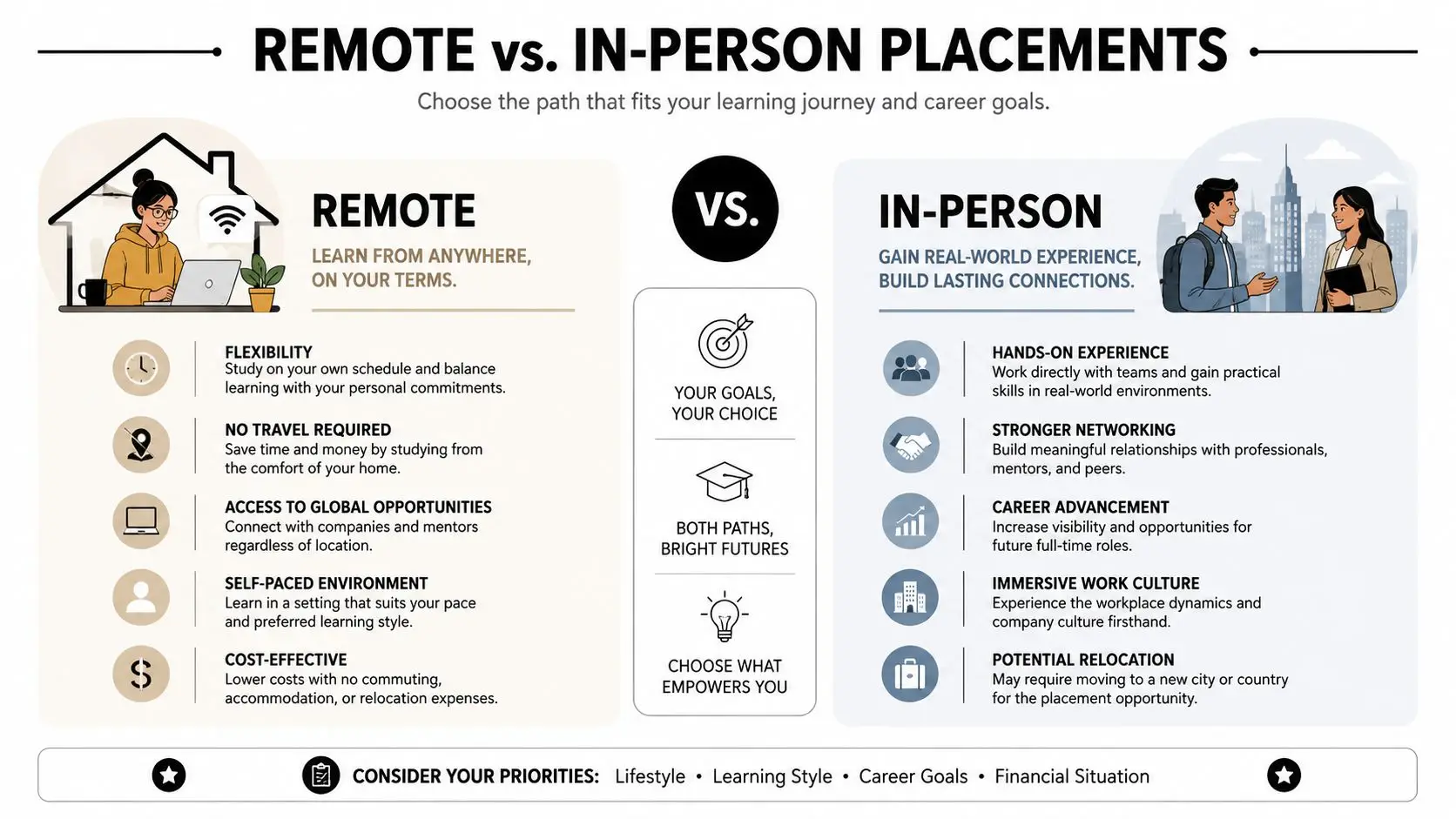
The trade-offs are real
Remote placements often suit students who need predictable routines, fewer transitions, or less sensory demand. They can also help families who are juggling multiple school timetables, caring responsibilities, or travel anxiety. The downside is that visibility can be weaker, and a student has to be much more proactive about communication.
In-person placements usually offer richer informal learning. The student can ask questions more easily, observe professional behaviour in context, and build relationships through small daily interactions. The trade-off is obvious, commuting, cost, energy drain, and for some children, the sheer sensory load of being in a busy environment.
The strongest decision criterion is not prestige, it's fit. A placement that looks impressive but leaves the child exhausted every day is not a win. The right role should support learning without overwhelming the rest of their week.
A simple way to decide
- Choose remote first if the child needs flexibility, quiet, or a controlled setting.
- Choose in-person first if the child learns best through observation, routine, and direct supervision.
- Consider hybrid if the employer allows some combination of home and office attendance.
If your child is already showing signs of stress or overload, it can help to look at practical stress-management guidance such as how to handle burnout at work. The point isn't to medicalise normal nerves, it's to make sure the placement isn't pushing them past their limit.
Preparing for Interviews and Securing Reasonable Adjustments
Interview nerves are normal, but they're harder to manage when a child is already masking stress or worrying about being misunderstood. Good preparation reduces that pressure. It also gives families a way to ask for support without feeling awkward about it.
What to do before the interview
Start with the basics. Research the employer, read the role carefully, and practise answering questions about motivation, strengths, and teamwork. Then practise asking a question back, because a good interview is a conversation, not an exam.
SEN and SEMH students can also ask for reasonable adjustments that make the interview fairer. That might mean extra time, written questions instead of spoken ones, a quieter room, or a short break between stages. These are not unusual demands, they're practical ways to let the employer see the child's actual ability.
A useful place to read more about adjustments in education is Queens Online School's guidance on reasonable adjustments, because the same principle carries across into recruitment. The aim is to reduce barriers, not lower expectations.
Language families can actually use
If you need to contact an employer, keep it direct. Something like, “My child would perform best with questions in writing and a little extra processing time. Could that be arranged?” is clear and respectful. You don't need to overexplain.
Here's the practical test for an employer's response. If they answer calmly, ask what would help, and make the process feel manageable, that's a positive sign. If they seem irritated or dismissive, it may be a poor fit for a young person who needs structure and respect.
Practical rule: the interview is partly about the employer. A child should come away feeling informed, not ashamed for asking to be treated fairly.
Quick questions families often ask
Can a student ask for adjustments before 18? Yes, if they need them. Age doesn't cancel the need for access.
Do adjustments have to be formal? Not always. A clear email often starts the process.
Should parents speak for the child? Only if needed. The long-term goal is self-advocacy, even if a parent helps draft the message.
Creating a Supportive Pathway for Students and Families
A strong internship search usually works best when families, schools, and students each do their part. Parents bring steadiness, schools bring structure, and students bring initiative. If one of those pieces is missing, the process can feel much heavier than it should, especially for SEN and SEMH learners who may already be managing extra pressure.
What parents can do without taking over
Parents help most when they stay in the organiser role rather than becoming the applicant. That can mean checking deadlines, reviewing a CV, or helping a child practise a short introduction before a call. It also means preparing for rejection, because a “no” often reflects timing, fit, or competition, not a child's ability.
A calm parent can make the whole search feel more manageable. Children often borrow confidence from the adult beside them, so steady support matters even when the family is anxious too.
What schools should make easier
Schools should do more than point students towards a jobs board. They can build links with employers who offer structured, remote, or flexible placements, and they can connect work-experience preparation to subject learning. For SEN and SEMH students, that support should feel continuous, not like a separate extra that appears only when careers week arrives.
That is where Queens Online School's mentorship in education fits naturally into the wider picture. When guidance is consistent and learning stays flexible, families have a better chance of planning internship opportunities around the child's needs without losing academic momentum.
What students need to own
Students do not need to be polished before they start. They need enough preparation to apply early, explain their strengths clearly, and ask for help when the process gets stuck. That also means planning around exam periods, energy levels, and travel limits instead of pretending those realities do not exist.
The emotional shift matters as much as the practical one. The late-night scroll that feels overwhelming at the start can become a shortlist, then an application plan, then a real chance at supervised experience. Good support turns noise into action, and it gives the child a process they can follow.
Summary
Parents keep the process calm and practical.
Schools make the route visible and accessible.
Students bring the effort, the voice, and the follow-through.
The result is a pathway that respects the child's needs while still moving them towards work, confidence, and independence.