


Results morning can find a family at the kitchen table in pyjamas, one cup of tea going cold and a teenager's phone open to a secure results portal. The login works, but neither of you knows quite what the screen will say. You're wondering whether the result is provisional, what to do if it's lower than expected, and how to support your child without letting your own worry take over.
For an online learner, the qualification is still awarded under the same regulated exam-board rules as it is for a pupil at a traditional school. The route to the results may feel different, though: the examination centre, portal access and follow-up support all matter. A clear plan can make the morning less fraught and help your child focus on what comes next, rather than treating one grade as a verdict on their future.
The Morning a Family Opens GCSE Online Results
The phone is ready. Your child is beside you, perhaps quiet, perhaps making jokes to hide how tense they feel. You may be holding the login details while they decide whether they want you to look at the screen with them or wait a moment. Let them have a say. That small choice can help a young person feel some control on a morning when the outcome is already beyond their control.

An online portal can be slow, a password can be forgotten, and a result can be a surprise. Those are practical problems, but the emotional question is often harder: what do you say if your child sees a grade they didn't want? Start with the person, not the result. “I'm here. We'll work out the options together” is more useful than rushing straight into a lecture about resits or comparing their grades with somebody else's.
The scale of results day can make it tempting to measure your child against the national picture. In England's summer 2025 series, 1,019,005 students received GCSE results and 5,661,970 individual results were issued. Grade 4 or above accounted for 67.1% of entries, and grade 7 or above for 21.8% (England's summer 2025 GCSE results). Those figures describe the national results, not what any one young person should achieve.
Keep the first conversation simple: your child needs to know you're on their side before you start solving anything.
A steady plan helps with both the login and the feelings that follow. This guide covers how results reach online learners, how to read and check a statement, what to do if something appears wrong, and how to choose a next step that fits your child. The result matters, but it isn't the whole story.
How Online GCSE Results Reach Your Child
There isn't one universal portal for every GCSE candidate. Your child's results normally come through the school or examination centre that entered them, using that centre's arrangements. Check its official instructions in advance. Don't assume an exam-board website will offer a direct student login, and don't treat a message or screenshot passed around before the official release time as confirmation.
For the June 2026 GCSE series, awarding bodies must release results to centres at 00:01 on Wednesday 19 August 2026. Candidates may receive their results from 08:00 on Thursday 20 August 2026, and centres must not release them earlier by email, post or another method (JCQ's June 2026 results-release notice). The early release is for centres, not a licence for families to seek grades overnight.
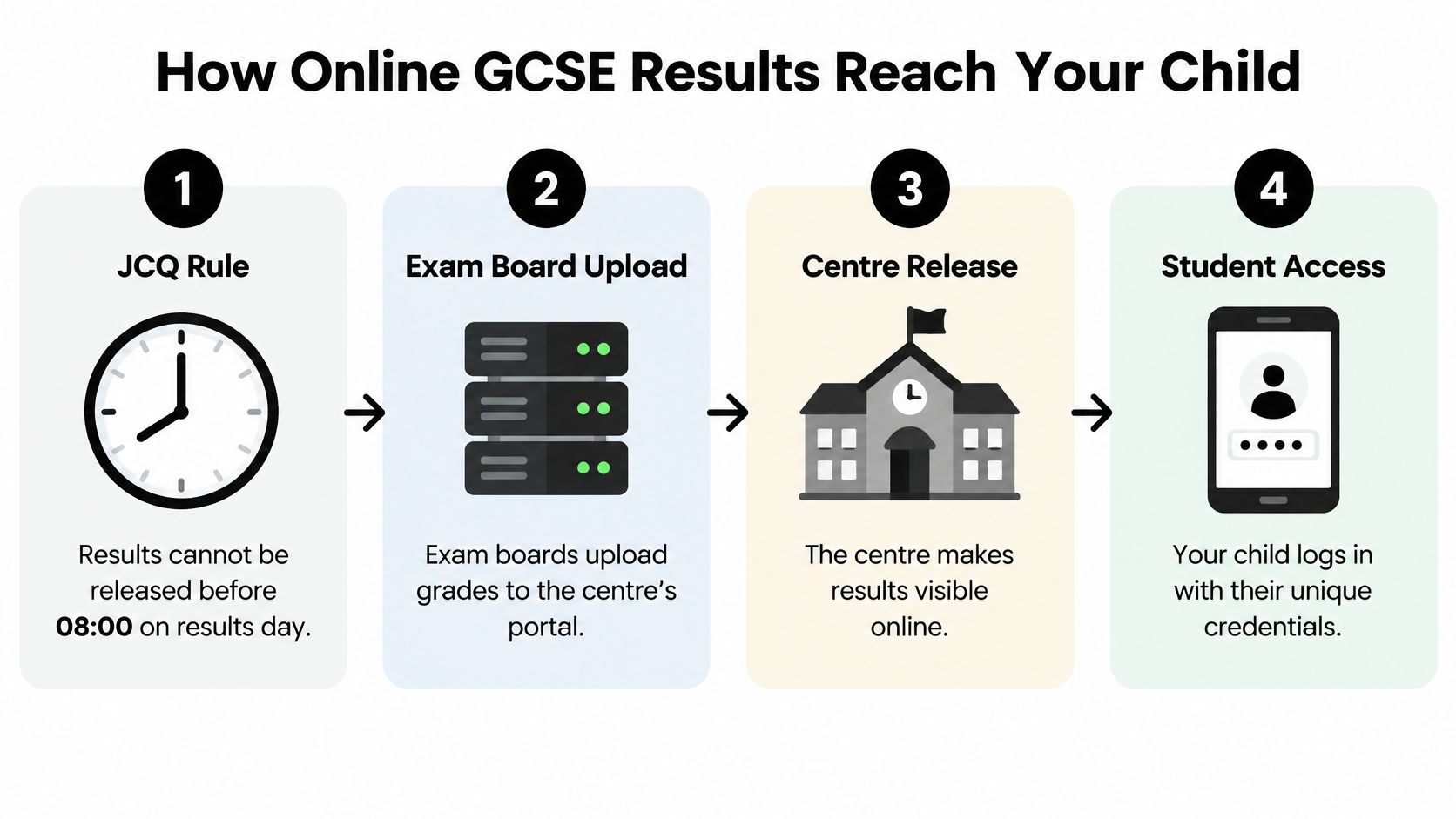
Prepare access before results morning
Ask the centre which portal or secure delivery method it uses, what login the student needs, and when the results will appear. Test the credentials beforehand and save the exams officer's contact details somewhere you can reach without searching through old emails. If your child is travelling or living abroad, arrange a reliable internet connection and confirm how the centre will verify their identity if support is needed.
A pupil with access arrangements should also have a plan for the morning that respects their needs. For example, agree whether they want a parent beside them, a quiet room, or time to read the statement before discussing it. If two children attend different centres, note each centre's release arrangements separately rather than assuming the portals work alike.
If the portal fails
Check that you're using the correct account and the centre's stated release time. Try signing in again or using another device; if the result still isn't available, contact the centre rather than guessing or repeatedly searching for an exam-board login. A parent can help with the technical steps, but let the young person know what you're doing and avoid sharing their results publicly.
If you're also looking for a simple guide to accessing results for a different qualification, see this advice on how to access A-level results online.
Reading the Results Slip Without Panic
Once the screen opens, slow down. A results statement isn't just a list of grades: the identifying details help show that you're looking at the right candidate, subject and qualification. Read one row at a time with your child, and check the subject and grade before interpreting what it means.
A statement may show a candidate number, centre number, qualification code, tier, component marks and a grade. Foundation or higher tier information is relevant where that qualification uses tiers. If a detail is missing or unfamiliar, note it and ask the centre to explain it rather than assuming the result is wrong.
What the grade tells you
Here's a hypothetical example: a Year 11 learner sees grade 7 in English Literature, grade 4 in Mathematics and grade 5 in Combined Science. The grades show different outcomes in different subjects, not a single judgement about the learner. A grade 4 is commonly associated with a standard pass; what a sixth form or college requires depends on its course and entry policy.
The current number scale doesn't translate neatly to the former A*–G system. As a broad comparison, grade 7 is in the A or A* range, while grade 4 is around the old C threshold. That comparison can help a parent understand the scale, but course providers set their own requirements, so check those directly rather than relying on a rough conversion.
National figures can give context, but they aren't predictions for an individual student. In England, 67.1% of GCSE results were grade 4 or above in 2025, compared with 67.4% in 2024; grade 7 or above accounted for 21.8%, compared with 21.6% (England's 2025 GCSE results infographic). These are national results across subjects and ages, not a benchmark your child has to match.
Read the word “provisional” carefully
A result described as provisional can be amended later through the awarding body's post-results processes. Don't mistake that label for evidence that the grade is unreliable, and don't promise your child that it will change. If they're disappointed, acknowledge it before discussing options: “I can see this isn't what you hoped for. Let's check the details and then decide what to do.”
If you want to connect a result with preparation and subject knowledge, a GCSE mock test can help frame a conversation about future learning. It shouldn't be used to dismiss how your child feels today.
Checking a Result Before You React
A quick verification is worth doing before you celebrate, contact a college or ask about a review. A portal screenshot is useful for keeping a record, but it isn't a full audit trail. JCQ's results data brings together information from awarding organisations across England, Wales and Northern Ireland, while government headline results may cover England only (JCQ's exam results data). Make sure you're comparing like with like if you look at national figures.
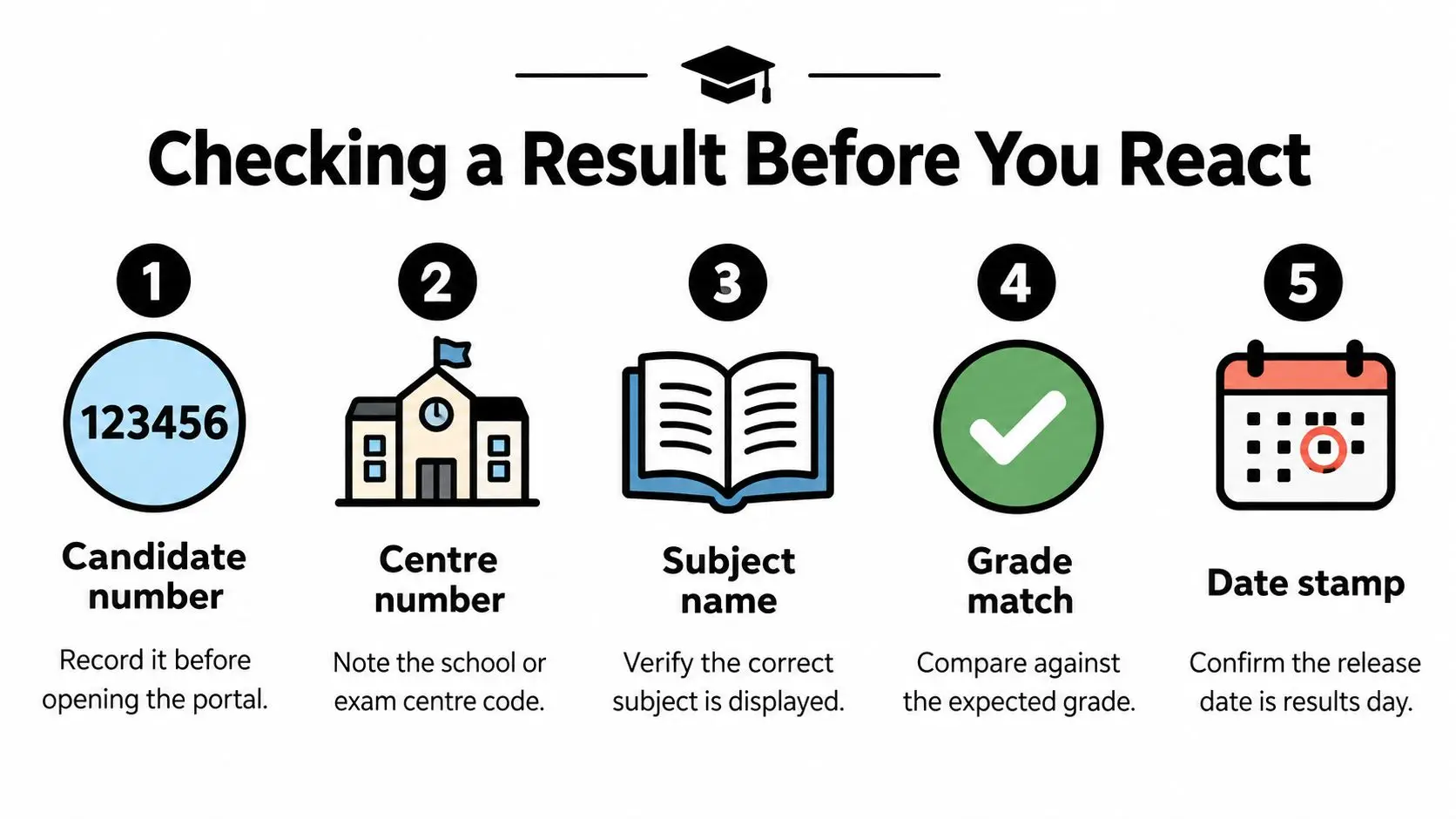
Make a record you can act on
Write down the details while the statement is open:
- Identify the entry: record the candidate number, centre number, qualification code and subject.
- Capture the result: note the tier, paper or component marks, and provisional grade shown.
- Check the awarding-body statement: reconcile the portal information against the centre's or awarding organisation's official statement.
- Confirm its status: ask whether the grade is final, pending, absent or already subject to a review.
- Compare before escalating: check the relevant specification and grade boundary, then ask about administrative errors, missing coursework or access-arrangement records.
An audit sheet with the exam series, centre, awarding body, specification, component marks, access arrangements and review deadlines gives the exams officer something concrete to investigate. It also helps your family separate a genuine query from the natural shock of seeing a different result than expected.
Distinguish a mismatch from disappointment
Suppose a result statement appears to show the wrong tier, or the subject doesn't match the entry your child expected. That is a specific discrepancy to raise with the centre. By contrast, a grade that is lower than hoped, even by a narrow margin, isn't by itself proof of a clerical error. A check of the recorded details can identify an administrative problem; it can't guarantee that a mark will change.
Take a breath before sending an emotional message or committing to a formal process. Ask the centre to explain any unclear row and keep the answer with your records. Five calm minutes spent checking details can spare your family a muddled query and make any necessary follow-up more focused.
Appeals, Reviews, and When to Challenge a Grade
Match the process to the problem before you write a single email. A missing or incorrect entry is a clerical result query. A Review of Results asks the awarding organisation to check marking or administration under its available services. A concern about access arrangements or special consideration goes to the centre first, so it can explain what was applied and which challenge route is open to your child.
A formal appeal is a later stage, not the first move. For most candidates, the examination centre submits requests through the awarding body's secure system, and JCQ's guidance says an appeal can be submitted only after the centre has received the outcome of a Review of Results. The relevant final deadline for Reviews of Results for the 2026 series is scheduled for 18 February 2027, so confirm the date with your centre before relying on it (JCQ's 2026 post-results guidance). For a family studying online, that centre relationship deserves early attention: your child may never have met the exams officer in person, so get the contact name, email and internal deadline in writing well before results day. Ask promptly about the centre's own deadline, any fee, which review applies and whether access to the script is appropriate.
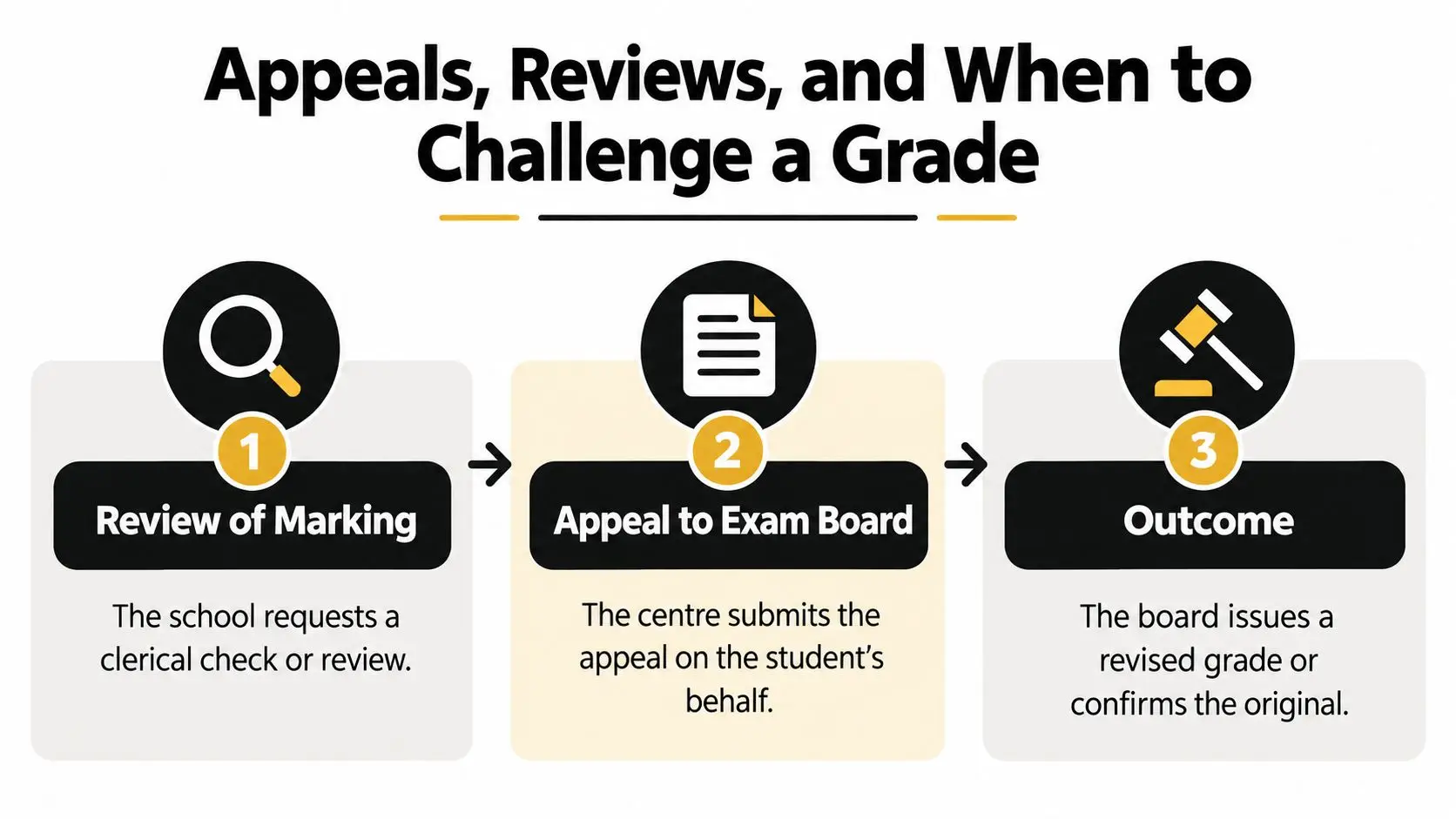
Who contacts whom
Start with the centre, not the exam board. Explain the concern clearly and give the subject, qualification and statement details from your records. A private candidate should contact the examination centre that entered them and ask who will handle the review; private candidates may be able to appeal directly to an awarding organisation after the required review or decision process.
An appeal and an Examination Procedures Review Service complaint are not interchangeable. If your concern is about how the procedure was followed, ask the centre or awarding organisation which route applies before submitting anything. Expect weeks, not days: the same JCQ guidance sets a target of up to 42 calendar days for a preliminary appeal and a further 70 days for an appeal hearing, so plan any challenge around sixth-form enrolment dates.
England recorded 1,165 GCSE appeals in 2024–25, up from 1,065 the previous year; 690 were upheld, including 525 associated with at least one grade change. Across GCSE, AS, A-level and project-qualification appeals, 56.6% were upheld overall (official 2024–25 appeals statistics). Appeals aren't automatically futile. They aren't a promise of a changed grade either.
An appeal is a formal check, not a shortcut. A mark may rise, stay the same or fall, so weigh the evidence and the timing with your child's next-step plans in view.
A parent worried that an access arrangement wasn't recorded should raise that specific concern with the centre, rather than assuming a review of marking will address it. If sixth-form enrolment is close, tell the provider that a review is being considered and ask how it will handle a pending outcome. For the full sequence of steps, timings and paperwork, this guide to appealing exam results lays the process out clearly.
Turning Results Into the Right Next Step
A result is a starting point for a decision, not a verdict on a young person. Begin with what your child wants to do, then compare their grades with the requirements of the course or provider they're considering. If a learner has strong grades, including several grade 7s or above, discuss suitable A-level subjects and check entry criteria directly. For applications beyond the UK, ask the institution how it wants qualifications verified.
A grade 4 in English and Mathematics may meet a basic pass threshold, but it doesn't automatically meet the conditions for every course. If your child has a grade 3 in Mathematics, speak with their college about options such as a resit, an alternative qualification route, or a course with further maths study built in. Don't frame the conversation as punishment. The right route is the one that supports the learner's goals and wellbeing.
Online learning doesn't change who awards the grade
Parents often ask whether the school or exam board issues the result, whether a learner can take a November resit, how to prove grades to a college or overseas university, and whether an entry through Pearson is recognised in the same way as an entry through another centre. Ask the centre and intended institution to confirm the arrangements for that specific qualification and course. The student's lessons may be online, but the awarding body and registered examination centre govern the assessment and result.
Digital marking is already common. In England's summer 2025 series, 93.4% of GCSE papers and 97.7% of scripts were marked online, and Ofqual reported increased post-16 entries for GCSE English language and mathematics (Ofqual's delivery report). That doesn't mean every exam is taken remotely, every student uses one results portal, or an online school awards the grades itself.
Let your child rest before you expect them to make a big decision. A disappointing result may need a practical conversation, but it also needs room for the young person to be upset, relieved or tired.
Your Results Day Plan and FAQs
Keep this plan where the family can find it:
- Before results day: confirm the centre's portal, login details and contact information.
- From the official release time: sign in using the centre's instructions.
- After opening the statement: save a secure copy and check the candidate, subjects and grades.
- Before making decisions: ask the centre about anything unclear, then discuss next steps with your child.
“Online GCSE result” means the centre has made results available through its chosen secure route. The same principle applies to online, home-educated and international learners: confirm the arrangements with the examination centre that entered the candidate. If a family requests an appeal, the preliminary appeal target is up to 42 calendar days, with a further 70 days for a hearing, so ask the centre about timing rather than promising a quick outcome.
If the child's emotional response is bigger than the grade, listen first and pause the problem-solving. Support needs are part of this conversation: 18.7% of pupils at the end of Key Stage 4 in state-funded schools in England had a special educational need in 2024/25, and the grade 5 or above gap in English and mathematics between pupils with an EHCP and those receiving SEN Support was 14.9 percentage points (England's Key Stage 4 performance statistics). That population-level gap doesn't define any individual child; discussing appropriate support is reasonable.
When you need to organise academic questions and follow-up, login for personalized academic guidance can be one way to seek guidance. Keep your child at the centre of every decision. The result is one data point; your child is the whole story.
Queens Online School offers live online teaching across the British curriculum, including GCSE and A-level study, with subject-specialist teachers and personalised support for learners. If your family is considering flexible online education and wants to understand how exam preparation and results arrangements fit together, visit Queens Online School to explore its approach.