

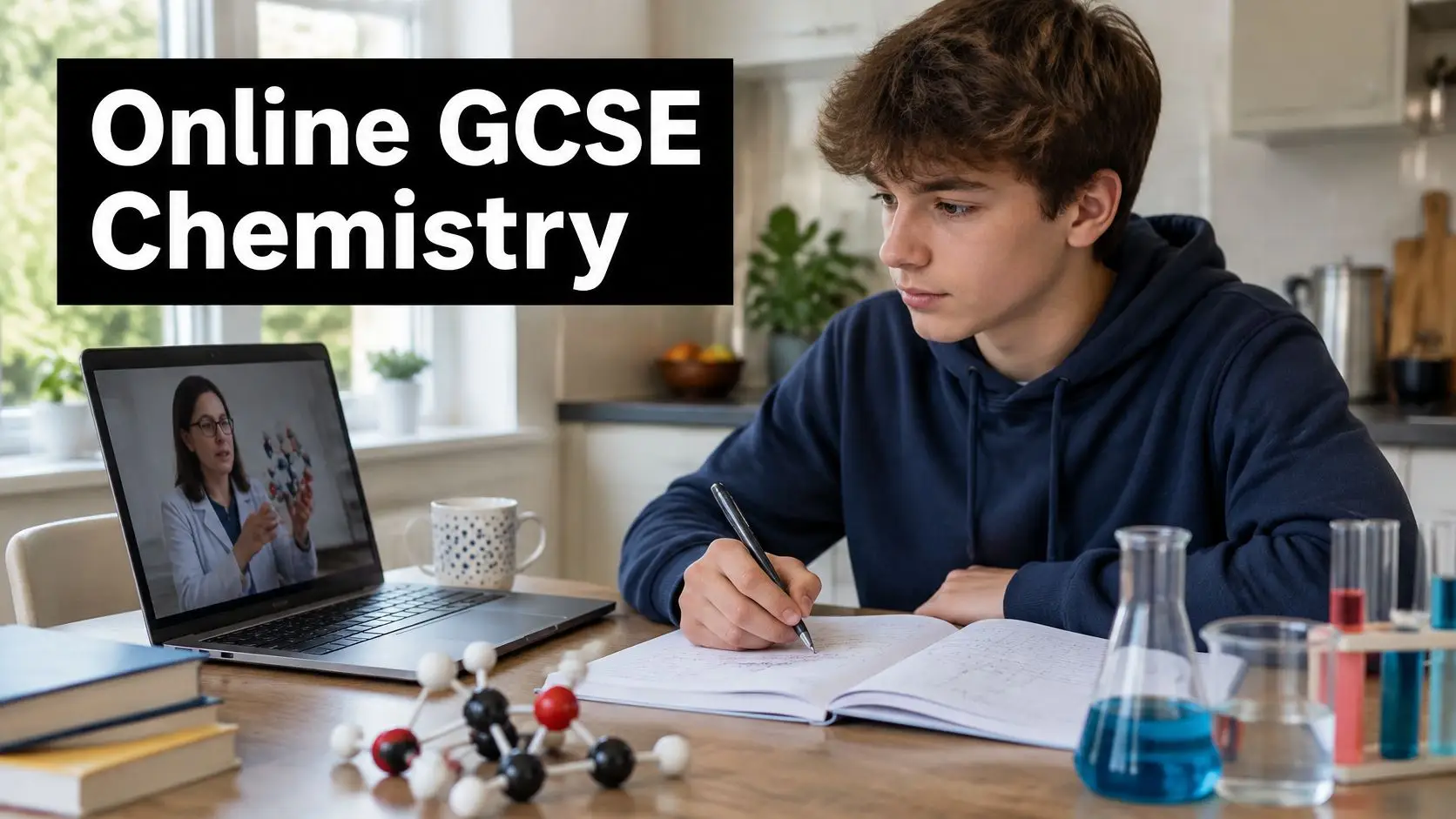
The report says your child is capable. The Chemistry teacher says the work isn't coming in. And you're at the kitchen table at ten at night with six browser tabs open, trying to work out whether online GCSE Chemistry is a genuine route to a recognised qualification or an expensive library of videos.
Both things exist, which is what makes the decision feel slippery. Some online Chemistry courses are taught live by subject specialists, examined at approved centres, and accepted by universities. Others are a login, a folder of recordings, and an inbox nobody monitors. The difference rarely shows up on the sales page. It shows up in March, in a mock paper, when nobody has checked whether your child can write a balanced equation under time pressure.
Here's how the subject works when it's taught online, where the Chemistry-specific gaps appear, and what to ask before you pay anyone.
What Online GCSE Chemistry Really Involves
It's six o'clock on a Tuesday. Your child is at the kitchen table with a worksheet asking why sodium chloride conducts electricity when molten but not when solid, and neither of you is confident enough to explain it.
That question is a fair test of any course. Yes, online GCSE Chemistry can teach it properly, but only when three conditions hold at once: the lessons are live, the teacher is a Chemistry specialist rather than a generalist covering a timetable gap, and the work is mapped to a named exam board specification. A video library can't do it, because nobody discovers that your child has misunderstood why the ions are free to move until an examiner does.
The test of a Chemistry course isn't whether the explanations look clear. It's whether anyone finds out what your child has misunderstood.
The subject itself is large, and it stays large after a dip. In England, 163,100 GCSE Chemistry entries were recorded for the summer 2025 exam series, a 6.7% decrease from 174,745 entries in 2024, according to the Department for Education's provisional entries statistics for summer 2025. One year's fall doesn't make Chemistry a niche choice. It remains one of the bigger single sciences, and providers keep teaching it.
Three jobs every Chemistry course has to do
Who sits it matters too. Government provisional-entry data shows 97.8% of summer 2024 entries came from Year 11 pupils, with 0.5% from Year 10 or below and 1.8% from Year 12 or above, as recorded in the 2024 provisional entries release. The typical learner is fifteen or sixteen and working to a school-shaped year, not an adult returning to study.
Every credible course teaches the specification content, runs the required practical work, and prepares the learner for timed written exams. A Year 11 student working on rates of reaction meets all three inside one week: a warm-up on collision theory, a practical log entry for the marble chips experiment, and a timed question on the factors that change rate. Strip out any one of those and the course is teaching a different subject from the one being examined.
Families planning further ahead sometimes work backwards from university requirements, using a guide to required courses before medical school to see where a Chemistry GCSE sits in a longer path. That's sensible planning, as long as the qualification in front of your child gets passed first.
Behind most searches for this course sit three feelings: fear of falling behind, guilt about screen time, and the hope of seeing a child feel capable again. A good provider answers all three. A weak one exploits them.
Core Parts of an Online GCSE Chemistry Course
A course can look complete on a website yet leave a gap in the learning. Check each part below to see what your child will study, how their work will be reviewed and what questions to ask before enrolling.
| Component | What the child does | What to check | Warning sign |
|---|---|---|---|
| Live lessons | Joins lessons with a teacher and has opportunities to ask questions | Lessons are live, with questions answered in real time | Recordings only, with no live questions |
| Specification content | Studies topics such as atomic structure, bonding, quantitative chemistry, rates of reaction and organic chemistry | The provider names the exam board specification and explains which topics and papers the course covers | No specification or paper structure named |
| Practical log | Completes required practical activities and records results | A written log is kept and reviewed by a teacher | Practicals shown only as videos, with no record kept |
| Assessment | Completes quizzes and other tasks, with feedback | The provider explains how feedback is given and how mock exams are used | Automatic quizzes only, with no written feedback |
| Final exams | Sits external papers at an approved exam centre | The provider explains how exam-centre arrangements work | Claims that all exams are taken at home |
| Support | Has a way to ask academic questions and raise concerns | The provider explains who students can contact and how | Only a general helpdesk is described |
The word interactive is doing a lot of work
A parent may reasonably ask whether “interactive” means their child has to speak in every lesson. It should mean there is a genuine way to take part, whether by speaking or using a written route to ask questions. A learner who freezes when put on the spot still needs a way to show confusion before it turns into a gap in understanding.
Check whether the course teaches Chemistry as a separate GCSE subject or as part of a combined Science course. Ask which specification and paper structure it follows, and how it covers Chemistry topics in enough depth. Queen's Online School lists Science among its GCSE subjects. Its GCSE Science course information can help families check what is offered.
Quantitative chemistry is a useful topic to ask about. Students need to connect measurements such as mass, amount of substance and volume when solving problems. A clear explanation of how to work out molar concentration can help make that relationship easier to follow, but a course should also give students practice applying it to chemistry questions.
Use the warning signs as prompts, not automatic verdicts. If a provider cannot explain a row clearly, ask again before enrolling. A straightforward answer helps you judge whether the course fits your child's needs.
A Week of Live Chemistry Lessons
A clear weekly rhythm can make online Chemistry feel manageable. Priya, aged fifteen, knows what to expect from each lesson, so she can give her attention to the subject rather than wondering what will happen next.
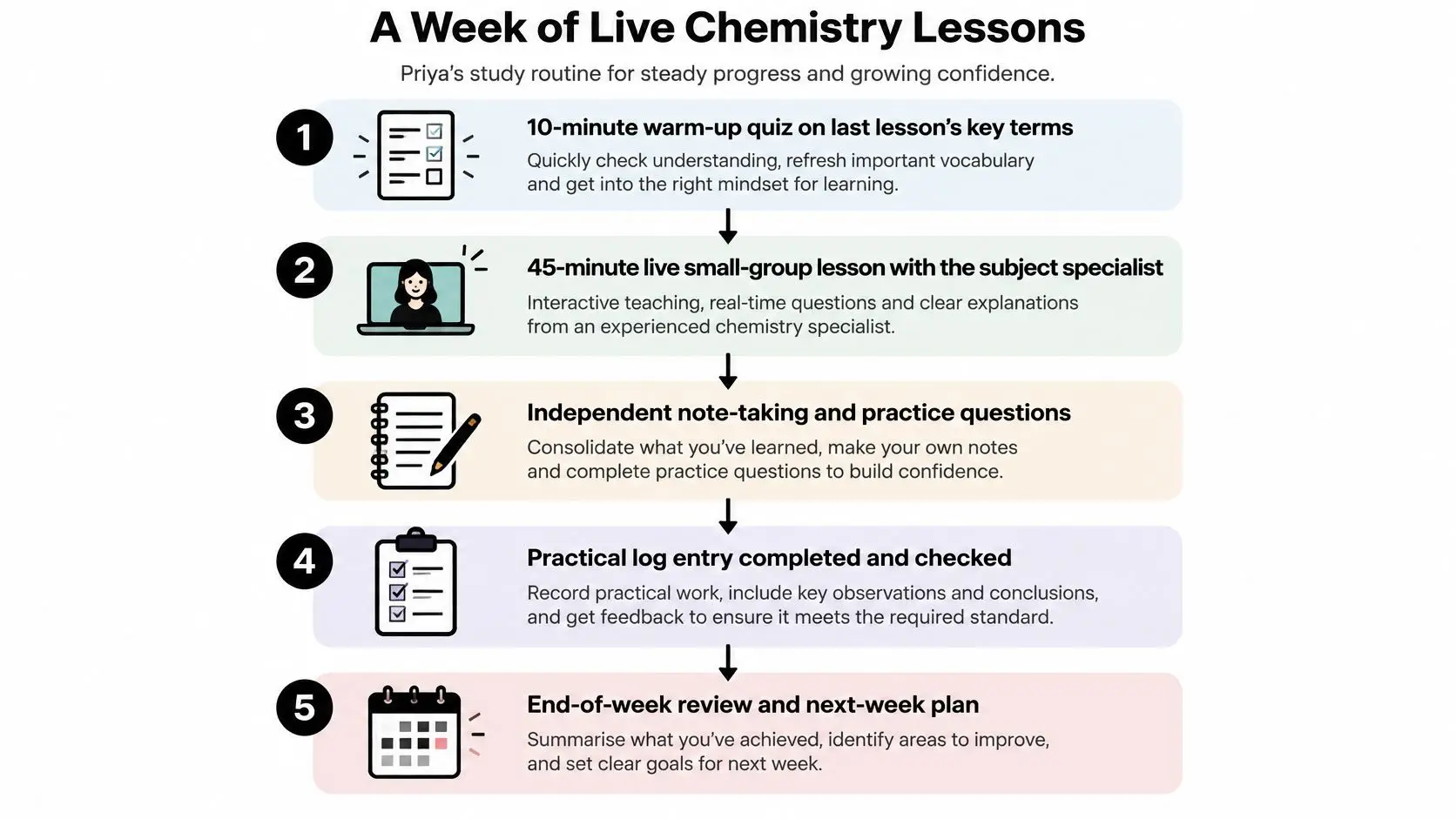
- A short retrieval quiz. Before the lesson, Priya answers questions on key terms from the previous class. Revisiting words such as electrolyte and electrode helps her recall them when they appear in a new explanation.
- A live lesson focused on one topic. This week, the class studies acids and alkalis. Keeping the lesson centred on one area gives the teacher room to explain it carefully and notice where students need another example.
- A low-pressure way to respond. Priya can answer a poll before being invited to speak. The teacher can see who may need help, while students who feel anxious have time to organise their thoughts.
- A worked question with feedback. Priya tries a pH calculation while the teacher is available to clarify a step she has misunderstood. That immediate correction can stop the same error appearing in later practice.
- A recording for review. If an explanation does not make sense the first time, Priya can return to it later and pause where needed.
- A private check-in. A short conversation with her teacher gives Priya a quieter way to say that she is stuck or worried about keeping up.
A steady routine can reduce uncertainty, especially for a learner who finds speaking in front of a group difficult. The emotional benefit is practical: when the next step is familiar, there is less to manage before the Chemistry begins.
Government wellbeing reporting found that 5% of 9-to-17-year-olds were unhappy with their online experiences, and that 29% said online safety was one of their main worries about the future, according to the Department for Education's wellbeing research. For an online learner, a predictable schedule and a private way to raise a concern can make it easier to ask for help when something feels wrong.
Priya may still finish a lesson unsure why pH 2 is more acidic than pH 5. She can revisit the explanation, then ask for help if the recording leaves a gap. Before enrolment, ask how lessons are recorded and how students can contact a teacher privately. A provider should be able to explain these arrangements clearly, just as businesses seeking to boost course sales with FOMOchat need to communicate what they offer.
Signs that the routine is helping include a child asking questions without prompting, keeping up with assigned work, and talking about an upcoming lesson with less reluctance. Progress will not look identical every week, but a clear route to help matters when Chemistry feels difficult.
Building Practical Skills Without a Laboratory
It's tempting to assume practical chemistry needs a bench, a fume cupboard and a teacher watching everyone's hands. The exam asks for something narrower and more achievable.
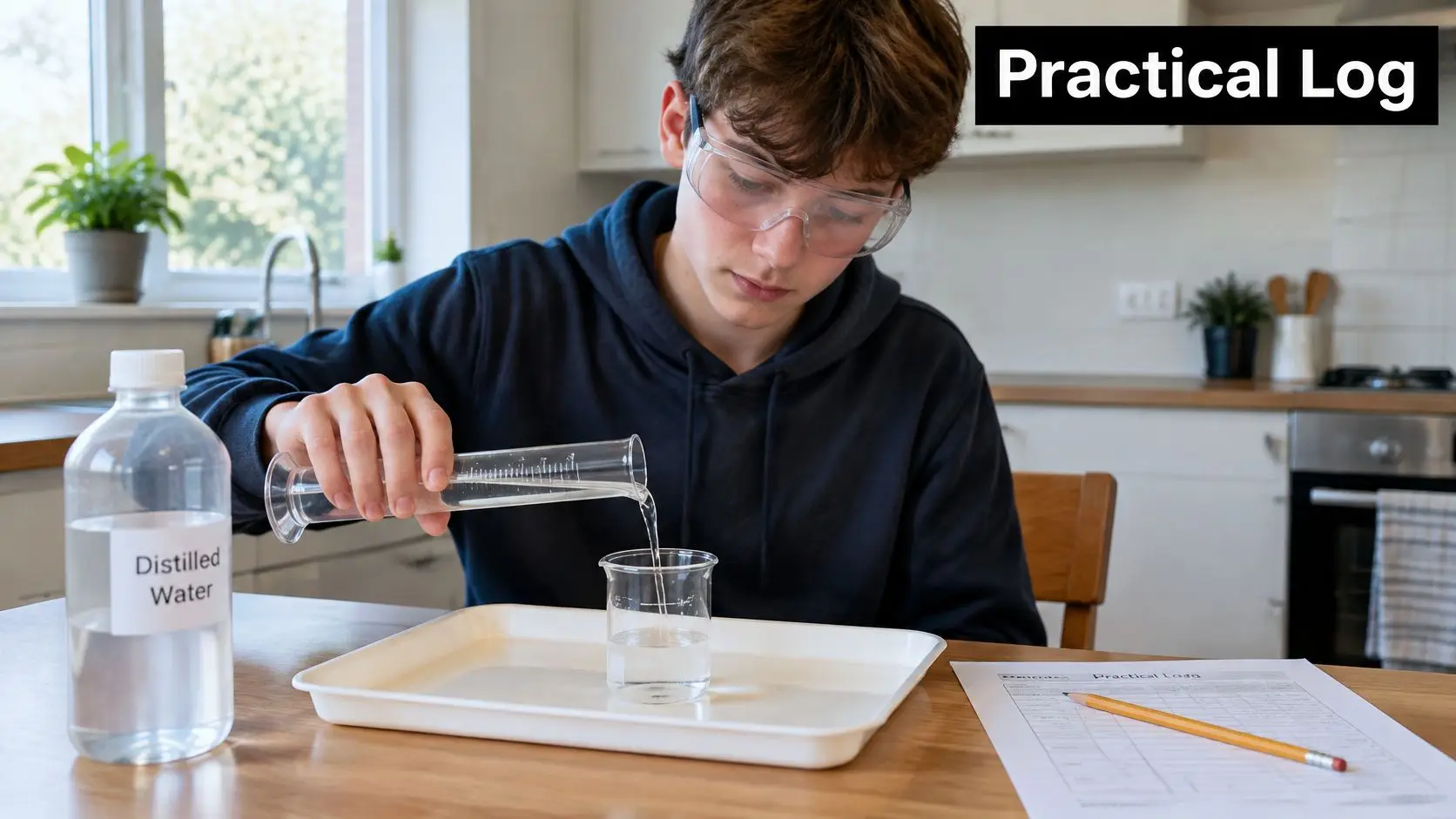
Ofqual's requirements state that an individual science GCSE must include at least 8 specified practical activities, while Combined Science must include at least 16. Schools must enable students to complete the full range and keep a record of the work, and at least 15% of the qualification's total marks must come from questions drawing on practical experience, as set out in the government consultation on assessing practical work in GCSE science.
There's no separate practical endorsement, which some families read as "practicals don't count". They count entirely, just through written papers. Exam boards require schools to provide opportunities for students to complete the specified activities and to keep contemporaneous records, and the AQA practicals handbook is explicit about safety procedures, risk assessment, reproducibility and evaluating investigations.
Three different skills that look like one
A learner needs three things that online content often blurs together. Understanding a method is the first; carrying it out safely is the second; answering unfamiliar written questions about variables, errors, data quality and improvements is the third. Only the third is directly marked, and only the third is routinely taught badly.
Take the reaction between hydrochloric acid and marble chips. A strong learner records the mass of chips, the acid concentration, the gas volume collected and the time taken, then explains why surface area and temperature had to be controlled. That's not a video to watch. It's a data set to interrogate, and a good teacher will keep changing the variables until the reasoning is secure.
Some activities cannot be reproduced at home. Anything involving heating to high temperature, concentrated acids, or hazardous gases belongs in a recorded demonstration where the teacher talks through the hazards and the control measures while the student watches. That's not a compromise. It's the same judgement a school makes when it decides which practicals go ahead with a class of thirty and which run as a demonstration.
Practical rule: if a provider can't tell you where the practical log is kept and who checks it, the practical element is marketing rather than teaching.
A usable log has five fields for every activity: the date, the method, a results table, a graph where relevant, and a conclusion that names the error sources. Ask to see the format. Then ask who marks it, and how often.
Assessment, Grades and Where Exams Are Taken
Online doesn't mean unassessed. GCSE Chemistry is an externally assessed qualification using England's 9 to 1 grading scale, with grades 9 down to 1 plus U and "No result" recorded where applicable, and Chemistry carries the general subject code RD1 in government qualification metadata, as recorded in the Department for Education's GCSE results data.
Ongoing assessment is not the same as the final exam
Two different things are happening across the two years, and families often conflate them. Coursework, quizzes and other ongoing assessments are typically completed online as part of regular lessons, and that's where the useful feedback lives. The final papers are sat in person at approved exam centres rather than at home, in line with UK examination board requirements. You'll need to arrange a centre early and plan for travel on the day.
A worked example shows how the two connect. After a mock paper on bonding, a student sees she lost four marks on explaining properties of ionic compounds, not on the bonding diagram. Her teacher sets a targeted quiz on that specific explanation, then a second exam question two weeks later to check it stuck. That loop, marking to diagnosis to re-testing, is what you're paying for.
What the grade numbers mean
A grade 4 is broadly the standard pass that sixth forms, colleges and employers look for, and a grade 7 sits in the strong band. The national picture gives you a sense of the competition: across all GCSE subjects in England in 2024, 21.7% of grades were at grade 7 or above, while 67.4% were at grade 4 or above, according to the same GCSE results release.
The qualification that comes out of this is the standard one. Recognised GCSE, International GCSE and A Level qualifications are accepted by universities, colleges and employers in the UK and internationally. If you want the practical detail on centres, timetables and entries, our guide to the GCSE online exam walks through what happens and when. The one thing to sort out early is where and when your child sits the papers, because that date drives the entire revision plan.
Support That Meets Different Learning Needs
A student with dyslexia may understand a chemical equation but lose their place when copying it from a crowded screen. In Chemistry, vocabulary, symbols, calculations and data interpretation can all add to the reading load, so a format that works for one learner may create extra barriers for another.
Access arrangements such as extra time, a reader or a scribe are agreed through the school or exam centre. They support a student during assessment; they do not replace the teaching and practice needed to learn Chemistry. In England, between 18.0% and 27.7% of students assessed in at least one qualification had at least one valid access arrangement in 2024 to 2025, which is 256,790 to 394,785 learners, up from the 15.9% to 22.5% range recorded the year before, according to the government's access arrangements statistics.
Support should respond to the barrier, not assume every student needs the same change. A learner with dyslexia may benefit from uncluttered notes, read-aloud-friendly text and clearly spaced equations. A student with ADHD may find a long task easier when it is divided into visible steps, with one instruction at a time. For working-memory difficulties, a scaffolded equation sheet can help a student practise a method before relying on memory.
For a learner with SEMH needs, ask how lessons make participation manageable and how the teacher gives feedback. Captioned recordings can let students revisit an explanation, while live teaching gives them a chance to ask questions and receive a response.
Needing a second route to the same idea is a normal path to mastery. It is not evidence that a child cannot do Chemistry.
Queen's Online School supports learners with SEN and SEMH needs, so ask its team how an arrangement is requested, who holds the evidence, and how it reaches the exam centre before you enrol. For background, read about reasonable adjustments in exams.
Choose the Right Course for Your Child

A Chemistry course can look convincing online and still leave important questions unanswered. Before enrolling, compare providers on five points and write down what each one says.
- Subject-specialist teaching: Who teaches Chemistry, and can they explain ideas such as why pH 2 is more acidic than pH 5?
- Live lessons: How do teachers check that quieter students are following the lesson?
- Practical work: Ask how practical activities are delivered and how any work or records are reviewed.
- Access arrangements: Who explains the process for requesting adjustments, and how is information shared with the exam centre?
- Exam arrangements: Where will your child sit the exam, and what should you know about travelling to the centre?
Queen's Online School is one option to consider. It offers GCSE, International GCSE and A Level qualifications and is a Pearson Edexcel Approved Centre. Check whether the Chemistry course covers the specification your child needs, then ask about the timetable, fees and enrolment deadlines.
Use these questions to guide a conversation with any provider:
- Can we see a sample live lesson?
- Who teaches Chemistry, and how are lessons scheduled?
- How is practical work delivered and recorded?
- Where are exams sat, and how are arrangements confirmed?
- Who can discuss how the course will support my child's needs?
A good fit should make it possible for your child to ask questions and for you to understand how their learning is progressing. Those answers matter more than a long list of features.
At Queen's Online School, Chemistry is taught live by subject specialists, and exams are sat at approved exam centres in line with UK examination board requirements. Before enrolling, ask the school to explain how practical work is delivered and recorded, so you can judge whether the approach suits your child. You can visit Queen's Online School to learn about its courses and arrange a conversation.