

Your child can finish a Spanish worksheet, but the moment someone asks them a question aloud, they look to you for help. You're considering online lessons because the school timetable isn't working, your child needs a calmer setting, or getting to lessons has become difficult. Yet you're worried that learning through a screen might make speaking even easier to avoid.
A good online GCSE Spanish course should make your child's progress visible, especially when they have to respond without a script. Before enrolling, look beyond lesson recordings and ask how teachers prepare pupils for the actual speaking assessment, who arranges the exams, and what happens when a learner loses confidence.
What an Online GCSE Spanish Course Covers
GCSE Spanish assesses listening, speaking, reading and writing at 25% each, as set out in Pearson Edexcel's GCSE Spanish getting started guide. That even weighting is a useful test of any course. A vocabulary app or a stack of written grammar drills can build useful knowledge, but neither shows that your child can follow a fast recording or answer a question aloud.
The four GCSE Spanish skills and how an online course practises them
| Skill | Share of marks | What the exam tests | How a live course practises it |
|---|---|---|---|
| Listening | 25% | Standard spoken Spanish from several speakers in public and social settings | Short recorded listening sets, then live discussion of answers |
| Speaking | 25% | Role play, picture or text stimulus and a conversation on more than one topic, according to the specification | Small-group conversation, timed tasks and recorded practice with feedback |
| Reading | 25% | Unseen texts and comprehension of varied written Spanish | Guided reading lessons that move from supported to unseen texts |
| Writing | 25% | Extended written responses in Spanish applying grammar accurately | Timed paragraph tasks marked by the teacher with targeted corrections |
The table describes the shape of the exam, not the fine print of every awarding body. GCSE and International GCSE can look similar on a course page and still differ in tasks, timings and assessment arrangements. Ask which qualification the course prepares your child for before you compare lesson schedules.
Grammar needs to become usable language
A child may recognise a past-tense verb on a worksheet and still miss it in a recording or freeze when asked to use it. Good teaching joins those steps: hear the verb in a short extract, find it in a text, say a sentence with it, then write one independently. The Department for Education's modern foreign languages subject content requires applied grammar, so check that materials match the current specification rather than an older course with a new label.
For a child who writes confidently but goes quiet in conversation, predictable oral practice matters more than a tidy worksheet score. Online lessons can rehearse the speaking exam's real demands, including the role play, picture or text stimulus and topic conversation, under timed conditions. What they cannot do is sit the exam for your child. The course should therefore give them repeated chances to speak without a script and receive specific feedback on pronunciation, tense choice and recovery after a mistake.
For general background on how modern foreign languages GCSEs are structured, see the modern foreign languages GCSE information from Queen's Online School. Check separately that your chosen provider offers GCSE Spanish, because subject lists differ between online schools.
Practical rule: Ask for separate evidence for listening, speaking, reading and writing. One overall grade can hide the skill your child most needs to practise.
A Typical Week on an Online GCSE Spanish Course
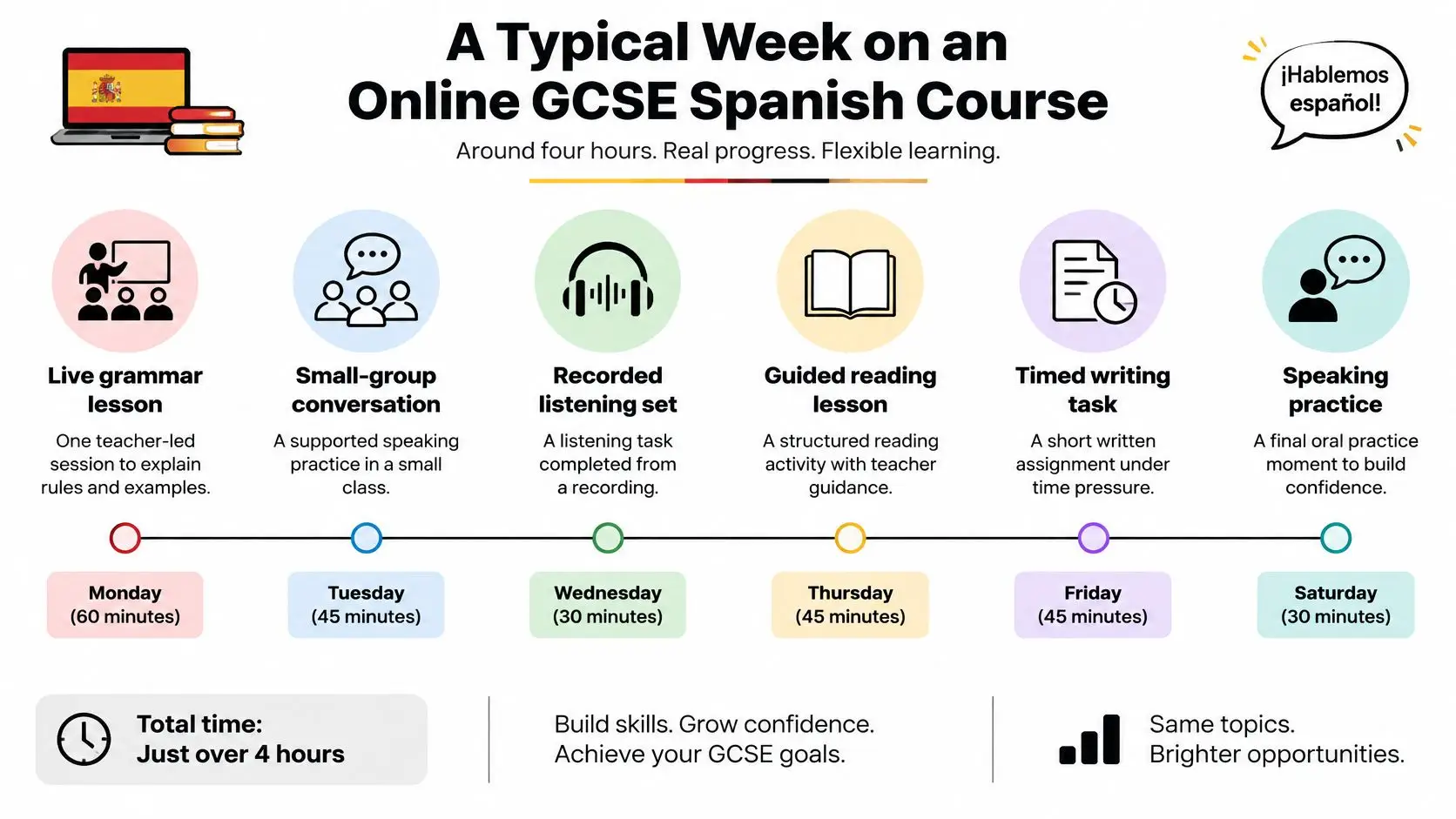
A manageable week gives your child different ways to practise without turning every evening into another school day. The following is a hypothetical reference timetable, totalling about four hours, not a statement of any provider's required hours.
Sample weekly timetable for an online GCSE Spanish course
| Day | Activity | Skill focus | Length |
|---|---|---|---|
| Monday | Live grammar lesson | Grammar and writing | 60 minutes |
| Tuesday | Small-group conversation | Speaking | 45 minutes |
| Wednesday | Recorded listening set and quiz | Listening | 30 minutes |
| Thursday | Guided reading lesson | Reading | 45 minutes |
| Friday | Timed writing task, teacher-marked | Writing | 45 minutes |
| Weekend | Speaking recording with feedback | Speaking | 20 minutes |
Providers organise teaching differently. Some combine reading and grammar in a live lesson; others set independent tasks beforehand so the teacher can spend lesson time checking understanding.
This visual schedule shows how that sample week could feel to a learner.
How the work develops
In a typical course plan, Year 10 establishes vocabulary, grammar and a familiar speaking routine. The middle stage introduces more independent work and diagnostic checks; Year 11 places greater emphasis on suitable past papers, speaking mocks and writing under exam conditions.
That progression shouldn't become a rigid march through topics. Say a diagnostic task shows that your child understands a holiday text but repeatedly uses present-tense verbs when describing a past holiday. In a hypothetical four-week adjustment, the teacher might redirect two existing practice sessions towards past-tense grammar and writing while maintaining listening, reading and conversation.
The important word is redirect, not add. A tired child who sees an ever-growing task list may begin avoiding Spanish altogether.
- Keep the purpose visible. Explain that a short verb task will help them describe something they did, rather than presenting it as extra punishment.
- Use feedback before new work. Revising yesterday's paragraph can be more useful than completing another uncorrected exercise.
- Adjust for avoidance. If your child keeps skipping oral work, replace a less urgent task with a brief speaking recording rather than extending the whole week.
Agree the adjustment with your child. A plan they understand is more reassuring than a timetable that changes without explanation.
Exam Entry, Centre Status and Tier Choice
An online course and an examination entry are different arrangements. GCSE, International GCSE and A Level exams are sat at approved exam centres rather than at home, in line with examination-board requirements. Your child needs to know where they'll go, not discover an unfamiliar venue shortly before assessment.
At Queen's Online School, we're a Pearson Edexcel Approved Centre and a registered UCAS centre. These credentials have different purposes: awarding-body approval concerns examination provision, while UCAS registration concerns university applications. Neither should be treated as proof that every subject or assessment can be delivered in every location.
Establish who is responsible
Use our online exam information to begin the practical discussion. Confirm the arrangements for your child's particular qualification and location, including:
- Entry ownership. Who submits the examination entry and confirms that it has been accepted?
- Venue arrangements. Where will each paper and the speaking assessment take place, and who books the place?
- Centre checks. What is the centre's awarding-body approval, and how can you independently confirm its status?
- Travel and support. What does your child need to bring, and who should they contact if something goes wrong?
A calm visit or clear description of the venue can help a child who finds unfamiliar places unsettling. Don't assume that a teaching provider's office is also the examination venue.
Make the tier decision deliberately
For Pearson's GCSE arrangements first assessed in summer 2026, the centre must decide the tier before the speaking assessment, and the candidate remains on the same tier across the qualification, according to the Pearson information manual.
Ask how the recommendation will be made, when it becomes final, and whether a change remains possible if mock results reveal a mismatch. The decision should reflect your child's performance across the qualification, not just their strongest written exercise.
Before committing, obtain written confirmation of entry deadlines, examination fees and responsibility for booking. Those details belong alongside the teaching agreement, not in a separate conversation months later.
How the Speaking Exam Works and How to Prepare Online
A nervous child needs to know what they'll be asked to do, what they may prepare, and what happens when they don't immediately understand a question. Telling them to be confident isn't enough.
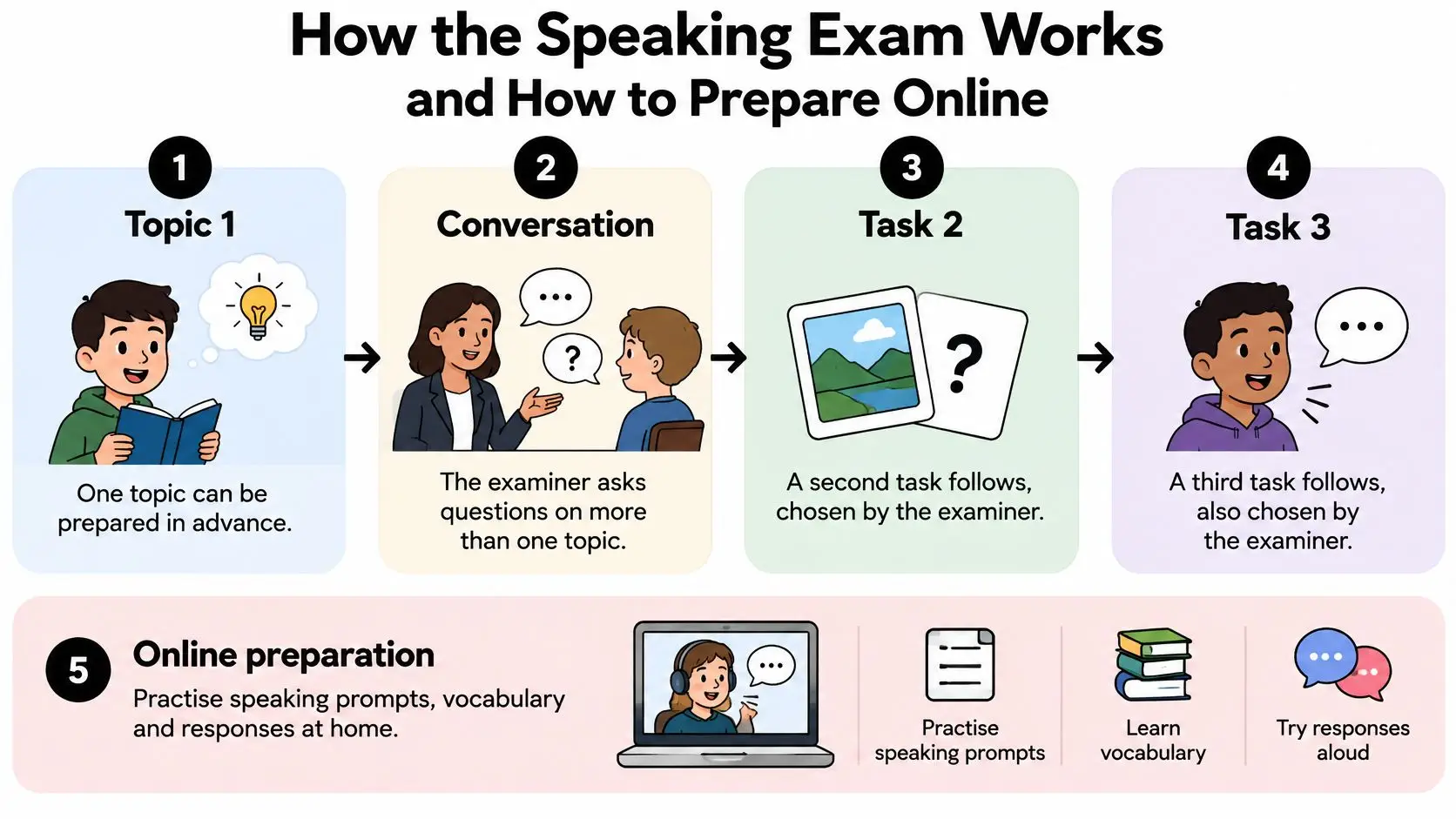
The Ofqual subject-level requirements for modern foreign languages describe a conversation covering more than one topic, with only one available for advance preparation, plus two additional tasks drawn from role play and picture, text or combined stimuli; the tier timings and grade ranges are summarised below. Check the current board-specific specification before using this framework as your child's exact rehearsal script, particularly when comparing GCSE and International GCSE courses.
Foundation and Higher tier speaking assessment
| Tier | Grades available | Speaking length | Preparation time |
|---|---|---|---|
| Foundation | 1-5 | 7-9 minutes | 10-12 minutes |
| Higher | 4-9 | 10-12 minutes | 10-12 minutes |
A child can picture the assessment as preparation followed by a series of spoken tasks. Their teacher should explain the actual order for their qualification, show the permitted materials and demonstrate how the examiner moves between activities.
The diagram offers a broad rehearsal framework rather than a board-specific running order.
Rehearse responding, not just remembering
For example, a practice lesson might allow 10 minutes to prepare a food-ordering role play, then move to spontaneous questions about school and holidays. This is a teaching scenario, not a promise about the exact tasks your child will receive.
At first, the teacher can pause, model a response and let the child try again. Later rehearsals should remove those supports so the learner discovers, safely, what they can manage independently.
A memorised answer can sound fluent until the question changes. Your child also needs practice recovering, clarifying and building a shorter answer.
Make the online practice technically useful
Use the microphone and headphones your child normally studies with. Check that their voice is audible without distortion, close unnecessary applications and choose a room where another person's conversation won't interrupt the recording.
A useful practice cycle is:
- Record a response. Use an unfamiliar prompt rather than reading a prepared paragraph.
- Listen with a purpose. Identify a pronunciation issue or a missing verb ending.
- Re-record selectively. Improve the weak passage without demanding endless perfect takes.
- Complete a timed mock. Practise continuing after a mistake without teacher rescue.
Online rehearsal can build readiness, but it can't reproduce every pressure of an unfamiliar examination room. Ask who reviews mock recordings, how feedback reaches your child, who conducts the formal assessment and what happens if an assessment recording is unusable.
Support for Children With SEN and SEMH Needs
Your worry may be that flexibility will mean less challenge. Or it may be the opposite: that your child will be left alone with a screen, expected to organise work they already find overwhelming.
Inclusion means specific teaching decisions, not just access to recordings. The Department for Education's Technology in Schools survey found that 61% of primary academy teachers identified supporting pupils with SEND as a technology-related priority. That finding concerns primary teachers, not GCSE Spanish outcomes, but it reinforces the need to ask what technology enables a particular child to do.
Match support to the difficulty
Consider a learner who feels physically anxious when asked to speak. A predictable sequence can help: see the prompt, rehearse privately, respond to a familiar partner, then answer the teacher. Visual prompts and additional rehearsal during teaching can make participation possible without removing the expectation to speak.
A child who struggles to retain theme vocabulary needs something different:
- Accessible preparation. Provide a clearly laid-out word list before the unit, with meaning, pronunciation support and useful sentence patterns.
- Supported retrieval. Begin with matching or choosing, then move towards recalling a word without the list.
- Visible success. Revisit familiar language alongside new material so the child can recognise what they've retained.
For a learner with processing difficulties, pausing and replaying a recording can make an explanation accessible. However, playback won't tell them whether an answer was intelligible or whether they responded to the question asked. They still need specialist feedback during live interaction.
Keep support accountable
Our lessons, assessments and support adapt to each learner's pace, preferences and goals. Students learn in small online classes with qualified teachers, regular pastoral support and opportunities to interact with classmates.
Use our SEN online learning information to frame a discussion about your child's actual barriers. Establish who monitors the agreed support and how you'll know whether it is helping participation and independent work.
Teaching adjustments and formal examination access arrangements aren't interchangeable. Extra rehearsal may be helpful in lessons; any change to examination conditions must be permitted under the relevant awarding-body rules.
Write down two specific needs before that conversation. For example, your child may need advance warning before speaking and help breaking written tasks into stages. Ask how each need will be met and reviewed.
Keeping Your Child Safe and Well Online
Your child will spend several hours a week in a digital space, interacting with teachers and other pupils. A lesson platform isn't automatically a safe environment because it is being used for education.
Bedford Borough Family Hubs, drawing on Ofcom evidence, reports that 24% of children aged five to seven owned a smartphone in 2024, while 32% of eight- to-17-year-olds had seen something upsetting online. The smartphone figure describes younger children; for GCSE families, the older age group is the more relevant warning against assuming teenagers can manage every online experience alone.
A comfortable study setup helps, but safeguarding also depends on what adults do.

Look beyond passwords
Good provision needs controlled meeting access, teacher supervision and clear rules for chat and screen sharing. Families should understand who can access lesson recordings, how those recordings are handled and how a child reports unwanted contact or upsetting behaviour.
A reporting procedure must be usable by the child, not only understandable to an adult reading a policy. A learner should know which person to contact and what to do if they feel unable to continue a session.
Agree this in advance: Your child can tell you something went wrong online without having to explain it perfectly or prove that it was serious.
Try a short family routine
A hypothetical five-minute routine can make the start and end of lessons more settled:
- Before joining. Check the camera background and remove personal documents or identifying information from view.
- Settle the equipment. Use headphones where suitable and make sure your child knows how to mute and contact the teacher.
- Plan adult availability. Keep a parent or carer nearby for younger learners, while respecting an older child's growing independence.
- Check in afterwards. Ask how the lesson felt, not only whether the work was finished.
Some children with social, emotional and mental health needs may find online conflict particularly distressing. They may need a trusted adult to help separate what happened from what they fear it means.
Agree tonight who your child will tell, and how they can leave an upsetting situation safely. That reassurance can make speaking up in class feel less risky too.
From GCSE Spanish to A-Level and University
GCSE Spanish can be a stepping stone rather than an endpoint. It is the usual preparation for A-Level Spanish and can support later study involving languages, including international business, translation and teaching.
Your child doesn't need a career plan before starting. The immediate aim is to develop enough understanding and confidence that continuing remains a genuine choice.
The pathway below shows possibilities, not guaranteed destinations.
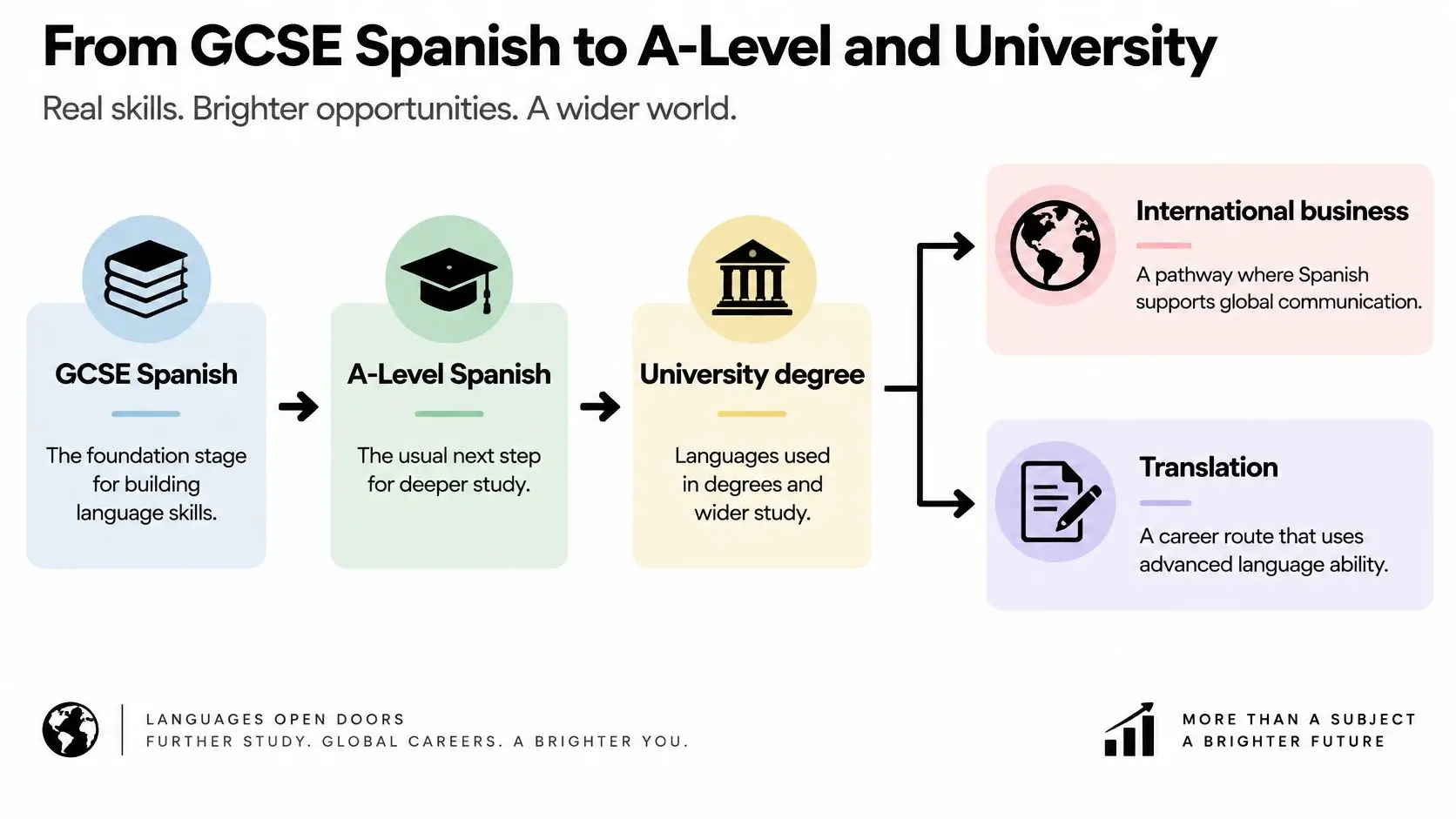
Typical route from GCSE Spanish to university
| Stage | Where it happens | What to check |
|---|---|---|
| GCSE Spanish | Year 11 summer exam series | Foundation (grades 1-5) or Higher (grades 4-9) entry |
| A-Level Spanish | Sixth form or college | Entry grade required by the institution |
| University application | UCAS | Course requirements and deadlines set by each university |
Use performance to guide the next decision
Say a Year 11 learner enjoys Spanish but worries that sixth-form study will be beyond her. Strong speaking performance and increasingly independent writing give her teacher something concrete to discuss: how she develops answers, handles unfamiliar language and acts on corrections.
That conversation is more useful than either promising she'll cope or discouraging her because she feels nervous. Her teacher can explain how her working grade compares with the intended college's requirements and what still needs strengthening.
The recognised GCSE, International GCSE and A Level qualifications offered by Queen's Online School are accepted by universities, colleges and employers in the UK and internationally. Recognition isn't the same as meeting an individual course's entry requirements, so check the intended institution's subject and grade conditions directly.
Separate eligibility from readiness
Our Guidance Team supports students completing A Levels or International GCSEs through the UCAS application process for university applications in the UK and internationally. This doesn't mean that an International GCSE alone normally meets undergraduate entry requirements; students must satisfy the university's full academic conditions.
For now, help your child keep examples of work they're proud of and notice which activities they enjoy. Interest in discussing ideas, reading unfamiliar material or improving an argument can make the next-stage conversation less dependent on a single result.
Choose and Enrol With a Provider You Can Trust
A reassuring conversation is helpful, but clear written answers are more useful when you're deciding whether to enrol. Compare providers using the same questions, with your child's needs beside you rather than a long list of attractive platform features.
We describe our GCSE subjects as English Language, Mathematics, Science and Art and Design Fine Art. Confirm Spanish availability and the exact qualification directly, including whether the proposed course is GCSE or International GCSE.
Questions to put in writing
- Is Spanish available? Request the awarding body, qualification title, specification and intended examination series. Don't infer availability from a general languages page.
- What is the full cost? Obtain course fees, examination-entry charges, any resit charges and payment terms. Clarify what happens financially if your child needs to change plans.
- What teaching time is included? Ask for the course duration and weekly live timetable, distinguishing teacher-led lessons from recordings and independent study.
- How is work assessed? Our coursework, quizzes and other ongoing assessments are typically completed online during regular lessons. Establish which tasks provide practice and which contribute to the formal qualification.
- How will my child practise speaking? Explain the particular difficulty, such as going blank when a question changes, and request a concrete teaching response rather than a general promise of flexibility.
- Who teaches and supports the class? We use qualified teachers, small online classes and regular pastoral support. Request the practical arrangements for the proposed Spanish group, including how concerns reach the right adult.
Compare the answers, not the promises
Suppose a parent compares two providers. One sends a polished brochure but leaves the speaking assessment and examination venue unclear; the other explains the qualification, shares a timetable and identifies who handles examination entry.
The clearer answer doesn't guarantee an effortless course. It does give the family something they can check, discuss with their child and hold the provider accountable for delivering.
Listen to your child's response too. They may be able to say that a sample lesson feels manageable, that they need longer to answer, or that they still don't understand what the examination involves.
Before paying anything, request the scheme of work by skill and a sample speaking assessment matched to the proposed qualification. Those documents reveal far more than the fact that lessons happen online.
Queens Online School offers live online teaching with qualified teachers, recorded lessons and support adapted to each learner's pace and goals. Visit Queens Online School to discuss Spanish availability, confirm the qualification and request the teaching and speaking-assessment information your child needs before enrolling.