


Your child follows the maths lesson, nods along with the teacher and seems to understand. Then a past-paper question asks them to rearrange a formula, and they freeze. Sitting beside them, you're left wondering whether they need more practice, a different explanation or someone who can work out exactly where they've become stuck.
Subject specific tutoring starts with that question, not with another worksheet. The right support should help your child understand the subject and feel safe enough to try again.
What Subject Specific Tutoring Really Means
Subject specific tutoring is teaching concentrated on one subject, with a plan matched to the learner's curriculum and, where relevant, the examination specification they will sit. It usually happens individually or in a small group, rather than as general help across whatever homework arrives that evening.
Take the formula question. A tutor might ask your child to explain each step aloud and discover that they understand multiplication but apply an inverse operation to only one side of the equation. Instead of repeating the whole algebra topic, the tutor models that precise step, checks the child's reasoning and offers a similar question to attempt independently.
For a child with SEN or SEMH needs, the same lesson may also need a different route in: shorter steps, more processing time, or a calmer start before the algebra begins. The subject stays the same; the way the tutor reaches the sticking point changes.
A rough medical analogy helps: general homework help resembles a GP keeping things manageable, while a subject specialist works more like a cardiologist investigating a particular faulty valve. Neither replaces the other. The difference is how narrowly the teacher investigates the difficulty.
Subject specific tutoring compared with other support
| Feature | Subject Specific Tutoring | General Homework Help | Whole-Class Teaching |
|---|---|---|---|
| Main focus | One subject and its exam specification | Finishing set tasks | Full curriculum for the year group |
| Who teaches | Subject specialist | Parent, sibling or general tutor | Class teacher |
| Feedback | Immediate and aimed at the specific misconception | Limited, often checked later | Shared across the whole class |
| Typical goal | Close a named gap before an assessment | Complete the work | Keep the whole group on pace |
| Session pattern | Short, regular blocks | Ad hoc | Fixed school timetable |
These are broad distinctions, not fixed boundaries. Class teachers also give individual feedback, and a capable homework tutor may identify misconceptions.
Subject expertise and specification fit are two separate checks. A tutor may know a topic thoroughly yet have little experience of the exam board's question style, mark scheme, or required content your child will face. Strong subject knowledge answers "can they teach this well?"; specification fit answers "can they teach this in the way your child will be assessed?"
Private tutoring became more common among young people in England during and after the pandemic, according to Sutton Trust research on private tutoring, and families often arrange it for a specific academic purpose such as GCSE preparation or selective-school entry.
Before arranging it, consider:
- Subject gap: Is the difficulty confined to a particular subject or topic?
- Specification gap: Is the planned support matched to the exam board and specification your child will sit?
- Pace gap: Is the class moving on before your child has secured the foundations?
Those answers give a tutor a useful starting point.
Signs Tutoring Could Help Your Child Move Forward
Homework ends in tears, and your child starts calling themselves stupid. Your first job isn't to persuade them to finish the page. It's to separate the difficulty from their sense of who they are.
The distress deserves attention, even when the unfinished task looks small.

Look for patterns rather than treating a difficult evening as proof that tutoring is needed:
- A topic-related change: Marks fall after the class moves from arithmetic into algebra.
- Selective avoidance: Your child tackles other homework but repeatedly postpones French.
- Lesson-specific dread: Anxiety appears before science, rather than throughout the school day.
- Assessment mismatch: Ordinary classwork looks secure, but timed tests lead to blank answers.
Knowledge, confidence or access
A child may have missing knowledge, such as insecure fraction skills. They may have missing confidence, despite understanding the method. Or they may be missing the adjustments that let them show what they know.
These can overlap. Dyslexia, autism, ADHD, anxiety and difficulties with emotional regulation can change how a child experiences a subject without defining their ability in it. A report on Sherpa Tutors' SEN provision records more than 1.8 million pupils in England with SEN or an Education, Health and Care Plan in 2025–26, underlining why accessibility belongs in the tutoring conversation.
Consider a dyslexic learner studying GCSE science who needs clearly labelled, accessible diagrams. An autistic learner may understand a novel but find an open-ended essay overwhelming without a visible structure. A learner with anxiety may avoid timed mathematics because the countdown makes starting feel impossible.
Subject expertise alone doesn't establish that a tutor can meet those needs. Tutoring should complement school special educational needs provision, not replace it. At Queen's Online School, we pair each student with special educational needs with a dedicated mentor who meets regularly, giving families a consistent person to contact.
You may also find this video useful when thinking about your child's support.
Ask your child what happens just before they stop working. Their answer may reveal a confusing instruction, fear of being wrong or exhaustion rather than unwillingness.
A useful question to end that conversation is: is my child avoiding the subject, or failing at it? Either deserves support, but the response shouldn't automatically be the same.
One-to-One, Small Group and Live Online Compared
| Format | Typical Group Size | Best For | Reported Gain |
|---|---|---|---|
| One-to-one, in person or live online | 1 learner with 1 tutor | Deep gaps, anxiety, or a child who needs every explanation adapted | Around five additional months over a year |
| Small group, live online | 3 to 6 learners in this example model | A shared misconception, such as rearranging equations | Around four additional months over a year |
| Live lessons with recordings | Class-sized, with recordings for later | Catch-up after absence or revisiting content | Gains vary with attendance and follow-up practice |
| Recorded lessons with guided independent study | Individual, self-paced | Revision and quick reference between live lessons | Gains vary with how consistently tasks are completed |
The government's independent review of tutoring associates targeted, consistent small-group tuition with around four months of additional progress over an academic year, compared with around five months for individual tuition. These are broad tutoring findings, not estimates specific to online delivery or a particular group size.
What the formats feel like for a child
Choosing a format is a separate check from confirming a tutor's subject expertise and specification fit. A tutor can know GCSE mathematics thoroughly and still run a session that suits your child poorly. Format decides who speaks, how often the tutor sees your child's working, and how much adapting happens in real time.
Consider Maya, a hypothetical secondary pupil who worries about answering incorrectly. Individual teaching could let her pause, ask for another explanation and work without an audience. It's a useful option when a tutor needs to adapt almost every exchange.
If Maya's main difficulty is structuring a history paragraph, a carefully matched small group could offer something different. She can compare approaches, discuss evidence and hear another learner explain a useful sentence choice. The group only works if the tutor still checks her understanding.
Live online teaching removes travel, while recordings can help Maya revisit an explanation after music practice. A recording, though, can't notice that she's copied a method without understanding it. The tutor needs to see her working and respond, not present slides.
For a learner with SEN or SEMH needs, the same choice carries extra weight. A child who finds speaking up distressing may contribute more freely one-to-one, while small-group work can suit a child who learns well by hearing peers think aloud. At Queen's Online School, small-group breakout sessions focus on areas such as executive function and literacy support, and teachers are trained to provide differentiated instruction so students with different needs keep making progress.
For families weighing language-learning formats, Englify's guide to English class options for Moroccan learners offers a relevant comparison of group and private study. Use it to sharpen questions about participation and individual attention.
Screen time and cost
Ofcom's children's online measurement report found that children aged 8 to 14 spent an average of 3 hours and 36 minutes online each day across smartphones, tablets or computers. That doesn't establish that online tutoring is harmful, but it makes passive lesson design hard to justify.
Maya's plan could combine a 45-minute live session, including paper work and a movement break, with a 15-minute offline task and a recorded worked example. That's an illustrative schedule, not a prescribed dose.
For budgeting, Atom Learning's private-tuition pricing analysis gives £30 as the average listed UK hourly price for GCSE tutoring in 2025. Confirm whether a quote is per learner or for the whole group, and compare the cost per child rather than the headline tutor rate.
Practical rule: Choose the smallest group that still gives your child active, individual feedback.
How to Adapt a Subject Lesson for SEN and SEMH Needs
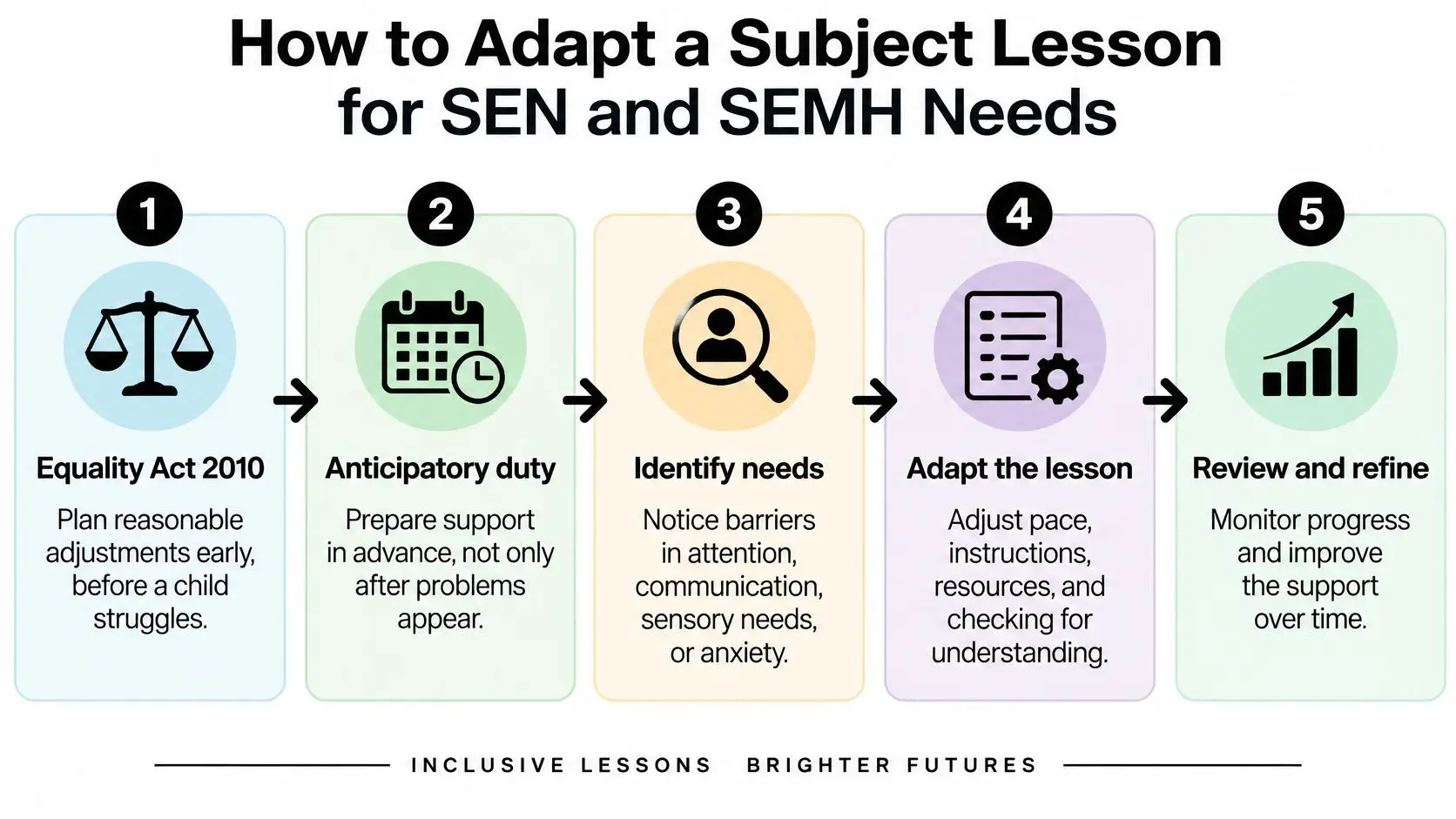
Under the Equality Act 2010, education settings must make reasonable adjustments so disabled children aren't placed at a substantial disadvantage, and the duty is anticipatory, as explained in the government's SEND reform guidance. Support should be prepared before a child repeatedly struggles, with adjustments considered individually.
SEN means special educational needs; SEMH refers to social, emotional and mental health needs. Neither label tells a tutor exactly how to teach a particular child.
This visual summarises the planning process.
Turn an access need into a lesson plan
Imagine Alex understands mathematical reasoning but panics during timed work.
Name the barrier, not the subject. Record that the countdown triggers panic, rather than describing Alex as weak at maths. The common slip is treating every unanswered question as missing knowledge.
Agree adjustments before teaching. Discuss the plan with Alex, their parents and the school's special educational needs coordinator. This prevents conflicting approaches; don't assume a diagnosis tells you which support Alex prefers.
Prepare usable materials. Give Alex uncluttered worksheets and audio instructions if those help, with speech-to-text available where written responses create an additional barrier. Avoid introducing unfamiliar software during an already stressful assessment.
Break the task into visible stages. Use fewer questions per page and a checklist for reading, choosing a method and checking the answer. The purpose is to reduce competing demands, not to remove the reasoning.
Make the sequence predictable. Begin with familiar practice, explain the next task and agree a pause before timed work. A surprise test can undermine the security you're trying to build.
Begin without the clock. Add timing only when Alex can attempt the method with growing confidence. Raising the pace because an answer was correct once is a common mistake.
Review the response after each session. Note whether Alex started more readily, asked for help or worked independently, then change one feature at a time. Otherwise, neither parent nor tutor can tell which adjustment helped.
Keep support connected
Oxfordshire's SEND guidance identifies practical support including extra time, modified homework, quiet spaces and timetable changes. Our explanation of differentiated learning gives further context for adapting teaching to the learner.
At our school, small-group breakouts focus on executive function, literacy and sensory-friendly peer groups. Independent study windows make assistive technology, reduced stimuli and modified tasks available; extended time, modified formats or different pacing can also be arranged.
If distress appears as anger or refusal, Wald Behavioral Health's resource on addressing disruptive behavior in kids offers another starting point for family discussion. Keep the learning barrier in view rather than assuming poor effort.
Adjustments remove barriers. They don't lower the expectation that a child can learn something worthwhile.
How to Choose a Tutor or Provider That Fits
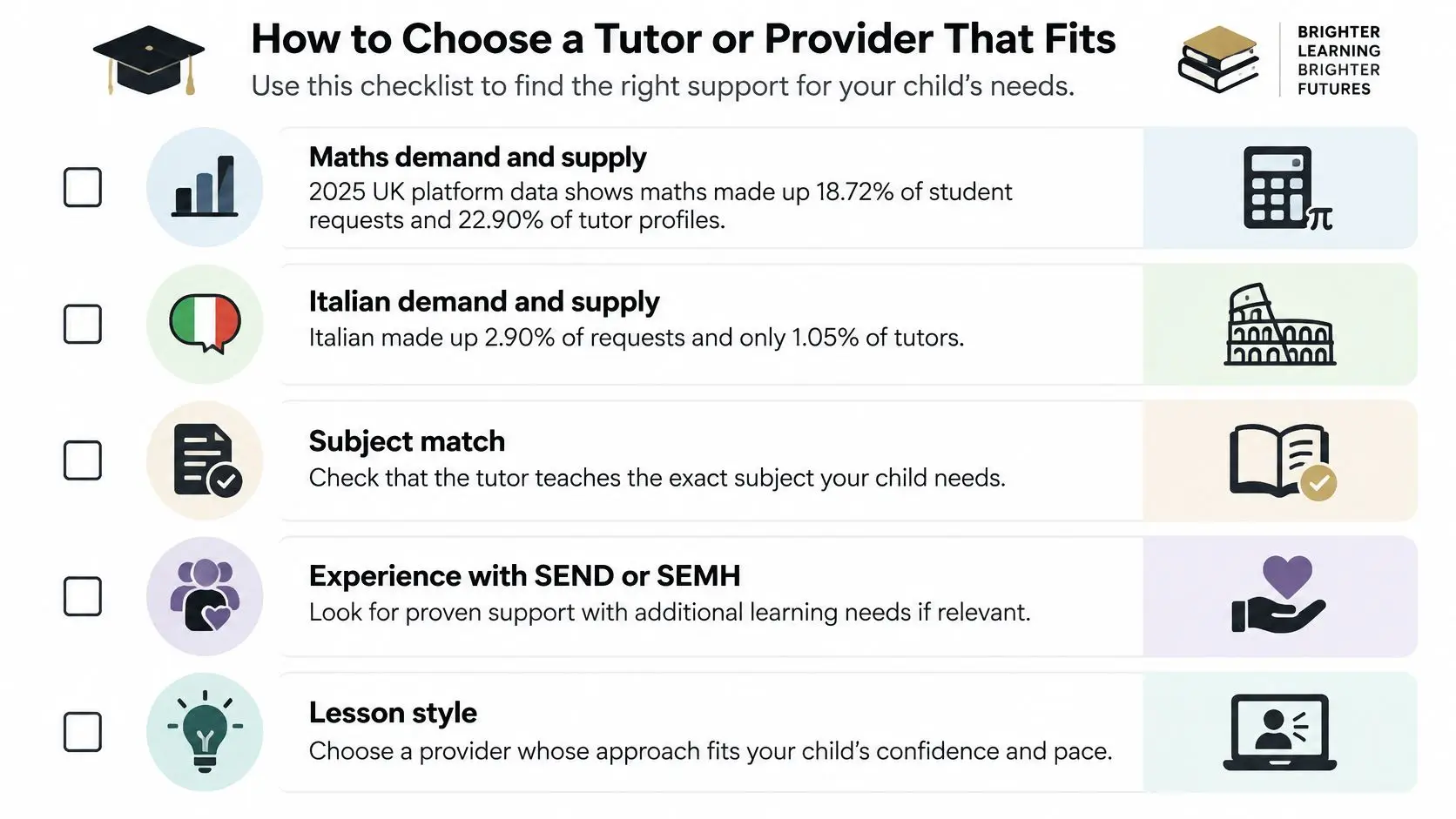
Subject availability isn't evenly balanced. Latimer Tuition's discussion of UK tutoring-platform data reports that in 2025, maths represented 18.72% of student requests and 22.90% of tutor profiles, while Italian represented 2.90% of requests and only 1.05% of profiles.
Those figures describe that platform evidence, not every tutor in the country. They nevertheless give parents a reason to check continuity early, particularly for less commonly taught options.
Make two separate checks
Subject expertise means the tutor understands the discipline and can explain it clearly. Specification fit means they understand your child's precise qualification, examination board, content requirements and assessment style.
A tutor may be excellent at university chemistry but unfamiliar with how your child's GCSE paper awards marks. Equally, someone may know a mark scheme yet struggle to explain why a chemical reaction happens. Your child needs both.
Use this checklist to prepare for an initial conversation.
- Confirm the exact specification and examination board. Have the qualification details in front of you, including any tier or route.
- Check experience at your child's level. Ask how the tutor would teach a learner beginning GCSE study differently from someone preparing for A-Level assessment.
- Discuss continuity. Establish availability across the academic year, including mocks and examination periods, rather than checking only the next appointment.
- Explore accessibility through an example. Ask how the tutor would change explanations, pacing and feedback for a child who becomes overwhelmed by long written instructions.
- Look at ongoing professional learning. Our mentors and specialist staff complete ongoing training in neurodiverse learning styles, assistive technology, inclusion strategies and adjustments.
- Request a sample lesson or mapped plan. Look for a connection between the starting difficulty, the teaching activity and the way understanding will be checked.
- Clarify the handover. If the tutor leaves, establish how the next teacher receives the learner's targets, successful adjustments and recent work.
Read the warning signs
Be cautious about guaranteed grades, a start without diagnosis or the absence of a written progress plan. A polished profile isn't a substitute for a tutor explaining what they'll do when your child doesn't understand.
Treat the earlier national price benchmark as context, not a promise of quality or a quotation. Our private tutor guidance for London families can support that comparison, and our Learning Advisors are available seven days a week to talk through options.
For a language learner, supplementary tools such as Gaeilgeoir AI's AI support for Irish pronunciation practice can provide a topic to discuss with a tutor. Ask how any practice tool connects to the learner's goals rather than treating it as a replacement for teaching.
The right fit is someone who knows both the specification and the child.
Tracking Progress Against GCSE and A-Level Goals
Progress checkpoints for GCSE and A-Level tutoring
This is a suggested review schedule, not a requirement for every learner.
| Checkpoint | How Often | What It Shows | Action If Weak |
|---|---|---|---|
| Baseline diagnostic against the specification | At the start of each block | Starting gaps by topic | Set the first three focus topics |
| Short retrieval quiz | Each session or weekly | Whether last week's content has stuck | Re-teach with a worked example |
| Past-paper section | Every two to three weeks | Marks by question type and command word | Target the lowest-scoring question type |
| Full mock exam | Each term | Readiness for the real exam | Reshape the weekly plan around the gaps found |
| Wellbeing and confidence check | Monthly or after each mock | Anxiety, fatigue and engagement | Change pace, format or session length |
A tutoring block should identify a named topic, a command word and a mark-scheme target. In biology, that might mean analysing a required practical, responding accurately to “evaluate” and supporting a conclusion with evidence rather than merely describing results.
The Education Endowment Foundation's one-to-one tuition guidance identifies a promising pattern of about 30 minutes, three to five times a week, for up to 10 weeks, with average estimated gains differing between primary and secondary settings (six versus four additional months) and between literacy and mathematics (six versus two additional months).
Those are averages across the evidence, not GCSE or A-Level grade forecasts. No service can guarantee a grade, and an individual learner may make more or less progress.
Check learning, not just completed work
Consider a hypothetical GCSE biology student beginning with a diagnostic on required-practical analysis. During a ten-week block, the tutor combines short explanations with guided practice and checks whether the learner can apply the skill later without prompting.
Moving on because the worksheet is finished would miss the point. Moving on because the learner can explain their reasoning and answer a fresh question gives a firmer basis for the next topic.
Our guide to learning objectives for students can help families turn broad ambitions into observable achievements. A useful objective describes what the child will do, not just which chapter they'll cover.
In our mentor sessions, we review academic goals, personal growth and strategies for independent learning, self-advocacy and resilience. The child's own view matters: feeling able to ask for clarification may be an important change even before a mock result improves.
At each review, ask: what can my child now do that they couldn't do at the baseline?
Plan Tutoring Around Your Child's Online Timetable
Tutoring should add a targeted layer to a full-time timetable, not replace the lessons that give a child their wider curriculum. More teaching isn't automatically better if the child loses rest, friendships or the energy to participate.
Our core academic lessons are live and teacher-led to keep students on track with their year group. A student who prefers fewer simultaneous live sessions can attend fewer, with catch-up provided through recordings or alternative formats.
A timetable that leaves room to recover
Consider Sam, a hypothetical dyslexic learner in full-time online schooling. Sam understands science discussions but finds it difficult to turn that understanding into written explanations.
An illustrative plan might give Sam two 30-minute science blocks each week, recordings to revisit terminology and a review after six weeks. Those timings are a starting proposal for this example, not a school policy or a promise of results.
The important scheduling decision is where the blocks sit. Sam might write most comfortably after a break, rather than immediately after a demanding English lesson. A parent's available evening isn't necessarily the child's best learning time.
Put the next step in the diary
- Name the subject gap. Use a recent piece of work to identify the skill that needs attention, such as explaining scientific evidence rather than science in general.
- Choose a suitable format. Match the level of interaction to the child's learning and emotional needs.
- Protect the weekly timetable. Avoid clashes with core lessons, rest and the times when your child has the most energy.
- Agree a review date. For example, set a review about six weeks ahead, while allowing an earlier conversation if the child becomes distressed or disengaged.
- Contact our Admissions Team. We can advise on the availability and cost of private tuition; additional private tuition sits outside standard package fees.
Give your child a voice in that plan. Ask what would make the next science lesson feel more manageable, and agree how they'll signal when an explanation isn't helping.
The aim isn't a timetable packed with interventions. It's a child who enters the next lesson feeling capable, with support that can change as they grow.
Queens Online School combines live, teacher-led British-curriculum lessons with mentoring and support suited to students' learning needs. Visit Queens Online School to discuss your child's subject difficulties with our team and ask about suitable support, private-tuition availability and costs.