


The school bag is packed, but your child is still awake worrying about tomorrow. Perhaps lessons themselves aren't the problem. It's the crowded corridor, the journey, the pace, or the feeling that asking for help will draw unwanted attention. When you start asking why online classes might work, you're usually asking something more personal: could learning feel manageable again without closing doors for the future?
Why Online Classes Are a Realistic Choice Today
Online classes are a realistic choice when live teaching, your child's needs and the provider's model line up. Families consider them for flexibility, personal pace, SEN and SEMH support, a global community, university routes and continuity during disruption.
Consider a hypothetical mother in Leeds whose 13-year-old has stopped sleeping before school and dreads the morning bus. She doesn't want less education for her child. She wants an arrangement in which feeling safe and making academic progress aren't competing priorities.
For this decision, think of online schooling as live, teacher-led lessons supported by recorded sessions and digital materials, rather than worksheets uploaded to a portal. Providers combine these elements differently, so the label alone tells you little.
Access makes it possible, not automatically suitable
In 2022, 97% of UK households with children aged 0 to 18 had home internet access, compared with 93% of all households, while 69% of children aged 3 to 17 used mobile phones to connect, according to Ofcom's Children and Parents Media Use and Attitudes report.
Online schooling is therefore no longer limited to unusually tech-savvy families. It's a practical option to investigate for primary and secondary education, although having internet access doesn't establish that a child has everything needed to participate.
Start with what your child needs to learn comfortably, not with what a platform promises.
Some children welcome learning from home; others miss classroom routines and nearby friends. The right choice rests on the actual teaching, support and daily experience.
The Main Reasons Families Choose Online Classes
The clearest answer is to match each reason for choosing online classes to the learner it could help and the evidence a provider should supply.
Reasons families choose online classes and what to check
| Reason | Who it suits most | What it looks like in practice | What to check first |
|---|---|---|---|
| Flexible timetable | Families with sport, performance or travel commitments | Recorded sessions and set live slots fit around training or travel | Recording access and live timetable |
| Personalised pace | Students who are ahead or need extra time | Teacher adjusts tasks; small groups allow questions and feedback | Class size and how feedback is given |
| SEN and SEMH support | Children with EHC plans, anxiety or sensory needs | Quieter setting, predictable routine and agreed adjustments | Individual support plan and specialist staff |
| Global community | Students who feel isolated locally or move often | Peer clubs, events and classmates from several countries | Extracurricular calendar and clubs on offer |
| University access | Teenagers working towards GCSE and A-level routes | Recognised qualifications taken through an approved centre | Awarding body and target universities' entry requirements |
| Continuity during disruption | Families facing illness, relocation or long gaps in attendance | Lessons remain accessible when attendance stops | Device, connection and study-space audit before enrolment |
Most families need a combination
A young performer might need scheduling flexibility but also reassurance that they won't become invisible to teachers. A child returning after illness might need continuity alongside a gentler workload. Neither family is merely buying convenience.
The strongest case for online classes is a close match between the problem your child faces and the support the school delivers. A recording library won't resolve difficulty asking questions. A lively classroom won't help if its compulsory timetable clashes with essential medical appointments.
There are also trade-offs within each reason. A learner who wants greater freedom may still need close supervision, while someone seeking quieter surroundings may need deliberate opportunities to build friendships.
Decision test: Describe the improvement you want in your child's ordinary school week. Then ask the provider to show exactly how its provision would support it.
Start with the row that addresses your child's biggest barrier, not the most attractive extra. If mornings are dominated by distress, investigate support before clubs. If your teenager is settled but planning university applications, examine the qualification route before choosing optional activities.
A reason becomes useful only when you can translate it into something observable: your child attends, contributes, completes appropriate work and knows where to get help.
How Flexibility and Personal Pace Work Day to Day
Consider a hypothetical learner, Aisha, 15, a competitive swimmer preparing for GCSE maths and chemistry. She trains at 6am, attends live maths in the afternoon with a small group, and revisits recorded chemistry explanations in the evening. Her teacher gives written feedback on each assignment.
This example illustrates a possible arrangement, not a timetable every school offers. Before enrolling, her family would need to confirm which sessions are compulsory and whether the evening workload leaves enough time to recover.
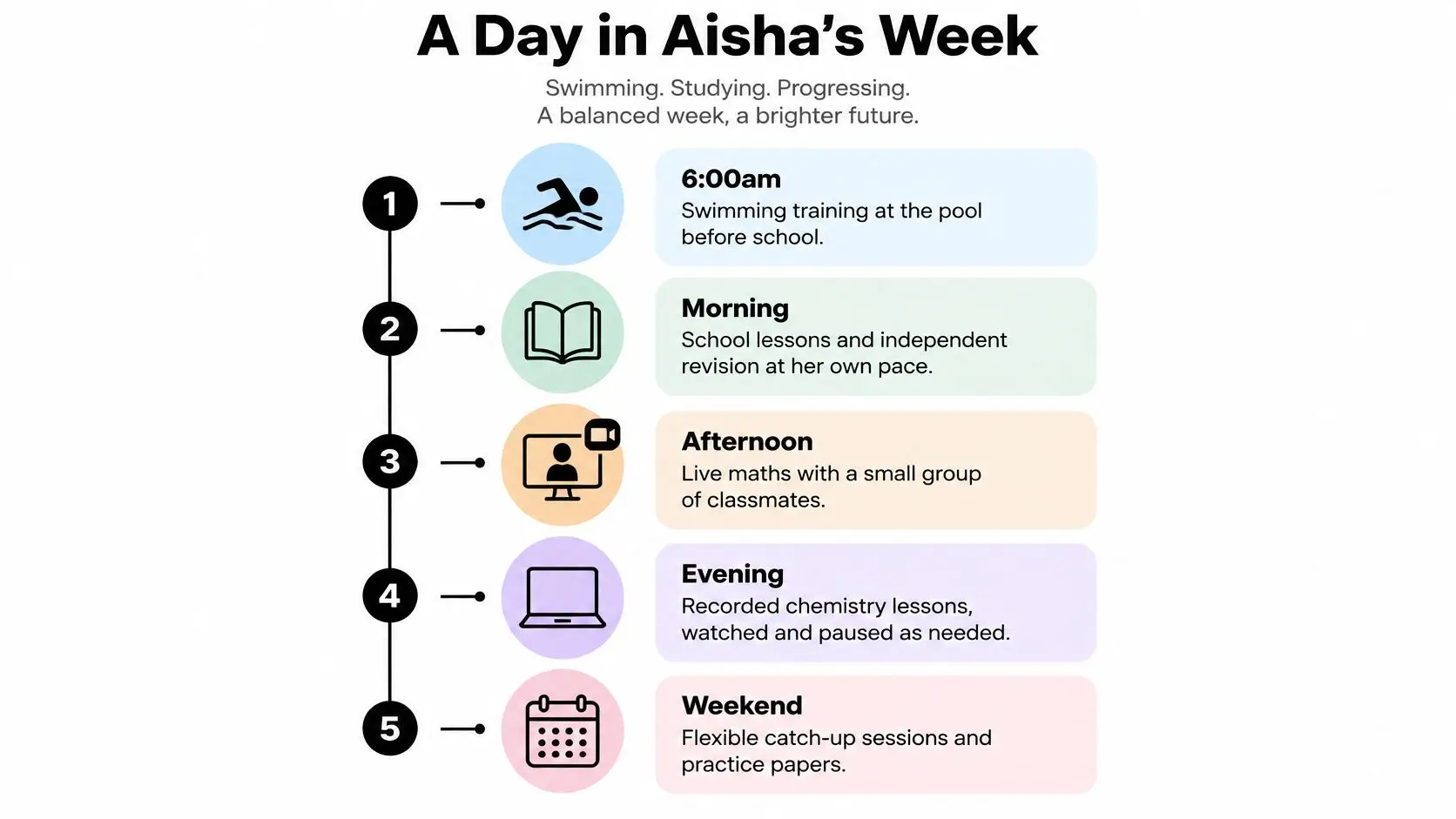
Different activities need different kinds of time
Live lessons happen at fixed times and allow immediate discussion. Recorded explanations can be paused and replayed. Self-paced work means completing an agreed task independently, but it should still have a purpose, a deadline and teacher oversight.
Personal pace isn't permission to skip difficult material. If Aisha misunderstands rearranging equations, her teacher should identify the gap, set suitable practice and check understanding before introducing work that relies on that skill. If she's already secure, extension work should provide challenge rather than just more questions.
A useful explanation of what flexible learning involves can help families distinguish adjustable study time from an entirely open schedule.
Build a week your child can sustain
Use this sequence with your child and the school:
- Map fixed commitments. Include training, appointments, travel, meals and sleep.
- Mark compulsory live lessons. Check clashes before assuming recordings can replace attendance.
- Allocate recorded and independent work. Give each task a realistic place rather than leaving it for spare time.
- Agree a weekly teacher check-in. Name the person who monitors attendance, unfinished work and emerging difficulties.
Flexibility without structure can become a growing backlog that leaves a child ashamed to log in. The response should be early contact and an adjusted plan, not silence until an assessment goes badly.
A sustainable timetable protects family time too. If every evening becomes catch-up time, the arrangement needs changing, even if your child can technically access lessons whenever they want.
Supporting SEN and SEMH Needs Through Online Lessons
In January 2025, more than 1.7 million pupils in England had SEN, with 5.3% holding an EHC plan and a further 14.2% receiving SEN support without one, according to the Department for Education's special educational needs statistics.
The Department for Education recorded 638,700 active EHC plans in January 2025, with autistic spectrum disorder accounting for 31.5%, speech, language and communication needs 21.3%, and social, emotional and mental health needs 20.7%, in its disability and EHC-plan statistics.
These are substantial, varied needs. SEND includes special educational needs and disabilities; SEMH refers to social, emotional and mental health needs. Neither term tells you, by itself, whether online education will suit an individual child.
A quieter room isn't a complete support plan
The Department for Education's remote education research found that 59% of parents of pupils with SEND reported disengagement, compared with 39% of parents of pupils without additional needs, while also identifying scope to adapt platforms and temporarily teach pupils with sensory-overload difficulties outside the main classroom before reintegration.
Consider a hypothetical child, Tom, 11, who is autistic and becomes overwhelmed in a noisy classroom. A quiet room, predictable routine, replayable explanations and agreed camera settings might remove some barriers. But if he can't understand an instruction or signal distress, changing location won't be enough.
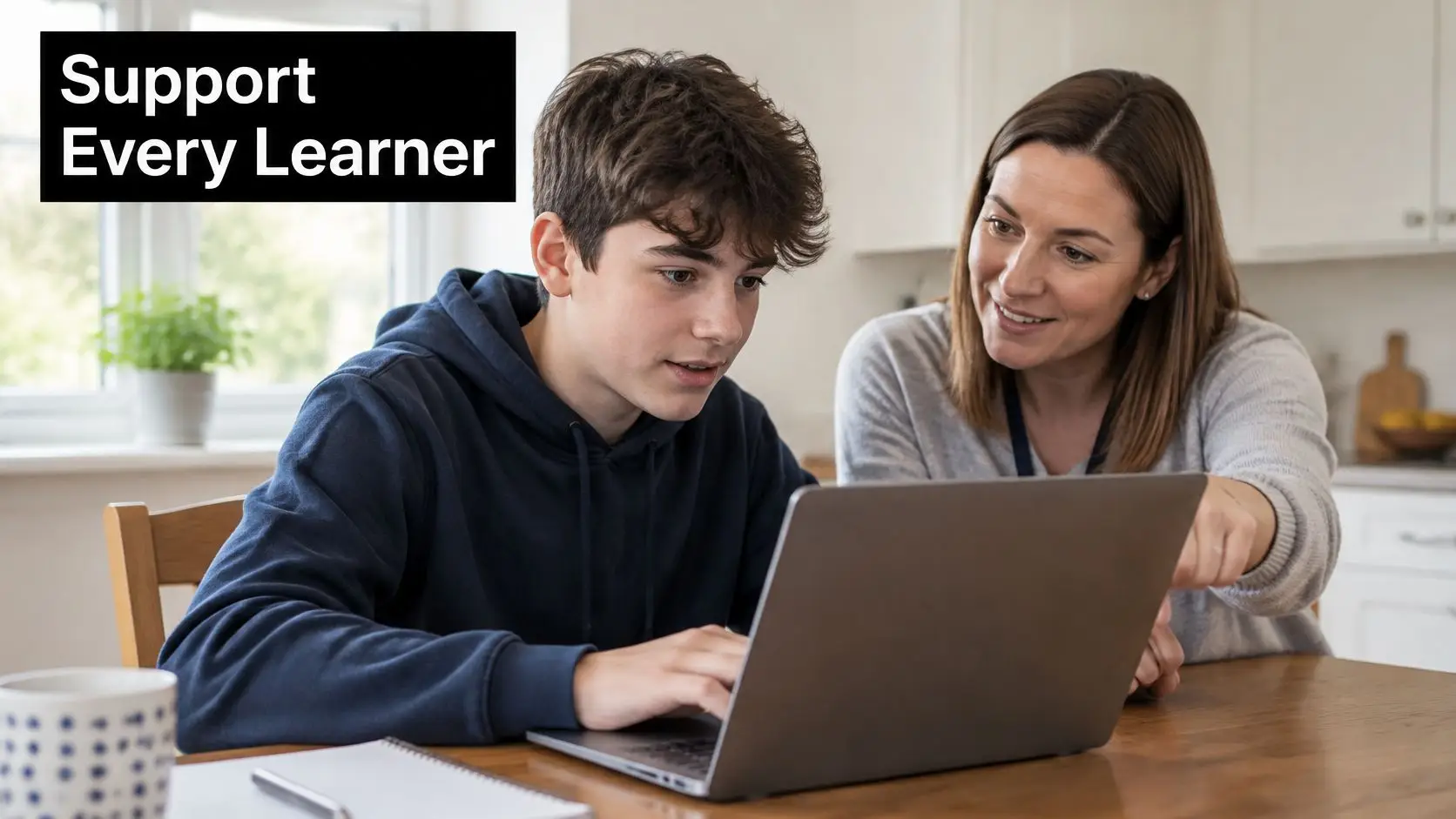
Ask how adjustments become everyday practice
An effective arrangement should specify:
- Teaching support. Subject specialists, short structured tasks and accessible materials.
- Communication choices. An agreed way to ask for help, request a break or contribute without unnecessary pressure.
- Individual planning. Written adjustments, a named coordinator and regular reviews involving the child.
- EHC-plan alignment. Clear links between activities, intended outcomes and the responsibilities of the school, family and local authority.
When assessing e-learning for special-needs students, ask how staff would respond if your child stopped speaking or submitting work. Look for a practical response, not a general assurance about inclusion.
Online education is most defensible as a bridge or complement when attendance isn't possible, within a personalised plan. It shouldn't become an automatic substitute that leaves a child comfortable at home but disconnected from teaching, relationships or appropriate support.
Global Community, Clubs and Routes to University
Consider a hypothetical student, Lucas, 17, who lives in Dubai, follows the British curriculum and wants to apply to UK universities. He needs peers who understand his school routine and a qualification pathway that meets his intended courses' requirements.
Those needs belong together. Academic ambition can feel lonely when classmates are names on a screen, while an enjoyable social programme can't compensate for unsuitable subject choices.
Look for participation, not just a club list
A strong online programme should make opportunities concrete: debate, creative writing, student-run interest groups, leadership roles, mindfulness sessions and social events. International classmates can broaden discussion, but children still need structured chances to get to know each other.
Ask for the published event calendar and actual participation information. Find out who runs each activity, how newcomers join and whether timings work in your child's location.
A community exists when your child has people to return to, not simply a list of activities they could attend.
In Lucas's possible week, lessons take place during the UK morning, debate club meets on Thursday evening, and a fixed tutor check-in keeps subject choices and predicted grades under review. His family would need to translate every slot into Dubai time before deciding whether that week is workable.
Check the qualification route separately
For GCSEs and A levels, establish exactly who awards the qualification and which approved centre handles entry. Don't assume that teaching a course means the provider can arrange every examination requirement.
Make these checks before committing:
- Awarding body. Obtain the qualification title and awarding body in writing.
- Examination centre. Confirm approved-centre arrangements, exam location and responsibility for any practical or coursework components.
- University requirements. Read each target course's subject and grade conditions, including any additional requirements relevant to the applicant.
Recognised qualifications don't guarantee admission. For Lucas, a suitable pathway means choosing the right subjects, receiving dependable guidance and understanding what each university expects.
Community is equally dependent on structure. A welcoming promise matters less than whether someone notices when your child stops turning up.
Common Concerns and What the Evidence Says
The Department for Education's March 2025 parent, pupil and learner voice survey found that 46% of primary-school parents and 41% of secondary-school parents identified increased screen time as a concern, while 57% and 53%, respectively, worried about reduced child–teacher interaction.
These concerns deserve direct answers. However, the survey doesn't distinguish passive, self-directed screen use from live teaching with real-time feedback, and it doesn't establish that every online model produces isolation or poorer learning.
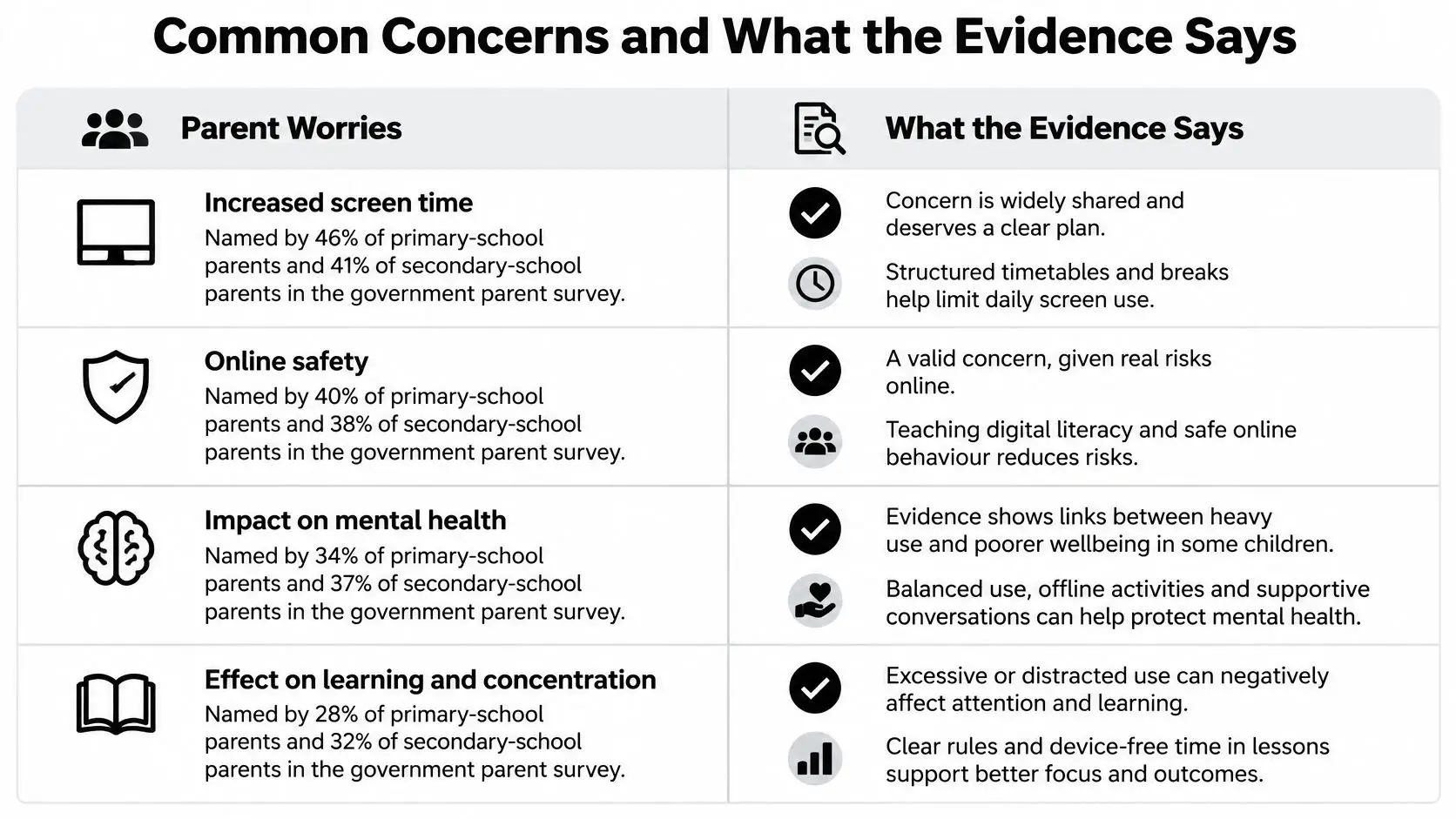
Test the experience behind each worry
Screen time is partly inherent in online delivery. Families should examine the total timetable, breaks and offline tasks, rather than treating every minute at a computer as the same activity.
Reduced teacher contact is a design risk. A child can sit through a live lesson without being noticed, so ask how teachers check individual understanding and how pupils obtain help afterwards.
Isolation can't be ruled out by offering clubs. Ask whether participation is supported and consider how local friendships, outdoor activities and face-to-face contact will fit into your child's life.
Structure matters when independence is difficult
Consider a hypothetical learner, Ravi, 12, who watches recorded videos alone for three hours daily and falls behind. A possible redesign would replace two of those hours with a live small-group lesson where a teacher checks his answers, with a fixed break between sessions. That's a change to test and review, not a guaranteed cure.
Weak self-discipline shouldn't be treated as a character flaw. Some children need reminders, task breakdowns and adult supervision. Parents should establish what the school provides and what they'll be expected to do themselves.
Device failure is a separate practical risk. A child who can't connect needs an alternative route to the work and technical help, not an unexplained absence mark.
For each concern, request something you can inspect:
- Screen use and independence. A sample timetable, offline activities and attendance follow-up.
- Contact and belonging. A demonstration lesson, feedback example and activity calendar.
- Technical continuity. Device requirements, support contacts and a fallback submission process.
The important distinction is between high-interaction online schooling and low-support digital learning. Concerns about being left alone are particularly relevant to the latter and should be reduced by well-designed interactive provision. They aren't automatically eliminated, which is why the provider's model matters more than the word online.
How to Check a Provider Against Your Child's Needs
According to Ofcom's 2024 Children's Media Literacy report, 34% of UK parents of school-aged children said their child lacked continuous access to an appropriate home device for online schoolwork, up from 28% in 2021, while more than 4% of all parents reported that this postponed schoolwork or made online learning impossible.
Start with a device, connection and study-space audit. Test the actual lesson platform on the computer your child will use, including the microphone, camera, document upload and accessibility settings.
Ask for evidence you can inspect
Provider criteria, questions to ask and red flags
| Criterion | Question to ask | Good sign | Red flag |
|---|---|---|---|
| Teaching | Who teaches each subject and what is their background? | Named subject specialists | Generic tutors for every subject |
| Class size | How many pupils share a live lesson? | Small groups with visible interaction | Large groups with no speaking time |
| Live interaction | How much of the week is live with a teacher? | Regular live lessons and real-time feedback | Mostly uploaded videos and worksheets |
| Recorded sessions | Can lessons be rewatched and for how long? | Recordings available for revision and catch-up | No recordings or short access windows |
| SEN and SEMH support | How is an individual support plan written and reviewed? | Named coordinator and regular review | Standard timetable for every learner |
| Device and connection | What happens if the device or connection fails? | Pre-enrolment audit and mobile access | No check before enrolment |
| Qualifications | Which awarding body and centre status apply? | Recognised awarding body and approved centre | Unclear accreditation |
| Safeguarding | What are the anti-bullying and safeguarding policies? | Written policies with clear reporting | Vague or missing policies |
| Community | What clubs, events and wellbeing activities run each term? | Published calendar with participation | Only general claims about community |
Queen's Online School is one option to assess against these criteria: it describes subject-specialist teaching, small classes, real-time feedback, recorded sessions and a zero-tolerance anti-bullying policy. Ask for current class-size limits and the written policy rather than treating those descriptions as sufficient evidence.
For broader questions about fit, culture and academic pathways, school choice advice from Mrs. College Counselor offers another useful perspective. Keep your child's daily experience central when comparing different school types.
Separate credentials from practical reliability
When investigating online-school accreditation, distinguish a school's status from its awarding-body and examination-centre arrangements. Ask what each credential covers.
Technical questions deserve equally clear answers. Request browser-based access on low bandwidth, mobile-compatible resources, downloadable or recorded material, flexible submission windows and prompt technical assistance.
A phone may help during an outage, but it shouldn't automatically be treated as an adequate replacement for the device needed for extended writing or subject software. Agree the fallback before your child needs it.
Confirm Your Child's Needs Before You Enrol
A workable choice sounds specific: which need is being met, which lesson feature meets it, and what evidence would show the fit is failing. Judge the plan by your child's requirements and the design of each lesson, not by the platform. High-interaction schooling gives a learner ways to speak, get feedback and feel known; low-support digital learning can leave an able child stuck without anyone noticing.
Make the decision observable
- Write a needs profile. Use separate lines for learning, communication, sensory and emotional needs. Add any EHC plan or SEN support already in place, plus the signs that tell you a day has gone well.
- Choose your priorities. Identify which reasons matter most, such as flexibility, specialist support or a suitable university pathway. Rank them, because a timetable can be convenient while still giving too little feedback.
- Shortlist carefully. Compare no more than three providers using the same criteria, rather than collecting incompatible promises.
- Request practical documents. Ask for a typical weekly timetable and an explanation of the individual support-plan process: who writes it, how often it is reviewed and how teachers are told.
- Watch a real lesson if one is offered. Observe your child's response as well as the teacher's presentation. Can they join in, ask a question and recover when something feels difficult?
- Set a review point. After half a term, compare the experience with the needs you recorded. If anxiety is increasing or learning is slipping, agree changes promptly and consider another provider if support remains unsuitable.
Watch the child, not just the dashboard: Completed tasks don't tell you whether someone feels secure enough to admit they're confused.
Include your child in the decision in a way they can manage. Ask what felt easier, what was tiring and who they'd approach for help.
Confidence, a sense of safety and the ability to ask for help matter alongside academic progress. A successful arrangement should support all three.
Queens Online School offers a British curriculum through live online teaching, supported by recorded lessons and personalised learning arrangements. Visit Queens Online School to ask about its class sizes, individual support arrangements and recorded-lesson access, then compare its answers with your child's needs profile.