

It's late, the house has finally gone quiet, and you're searching again. Your child hasn't managed a full week at school in months, mornings end in tears, and every website you open promises flexibility, small classes and recognised qualifications. They all look reassuring. They can't all be right for your child.
That's the moment when online schools accredited stops being a search phrase and becomes a practical question. Who has checked this school, what did they check, and will your child be safe, noticed and taught well there?
What Accreditation Really Means for an Online School
Amira knows that late night feeling well. Her 13 year old stopped attending school after months of anxiety, at first missing Mondays, then whole weeks, then refusing to leave her bedroom on school mornings. Amira isn't looking for a glossy promise. She's looking for somewhere her daughter can learn without dread, and somewhere she can trust when she isn't in the room.
A useful way to think about it is a café on your high street. The shop window is the website, the smiling photos, the prospectus and the testimonials. Those things tell you what the school wants you to see. Accreditation is different. It's the independent inspection behind the door, a bit like a food hygiene rating, where someone outside the business checks whether standards are actually being met.
A polished website proves a school can design a website. It doesn't prove anyone independent has checked its teaching or safeguarding.
Confusion starts because families are often shown three separate layers as if they're one thing. Separating them makes every later decision easier.
The Three Layers Families Often Mix Up
- Provider accreditation: Has the school itself, as your child's main educator, been checked against national standards for education quality and safeguarding?
- Examination centre approval: Is the school, or a centre it uses, approved to host and administer exams properly and securely?
- The qualification itself: Will your child receive a GCSE or A-Level certificate awarded by a recognised awarding body at the end?
Each layer answers a different worry. Provider accreditation is about the daily experience, lessons, welfare and whether adults notice when a child goes quiet. Examination centre approval is about what happens on exam day, papers arriving securely, invigilation being done properly, and access arrangements being in place. The qualification is the certificate your child carries forward.
A school can be strong on one layer and weak on another. For example, a provider might offer well taught courses but expect families to find and pay for a separate exam centre, which can be stressful for an anxious teenager who has never set foot in that building. Another provider might have slick exam arrangements but little evidence that anyone has checked its full time teaching or safeguarding.
For Amira, the shift was simple. Instead of asking, are you accredited, she started asking, accredited for what, by whom, and can I see the evidence. Those questions protect her daughter far better than a badge on a homepage.
Recognised UK Accrediting Bodies and International Scope
For a family choosing full-time online schooling in England, the key question is what each approval covers. A school's accreditation, its examination-centre approval and the qualification a child earns are separate checks. Each answers a different question, much like checking a building's structure, its electrical system and its ownership documents.
The Department for Education Online Education Accreditation Scheme is the relevant scheme for eligible full-time online providers in England. It is non-statutory, so it is a government-run quality assurance route, not a legal requirement for every provider. Eligibility is specific: a provider must operate online permanently, offer a full curriculum or serve as the learner's main or only source of education, have at least one full-time pupil based in England, and maintain a physical presence there. The Department for Education guidance on applying for online education accreditation explains that Ofsted conducts suitability checks and accreditation visits. The DfE makes the final decision and publishes the outcome.
That distinction matters if your child will attend only a few online lessons alongside another school. Accreditation for a provider's full-time provision should not automatically be taken as approval of every course or service it offers. Families outside England should also ask how the scheme applies to their circumstances. It is not a general UK-wide guarantee.
Who Checks What in Online Schooling
| Body | What It Assesses | Relevance for Families |
|---|---|---|
| Department for Education | Decides accreditation for eligible full-time online providers in England and publishes the outcome | Shows whether the provider has met the scheme's standards |
| Ofsted | Conducts suitability checks and accreditation visits covering education quality and safeguarding | Provides an independent report on the provider's operation |
| Ofqual | Regulates qualifications and awarding bodies in England | Helps establish whether a GCSE or A-Level is a regulated qualification |
| Pearson | Awards qualifications such as Pearson Edexcel GCSEs and A-Levels, and approves examination centres | Clarifies who awards the certificate and where exams may be taken |
| Council of International Schools | Accredits and benchmarks international schools | This is not evidence that a provider's online provision is accredited |
For international families, the Council of International Schools (CIS) should not be treated as an online-school accreditor. Its accreditation and benchmarking relate to international schools; that alone does not establish that it assesses a school's online provision. The bodies listed here also do different jobs: Ofqual's regulation of qualifications does not assess the quality of a child's lessons, and Pearson's approval of an exam centre does not show whether the school supports a child who stops logging in.
For your child, the practical question is whether the evidence covers the actual service they will use. A government listing, an inspection report, a qualification and an exam-centre approval are separate pieces of information. Check each against your child's needs, including the day-to-day teaching and safeguarding arrangements. A recognised badge can offer useful assurance, but it cannot by itself tell you whether your child will feel noticed, supported and able to learn.
How to Verify an Online School's Accreditation Yourself
A parent comparing online schools may find a familiar logo on one site and a reassuring report on another, yet still wonder what those checks mean for their child's daily learning. You don't need specialist knowledge to find out. Take the checks one at a time, and ask for clear answers before paying a deposit or withdrawing your child from another school.
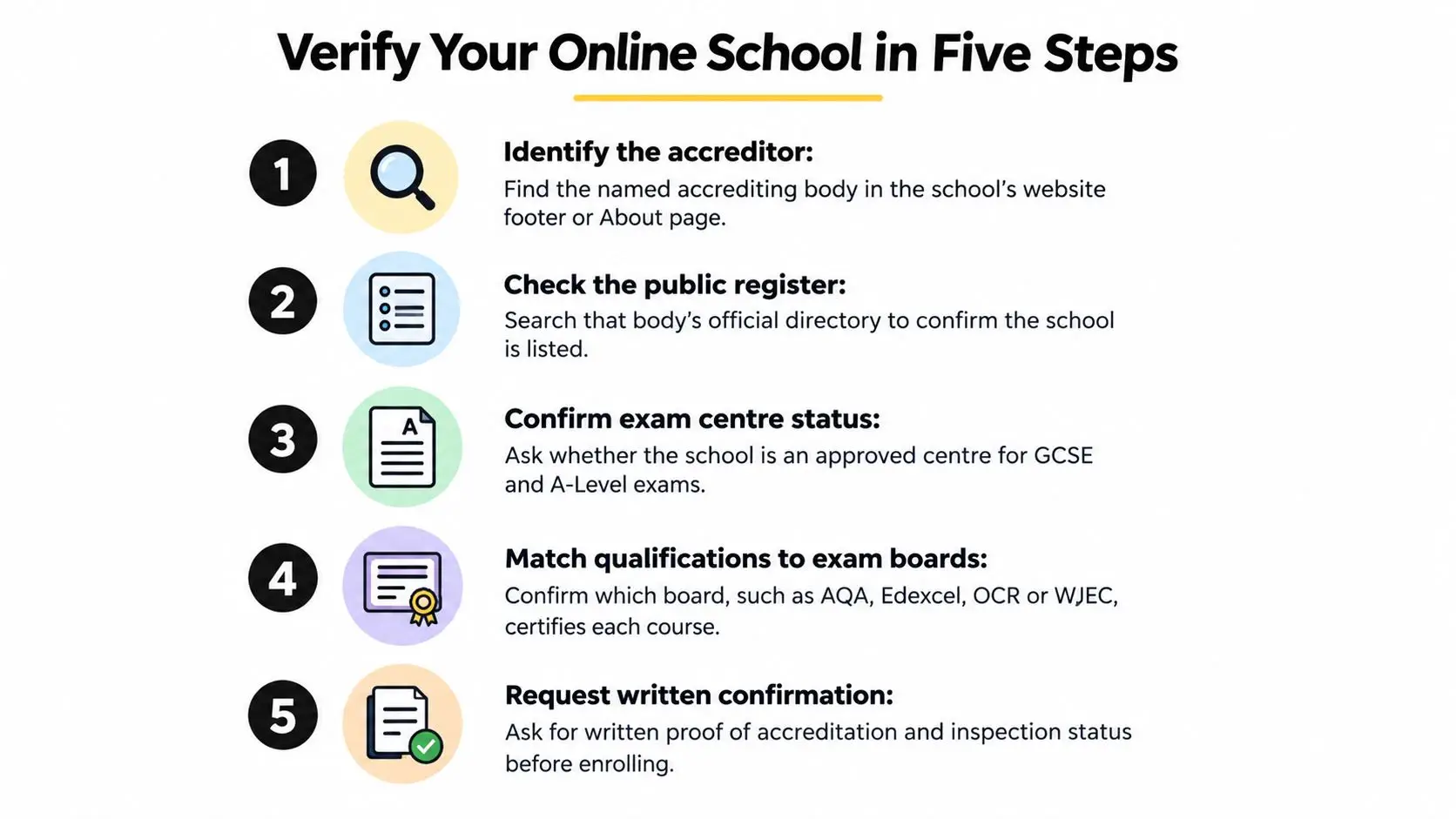
Five Checks You Can Do This Week
- Find the current DfE listing: Ask where the school's accreditation is published, then check the listing yourself. Make sure the provider's name matches. A logo without a listing you can find is a reason to ask more questions.
- Read the latest inspection report: Look at the inspectors' findings, not only the school's summary. You can compare the school's claims with inspection reports for online provision and ask about any points that concern you.
- Check what the accreditation covers: A provider may be listed for a different kind of education from the full-time place your family is considering. Ask directly whether its accreditation covers your child's full-time education there.
- Check qualifications and exam arrangements separately: Ask which awarding body certifies each subject, which exact specification your child will study, and where they will sit the exam. Provider accreditation, exam-centre approval and the qualification itself answer different questions.
- Get the details in writing: Request written confirmation of the provider's accreditation status, exam arrangements, safeguarding responsibilities and support for special educational needs.
The DfE accreditation scheme involves evidence-based checks. Its guidance for online providers explains the process, while the Ofsted handbook on accreditation visits to online providers gives further information about accreditation visits. These checks can tell you about standards and oversight, but an accreditation badge alone cannot show how well staff will respond when your child struggles, needs a change to their learning, or stops taking part. Ask how the school identifies those needs and who will speak with your family.
Practical rule: If a school cannot point you to a public listing and a report you can read yourself, treat “accredited” as a claim to check before relying on it.
Warning signs are reasons to pause, not panic. Be cautious about phrases such as “internationally accredited” without a named body, a claim that appears to cover only one course or a website rather than the school, or staff who avoid questions about reports. A trustworthy school should expect you to ask. You are choosing who will guide your child's school day, and clear answers help you judge whether the provision fits their learning and wellbeing needs.
What Accreditation Means for GCSE, A-Level and University Entry
For older children, one fear sits above the rest. If we leave a mainstream school now, will we accidentally close doors later? It's a fair question, and the answer depends on keeping those three layers connected rather than treating them in isolation.
The image below captures the ordinary reality behind the policy language, a student at a desk who still needs her work to count.
GCSEs and A-Levels are awarded by awarding bodies, such as Pearson, and students usually sit assessments through approved examination centres. Your child's certificate carries the qualification and grade. It doesn't say she learned at a kitchen table, in a classroom, or in a live online lesson with six classmates. What matters is that she was entered for the right specification, taught its content, and assessed under approved conditions.
Priya's family learned why precision matters. Priya, in Year 12, was studying A-Level Maths online and hoping to apply for competitive university courses. Her parents assumed that because the school advertised A-Levels, everything was covered. When they checked, they asked a sharper question. Is the exam centre approved for the exact specification Priya is studying, including any access arrangements she needs? That question turned a vague reassurance into a concrete plan for entries, deadlines and exam location.
Provider accreditation and awarding body approval then work together. Accreditation speaks to the quality and safety of the education leading up to the exam. Awarding body and centre arrangements secure the exam and certificate at the end. A child needs both. Good teaching without a valid exam route leaves her stranded in June. A valid exam route without good teaching leaves her underprepared.
The short video below is a useful pause before you map subjects to future applications.
University admissions teams generally judge the grades and qualifications presented, rather than the delivery mode behind them. Still, don't rely on general reassurance. Check target courses early for required subjects, grade expectations and reference arrangements, using guidance on university entry requirements in the UK as a starting point for your own university by university checks. If your child needs a reference or predicted grades, ask the online school who provides them and what evidence they'll use. Protecting ambition is part of protecting wellbeing.
Supporting SEN and SEMH Learners Beyond the Accreditation Badge
A child can meet the school's timetable and still be struggling. Perhaps she logs in with her camera off, contributes less each week and begins missing work. Accreditation may show that a provider met specified standards when assessed. It cannot tell you whether a teacher will notice these changes, understand what may be behind them or respond in a way that helps your child feel safe enough to learn. For children with SEN or SEMH needs, that difference matters.
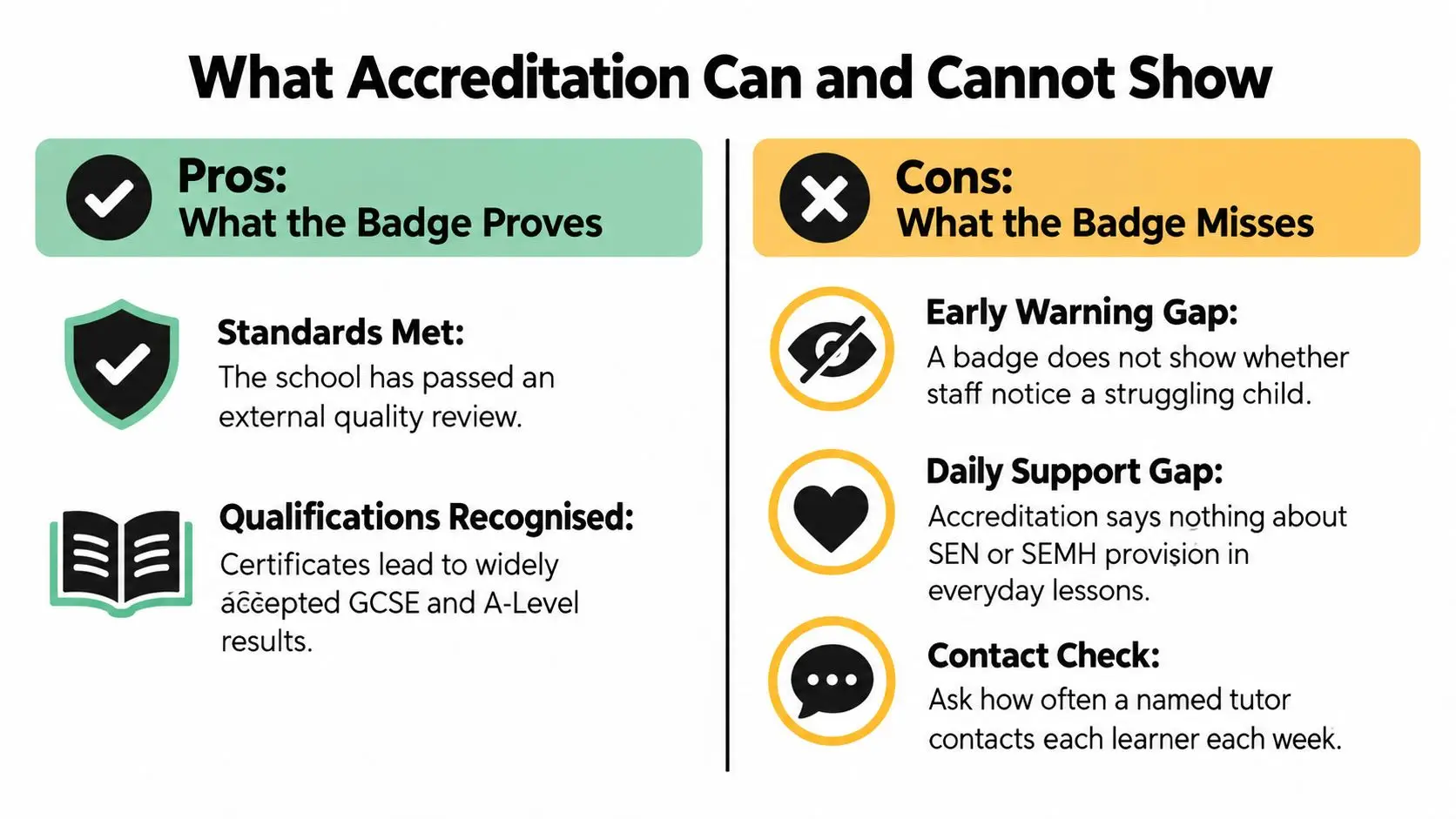
Accreditation, attendance monitoring and individual support are separate parts of a school's work. Public attendance data covers state-funded schools, not online providers, so it cannot show how a particular online school tracks participation or responds to absence. Ask the provider how it notices when a child stops joining lessons or submitting work, who makes contact, and what happens if the first response does not help. A flexible timetable can suit a child's needs, but flexibility alone does not ensure that someone will spot disengagement.
Questions That Reveal Daily Support
- Named leads: Who are the safeguarding lead and SEN lead, and how can you contact them?
- Review rhythm: How often will the school discuss your child's progress and wellbeing with you and with them?
- Reasonable adjustments: What could shorter tasks, camera flexibility, visual instructions or extra processing time look like in practice?
- Live contact: How much live teacher contact is timetabled, and who checks in if work stops arriving?
- Absence response: How does the school define absence online, when does it follow up, and how can you raise a concern?
A written SEN support plan can turn these answers into clear expectations before enrolment. It gives you and the school a shared record of the adjustments agreed and how they will be reviewed.
Consider a 14-year-old with school-related anxiety. Support might begin with predictable lessons at the same times each day and a named pastoral contact who greets him. He could contribute by chat before speaking aloud. If he misses a lesson, a follow-up could ask what made it difficult, then agree a manageable next step rather than merely logging an absence.
Listen for practical detail, not just a promise of inclusion. A school should be able to explain who will act, how they will keep in touch and how the approach can change if your child is still struggling. Accreditation can be one useful check on a provider; the day-to-day support must be checked separately.
Choosing an Accredited Online School for Your Child
A child who is anxious about returning to school may need predictable lessons and steady adult contact more than a flexible timetable. Once you have checked accreditation, compare how each school's daily learning model would feel for your child. The key question is whether they can learn, feel supported and settle into the routine.
With a recorded-only, flexible model, pupils can study at different times and revisit lessons. That can suit a confident, independent teenager recovering from illness or balancing elite sport. For a child who feels isolated or avoids schoolwork, though, working alone may make it harder to stay engaged or ask for help.
A live, teacher-led model gives the day more structure. Pupils meet teachers and classmates in real time, ask questions and receive feedback; recordings can still support revision. Knowing when a lesson starts and who will notice an absence can reassure some children with SEN or SEMH needs. The format alone does not guarantee support, so ask how teachers respond when a pupil struggles.
The Department for Education's summary of special educational needs and disability data sources covers official data on pupils with SEND in England. It does not, by itself, establish whether a particular online school can meet your child's needs. (the Department for Education summary of special educational needs and disability data sources) For a child overwhelmed by noise, travel or crowded corridors, online lessons may offer a more controlled setting. Ask what individual support, timely feedback and realistic expectations look like in practice.
Comparing Models Against Your Child
- Recorded-only learning: Who marks work, how soon does your child receive feedback, and who checks in if motivation drops?
- Live small-group learning: What is the class size? Are teachers subject specialists? What are the camera expectations, and how can a shy pupil take part?
- Either model: How will you receive progress updates, and how can your child tell staff when an adjustment is not working?
As one example, Queens Online School, part of the Cambridge Online Education Group, teaches the British curriculum online from Key Stage 2 through A-Level. Its offer includes live interactive classes with subject specialist teachers, small class sizes, real-time feedback and recorded sessions for review. It is a Pearson Approved Examination Centre for GCSE and A-Level, supports learners with SEN and SEMH needs, and offers mindfulness, leadership opportunities and a global peer community alongside academic lessons. These are features to ask about, not proof that the school will suit every child.
Keep the three checks separate. Provider accreditation concerns the school; examination-centre approval concerns where exams can be taken; the qualification itself depends on the awarding body. Confirm the school's current DfE listing and Ofsted report directly, and check that evidence against your child's age, subjects and support needs. Accreditation does not tell you how your child will be treated on an ordinary Tuesday. Ask the school to describe that day, from the first lesson to the support available if your child becomes overwhelmed.
Choose the school that can explain how your child will be known, not only how she will be taught.
Your Next Step Towards a Trustworthy Online School
Return for a moment to Amira at that kitchen table. She doesn't need to become an expert in regulation overnight. She needs a manageable plan for this week, and enough clarity to stop every website sounding the same.
Keep the three layers in plain language. First, has the school itself been independently checked for full time online education and safeguarding. Second, are exam arrangements approved for the exact courses your child will take. Third, will the certificate at the end be a recognised GCSE or A-Level from an awarding body. If any layer is fuzzy, you're not ready to enrol.
Three Steps to Take This Week
- Check the listing: Find the school's current DfE accreditation listing yourself and confirm it matches full time education for a child of your child's age and location.
- Read and request evidence: Ask for the latest Ofsted report in full, plus written names for the safeguarding and SEN leads and a clear explanation of how absence and distress are followed up.
- Experience a lesson: Book a conversation and, where possible, a trial live lesson. Watch whether teachers know pupils' names, how questions are handled, and whether your child can imagine returning tomorrow.
Notice how different these steps feel from scrolling testimonials at midnight. You're no longer hoping a badge means care. You're testing whether care is organised, staffed and reviewable. You're also giving your child a voice. Ask her after a trial lesson what felt safe, what felt confusing, and what would help next time. Her answers are evidence too.
A trustworthy accredited school should be able to welcome scrutiny without defensiveness. It should explain its limits as clearly as its strengths, put adjustments in writing, and show you who will know your child as a person. Accreditation is the floor, the minimum independent assurance you should expect. Daily teaching, relationships and follow through are what turn that floor into a place where a child can stand steadily again.
You don't have to solve the whole future this week. Take the first check, then the next. The right school should leave you calmer after each conversation, and leave your child feeling safe, understood and ready to learn.
If you're weighing online schools accredited for full time British education, Queens Online School offers live, small group teaching from Key Stage 2 to A-Level, recognised GCSE and A-Level exam routes through its Pearson Approved Examination Centre, and structured support for learners with SEN and SEMH needs. Visit Queens Online School to check its provision, ask for current accreditation and inspection evidence, and talk through how its teachers would support your child.