

Your child comes home unusually quiet, leaves their lunch untouched, and asks whether they have to go to school tomorrow. When you gently ask what's wrong, they shrug. You don't yet know whether there's been a disagreement, repeated exclusion, or something more frightening. You do know that your child needs adults to listen and a clear plan to keep them safe.
Why Every Primary School Needs a Strong Anti Bullying Policy
An anti bullying policy in primary schools should answer a personal question: what will the adults do when my child doesn't feel safe? Families need more than reassurance that staff take bullying seriously. They need to understand how that commitment will work during tomorrow's lesson, lunch break, or journey through the playground.
Consider a child who waits beside the classroom door because other pupils repeatedly stop them joining a game. They might not use the word bullying. They might say they hate playtime, or worry that telling a teacher will make everyone dislike them.
A useful policy gives staff a shared way to recognise and respond to that concern. Without clear arrangements, one adult might investigate while another tells the child to find different friends. The child shouldn't have to depend on which adult happens to be nearby.
A promise children can recognise
Parents should be able to see the school's commitments in ordinary routines:
- Someone notices: Staff ask about changes in participation rather than waiting for a formal complaint.
- Someone takes responsibility: A named adult coordinates action so the family isn't repeatedly starting again.
- Something changes: The response addresses the place, activity, or interaction that feels unsafe.
- The child remains involved: Adults ask what would help without making the child responsible for solving the problem.
A child shouldn't need the confidence to argue their case before adults offer protection.
Fear, shame, and isolation belong at the centre of policy discussions, not in a brief paragraph at the end. A child may need help describing what happened, reassurance that they haven't caused trouble, and time to trust adults again.
The standard I'd encourage families to use is practical: can you explain what the school will do differently for your child? A well-written document matters, but the child's experience of school is the more important test.
The Legal and Safeguarding Duties Every School Must Meet
Preventing bullying is a formal responsibility, not an optional kindness initiative. The legal details below concern England. Families elsewhere in the UK should check the framework that applies to their school.
The timeline offers a visual introduction to legal and safeguarding responsibilities.
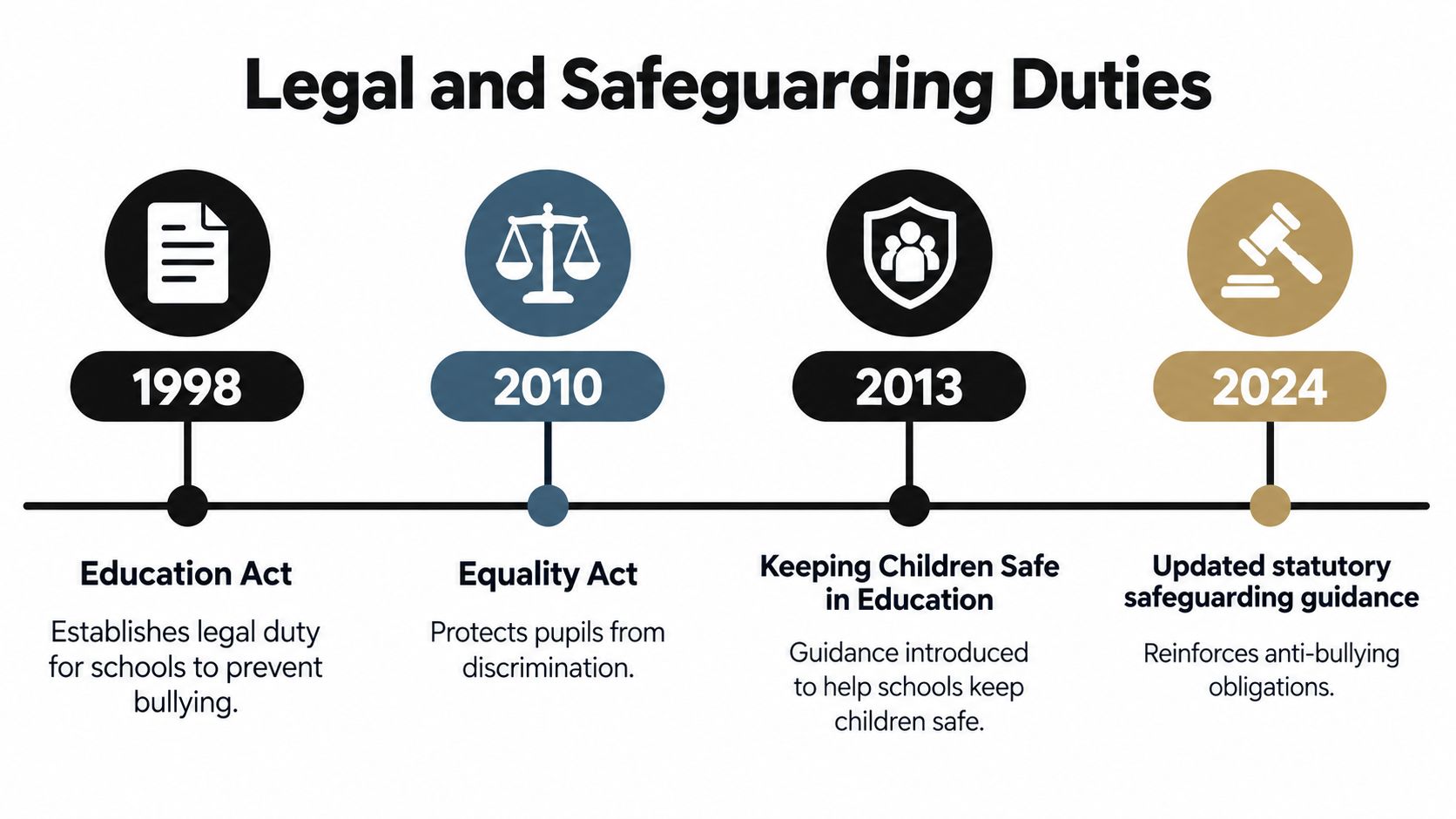
England has required formal anti-bullying arrangements for more than 25 years: section 61(4) of the School Standards and Framework Act 1998 required headteachers to determine measures preventing all forms of bullying, publicise them in writing, and communicate them to pupils and parents at least once each school year; the Education and Inspections Act 2006 subsequently placed anti-bullying measures within the wider behaviour-policy framework, as outlined in this analysis of English school policies.
When bullying becomes a safeguarding concern
The safeguarding threshold is particularly important. Where there's reasonable cause to suspect that a child is suffering, or is likely to suffer, significant harm, staff should treat the incident as a child-protection concern, discuss it with the designated safeguarding lead, and report concerns to local-authority children's social care, according to Department for Education anti-bullying guidance.
A disagreement about whose turn it is to use the football isn't the same situation as classmates repeatedly threatening violence. Both deserve an appropriate response, but the latter requires staff to consider immediate protection and safeguarding, not friendship advice.
Parents can ask direct questions:
- Responsibility: Who is the designated safeguarding lead, and who covers their absence?
- Escalation: How will staff assess whether the safeguarding threshold has been met?
- Accountability: Who checks that agreed protective arrangements happen?
For further context, the explanation of anti-bullying law in the UK can help families frame questions about school responsibilities.
The accompanying video provides another way to approach the topic.
Parents don't need to diagnose significant harm themselves before raising a concern. Describe what your child has said and what you've observed, then ask the school to explain its assessment and protective response.
Core Elements of an Effective Anti Bullying Policy
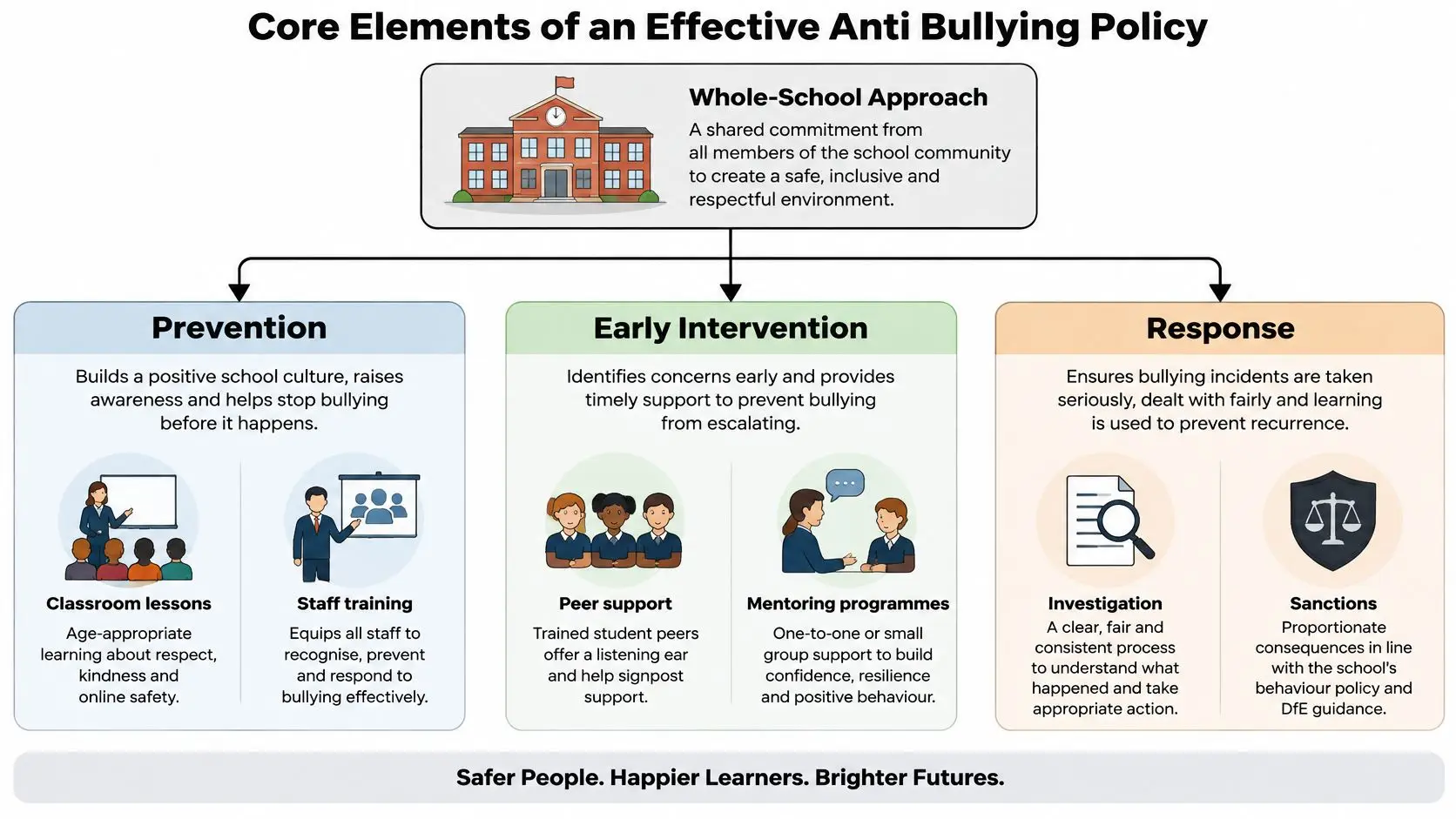
A whole-school approach means staff, pupils, and families understand their roles, rather than relying on an occasional assembly or a zero-tolerance statement. The policy should connect classroom teaching, playground supervision, reporting, and follow-up.
England's United Against Bullying programme attracted 2,400 schools, collected more than 216,000 pupil questionnaire submissions, and recorded 73% of participating schools reporting reduced bullying; reductions were particularly evident among Silver- and Gold-awarded schools, including pupils with special educational needs and disabilities and those receiving free school meals, according to the programme's summary report. These results are an implementation benchmark, not a national prevalence estimate or a guarantee for every school.
Define the behaviour clearly
The policy should explain intentional harm, repetition, and power imbalance, including online and offline conduct. Power might come from physical strength, popularity, or a group acting against an isolated child.
For example, classmates organising repeated exclusion from games is different from friends disagreeing about what to play. However, staff shouldn't withhold support while debating terminology: a serious isolated incident still needs action.
Make prevention part of daily practice
A workable policy should connect several practical arrangements:
- Staff training: Adults practise recognising subtle exclusion and responding consistently, including lunchtime supervisors and cover staff.
- Pupil participation: Children help identify unsafe places and suggest changes adults might overlook.
- Classroom learning: Pupils practise emotional vocabulary, respectful disagreement, and safe ways to seek help.
- Targeted supervision: Staff review places and transitions where concerns arise, rather than assuming general playground coverage is enough.
Evidence synthesised by the University of Oxford indicates that mainstream interventions can reduce victimisation by approximately 15–16% and perpetration by 19–20%, although outcomes vary with programme quality and implementation, as described in the Oxford evidence summary.
Monitoring should test whether children feel safer, not just whether staff record fewer incidents. A useful termly review would examine incident frequency, repeated victimisation, response times, locations, protected characteristics, and pupil-reported safety.
Fewer reports could mean improvement, but they could also mean children have stopped trusting the process. Ask pupils whether adults acted, whether the behaviour stopped, and whether they'd feel comfortable reporting again. Staff should also review whether the arrangements are realistic enough to deliver consistently.
How Reporting and Investigation Should Work in Practice
A reporting route only helps if a child can use it. A confident speaker might approach their teacher; another child might need a private conversation, a drawing, or an adult who recognises that something is wrong.
An Anti-Bullying Alliance survey of 8,665 children aged 7 to 16 found 26.6% reported frequent bullying and 56.4% reported being bullied a little; 29% of primary pupils, compared with 23% of secondary pupils, reported experiences a lot or always in the Bullying and Wellbeing report_0.pdf). Those categories need context, particularly where less serious or isolated experiences were included.
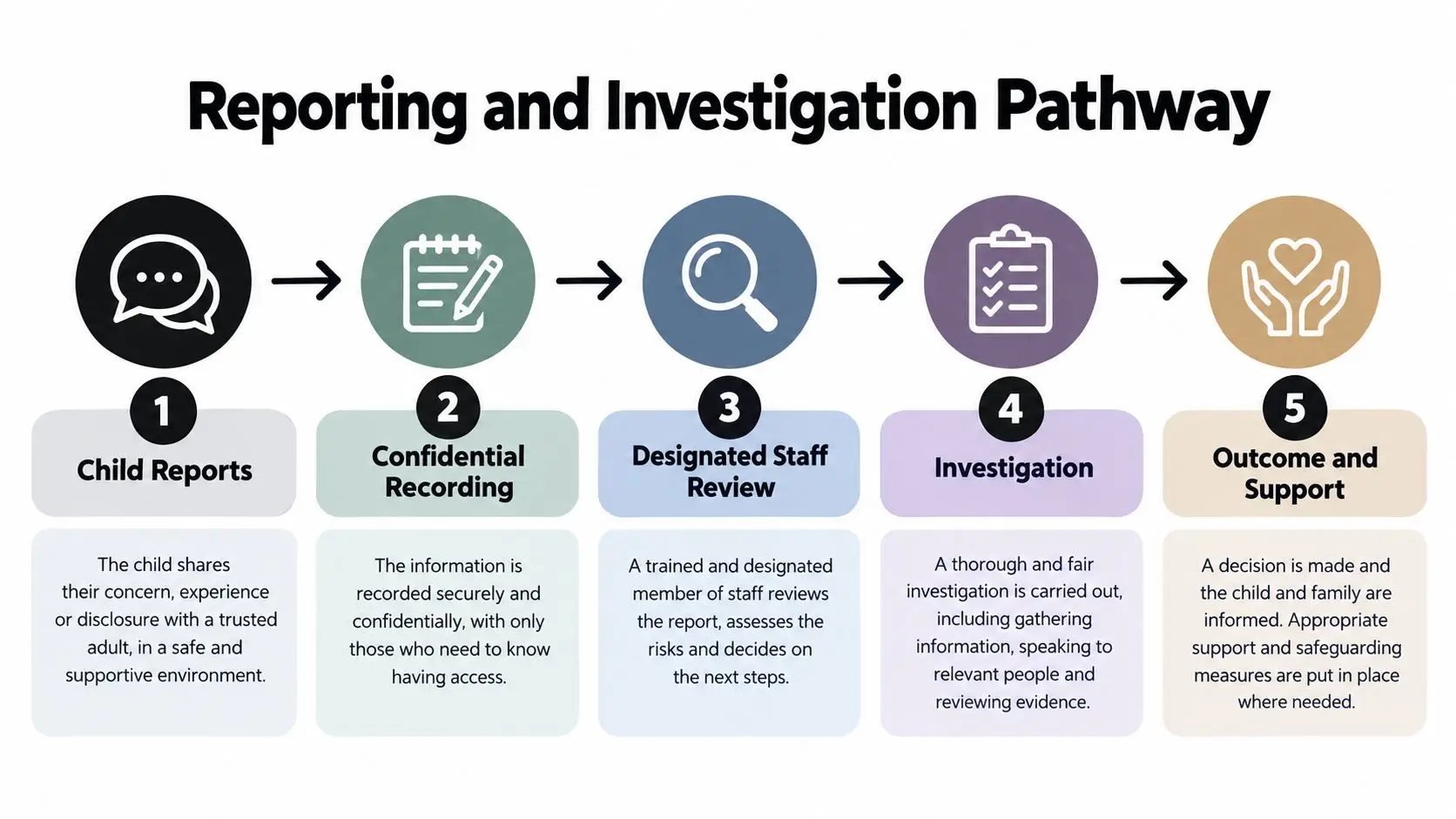
From disclosure to a protective response
- Listen without blame. Give the child space to explain, using open prompts such as asking what happened next. Thank them for telling you.
- Record accurately. Separate the child's account, adult observations, and unanswered questions. Parents can provide dates, locations, and relevant messages.
- Assess immediate safety. Decide what needs to change before the child next encounters the situation.
- Investigate fairly. Speak separately with relevant pupils and staff, examine available evidence, and avoid treating an allegation as an established finding.
- Explain the follow-up. Tell the family who is coordinating the response and when they'll hear again, even if enquiries remain underway.
Confidentiality isn't a promise of secrecy. Adults should explain that they'll share information with people who need it to protect the child, while avoiding unnecessary disclosure.
Helpful reassurance: We'll listen carefully, explain what happens next, and check whether you feel safe after we act.
For example, if a child repeatedly refuses school because classmates threaten violence, staff should arrange immediate safety planning, contact parents, and apply the safeguarding threshold described earlier. Punishing an alleged aggressor, without checking how the threatened child will enter school or spend breaktime, leaves the most urgent question unanswered.
An investigation should finish with more than a decision about the allegation. The child needs to know which adult will help, what arrangements have changed, and how to report any retaliation or continuing worry.
Supporting Victims and Perpetrators After an Incident
Stopping the behaviour and helping a child recover are related, but they aren't identical. A child may still feel frightened at lunch even after staff have addressed the incident. I'd judge the response by whether they can gradually participate without constantly watching for danger.
A local Staffordshire survey found that 51% of primary pupils considered bullying a big or quite a problem; 51% of Year 5 pupils reported being bullied during the term, compared with 28% of Year 8 pupils, according to the Staffordshire Council anti-bullying resource. These are local findings, not national estimates, but they reinforce the value of asking children about their everyday experiences.
Recovery should feel manageable
Support should reflect what matters to the individual child. Someone who fears the dining hall may need a supported lunch arrangement, while another child wants help returning to a club without everyone asking questions.
- Offer dependable contact: Agree a trusted adult and a discreet way to ask for help.
- Restore choice: Discuss seating, activities, and companionship without automatically moving the child who was harmed.
- Protect dignity: Avoid requiring public explanations or treating the child as permanently vulnerable.
- Review confidence: Ask about participation and belonging, not only whether another incident occurred.
For families unfamiliar with this support, understanding pastoral care in schools can help clarify what to ask for.
Accountability without defining a child by their behaviour
The child who bullied others also needs a structured response. Compassion doesn't mean excusing harm, and consequences shouldn't replace teaching.
A practical behaviour plan might identify the harmful action, set a clear boundary, teach a different response, and specify how staff will review progress. For instance, a pupil who recruits friends to exclude someone could practise handling disagreement without organising group rejection.
Restoring relationships must never require the harmed child to forgive, meet, or reassure someone before they feel safe.
Restorative conversations should therefore be considered carefully, not treated as an automatic solution. Staff should assess readiness, safety, and whether the child wants to participate.
If your child is accused of bullying, listen calmly and ask the school for specific examples. You can support fair investigation while making clear that intimidation or deliberate exclusion isn't acceptable. The aim is changed behaviour alongside protection for the child who was harmed.
Adapting the Policy for Online and Flexible Schooling
Learning from home doesn't remove the need for an anti-bullying policy. Schools should plan for harmful messages, exclusion during collaborative tasks, and misuse of digital classroom features, rather than assuming that physical separation guarantees emotional safety.
Attendance also deserves attention. In a 2024 Norfolk survey covering pupils from Year 4 to Year 13, 30.7% reported being bullied a little, 10.0% a lot, and 8.1% had missed school because of bullying; among Year 6 pupils, bullying-related absence rose from 3.9% in 2017 to 9.5% in 2024, according to the Norfolk bullying and attendance findings. These local results shouldn't be presented as national figures or evidence specifically about online schools.
Look beyond the attendance register
If a pupil stops joining live lessons, staff shouldn't assume ordinary reluctance or a technical problem. A private conversation could explore whether the worry concerns a particular class, pupil, group task, or message.
| Practical concern | Adaptation to discuss |
|---|---|
| A child avoids collaborative lessons | Offer supported participation while staff investigate the concern |
| Harmful messages appear in lesson chat | Preserve relevant evidence securely and review chat permissions |
| A pupil fears reporting publicly | Provide a private, child-friendly reporting route |
| Learning has been missed | Agree manageable catch-up work alongside pastoral support |
A reintegration plan should name the adult contacting the family, identify missed learning, and explain how staff will assess anxiety and review safety. Sending catch-up work alone doesn't answer why the child felt unable to attend.
Make digital boundaries explicit
Online policies should describe expectations for lesson chat, breakout rooms, shared documents, and school-connected messaging. Families can use guidance on cyberbullying prevention to start conversations about reporting, evidence, and respectful conduct.
Digital settings can offer useful controls, such as teacher-managed permissions and supervised group spaces. Those controls need thoughtful use: monitoring should be explained, access to records restricted, and children told how to obtain human help.
Flexible provision should support a return to participation, not leave a frightened child learning alone indefinitely. Success means restored access to education and a sense of belonging, rather than a zero-tolerance statement sitting untested on a website.
A Practical Checklist and Sample Policy Language
Read the policy as though your child needs help tomorrow. Could you identify the right contact, understand the likely response, and explain it to your child without translating pages of formal language?
What to check
- Scope and definitions: Online and offline behaviour, power imbalance, prejudice-based harm, and the distinction between bullying and conflict.
- Legal responsibilities: Clear links between behaviour management and safeguarding.
- Prevention: Staff preparation, pupil involvement, curriculum teaching, and supervision.
- Reporting and investigation: Accessible routes, careful recording, immediate safety assessment, and family communication.
- Support: Separate arrangements for recovery, accountability, attendance, and missed learning.
- Review: Named responsibility for monitoring, policy updates, and communication with the school community.
Wording schools can adapt
The following examples are suggested wording, not quotations from legislation or an existing school policy.
Definition: We recognise bullying as intentional harmful behaviour involving a power imbalance, usually repeated over time. It may happen face to face or online. We will also respond to harmful isolated incidents.
Reporting wording: Children can speak to any trusted member of staff or use our published reporting route. We will listen, record the concern, assess immediate safety, and explain who will respond.
Follow-up wording: We will agree a suitable update point with the family and review whether protective arrangements are working. We will not treat the absence of further reports as sufficient evidence that a child feels safe.
Keep the document active through annual communication, regular review, and child-friendly explanations. The longstanding communication requirement outlined earlier is a useful reminder that publishing a document isn't the same as helping families understand it.
Schools should test their wording against realistic situations. If the policy doesn't explain what happens when a child cannot face lunch, misses lessons, or fears an online group, revise it until staff and families can identify a practical response.
Frequently Asked Questions About Anti Bullying Policies
What if the school isn't responding?
Write to the headteacher with a factual summary, previous contact, and the protective action you're seeking. Ask for a response and follow the school's published complaints procedure if necessary; urgent safety concerns should also go to the safeguarding lead.
Is it bullying or ordinary conflict?
Consider repetition, intentional harm, and unequal power, using the distinctions explained earlier. You don't need to settle the label before asking adults to address distress or unsafe behaviour.
What if my child cannot safely return?
Request an individual safety and reintegration discussion. Ask who will support arrival, classroom participation, breaktimes, and missed learning, and how the school will review arrangements with your child.
Can parents ask to see the policy?
Yes. State schools in England must have a behaviour policy containing anti-bullying measures and communicate it to teachers, pupils, and parents; individual schools determine their policies, so check the actual wording through the government's bullying-at-school guidance.
What about online bullying outside school hours?
Report school-connected concerns and explain their effect on learning or safety. Ask the school to clarify its policy's scope and safeguarding response rather than assuming that an evening message falls outside its concern.
How can I help my child at home?
Listen without repeatedly questioning them, reassure them that seeking help was right, and offer manageable choices about what happens next. Preserve relevant messages without encouraging retaliation, and agree how you'll share concerns with school while respecting your child's feelings.
Queens Online School offers live, interactive British-curriculum learning online, with flexible scheduling and support for learners with SEN and SEMH needs. If you're considering a different setting, visit the school to discuss your child's needs and ask how its anti-bullying arrangements, reporting routes, and pastoral support would work in practice.