


Flexible learning is the deliberate redesign of when, where, how and at what pace a child studies, not lessons on a screen. In England, 639,000 children and young people aged up to 25 had an Education, Health and Care plan in January 2025, a reminder of how varied learners' needs can be (Department for Education statistics).
At half past eight, one child may be ready to join a live lesson at the kitchen table, while another needs a calm start and a check-in with a trusted adult before opening a laptop. If you're weighing up alternatives to a conventional school day, the important question isn't whether lessons happen online. It's which changes will help your child take part, feel secure and keep learning, without placing the whole job of running school on your family.
A Morning That Looks Different for Every Family
A Year 6 pupil joins a live history lesson from home because the school run has become a source of intense anxiety. A Year 9 pupil in Spain watches a recorded maths explanation while their parents are at work. A Year 11 learner with social, emotional and mental health needs starts with a short pastoral conversation before tackling any academic work.
These are different arrangements, but each can be flexible learning. The child's day is organised around what helps them access education, rather than assuming that every learner must be ready at the same time, in the same place and in the same way. Flexibility doesn't mean removing expectations. It means considering how a child can meet them.
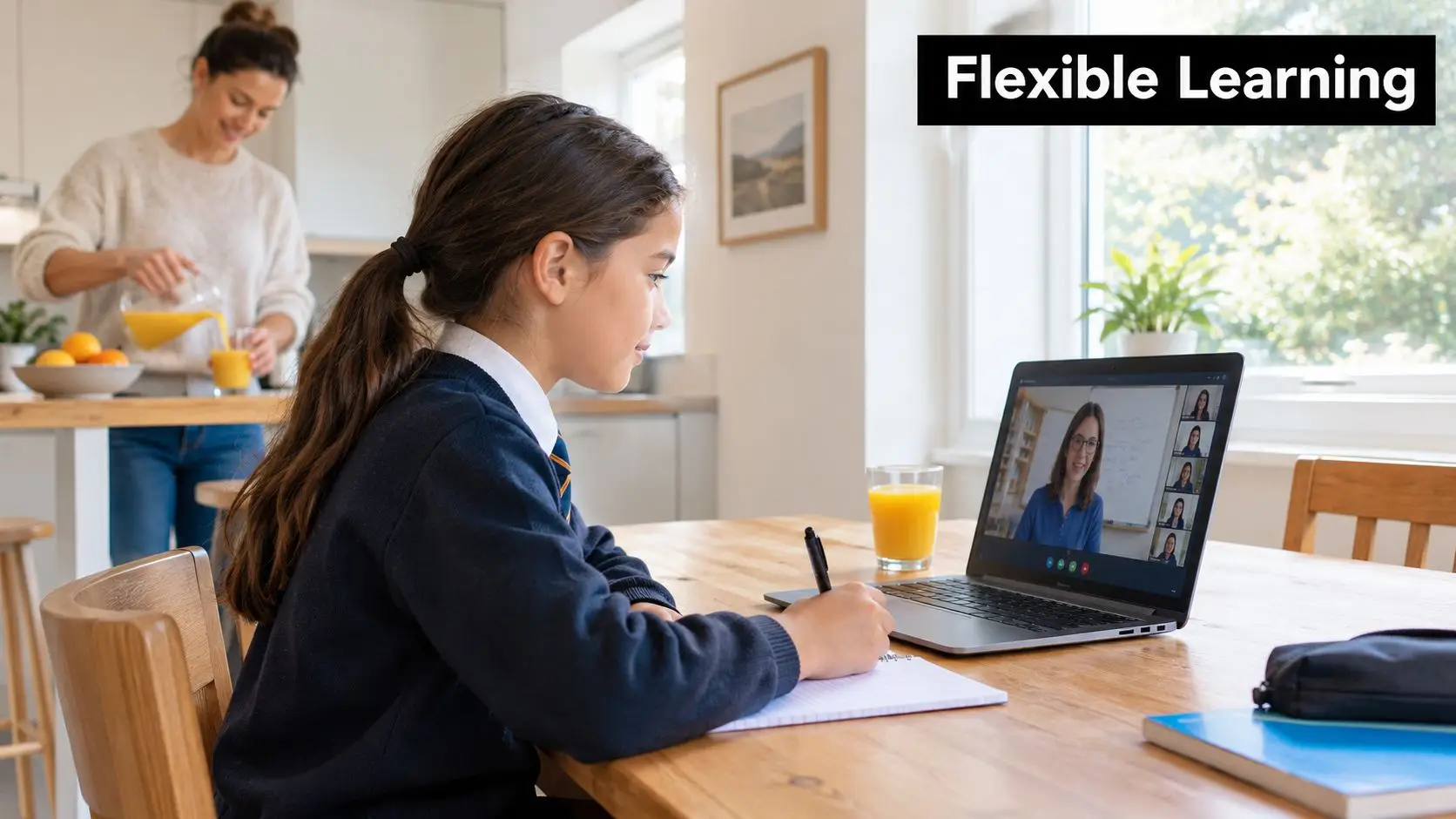
For a parent, the distinction matters most when a child is struggling. An Office for National Statistics analysis found that, among children aged 5 to 16 in two-parent households in England, the estimated probability of presenting at hospital with mental-health issues was 1.82% when there were no school absences, 3.77% when absence reached 20%, and 5.27% at 30% absence. The relationship went both ways, so these figures don't mean that absence alone causes mental-health problems (ONS analysis of child mental ill health and school absence).
A different timetable may help preserve a connection to learning, but it should never be treated as a substitute for understanding what's troubling the child. If you're looking for practical ways to support a child's learning at home, support your child with ABA at home offers another perspective on creating supportive routines.
The Four Dimensions of Flexible Learning Explained
Think of a conventional school model as a standard house plan. Flexible learning keeps the foundations, such as a clear curriculum and teaching, but adjusts the layout to fit the learner. To understand what a provider is offering, ask which part of the learning experience it changes.
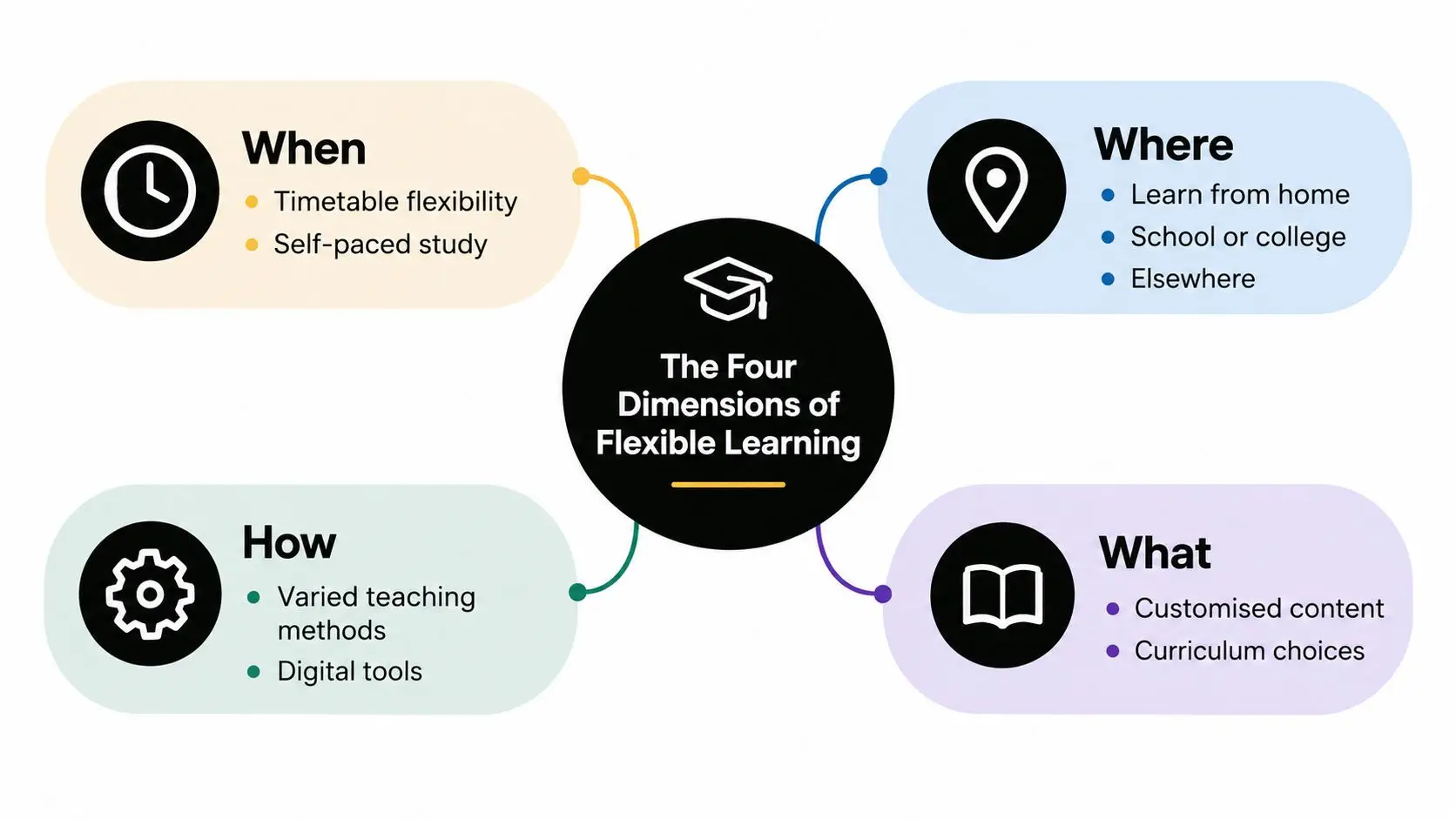
UK education policy describes flexibility as choice over when, where, how and at what pace a learner studies. The definition can also include changes to course structure, support and assessment, not just the use of online lessons (UK government research on remote education).
When and where
When concerns the timetable. A child might join a live lesson at a set time, watch its recording later, or work through an agreed sequence at a different pace. This can matter to a young athlete with training commitments, a child managing a health condition or a family living across time zones.
Where is the place learning happens. It could be home, a school site, a library or another suitable setting. Learning from home may avoid a difficult journey, but it doesn't automatically solve problems such as distraction, lack of equipment or feeling isolated.
How and at what pace
How describes the teaching and ways a child can show understanding. A lesson might be live and discussion-based, recorded with written instructions, or built around a project. Pace is about how quickly a learner moves through the material. A child might revisit a difficult concept, take more time to complete a task or move on once they've mastered it.
The four levers work together, but changing one doesn't necessarily change the others. A lesson can be online yet happen at a fixed time, for example. When digital access is part of the arrangement, it's worth considering whether the device is suitable for the child and their circumstances. Parents comparing options might browse eco-conscious tablets for young users. For a closer look at a model combining online and in-person teaching, see what blended learning means.
The Main Models Families Can Choose From
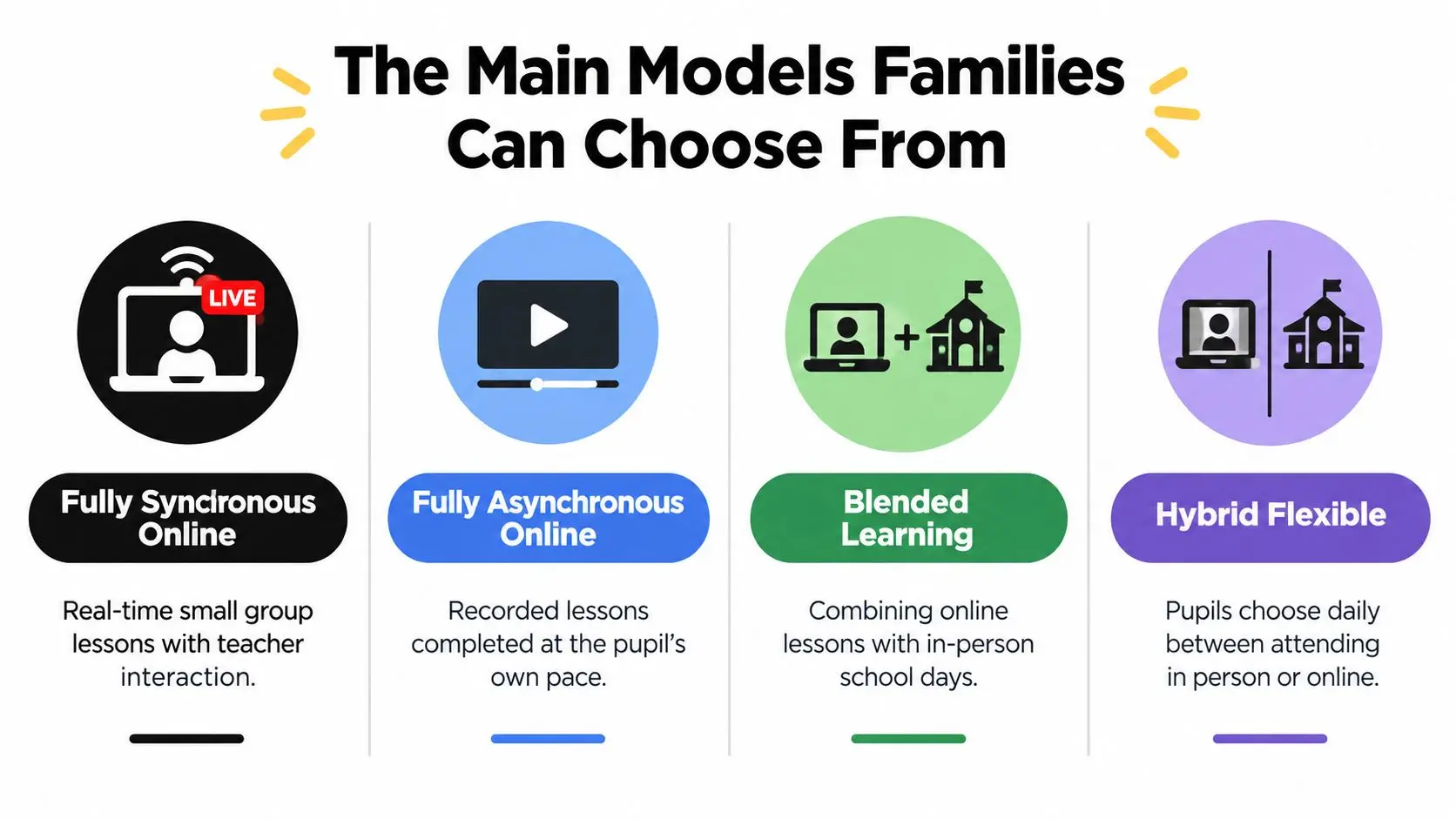
The names used by schools can be confusing. One useful way to compare them is to ask what the child does each day, how much teacher contact is built in and what happens if the child can't join at the scheduled time.
| Model | Best suited to | Key safeguard |
|---|---|---|
| Fully synchronous online | A pupil who benefits from live explanations, discussion and regular teacher contact | A plan for missed live lessons and access to follow-up materials |
| Fully asynchronous online | A learner who needs to study at varied times or review explanations independently | Clear deadlines, teacher availability and regular feedback |
| Blended learning | A child who benefits from a mix of online study and in-person teaching or social contact | A coherent plan joining the online and face-to-face parts |
| Self-paced learning | A motivated learner who needs room to move more slowly or quickly through material | Scheduled check-ins and milestones so work doesn't drift |
A Year 4 pupil with dyslexia might benefit from live phonics teaching, then use recorded reading explanations to practise again without pressure. A Year 11 GCSE candidate preparing for Pearson Edexcel exams may need structured live teaching and scheduled mock exams, rather than unlimited freedom to decide when to study. A young carer may need asynchronous lessons, but also reliable teacher office hours when a question can't wait.
The labels aren't always used consistently, so ask providers to show you a typical week. Cambridge Assessment defines blended learning as an intentional combination of online and classroom-based teaching, not just a collection of separate options. If you're comparing how independent study works, this explanation of asynchronous learning can help clarify the term. Families exploring early-years education in a multilingual setting may also find it useful to compare bilingual immersion kindergartens.
What UK Evidence Says About Outcomes
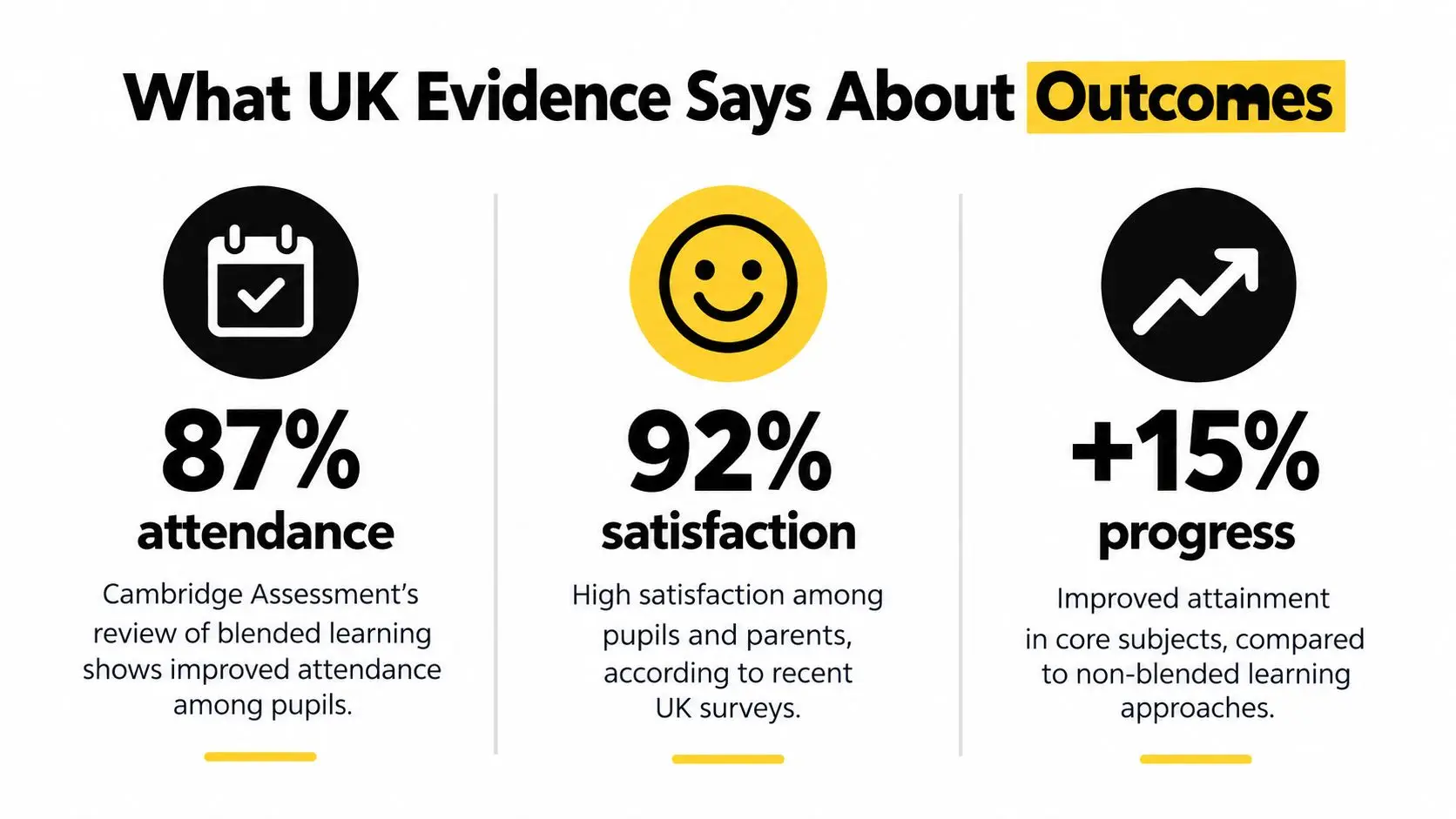
A flexible arrangement can improve access without automatically improving attainment. The difference depends on how the school keeps the child connected to teaching, feedback and support. The evidence is encouraging in some contexts, but it doesn't justify assuming that every online or blended model will work for every pupil.
Cambridge Assessment's review reports evidence of improved attendance, learner satisfaction, retention and examination performance in some blended-learning contexts. It also cautions that attainment gains aren't universal, particularly for non-traditional learners (Cambridge Assessment review of blended learning).
That is why a school needs to notice whether a child is participating, not just whether lessons are technically available. Useful indicators include attendance at live lessons, access to recordings, assignment completion, performance on low-stakes checks, how quickly teachers return feedback and whether pupils with SEN or SEMH needs are participating.
For a child with sensory sensitivities, a digital lesson may make it easier to step away briefly and rejoin later. A child who has missed a live explanation might use a recording before asking a teacher for help. These options can remove barriers, but they need to be paired with accessible materials, clear milestones and regular human contact. Otherwise, the child may end up working alone without anyone noticing they're stuck.
A useful question for a school: How will you know whether this flexibility is helping my child learn and feel connected, rather than simply making lessons available?
Real Learners and How Flexibility Works for Them
A plan becomes meaningful when you can picture your child using it. The arrangements below are examples of how a school and family might respond to different needs. They aren't prescriptions: the child's preferences, support plan and response to teaching should guide the decisions.
A Year 5 pupil with sensory needs
Maya finds long, busy lessons overwhelming. Her school breaks learning into shorter blocks, provides visual instructions and records explanations so she can revisit them when the room is quiet. Headphones reduce distracting sound during independent work, while a teacher checks that Maya understands the task before she starts.
The family can notice whether she feels calmer and more able to join in. The school can review whether the adjustments are helping her participate, not just whether she finishes a worksheet.
A Year 10 pupil with SEMH difficulties
For Adam, the day begins with a fifteen-minute pastoral check-in. He attends one live lesson in the morning, then uses a recorded explanation to consolidate learning later. After a difficult week, his school agrees a gradual route back into live lessons rather than treating missed sessions as defiance.
The emotional safeguard is a known adult who can ask how the plan feels and help Adam return without shame. A reduced timetable is useful only if the child remains connected to people and learning.
A Year 12 athlete training abroad
Leila's live lessons anchor her week, while a library of recordings helps her catch up when training or travel conflicts with the timetable. A subject specialist offers targeted A-Level support when she needs to work through a difficult topic.
The scale of additional needs in England makes individual planning important. 639,000 children and young people aged up to 25 had an EHC plan in January 2025, according to the Department for Education's SEND statistics. The number isn't a measure of what any one child needs. It does underline why families should ask how a school turns a learner's profile into practical classroom adjustments.
The Hidden Question Families Actually Ask
A timetable can be flexible for a child and still become inflexible for everyone else. If parents must organise every lesson, find resources, supervise each task and explain the work, online learning may shift teaching responsibilities into the home rather than reducing the family's pressure.
The Department for Education's October 2025 parent survey found that 3% of secondary-school parents reported poor internet or device access as a barrier to supporting learning outside school, and 7% cited resource costs. Among parents of children in special schools, 8% reported inadequate subject resources and 11% cited cost (October 2025 parent survey). These findings are a reminder that a recording is only useful if the child can access it and has the support needed to use it.
Schedule flexibility and support flexibility
Schedule flexibility asks when and where the child can learn. Support flexibility asks how much coordination the family must provide. A strong arrangement considers both. It gives the child room to learn at a workable time while keeping teachers responsible for instruction, feedback and follow-up.
Ask what a normal week looks like for a parent. Who checks the child's work? Can they contact a teacher when they're stuck? Does the school provide recordings and resources directly, or must a parent source and organise them? Is the child expected to manage the timetable independently, and is that realistic for their age and needs?
The purpose isn't to avoid family involvement. Parents know their children well and have an important role in communication. But a school should be clear about what it teaches and supports, so flexibility doesn't become hidden domestic labour.
A Practical Checklist for Evaluating Any Flexible School
Take these questions to an open evening or admissions conversation. Ask for clear examples of what happens on an ordinary day, not just a general promise that learning is personalised.
Access
- Identifying needs: How does the school understand my child's needs before they start?
- Turning plans into practice: If my child has an EHC plan, how will relevant needs translate into everyday teaching adjustments? EHC plans record a child's special educational, health and social-care needs, so ask how staff use that information in lessons (Department for Education guidance on EHC plans).
- When live attendance is difficult: Can my child access a recording or another agreed route, and who helps them catch up?
Belonging
- A named adult: How often will my child speak with a teacher or pastoral contact who knows them?
- The child's voice: How will staff ask whether the arrangement feels manageable and safe?
- Wellbeing and absence: What happens if my child starts missing lessons or becomes distressed?
Sustained learning
- Progress and feedback: How often will teachers assess work, return feedback and explain next steps?
- Communication with parents: How will I know whether my child is participating and making progress?
- Personalisation: Ask how a personalised learning path is planned, reviewed and adjusted when a learner's needs change.
Look for specific answers, clear responsibilities and a willingness to adapt. If the school can't explain who will do what when a child gets stuck, ask again before making a decision.
Putting Your Child at the Centre of the Decision
Flexible learning isn't measured by how many timetable options a school advertises. It's measured by whether the arrangement helps your child access learning, feel they belong and keep making progress.
A simple rule can help you weigh the options: schedule flexibility should reduce friction for your child, support flexibility should reduce friction for your family, and academic flexibility should keep learning purposeful. All three matter. A plan that removes a difficult school run but leaves a child alone with confusing work hasn't solved the whole problem.
Emotional wellbeing belongs in the decision, too. The Department for Education reported that seven in ten schools and colleges said attendance improved after they received mental-health support (Department for Education update on mental-health support in schools). Support doesn't look identical for every learner, but the principle is clear: wellbeing and participation are connected.
This week, ask your child what part of the school day feels hardest and what would make it easier to take part. The right arrangement is the one that helps them feel safe enough to ask questions, make mistakes and return after a setback.
Queens Online School offers a British curriculum from Primary through Sixth Form, combining live interactive classes with recorded lessons and self-paced study. If you're considering an online option with subject-specialist teaching and support for learners with SEN or SEMH needs, visit Queens Online School to explore how its provision works for your family.