


At the kitchen table, a child pushes a maths book away and whispers, “Will I be ready for the tables check?” The school bag feels heavier, homework takes longer, and a simple mistake can suddenly feel like proof that everyone else is ahead.
For many families, that worry sits underneath every search for a curriculum for Year 4. Year 4 is deliberately more demanding, but a child who needs more time, more explanation or a different route into learning isn't behind, broken or failing. The multiplication tables check is one milestone in a much larger year involving reading, writing, science, creativity, movement, friendships and growing independence.
The Year Your Child Starts to Stretch
Year 4 often feels like a turning point. A child may still want a bedtime story and time to play, yet schoolwork now asks for longer concentration, more precise explanations and greater independence. One day your child might confidently explain a habitat, then become upset because they can't recall a multiplication fact quickly enough.
That mixture is normal. Children don't develop evenly, and confidence rarely grows in a straight line. A pupil may understand that four groups of six make twenty-four but hesitate when asked for 4 × 6 without counters. Another may know the answer but lose time entering it on a screen. Those are different needs, and they call for different support.
The multiplication tables check, or MTC, matters because it is part of the statutory Year 4 assessment picture. It doesn't matter because it can define a child. Calm practice, clear teaching and a supportive adult will help far more than anxious drilling.
A useful message for your child: “The check tells your teacher which facts might need more practice. It doesn't measure how clever you are.”
A strong Year 4 curriculum stretches knowledge while protecting curiosity and emotional safety. It gives children repeated chances to retrieve facts, discuss ideas, make practical discoveries, read widely and recover from mistakes. It also gives adults a better vocabulary for noticing what's really happening: is the difficulty mathematical, technological, linguistic, sensory or emotional?
The pages that follow bring together the statutory expectations, everyday examples and inclusive habits that help children feel secure. You'll see what schools teach, how online learning can preserve breadth, how to prepare for the MTC without panic and how to support progress without turning home into another testing room.
Where Year 4 Fits in the National Curriculum
Year 4 is the second year of Key Stage 2 in England, normally attended by children aged eight to nine. It sits within a national framework of programmes of study and attainment targets, so it isn't an isolated primary-school year. The current national curriculum followed the 2013 framework publication. Most of the curriculum began in September 2014, while English and mathematics became applicable to all year groups from September 2016. These dates are set out in the Department for Education's national curriculum framework.
The phrase “programme of study” means the knowledge, skills and content pupils are expected to encounter. “Attainment targets” describe the standards children work towards. They don't prescribe one teaching style, one textbook or one type of classroom. A school can choose stories, experiments, fieldwork and digital tools while still mapping its units to the national expectations.
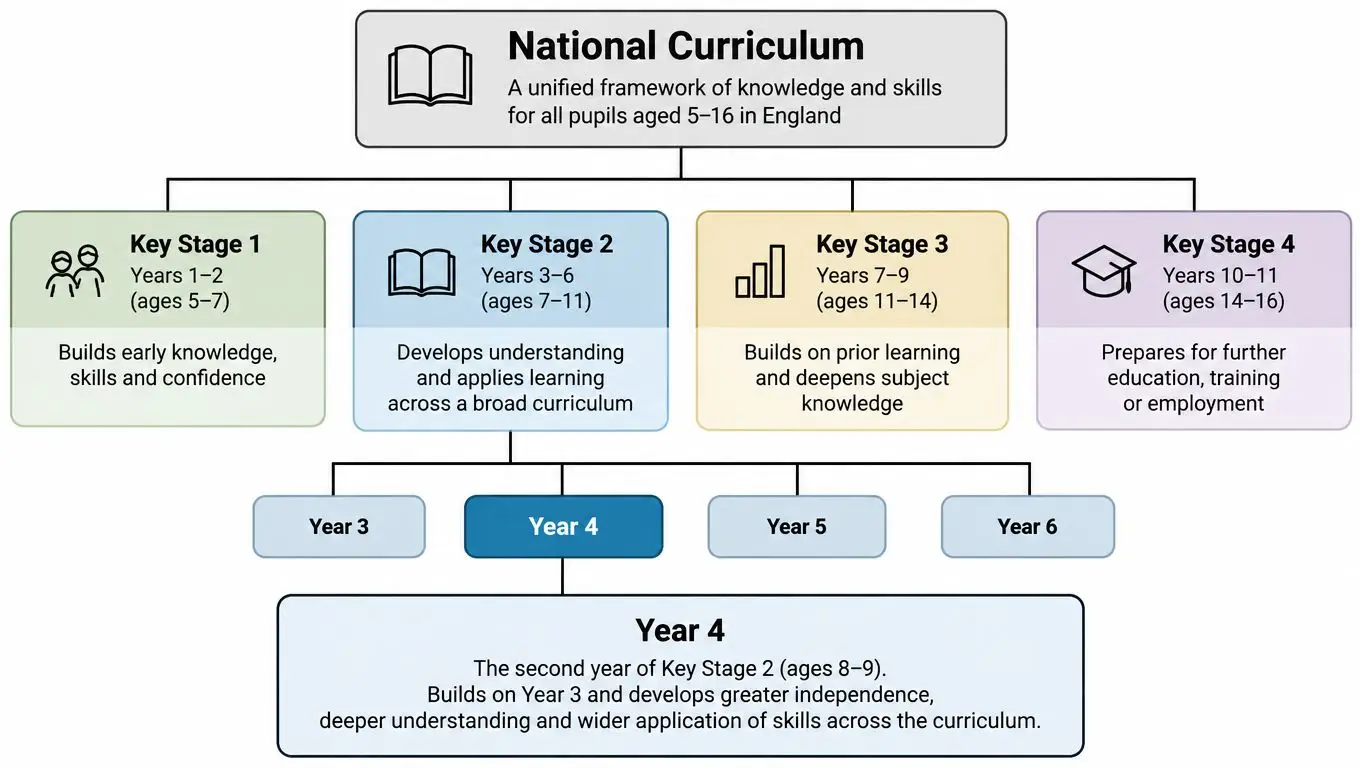
The subject entitlement
A compliant Year 4 programme covers:
- English, including reading, writing, spoken language, spelling and grammar.
- Mathematics, including fluency, reasoning and problem-solving.
- Science, with practical investigation and evidence-based explanation.
- Design and technology, where pupils design, make and evaluate.
- History and geography, building knowledge of people, places and change.
- Art and design, including experimentation with materials and techniques.
- Music, including listening, performing and composing.
- Physical education, including swimming.
- Computing, covering digital use, systems and computational thinking.
- A modern foreign language, developing communication and cultural understanding.
The Key Stage 2 curriculum overview can help families compare a school's published plan with this entitlement. Look for more than a list of topics. Ask whether children investigate, create, discuss, practise and receive feedback across the year. The national framework describes progression, while teachers make that progression visible through the work children produce.
Subject-by-Subject Learning Objectives
A useful way to understand the curriculum for Year 4 is to connect every subject to something a child might do. The point isn't to memorise a list of labels. It's to recognise the knowledge and habits that appear in ordinary conversations, homework and projects.

English and mathematics
In English, pupils develop reading comprehension, draft and improve writing, discuss vocabulary and build handwriting fluency. At home, this might look like explaining why a character made a choice, planning a short information page about an animal or rereading a paragraph to improve one sentence. Families wanting suitable reading practice can find sample texts and tips, then discuss the child's thinking rather than treating reading as a pronunciation test.
In mathematics, Year 4 includes counting in multiples of 6, 7, 9, 25 and 1,000, finding 1,000 more or less than a number, using formal written methods and solving two-step problems. A child might calculate the cost of several equal items, then work out how much remains, explaining each step.
Science and the foundation subjects
Science asks pupils to study living things and their habitats, group organisms, use classification keys and understand how environmental change can endanger living things. They also study animals, including humans, with attention to nutrition and the fact that animals need the right types and amounts of nutrition but can't make their own food. A kitchen investigation might involve sorting leaves by observable features, recording results in a table and explaining why a classification key helps.
The foundation subjects give children different ways to understand and express ideas:
- Computing: sequence instructions, debug a simple program and explain why an algorithm didn't work.
- History: use a source, timeline or artefact to ask what happened and how we know.
- Geography: read maps, describe locations and collect information about places.
- Art and design: explore colour, texture or pattern, then evaluate a finished piece.
- Music: keep a beat, perform a part and describe how a piece creates a mood.
- Physical education and swimming: practise movement, coordination, teamwork and water safety.
- Design and technology: design a useful object, select materials, make it and review the result.
- Modern foreign language: greet someone, ask a simple question and notice how another language works.
A child who struggles with written work may shine while explaining a classification decision or composing a rhythm. Those strengths aren't extras. They help teachers understand the whole learner.
Multiplication Tables and What Fluency Really Means
The English national curriculum expects pupils to have memorised multiplication tables up to and including the 12 times table by the end of Year 4, with precision and fluency. Fluency means more than producing an answer quickly. It includes recalling a fact, connecting it to related facts, using inverse division and applying it in a problem.
Start with meaning. Arrange four rows of six counters. Your child can see 4 × 6 as four equal groups of six, count twenty-four objects and then connect the idea to 24 ÷ 6 = 4. From there, arrays, number lines and patterns help the child build a network of facts rather than memorising disconnected answers. For example, if 5 × 8 is secure, adding one more group of eight gives 6 × 8.
The image URL above contains a mismatch in the supplied asset path, so the exact mandatory URL is preserved below as provided:
A child may know the mathematics but need longer to process language, find a key on the keyboard or manage anxiety. That's why Key Stage 2 maths guidance should be judged by the quality of reasoning as well as recall.
Fluency is secure knowledge used flexibly. Speed can be useful, but speed alone isn't understanding.
A Sample Year 4 Week That Works Online
Online learning works best when the week has a dependable rhythm and children can show what they know in more than one format. A teacher might combine live participation, recorded demonstrations, digital portfolios, retrieval quizzes and written feedback. In maths, a lesson should move from fluency to reasoning and problem-solving, not stop at a worksheet. In science, pupils can use home-safe experiments, simulations, video evidence, data tables and claims evaluated against evidence.
| Subject | Weekly Focus | Live Lesson Time | Independent or Retrieval |
|---|---|---|---|
| English | Reading comprehension and drafting | Shared reading and discussion | Read, annotate and improve a paragraph |
| Mathematics | Multiplication, written methods and problems | Teacher modelling and guided practice | Short retrieval, reasoning task and feedback |
| Science | Habitats and classification | Demonstration and questioning | Observation table or recorded explanation |
| Foundation subject | Geography, history, art, music or computing | Workshop or collaborative activity | Portfolio task or reflection |
| Physical activity | Coordination, fitness or swimming where available | Movement instruction | Safe practice and personal reflection |
| Modern foreign language | Vocabulary and simple conversation | Pronunciation and partner talk | Oral rehearsal and recall cards |
This kind of timetable makes learning observable. A child can submit a photograph of a labelled habitat diagram, record an explanation of a maths strategy, add a drawing to a digital portfolio or answer a retrieval quiz. The teacher then sees more than a completed page.
Parents should look for balance rather than constant screen use. A live lesson can introduce a concept, a recorded demonstration can make the explanation available again, and independent work can give the child time to think without an audience. Movement, reading away from the screen and practical materials still belong in an online curriculum.
The Multiplication Tables Check Without the Panic
The MTC is an onscreen assessment for Year 4 pupils, typically aged eight to nine, and the first digital primary assessment of its type in England. It's normally administered during a two-week period in June and is statutory for pupils in state-funded maintained schools, special schools and academies, including free schools. A school may record that an individual pupil shouldn't participate.
The activity contains 25 questions, each worth one mark, with six seconds allowed for each response. Children receive three practice questions first, and the whole activity should usually take no more than five minutes. These details come from the official multiplication tables check information.
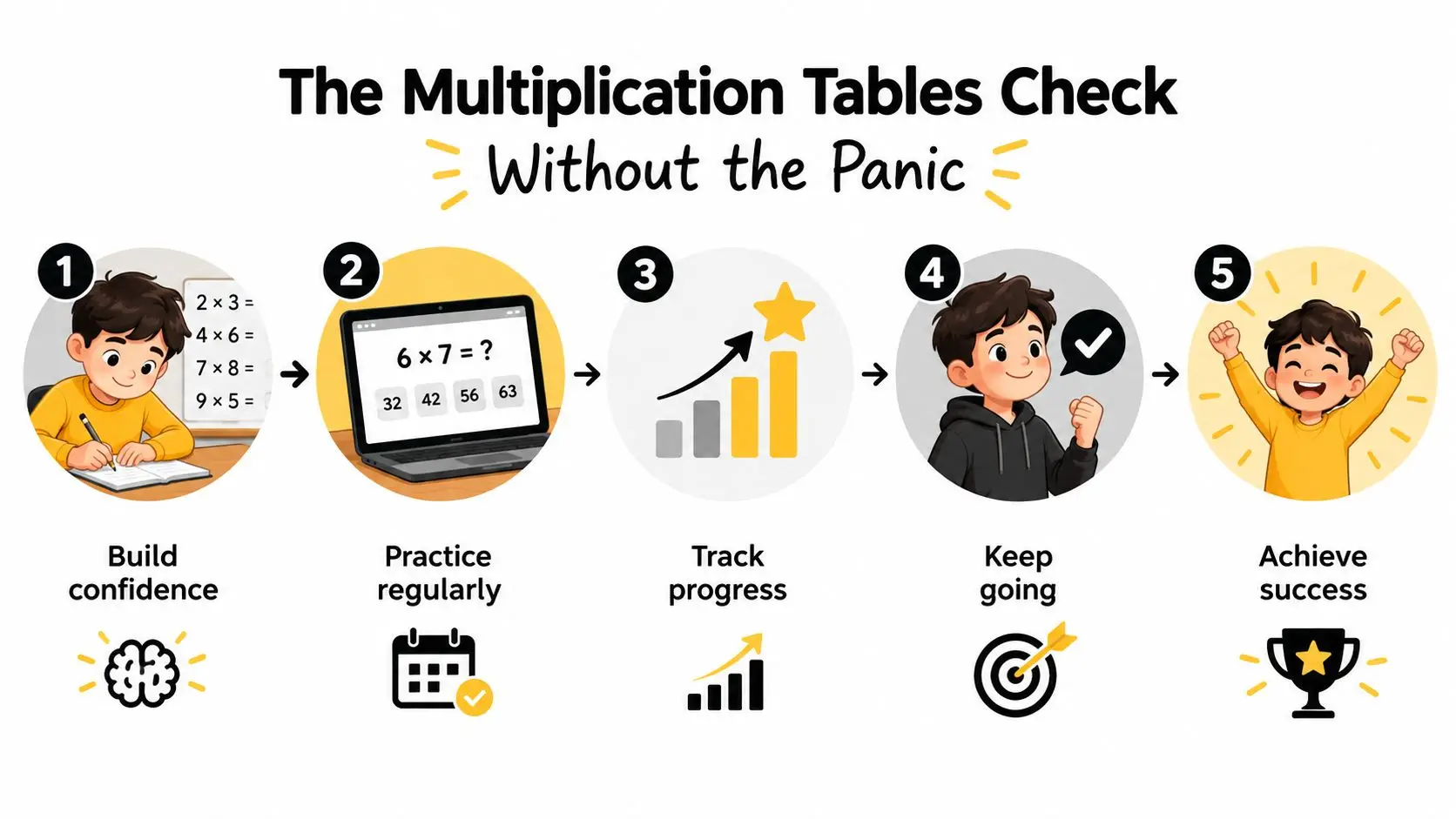
Prepare the whole child
The six-second format creates demands beyond mathematical recall. Children may need to use a keyboard or mouse, track information on screen, read the question, process the fact and enter one number. Practise the interface calmly, perhaps by locating the answer box, entering a response, correcting an error and stopping before the activity becomes tiring.
Notice what slows your child down. Is it the fact itself, typing, visual tracking, working memory or worry? The answer changes the support. A child who understands 7 × 8 with counters but freezes on screen needs reassurance and accessible practice, not a harsher drill routine.
The MTC identifies fluency gaps. It doesn't define mathematical ability, confidence or wider progress. Talk about it as one brief check, not a pass-or-fail judgement.
Assessment Checkpoints Across the Year
A child may explain a science result confidently, then hesitate over a familiar multiplication fact. Year 4 assessment helps teachers understand that difference and choose the next useful step.
Good assessment is frequent, brief and practical. Teachers use low-stakes retrieval, oral rehearsal, inverse-fact practice and short diagnostic checks. A maths conversation might show that 6× and 8× facts are secure, while 7× and 12× facts need spaced review. The response should match the barrier, whether it is recall, language, working memory or anxiety.
Reading comprehension needs the same care. Ask your child to explain an inference, summarise a paragraph or support an opinion with evidence. A correct answer without explanation may conceal uncertainty. A thoughtful explanation with spelling errors may show secure understanding, so marking should separate ideas from presentation.
The 2024 figures provide context: 96% of eligible Year 4 pupils in England took the MTC, and the average score among those who took it was 20.6 out of 25, compared with 20.2 in 2023. Full marks rose from 29% in 2023 to 34% in 2024, according to the 2024 multiplication tables check performance statistics. These are group results, not a forecast of an individual child's potential.
A half-term conversation should include the whole curriculum:
- Can my child describe a science investigation and evaluate evidence?
- Can they use a digital tool safely and explain their choices?
- What practical work have they completed in art, music, design or PE?
- Which new idea can they explain with confidence?
- Which adjustment helps them participate most fully?
The later Key Stage 2 assessment context matters, yet Year 4 should retain room for curiosity, emotional safety and meaningful learning. Assessment should guide teaching, not reduce progress to test speed.
Supporting Learners with SEND and SEMH Needs
Every child has a right to experience the Year 4 curriculum as a learner, not as a problem to be managed. England's SEND framework asks mainstream schools to use their best endeavours to provide support whether or not a child has an Education, Health and Care plan. The graduated process is assess, plan, do and review, and it should change as adults learn more about what helps.
Take a child who avoids multiplication. Before deciding that the child lacks number knowledge, a teacher might check whether they can read the question, hold the information in working memory, see the screen clearly, manipulate counters or stay calm under time pressure. Each possibility suggests a different response.
Adjust the barrier, not the ambition
Useful adjustments can include:
- Larger text: reduce visual strain during online tasks.
- Manipulatives: use counters, arrays or number lines to make relationships visible.
- Extra processing time: allow thinking before expecting an answer.
- A reduced question set: focus on a precise gap without creating overload.
- Predictable routines: explain what will happen before a timed activity.
- A quiet space: reduce sensory or emotional pressure.
- Private checking: let a trusted adult ask, “Which part feels tricky?” without an audience.
National evidence cited in the assessment guidance records a 16.2-month gap for pupils receiving SEND support by the end of primary school. That figure should prompt adults to examine systems and barriers, not attach blame to children. The SEND Code of Practice guidance supports a collaborative cycle in which families receive clear feedback about what a child can do, what remains difficult and what will be tried next.
A child who shuts down during timed work may need emotional safety before more practice. Progress might begin with explaining one fact using counters, then choosing an answer orally, and only later entering it on screen.
Why Curriculum Breadth Protects Every Child
Primary assessment naturally draws attention towards English and maths, but a child's education is larger than the subjects most often tested. The Curriculum and Assessment Review notes that statutory primary assessments focus heavily on English and maths, while 61% of pupils achieved the expected standard in reading, writing and maths at Key Stage 2 in the cited period. The review supports a clear conclusion: families and schools must actively protect breadth. See the Curriculum and Assessment Review for the wider context.
Breadth also strengthens core learning. A geography activity involving rainfall or population data can create a meaningful maths context. A historical source can deepen reading comprehension. Coding develops sequencing, precision and problem-solving. Art gives children another route to discuss pattern, proportion and revision.
This matters especially for flexible and home-based learners, who may not automatically have access to laboratories, group work, clubs, instruments or outdoor learning. A practical breadth audit can ask:
- Time: Does the week allocate attention to every statutory subject?
- Experience: Has the child investigated, made, performed, moved and collaborated?
- Evidence: Can the family see progression in a portfolio, notebook or recording?
- Connection: Do subjects reinforce one another rather than sit as disconnected tasks?
Enrichment isn't decoration added after the “real” work. It gives children reasons to read, calculate, explain, design and persist. A broad Year 4 helps a child discover that learning can feel challenging without feeling narrow.
How Parents Can Support Learning at Home
Home support works best when it feels like shared problem-solving. Instead of asking, “How many did you get right?”, try, “Which fact felt friendly today?” or “Can you show me how you know?” These questions reveal thinking and lower the emotional temperature.
For multiplication, use one or two facts at a time. Arrange counters in an array, draw a number line, say the related division fact and connect a new fact to one your child already knows. If 5 × 8 is secure, ask whether one more group of eight could help with 6 × 8. Keep practice short enough that your child can finish feeling capable.
The MTC methodology guidance supports frequent low-stakes retrieval, oral rehearsal, inverse facts, arrays, scaling and spaced review rather than relying only on timed tests. It also recommends distinguishing mathematical knowledge from processing speed and using diagnostic checks to identify gaps in the 6×, 7×, 8×, 9×, 11× and 12× families.
What helps and what harms
Helpful habits include:
- Celebrate partial progress: “You used the array independently” is specific and encouraging.
- Practise the format calmly: use a few onscreen items without presenting them as an exam.
- Let your child choose a strategy: explanation builds ownership.
- Stop before frustration peaks: a calm ending supports the next attempt.
- Name effort and self-advocacy: asking for counters or more thinking time is a strength.
Avoid presenting the MTC as a pass-or-fail test, praising speed alone or treating silence as laziness. A quiet child may be processing, worried about being wrong or struggling with the interface. Listen before increasing the pressure.
Quick Reference Summary for Busy Parents
| Area | Year 4 focus | Useful checkpoint |
|---|---|---|
| English | Comprehension, drafting, vocabulary and handwriting fluency | Can the child explain and improve their ideas? |
| Mathematics | Multiples, written methods, two-step problems and multiplication facts | Can they explain a strategy as well as recall a fact? |
| Science | Habitats, classification, environmental change and nutrition | Can they observe, record and use evidence? |
| Foundation subjects | History, geography, art, music, PE, computing, design and technology, language | Is there practical work and visible progression? |
| MTC | Onscreen recall of multiplication and division facts | Is practice calm, accessible and specific? |
| Home support | Short retrieval, arrays, oral rehearsal and spaced review | Does the child finish feeling more confident? |
Remember the central points: Year 4 is part of Key Stage 2, the MTC is one milestone, fluency includes understanding, and a broad curriculum protects the whole child. When anxiety rises, return to the question, “What does my child understand, and what barrier can we remove?”
Questions Year 4 Parents Ask Most
Can an online school deliver the full Year 4 curriculum?
Yes, if it maps learning to the national programmes of study and preserves subject breadth. Look for live teacher participation, recorded demonstrations, digital portfolios, retrieval quizzes, feedback and practical alternatives for science, art, PE and design.
Is the multiplication tables check a pass-or-fail exam?
No. It identifies recall and helps teachers spot where further support may be useful. A score shouldn't be treated as a complete description of mathematical understanding or a child's value as a learner.
What if my child is anxious about timed questions?
Begin away from the timer. Use counters, arrays and oral rehearsal, then introduce a small number of onscreen questions calmly. Ask the teacher whether the difficulty appears to involve facts, reading, processing, motor control, visual access or anxiety.
How can I tell whether my child is falling behind?
Look for patterns across different tasks. A child may struggle with a timed screen activity yet explain multiplication accurately with objects. Share specific observations with school and ask what will be assessed, planned, tried and reviewed.
Should Year 4 focus mainly on maths and English?
No. English and maths need consistent attention, but science, computing, history, geography, art, music, PE, design and technology and language are statutory parts of the entitlement. Breadth also gives children meaningful contexts for reading, reasoning and problem-solving.
How does Year 4 prepare children for later Key Stage 2?
It builds foundations in knowledge, independence, communication and application. Children learn to retrieve information, explain evidence, solve connected problems and reflect on their work. Those habits matter beyond any single assessment.
Queens Online School offers a British Key Stage 2 curriculum, including Year 4, through live teacher-led online lessons, small classes, recorded access and tutor support. If you're looking for a flexible setting that combines academic expectations with personalised support, visit Queens Online School to explore how its approach could fit your child.