


A familiar conversation starts at the kitchen table. Your child has reached the early secondary years, but the usual school routine is becoming harder to manage. Perhaps anxiety is making mornings painful, a learning difference is being missed in a busy classroom, or family circumstances make a fixed timetable difficult. You want to protect your child's confidence without allowing academic progress to drift.
Online learning can feel like both an answer and a risk. Parents often ask whether their child will be taught properly, make friends, receive enough support, and remain ready for future examinations. Those questions matter because Key Stage 3 is not just a collection of online lessons. It's a formative stage in which children develop knowledge, independence, relationships, and a sense of themselves as learners.
Why Online Key Stage 3 Matters Now
After several difficult mornings, a parent may begin searching for key stage 3 online. Their child might be bright but drained by noise, travel, or the pressure of a busy school day. Another may understand ideas clearly in conversation yet struggle to show that understanding in writing. A family moving between countries may need continuity through a British curriculum. These situations have different causes, but they share one starting point: ask what helps this particular child feel secure, understood, and ready to learn.
Digital spaces already form part of young people's everyday lives. Official UK data show that 92.6% of 10- to 15-year-olds went online daily or almost daily in the year ending March 2023, while 58.1% spent three or more hours online on an ordinary school day, according to Ofcom's evidence on children's online experiences. Online education therefore needs more than attractive software. Children need adults who can teach safe online behaviour, notice changes in mood, and provide human contact when learning feels difficult.

A deliberate choice, not a second-best option
Online KS3 may give a pupil greater control over pace, surroundings, and communication. Recorded explanations and written instructions can support a child who needs longer to process a question. Predictable routines and alternative ways to respond may help a pupil with SEN or SEMH needs take part without the strain of a crowded classroom.
Wellbeing also depends on what happens beyond the lesson. A thoughtful programme makes space for PSHE, emotional check-ins, respectful discussion, and planned opportunities for socialisation. A child should build confidence with other people, not just complete tasks alone. Families should ask how teachers identify distress, respond to absence, and maintain relationships between pupils.
In England, KS3 is the statutory phase for pupils aged 11 to 14, covering Year 7, Year 8, and Year 9. The GOV.UK key stage 3 statistical collections reflect its established place in the national system. An online programme should therefore follow national curriculum expectations while adapting support to the learner, rather than supplying disconnected worksheets.
Online resources can also complement formal schooling. A young person interested in languages might study Irish online for enrichment, while their main programme continues to provide the required subjects and progression.
Families comparing providers can first read what Key Stage 3 means. Then ask: What conditions help my child feel safe enough to learn? The answer should be visible in the provider's teaching, pastoral care, PSHE, support for SEN and SEMH, and communication with families.
How Key Stage 3 Online Learning Works
A sound online school resembles a digital classroom, not a video library. Your child should know when lessons begin, where to find resources, how to contact a teacher, when work is due, and how adults will respond if progress slows. Structure matters particularly during the move from primary to secondary learning, when pupils are expected to manage more subjects, teachers, and routines.
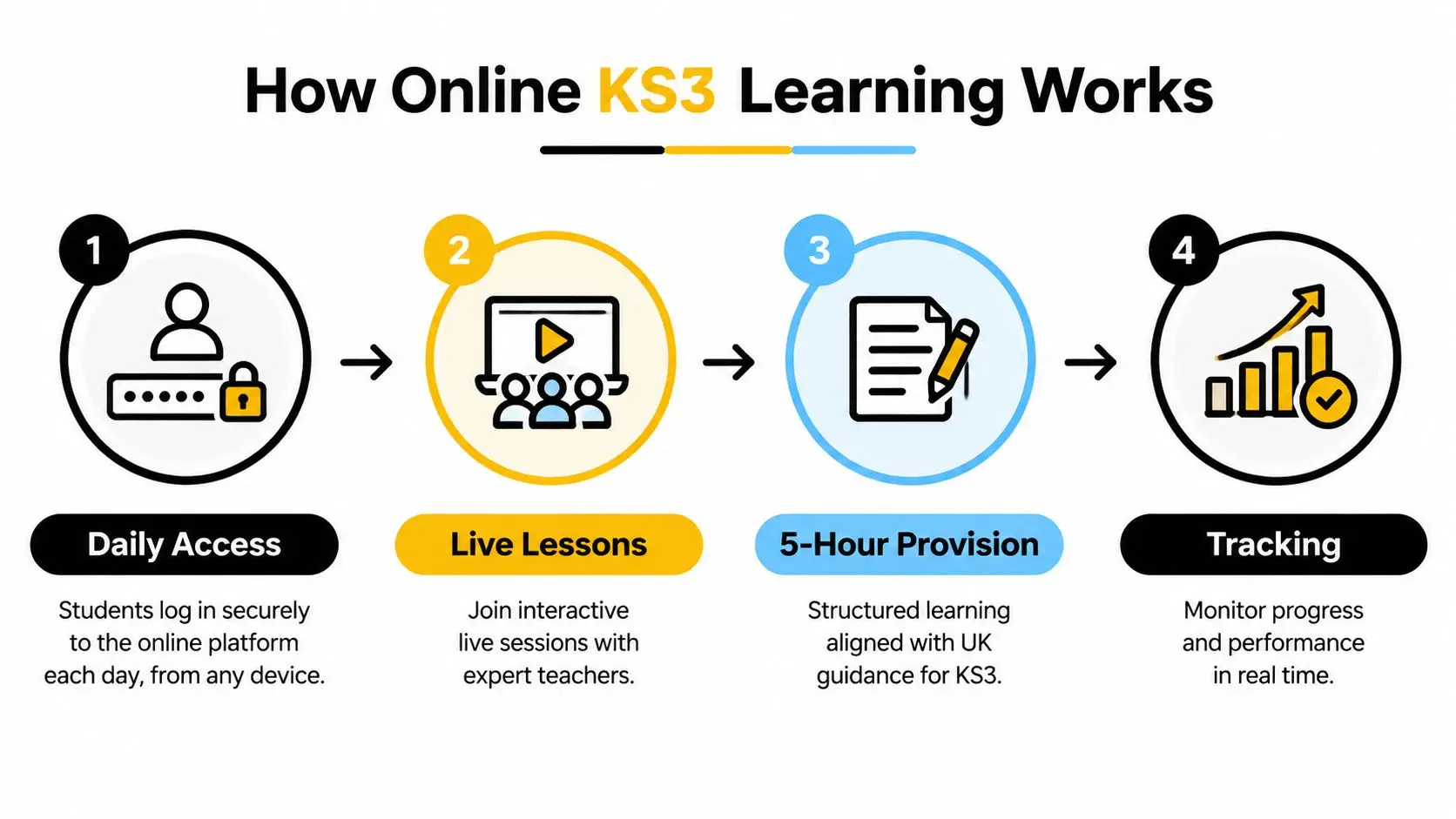
UK remote education guidance expects pupils in Key Stage 3 and 4 to receive about five hours a day of provision, but that time includes live or recorded teaching and independent work. It doesn't mean five hours of uninterrupted screen teaching. The UK remote education research guidance also stresses that remote curricula should remain aligned with classroom curricula and be sequenced so pupils build prerequisite knowledge before meeting more demanding ideas.
A typical learning day
A child's day might begin by logging into a secure platform and checking the timetable. A live English lesson could include teacher explanation, discussion, questioning, and a written task. Later, the pupil might complete mathematics practice independently, watch a recorded science explanation, and submit work for feedback.
One UK secondary example uses Microsoft Teams to organise a full school day, with live lessons in core subjects and asynchronous work elsewhere. Its online learning provision also illustrates why submission and marking need to be simple. If a child struggles to upload work or cannot see teacher comments, an apparently small technical barrier can become an academic and emotional barrier.
A practical online timetable should make these elements visible:
- Live teaching: Your child can see and hear a teacher, ask questions, and take part rather than passively watching.
- Independent work: Tasks help pupils practise, read, investigate, write, or solve problems away from the live lesson.
- Recorded access: A recording can support revision or help a pupil revisit an explanation at a calmer pace.
- Feedback: Teachers identify strengths, correct misunderstandings, and show the child what to do next.
- Pastoral contact: The child has a recognised route to discuss worries, friendships, motivation, or wellbeing.
What parents should observe
Ask to see a sample timetable and request a clear explanation of the balance between live teaching and independent activity. Find out whether subject teachers know the child's work, or whether feedback comes from a largely automated system. A useful platform supports teaching, but it doesn't replace a relationship with a teacher.
Families comparing systems may find it helpful to review CBE-aligned online learning tools to understand the kinds of functions schools use to organise access, assignments, communication, and progress. The tool itself is only part of the decision. The more important question is whether staff use it consistently enough for a child to feel oriented rather than lost.
For a subject example, parents can examine how an online provider presents a KS3 mathematics curriculum. Look for progression, explanation, practice, feedback, and opportunities to ask for help. A polished page is useful, but a child's daily experience depends on what happens when they say, “I don't understand this.”
The Balance of Benefits and Challenges
Online KS3 can change the emotional temperature of learning. A pupil who dreads being called on unexpectedly may contribute through chat first, then gradually speak in a live lesson. A child who needs repetition can revisit an explanation without feeling that classmates are watching. For a family managing health, travel, relocation, or a difficult school placement, flexibility can make regular learning possible.
That flexibility doesn't remove responsibility. Children aged 11 to 14 are still developing organisation, attention, social judgement, and emotional regulation. Since KS3 covers the transition from primary to lower secondary and maps to Years 7, 8, and 9, an online offer must respond to early adolescent development, not merely place younger pupils in front of secondary content. The SEND Code of Practice framework provides an important reference point for understanding that transition.
Where online learning can help
The benefits become clearer when connected to a specific child:
- A cautious speaker may contribute through a poll, shared document, or written response before gaining confidence in discussion.
- A child with an uneven profile may move more slowly through a difficult mathematics concept while continuing with a stronger subject at an appropriate pace.
- A family needing flexibility may use recorded teaching when an appointment or change in circumstances interrupts the usual day.
- A learner affected by bullying may regain concentration in a carefully supervised environment with clear behaviour expectations.
- An international family may maintain a consistent British curriculum while living outside the UK.
These outcomes depend on adults noticing the child, not just delivering content. A teacher who checks attendance but never asks why a pupil has stopped contributing may miss the underlying problem.
Where families need to be realistic
The home environment matters. A child may need a quiet place to work, a reliable routine, help interpreting instructions, and encouragement to take breaks. Parents shouldn't have to become subject teachers, but they do need to know who to contact when motivation falls or work begins to accumulate.
Screen use also needs thoughtful management. The fact that children are already highly connected doesn't make every digital activity equally healthy. Live discussion, reading, writing, practical investigation, and movement serve different purposes. A strong timetable varies the experience instead of treating the screen as the whole lesson.
A useful test: Ask whether the programme gives your child more access to learning, or merely gives them more time online.
Social connection deserves equal attention. An online learner may have classmates but still feel alone if interaction is limited to answering questions. Look for structured collaboration, clubs, pastoral conversations, and opportunities for pupils to know one another safely. Flexibility should create breathing space, not isolation.
Supporting Every Child, SEN, SEMH, and Wellbeing
Academic progress and wellbeing aren't competing priorities. A child who feels unsafe, misunderstood, or constantly behind will struggle to use even an excellent curriculum. At KS3, the teacher's response to a missed task can influence whether the pupil asks for help next time or slips away from learning.

The SEND Code of Practice for England says every school must identify and address the special educational needs of the pupils it supports. The revised code came into effect on 1 April 2015. For online KS3, the practical meaning is clear: support should be part of ordinary teaching, planning, communication, and assessment, rather than an extra service offered only after a child reaches crisis point.
What inclusive teaching looks like online
Consider a pupil with dyslexia who understands a history topic but finds dense text exhausting. Inclusive practice might include clear layouts, spoken explanations, manageable instructions, and different ways to demonstrate understanding. A pupil with attention difficulties may need shorter task stages, visible deadlines, movement breaks, and a teacher who checks comprehension before moving on.
A pupil with SEMH needs may appear disengaged when they are anxious about making a mistake. The teacher might offer a predictable lesson opening, private check-ins, a low-pressure route into discussion, and a calm response to incomplete work. These adjustments aren't signs of reduced ambition. They can give the child enough security to attempt demanding work.
Parents should ask providers:
- Who coordinates support? Find out whether a named adult understands the child's needs and communicates with teachers.
- How are needs identified? Ask how the school uses family information, previous reports, conversations, and classroom observation.
- How does support appear in lessons? Look for practical adjustments, not only promises of individual attention.
- What happens during distress? Request a clear safeguarding and pastoral pathway.
- How is progress shared? Parents need useful information about learning and wellbeing, not vague reassurance.
A complete KS3 experience also includes PSHE, citizenship, relationships, digital safety, and opportunities to develop confidence. These areas shouldn't be treated as decorative extras. Children need to practise listening, disagreeing respectfully, asking for help, recognising pressure, and understanding their responsibilities within a community.
A teacher's explanation of an online safety issue can be followed by a private reflection, a small-group discussion, or a practical scenario. That combination helps a child connect knowledge with life beyond the lesson.
Socialisation may look different online, but it can still be intentional. Clubs, collaborative projects, tutor groups, leadership opportunities, and informal conversations give pupils ways to belong. Parents should listen for their child's own account of friendships. “They attend lessons” doesn't necessarily mean “they feel connected”.
For families exploring targeted provision, a dedicated guide to special educational needs support can help turn general concerns into specific questions. The right choice is the one that protects dignity while helping the child grow in independence.
Accreditation and Choosing the Right Provider
Once a family knows what its child needs emotionally and academically, provider comparison becomes much easier. Don't begin with the most attractive timetable or the largest subject list. Begin with the route ahead. Ask how the programme prepares pupils for the next stage, how teachers measure progress, and whether the provider can explain its qualifications and examination arrangements plainly.
For families aiming towards GCSEs and A-Levels, examination-centre status deserves careful verification. A provider that says it supports recognised qualifications should explain which awarding organisation arrangements apply, where examinations take place, and who manages entries. Pearson Approved Examination Centre status is one example of a concrete credential parents can ask to verify, rather than relying on broad statements about accreditation.
A practical comparison
Use this matrix during calls, open events, or admissions meetings. Write down the provider's actual answer, not the impression created by its website.
| Criterion | What to Look For | Example Standard |
|---|---|---|
| Curriculum alignment | A clear map of KS3 content, sequence, and progression | The provider explains how lessons build knowledge for later GCSE study |
| Live lesson quality | Regular interaction, questioning, discussion, and teacher presence | Your child can ask questions and receive a meaningful response |
| Teacher expertise | Subject-specialist teaching and familiarity with online classrooms | The teacher can describe how they support misconceptions remotely |
| Assessment | Marked work, useful feedback, and a process for spotting gaps | Parents and pupils understand what has improved and what comes next |
| SEN and SEMH support | Adjustments integrated into routine teaching and a named contact | Support is planned before difficulties become repeated failures |
| PSHE and citizenship | Deliberate attention to relationships, wellbeing, responsibility, and safety | The programme develops the pupil as a person, not only as a test-taker |
| Community | Safe, purposeful ways for pupils to interact | Clubs, group work, tutor contact, or social events have clear supervision |
| Safeguarding | Transparent reporting routes and staff responsibilities | The provider explains what happens when a child raises a concern |
| Examination pathway | Clear information about qualifications and centre arrangements | The provider can identify its examination processes and responsibilities |
| Family communication | Regular, understandable updates | Parents know how attendance, work, progress, and wellbeing are discussed |
Questions that reveal quality
Ask to observe a live class if possible. Notice whether pupils are invited to think, whether the teacher waits for answers, and whether the atmosphere feels respectful. A lesson can be technically smooth yet educationally flat.
Ask what happens when a child misses work. An effective answer should include contact, investigation, support, and a plan. “The system sends a reminder” isn't enough for a pupil who is anxious, overwhelmed, or struggling with executive function.
Check how the provider handles the transition into examination years. The historical GOV.UK KS3 statistics release shows that KS3 has long been treated as a stage where attainment can be examined by subject and region. Parents can therefore reasonably expect a provider to understand academic progress in specific subjects, not describe it only through general confidence statements.
Request examples of feedback, progress reports, safeguarding information, and the support plan used for a pupil with additional needs. You're not being difficult. You're checking whether the school's promises would still help on the day your child is worried, stuck, or falling behind.
Your Next Steps to Enrolment
Choosing an online KS3 place becomes clearer when you begin with your child's daily experience. Ask what currently works, what causes distress, which subjects feel secure, and where gaps are appearing. Include your child in these conversations, even when adults make the final decision. Their response can reveal needs that reports do not show.
Follow a child-centred process
1. Define the support required. List what helps your child learn consistently. This may include smaller classes, recorded lessons, a predictable timetable, flexibility around appointments, specialist teaching, or a named pastoral contact. Consider PSHE, friendships, confidence, and emotional regulation alongside academic provision.
2. Check the curriculum route. In England, Key Stage 3 is the statutory phase for pupils aged 11 to 14, covering Year 7, Year 8, and Year 9. The national curriculum overview marks formal assessment as “not applicable” at these year levels because KS3 is mainly a teaching-and-learning phase rather than an externally tested one, as shown in the GOV.UK KS3 statistical collections. The provider should still use regular school-based assessment to identify gaps, guide teaching, and prepare pupils for later qualifications.
3. Speak with future teachers. Ask how they explain difficult ideas, respond to missed work, support anxiety, and adapt lessons for SEN or SEMH needs. Admissions staff can describe the programme. Teachers can explain what your child's ordinary day may feel like.
4. Request a placement conversation. Share reports, previous work, professional advice, and your child's own view. A responsible provider will want enough information to understand the learner, rather than placing them by age alone. Ask who will coordinate support and how concerns will be communicated.
5. Test the practical routine. Confirm lesson times, recording access, communication channels, equipment, attendance procedures, and methods for submitting work. Then ask your child to explain what they would do if a lesson would not load or a task made no sense. Their answer may show whether the routine feels manageable.
6. Plan the first month. Agree on a calm workspace, a morning routine, regular breaks, and a simple progress check. Keep the opening weeks focused on belonging and consistency. A child needs time to learn the systems, build trust with teachers, and feel safe asking for help.
Keep the future in view
A strong KS3 programme develops subject knowledge, study habits, confidence, and independence for later qualifications. It should also allow room for change. Interests develop, support needs become clearer, and a pupil who once avoided speaking may later want collaborative or leadership opportunities.
After a visit or introductory call, listen for relief, curiosity, or worry. That reaction will not answer every academic question, but it is useful evidence. Rigour and kindness can exist together, helping children sustain effort through a demanding developmental stage.
Queens Online School offers live and recorded KS3 lessons, subject-specialist teaching, personalised support, and a wider British curriculum pathway. Visit Queens Online School to explore its approach to academic progress, wellbeing, and transition towards future qualifications.