


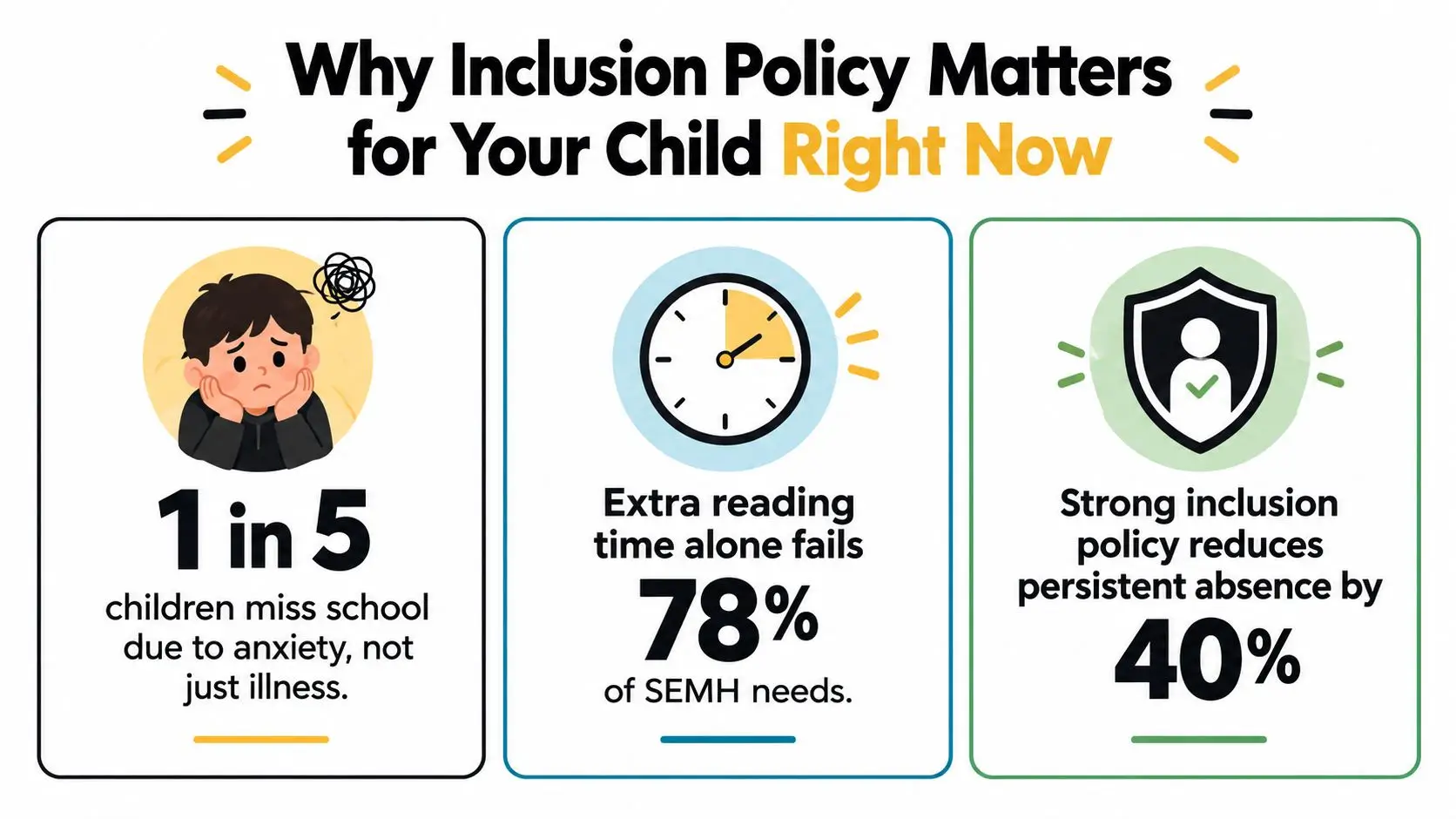
You're at parents' evening. Your Year 4 child is anxious, missing lessons and increasingly refusing school. The answer you receive is, “They'll be fine with a bit of extra reading time.” You leave knowing that reading isn't the whole problem, but you're not sure what the school must do next.
That uncertainty is exactly why an inclusion school policy matters. It should tell you how the school identifies needs, makes adjustments, responds to distress, prevents bullying and measures whether support is helping your child. It shouldn't be a warm statement about belonging that sits unnoticed on a website.
England's inclusion approach has changed substantially. In January 2024, 1.9 million children and young people aged 0 to 25 were identified with special educational needs, including 1.7 million pupils in schools, and 99% of the 1.14 million pupils receiving SEN support in state schools attended mainstream schools. The same data recorded 576,474 children and young people with an Education, Health and Care plan, an increase of 11.5% from 2023, while the proportion receiving SEN support reached 13.6%. These figures are set out in the National Audit Office summary of support for children and young people with special educational needs.
Your child shouldn't have to wait for a crisis, an exclusion or a tribunal decision before adults coordinate support. A clear policy is the first practical protection available in school every day.
Why Inclusion Policy Matters for Your Child Right Now
The promise of inclusion is easy to write and harder to deliver. For a child who finds noisy classrooms overwhelming, struggles to process spoken instructions or wakes each morning in panic, inclusion means more than being placed on the register. It means being able to arrive, participate, learn and feel safe without having to hide the barrier first.
England's mainstream schools now carry most of the day-to-day responsibility for pupils with additional needs. The figures above show that inclusion isn't a small specialist concern. It's the ordinary setting in which most children with SEN receive education, support and progress monitoring.
What parents should be able to verify
Read the policy looking for actions, not slogans. You should be able to identify:
- An early-identification route: The policy should explain how staff notice patterns in learning, attendance, communication, sensory regulation or behaviour.
- A named decision-maker: It should identify the SENCO, pastoral lead or other person responsible for coordinating support.
- A review method: You should see how the school records a starting point, agrees an adjustment and checks whether your child is making progress.
- A child's voice: Your child's experience should influence the plan, including what helps them enter lessons, communicate distress and recover after overwhelm.
- A response when support fails: The policy must explain what happens if needs increase or the first adjustment doesn't work.
A child who is anxious about school may need a trusted adult at the gate, a predictable morning routine, reduced verbal demands and a gradual return to group learning. Extra reading time may still help reading, but it doesn't resolve fear, sensory overload or emotional exhaustion.
Practical rule: Ask the school to show you what will change on Monday morning, who will do it and when you'll review the impact.
What the Law Expects of an Inclusion School Policy
The legal baseline is clear. Inclusion must operate through planned provision, not depend on whether staff have spare time.
The Special Educational Needs and Disability Act 2001 explanatory notes describe the extension of disability discrimination duties into education and the requirement for education providers to make reasonable adjustments. The Equality Act 2010 now provides the wider framework for preventing discrimination and improving disabled pupils' access to education.
The SEND Code of Practice sits alongside those duties. It is statutory guidance under Part 3 of the Children and Families Act 2014, applies from birth to age 25, and expects mainstream schools to use their “best endeavours” to secure special educational provision for pupils with SEN, whether or not they have an EHC plan. It also expects pupils with SEN to join school activities alongside peers without SEN wherever possible.
The operational test
A policy earns trust by showing how the graduated approach works in daily practice:
- Assess: Gather information from the child, family, teachers and relevant professionals.
- Plan: Agree outcomes, provision, responsibilities and review arrangements.
- Do: Put the support into teaching, routines and school activities.
- Review: Check the child's experience and progress, then adjust or escalate.
Parents should be able to verify who acts, what changes and when the school will review the effect. The policy should cover transport, trips, clubs, examinations, off-site learning, lunchtime arrangements, digital platforms, and temporary changes such as illness or recovery from surgery.
A policy also needs a clear response to disability-related bullying. If a child is threatened, targeted or repeatedly excluded because of disability, race, communication style or another protected characteristic, staff must treat it as a welfare and safeguarding concern, not dismiss it as ordinary friendship trouble.
Identifying SEN and Triggering the Right Support
A quiet Year 2 pupil struggles with reading. They copy classmates, avoid reading aloud and produce work that looks neat but contains the same errors each week. Adults describe the child as “slow to get going”. Two years pass without anyone recording the pattern against a clear baseline.
A stronger inclusion school policy treats that pattern as information. The teacher records the difficulty, discusses it with the SENCO and family, tries an appropriate adjustment and reviews the response within an agreed period. If the barrier remains, the child moves into SEN support rather than being left to cope alone.
The SEND Code of Practice identifies four broad areas of need. They're useful for organising support, but they aren't boxes that define a child. One pupil may have literacy difficulties, anxiety, sensory sensitivities and communication differences at the same time.
| Area of Need | Typical Examples | Common Signs |
|---|---|---|
| Cognition and learning | Dyslexia, literacy difficulties, processing differences | Slow progress, avoidance, difficulty retaining instructions |
| Communication and interaction | Speech-language needs, autism, social communication differences | Misunderstood language, limited interaction, distress during conversation |
| Social, emotional and mental health | Anxiety, ADHD-related dysregulation, trauma responses | School refusal, withdrawal, emotional outbursts, persistent worry |
| Sensory and physical | Hearing or visual needs, motor difficulties, sensory processing differences | Fatigue, discomfort, avoidance of particular spaces, difficulty with movement |
Parents should ask four direct questions:
- What baseline are you using?
- What triggers SENCO involvement?
- Who decides whether SEN support starts?
- When will we review the adjustment and what evidence will we see?
Identification isn't a verdict. It's a doorway to help. For families trying to understand sensory responses before a meeting, this sensory profile guide for paediatric therapy offers useful context for discussing patterns without reducing the child to a label.
SEMH Provision Beyond Academic Adjustments
SEMH means Social, Emotional and Mental Health. It deserves its own pathway in an inclusion school policy because a child can understand the curriculum and still be unable to access it.
DfE evidence recorded 23.6% of pupils on SEN support and 16% of pupils with an EHC plan as having SEMH as their primary need in 2025, as set out in the rapid evidence review on identifying and supporting SEMH needs. The same review highlights the practical pressure on schools around earlier identification, teacher training and accountability.
What a real SEMH pathway contains
A policy should state how staff respond to anxiety, attachment-related behaviour, school refusal, self-harm, trauma responses and ADHD-related dysregulation. It should name the mental-health lead, set out referral routes to CAMHS or NHS Children and Young People's Mental Health Services, and explain what support is available while a referral is pending.
Behaviour that looks defiant may be communication. A child who leaves the room might be escaping noise, shame or an impossible demand. Before applying a sanction, staff should check the trigger, the child's communication and the adjustment already promised.
Useful provisions can include:
- A named safe space: The space should support regulation and return, not become an unofficial exclusion room.
- Movement and sensory breaks: These should be planned, predictable and linked to the child's needs.
- Pastoral check-ins: A brief morning connection can reveal distress before it becomes refusal.
- Emotional literacy work: ELSA-style support can help a child identify feelings and practise alternatives.
- A written support plan: The child and parents should help shape it, with review dates agreed in advance.
The policy should also explain how the school works with external professionals. Families shouldn't have to chase every update while a child's attendance, sleep and confidence deteriorate.
Anti-Bullying Provisions That Protect Emotional Safety
A Year 8 pupil is left out of group chats, watches classmates arrange plans in front of them and is told they're “too serious” for the friendship group. That isn't harmless banter. For a child already feeling different because of SEN, race, disability, gender, sexuality, faith or home circumstances, repeated exclusion can make school feel unsafe.
A strong inclusion school policy names the harm precisely. The UK Parliament briefing on bullying reports that around 17% of young people had been bullied during 2017 to 2018. The Anti-Bullying Alliance policy analysis shows how policies increasingly address cyberbullying and bias-based bullying. Those provisions need to work in practice, not just appear in a list.
Five clauses parents should look for
- Clear definitions: Include cyberbullying, name-calling, sexualised behaviour, social exclusion and prejudice-based incidents.
- Several reporting routes: A child should be able to speak to a trusted adult, use an online form or report anonymously.
- A documented response: The policy should name the lead, record the report and set a clear investigation timetable.
- Repair where safe: Restorative work can help repair harm, but it must never force a frightened child into contact with the person who harmed them.
- Pattern monitoring: Leaders should review records for repeat victims, repeat perpetrators and unsafe locations or online spaces.
Staff have a bystander duty too. A teacher who sees a humiliating comment in a lesson chat shouldn't wait for the target to complain. Parents wanting structured training may find it useful to enrol in DASA Act training, while this anti-bullying policy guide for schools provides a further practical reference.
Ask how the school will update you without taking control away from your child. The response should protect dignity, explain what has changed and confirm how staff will check that the bullying has stopped.
Accessibility and Reasonable Adjustments in Practice
Accessibility isn't limited to ramps. A child can enter the building and still be excluded by fast speech, fluorescent lighting, inaccessible worksheets, uncaptioned recordings or a timetable that makes medical appointments impossible.
A serious inclusion school policy lists adjustments by barrier and names who can approve them. It also connects each adjustment to the child's outcome. “Support available” tells you very little. “The pupil will receive a visual timetable and pre-teaching for unfamiliar activities, reviewed against lesson participation” gives adults something they can deliver and families something they can verify.
| Barrier Type | Example Adjustment | Why It Matters |
|---|---|---|
| Physical access | Ramps, automatic doors, accessible toilets | Allows safe movement and independent participation |
| Hearing and sensory access | Hearing loops, captions, BSL interpretation | Prevents missed teaching and reduces communication strain |
| Communication | Visual timetables, communication boards, AAC-aware staff | Makes instructions and choices accessible |
| Curriculum access | Recorded lessons, adjusted formatting, restated instructions | Lets pupils process information in a usable form |
| Health and attendance | Flexible timetabling, rest breaks, adapted assessment windows | Keeps education available during treatment or recovery |
For an autistic pupil, a visual timetable may prevent the panic caused by an unexpected room change. For a dyslexic learner, dyslexia-friendly formatting and recorded explanations can remove an unnecessary reading barrier. For a pupil with selective mutism, a microphone-off option may enable participation without public pressure.
The school should record how it balances dignity and safety when a pupil needs a quiet room, a nearby teaching assistant or an alternative way to demonstrate knowledge. Parents can use this guide to understand reasonable adjustment before asking the school to specify its own arrangements.
The Graduated Approach and New Specialist Layers
The graduated approach answers one question, what should happen next when a child needs more help? The newer reform model adds layers of provision, but families still need to see a clear path rather than a series of labels.
The DfE guidance on inclusive education estates reinforces the importance of adaptive teaching, curriculum design, early intervention, safe spaces and environments that support participation. The practical cycle remains assess, plan, do and review.
| Layer | Trigger | What Happens | Typical Move-Up Point |
|---|---|---|---|
| Universal classroom support | A barrier appears in ordinary learning | The teacher adapts teaching, instructions, materials or routines | Progress remains limited or distress continues |
| SEN Support cycle | Needs require coordinated planning | The SENCO and teacher agree outcomes and review evidence | Adjustments don't secure meaningful progress |
| Targeted or Targeted Plus | A child needs more intensive help without an EHC plan | Specialist-informed intervention is added and monitored | The profile is complex or progress remains flat |
| Specialist provision | Needs require specialist services or formal planning | External professionals and specialist settings or support become involved | The child needs provision beyond ordinary mainstream capacity |
Consider a Year 5 pupil with emerging literacy difficulties. The teacher first uses explicit phonics, shorter instructions and accessible texts. The SENCO then coordinates a targeted literacy intervention, records the starting point and reviews the child's response. If progress remains flat, the school should gather stronger evidence and consider specialist input rather than repeating the same intervention indefinitely.
The 2026 reform package describes Targeted, including Targeted Plus, and Specialist layers, alongside digital Individual Support Plans for children and young people with identified SEND. It also refers to a £4 billion investment, including £1.6 billion for the Inclusive Mainstream Fund over three years and £1.8 billion for an “Experts at Hand” service, as detailed in Every Child Achieving and Thriving. These reforms will only help if schools explain who receives support, how long it lasts and what evidence triggers escalation.
Schools designing accessible curriculum materials can also apply inclusive design to courses so access is built in rather than retrofitted.
Sample Policy Language You Can Adapt
Policy wording should guide staff and give parents something specific to check. A values statement is not enough. Each commitment should identify what the school will do, who will do it and how the child's experience will be reviewed.
Equality statement
“We include disabled pupils and pupils with SEN in school life. We identify and remove barriers to attendance, participation and achievement, reviewing arrangements when a child's needs or circumstances change.”
SEN identification
“We identify possible SEN through teacher observation, progress information, attendance, behaviour, family knowledge and the child's views. When a persistent barrier appears, the class teacher consults the SENCO and family, records the concern and agrees an assessment and support route without avoidable delay.”
SEMH commitment
“We recognise SEMH as a distinct area of need. Staff consider anxiety, dysregulation, trauma and communication of distress before applying sanctions. Support may include Boxall profiling, ELSA provision, pastoral check-ins, regulation breaks and a named safe space, where appropriate.”
Anti-bullying clause
“We prohibit bullying, including cyberbullying, social exclusion, name-calling, sexualised behaviour and prejudice-based harm. Pupils can report concerns through a trusted adult or confidential route. Staff record, investigate and review every concern while protecting the child's dignity and voice.”
Accessibility duty
“We make reasonable adjustments to teaching, communication, the environment, activities, assessments and digital learning so disabled pupils can participate on equal terms. Every adjustment has a named owner, a stated purpose and a review point.”
Graduated approach
“We use an assess, plan, do, review cycle. We record the child's strengths, barriers, outcomes, provision and views, then amend or escalate support when evidence shows that current provision is insufficient.”
Parent partnership pledge
“We involve parents and children in decisions about identification, provision and review. We explain who is responsible, what will happen next and how families can raise concerns when agreed support is not delivered.”
Parents should reject wording such as, “Support will be provided where resources allow.” It gives the school room to avoid a clear duty when the child needs help most.
Use this instead: “The school will provide or arrange appropriate support within its duties. If existing provision cannot meet the child's needs, the SENCO will explain the shortfall, agree interim measures and begin the next referral or escalation route with the family.”
Parents can use this SEN support plan resource to organise concerns, outcomes, responsibilities and review questions. A usable policy should let a parent verify whether support happened, whether it helped and what the school will change when it did not.
How Queen's Online School Puts Inclusion into Practice
Online inclusion still has to be visible in the child's daily experience. Queen's Online School describes inclusion as part of the structure of the school day, supported through live interactive lessons, recorded sessions, flexible scheduling and individualised learning arrangements.
Small classes of roughly twelve allow teachers to notice when a learner stops contributing, keeps a camera off because of distress or submits less work than usual. That early observation matters because disengagement can look like laziness when the child is overwhelmed, anxious or struggling to process the lesson.
A pupil may need captions during live teaching, a recording to replay later, a screen break or a different assessment window. A dyslexic learner may benefit from accessible formatting and scaffolded tasks. A pupil with selective mutism may participate through chat or keep a microphone off while still demonstrating knowledge. These are practical changes, not concessions.
A phased return example
Take a Year 8 pupil experiencing school-refusal anxiety. A full timetable of live group lessons may be too much at first. The school can begin with one-to-one registration, predictable contact from a named coordinator and asynchronous work that allows the pupil to rebuild confidence without the pressure of immediate public participation.
The next step might be a short live lesson with a known teacher, followed by a planned review. As tolerance increases, the pupil can enter wider group learning gradually. Staff should track attendance, completed work, communication and the pupil's own sense of safety, rather than declaring success because the child has logged in.
Queen's Online School also describes zero-tolerance anti-bullying expectations, monitored chat, restorative follow-up and parent-visible incident records. Its provision includes specialist SENDCO oversight, support staff access, extended assignment time, modified or scaffolded curriculum and individualised learning plans.
For families comparing schools, the important question isn't whether a provider uses the word inclusion. Ask how the school spots distress online, who contacts the child, how adjustments are recorded and what happens when the first plan fails.
Quick Reference for Parents and School Leaders
A parent should be able to audit an inclusion school policy and test its promises in conversation. Treat the policy as a practical commitment to your child, not a values statement on a website. Ask staff to show what each promise looks like in daily learning, communication and support.
Parent verification list
- Legal alignment: Check that the policy reflects the SEND Code of Practice, best endeavours, participation and reasonable adjustments.
- Identification: Find the trigger for SENCO involvement, the assessment route and the point at which parents and children are consulted.
- Graduated support: Look for assess, plan, do and review, with outcomes, named owners and review dates. A general promise of help is not enough.
- SEMH provision: Confirm a distinct pathway for anxiety, school refusal, dysregulation, self-harm and trauma responses.
- Accessibility: Check physical, sensory, communication, curriculum, assessment, transport and digital access.
- Bullying protection: Require explicit references to cyberbullying, social exclusion and bias-based harm, alongside reporting, investigation and follow-up.
- Escalation: Ask what happens when support fails, needs become more complex or external advice is required.
- Child voice: Confirm how the child's views are gathered, recorded and used.
Leaders' audit table
| Policy Clause | Responsible Owner | Evidence to Gather | Review Frequency |
|---|---|---|---|
| SEN identification | SENCO and class teachers | Referral records, baselines, support plans | Review after each support cycle |
| SEMH pathway | Mental-health lead and pastoral team | Support plans, attendance information, child voice | Review at agreed plan points |
| Accessibility | Senior leader and designated staff | Adjustment register, access checks, pupil feedback | Review when needs or provision changes |
| Anti-bullying | Designated safeguarding or pastoral lead | Incident logs, response records, follow-up notes | Review patterns regularly |
| Curriculum access | Subject and phase leaders | Adapted resources, assessment arrangements | Review through teaching and progress checks |
| Family partnership | SENCO and headteacher | Meeting notes, consent records, unresolved concerns | Review after significant decisions |
Take these questions into every meeting:
- Who decides what happens next?
- How will you measure whether it helps my child?
- What happens if my child's needs escalate or the adjustment fails?
Vague answers require a written plan. If the school names an adjustment, ask when it starts, who delivers it and how its effect will be reviewed. If staff describe behaviour without identifying the barrier, return the discussion to communication, safety and access.
A policy works only when the child can feel the difference. Your child should know what will happen, know who will help, experience less fear and have a genuine way to participate. Parents should be able to verify those outcomes through attendance information, support records, child feedback and regular reviews.
Queens Online School offers live British-curriculum teaching, small classes, specialist SENDCO oversight, recorded lessons, flexible scheduling and adjustments such as scaffolded work and extended assignment time. Visit Queens Online School to explore an online setting where inclusion is built into everyday learning and support can be reviewed around your child's needs.