

You can feel the pressure before the kettle's even boiled. One child is trying to start homework at the kitchen table, another is asking where the charger is, and the room is already full of noise, bags, and unfinished jobs. Most families do not need a perfect study suite. They need a home learning environment that makes it easier for a child to settle, concentrate, and keep going when the day is messy.
What a Home Learning Environment Really Is
A lot of parents still picture a desk, a lamp, and a laptop when they hear home learning environment. That's too narrow, and it misses what changes outcomes. The stronger evidence points to three things that live in ordinary family life, warm adult presence, predictable routines, and accessible learning materials. The Education Policy Institute's review of UK evidence puts those core elements clearly, alongside the importance of reducing noise, using routines, responding to attention, and giving feedback (Education Policy Institute).
The Department for Education's 2025 research report makes the reality plain. 99% of pupils in England said they are regularly assigned homework, 83% said someone at home helps them with it, 16% said they receive no help at home, and 49% said homework completion was monitored every time at home (Department for Education research report). That tells you the home learning environment is not some optional extra. It's part of the daily education system children already live in.
Practical rule: if you are short on time, protect the people, the pattern, and the materials before you touch the décor.
That means a calm five-minute chat at tea-time can matter more than a second screen. A reliable homework slot can matter more than a Pinterest-worthy desk. A child who knows where to sit, when to start, and who will check in with them has a better chance of getting work done without a battle.
If you're looking for a flexible online model that sits within family life rather than fighting it, Queens Online School is one place families use to make that structure workable. The point is not to copy a school into your house. The point is to make the home support learning in a way your child can live with.
Setting Up the Physical Space Without Overthinking It
A good study space does not need to look impressive. It needs to be comfortable, low-distraction, and repeatable. The Education Policy Institute review is useful here because it links educational growth to active engagement, warm parent-child interaction, and access to educational materials, then backs that with advice about reducing noise and keeping routines steady (Education Policy Institute). That is the opposite of decorative clutter.
Start with the body, not the furniture
If a child is leaning forward, twisting round, or balancing a laptop on their knees, they will tire faster and drift more easily. A chair with enough back support, a table at the right height, and a screen that does not force the child to hunch are basic, not luxurious. For younger pupils, a footrest can help them stay planted. For teenagers revising for GCSEs, a side table for books and a clear desk surface do more than fancy stationery ever will.
Noise matters too. If the home is busy, you do not always need a silent room, but you do need a calmer soundscape. A room HEPA purifier can be useful where families want a steadier environment and less sense of visual or sensory clutter, especially when a child is easily distracted by every movement in the room. You can find one practical option in this room HEPA purifier resource from EcoQuest Purifiers.
Use the room you've actually got
Most families are not working with a spare classroom. That's fine. A corner of the living room, a kitchen table that's cleared at the same time each day, or a small desk pushed near a wall can work if the setup stays consistent. A visually quiet background helps. A child facing a blank wall or a tidy shelf will usually settle more easily than one staring into the busiest part of the house.
Keep the child's line of sight simple. The less the eyes have to process, the less the brain has to fight for attention.
Don't over-invest in objects. The EEF-linked evidence on the home learning environment warns that more stuff is not automatically better, which is exactly why the room should be functional before it is pretty. A stable seat, a decent light source, and a place to put books are the essentials. For families wanting a practical reference point on learning tools for online study, this guide to Microsoft Office for home students is worth using alongside the physical setup.
Tech, Connectivity, and the Tools That Actually Get Used
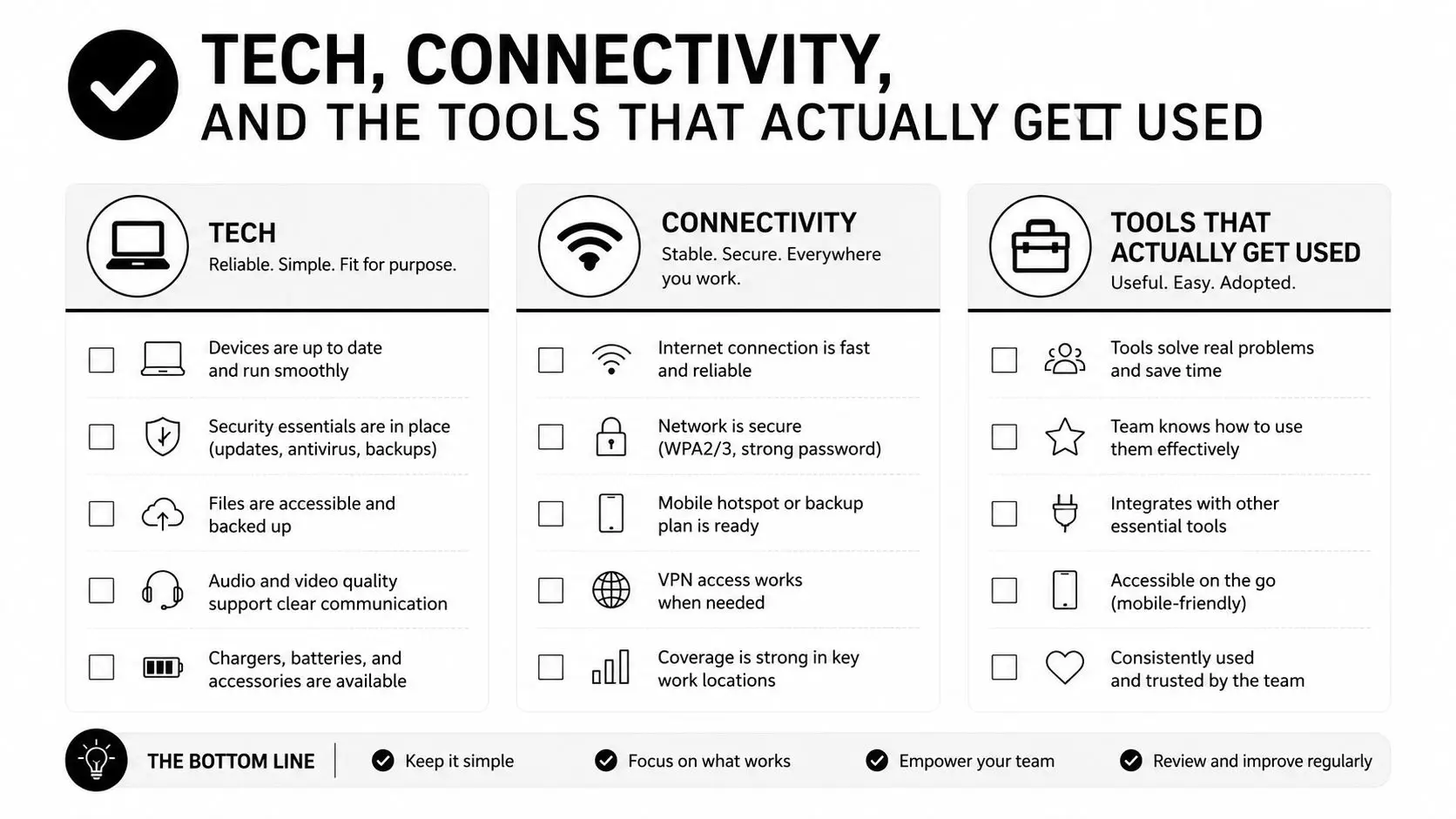
Families often overspend on devices and underthink reliability. That is backwards. UCL's CEPEO briefing says inequalities in the home learning environment come from overlapping layers, including reduced access to devices, slower or unreliable internet, less physical space, and lower adult numeracy and literacy, and it warns that the quality of activity matters more than the sheer amount of time spent learning at home (UCL CEPEO briefing).
Buy for everyday use, not showroom specs
A child who needs live lessons needs a device that starts quickly, holds a charge, and handles a browser, video call, and document editing without freezing. That is the baseline. If siblings share one laptop, the issue is not the brand name, it's whether the household has a clear handover routine so one child is not waiting half the morning for access.
Set up the browser and login properly. Separate profiles help children keep their school tabs, saved work, and bookmarks in one place. Keep passwords written down somewhere secure but accessible to the adult who handles learning admin. If that sounds dull, good. Dull systems are the ones that survive a busy Tuesday.
Make the connection stable before you make it fast
A weak Wi-Fi signal will waste more learning time than an old laptop. Families looking for practical ways to improve the connection can use faster home WiFi advice from Premier Broadband as a starting point. The useful question is not, “Do we have broadband?” It's, “Can this child stay connected without repeated dropouts at lesson time?”
Reliability beats novelty. One solid device with clear rules is better than three half-working gadgets and a room full of complaints.
Keep the toolset tight. Headphones, a charger, a notebook, and the actual platform the school uses are usually enough. Add software only when it saves a recurring problem. A child does not need five apps to do one worksheet, and parents do not need to become part-time IT support.
For families using a school-led online model, Queens Online School's home student Microsoft Office guidance can help keep the digital side orderly without making it the centre of family life.
Daily Routines That Hold Up on Tired Days
The best routine is the one you can still run when everyone's tired. That is why I tell families to work with short anchors, not grand plans. The home learning environment research from the UK government links the home learning environment to later qualification outcomes at age 19, alongside family relationships and perceptions of safety, which is a reminder that the rhythm around learning matters for the long term, not just the next worksheet (UK government attainment research).
Build around transitions, not perfection
A child moves best when the day has clear edges. Start with a brief check-in, move into a defined lesson or task block, then give a proper break before the next stretch of work. That helps especially in homes where a parent is also working, because it reduces the number of times everyone has to renegotiate what happens next.
If your child struggles with transitions, do not argue them into readiness. Use a warning, a visual cue, or the same phrase every time. “Five minutes, then we start.” “Tea is done, books open.” “After this task, you get your break.” Repetition is not boring in this context. It is calming.
The routine should carry the child, not demand constant motivation.
A realistic weekday rhythm for an online learner
| Time | Activity | Why It Matters |
|---|---|---|
| Before lessons | Quiet start, water, check timetable | Reduces friction and helps the child arrive mentally ready |
| Morning lesson block | Live teaching and quick responses | Keeps learning social and structured |
| Mid-morning | Short movement or snack break | Prevents fatigue and reset overload |
| Late morning | Independent task or reading | Builds concentration without overloading the child |
| Early afternoon | Feedback, corrections, or practice | Makes learning stick while the lesson is still fresh |
| Late afternoon | Outdoor time or non-screen activity | Protects energy and supports emotional regulation |
| Early evening | Pack-up, preview tomorrow, calmer screen-down period | Helps the child leave learning behind and rest properly |
For SEN and SEMH learners, this kind of rhythm matters even more, because regulation comes before output. Some children can only focus after movement. Others need a predictable break point to stop anxiety from taking over the whole day. That's not a failure of discipline. It's a cue to adjust the structure.
Adapting the Setup for SEN and SEMH Learners
A child who is anxious, sensory-seeking, overwhelmed, or easily dysregulated does not need a louder version of school at home. They need a regulated base. The UK government's attainment research links the home learning environment to qualification outcomes at age 19, alongside socioeconomic background, parent and carer relationships, and perceptions of safety, which shows this is not only an early-years issue (UK government attainment research).
Regulation first, learning second
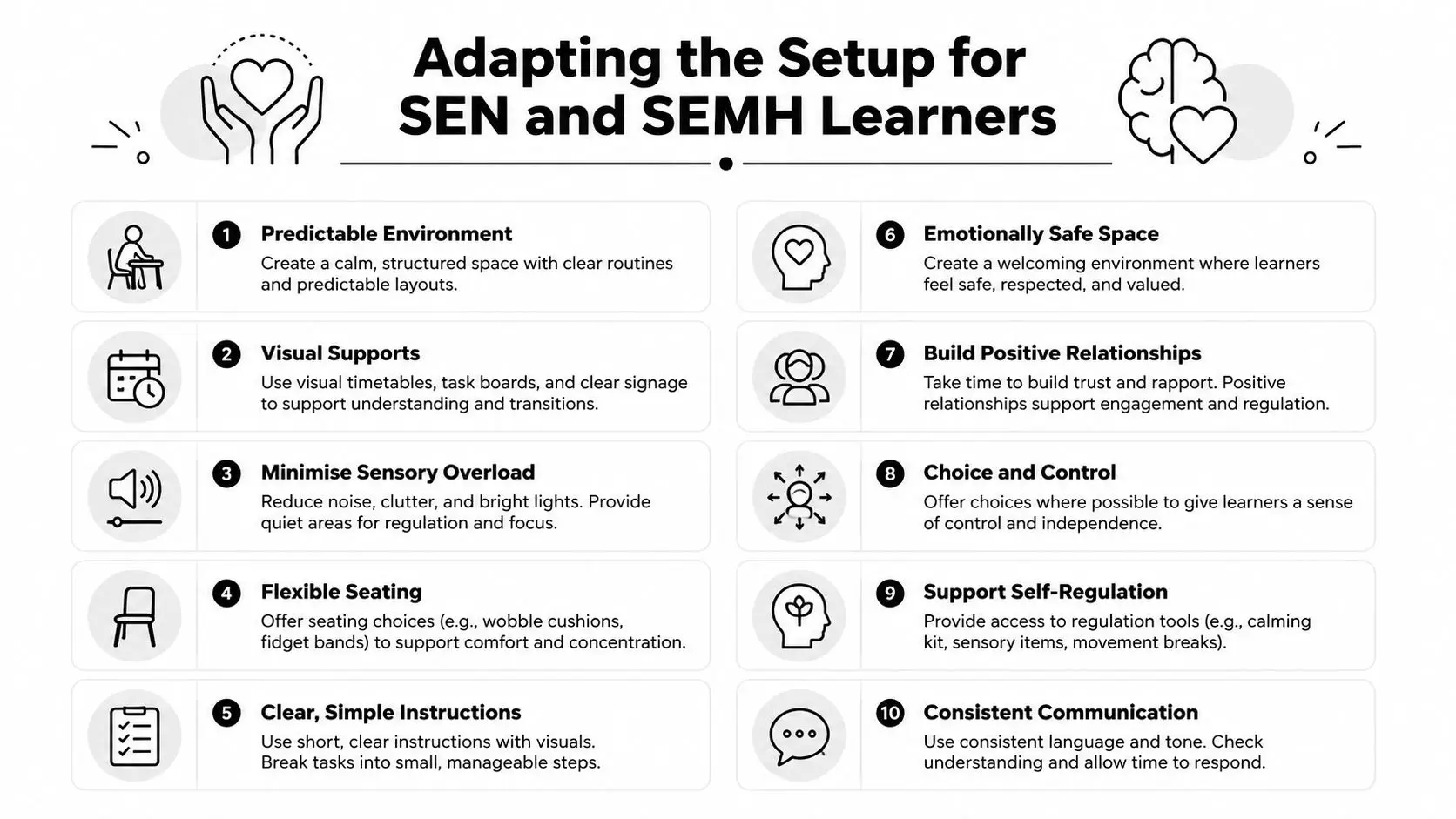
If a child cannot sit, the answer is not always “sit longer”. Sometimes it is a wobble cushion, a different chair, or a short movement break before a lesson begins. If a child is sensitive to noise, use headphones or reduce background sound before you expect concentration. If bright light makes them tense, soften it. These are simple changes, but they tell the child, “This room is built for you.”
Visual schedules help because they take pressure off memory and reduce negotiation. A child who can see the lesson order is less likely to panic at the unknown. Transition objects can help too, especially for younger children, a familiar item carried from one activity to the next can bridge the gap between tasks.
Use the home as a safe base, not a testing ground
For SEMH learners, the emotional message of the space matters as much as the practical one. Keep expectations visible and calm. Keep corrections brief. Praise specific effort, not vague compliance. If a child has had a rough morning, the win might be attending for a short block, not completing everything on the timetable.
That is where partnership with the online school matters. If a child is regularly avoiding lessons, shutting down, or becoming distressed, bring in the SENCo or pastoral team early. Don't wait for the problem to become entrenched. The best support is usually the one that arrives while the child still trusts the routine.
Practical supports for this group often work best when they're small:
- Visual schedule on the wall, so the day feels containable.
- A regulation break box, with one or two approved items only.
- A clear retreat point, such as a chair or cushion the child can use to reset.
- Low-stakes practice runs, so attendance and attention are rehearsed before pressure rises.
Study Habits That Pay Off at GCSE and A-Level
Teenagers do not need more lectures about working harder. They need a system that makes revision harder to avoid. The key point from the UK research is simple, early home learning effects can persist through secondary school, even when later home stimulation is taken into account, when analysed with appropriate multilevel models (peer-reviewed UK government research report). In plain English, the home conditions around study still matter long after the primary years.
Turn revision into a repeatable habit
Passive reading is weak. Retrieval practice, spaced revision, and past-paper work are better because they force the brain to produce answers, not just recognise them. One evening should not be a marathon. It should be a controlled block with a clear start, a focused task, and a proper stop.
Parents should coach, not hover. That means asking, “What are you revising tonight?” rather than “Have you finished yet?” It means checking the plan, not sitting over the teenager's shoulder. The habit you want is ownership, because ownership survives exam stress better than surveillance.
For students who want a method they can apply immediately, these note-taking methods for online learners are a sensible place to start.
A simple revision shape that actually holds
A good GCSE or A-level week usually needs three things, a content review, a practice task, and a feedback loop. Content review keeps knowledge fresh. Practice exposes what still isn't secure. Feedback tells the student what to fix next.
If the school gives recorded lessons, use them for the parts that need replaying, not as an excuse to drift through the week. If a teacher gives written comments, turn those into a correction list before the next session. That is how the home learning environment and the online classroom start to work together instead of separately.
Revision works when the home makes consistency easier than avoidance.
Sleep and downtime are part of the study plan, not the reward for finishing it. Teenagers revise better when they can recover. A household that protects that balance is giving the child a serious advantage, even if it doesn't look glamorous from the outside.
Bringing It Together for Your Family
The home learning environment is not a decorating project. It is the set of conditions that help a child feel safe enough to learn, steady enough to keep going, and supported enough to improve. The 2025 South India study is a useful reminder that the mix matters, not just the quantity, because at least six age-appropriate books, diverse play materials, and active caregiver engagement were associated with better non-verbal fluid intelligence and early language outcomes in children aged 4 to 8 (2025 study of 940 mother-child pairs). More stuff alone did not do the same job.
A quick self-audit for parents and carers
- The room: Is there one reliable place to sit, with manageable noise, decent light, and a clear surface?
- The routine: Does your child know when learning starts, when it ends, and what happens in between?
- The relationships: Does your child get calm help, not just correction, when they're stuck?
- The materials: Are the right books, device, and login details easy to reach?
- The fit: Does the setup suit your child's age, temperament, and support needs?
Start with one change, not ten. A better chair, a calmer check-in, or a firmer homework slot can shift the whole week. Children do not need us to make home look like school. They need us to make home a place where learning can happen without constant friction.
If you want a school model that respects family life while giving your child live teaching, feedback, and a structured online routine, take a look at Queens Online School. It's built for families who want a serious British curriculum in a home setting that still feels human, flexible, and manageable.