

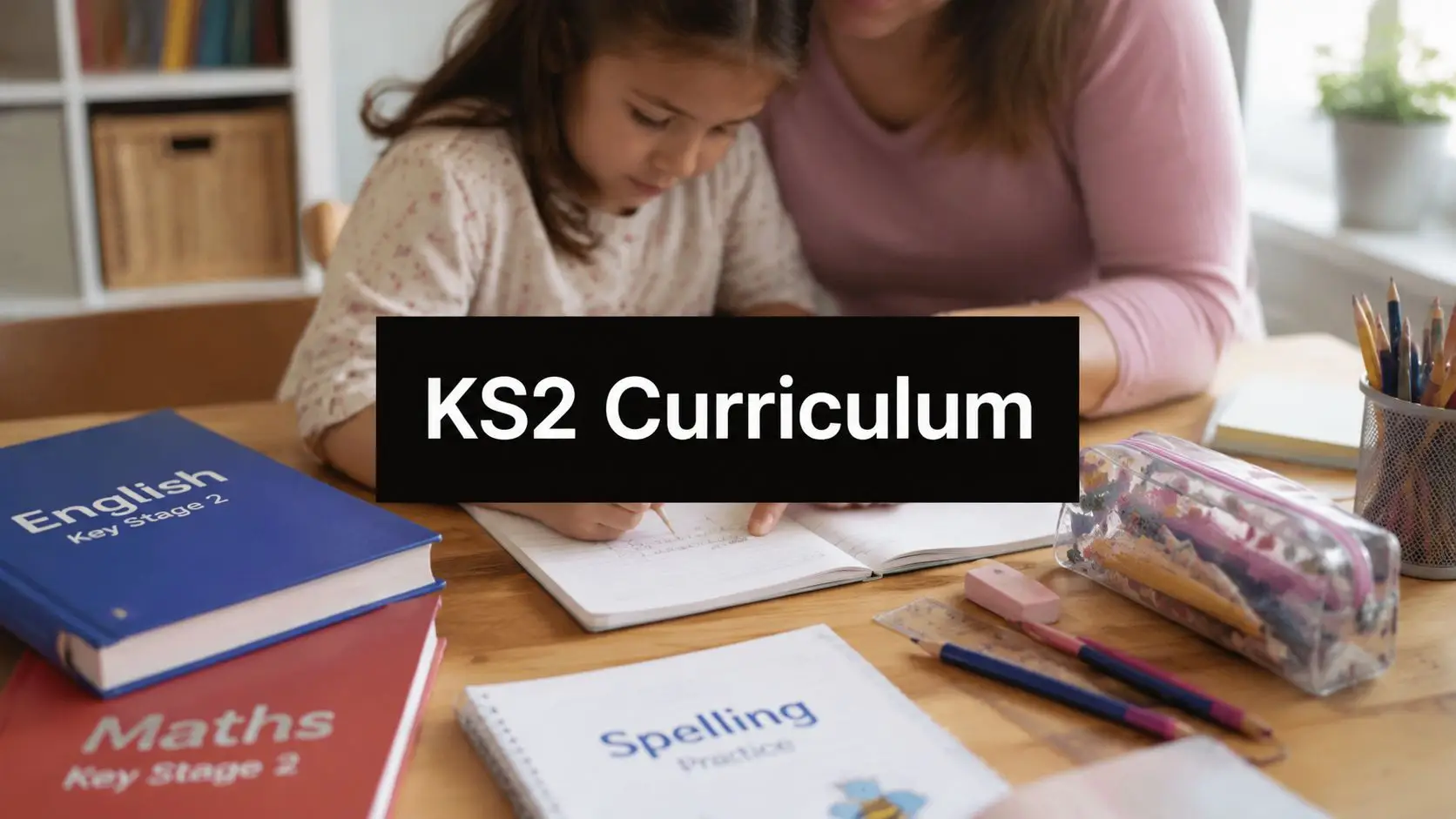
If you've ever felt a pang of anxiety wondering what your child is actually learning in Years 3 to 6, you're not alone. The Key Stage 2 curriculum provides the map for this crucial period, but what matters most is the journey. This is the middle chapter of primary school—that magical, sometimes wobbly, stretch where knowledge, curiosity, and independence start to blossom together. Think of it like moving from stabilisers to riding a bike alone: it requires steady practice, a guiding hand that gradually eases back, and a whole lot of encouragement to build confidence with every turn of the wheel.
Understanding the Key Stage 2 Curriculum Framework
Key Stage 2 spans Years 3 to 6, covering the pivotal ages of 7 to 11. The goal is to balance core subjects with a wider foundation, helping your child build stamina for secondary school while still protecting the joy of discovery. It’s designed to meet your child where they are, not force them into a box.
Here's what that looks like in practice, with your child at the heart of it:
- English and maths take centre stage. This is where your child moves from decoding words to getting lost in chapter books, from writing simple sentences to expressing their own ideas in structured paragraphs. In maths, they'll work towards gaining real confidence with number facts, multiplication tables, and the basics of fractions—tools they'll use for life.
- Science isn't just about memorising facts; it's about nurturing your child's inner detective. They'll learn to ask "why?", form a guess (a hypothesis!), and test it out. Biology, chemistry, and physics all get their moment to spark wonder.
- History and geography help your child find their place in the world. They'll build a sense of time, learn to read maps, and start to understand the connections between people and places.
- Computing introduces the building blocks of coding, how to stay safe online, and the kind of digital literacy that is essential for their future.
- PSHE and citizenship are the heart-work. This is where they develop emotional literacy, learn about healthy friendships, and start to understand what it means to be a kind and responsible person.
"This stage is really about putting responsibility into children's hands while keeping adults close enough to steady them when things wobble."
For busy families who want the essentials at a glance:
| Subject | Years Covered | Key Milestones Parents Might Notice |
|---|---|---|
| English | 3–6 | Getting lost in a chapter book, writing organised paragraphs, using new punctuation |
| Maths | 3–6 | Recalling times tables, using formal methods for sums, understanding decimals |
| Science | 3–6 | Asking "what if?", testing ideas, recording results, explaining their findings |
| History | 3–6 | Putting events in order, asking about cause and effect, learning local history |
| Geography | 3–6 | Using maps, doing fieldwork, spotting human vs. physical features |
| Computing | 3–6 | Understanding algorithms, trying basic programming, staying safe online |
| PSHE / Citizenship | 3–6 | Growing self-awareness, navigating friendships, understanding citizenship |
Learning as Developmental Growth
Progress in Key Stage 2 isn't a straight line—it's a journey full of twists, turns, and occasional pit stops. A Year 3 child wrestling with a longer writing task is building stamina. A Year 6 pupil blending ideas from different sources is showing true independence. Both are milestones to be celebrated.
Think of it this way: Practising paragraphing in Year 4 is like rehearsing a speech; presenting a confident argument in Year 6 is performing it on the main stage. The groundwork comes first.
- Practical Example: To build reading stamina without pressure, try a "cosy reading challenge." For 10 minutes each evening, cuddle up with a book. If your child reads for the full time for five nights, they get to choose a special weekend activity. It connects reading with warmth and reward.
- Another Idea: When you get a takeaway pizza, ask your child to help you cut it into equal slices (halves, quarters, eighths). Then ask, "If I eat two slices, what fraction is left for you?" Suddenly, fractions aren't a worksheet; they're a delicious, tangible puzzle.
What This Means Emotionally for Families
Let's be honest—it's easy to get swept up in worries about tests or the fear of your child falling behind. That anxiety is completely normal. The key is to consciously shift your focus from scores to effort. Celebrate curiosity. Praise persistence. Notice the small wins.
Imagine your child is disappointed with a science test mark. Instead of focusing on the score, you could say, "I'm so impressed with how you explained your experiment to me yesterday. That shows you're really thinking like a scientist." That's not ignoring a result; it's validating the real learning behind it. That's how you build a resilient learner.
If you're exploring home education options, you might find it helpful to read our guide to the UK curriculum for homeschooling and nurturing your child's unique spark.
When you put your child's feelings and unique needs first, Key Stage 2 transforms from a hurdle to a confident bridge to secondary school—helping them find their balance and ride forward with joy and capability.
Tracking Learning Progression From Year 3 to Year 6
The journey from Year 3 to Year 6 is less like a race and more like four seasons of growth, each building on the last. Year 3 has a spring-like energy: children suddenly discover the stamina to write for longer and start to feel the rhythm of multiplication tables.
By Years 4 and 5, things deepen like a long summer day. Confidence grows, vocabulary expands, and children begin connecting ideas across subjects. A child who once decoded short chapter books might now debate a character's motives in a whole novel. Then Year 6 arrives—the harvest. Pupils gather everything they've learned, constructing arguments, mastering decimals and fractions, and preparing their hearts and minds for the big move to secondary school.
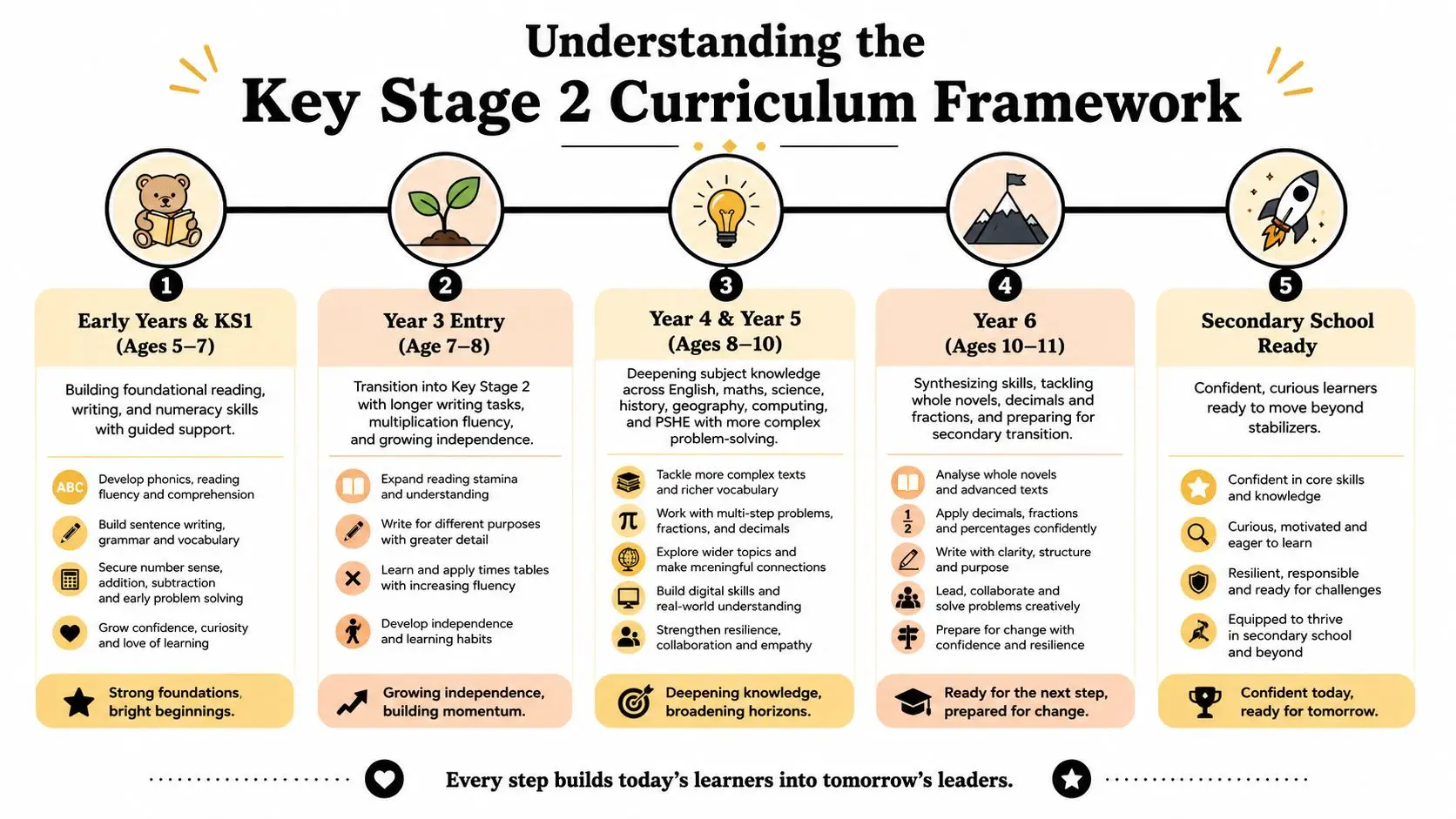
This infographic shows the developmental journey from Early Years and KS1 all the way to Year 6. Notice how the curriculum deliberately spirals, revisiting core skills in new contexts. This staggering of complexity takes the pressure off, allowing progress to happen at a child's natural pace.
How Expectations Deepen Each Year
Year 3 focus
Children are encouraged to write pieces across multiple paragraphs and become fluent with the 3, 4, and 8 times tables. A child who once needed help following a story can now get lost in a five-chapter book and tell you all about their favourite character.Year 4 and Year 5 focus
The emphasis shifts to making connections and solving problems. For instance, a Year 5 maths lesson isn't just about multiplication; it's about using those facts to calculate the area of a dream bedroom they're designing. It connects numbers to their imagination.Year 6 focus
Synthesis and independence take the spotlight. A Year 6 pupil might compare the theme of courage in two different novels, use formal methods for complex division, and confidently explain their reasoning—all skills that empower them for secondary school.
Key insight: Every child's journey has its own rhythm. Plateaus are normal and often come right before a big leap forward. Trust the process.
Practical Home Milestones to Spot Without Pressure
- Growing reading endurance: You notice them reading for longer stretches without interruption and starting real conversations about the plot.
- Independent problem-solving: They might try a tricky bit of homework on their own first, asking for help on a specific part rather than giving up.
- Transfer of skills: They use maths while baking ("We need to double the recipe!") or mention a historical fact on a family day out.
Tips for Parents to Be Supportive Observers
- Celebrate the small wins: a beautifully structured paragraph, a times table recalled instantly, a new word used perfectly in conversation.
- Use everyday moments for gentle practice: a shopping list for decimals, a recipe for measurements, a car journey for storytelling.
- Keep your language encouraging. Instead of "You're so smart," try "I love how you didn't give up on that tricky problem." This praises the effort, which is something your child can control.
A Concrete Example
Imagine a Year 4 child finds telling the time on an analogue clock stressful. Instead of drills, you could play a game: "The bus leaves at 4:15. How many minutes until we need to go?" Start with simple times and build up. This low-stakes, real-world repetition builds confidence far more effectively than a worksheet.
A Practical Next Step
In a notebook, jot down one small, achievable goal for your child each term: maybe a reading goal (finish a chapter book), a maths habit (practise times tables on the way to school), or a curiosity project (find out three facts about the Romans). Check in with warmth, not pressure. That steady, loving attention is the real engine of progress.
Demystifying KS2 SATs and Assessment Outcomes
Facing SATs can feel overwhelming, for you and your child. The pressure for that "perfect" result can feel immense.
That feeling is real and valid. So, let's reframe these tests for what they are: a single photograph. It's a snapshot of what your child could do on one particular day, not a definitive label of who they are or what they are capable of.
At the end of Year 6, pupils sit statutory tests in English Reading, Mathematics, and Grammar, Punctuation and Spelling (GPS).
Crucially, Writing and Science are judged through teacher assessment, drawing on a portfolio of classroom work gathered over time. This blend means the results reflect both a single performance and a teacher's long-term, professional insight.
What the Numbers Mean
Scaled scores are used to translate raw marks into a consistent measure.
A scaled score of 100 represents the expected standard—the benchmark most children are anticipated to reach. Scores above or below 100 simply show how a child performed relative to that standard.
Progress measures are even more insightful. They compare your child's Year 6 results with their starting point, showing how much they've grown. This means a child who started with significant challenges but made huge strides gets recognised for that incredible journey, not just their final score.
"A scaled score is not a judgement of your child's character—it's a measurement of one set of skills at one point in time."
Practical Example: Imagine your daughter, Aisha, scores 98 in maths, just below the expected standard. You might feel a knot of worry. But her teacher's report glows, noting her fantastic problem-solving skills and how she always helps her friends. The secondary school will see both pieces of information. That full, human picture matters far more than a single number.
Recent KS2 Attainment Statistics Overview
Understanding national trends can help put individual results in context. The table below shows the percentage of pupils reaching the expected standard across key subjects in recent years.
| Year | RWM Combined | Maths | Science |
|---|---|---|---|
| 2021 | 59% | 70% | 78% |
| 2022 | 61% | 72% | 79% |
| 2023 | 60% | 71% | 77% |
These figures show that year-to-year variation is normal and confirm that a significant portion of children find some areas more challenging than others. Seeing this helps us ground our expectations and remember that our child's result is part of a much bigger, more complex national picture.
How Schools Use Results
Secondary schools rarely, if ever, look at SATs scores in isolation. They are one piece of a puzzle, viewed alongside teacher reports, classroom observations, and sometimes their own assessments.
One lower score does not close doors. Schools know that a single test on a single morning doesn't define a child.
Practical Reassurance for Parents:
- Take a deep breath before looking at the results. Ask the Year 6 teacher for a quick chat to understand the scores in the context of your whole child.
- Focus on "what's next?" rather than "what went wrong?". A simple plan of targeted, fun practice over the summer can make a huge difference.
- Celebrate their effort and resilience, no matter the outcome. A hug and "I'm so proud of how hard you worked" means more than you know. Emotional safety is the bedrock of learning.
What to Do If Your Child Feels Anxious
- Acknowledge their feelings. "It sounds like you're feeling really worried about this. Let's talk about it." Separate their worth as a person from their performance on a test.
- Use low-stakes practice purely for familiarity. Frame it as "playing a game" to understand the question types, not as a high-pressure rehearsal.
- Protect their well-being with steady routines: good sleep, nutritious food, and calm, loving morning rituals on test days.
For families looking at targeted Year 6 support and curriculum-aligned practice, check out our guide on Year 6 Maths Curriculum at Queen's Online School.
"One test day does not define a child's future—their consistent curiosity, resilience, and feeling of being loved and supported do."
Adapting Learning for SEN and Emotional Wellbeing
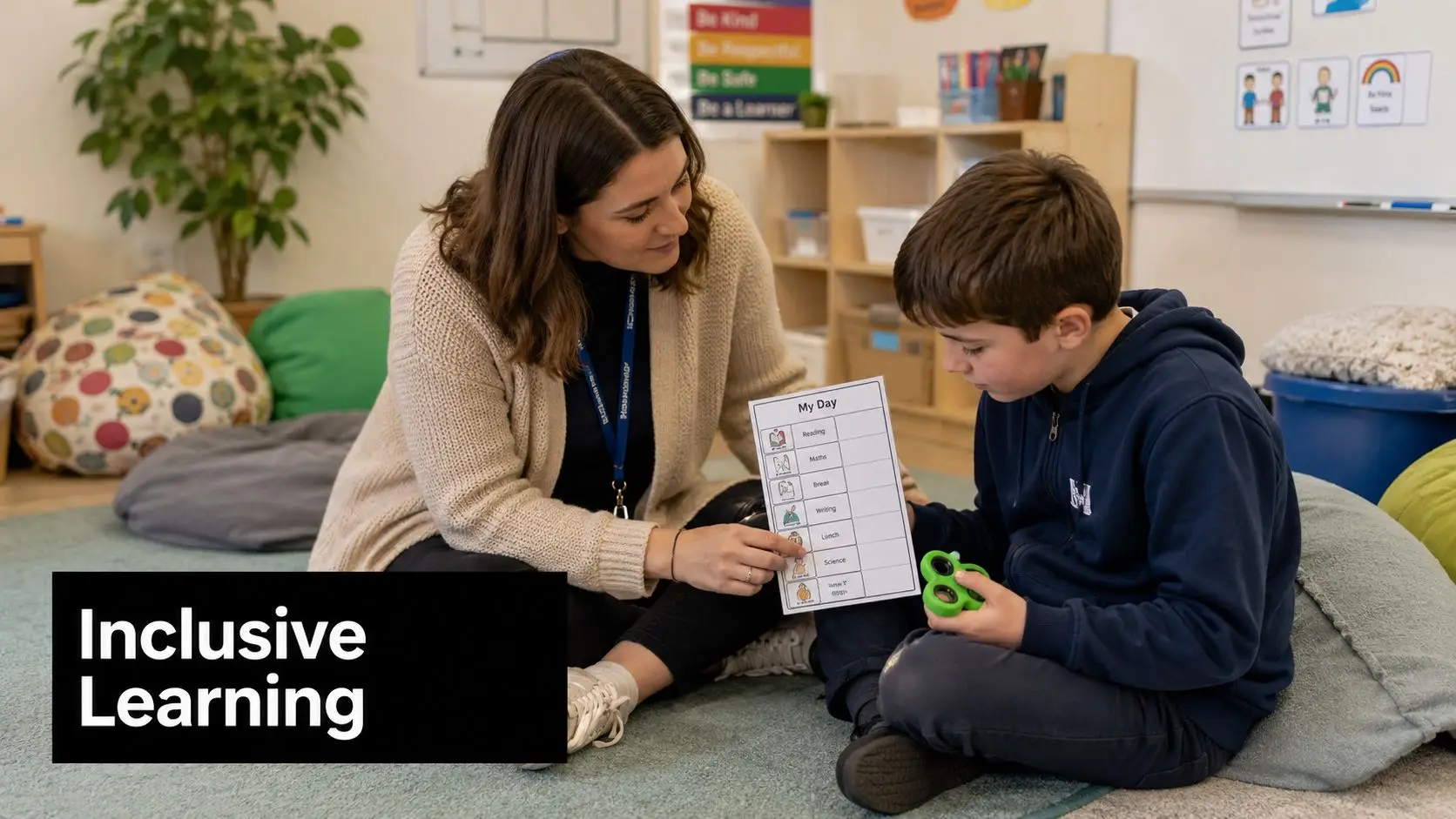
Children learn best when they feel safe, seen, and emotionally secure. For this reason, the Key Stage 2 curriculum is not a rigid cage but a flexible map. Great teachers use it as a starting point, adapting the journey to meet each child exactly where they are.
Differentiated tasks break down a big goal into smaller, more manageable steps, allowing a child to build confidence with each success. Take a Year 4 fractions objective. For one child, this might mean physically folding paper "pizzas." For another, it could involve using interactive digital fraction bars. A third might be ready for abstract written problems. Same goal, different paths.
Movement breaks and sensory-friendly spaces are not just "nice to have"; they are essential for focus and calm. A quick 3‑minute "brain break" with stretching, or five minutes in a quiet corner with a weighted cushion, can help a child reset and return to their work ready to learn.
Visual supports, like picture-based daily schedules or task checklists, reduce the mental load of "what's next?", which naturally lowers anxiety. For a child with dyslexia or working memory challenges, these tools are a lifeline, allowing them to manage their own work with dignity.
Emotional regulation is the foundation for academic learning. When a child feels calm and regulated, the skills follow much more easily.
Practical Classroom Adjustments for KS2
- Small-step learning goals with visible progress charts, so a child can see how far they've come.
- Multi-sensory activities that engage hands, eyes, and ears to make learning stick.
- Flexible timing and "chunked" tasks to reduce overwhelm and make success feel achievable.
- Quiet breakout rooms or one-to-one check-ins for pupils who need a moment of personal connection and reassurance.
Example of Inclusive Online Practice
Picture a live Year 5 writing lesson. The teacher shares a short model text using engaging visuals and audio. Then, they open a 10‑minute breakout room for pupils to plan in pairs using helpful sentence starters. Meanwhile, a pupil with ADHD has a personalised on-screen plan: a 7‑minute focused writing task, followed by a fun, teacher-prompted movement break.
On this child's screen is a simple visual checklist: 1. Brainstorm ideas. 2. Write two sentences. 3. Check for capital letters. The teacher pops into their breakout room for a quick, encouraging 2‑minute chat and later leaves a private message praising their great opening sentence. This blend of structure, choice, and personal connection keeps the child engaged and protects their self-esteem.
Practical Tips for Parents
- Build predictable home routines. A short reading time followed by a simple, two-item homework checklist can work wonders for an anxious child.
- Ask the teacher for visual aids or checklists they use in class. Mirroring these at home creates a powerful sense of consistency and security for your child.
- Share "good news" reports with your child. Focus on effort and small steps of progress ("I noticed you sounded out that tricky word all by yourself today!") rather than just scores.
To further support diverse learning needs and emotional well-being, exploring different teaching methods can be incredibly helpful. Check out these multi-sensory learning tips for parents for practical ideas to try at home.
Online British curriculum providers like Queen’s Online School weave these adaptations directly into every lesson. This means children can access the full Key Stage 2 curriculum in a way that honours their individual needs and preserves their sense of belonging. Asking for help is a proactive, caring step—never a sign of failure.
Delivering the British Curriculum Through Online Schooling
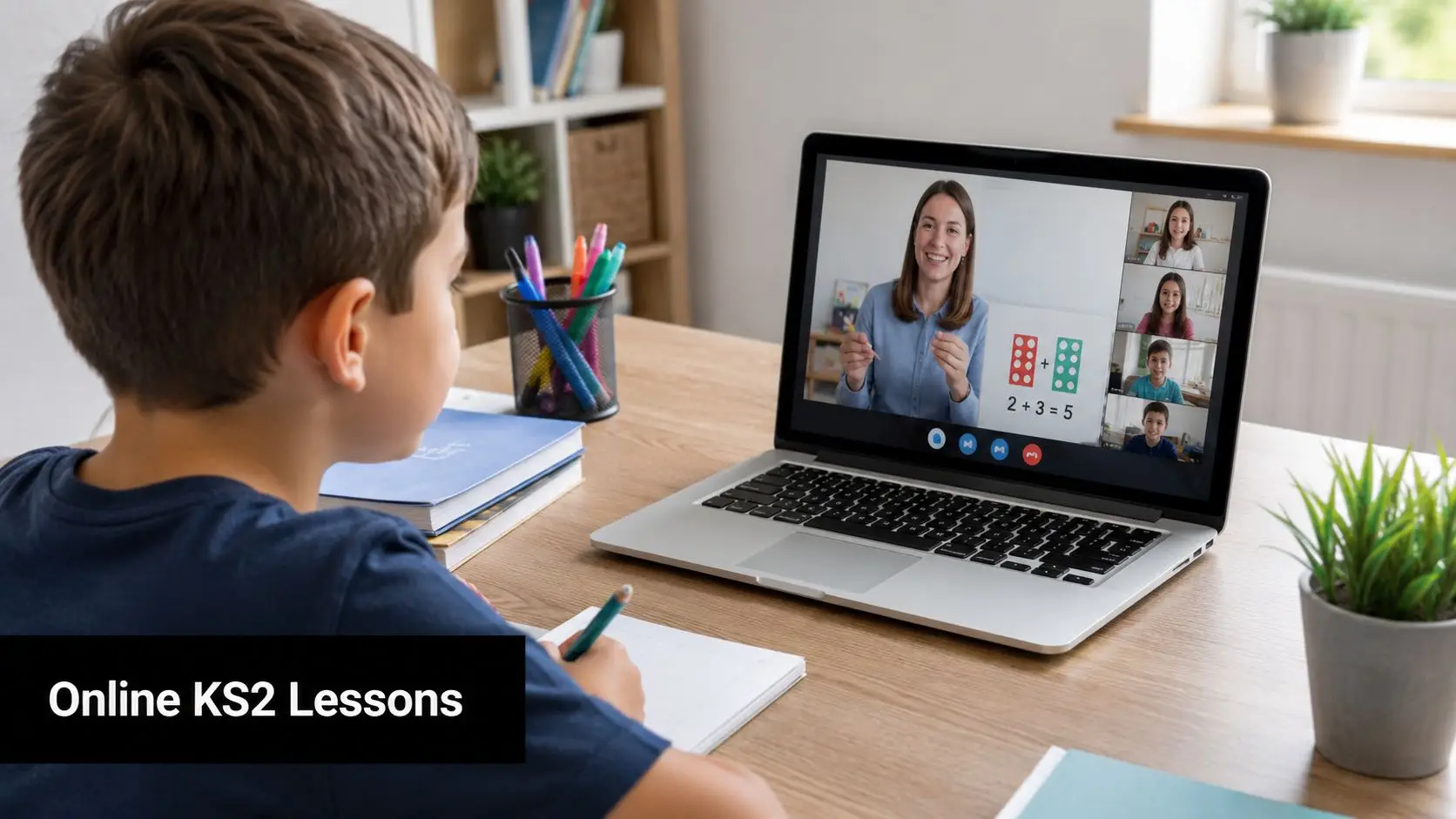
Online schooling works best when it puts the child, not a rigid schedule, at its centre. At Queen’s Online School, live Key Stage 2 lessons are led by specialist teachers who are experts in their subject and in connecting with children. They align every lesson with the curriculum while keeping a close, compassionate eye on each pupil's well-being.
Small class sizes are transformative. They allow teachers to offer specific, timely feedback instead of generic praise. This matters deeply because genuine attention builds confidence, and a confident child is a resilient learner. A calm child will push through challenges and see mistakes as opportunities to grow.
A small class lets a teacher notice the quiet flicker of understanding—or the subtle frown of confusion—and step in with support before frustration takes hold.
Practical Example: In a Year 4 online fractions lesson, pupils might first manipulate on-screen digital pieces that respond to their touch. This is followed by a brief, clear whole-class demonstration. Then, pupils are moved into small breakout rooms to discuss their strategies. The teacher can see that one child is hesitant and quietly joins their breakout room for a quick, encouraging two-minute chat, helping them find their voice. That cycle—model, try, discuss, personalised nudge—is active, relational teaching at its best.
This flexible structure supports real families. Live lessons run at set times, but every session is recorded. This is a lifeline for families who travel, manage health needs, or simply have a child who learns better at a different pace. A recording means a child can rewatch a tricky concept as many times as they need, ensuring they never feel left behind.
Class Mechanics That Support Children
- Live teaching with specialists who prioritise both curriculum goals and emotional check-ins.
- Breakout rooms for low-pressure peer talk and collaborative tasks that build social skills.
- One-to-one check-ins during or after lessons for personalised reassurance and support.
Screen time is a valid concern for every parent. A good online school blends active, on-screen learning with mindful off-screen breaks. Lessons include short movement prompts, and the school day is balanced with virtual clubs, collaborative projects, and global peer communities that build a true sense of belonging.
Evidence of Rigour and Care
- Detailed curriculum maps ensure every lesson aligns with Key Stage 2 learning objectives, so progress is always visible.
- Regular, low-stakes quizzes and checks give teachers the data they need to adjust the pace for each child.
- Personal learning plans set small, achievable goals that celebrate effort and build self-esteem.
For parents exploring online schooling, our platform offers a flexible, engaging, and deeply human way to deliver the Key Stage 2 curriculum. You might also find it useful to read about video production for e-learning to understand how high-quality, engaging lessons are crafted.
Read also: Learn about practical experiences of Key Stage 2 online learning in our detailed guide at Queen’s Online School Key Stage 2 Online Learning.
Supporting Your Child’s Journey Beyond the Classroom
Key Stage 2 can feel like a huge leap, both for children and for the parents cheering them on. The good news? You don't need to become a full-time tutor or overhaul your life. Small, consistent, and loving habits woven into your everyday routine make the biggest difference—and they don't have to add any pressure.
Reading Together Without the Pressure
A daily shared reading session of just 10–20 minutes does more for your child’s academic and emotional well-being than almost anything else. The secret is to keep it relaxed and connected. Cuddle up on the sofa, take turns reading a page, and let the conversation wander. Ask gentle questions like, "I wonder why she did that?" or "What do you think will happen next?". It's not a quiz; it's about sharing a story and nurturing a love of books that will fuel their learning for years to come.
Maths in Bite-Sized, Real-Life Chunks
Long, stressful maths sessions rarely work for children this age. Instead, aim for short, fun maths bursts three times a week. Five minutes of chanting times tables to a favourite song, working out the change at the corner shop, or doubling a recipe together while baking—these moments show your child that maths is a useful, real-life tool, not just a scary subject at school. Fluency builds quietly in the background when the pressure is off.
Why Sleep Matters More Than Extra Revision
It can feel completely counterintuitive, but a consistent bedtime and a calm, screen-free wind-down routine will boost your child's learning far more than last-minute cramming. A child who sleeps well arrives at school with a settled nervous system, better focus, and more emotional resilience. A 30-minute screen-free window before bed makes a remarkable difference. A rested brain learns; an exhausted one can't.
Checking In on Feelings, Not Just Grades
One of the most powerful shifts you can make is in your conversations. Instead of "What mark did you get?", try asking, "What was the most interesting thing you learned today?" or "Was there anything that felt tricky?" Then, truly listen to their answer. When children feel that you value their effort and are there for them during their struggles, they develop the resilience to keep trying. Perfection ceases to be the goal; growth becomes the adventure.
Small acts of presence over time matter more than last-minute cramming or chasing perfect results.
Practical, Sustainable Habits to Try This Term
- Read together for 10–20 minutes each evening—ask one gentle, open-ended question to spark connection.
- Short maths bursts of 5–10 minutes, three times a week—use coins, cooking, or shopping to ground it in real life.
- Stick to consistent bedtimes with a 30-minute screen-free wind-down to protect their precious sleep.
- Weekly 10-minute "heart check-ins"—focus on how they're feeling and praise their effort or kindness.
Getting the basics in place can also smooth out those chaotic mornings. Having school supplies ready removes one more source of daily stress—find supplies and labels at.
If a traditional classroom setting isn't meeting your child's needs, please know that you have options. Queen's Online School delivers the full Key Stage 2 curriculum through live, interactive lessons, small classes, and personalised support—providing a genuine and nurturing alternative.
The simplest next step? Pick one habit from the list above. Try it consistently for two weeks and just notice what shifts. You might see calmer mornings, less homework resistance, or a child who seems a little more confident. Progress often shows up quietly, but it always lasts.
Frequently Asked Questions About Key Stage 2
Are SATs Compulsory and What If My Child Struggles?
Yes, KS2 SATs are statutory at the end of Year 6 in England. However, it's vital to remember that a single test does not define your child. Teacher assessments for Writing and Science provide a more rounded view of their progress over time. If your child has a difficult test day, that’s okay. The most constructive step is to schedule a meeting with their teacher to discuss the results alongside their classroom performance and plan for their transition to secondary school.
How Does the Curriculum Adapt to a Late SEN Diagnosis?
If a special educational need is identified, schools act to put support in place. This is a moment for collaboration, not alarm. Support might include differentiated tasks, visual aids, extra time, or small-group sessions. For example, a child diagnosed with dyslexia in Year 5 might receive texts with a special font, use speech-to-text software, and have 1-to-1 reading time. Online schooling can be particularly effective, seamlessly integrating personalised check-ins and assistive technology to support the child without making them feel different.
What Ages and Year Groups Does KS2 Cover for International Families?
Key Stage 2 covers Years 3 to 6, which corresponds to ages 7 to 11. For families moving to the UK system, this is a helpful guide:
- Year 3: Ages 7-8
- Year 4: Ages 8-9
- Year 5: Ages 9-10
- Year 6: Ages 10-11
Knowing these equivalents helps ensure a smooth transition for your child.
Do Online British Schools Offer Recognised Qualifications and Real Community?
Absolutely. Accredited online schools like Queen's Online School follow the official British curriculum, ensuring pupils are on a direct path towards recognised IGCSEs and A-Levels. More importantly, the best online schools create a true sense of community. Through live lessons, virtual clubs, collaborative projects, and small classes where every child is known, pupils form real friendships and feel part of a supportive school family.
Keeping your child’s needs and wellbeing at the centre makes every next step clearer.
If you want to explore how Queen’s Online School supports KS2 pupils through live lessons and personalised care, visit Queen's Online School.