

Your child used to chatter about school in the car. Now you get one-word answers. Homework that should take twenty minutes stretches into tears, avoidance, or a total shutdown. You can see they're bright. You can also see that something in the school day isn't fitting them, and that mismatch is starting to chip away at their confidence.
Parents often notice this long before anyone else says it out loud. A child who looks “fine” on paper may be exhausted by noise, overwhelmed by transitions, unable to record ideas fast enough, or anxious because they're working twice as hard as everyone around them just to stay afloat. That isn't laziness. It isn't poor attitude. It's usually a sign that the environment needs to change.
That's where reasonable adjustments education becomes more than a legal phrase. It becomes a practical route back to access, dignity, and progress.
That Feeling Something Isn't Right
You might be living a version of this already. Your child sits at the table after school, staring at a worksheet they absolutely understood in class but couldn't finish in time. Or they come home angry every day because the corridor noise, rushed instructions, and constant switching between tasks leave them spent before actual learning even begins.
Parents often tell me the same thing in different words: “I know my child can do this. I just don't think school is set up in a way that lets them show it.”
They're usually right.
A child with dyslexia may know the answer and still freeze when asked to copy from the board. A child with autism may manage the lesson content but fall apart during unstructured group work. A child with anxiety or depression may look oppositional from the outside when what is happening is overload. If you're trying to understand whether mental health can meet disability thresholds, this overview of depression disability rules can help you think more clearly about that overlap.
What matters first is this: your concern is not overreacting. It's information.
You do not need to wait until your child is failing completely before you take action.
The worrying part is that too many families are left to push for support that should already be in place. The Disabled Students UK Access Insights Report 2023 found that only 16% of disabled students said they received all the reasonable adjustments they required. That figure is from higher education, but the message is wider and painfully familiar. There is often a gap between what the law expects and what children receive.
Why this matters so much
When a child doesn't get the support they need, the impact spreads fast:
- Learning suffers because the barrier stays in place every day.
- Behaviour changes because frustration often shows up before a child can explain it.
- Self-esteem drops because children start blaming themselves for an environment that isn't adjusted properly.
- Home life gets harder because school stress rarely stays at school.
Reasonable adjustments can change that trajectory. They are not a luxury add-on. For many children, they are the difference between surviving school and accessing it.
What Are Reasonable Adjustments Really
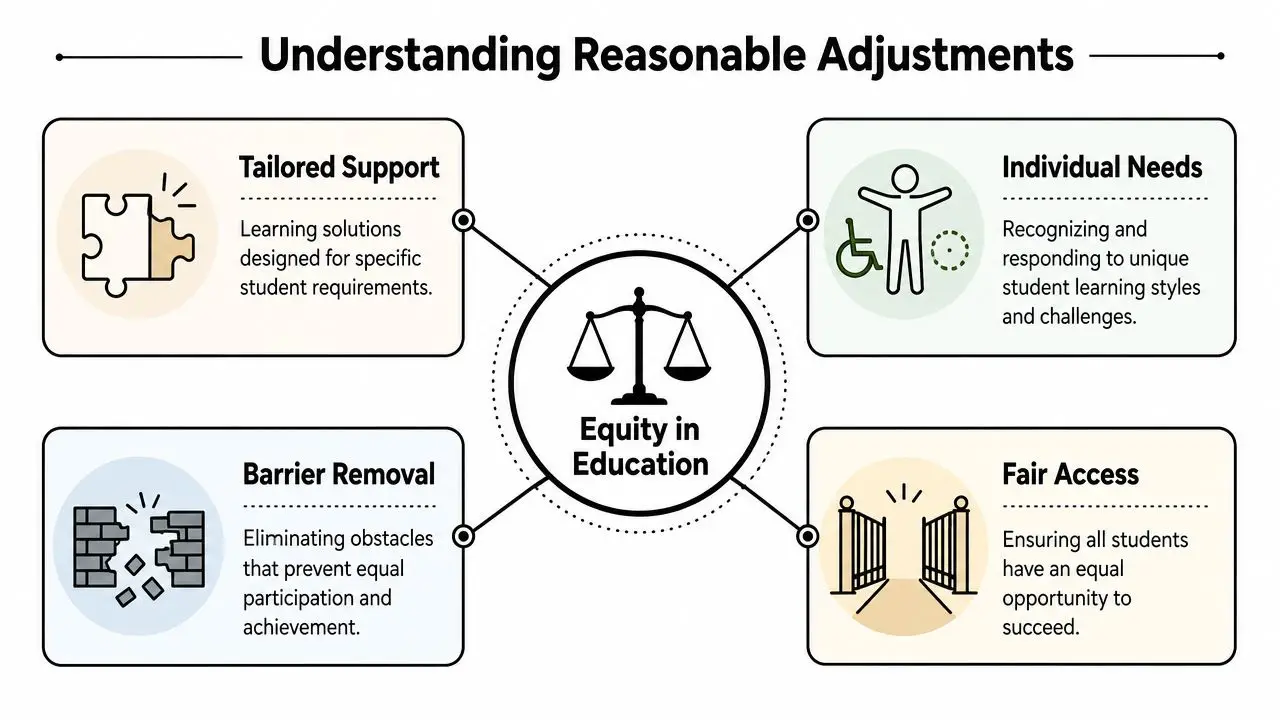
Think of reasonable adjustments like glasses. If a child can't see the whiteboard, giving them glasses doesn't give them an unfair advantage. It removes a barrier so they can learn alongside everyone else.
That's what reasonable adjustments are for. They are changes that help a disabled pupil avoid being placed at a substantial disadvantage compared with their peers. In plain English, school must not stay rigid while your child struggles around the edges of it.
A right, not a favour
Schools have had a mandatory legal duty to provide reasonable adjustments for disabled pupils since September 2002, first under the Disability Discrimination Act 1995 and then under the Equality Act 2010 from October 2010, as set out in the Equality and Human Rights Commission guidance on reasonable adjustments for disabled pupils. That duty is anticipatory, which means schools are supposed to plan ahead for disabled pupils' needs generally. They shouldn't wait until your child has already struggled for months.
This is one of the biggest misunderstandings I see. Parents often feel they must prove their child has suffered enough to “earn” support. No. The school's duty is to think ahead, identify likely barriers, and act before those barriers keep harming access to learning.
If you want a simple overview of how support can sit within school systems, this guide on what SEN support is is useful background.
What this looks like in practice
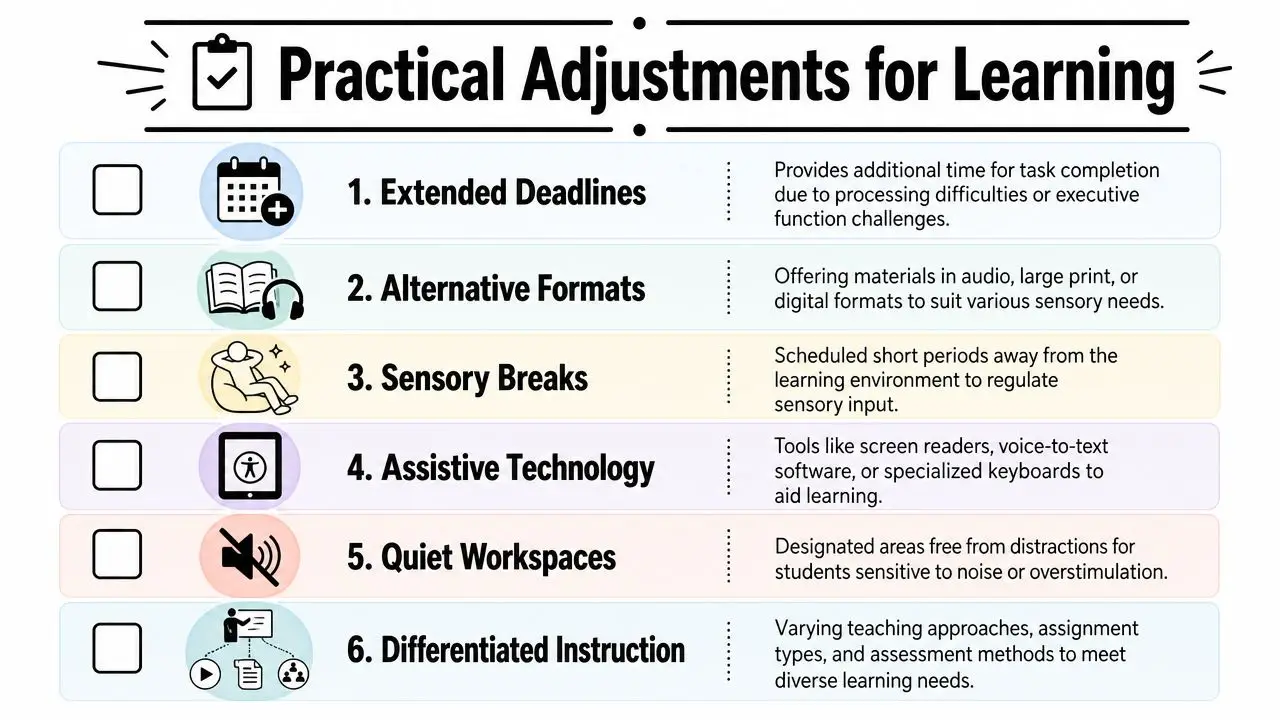
Reasonable adjustments are often simple, practical changes such as:
- Changing a routine so a child can enter class more calmly
- Adapting materials with larger print, coloured overlays, or simplified layout
- Using aids or services such as specialist software, a scribe, or communication support
- Altering how instructions are given so the child can process them clearly
Practical rule: If a child is capable but blocked, the question isn't “Why can't they cope?” It's “What barrier can we remove?”
Good schools understand this quickly. Struggling schools sometimes talk as if flexibility is generosity. It isn't. In reasonable adjustments education, flexibility is often the legal and ethical baseline.
Reasonable Adjustments in the Real World
Parents usually feel more confident when they can picture actual examples. Abstract language doesn't help much when your child is crying over spellings, refusing school, or coming home completely dysregulated.
So let's make this concrete.
In a primary classroom
A Year 3 pupil with sensory sensitivity may not need “more discipline”. They may need the classroom to stop assaulting their nervous system all day.
Helpful adjustments can include:
- Visual timetables so transitions don't arrive as a shock
- Now-and-next boards for children who feel overwhelmed by a full day plan
- Movement breaks built in before concentration falls apart
- Alternative seating such as a wobble cushion or a stable, low-distraction place in the room
- Reduced copying from the board when writing speed or visual processing is the issue
- Chunked instructions given one step at a time
A child with speech and language needs might also benefit from pre-teaching key vocabulary before a lesson. That one change can stop them from spending the whole session trying to catch up with language rather than content.
In a secondary classroom
The barriers often become less visible and more punishing in secondary school. There are more teachers, faster pace, noisier corridors, heavier homework loads, and more pressure to appear independent.
Adjustments might include this mix of support:
| Situation | Possible adjustment |
|---|---|
| Fast note-taking lessons | Teacher provides lesson notes in advance |
| Weak working memory | Written instructions alongside verbal ones |
| Anxiety in crowded movement times | Permission to leave class a few minutes early |
| Difficulty handwriting at speed | Laptop or word processor |
| Processing delays | Extra thinking time before answering |
| Overload in homework planning | One central homework checklist or digital planner |
For a teenager with cerebral palsy or motor difficulties, technology can be the access point that changes everything. Families exploring practical tools may find this guide to understanding assistive tech solutions for CP helpful as a starting point.
During tests and exams
Many parents often panic when school mentions “exam rules” without explaining what can still be adjusted.
Internal tests can often be adapted more flexibly than formal external exams. For public exams, schools usually consider access arrangements under exam board and JCQ processes. The exact arrangement depends on evidence and need, but common examples include:
- Extra time
- Rest breaks
- A smaller room
- A reader
- A scribe
- Use of a laptop
- Modified papers
The key point is that support should match the barrier. A child who knows the material but cannot physically handwrite fast enough should not be judged on handwriting speed unless that is the skill being assessed.
If an adjustment helps your child show what they know, it supports fairness. If it changes what they are actually being assessed on, that's a different question.
In online learning
Online environments can also support access well when they're designed properly.
Examples include recorded lessons for replay, typed chat for pupils who struggle to speak in front of others, digital submission instead of handwriting, closed captions where available, clearer routines on screen, and easier use of assistive software. A child who finds mainstream classrooms exhausting may learn far better in a quieter online setting with fewer sensory demands and more control over pace.
How to Ask for and Secure Adjustments for Your Child
This is the part parents often dread. You know your child needs help, but you don't want to be dismissed, labelled difficult, or sent into a maze of meetings and vague promises.
Keep it steady. You do not need a perfect script. You need a clear record, a child-centred focus, and the confidence to ask for specifics.
Start with evidence from daily life
Don't begin with labels. Begin with impact.
Write down what you're seeing over two or three weeks. Keep it practical and observable:
- At home your child melts down after school, avoids reading, or takes far longer than expected to complete tasks.
- In schoolwork you may notice unfinished work, rushed writing, lost marks for presentation, or strong verbal answers that don't match written output.
- Emotionally you might see dread on Sunday evenings, sleep problems, headaches, or constant self-criticism.
A short pattern log is more persuasive than a long emotional essay. Both matter, but schools respond better when the concern is concrete.
Know the legal test
Under the Equality Act 2010, the duty to make adjustments is triggered when a disabled pupil faces a substantial disadvantage compared with peers. That duty can cover changes to practices, the provision of auxiliary aids such as specialist software or scribes, and physical features, but it does not require changing the core competence standards of a qualification, as explained in this SENDIASS Southend guide to reasonable adjustments.
That wording matters. It gives you a framework. You are not limited to saying, “My child is unhappy.” You are saying, “My child is at a substantial disadvantage in these specific situations, and these adjustments may reduce that disadvantage.”
Who to contact first
This usually works best in sequence:
- Class teacher or form tutor if the issue is newly emerging or classroom-specific.
- SENCO if the pattern is broader, ongoing, or already affecting access seriously.
- Head of year or senior leader if communication stalls or agreed actions don't happen.
If exams are part of the issue, it also helps to understand how exam access arrangements are typically handled so you can ask informed questions.
Bring examples. Bring dates. Bring your child's voice if they can share it. Don't bring a fight unless the school leaves you no other choice.
What to write in your email
Keep your first email calm and specific. Something like this works:
- State the concern clearly. “My child is finding it difficult to access learning because…”
- Give two or three examples. “They consistently understand content verbally but cannot finish written work in the time allowed.”
- Describe the impact. “This is affecting confidence, participation, and progress.”
- Request a meeting. “I'd like to discuss reasonable adjustments that could reduce this disadvantage.”
In the meeting
Ask direct questions:
- What barriers has the school identified?
- What adjustments can be put in place now?
- Who is responsible for each action?
- How will these be shared with all relevant staff?
- When will we review whether they're working?
Leave with named actions, not warm words. “We'll keep an eye on it” is not a plan.
How Online Learning Creates a Supportive Environment
Your child logs off a lesson calm instead of drained. No noisy corridor before class. No pressure to mask through registration. No energy wasted on coping with the room before the learning has even started.
For some children, that shift is not a bonus. It is the difference between access and distress.

Online learning can remove barriers that mainstream settings often struggle to reduce quickly. Sensory load is lower. Transitions are simpler. The day is more predictable. A child who spends school hours bracing for noise, crowds, movement, or constant social demand often has far more capacity to listen, think, and join in when those pressures are stripped back.
That matters more than many schools admit.
Built-in flexibility matters
A strong online setup gives teachers and families practical options, not vague reassurance. Recorded lessons help pupils who need extra processing time, repeated instructions, or breaks for fatigue, pain, anxiety, or medical appointments. They can return to the content without the fear that one difficult morning has ruined the whole day.
Smaller live classes help too. Teachers are more likely to notice hesitation, overload, or confusion early. Support can be offered discreetly in the chat, through clear written instructions, or with more controlled turn-taking. That protects dignity as well as access.
Digital learning also works best when the platform is predictable. If your child benefits from structure, it helps to understand how a virtual learning environment keeps lessons, tasks, and feedback in one consistent place.
Digital formats can reduce friction
Paper-heavy systems create avoidable problems for many children with SEN or SEMH needs. Sheets go missing. Handwriting slows thinking down. Instructions are forgotten because they were said once and never seen again.
Digital formats remove a lot of that friction. Typed work is often easier to produce and easier for teachers to read. Built-in tools can support reading, writing, and organisation. Online submission cuts down the daily stress of lost worksheets, unreadable notes, and last-minute panic.
Good online practice does not happen by accident. It depends on accessible design, clear routines, and teaching that expects different needs from the start. This guide on how to make e-learning accessible gives a useful overview of what that should look like.
One online option parents sometimes consider is Queens Online School. It offers a British curriculum through live online teaching, recorded sessions, and smaller classes. For some families, that model suits a child who needs quieter access, more predictable routines, or a less overwhelming school day.
The right setting lets your child spend their energy on learning, not on surviving the environment.
Online learning is not the right answer for every child. But if school has become a cycle of overload, masking, exhaustion, refusal, or slow recovery every evening, it is reasonable to ask whether a calmer online environment would give your child fairer access to education.
Your Parent Advocacy Toolkit
Strong advocacy isn't about becoming aggressive. It's about becoming organised, clear, and difficult to brush aside.
You know your child in a way no meeting note ever will. The school knows the system. Progress happens fastest when you bring those two kinds of knowledge together and refuse to let your child's needs disappear into vague language.
Build a one-page profile
This is one of the most effective tools a parent can create. Keep it short enough that staff will readily read it.
Include:
- Strengths first such as humour, subject interests, kindness, verbal ability, creativity, or strong factual memory
- Pressure points like noise, handwriting load, sudden change, unstructured group work, or long verbal instructions
- Signs of overload including shutdown, irritability, silence, tears, refusal, or perfectionism
- Adjustments that help such as visual instructions, extra processing time, movement breaks, reduced copying, or a named safe adult
That single page often does more than a pile of reports because it is usable.
Keep communication purposeful
You don't need to email every week about everything. You do need a clear thread of communication when access is affected.
A good pattern is:
- Send one concise update when a concern emerges
- Ask for named actions
- Request a review date
- Follow up in writing after meetings so there's a shared record
If online or blended learning is part of your child's life, it also helps to understand wider principles of how to make e-learning accessible. It can sharpen the questions you ask about platform design, resources, and participation.
Know when to escalate
If the school is kind but disorganised, stay collaborative and firm.
If the school is minimising, delaying, or repeatedly failing to implement agreed support, escalate calmly. Move from the teacher to the SENCO, then to senior leadership. Keep dates, decisions, and examples. The more factual your record, the stronger your position.
Your child does not need a parent who is liked by everyone. They need a parent who stays steady when things get slippery.
Involve your child
As children get older, involve them more directly. Ask what helps. Ask what makes school harder. Ask what support feels discreet and what feels embarrassing. Good advocacy is not doing everything over your child's head. It's helping them grow into their own voice.
Frequently Asked Questions About Adjustments
What if the school says an adjustment isn't reasonable
Ask why. Ask what evidence they used. Ask what alternative they are offering to reduce the barrier.
Sometimes a school rejects the exact adjustment suggested but can still meet the need in another way. That can be perfectly acceptable if it effectively reduces the disadvantage. What isn't acceptable is a flat refusal with no thoughtful alternative.
Do we need a formal diagnosis or an EHC Plan
No, not necessarily.
Many parents get stuck here because they assume nothing can happen until a diagnosis lands or an EHC Plan is in place. Schools can and should respond to need and impact. If your child is facing clear barriers, start the conversation. Don't wait for paperwork if the disadvantage is already obvious.
How long should implementation take
There isn't one fixed timescale that covers every situation. Some adjustments can begin almost immediately, such as seating changes, written instructions, reduced copying demands, or movement breaks. Others take more planning.
What matters is whether the school is acting with urgency, clarity, and accountability. If weeks pass with no action, ask for a written timeline and named responsibilities.
Are reasonable adjustments the same as general SEN support
Not exactly.
General SEN support is the broader framework a school may use to identify need, plan provision, review progress, and involve specialists where appropriate. Reasonable adjustments are specifically about removing barriers so a disabled pupil is not placed at a substantial disadvantage. In real life they can overlap, but they are not identical.
What if my child hates standing out
That concern is valid. Older children especially may refuse support if it feels public or stigmatising.
The answer isn't to drop the adjustment. It's to design it better. Discreet support often works well. That might mean shared class routines that benefit everyone, technology that blends in naturally, or quiet check-ins rather than public intervention.
What if I feel exhausted already
That feeling makes sense. Chasing support for your child can be lonely and draining.
But you do not have to solve everything at once. Start with one barrier. Ask for one meeting. Get one useful adjustment in place. Small, solid changes build momentum, and your child feels that relief quickly.
If you're looking for a flexible school setting where personalised support can be built into daily learning, Queens Online School is worth exploring. It offers a full British curriculum online, including live teaching and recorded lessons, which can suit pupils who need a calmer environment, more consistent routines, or adjustments that are easier to deliver digitally.