

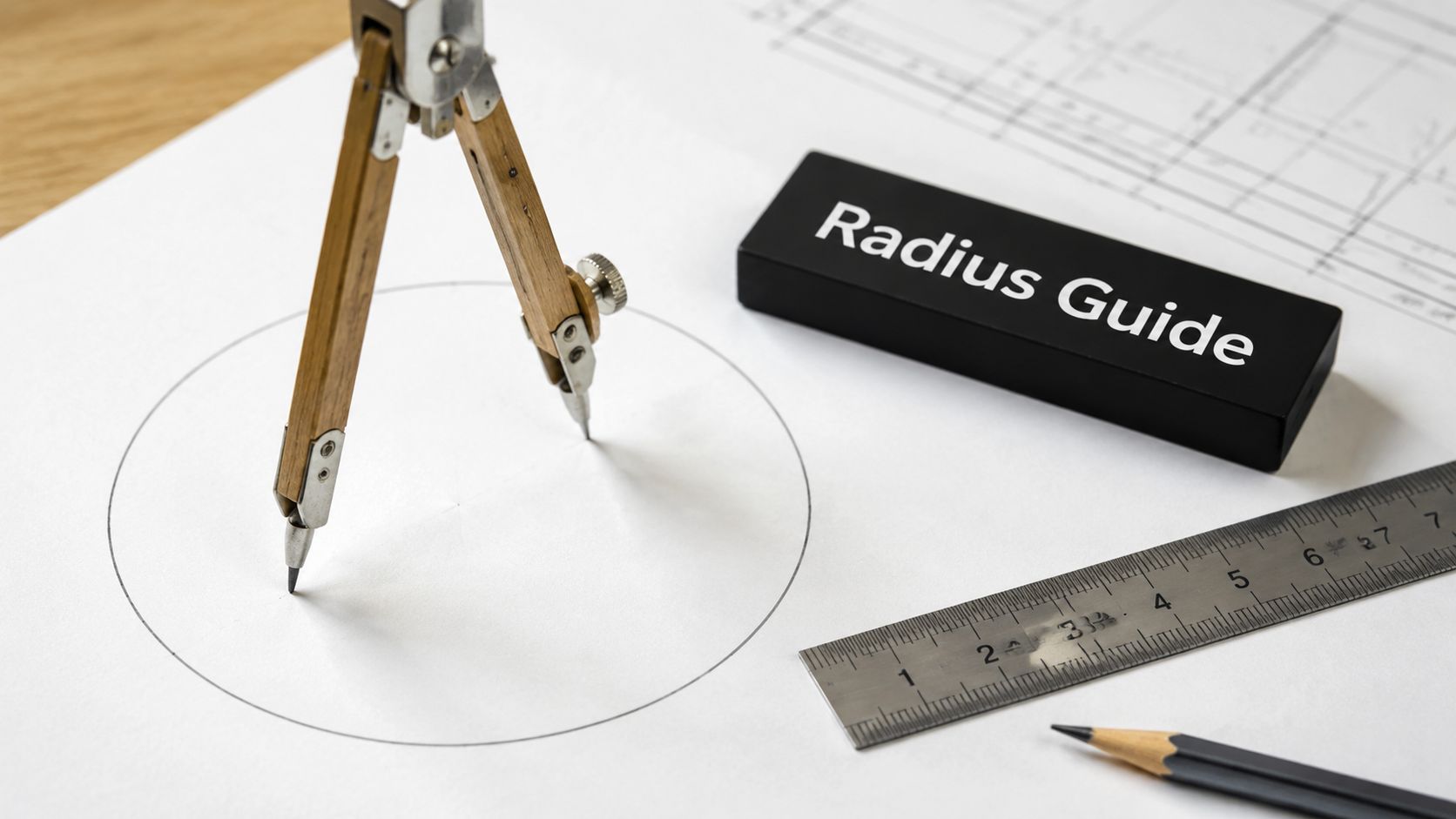
The radius is the distance from the very centre of a circle out to its edge. It's the first clue that helps a child understand almost everything else about a circle, from how wide it is to how much space it covers.
If you're sitting with your child right now, perhaps looking at a homework page, a hand-drawn circle, or even the top of a plate on the kitchen table, you're already close to understanding it. A circle can seem simple until someone asks, “What is a radius in a circle?” and suddenly a very ordinary shape starts to feel oddly tricky.
That's a completely normal moment.
Children often draw a circle, look at it, and know it's round, but they don't yet know how mathematicians describe that roundness. The good news is that radius isn't a frightening maths word. It's just a name for one very important distance inside a circle. Once that distance makes sense, many other ideas become much easier.
Your Journey into the World of Circles
A child draws a circle and frowns at the page. It looks almost right, but not quite. One side bulges out. Another side dips in. They know what a circle should look like, yet making one by hand feels harder than expected.
That small moment matters. It's often where curiosity begins.
A circle isn't just a round shape. It's a shape where every point on the edge is the same distance from the centre. That one idea is the secret behind its neatness and symmetry. If your child can understand that, the circle stops being a mystery and starts becoming something logical and friendly.
For many younger learners, it helps to think of the centre as the “heart” of the circle. From that heart, you can stretch an imaginary line to the edge. That line has a special name. It's called the radius.
A circle stays a circle because its edge is evenly spaced from the centre all the way round.
That's why circles appear in so many early maths lessons. They're not random shapes. They follow a clear rule. Children who enjoy patterns often respond well to this. Children who feel less confident in maths often relax when they realise the rule is so simple.
If your child is building these ideas in primary maths, extra guided practice with shape and measurement can help everything click more naturally through Key Stage 2 mathematics support.
A gentle way to picture it
Try this at home. Put a coin, plate, or mug on paper and trace around it. Then mark the centre as best you can. Draw a straight line from the centre to the edge. That line is the radius.
It's a small idea, but it opens a very big door.
The Heart of the Circle Understanding the Radius
The easiest way to understand the radius is to use something familiar. Think of a pizza.
If you place your finger in the very middle of the pizza and then draw a straight line to the crust, that distance is the radius. Not the curved edge around the pizza. Not the whole width from one side to the other. Just the straight line from the centre to the outside.

Definition: A radius is a straight line from the centre of a circle to any point on the circumference.
The word circumference means the edge of the circle. So if your child hears “radius goes from centre to circumference”, it means “from the middle to the edge”.
Why the radius matters so much
A circle has many possible radii. You can draw one pointing up, one sideways, one diagonally, and another anywhere else. They all start at the centre and end on the edge.
Here's the important part. In a true circle, every radius has the same length.
That's the magic property of a circle. If one of those lines were shorter or longer, the shape wouldn't be a proper circle anymore. It might become stretched or uneven.
A simple way to help a child feel this is to use a bicycle wheel, a round cake tin, or a clock face.
- Clock face idea: Start at the middle pin of the clock hands and imagine a straight line to any number on the edge.
- Cake tin idea: Measure from the centre to the rim in different directions. The distance should stay the same.
- Wheel idea: The centre of the wheel to the tyre edge gives the same distance all around.
What does the letter r mean
In maths, people often use the letter r to stand for radius. That's just shorthand. It doesn't change the meaning.
So if a question says r = some length, it means the radius has that length.
Children sometimes worry when letters appear in maths. Reassure them that this letter is just a label. It's like writing “d” for dog on a flashcard. The letter helps us talk about the idea quickly.
When your child sees r, they can quietly say to themselves, “That means radius.”
That tiny habit builds confidence fast.
Connecting the Dots Radius Diameter Circumference and Area
Once the radius is clear, several other circle words stop feeling random. They connect neatly, almost like a set of keys on the same ring. The radius is the one that illuminates the others.

Radius and diameter
The diameter is a straight line that goes all the way across the circle, passing through the centre. If you picture two radii placed end to end, you've got the diameter.
That relationship is written like this:
- d = 2r
So if a child knows the radius, they can double it to get the diameter. If they know the diameter, they can halve it to get the radius.
This is one of the most common links in geometry, and also one of the most commonly mixed up.
Radius and circumference
The circumference is the distance all the way around the circle. You can think of it as the circle's outer “hug”.
The formula is:
- C = 2πr
For many children, the symbol π looks unusual at first. It's said as “pi”. They don't need to be intimidated by it. In school maths, it's usually treated as a special number used in circle work.
The main idea to notice here is this. The formula needs the radius. That's why the radius is so important.
If the radius changes, the distance around the circle changes too.
Radius and area
The area is the amount of space inside the circle. If you coloured the whole circle in, the coloured part would be its area.
The formula is:
- A = πr²
That little raised 2 means “squared”. So r² means radius multiplied by radius.
Children often ask why the radius appears again here. The simplest answer is that the size of the whole inside depends on how far the circle stretches from its centre. A bigger radius means a bigger circle inside and outside.
A simple comparison
| Circle measure | What it means | How radius helps |
|---|---|---|
| Radius | Centre to edge | The starting measurement |
| Diameter | Across the circle through the centre | It is double the radius |
| Circumference | Around the outside | It uses the radius in the formula |
| Area | Space inside the circle | It uses the radius squared |
If your child already knows area from other shapes, it can help to compare circles with triangles and rectangles. This simple guide to the area of a scalene triangle can support that wider understanding of area as “space inside a shape”.
A recipe way to remember it
Some children remember circle formulas better when they think of them as recipes.
- Diameter recipe: take the radius and double it
- Circumference recipe: take the radius, multiply by pi, then multiply by two
- Area recipe: take the radius, square it, then multiply by pi
That way, the formulas aren't just symbols on a page. They become actions.
Putting It into Practice Worked Examples for All Ages
Understanding grows when children do something with the idea. A definition helps, but a worked example turns “I've heard that word” into “I know how to use it”.

Example for a younger child
Let's say your child has a circle drawn on paper and a ruler in hand. They need to find the radius.
Try these steps.
- Find the centre: If the centre is already marked, great. If not, an adult can help estimate the middle.
- Place the ruler carefully: Start the ruler at the centre, not at the edge.
- Measure to the circle's edge: Draw or imagine a straight line from the centre to the edge.
- Read the length: That length is the radius.
If your child accidentally measures from one side of the circle right across to the other, they've measured the diameter instead. That's a very common slip, not a failure.
A helpful phrase is: centre to edge means radius.
Example for an older student
Now take a more advanced question. A student is given the area of a circle and asked to work backwards to find the radius.
The key idea is to start with the formula:
- A = πr²
Then isolate r step by step.
A clear method looks like this:
- Write the formula
Start with A = πr². - Divide by π
This leaves r² on its own. - Square root both sides
This undoes the square and gives r.
That process is often more emotional than adults expect. Teenagers can feel stuck not because they don't understand circles, but because rearranging formulas feels stressful. Slow, calm practice helps.
Classroom habit: When a formula looks crowded, cover what you're trying to find and ask, “What was done to it?” Then undo those steps one at a time.
Helping a child who freezes on maths questions
Some learners know the idea but panic when they see a problem. That's where problem-solving habits matter just as much as content knowledge. A practical resource on Strategies for child problem-solving can help families build calmer, more organised thinking routines.
You can also support your child with prompts like these:
- Ask for the shape first: “Is this definitely a circle?”
- Spot the clue word: “Are they asking for radius, diameter, area, or circumference?”
- Choose the starting fact: “What do we already know?”
- Move one step at a time: “What can we work out from that?”
When students move into exam-style questions
At GCSE level, radius questions often stop being simple measuring tasks and start appearing inside algebra, word problems, and multi-step geometry. Students may need to find a missing radius, compare circles, or use the radius inside a larger problem.
That's why it helps to practise in a structured way with GCSE maths online free resources.
A child doesn't need to get every question right straight away. They need repeated chances to see that the same idea keeps returning. Centre to edge. Start there. Then build.
Common Stumbling Blocks and Memory Tricks
The biggest mix-up is usually radius versus diameter. The words sound a bit alike, both live inside the circle, and both are straight lines. No wonder children blur them together.
That confusion is normal. It doesn't mean your child isn't trying.
The difference in one glance
Use this quick comparison:
- Radius: centre to edge
- Diameter: edge to edge through the centre
The radius only goes halfway across. The diameter goes all the way across.
Memory tricks that actually help
Some children remember best with sound. Others need a picture. Try both.
- Radius is shorter: the word is shorter, and the line is shorter.
- Diameter is double: it's made of two radii.
- Radius is like a ray: think of one ray of sunshine coming out from the centre.
- Diameter is a big deal: it stretches across the whole circle.
Many children stop mixing them up once they say aloud, “Radius reaches out. Diameter goes through.”
A quick home check
Ask your child to point to the centre of a plate. Then ask them to show you:
- A line from the centre to the rim
- A line from one side of the rim to the other through the middle
If they can show both with confidence, the difference is starting to settle in.
One more gentle note. If your child keeps forgetting, don't rush past it. Repetition with simple objects often works better than more worksheets.
The Radius in Our World From Pizza to Planets
Radius isn't trapped in a maths book. It appears in ordinary life and in some very exciting places too.

A child sharing a pizza is already meeting the idea. The distance from the middle of the pizza to the crust helps describe the size of each slice. A ride on a Ferris wheel hints at it too. The centre axle stays fixed, and each seat travels around it at the same distance from that centre point.
That same idea appears in work adults do every day.
Mini stories from real life
A bicycle mechanic thinks about wheel size. An engineer designing a gear needs the right circular measurements so the parts fit and turn properly. A mapmaker may use a radius to describe an area around a central point. Even ripples in a pond spread outward in circles, each new ripple having its own radius from the splash point.
For children, this matters because it answers the question they often ask with complete honesty. “When will I use this?”
You may not use the word every day, but the idea is everywhere.
Here's a short video that can help visual learners see circle ideas in motion:
Why this sparks confidence
When maths connects to objects children can touch or picture, it becomes less abstract. The radius stops feeling like a test word and starts feeling like a tool for describing the world.
That shift can be powerful. A child who says, “I'm not good at maths,” sometimes really means, “I can't see what this means yet.” Once they can see it, they often begin to believe they can do it.
Your Radius Questions Answered A Quick FAQ
Can a circle have more than one radius
Yes. You can draw a radius from the centre to any point on the edge of the circle. There are many of them, but in a true circle they are all the same length.
Is the radius always a straight line
Yes. A radius is a straight line segment from the centre to the circumference. If the line bends, it isn't a radius.
Is the radius half the diameter
Yes. The diameter is made of two radii in a straight line through the centre, so the radius is half of the diameter.
Do ovals have a radius
Not in the same way circles do. A circle is special because every point on its edge is the same distance from the centre. An oval doesn't keep that same equal distance all the way round.
What if the centre isn't marked
That can make the question harder, but not impossible. In school problems, the centre is often given. In drawings, an adult or teacher may help find or estimate it before measuring.
If your child would benefit from patient teaching, live lessons, and a supportive online environment where maths is explained clearly and step by step, explore Queens Online School. It's a thoughtful option for families who want strong academic guidance with the child's confidence and wellbeing kept at the centre.