
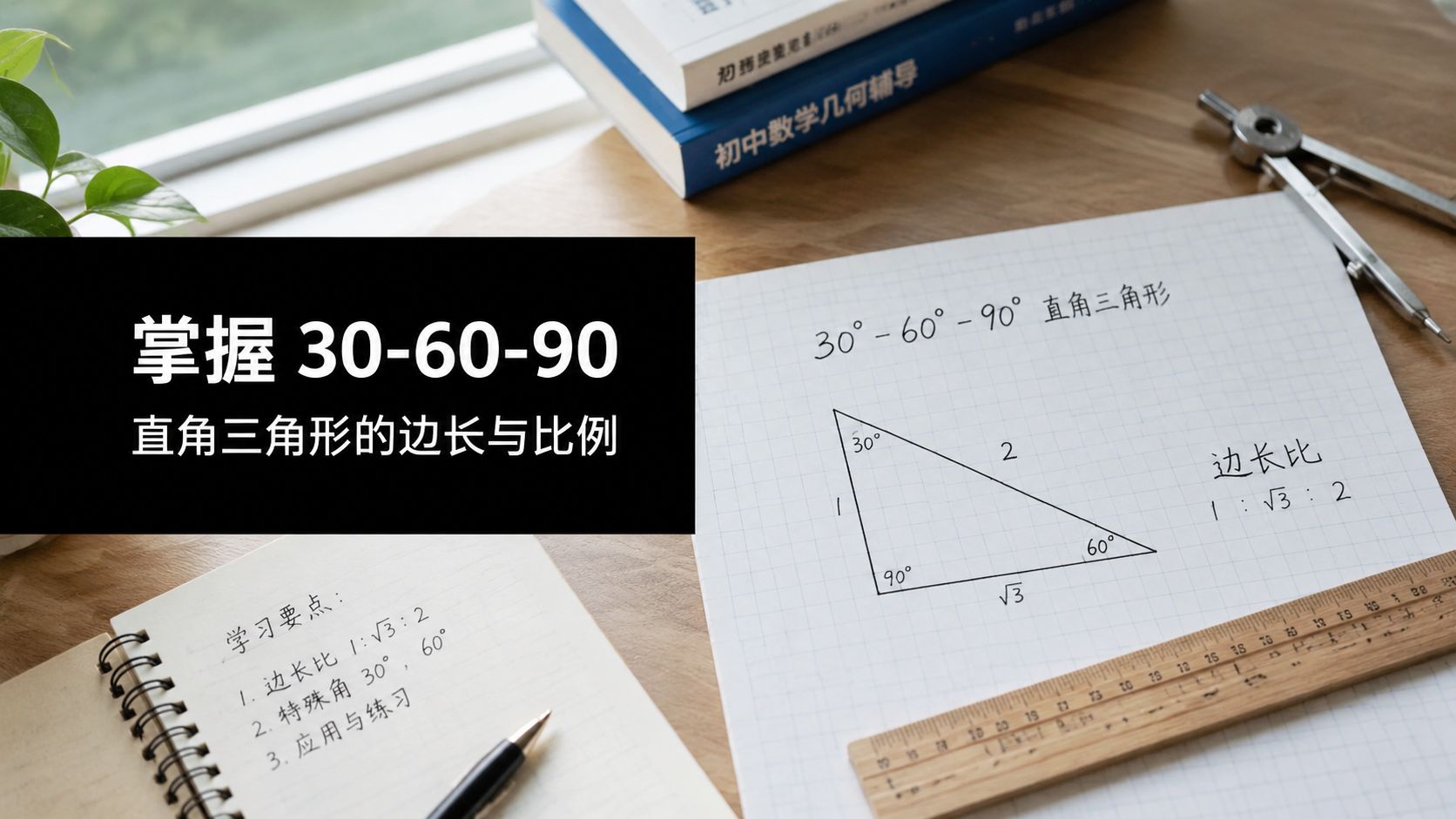
You might be looking at a geometry question right now with that sinking feeling of, “I know I've seen this before, but I can't remember what to do.” That feeling is common, especially when triangles start mixing angles, square roots, and side lengths all at once.
The good news is that 30 60 90 triangles are one of the friendliest shortcuts in maths. Once you understand why they work, they stop feeling like a random rule and start feeling predictable. That's when confidence begins to replace panic.
Why 30 60 90 Triangles Are a Maths Secret Weapon
A student in an exam often loses time in the same way. They see a right-angled triangle, spot a square root somewhere in the question, and freeze. They start wondering whether to use Pythagoras, trigonometry, or pure guesswork. Meanwhile, the clock keeps moving.
But some triangle questions are much kinder than they first appear. If the angles are 30°, 60°, and 90°, the triangle follows a fixed pattern. You don't need to build the answer from scratch every time. You can recognise the pattern and move straight to the side lengths.
That's why this triangle is a secret weapon. It turns a messy-looking problem into a familiar one.
Why students remember it better when they understand it
Many children are told to memorise a rule and hope it sticks. That can work for a short quiz, but it often falls apart under pressure. In an exam, memory feels shaky if there's no meaning behind it.
When you connect the rule to something you already know, it becomes much easier to trust. A 30 60 90 triangle comes directly from an equilateral triangle, which is a shape most students have met many times before. That link gives the rule a reason.
A maths rule is easier to use when it feels logical, not magical.
If your child is building confidence for assessments, it often helps to practise with familiar GCSE-style questions such as those on free GCSE maths resources. The key isn't endless repetition. It's recognising patterns calmly.
What makes this triangle so useful
Here's why students often grow to love this topic once it clicks:
- It saves time: You can find missing sides quickly if you know the pattern.
- It reduces stress: You're not guessing which method to use.
- It prepares you for trigonometry: These triangles sit underneath some exact trig values later on.
- It rewards understanding: Once the idea makes sense, it's much harder to forget.
For many learners, especially those who get anxious in maths, that sense of certainty matters just as much as the answer itself.
The Core Rule of 30 60 90 Triangles
Every 30 60 90 triangle has side lengths in the same ratio:
1 : √3 : 2
That ratio tells you the relative lengths of the three sides. It doesn't matter whether the triangle is tiny or large. The pattern stays the same.

Match each side to its opposite angle
This is the part students most often mix up, so go slowly here.
| Angle | Opposite side | Role in the ratio |
|---|---|---|
| 30° | shortest side | 1 |
| 60° | middle side | √3 |
| 90° | hypotenuse | 2 |
The side opposite the smallest angle is the shortest. The side opposite the largest angle is the longest. That makes sense even before you memorise anything.
So if you remember just one sentence, make it this:
Practical rule: Opposite 30° is the short side, opposite 90° is the hypotenuse.
A simple way to hold the pattern in your mind
Students sometimes try to remember the numbers without attaching them to the triangle. That's where mistakes creep in. Instead, tie each number to a feature.
- Short side = 1
- Longer leg = √3
- Hypotenuse = 2
If the shortest side were called (x), then the full set of sides would be:
- x
- x√3
- 2x
That form is often easier to use in questions than the bare ratio.
A quick example
Suppose the side opposite 30° is 4 cm.
Then:
- the shortest side is 4
- the side opposite 60° is 4√3
- the hypotenuse is 8
Notice the structure. You're not doing anything mysterious. You're just scaling up the ratio.
Where children often get muddled
The most common confusion is this: students see the √3 and assume it must be the hypotenuse because it looks more complicated. It isn't. The hypotenuse is always opposite the right angle, and in this triangle it matches the 2 part.
Another confusion is forgetting that the ratio describes relationships, not fixed lengths. The sides are not always 1, √3, and 2. They are in that proportion.
If that distinction feels slippery at first, that's normal. Once you've worked through a few examples, it settles.
Where Does the 30 60 90 Rule Come From
A lot of maths becomes less scary when you can see where it comes from. The rule for 30 60 90 triangles isn't arbitrary at all. It grows out of an equilateral triangle.

Start with an equilateral triangle
An equilateral triangle has:
- three equal sides
- three equal angles
- each angle is 60°
Let's say each side has length 2x. That choice is helpful because it will split neatly in half.
Now draw a line from the top vertex straight down to the middle of the base. This line cuts the equilateral triangle into two identical halves.
Each half is a right-angled triangle.
What the new triangle looks like
Look at one of those halves.
- The top 60° angle has been cut in half, so it becomes 30°.
- The base corner stays 60°.
- The new angle at the bottom is 90° because the line was drawn perpendicular to the base.
So you now have a 30°-60°-90° triangle.
The side lengths begin to reveal themselves too:
- The original full side was 2x, so the hypotenuse is 2x.
- The base was split into two equal parts, so the shortest side is x.
- The height is still unknown.
Use Pythagoras to find the missing side
Now we use a method students already know. In the new right-angled triangle:
- one leg is x
- the hypotenuse is 2x
- the other leg is unknown
Call the unknown side b.
Using Pythagoras:
x² + b² = (2x)²
First expand the square on the right:
x² + b² = 4x²
Now subtract x² from both sides:
b² = 3x²
Then take the square root:
b = x√3
That means the three sides are:
- x
- x√3
- 2x
So the ratio is 1 : √3 : 2.
The square root of 3 doesn't appear by magic. It appears because Pythagoras is working inside half of an equilateral triangle.
A short explanation can also help to settle this visually:
Why this proof matters
When students only memorise the rule, they often forget which side goes where. But if they know the rule came from halving an equilateral triangle, they've got a mental picture to fall back on.
That mental picture is powerful. It says, “I know this shape. I know why the shortest side is opposite 30°. I know why the hypotenuse is double.”
That's a very different feeling from blind memorisation.
Solving Problems with 30 60 90 Triangles
Knowing the rule is one thing. Using it smoothly is where confidence starts to grow.

The best way to get comfortable is to solve three different kinds of problem. In each one, you're given a different side. Your job is always the same. First identify which part of the ratio that side represents. Then scale the other parts to match.
Challenge one when the short side is given
Suppose the side opposite 30° is 5 cm.
That means you've been given the 1 part of the ratio.
So:
- short side = 5
- middle side = 5√3
- hypotenuse = 10
You can think of it this way. The basic ratio is:
1 : √3 : 2
If the 1 has grown into 5, then every part of the ratio grows by the same factor.
| Side in the ratio | Actual length |
|---|---|
| 1 | 5 |
| √3 | 5√3 |
| 2 | 10 |
This is the most straightforward type of question, and it's the best place to start when learning.
Challenge two when the hypotenuse is given
Now suppose the hypotenuse is 12 cm.
This time, the side you know matches the 2 part of the ratio. So ask yourself, “What number doubled gives 12?” The answer is 6.
That means:
- short side = 6
- middle side = 6√3
- hypotenuse = 12
Students often rush here and accidentally double instead of halve. Slow down. If the hypotenuse is the 2x side, then you must work backwards to find x first.
Don't fill in the other sides until you've identified whether your given side is the x, the x√3, or the 2x side.
Challenge three when the longer leg is given
This is the one that often feels hardest at first.
Suppose the side opposite 60° is 9√3 cm.
That side corresponds to the √3 part of the ratio. So if:
x√3 = 9√3
then x = 9.
Now you can complete the triangle:
- short side = 9
- middle side = 9√3
- hypotenuse = 18
This works because the √3 matches on both sides, leaving the scale factor easy to spot.
A good routine to follow every time
When your child gets stuck, a fixed routine helps. Try this:
- Check the angles: Make sure it really is a 30°-60°-90° triangle.
- Label the sides: Mark which side is opposite each angle.
- Match the known side: Decide whether it is the 1, √3, or 2 part.
- Find the scale factor: Work out what the basic ratio has been multiplied by.
- Complete the triangle: Fill in the other two sides.
This same calm method also helps with broader triangle work, including questions involving the area of a scalene triangle, where careful labelling matters just as much.
One more worked example in words
Suppose a right triangle has angles 30°, 60°, and 90°, and the shortest side is k.
Then the sides must be:
- k
- k√3
- 2k
If instead the hypotenuse is m, then the shortest side must be m/2, and the middle side is (m√3)/2.
That kind of algebraic version appears later in school, and it becomes much less intimidating once the structure feels familiar.
Common Pitfalls When Using the 30 60 90 Rule
Even strong students slip on this topic, not because it's impossible, but because the triangle looks simple enough to tempt rushed thinking.

Pitfall one mixing up the side labels
A student sees 1 : √3 : 2 and remembers the numbers, but not which side each one belongs to. Then they place √3 on the hypotenuse or put 2 on a shorter side.
The fix is to anchor the ratio to the angles:
- opposite 30° = 1
- opposite 60° = √3
- opposite 90° = 2
The side opposite 90° must always be the longest because it is the hypotenuse.
Pitfall two getting stuck when the √3 side is given
Suppose the longer leg is given as a plain whole number, such as 7. Some students wrongly treat that as the short side immediately.
But if that side is opposite 60°, then it represents x√3, not x.
So the setup is:
x√3 = 7
To find x, divide by √3:
x = 7/√3
If needed, you can rationalise the denominator:
x = 7√3/3
That means the hypotenuse would be 14/√3, or rationalised, 14√3/3.
When the side opposite 60° is given, pause before doing anything else. That side is not the short side.
Pitfall three using the rule on the wrong triangle
This shortcut only works for 30 60 90 triangles. Not every right-angled triangle is special.
A child might spot the right angle and jump straight into the ratio without checking the other angles. That leads to answers that look tidy but are completely wrong.
| Wrong thought | Better thought |
|---|---|
| “It's a right triangle, so I can use 1 : √3 : 2.” | “It's only valid if the angles are 30°, 60°, and 90°.” |
| “The square root means special triangle.” | “Check the angle measures first.” |
This is one of those places where being careful is faster than correcting mistakes later.
Your Next Steps in Geometry and Trigonometry
Once 30 60 90 triangles make sense, a bigger door opens. You're no longer just solving one geometry topic. You're stepping into trigonometry with understanding already in place.
These triangles help explain exact trig values. Using the side ratio 1 : √3 : 2, you can work out values such as:
- sin 30° = 1/2
- cos 60° = 1/2
- tan 30° = 1/√3
You can also turn the triangle around and see related values for 60°, which makes trigonometry much easier when the values come from a picture you understand, not a list you're trying to force into memory.
Why this matters for future learning
Children often feel maths is a collection of disconnected tricks. One week it's triangles. Another week it's sine and cosine. Later it's algebra mixed with geometry.
But this topic shows that maths is connected.
- Equilateral triangles lead to special right triangles.
- Special right triangles lead to exact trig values.
- Exact trig values support more advanced work later on.
That kind of connection can be deeply reassuring for a learner who's been feeling lost.
You don't need to learn everything at once. You need one clear idea, then the next idea built on top of it.
If your child is still developing confidence with these links, structured support in Key Stage 3 mathematics can make a real difference. A steady foundation helps later topics feel far less overwhelming.
The most important takeaway is simple. Don't treat the 30 60 90 rule as a fact to cram. Treat it as a pattern you can see, explain, and trust. That's the moment geometry starts feeling manageable.
If your child would benefit from patient, expert support in maths, Queens Online School offers live online teaching designed to build understanding step by step. With clear explanations, specialist teachers, and a supportive learning environment, students can move from uncertainty to real confidence in maths.