

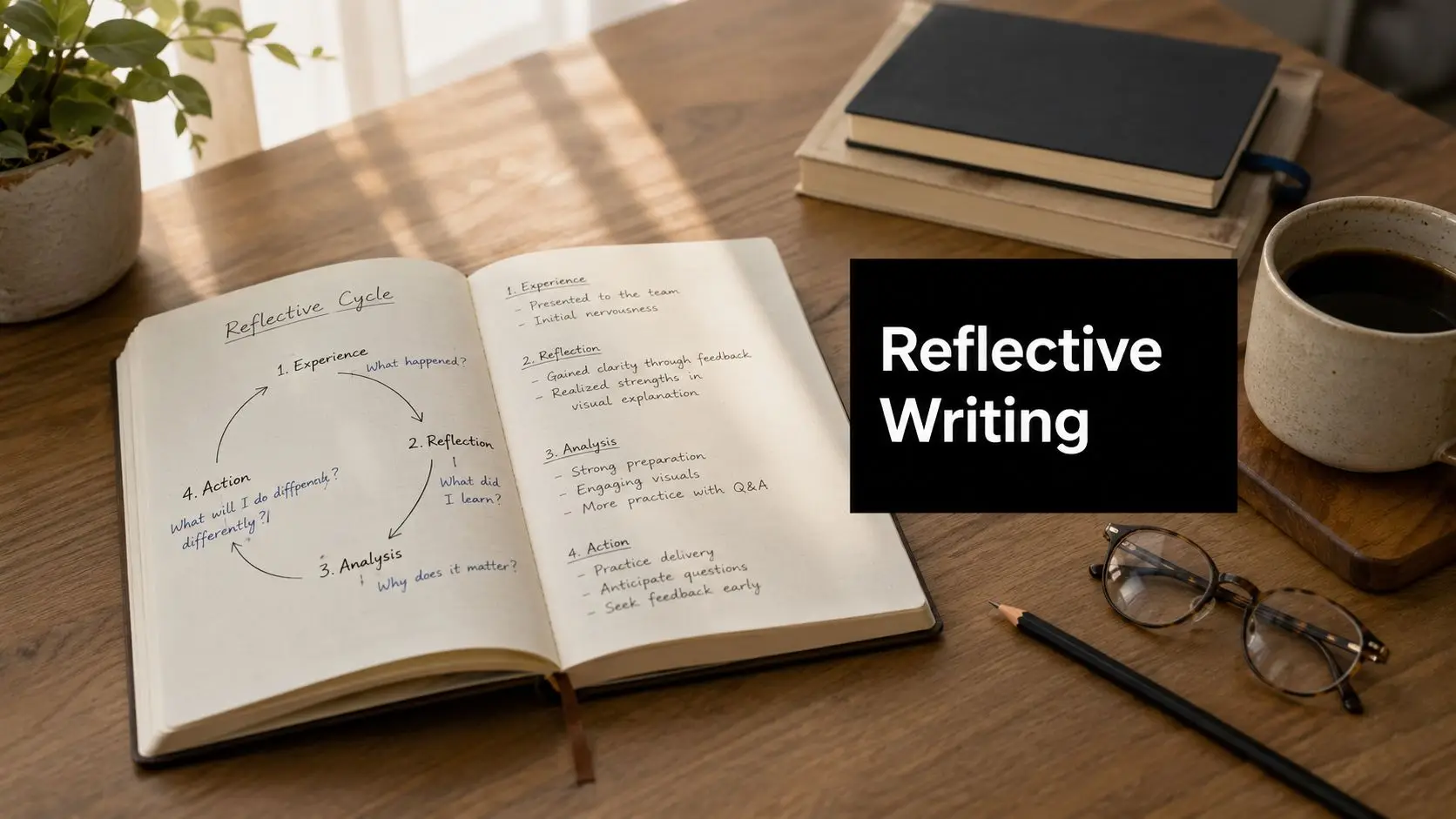
Have you ever asked a child what they learned today, only to hear “nothing” or get a shrug? That answer often hides a great deal. Children may have solved a difficult problem, felt embarrassed in class, recovered from a mistake, or discovered a new strength, but they don't always have the language to explain it.
That's where reflective writing helps. It turns learning into something a child can notice, name, and understand. Instead of stopping at “what I did”, reflection asks what I felt, why it mattered, what helped, and what I'll try next. In UK education, reflective writing is treated as a serious academic skill, not just a diary exercise. A study published in the Journal of Further and Higher Education reported that 98% of 259 students completed reflective writing tasks linked to counselling activities, showing how strongly students can engage with this kind of work when it is built into learning via the journal article.
For children, the strongest reflective writing doesn't begin with performance. It begins with wellbeing. When a pupil can say “I felt nervous before maths, then proud when I understood it”, that child is doing more than writing. They're building self-awareness, resilience, and emotional vocabulary.
If you want a practical example of reflective writing that supports both progress and mental wellbeing, the ideas below give you a clear starting point. They work at home, in school, and online. They're especially useful for children who need structure, reassurance, and space to process their feelings. Teachers can also deepen their own effective teacher reflection by noticing how children describe their emotional journey through learning.
1. The Emotion Check-In Journal
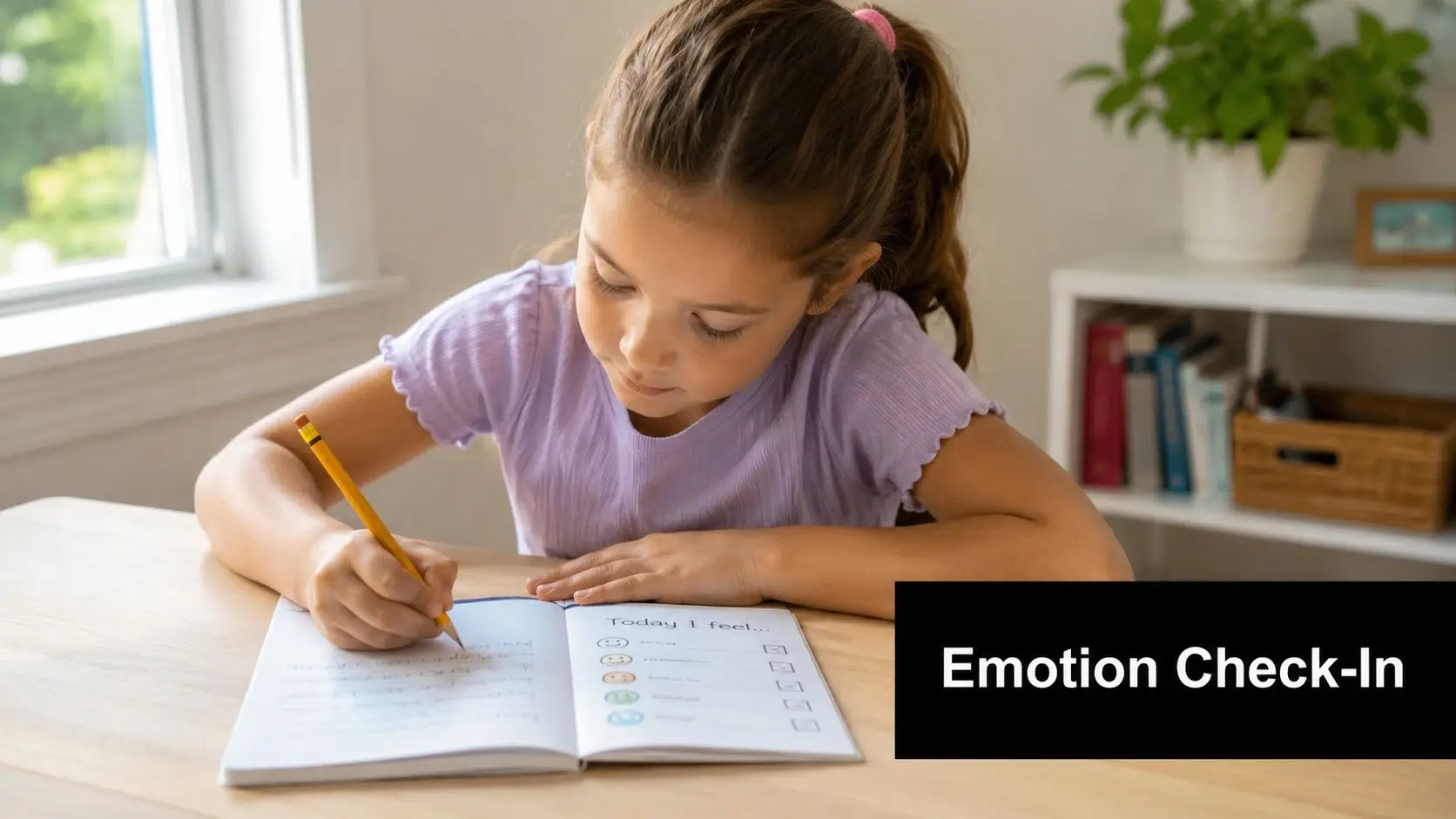
Some children can tell you exactly what they completed, but not how they felt while doing it. An emotion check-in journal fixes that. It gives a child a routine for noticing feelings before, during, and after a task, which is especially helpful for pupils with SEMH needs or children who become overwhelmed without warning.
A Year 5 pupil might write, “Before live maths I felt nervous and excited. When I got stuck I felt hot and cross. When I solved the last question I felt proud.” That short entry already reveals far more than a score ever could. It shows emotional movement, not just academic output.
How it can look in practice
A secondary pupil who dreads presentations might notice that anxiety always spikes before peer speaking tasks. A child with autism might realise that late afternoon lessons feel harder because that's when sensory overload builds. Once those patterns are visible, adults can respond with better timing, extra preparation, or quieter recovery time.
Practical rule: If a child struggles to name feelings, start with simple choices such as calm, worried, frustrated, proud, tired, or confused.
This kind of reflection also supports wider emotional literacy. If you're building those skills deliberately, this guide to social emotional learning is a useful companion.
- For younger children: Use emoji faces, colour scales, or “weather words” such as sunny, stormy, cloudy.
- For online learners: Keep the journal private and digital, shared only with a trusted adult.
- For monthly review: Read past entries together and look for patterns, triggers, and signs of growth.
Teachers are often encouraged to notice not only their own feelings after lessons but also pupils' emotional responses, using notes or diaries to make those patterns visible in this reflective practice guide for teaching. Children deserve the same careful attention.
For some families, this pairs well with gentle prompts from outside school, such as shadow work journaling prompts for anxiety, adapted in age-appropriate ways.
2. Learning Journey Narrative Reflections
Not every example of reflective writing needs to be short and boxed into a template. Some children think better in stories. A learning journey narrative lets them describe where they began, what felt difficult, when things changed, and what they now understand about themselves.
A Year 4 child might write, “At first I thought fractions were impossible. Then my teacher showed us pizza slices and I understood that fractions are parts of a whole. I felt frustrated in the first week, but now I feel clever because I can explain it.” That reflection shows emotional honesty and growing confidence in the same piece.
Why stories help children make sense of learning
Narrative reflection works well over a topic, project, or term because it helps children connect lessons that otherwise feel disconnected. A GCSE pupil might write, “This unit made me realise I enjoy science when I understand why things happen, not when I only memorise facts.” An international pupil learning online might reflect, “Online school scared me at first, but now I feel part of a global classroom.”
These reflections are especially helpful when children are trying to understand how they learn best. Different pupils process ideas through talk, visuals, repetition, movement, or quiet review. This overview of learning styles can help families and teachers frame those conversations without reducing a child to a label.
Reflection works best when a child can say, “This is how learning felt for me,” not just “This is what the class did.”
A strong prompt set might include:
- Beginning: “When I started this topic, I thought…”
- Emotion: “At first I felt…”
- Turning point: “The moment it began to make sense was…”
- Growth: “Now I can see that I've become…”
In UK reflective writing guidance, first-person voice matters, and the writing should move beyond simple retelling into thoughtful analysis. Newcastle University's guidance also stresses that description should only take a small part of the overall piece, around 10 to 15% of the word count, so the main emphasis stays on thinking, feeling, and learning in its reflective writing advice.
3. The Growth Moment Reflection Grid
Some pupils freeze when asked to “reflect” because the word sounds vague. A grid makes it concrete. Four boxes are often enough: what happened, how I felt, why it mattered, and what I learned.
A Year 6 pupil might write:
- What happened. “I got the algebra wrong.”
- How I felt. “Frustrated and stupid.”
- Why it mattered. “Because I thought I was good at maths.”
- What I learned. “Mistakes show me what to practise next.”
That's a powerful example of reflective writing because it turns a painful moment into a clear next step.
A useful structure for children who need clarity
This works especially well after practical lessons, discussions, experiments, and any task where a child's confidence shifts quickly. In a science lesson, a pupil may realise that a failed prediction wasn't failure at all. It was part of learning through doing. That's one reason reflective writing fits naturally with experiential learning, where children build understanding through direct experience and then make sense of it afterwards.
A secondary pupil who speaks for the first time in discussion might write, “I felt nervous but proud. It mattered because I usually hide. I learned my ideas are valid.” A child with social anxiety might note that asking for help felt brave, and that nobody laughed.
- Model it first: Fill in a class example together before asking for independent writing.
- Keep it visible: Put the same four prompts on paper, on screen, or in a notebook every time.
- Use it in reviews: Look back weekly so the child can see patterns of courage and growth.
A child doesn't need polished language to reflect well. They need safety, consistency, and a structure that helps them tell the truth about their learning.
4. The Feedback Integration Reflection
Many children hear feedback as judgement. They see a correction and think, “I'm not good enough.” Reflective writing can soften that reaction by helping them translate feedback into action.
A Year 5 pupil might write, “My teacher said my description was strong but I should vary my sentence length. At first I felt disappointed because I wanted it to be perfect. Then I realised she was showing me how to improve.” That shift matters. The child is no longer receiving feedback passively. They're thinking with it.
Turning comments into confidence
This kind of reflection is particularly helpful for perfectionist pupils, anxious learners, and children with SEN who may already feel watched or compared. A primary pupil might write, “Teacher said I made progress on sitting still. That made me feel proud, not sad about what I can't do yet.” A GCSE learner might realise that “you rushed” doesn't mean “you failed”. It means “show your thinking more clearly”.
Recent university guidance highlights a point that applies just as strongly in school. Students lose marks when they don't bring theory and experience together, and many learners fear admitting mistakes because they worry about losing face. One NHS-linked discussion of reflective writing notes that 78% of UK nursing and social work students report fear of admitting error and losing face as a barrier to reflection in this reflective writing discussion. Children often carry the same fear, even if they don't say it aloud.
“What is my teacher trying to teach me here?” is often a better prompt than “What did I get wrong?”
Try prompts like these:
- Meaning: “What does this feedback mean?”
- Emotion: “How did I feel when I read or heard it?”
- Intention: “Why might my teacher have given me this advice?”
- Action: “What will I try next time?”
When adults normalise feedback as care, not criticism, children become more willing to revise, recover, and keep going.
5. The Peer Impact Reflection
Learning is social. Children often understand themselves better when they reflect on who helped them, who reassured them, and when they felt less alone. A peer impact reflection focuses on relationships and shows that confidence doesn't grow in isolation.
One Year 5 pupil might write, “When Amara explained it differently, my brain suddenly got it. I felt grateful and less embarrassed.” A GCSE pupil might say, “My study group keeps me going when chemistry feels too hard.” Those are not side notes. They're central to learning.
What children notice about belonging
This format is particularly helpful in online learning, where adults sometimes worry that connection will be thinner. In reality, children often become reflective about belonging when they're invited to notice it. An international pupil might write, “Hearing about school life in other countries made me feel less strange about learning online. I felt part of something bigger.”
For children who feel isolated, prompts need to be direct and gentle:
- Connection: “Who helped you today?”
- Recognition: “When did you feel understood?”
- Change: “How did someone else's idea improve your thinking?”
- Confidence: “Did working with others make anything feel easier?”
A short reflection after breakout rooms, paired tasks, or shared projects can reveal far more than a teacher might otherwise see. It can show which pupils feel included, which ones are masking confusion, and which friendships are supporting resilience.
Sometimes the most important learning moment is, “I wasn't the only one who found this hard.”
Teachers can also use peer reflection carefully during review and response activities. If you're interested in language for constructive responses, these examples of feedback for AI-generated content offer useful models for respectful critique that can be adapted for pupil-friendly peer feedback.
6. The Challenge-to-Confidence Reflection Arc
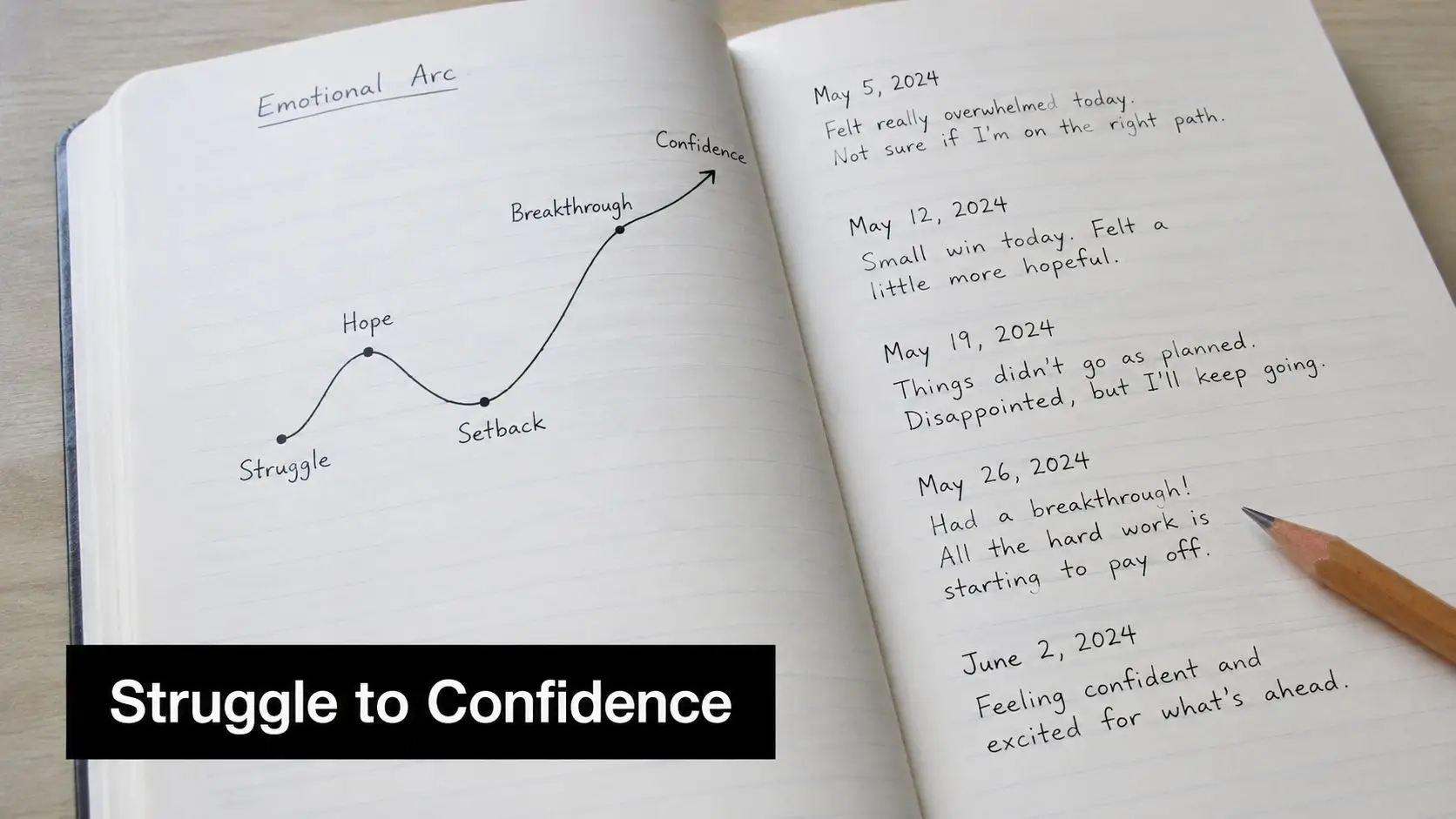
A single reflection can miss the most important truth. Growth usually happens over time. A challenge-to-confidence arc lets a child record the emotional journey from “I can't do this” to “I'm getting there”.
A Year 4 pupil might write:
Day 1. “This is impossible. I hate writing.”
Day 5. “It's still hard but I wrote one sentence I'm proud of.”
Day 10. “I wrote a whole story. I feel amazed.”
That sequence helps children see that struggle is a stage, not an identity.
Why time-based reflection is so reassuring
This approach is highly supportive for children with anxiety, perfectionism, dyslexia, or low academic confidence. A pupil studying Spanish might begin with panic and later write, “I'm still nervous, but I managed a conversation.” A child with dyslexia might track how audiobooks, overlays, or extra reading support changed the experience of stories over several weeks.
In one UK case study on reflective journal writing, teachers who reflected consistently over six months showed a 35% increase in critical self-awareness and a 28% reduction in classroom conflict incidents, with many also reporting that they could account for new ideas and draw conclusions that changed their practice in this case study on reflective journal writing. The key lesson for schools and families is simple. Reflection becomes more powerful when it captures patterns across time, not just one isolated feeling.
- Use checkpoints: Build entries into week 1, mid-point, and end-point.
- Track feelings visually: Add colours, a mood line, or a simple graph.
- Keep old entries: Don't hide the early struggle. It helps children see how far they've come.
A child who can reread their own path from fear to progress develops something precious. They start trusting that hard moments won't last forever.
7. The Values and Identity Reflection
Older pupils often disengage when learning feels disconnected from who they are. A values and identity reflection brings purpose back in. It asks a child not only what they learned, but who they're becoming.
A Year 7 pupil might write, “I'm learning languages because my parents come from different countries, and every new word helps me understand my family better.” Another student might reflect, “I want to be a doctor because I watched my gran go through illness, so when we studied disease in science it felt personal.” This is an example of reflective writing at its most meaningful. It ties school work to identity, care, memory, and ambition.
Questions that deepen motivation
Teenagers especially benefit from reflective prompts that honour complexity. A pupil exploring identity might write, “Studying literature with different kinds of characters helped me feel less alone.” A child from an international family may connect history, geography, or language learning to belonging in two cultures at once.
Useful prompts include:
- Future self: “Who do I want to become?”
- Purpose: “Why does this learning matter to me?”
- Values: “What do I care about that connects to this subject?”
- Identity: “What does this topic help me understand about myself?”
Not every child will want to share these reflections out loud, and they shouldn't have to. Some of the most valuable reflective work stays private between learner and trusted adult.
Reflective practice in education works best when the child's needs stay at the centre. In school settings, that can include journal prompts about what a learner enjoyed, how they felt, what they understood, what they still need help with, and what could have been better as outlined in this reflective practice resource. That simple shift keeps reflection grounded in the child's real experience, not adult assumptions.
8. The Five Senses Learning Reflection
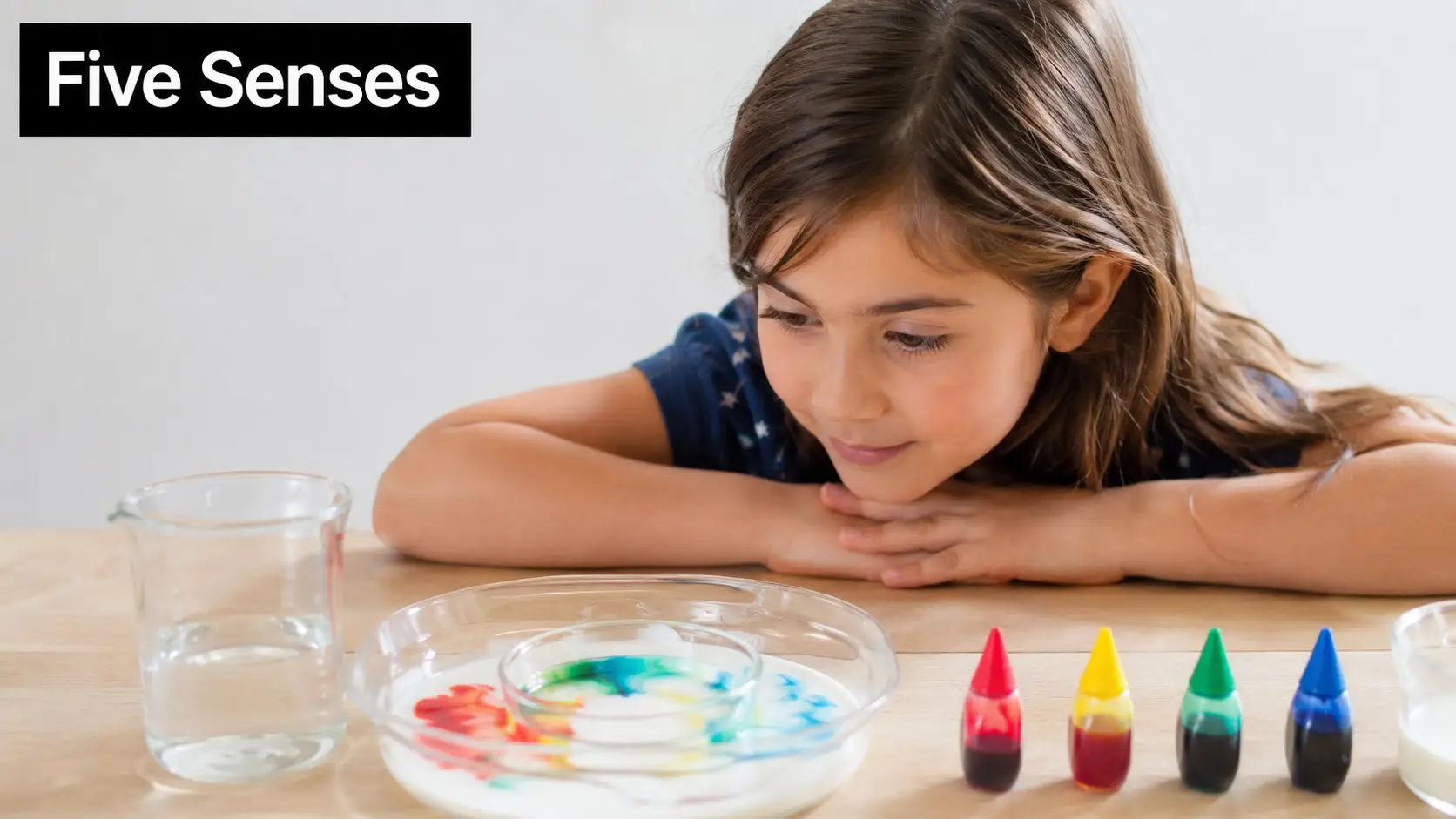
For younger children, abstract reflection can feel too slippery. Sensory reflection makes it concrete. Instead of asking, “What did you learn?”, ask what they saw, heard, felt, and noticed in their body or surroundings.
A Year 3 pupil after a virtual science experiment might write, “I saw the colours change. I heard my teacher explain the reaction. I felt excited in my stomach.” A primary child reflecting on a story might write, “I heard the rain in my mind and felt goosebumps when the character was sad.” This is often a strong example of reflective writing for children who need a physical, sensory entry point into language.
A helpful option for younger pupils and some SEN learners
This format is especially useful for pupils with sensory processing differences, autistic children, and those who find emotional language easier when it is connected to body sensations or visual cues. A child might write, “The maths lesson felt calm and blue. The sound was clear. My brain felt comfortable.” That tells an adult a great deal about the learning environment.
For younger age groups, reflective writing is often introduced through developmentally appropriate forms such as drawing, oral rehearsal, and structured prompts before longer written responses in this classroom reflection guidance. That matters because children need different routes into reflection at different ages.
Start with the senses if a child can't yet explain the thought. Sensory language often opens the door to emotional language.
Try a simple template with icons:
- I saw
- I heard
- I felt
- My body noticed
- Next time I'd like
This method works beautifully in online learning too. Children can reflect not only on the lesson itself, but on light, sound, comfort, and focus in their home learning space.
8 Reflective Writing Examples Comparison
| Method | Implementation Complexity 🔄 | Resource Requirements ⚡ | Expected Outcomes 📊 | Ideal Use Cases 💡 | Key Advantages ⭐ |
|---|---|---|---|---|---|
| The Emotion Check-In Journal | Low–Medium, daily habit; consistent prompting | Low, journals/templates; occasional review time | Improved emotional literacy; trigger patterns; better self-regulation | Primary & secondary learners; SEMH support; private online reflection | Builds self-awareness; tracks emotions; supports regulation |
| Learning Journey Narrative Reflections | Medium–High, time‑intensive, creative scaffolding | Medium, teacher mentorship, time to write/share, digital archive | Stronger growth mindset; coherent learning stories; motivation | Upper primary → A‑Level; confidence building; projects/units | Reframes struggle as progress; deep engagement via story |
| The Growth Moment Reflection Grid | Low, structured, quick to complete | Low, grid templates, weekly review time, modelling | Increased metacognition; concise evidence of growth; doable actions | All ages; learners with executive function or low confidence | Reduces overwhelm; repeatable; captures actionable insights |
| The Feedback Integration Reflection | Medium, cultural change, explicit teaching | Medium, feedback records, guided prompts, safe space | Better feedback uptake; resilience; clearer action plans | Perfectionism, low confidence, exam-focused learners | Reframes feedback as supportive; increases implementation |
| The Peer Impact Reflection | Low–Medium, needs planned peer interactions | Low–Medium, breakout rooms, structured tasks, facilitation | Greater sense of belonging; improved collaboration; less isolation | Online/global classes; isolated or socially anxious learners | Strengthens community; highlights peer learning benefits |
| The Challenge-to-Confidence Reflection Arc | Medium–High, longitudinal checkpoints, tracking | Medium, scheduled reflections, tracking tools, adult sensitivity | Evidence of resilience; tracked emotional/cognitive progress | Persistent challenges; perfectionism; long projects/units | Documents trajectory from struggle to mastery; motivational |
| The Values and Identity Reflection | High, deep, sensitive facilitation required | Medium–High, trusted environment, skilled prompts, private options | Increased intrinsic motivation; clearer purpose and identity | Secondary students; identity exploration; purposeful learning paths | Connects learning to personal purpose; boosts long‑term engagement |
| The Five Senses Learning Reflection | Low–Medium, needs modelling for sensory language | Low, icons/templates, sensory prompts, adaptable online | Stronger embodied recall; richer descriptive vocabulary; accessibility | Younger children; neurodivergent/kinesthetic learners | Grounds abstract concepts; accessible and memorable |
Fostering Lifelong Learners Through Reflection
What helps a child keep learning long after a lesson ends?
Reflective writing helps children notice more than whether they got something right or wrong. It teaches them to spot patterns in their thinking, name their feelings, and choose a sensible next step. That matters because steady progress rarely comes from marks alone. It comes from understanding what helped, what got in the way, and what to try next.
In older year groups and professional settings, reflection is often taught through clear stages. A learner describes an experience, identifies feelings, evaluates what happened, examines why it happened, and decides what to do differently next time. Young children do not need a formal six-part model from day one. They do need the same underlying habit. Reflection works like a mirror with labels on it. Instead of seeing only a blur of "good" or "bad," the child begins to see specific causes, emotions, and choices.
That is why the most useful reflective writing is not only academic. It also attends to the child's emotional journey.
For some pupils, especially those with SEN or SEMH needs, the first success may be as simple as writing, "I felt overwhelmed when the instructions changed." For a child learning online, the breakthrough may be noticing, "I stayed quiet in the live lesson, but I understood better after watching the recording." Those small observations are not minor. They are the raw material of self-awareness, resilience, and stronger learning habits.
The eight models above give adults practical ways to support that process. Some help children check in with feelings before frustration builds. Some help them turn feedback into action. Some help them recognise how peers, values, or sensory experiences shape learning. Together, they show children that reflection is not a performance for the teacher. It is a tool they can use to understand themselves more clearly.
This has a long-term benefit. Schools, universities, and many professions value people who can objectively assess their own work, respond to feedback, and keep improving. A child who learns to say, "I was confused, then I asked for help, and now I know what to practise," is building a habit that supports future study, work, and wellbeing.
Start small and keep it regular. One honest sentence can be enough. A feeling word, one reason, and one next step can be enough. Short, structured reflection often works better than long writing that feels forced, especially for younger pupils, reluctant writers, and children who need emotional safety before depth.
At Queen's Online School, reflection sits within personalised teaching because children learn best when their feelings and thinking are both taken seriously. That includes pupils with SEN and SEMH needs, and pupils learning in the distinct rhythm of online education. Used well, reflection helps children connect what they learned, how they experienced it, and who they are becoming.
If you're looking for a school that values both academic progress and emotional wellbeing, Queens Online School offers a thoughtful online British education shaped around the individual child. With live teaching, small classes, specialist support for SEN and SEMH needs, and a strong global community, the school helps learners to reflect, grow, and achieve with confidence.