

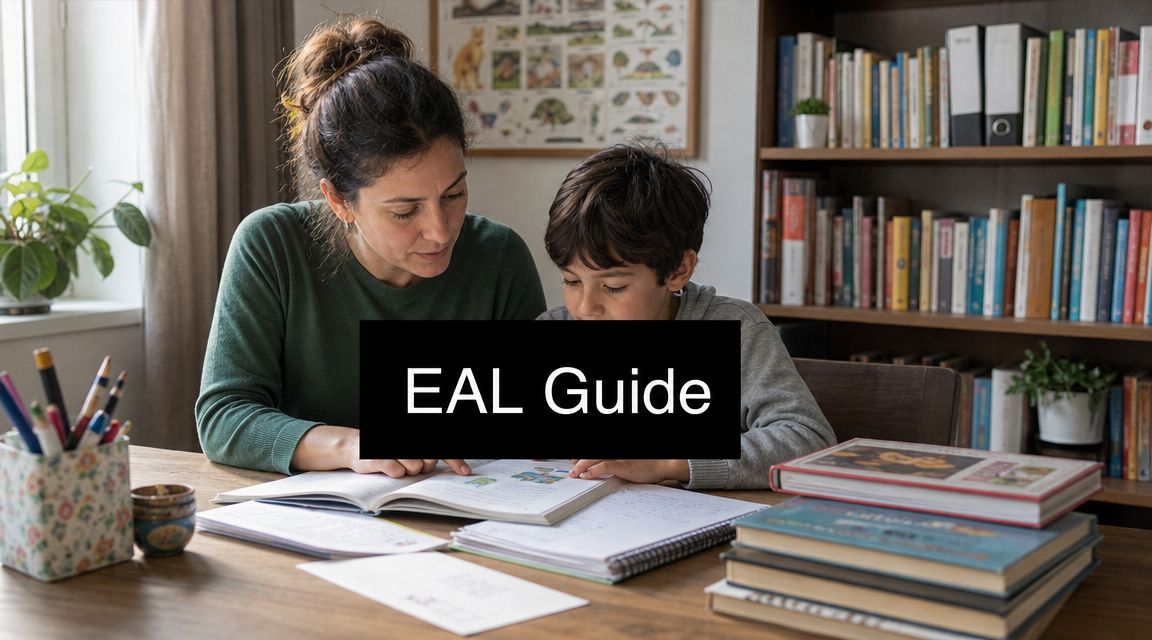
At 6pm, your child may be animated, funny, and full of stories in the language that feels most like home. Then a simple question about school in English brings a pause, a shrug, or a very short answer. For many parents, that shift can feel unsettling. You start wondering what school feels like from the inside for your child, and whether anyone else can see how much they know.
A child in this position is often carrying far more than adults realise. They are learning new content and a new language at the same time, while also trying to fit in, follow routines, and protect their confidence. If your child also has SEND or social, emotional and mental health needs, that load can feel heavier. Language, anxiety, attention, processing speed, and self-esteem can become tangled together, which is why a careful, humane response matters.
English as an Additional Language, often shortened to EAL, is the term schools use when English is not a child's first language. It describes part of your child's educational experience. It does not measure intelligence, potential, or character. Many pupils in England learn through EAL, so your family is far from alone.
What parents need at the start is clarity. A child can be articulate, thoughtful, and academically able, yet still struggle to show that fully in English for a time. That gap between what a child knows and what they can express can look worrying from the outside. In practice, it often reflects development in progress.
At Queen's Online School, we see the whole child. That includes their language profile, their emotional wellbeing, and any SEN or SEMH needs that may sit alongside EAL. The aim is never to squeeze children into a single mould. It is to help them feel understood, safe enough to participate, and steadily more able to show what they know.
Parents often tell us they want two things at once. Reassurance, and honest guidance. Both are possible.
Your Child's Journey with a New Language
It is 8.30 on a Tuesday morning. Your child has chatted happily over breakfast, corrected your version of a family story, and asked a surprisingly thoughtful question about the news. An hour later, in an English lesson, the same child may go quiet, watch carefully, and offer only a few words.
For a parent, that shift can feel unsettling. You know the full, vivid child at home. School may be seeing only the part of them that can currently come through in English.
A new language can work like a heavy winter coat. It keeps a child in the room and part of the day, but at first it can also make every movement feel slower and less natural. If your child also has SEN or SEMH needs, that extra layer can affect much more than vocabulary. It can touch confidence, stamina, attention, and willingness to join in.
What parents often notice first
Many families spot the pattern before anyone names it.
- At home, their ideas flow. They explain, debate, joke, and ask complex questions with ease.
- In English, they become more guarded. They may pause for longer, choose simpler words, or say “I don't know” when the primary challenge is finding the language.
- Feelings may show up in indirect ways. A child who seems cross, tired, or unusually quiet may be carrying the strain of learning, listening, and responding in English for hours at a time.
That does not automatically point to a serious difficulty. Very often, it points to effort that other people cannot fully see.
Children do not become less able because they need more time to show their thinking in English.
The uncertainty is often the hardest part. Parents ask sensible questions. Is this a normal stage in learning another language? Is anxiety making it harder? Could a language difference be hiding a special educational need, or could a special educational need be mistaken for a language difference?
These are careful questions, not overreactions. They deserve careful answers.
Why this experience can feel so intense, and why families should not feel alone
Many children in England learn through English while also using another language in family life, so this experience is far from unusual. That wider picture often brings relief. It helps replace isolation with perspective.
Even so, common does not mean easy.
A child can feel split between two versions of themselves. One version is quick, expressive, funny, and confident. The other is cautious, slower to answer, and more likely to stay on the edge of a group. Parents can feel that split too. You may wonder whether teachers can see your child's real personality, or whether quietness is being mistaken for lack of understanding.
In a thoughtful school, that question is taken seriously. Good support starts with an inclusive approach that puts children's needs first, so staff look at the whole picture rather than making quick assumptions from spoken English alone.
That is especially important for children with SEN or SEMH needs. A pupil with processing differences may need longer to respond. A child with anxiety may know the answer and still be unable to say it aloud in a live lesson. Another may appear distracted, but is working hard to translate instructions, manage feelings, and keep up socially at the same time.
Once adults see that full picture, the conversation becomes more useful. The question is no longer whether something is "wrong" with the child. The better question is what helps this child feel safe, understood, and able to show what they know.
That is where progress begins.
What Does English as an Additional Language Really Mean
English as an Additional Language is the usual UK term for a child who uses another language at home and is also learning in English. The key word is additional. It recognises that English is being added to the child's language world, not replacing their first language or cancelling it out.
That wording matters. It frames multilingualism as something a child has, not a problem a child is.

EAL, ESL, and EFL in plain English
Parents often hear several similar terms and assume they all mean the same thing. They don't quite.
| Term | Usual meaning | Where you may hear it |
|---|---|---|
| EAL | English is an additional language used alongside one or more others | UK schools |
| ESL | English as a second language | Older terminology or international contexts |
| EFL | English as a foreign language | Learning English in a country where English is not the main teaching language |
In a British school context, EAL is usually the most accurate term.
What EAL is not
EAL is not a learning difficulty. It is not a diagnosis. It is not proof that a child needs special educational needs provision.
It is a description of a language-learning pathway.
That distinction is important because parents sometimes fear a child will be seen as less capable because they are still building English. Good schools know better. They look at the child's understanding, communication, prior learning, confidence, and progress over time.
Research has shown that EAL pupils with English-language proficiency comparable to monolingual peers are as likely to meet curriculum targets in Reception and were more likely to meet them in Year 2 in this longitudinal study on English-language proficiency and achievement. That is a powerful reminder that the label itself doesn't tell you how well a child can learn. English proficiency is the more useful guide.
A helpful way to think about proficiency
I often compare language learning to navigating a new city.
At first, your child learns the main roads. They can ask for help, greet people, follow routines, and manage everyday conversations. That can look impressive, and it is. But school asks for more than the main roads.
A pupil also needs the side streets and shortcuts. They need words for comparing, predicting, explaining, evaluating, and justifying. They need to understand subject vocabulary in science, the hidden meaning in literature, and the formal phrasing used in exam questions.
That is why a child can sound fluent in conversation and still need support in class.
Why this matters for inclusion
When adults understand EAL properly, they stop confusing language development with lower ability. They also become more careful about how they judge silence, hesitation, or simple sentence structures.
That child-centred mindset sits at the heart of inclusion in education that puts children's needs first. The most supportive schools don't ask whether a child fits the system neatly. They ask what the child needs in order to participate, belong, and succeed.
Observing Your Child's Language Skills at Home
Home gives you a view that school never fully can.
You hear the words your child reaches for naturally. You notice the moments when they light up, shut down, guess, avoid, or become frustrated. That doesn't make you responsible for diagnosing anything. It does make you an important observer.
Social fluency and school fluency are not the same
Many children learn conversational English before academic English. Parents often breathe a sigh of relief when a child starts chatting with friends, joining in games, or speaking comfortably in everyday situations. That progress is real, but it can hide a quieter struggle.
A child may be able to say, “We played football and I scored,” yet still find it hard to explain why a character changed in a novel, summarise a history topic, or understand the language in a maths word problem.

That difference catches families out all the time. Social confidence can arrive before the language of schooling does.
Practical rule: If your child sounds confident in everyday conversation but avoids explaining, describing, or reasoning in English, they may still need support with academic language.
What you might notice in everyday life
Some patterns are easy to miss because they don't look dramatic. They look like tiredness, irritability, or a preference for shorter answers.
You might notice that:
- Instructions get lost. Your child can follow “Put your shoes on” but struggles with multi-step directions or questions that include unfamiliar vocabulary.
- Stories become brief. They can tell you what happened, but not in much detail, or they switch back to the home language when the ideas become more complex.
- Reading feels heavier than talking. A child may cope in conversation but stumble when trying to explain a chapter, infer meaning, or discuss the author's message.
- Homework causes disproportionate stress. The topic may not be the underlying issue. The barrier may be the language used to access it.
If reading is where the pressure shows up most clearly, this guide on how to improve reading comprehension can help parents frame what they are seeing.
Questions worth bringing to school
A useful conversation with school often starts with specific observations, not a general worry.
Try noting examples like these:
- “She can explain things clearly in our home language, but struggles to do the same in English.”
- “He chats confidently with friends, but written tasks take much longer.”
- “She seems to understand more than she can say.”
- “He gets upset with reading tasks even when he knows the topic.”
A teacher can do more with that than with, “I think my child's English is weak.”
Watch the emotional signs too
Language learning is emotional work. Some children become perfectionists and won't speak unless they can say it exactly right. Others become jokey, avoidant, or restless. Some go quiet because silence feels safer than getting it wrong.
If your child looks different in English than they do in their strongest language, pay attention. That difference can reveal where support is needed, and also where confidence needs protecting.
Effective EAL Strategies for a Flourishing Child
The best EAL support doesn't ask a child to “try harder in English”. It changes how learning is presented so the child can access meaning, join in, and build independence over time.

Scaffolding gives support without lowering expectations
A useful image is scaffolding around a building. The structure is there while the building is taking shape. It is supportive, temporary, and purposeful. In teaching, scaffolding means giving children enough help to succeed with demanding work, then removing that help as they become stronger.
That might include:
- Pre-teaching key vocabulary before a lesson on fractions, volcanoes, or persuasive writing
- Using visuals and graphic organisers so language isn't the only route into understanding
- Modelling sentence patterns such as “I predict this because…” or “The main cause was…”
- Structured talk with clear prompts, so speaking practice feels manageable rather than exposing
For parents who want to understand this approach more clearly, this explanation of scaffolding in education is helpful.
The home language is a bridge, not a barrier
One of the most reassuring truths for families is that children do not need to leave their first language at the door in order to learn English well.
A child who discusses a science idea at home in Arabic, Polish, Spanish, Mandarin, or another language is still doing academic thinking. A child who reads a story in two languages is not “getting confused”. They are building connections. A child who learns new English vocabulary by linking it to a known word in their home language is using an efficient learning strategy.
Home language knowledge can reduce strain. It helps children connect new English learning to ideas they already understand.
That is why bilingual books, translated key words, first-language discussion, and side-by-side vocabulary lists can all be so valuable.
What strong teaching can look like in practice
A good EAL lesson often feels calm, clear, and well signposted.
A teacher might begin by introducing five important words before reading a text. They might show an image, model pronunciation, use each word in a sentence, and ask pupils to match words to meanings. During the task, children may speak in pairs using sentence starters before writing independently.
Later, if your child wants extra speaking practice beyond lessons, simple routines at home can help. Families often find value in strategies for confident English speaking when they want practical, low-pressure ways to build oral fluency.
A short visual explanation can also help parents recognise these methods when they see them in action.
What support should not look like
Not all “extra English” is equally useful.
Endless copying, isolated word lists with no context, or constant correction in front of peers can make children feel smaller, not stronger. The most effective support keeps meaning, confidence, and participation at the centre.
If a child is bright but hesitant, the answer is usually not to simplify everything. It is to support access while keeping the thinking rich.
How Queen's Online School Provides Tailored Support
Your child logs off a lesson looking lighter than they did when they logged on. They were able to answer in the chat first, then speak aloud when ready. They understood the idea, felt noticed by the teacher, and finished the lesson with dignity intact. For many families, that kind of moment changes what school starts to feel like.
For children learning through EAL, the setting shapes the experience of learning just as much as the lesson content. A pupil who is worried about getting words wrong, already carrying anxiety, or coping with an additional need can fade into the background in a fast, noisy classroom. An online setting can soften that pressure while keeping expectations high.

Why the online model can help EAL learners
A strong online lesson gives children more room to process language. They can look closely at visual materials, reread instructions, and use the chat to test an answer before saying it aloud. Where appropriate, recorded sessions also give families more control over review and reinforcement.
That extra space often matters most for children who feel exposed in a physical classroom. Lower the pressure, and you often see more of the child's real understanding.
Small classes help for a different reason. Teachers can spot the difference between a child who understands the task but cannot yet express the answer in academic English, and a child who is becoming overloaded and needs the task presented another way. Those are not the same issue, and they should not be treated as if they are.
EAL, SEN, and SEMH can overlap
Many parents arrive with more than one question in mind. Is this part of learning English, or could there be dyslexia? Is my child quiet because they are translating, or because anxiety is getting in the way? Is school avoidance linked to language, attention, confidence, or all three?
Schools need the judgement to separate these threads carefully.
A common mistake is to assume that more exposure to English will solve every difficulty. Evidence summarised by The Reading League on English learners and literacy support explains that EAL learners often need explicit oral-language teaching alongside foundational literacy support, and that expert assessment matters when a learning difficulty may also be present.
For families, the message is reassuring. A child can be learning English and have a specific learning need. A child can be bright and still need help with literacy. A child can be multilingual, able, and emotionally exhausted all at once. Good schools hold the full picture in mind.
What This Support Looks Like in Practice
At Queen's Online School, the model is designed for personalised learning. Live teaching, subject specialists, and small class sizes make it easier to notice patterns in how a child learns, communicates, and copes. One pupil may explain a science idea confidently out loud, then struggle to write it in formal academic language. Another may know the answer but freeze when asked to speak in front of others. Another may show signs that point to a separate literacy difficulty that needs closer investigation.
Support in a setting like this should be precise and responsive, including:
- A careful first review of the child's profile, including previous schooling, language background, and any identified needs
- Teaching that keeps the curriculum demanding but reachable, so children are supported into the work rather than kept on the sidelines
- Structured communication support through visuals, guided discussion, writing frames, and subject vocabulary taught in context
- Close pastoral attention when confidence, emotional regulation, or belonging are affecting learning
- Joined-up planning so EAL, SEN, and SEMH are considered together, not as separate boxes
A child shouldn't have to prove they are struggling "enough" before adults start looking carefully at what kind of support will help.
The emotional benefit of being known
Families often tell us that the greatest relief is not one single strategy. It is the feeling that someone finally sees the whole child clearly.
That child may be multilingual, academically capable, sensitive, ambitious, funny, and worn down by repeated misunderstandings. When teachers recognise that full picture, support becomes more accurate. The child often becomes calmer too.
Language grows best in safety. Children are more willing to try, risk mistakes, and keep going when they feel understood, not judged.
Practical Ways Parents Can Champion Learning at Home
Parents often worry that they need to become language teachers at home. You don't.
Your most powerful role is to make language feel safe, rich, and worth using. That means connection before correction. Curiosity before pressure.
Small habits that make a real difference
A supportive home language environment can look very ordinary:
- Read together in any language. If your child loves a story in your home language, that still strengthens comprehension, vocabulary, and narrative understanding.
- Use subtitles thoughtfully. Films and programmes in English with subtitles can support listening and word recognition without turning relaxation into a lesson.
- Talk about ideas, not just routines. Ask what they think, what surprised them, what they would change, or which character they agreed with.
- Keep the home language strong. A child who can think in one language has a stronger base for learning in another.
- Celebrate effort out loud. “You explained that clearly,” or “I noticed you used a new word there,” goes much further than constant correction.
When progress feels slow
EAL progress can feel uneven. A child may suddenly start speaking more, then retreat. They may sound confident one week and resistant the next. That doesn't always mean something is going wrong.
The longer view matters. UK evidence reported by the Education Policy Institute shows that while EAL pupils may lag at age 5, the attainment gap narrows significantly over time, and by Key Stage 4 the difference in core subjects is often small, with EAL pupils in some cases outperforming monolingual peers according to the EPI annual report on EAL. Early difficulty is not a verdict on your child's future.
That is often the reassurance families need most.
What to say to your child
Children listen closely to how adults talk about language.
Try phrases like:
- “You already know a lot. You're learning how to show it in English.”
- “It's fine to need time.”
- “Speaking more than one language is a strength.”
- “We can ask for support without thinking anything is wrong with you.”
Those messages protect identity. They stop language learning from becoming a story of lack.
Your Questions About EAL and Admissions Answered
Parents usually reach admissions with practical questions in one hand and emotional questions in the other. Both deserve clear answers.
How is my child's English level assessed during admissions
A thoughtful admissions process doesn't rely on one impression from one conversation. It looks at how your child understands spoken English, how confidently they communicate, what kind of reading and writing they can manage, and whether they seem stronger socially than academically.
School reports, writing samples, and a warm conversation with the child can all help build a more accurate picture. The aim isn't to catch a child out. It's to identify what kind of support will help them start well.
What if my child has both EAL and another need
That can absolutely happen. A child can be learning English as an additional language and also have dyslexia, ADHD, autism, anxiety, or another identified need. One does not cancel out the other.
What matters is whether the school can distinguish between language acquisition and a separate barrier to learning. Parents should feel comfortable asking how concerns are reviewed, who looks at them, and what happens if a child needs support across more than one area.
Is there an extra fee for EAL support
This varies from school to school, so it's worth asking directly and early. Some schools build ordinary EAL classroom support into their standard provision. Others may charge for additional specialist input or one-to-one intervention.
A strong admissions team should answer this plainly. Families should not be left guessing about costs, availability, or what is included.
How long will my child need EAL support
This is one of the most important questions, and the honest answer is that it depends on the child. Effective programmes monitor academic language, not just social fluency. A child who chats easily may still need support with reading complex texts, using formal vocabulary, or responding to exam-style questions.
Guidance summarised by WestEd on support for English learners highlights exactly this point and also notes that a student's home language can be an asset that strengthens English development. In practice, that means support should continue for as long as the child needs help accessing learning at the right level. It should not stop merely because they sound fluent in everyday conversation.
Good admissions conversations leave parents feeling informed, not managed.
If you're speaking to any school, ask direct questions. How do you assess? How do you monitor progress? How do you tell the difference between EAL and SEN? What support is built in? What would happen if my child needs more?
Those are not difficult-parent questions. They are responsible-parent questions.
If you're looking for a school that understands the full picture of a multilingual learner, including academic potential, confidence, and any overlapping SEN or SEMH needs, Queen's Online School is well worth exploring. Its live British curriculum, small classes, and personalised approach can give families the clarity and support that make a child feel understood from the very start.