


What exactly will your child be learning, and is it only a list of mental illnesses? That question shows the gap. Most families picture A Level Psychology as clinical training. It isn't. The eight core areas are social influence, memory, attachment, psychopathology, approaches, biopsychology, research methods, and issues and debates. Each one sits inside ordinary teenage life: friendships that pull someone off course, the fear of going blank in an exam, and the need to feel safe with an adult who stays.
These aren't niche options. In summer 2025, JCQ A-level trends recorded 75,943 Psychology entries nationally, 8.6% of all A-level entries, second only to Mathematics, even after a 3.3% fall from 78,556 the year before. Your child is joining a huge cohort, and popularity alone won't make the ideas feel personal.
Every topic below comes with a classroom scene and a way to revise it. Nobody has to sit with abstract theory and no picture of a real child. Start with the feeling, then learn the study that names it.
1. Social Influence: Conformity, Obedience and Minority Influence

A Year 12 student joins classmates posting unkind comments, then wonders whether they would have typed the same words alone. That uneasy feeling is the heart of social influence, one of the central a level psychology topics. Asch's line judgement studies (1951) showed people agreeing with an obviously wrong answer. Milgram's obedience studies (1963) found that 65% of participants in the baseline condition continued to the maximum 450-volt shock.
Normative influence is wanting approval. Informational influence is wanting to be right. A teenager who skips a mindfulness session because friends do is meeting normative pressure, not a lack of interest. Moscovici's blue-slide study (1969) showed that a consistent minority can shift the majority. In a small live class on an A Level Psychology course, one learner who keeps a calm dissenting view can gradually change the room.
Practical rule: Name the study, the key finding, and the concept it supports before you evaluate it.
- Draw the split first: Sketch normative and informational influence before any evaluation paragraph.
- Hold the ethics: Milgram's findings matter, and they also raise serious questions about participant welfare.
- Plan an exit: Agree a sentence your child can use when the group turns unkind, so standing apart doesn't feel like a blank.
2. Memory: Models, Capacity, Duration and Eyewitness Testimony
Forgetting in an exam often feels like a personal failure. It usually isn't. Memory is how information is encoded, stored and retrieved, and it is the topic that most directly soothes a child who panics about going blank.
The multi-store model (Atkinson and Shiffrin, 1968) proposes sensory, short-term and long-term stores. A student who spaces revision across a week is using rehearsal to move material onward. The working memory model (Baddeley and Hitch, 1974) adds a central executive, phonological loop, visuospatial sketchpad and episodic buffer. A learner with dyslexia who builds a visual mind map is taking load off the phonological loop. Miller's magical number seven (1956) and Peterson and Peterson's trigram study (1959) cover capacity and duration.
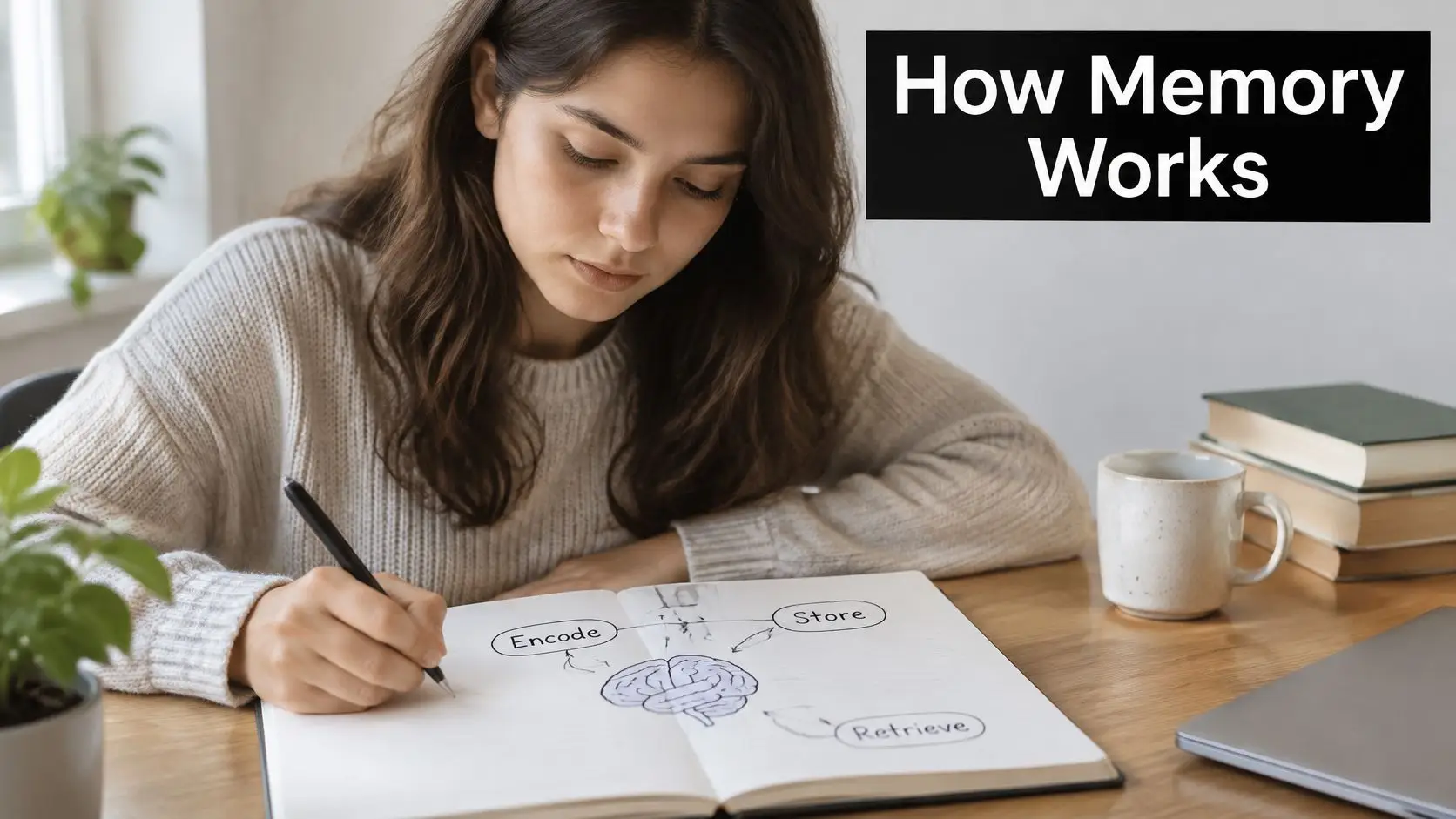
Loftus and Palmer (1974) showed that wording changes recall. Cars described as having "smashed" were estimated as faster than cars that "hit". A learner who pauses a recorded lesson, recalls the point, then checks notes is using retrieval, not rereading.
Forgetting is normal. Smaller chunks, written prompts and spaced practice lower the shame around a blank page.
3. Attachment: Bowlby, Ainsworth and the Strange Situation
A child at a new school looks back at a parent, takes a teacher's hand, then walks in. That glance is attachment in real time. John Bowlby argued that attachment is an innate survival system, with a critical period in early childhood, and that early bonds become an internal working model for later relationships. The secure base is the practical idea. Safety comes first, then exploration.
Mary Ainsworth's Strange Situation (1978) classified infants as securely attached, insecure-avoidant or insecure-resistant. Main and Solomon (1990) later added disorganised attachment. Teach the procedure in order, then match each type to the behaviour you would see.
Why the same care system isn't one story
Among 43,540 children looked after in England with Strengths and Difficulties Questionnaire results in 2024, the children looked after statistics show 46% had a normal emotional and behavioural-health score, 13% a borderline score and 41% a score considered a cause for concern. One child may settle into a new school. Another may feel worried, angry or withdrawn and need a trusted adult and a predictable routine. A screening score isn't a diagnosis.
The Romanian orphan studies (Rutter and the English and Romanian Adoptees study) show that children adopted after institutional care can still form attachments when care is consistent. An international family whose child struggles after a move can rebuild trust with the same predictable routine. Evaluate cultural bias with Japanese and German comparisons, and treat consistent adult relationships as a way back to safety for learners with SEMH needs.
4. Psychopathology: Defining and Explaining Abnormality
Learning explanations of behaviour isn't the same as diagnosing yourself or a friend. That boundary matters because Psychology was one of the five largest A-level subjects in England in summer 2025, with 72,930 results, and 73.7% of those results went to female students, according to the qualification results in England. More mental-health content isn't automatically kinder. Simplified labels can invite self-labelling or stigma.
Students meet four definitions of abnormality.
- Deviation from social norms: Behaviour that breaks the rules of a group.
- Failure to function adequately: Daily life becomes hard to manage.
- Deviation from ideal mental health: Jahoda (1958) listed features of good mental health, then treated distance from them as a problem.
- Statistical infrequency: A behaviour is rare, which isn't the same as harmful.
DSM-5 and ICD-11 frame depression, phobias and OCD. Explanations include serotonin in depression, classical conditioning in phobias, and Beck's negative triad. A learner with a spider phobia can move, in systematic desensitisation, from pictures to the same room as a spider. A student with low mood can use CBT to challenge thoughts about exam performance. Rosenhan's (1973) pseudopatients show how labelling can bias judgement. Keep diagnostic words out of casual chat, and point families to a school counsellor when a personal story surfaces.
5. Approaches in Psychology: Behaviourist, Psychodynamic, Social Learning, Cognitive, Humanistic and Biological
A Year 12 student's hands shake every time an exam paper lands on the desk. Ask six psychologists why, and you get six different answers. That is why this topic exists: each lens catches something the others miss.
Behaviourism (Pavlov, Skinner, Watson) counts only what can be observed. One frightening mock can turn the exam hall itself into a trigger, the same logic as Watson and Rayner's Little Albert study (1920). Unlearning uses gentle, supported exposure that re-pairs the hall with calm. Freud's psychodynamic approach looks to unconscious drives and early experience, as in Little Hans (1909); the panic may guard a deeper fear of letting family down. Bandura's social learning theory (1961) adds imitation: the Bobo doll study showed children copying aggression, while a learner who picks up a teacher's slow breathing in a live class shows the same mechanism helping.
The cognitive approach works with schemas, the mental shortcuts behind thoughts like "I'll fail". A tutor who helps a student test that thought against evidence uses this lens, and cognitive development in adolescence explains how teenage thinking matures. The humanistic approach (Maslow and Rogers) asks whether a learner feels safe and accepted before growth is possible. The biological approach points to genes, hormones and the brain.
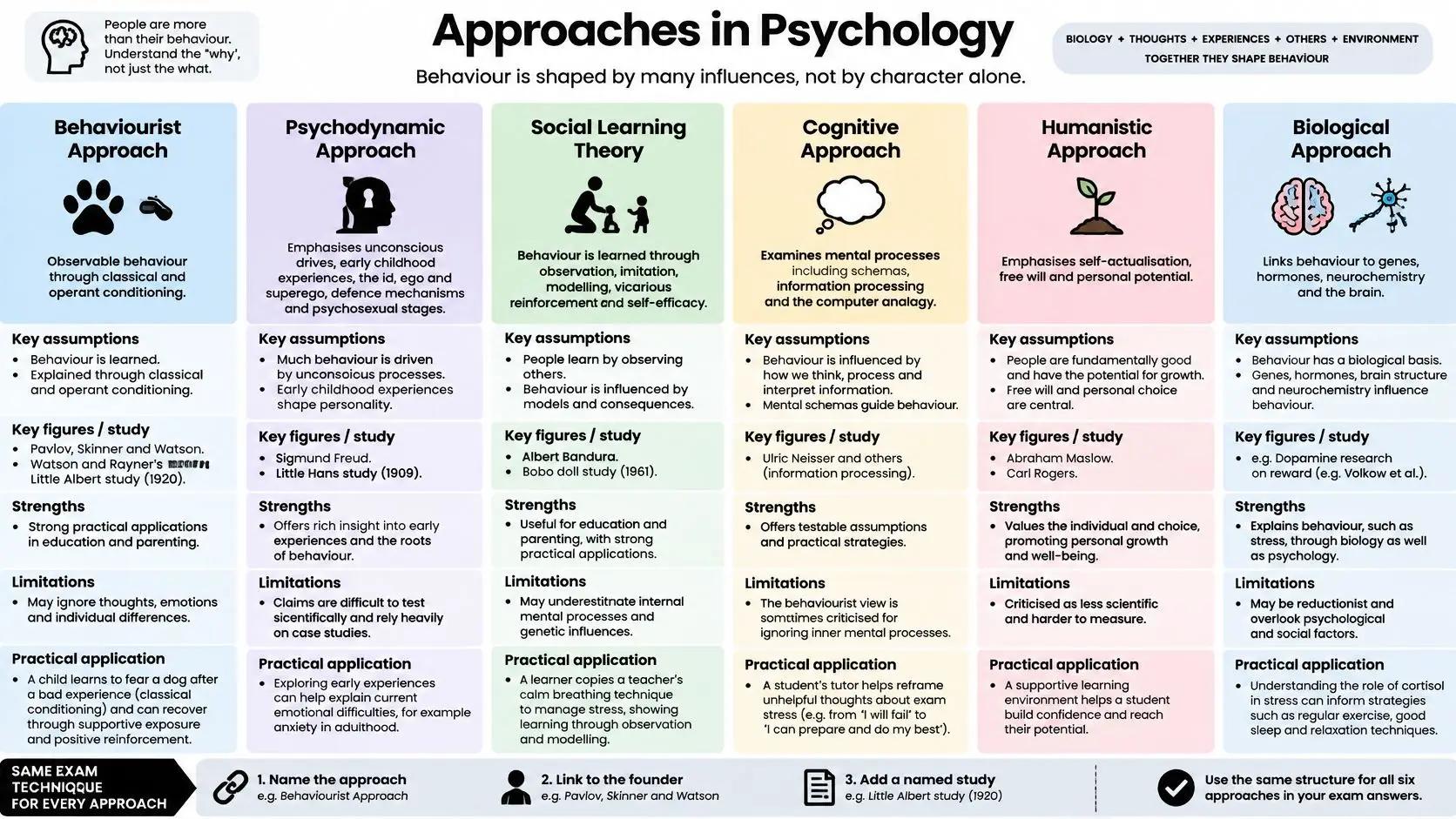
Mark schemes reward three skills for every approach: knowing the theory, applying it to a new scenario, and evaluating its strengths and limits. A comparison table of assumptions, founders and named studies, with the exam-anxiety story run through each row, makes revision concrete. Real distress rarely sits inside one lens.
6. Biopsychology: The Brain, Nervous System and Hormones
A racing heart before a test isn't weakness. It's a body doing a job. Biopsychology explains the central nervous system (brain and spinal cord) and the peripheral nervous system, split into somatic and autonomic branches. Neurons pass messages by synaptic transmission. Serotonin and dopamine shape mood and drive. The endocrine system, through adrenaline and cortisol, runs the fight-or-flight response.
The Office for National Statistics reported that children aged 10 to 15 described academic pressure, excessive homework and too many examinations as sources of stress, alongside bullying, changing schools, social media, family finances and bereavement. Some described anxiety, depression and panic attacks, and some felt stigma or too little support at school. A teenager who feels panicky before an exam needs workload, sleep, peer comparison and coping looked at together, not a lecture on motivation.
Slow breathing before a test can calm the autonomic system and ease adrenaline. A student recovering from a head injury may show neuroplasticity as other regions take on lost work. Exercise and sleep support serotonin and dopamine, which helps mood and concentration. Broca's and Wernicke's areas illustrate localisation, and Sperry's split-brain research (1968) shows the hemispheres working as a pair. Link any biological claim to a psychological effect, or the answer slides into reductionism. The brain is adaptable, which is a kinder message than "you're stuck with this".
This short film is a clear way to see the stress response before you label a synapse diagram.
7. Research Methods: Designing, Conducting and Evaluating Psychological Studies
"Can I trust this study?" is a better revision question than "Can I recite it?" The AQA co-teaching guide expects reliability, validity, significance testing, qualitative analysis, inferential tests and theory construction. A newer study isn't automatically stronger. It can still rest on a small sample or weak ecological validity, while an older study can still teach the theory.
Official A Level Psychology subject content includes experiments, observations, self-report and correlation, plus independent-measures and repeated-measures designs. Say a class compares two groups of children on a short relaxation activity, or measures the same children before and after. Participation stays voluntary, questions stay age-appropriate, and a child who becomes upset can stop without penalty. That last point matters more than it sounds. A learner who feels safe enough to withdraw is also a learner watching ethics work in real time rather than as a list in a textbook.
Anxiety ratings are quantitative. A child's own words about feeling calmer or pressured are qualitative. Watch for demand characteristics, where a participant guesses the aim and performs accordingly, and order effects, where practice or boredom distorts the second condition.
A learner might run a small repeated-measures study on background music and memory, counterbalancing the order so half the group hears music first. Another might correlate sleep and mood with anonymous questionnaires and consent forms. In a live class, a digital survey can be followed by Spearman's rho. Other tests to practise include the sign test, Chi-squared and Mann-Whitney. The British Psychological Society Code of Human Research Ethics covers consent, debrief and the right to withdraw. Building these habits early is part of research skills development, and it pays off when the exam asks for a designed study rather than a recalled one.
- Name the variables: Find the independent and dependent variables in a short study before you attempt a long question.
- Support the statistics: Step-by-step worksheets and a worked visual example help learners who find numbers heavy.
- Write the reflection: One note on what went well, and what to change, builds resilience as well as method.
8. Issues and Debates: Nature versus Nurture, Free Will, Reductionism and Ethics
Step back from the named studies and the subject starts to argue with itself. That's the point of issues and debates, and it's where essay marks often appear.
Nature versus nurture asks how far genes and environment each shape behaviour. In a live class, a reading difficulty can be discussed as both a possible genetic influence and a teaching influence, without crowning a winner. Free will versus determinism asks whether joining a club was a real choice or a learned response. Reductionism versus holism asks whether a simple explanation is enough. Idiographic versus nomothetic contrasts one child's story with general laws.
Gender patterns inside the subject belong in this debate, not as a claim about ability. Education and training statistics for the UK reported that approximately 82% of students in psychology were female, against 79% male in engineering and technology and 75% male in computing. Classrooms should not treat the subject as belonging to one gender.
Ainsworth's Strange Situation is a clean example of cultural bias. What it shows about one group of families may not travel. Socially sensitive research and ethics sit here too. Use point, evidence, evaluation, then a link back to the debate. Keep one ready example for each debate, and remember that a child with SEN or SEMH needs isn't a statistic in someone else's essay.
The 8 A Level Psychology Topics at a Glance
| Topic | Key thinkers | Best for | Main challenge |
|---|---|---|---|
| Social Influence: Conformity, Obedience and Minority Influence | Solomon Asch, Stanley Milgram, Serge Moscovici | Understanding peer pressure and group behaviour | Ethical concerns and limited generalisability of classic studies |
| Memory: Models, Capacity, Duration and Eyewitness Testimony | Richard Atkinson, Richard Shiffrin, Alan Baddeley, Graham Hitch, Elizabeth Loftus, George Miller | Revision strategies and evaluating eyewitness evidence | Models can oversimplify memory; studies may lack real-world validity |
| Attachment: Bowlby, Ainsworth and the Strange Situation | John Bowlby, Mary Ainsworth, Mary Main, Michael Rutter | Understanding children's emotional needs and relationships | Cultural bias and overemphasis on early experience |
| Psychopathology: Defining and Explaining Abnormality | Marie Jahoda, Aaron Beck, David Rosenhan | Understanding mental health and reducing stigma | Definitions and diagnostic labels can be culturally biased or harmful |
| Approaches in Psychology: Behaviourist, Psychodynamic, Social Learning, Cognitive, Humanistic and Biological | Ivan Pavlov, B.F. Skinner, Sigmund Freud, Albert Bandura, Abraham Maslow, Carl Rogers | Comparing explanations of behaviour and applying them to everyday life | Some approaches are difficult to test or overlook important influences |
| Biopsychology: The Brain, Nervous System and Hormones | Paul Broca, Carl Wernicke, Roger Sperry, Santiago Ramón y Cajal | Understanding biological influences on behaviour, stress and health | Biological explanations may overlook psychological and social factors |
| Research Methods: Designing, Conducting and Evaluating Psychological Studies | Ronald Fisher, Karl Pearson, Charles Spearman, British Psychological Society | Building research, data analysis and critical-thinking skills | Statistics can be challenging; ethical limits constrain research |
| Issues and Debates: Nature versus Nurture, Free Will, Reductionism and Ethics | Francis Galton, Noam Chomsky, Gordon Allport, B.F. Skinner | Developing balanced evaluation and essay-writing skills | Abstract debates and sensitive topics can be difficult to navigate |
Turning Eight Topics into One Confident Learner
Eight topics feel separate on a contents page. In a strong answer they lock together. Social influence explains the friendship group a child cannot seem to leave. Memory explains why last night's revision stuck or vanished. Attachment explains who felt safe enough to put a hand up. Psychopathology explains distress without turning a classroom discussion into a diagnosis. Approaches give more than one explanation for the same behaviour. Biopsychology shows the body inside the feeling. Research methods tell a student whether the evidence deserves their trust. Issues and debates stop a neat theory from pretending it fits every child.
A workable roadmap rests on three habits. First, master the named studies and keep each finding attached to its concept, not floating as a date. Second, anchor every idea in one real scene: a skipped revision session, a spider phobia, a new school morning, the panicky walk into the exam hall. A visual mapping guide can help a learner see those links instead of storing eight isolated lists. Third, use the debates to strengthen evaluation, because nature and nurture, free will, reductionism and cultural bias are what turn an average paragraph into a careful one.
Grade benchmarks can set targets without becoming predictions. The 2025 level 3 results infographics report a UK Psychology distribution of about 5.8% A*, 19.4% A, 47.0% A–B, 72.4% A–C and 88.7% A–E, and place Psychology as the second-largest A-level subject by results issued in England in 2025, with 72,930 results, ahead of Biology and behind Mathematics. Compare by exam board and by the learner in front of you. A subject assessed at that scale rewards steady practice, so timed essays, research-methods data and examiner-style feedback belong in the weekly plan.
Queen's Online School delivers A-Level study entirely online in small live classes, with subject-specialist teaching and personalised support for learners with SEN and SEMH needs. Progress is monitored through assessment, mentor check-ins and the learner's own reflection, with wellbeing and confidence considered alongside grades. Sessions on planning, self-reflection and confidence sit inside the programme, and independent study windows can include assistive technology and reduced-stimulus environments. For a family weighing up how a child handles topics like these, and the exams that follow, that structure offers a concrete next step.
If you want your child to study with personalised pacing and a safe online classroom, visit Queens Online School to explore its A-Level options.