

The envelope from school is still on the kitchen table, and the words inside do not describe the child you tucked in last night. It talks about Year 6 SATs, an expected standard and English Key Stage 2, yet none of that tells you whether your child can follow a story, hold a sentence together, or stay calm when a timer starts. That mismatch is what makes these letters feel heavier than the paper they're printed on.
English at this stage is not one ability with one verdict. Reading, writing, grammar and vocabulary each do a different job, and a child can be confident in one while struggling without much notice in another. Once you can see those strands apart, you can ask for the right help instead of chasing a single grade.
Key Stage 2 English at a Glance
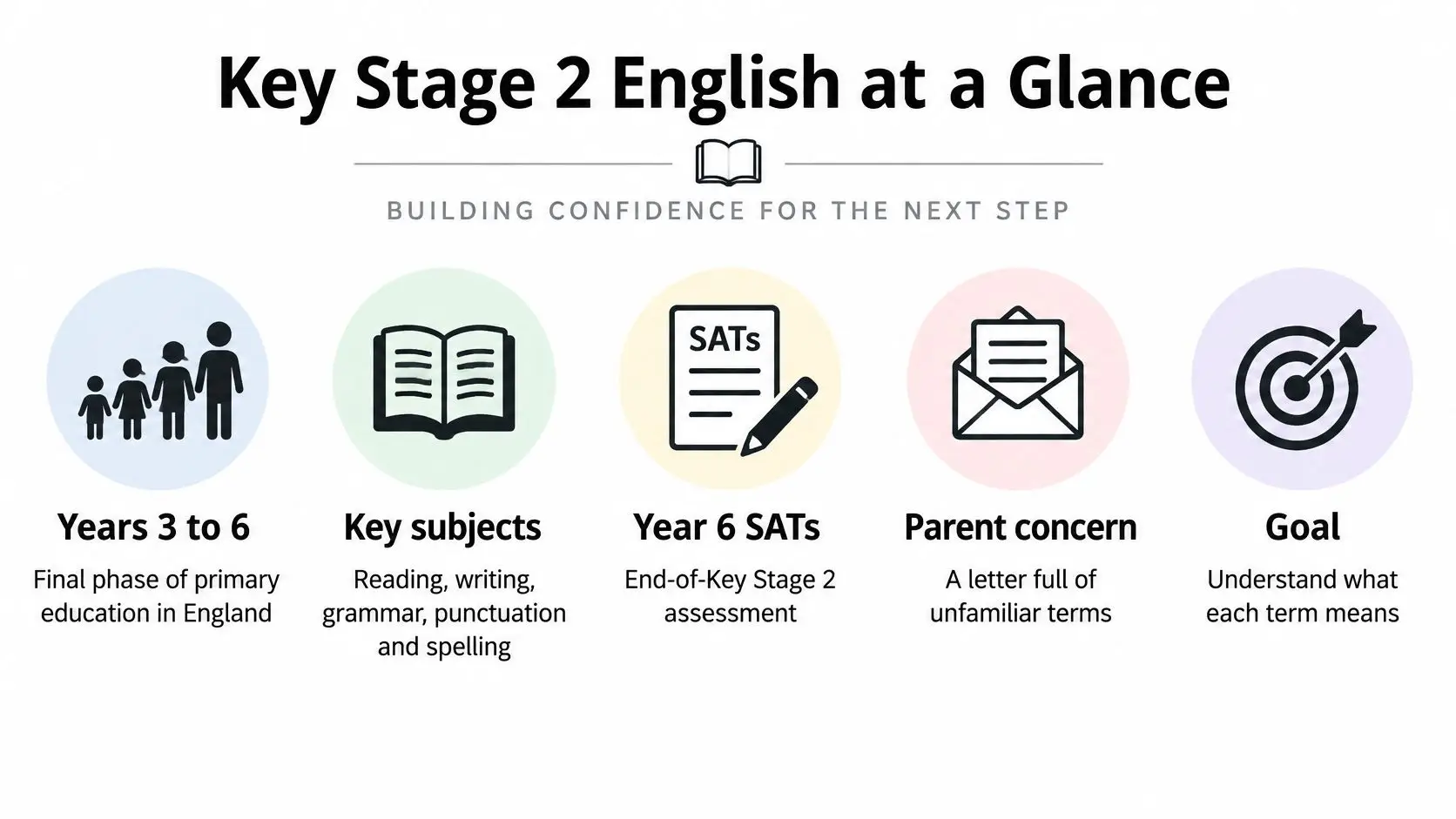
You read the letter twice and the terms still blur. Key Stage 2 is the final phase of England's primary curriculum and normally covers Years 3 to 6, when pupils are approximately 7 to 11 years old, as the Department for Education's 2024 Key Stage 2 attainment headlines set out. National assessments are taken at the end of Year 6, usually at age 11.
English is taught through four strands: reading, writing, grammar and punctuation, and vocabulary. Vocabulary isn't tested on its own. It runs through the books a child reads and the sentences they write, so it grows in ordinary talk, not in a separate exam.
What the national picture shows
In 2024, 61% of pupils in England achieved the expected standard in the combined reading, writing and mathematics measure, an increase from 60% in 2023 but below the 65% recorded in 2019, according to those same national headlines. Subject-level results showed that 74% met the expected standard in reading, 72% in writing, and 72% in grammar, punctuation and spelling. The combined measure is demanding because a pupil must meet the expected standard across reading, writing and mathematics, not in only one subject.
| Strand | What pupils learn | How it is assessed |
|---|---|---|
| Reading | Decoding, comprehension and inference across fiction and non-fiction | Externally marked end-of-stage test |
| Writing | Planning, drafting, editing and composing for purpose and audience | Teacher assessment against the national framework |
| Grammar, punctuation and spelling | Sentence structure, tense, punctuation and statutory spellings | Externally marked end-of-stage test |
| Vocabulary | Word meaning, word families and figurative language | Not tested alone; judged within reading and writing |
A strong reading score doesn't tell you the writing judgement, and a tidy grammar paper doesn't prove a child can build a paragraph under their own steam.
Ask the school which strands it reports on, and request the expectations for your child's current year. That conversation turns an opaque letter into something you can act on this week.
Year-by-Year English Objectives from Year 3 to Year 6
Find your child's year in the table first. The objectives stack, so a gap you leave in Year 4 often reappears when Year 6 writing has to carry more ideas, longer sentences and a named reader.
| Year | Reading focus | Writing and grammar focus | Example task |
|---|---|---|---|
| Year 3 | Reading aloud fluently and retrieving facts | Paragraphs, fronted adverbials and Year 3-4 spellings | Write a paragraph about a day out using a fronted adverbial |
| Year 4 | Inference and explaining word meaning | Direct speech, adjectives and Year 3-4 spellings | Punctuate a short dialogue with inverted commas |
| Year 5 | Summarising and comparing texts | Relative clauses, modal verbs and the passive voice | Rewrite a sentence in the passive voice |
| Year 6 | Analysing structure and author choice | Subjunctive, semicolons, colons and formal writing | Edit a story into a formal letter for a named reader |
Lower Key Stage 2
Years 3 and 4 are about reading accurately and fluently, spelling the statutory words for the year group, and writing narrative and non-fiction in proper paragraphs. Grammar arrives as tools the child can hear, not as labels to memorise.
A Year 3 paragraph about a day out might open, "After lunch, we raced down to the pier and bought hot chips." The fronted adverbial tells the reader when, and the comma keeps the sentence from tripping. A Year 4 dialogue needs the speech marks in the right place: "Where are we going?" asked Maya. If the comma or the capital wanders, the child hasn't failed English. They've missed one small convention, and that convention is teachable.
If you're looking for short, concrete writing prompts that match this age, Teacher Planner third grade writing ideas offers tasks you can adapt to a British classroom without turning the evening into a worksheet marathon.
Upper Key Stage 2
Years 5 and 6 ask for more control. Relative clauses, modal verbs and the passive voice let a child choose how a sentence feels. Reading shifts towards inference, summarising and comparing texts. Writing has to hold a consistent tense for different audiences.
Take a Year 5 sentence, "The wind broke the window," and rewrite it as "The window was broken by the wind." The event hasn't changed. The focus has. Year 6 adds the subjunctive, semicolons, colons and bullet points, plus revision for the May tests. A useful task is to take a lively story about a lost dog and edit it into a formal letter to the park manager, with one reader, one purpose and no chatty asides.
Practical rule: Compare your child's work with the objectives for their year, not with the child who sits next to them.
Spelling that was shaky in Year 4 doesn't stay in Year 4. It shows up again when a Year 6 letter has to look formal. Ask the school for the current objectives, sit them beside this table, and mark the one strand that needs the next month of attention.
How KS2 English Is Assessed and What Scores Mean
A child's English attainment is built from different assessments, rather than one overall score. Reading is assessed through an externally marked test, grammar, punctuation and spelling through a separate externally marked test, and writing through teacher assessment. The 2024-25 revised Key Stage 2 attainment statistics describe how these test results and the writing assessment contribute to statutory reporting.
The combined measure adds another piece: it requires the expected standard in reading, writing and mathematics. A pupil who meets the standard in two subjects but not the third does not meet the combined measure. In 2025, 62% of pupils achieved the expected standard in all three, compared with 75% in reading and 74% in mathematics. A test result can therefore look secure while the overall measure is missed because writing is assessed separately.
Scaled scores are not percentages
Reading and mathematics results are reported on a scaled score from 80 to 120. A score of 100 marks the expected-standard threshold, and 110 marks the higher-standard threshold, according to the 2025 scaled score conversion tables. Raw marks do not convert to a fixed percentage: the mark needed for a given scaled score can vary between tests. So an 80% mark does not always mean the same scaled score.
Here is how to read the bands:
| Scaled score | Meaning | What parents can do |
|---|---|---|
| Under 100 | Expected standard not yet met | Ask which question types or skills were difficult, then practise those in short, focused sessions. |
| 100 to 109 | Expected standard met | Keep skills steady with regular reading and opportunities to explain answers and edit writing. |
| 110 to 120 | Higher standard met | Offer challenging texts and longer written pieces, while keeping practice enjoyable. |
A score of 98 is below the expected-standard threshold; 104 meets it; 112 meets the higher-standard threshold. These scores describe performance in the tested subject, not a child's whole ability in English. For a clearer picture of the tests and their role, read this guide to Key Stage 2 SATs.
Before parents' evening, ask for the reading and grammar, punctuation and spelling scores, the teacher assessment for writing, and whether your child met the combined measure. Together, these results work like separate pieces of a map: they show where progress is secure and where targeted support may help.
Where Reading, Writing and Grammar Break Down
On Monday, a Year 5 pupil works out that a character is reluctant to join in. On Thursday, the child uses the word in a story of their own. That transfer shows how reading can feed writing. Yet English is not one ability: a pupil may read fluently but struggle to explain an inference, or have strong ideas that are hard to put on the page. Looking at the strands separately helps you identify what needs support.

The Key Stage 2 attainment methodology distinguishes English reading, English writing, and grammar, punctuation and spelling. Reading and grammar, punctuation and spelling are tested, while writing is assessed by teachers. Strong results in one strand do not guarantee the same level in another, so look for the specific point of difficulty rather than judging English as a whole.
Three profiles parents actually meet
Strong ideas, but writing is hard work. The child has plenty to say, yet spelling, handwriting or tiredness gets in the way. The page may look untidy, and the child may decide they “can't write”. Try dictating a first draft, keeping a word bank nearby, or using a keyboard if handwriting is the main obstacle.
Accurate grammar, but very short sentences. Full stops and basic sentence rules are in place, but ideas stay undeveloped. A model paragraph can show how to add detail; sentence-combining games let the child practise joining ideas without losing clarity.
Fluent reading, but uncertain answers. The child reads aloud smoothly, then struggles to explain what a passage implies. Check understanding separately from decoding: pause after a page and ask for a retelling, then ask which words or details support the answer. These ways to improve reading comprehension can help you practise that kind of close reading with different texts.
Other pressures can affect more than one strand. Anxiety around timed tasks, working-memory demands, or difficulty organising a sequence of steps may make a child's work look less secure than it does in a calm setting. Dyslexia, dyspraxia, or social, emotional and mental health needs may also shape how reading and writing feel. Ask the SENCo which support is already in place, such as a scribe, word processor, extra time or rest breaks, and whether it can be used in class as well as during tests.
| Pattern | Likely barrier | Response to try |
|---|---|---|
| Strong ideas, weak spelling and handwriting | Transcription effort or fatigue | Dictate first drafts, use a word bank and allow typing |
| Accurate grammar, very short sentences | Ideas are not yet elaborated | Try sentence-combining games and model paragraphs |
| Fluent reading, weak answers to questions | Difficulty explaining meaning or inference | Use question prompts and retell each page |
| Strong work at home, difficulty under timed conditions | Anxiety or difficulty working at speed | Practise briefly with a clear, predictable routine |
A child's profile can change with the task: composing an idea, spelling it and checking punctuation place different demands on attention. That is why a single score or a tidy page cannot show the whole picture. The precision expected later in A-Level English Language exam prep is a reminder that language skills develop over time; at KS2, focus on the specific part of the process that is holding your child back.
A Sample Weekly English Routine for Home Support
Schools administer the statutory tests every year in May for pupils at the end of Key Stage 2, and the national curriculum assessments collection sets out the three areas: English grammar, punctuation and spelling, English reading, and mathematics. Practise each component on its own. A mixed worksheet teaches the child that English is a blur.
Keep the session to about 30 minutes. Short work protects confidence, and a child who finishes still willing to talk will come back tomorrow.
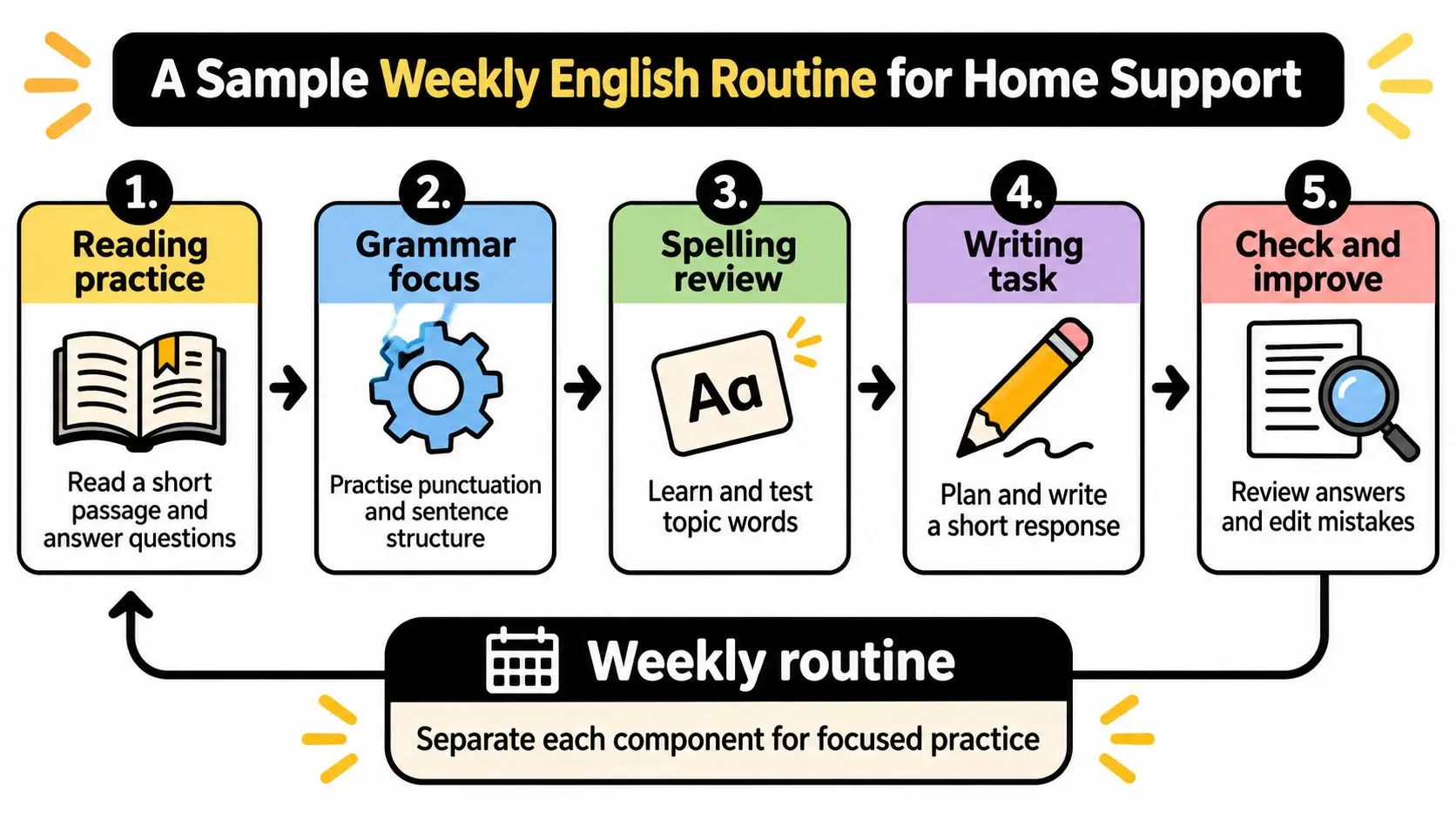
- Read a short passage aloud together for five minutes. Pause once to predict what happens next. Prediction keeps the child inside the text instead of racing to the end.
- Answer three questions in a fixed order. One is literal, one is inference, and one is vocabulary. The order stops every question turning into a guess.
- Spend five minutes on one grammar or punctuation point. The comma after a fronted adverbial is enough. One point sticks, and three points compete.
- Write a short paragraph that uses that point. The child chooses the topic, whether that's a lost hamster or a complaint about packed lunches. Choice lowers the anxiety that arrives when every prompt feels like a test.
- Read the paragraph back. Praise one specific thing, then correct only one thing. Specific praise shows progress, and a single correction keeps the child willing to write again.
How the week fits around that session
Use a longer piece on Saturday, when nobody is rushing for the school run. Put a non-fiction text in midweek, perhaps a short news story or a museum label, so reading isn't only fiction. Keep one day completely clear. Rest is part of the plan, not a failure of it.
Tears, stomach aches or a sudden need to leave the room mean the session is too long or the text is too hard. Shorten it, and return to something the child can already do.
You're not trying to finish the curriculum at the kitchen table. You're trying to leave the child with one success they can name.
A Sample Live KS2 English Lesson
A live lesson works when the child stays with their year group and the teacher can see the moment confidence dips. Forty-five minutes is long enough for one objective and short enough that an anxious pupil isn't performing for most of an hour.
Warm-up, five minutes
The child retells yesterday's text out loud. The teacher listens for one new word used accurately, not for a perfect summary. Speaking first means the later writing isn't the first time the idea has existed.
Teach, ten minutes
One objective from the year group is modelled on a shared text. For a Year 5 group that might be the passive voice in a single sentence about a broken window. The model comes before any request to produce, so the child isn't inventing the rule and the sentence at once.
Guided practice, ten minutes
Child and teacher edit one sentence together. The teacher prompts ("Who did the action? Do we need to name them?") rather than overwriting the line. Prompting keeps the thinking with the child. Correcting takes it away, and a quiet child learns to wait for the answer.
Independent writing, fifteen minutes
A short paragraph on a topic the child has chosen, with the success criterion visible on the screen. Visible criteria beat a vague "write more". If the criterion is "one passive sentence and a clear tense", the child knows when they've finished.
Plenary, five minutes
The child reads back one sentence, names one thing that worked, and names one next step. That habit matters more than a longer piece. Small groups keep each child visible and accountable, and the teacher records which objective was met so you can track progress against the year-group list rather than against a mood.
Watch the pace. A child who goes quiet during guided practice needs a smaller task next lesson, not a longer one. Silence is information, and adding more writing on top of it usually makes the next lesson harder, not easier.
Choose Personalised KS2 English Support for Your Child
The decision in front of you is practical. Does your child need an adjustment at their current school, a tutor for one strand, or an online school with a personalised pathway? The right choice is the one that changes the weakest strand without making the child feel like a problem to be fixed.

Three tests for any option
Does the pace follow the child? A pathway should speed up where the child is already secure and slow down on the strand that keeps slipping, whether that's inference, spelling or the courage to write more than two sentences. A timetable that treats every pupil as the same age with the same gaps will repeat the frustration you're trying to leave behind.
Do live, small-group lessons keep the child in view? Recorded videos help with review, but they don't notice a child who has stopped answering. A teacher who can hear the retell, prompt the edit and record the objective is what makes a year-group expectation feel reachable rather than remote.
Is support for SEN or SEMH built in? Adjustments such as typing, a scribe, a predictable routine or a smaller task shouldn't be a favour added after a crisis. They should be part of how the lesson is planned, discussed with you, and reviewed when something isn't working.
What a pathway looks like in practice
Our Primary Online course covers Key Stage 2, Years 3 to 6, for ages 7 to 11, with Art and Design, English, Projects and Maths. Core academic lessons are live and teacher-led so pupils stay with their year group. After a discovery call, we design a customised learning pathway covering subjects, pace and schedule, from Key Stage 2 through to Sixth Form. You can see how that primary English teaching is organised on our primary school English online page.
A useful pathway starts with a diagnostic, names the weakest strand, and gives feedback tied to the year-group objective rather than to a vague comment such as "try harder". Writing is assessed by the teacher against the framework, not guessed from a reading score. SEN and SEMH needs sit inside that plan, with small classes and real-time feedback, so a child who shuts down under a timer isn't left to toughen up alone.
This week, book a discovery call and bring the latest school report. Agree one measurable goal for the next half term. "Write three paragraphs that each open with a fronted adverbial and a correctly placed comma" is a goal a child can see. "Improve English" isn't.
Queens Online School teaches English Key Stage 2 in live, teacher-led lessons for Years 3 to 6, with small groups, a pace that follows your child's gaps, and support shaped around SEN and SEMH needs. If the letter on the table still doesn't match the child you know, bring their latest report and one strand you want to change. Visit Queens Online School to book a discovery call and agree that goal for the next half term.