
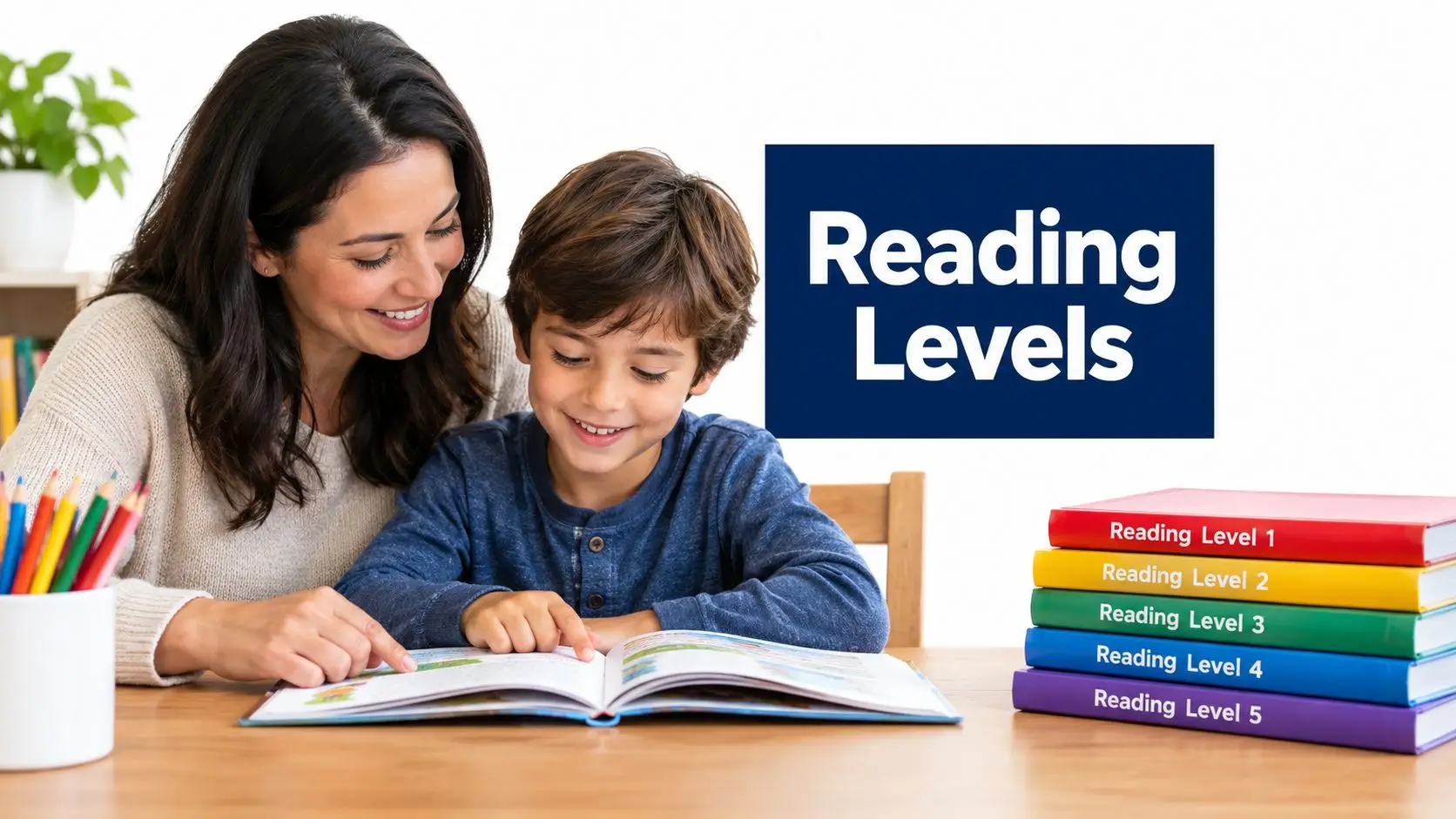
The book bag is on the kitchen chair. There's a reading book inside with a coloured band or a small number on the back, and somehow that tiny label can stir up a lot. Pride if your child seems to be moving up. Worry if they aren't. A quiet urge to compare with a sibling, a cousin, or the child in the WhatsApp group who is “already on chapter books”.
If that sounds familiar, you're not overthinking it. Parents often get handed a level, a colour, or a score without much translation into ordinary family life. What does it mean when your child hesitates over one page but laughs at the next? Why can they read one book smoothly and then stumble on another that looks similar? And should you be concerned if they love stories but resist reading aloud?
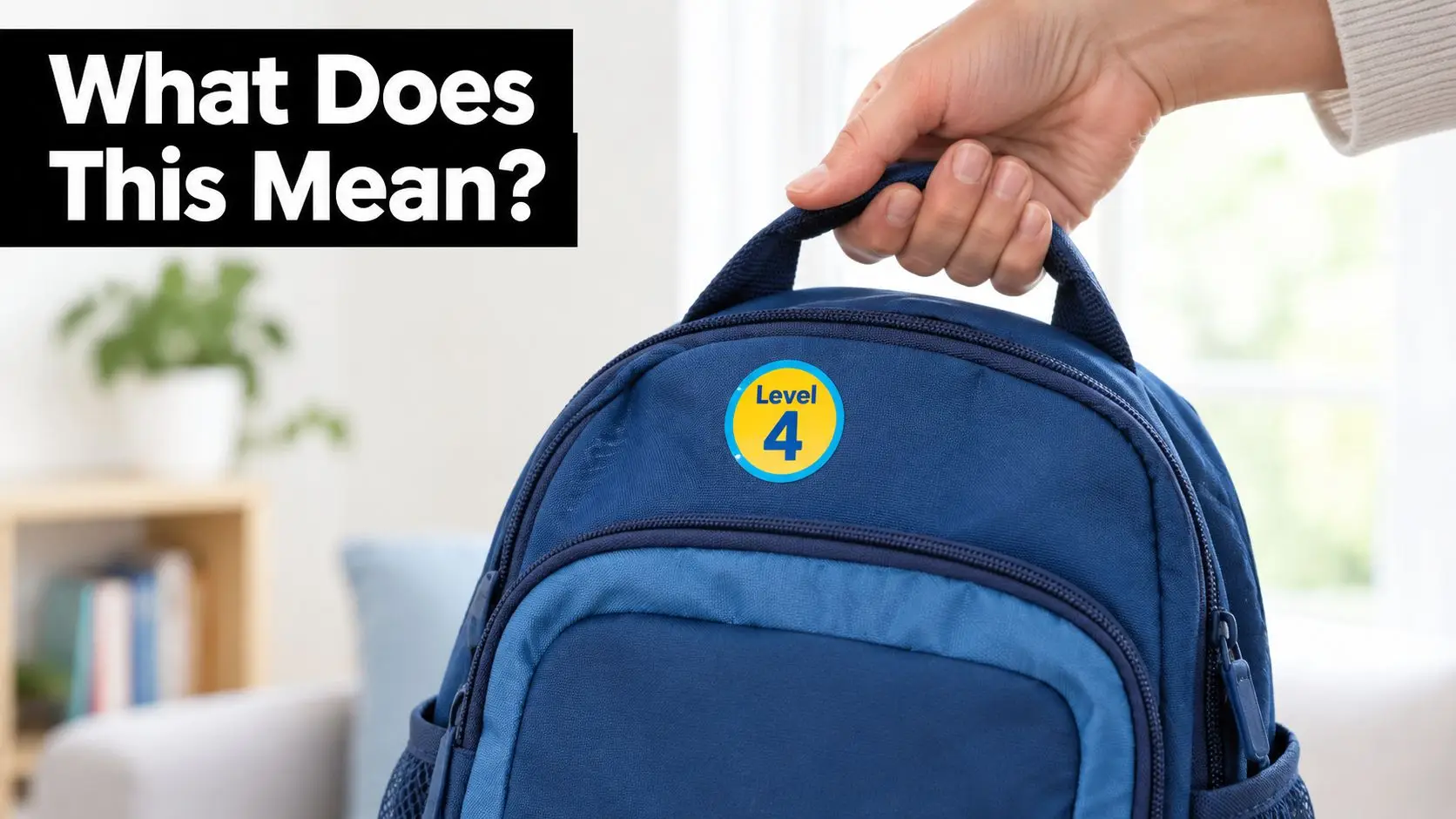
The good news is that primary school reading levels are meant to help, not judge. They're a map. They help teachers choose books that give a child enough challenge to grow, but not so much that reading starts to feel like failure. That balance matters far more than racing ahead.
At home, what helps most is often simpler than parents expect. A warm routine, the right book, and a child who feels safe making mistakes can do far more than pressure ever will. If you're rebuilding that calm reading rhythm, collections like these kindergarten must read books can be useful for finding stories children want to come back to.
Introduction Why Reading Levels Feel Confusing for Parents
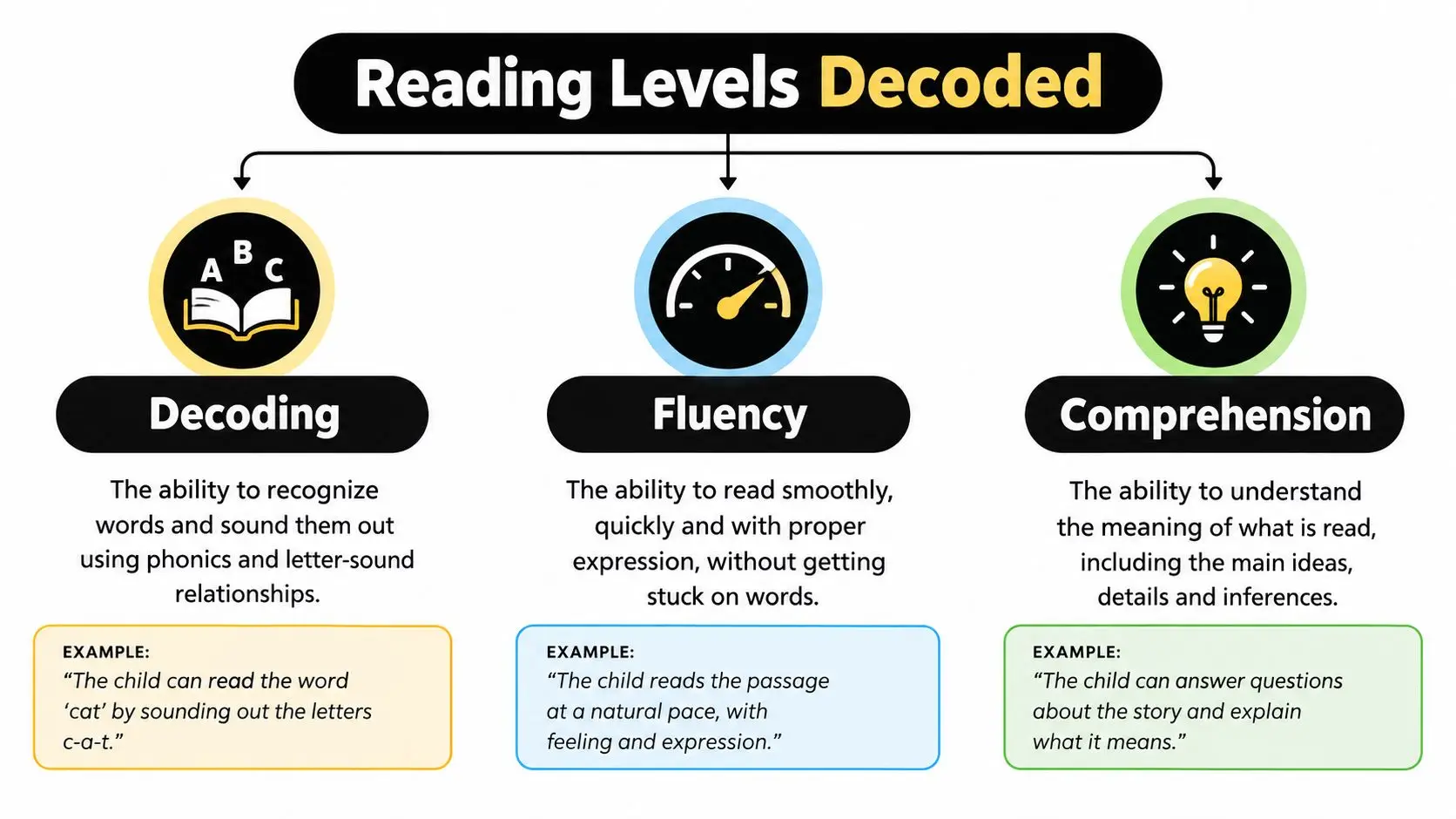
One reason reading levels feel muddled is that schools use them for several different things at once. A level can point to decoding, which is sounding out words. It can hint at fluency, which is how smoothly a child reads. It can also connect to comprehension, which is whether the meaning has landed. Parents understandably hear one label and assume it sums up everything.
A level can't tell the whole story
A child might read the words in a book accurately but have no idea why a character is upset. Another child may understand the whole story beautifully when you read it together, but still get stuck on the print. Both children need support, but not the same kind.
Primary school reading levels work best when adults treat them as a snapshot of what a child can manage right now, not a verdict on what kind of reader they are.
That distinction matters emotionally. Children pick up very quickly on whether reading feels like a test. If every session becomes “Go on then, prove you're a Level 4,” confidence can drain away even when skill is growing.
Why schools use levels at all
Teachers need a practical way to match books to children. If a text is far too easy, a child doesn't get much practice stretching. If it's far too hard, they spend all their energy fighting through the words and can't enjoy the meaning.
A useful way to think about it is this:
- Too easy: your child reads every word quickly but barely needs to think.
- Too hard: your child stops every few words, guesses often, or wants to give up.
- About right: your child can read most of it, needs light help, and still follows the story.
That middle ground is where growth usually happens. It's also where children are most likely to leave a reading session feeling, “I can do this.”
What Primary School Reading Levels Really Mean
A reading level is not a fixed badge. It's closer to a stepping stone. It tells you what sort of text your child can manage with success at this point in time.
Some children move steadily from one stone to the next. Others leap in one area and wobble in another. That's normal. Reading is made of several parts working together, not one single skill.
The three parts parents should watch
When teachers talk about primary school reading levels, they're usually holding three things in mind.
- Decoding means turning letters into sounds and blending them into words. A child might read “ship” correctly because they can spot the sound pattern.
- Fluency means reading with a pace and rhythm that makes sense. A fluent reader doesn't sound as if every word is a separate puzzle.
- Comprehension means understanding what the text is saying, including ideas that aren't stated directly.
A child can be stronger in one part than another. For example, a pupil may decode neatly but read in a flat, stop-start way, which shows fluency still needs work. Another may sound expressive but miss key details, which points to comprehension support.
Practical rule: if your child reads the words correctly but can't tell you what happened, the level may fit their decoding more than their understanding.
Why levels rise
As children progress, books usually change in predictable ways. Vocabulary becomes less familiar. Sentences grow longer. Pictures offer less support. Meanings become less obvious, so the child has to infer, predict, and connect ideas.
That's why moving up a level isn't just about “harder words”. It can also mean handling:
- longer sentences with more detail
- characters with mixed feelings
- information texts with topic words
- fewer repeated patterns
- less help from pictures
This short video gives a helpful overview of how reading skills build over time.
Reading level is not the same as reading age
Parents often get tangled here. A reading age sounds neat, but classroom decisions are usually more useful when they focus on the child's current reading behaviours. A child might cope with one text that looks “older” because it matches their interests or background knowledge, and then struggle with another that appears simpler.
So if you hear a level, think less about a permanent rank and more about a working match between child and text. The best match protects confidence while still nudging skill forward.
How Different Levelling Systems Map to Ages and Key Stages
Schools don't all use the same labels. One school may use colour bands. Another may talk about phonics phases. Another may refer to scaled scores or expected standard. That can make parents feel as if they need a translator.
You don't need to memorise every system. You just need to know what each one is trying to measure.
The broad journey from Reception to Year 6
In the early years and Year 1, the main job is learning how print works. Children are building sound knowledge, blending, and confidence with simple text. By Key Stage 1, fluency starts to matter more. Children need to read familiar patterns more smoothly and begin talking about meaning with less strain.
By Key Stage 2, the reading demand shifts again. Teachers are listening for stamina, vocabulary understanding, and deeper comprehension. National benchmarks at the end of primary are based on scaled scores rather than informal labels. In England, a scaled score of 100 or above marks the expected standard, and 110 or more marks the higher standard in reading according to the Key Stage 2 attainment national headlines for 2025 to 2026.
Primary Reading Levels Mapped to Age and Key Stage
| Levelling Approach | Typical Age and Year Group | Key Stage Focus |
|---|---|---|
| Book bands or colour bands | Usually ages 4 to 11, depending on the scheme | Matching children to books they can read with support and success |
| Phonics phases or phonics teaching groups | Most visible in Reception, Year 1, and often Year 2 | Hearing sounds, linking sounds to letters, blending, segmenting |
| Teacher judgement from reading conferences or running records | Across primary years | Accuracy, fluency, comprehension, confidence, and strategy use |
| KS1 classroom expectations | Often ages 5 to 7 | Moving from decoding into smoother reading and simple discussion of meaning |
| KS2 scaled scores | Usually linked to end of primary benchmarks around ages 7 to 11, especially Year 6 outcomes | Secure comprehension, inference, stamina, vocabulary, and test performance |
National standards and classroom systems are related, not identical
Many families get tripped up here. A book band is not the same thing as a national score. A child can move through school reading bands while teachers also track how they are doing against wider end of key stage expectations.
The Department for Education reported that the average KS2 reading scaled score was 105 in 2023, and the share reaching the expected standard rose from 73% in 2023 to 74% in 2024, while 29% reached the higher standard in 2024 in the national headlines for 2022 to 2023. That tells us schools are looking beyond a simple pass or fail picture.
A helpful parent question is not “What exact age is this band?” but “What can my child do confidently in this band, and what are they learning next?” Teachers using structured tools such as these Key Stage 1 planning tools are often mapping those small classroom steps very carefully.
If you want a clearer sense of how reading expectations sit within the wider upper-primary curriculum, the Key Stage 2 English overview gives useful context around the sort of language work children meet as they grow.
How Schools Assess Your Childs Reading Level
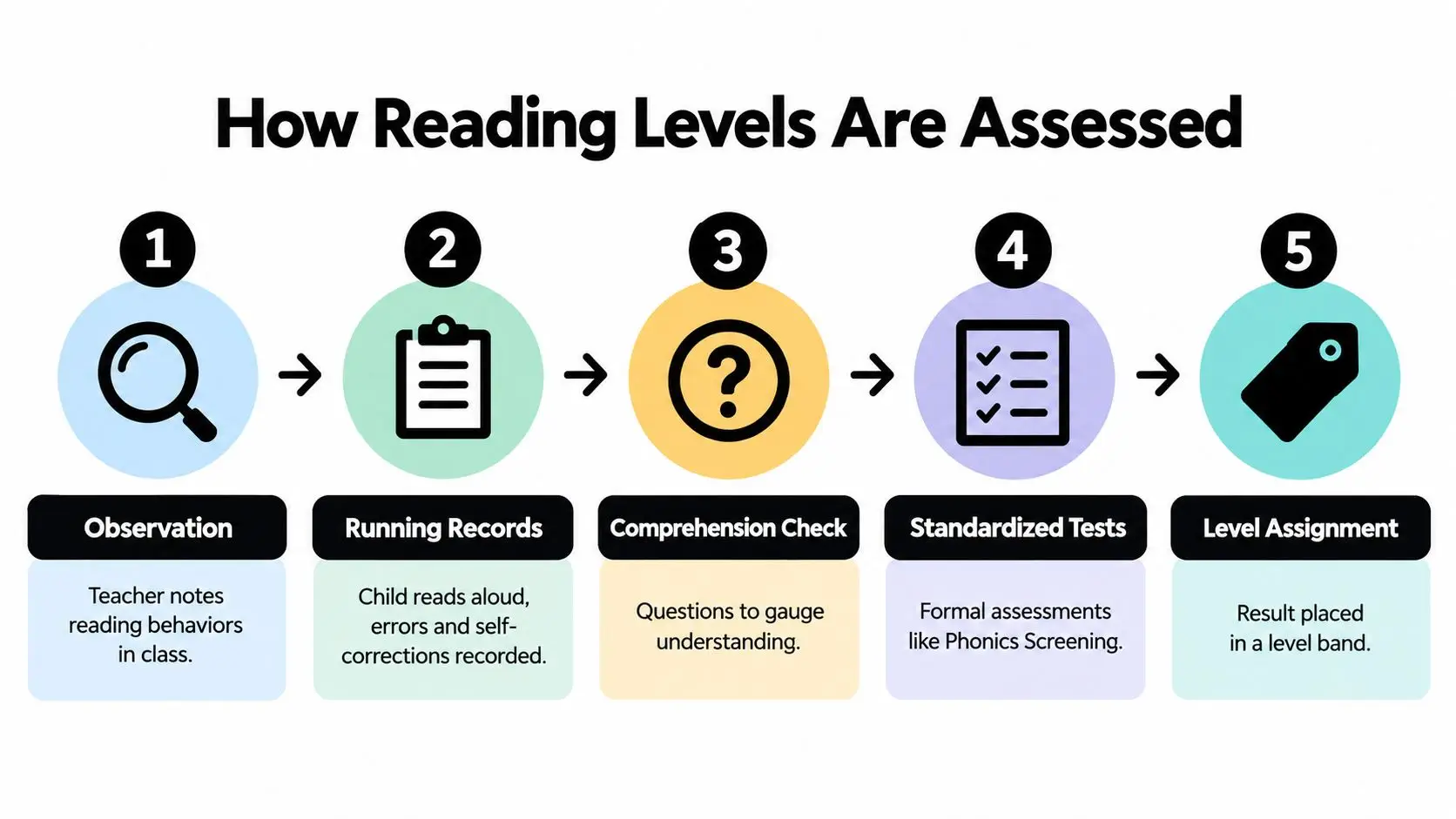
Many parents picture reading assessment as a child sitting at a desk doing a test. Sometimes there is a formal check, but most assessment begins much more. A teacher listens, watches, and notices patterns over time.
They notice whether your child points carefully under words, rushes past punctuation, rereads when something doesn't make sense, or lights up when the topic feels familiar. Those details matter because they show what support will help next.
What teachers usually look at day to day
In school, assessment often includes a mix of informal and formal checks.
- Reading aloud: a teacher listens for accuracy, pacing, expression, and self-correction.
- Comprehension talk: the child explains what happened, why it happened, or what they think might happen next.
- Book choice behaviour: some children avoid books that expose a weakness. Others choose books that are far too hard because they want to look grown up.
- Written responses: older primary pupils may show understanding through discussion, short answers, or classwork linked to reading.
A child who says “I don't know” after reading may not be careless. They may be using so much energy on the words that there is little left for meaning.
The phonics screening check in plain English
The clearest formal example in early primary is the Year 1 phonics screening check. In England, it is a statutory one-to-one assessment for pupils who reach age 6 by the end of the school year, and it is designed to confirm age-appropriate phonic decoding and identify children who need extra help with decoding, as set out in the 2025 phonics screening check assessment and reporting arrangements.
The check has 40 items, made up of 20 real words and 20 pseudo-words in that same official guidance. Those made-up words matter. They show whether a child can decode unfamiliar letter patterns instead of relying on memory.
Why one mark can matter
For the 2026 phonics screening check, the threshold mark is 31 out of 40, so 31 or more meets the expected standard and 30 or below does not, according to the official 2026 phonics screening check materials. That can feel painfully narrow for families, especially if a child was close.
It helps to remember what the threshold is for. It isn't there to shame a child. It flags who may need sharper, more targeted support with decoding before reading frustration grows. Schools also work to act quickly. The 2026 phonics data collection window opens on 8 June 2026 and closes on 17 July 2026, which gives schools a defined reporting period for follow-up, according to the 2026 phonics technical specification.
If you've ever wondered how formal checks sit alongside wider classroom evidence, this guide to methods of assessment is helpful for seeing the bigger picture.
Understanding Levelled Texts and What to Look For
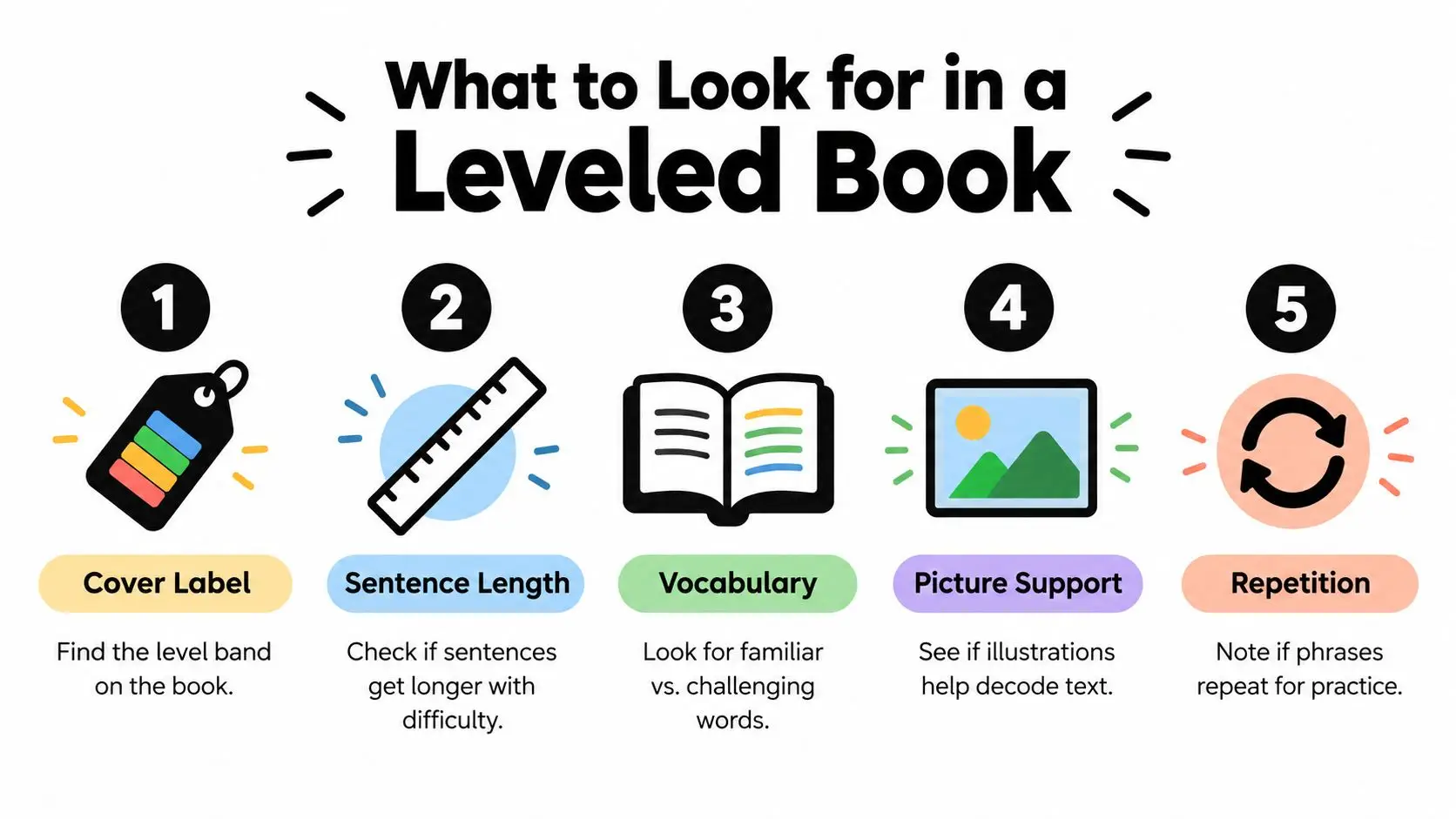
When you open your child's school book, you can learn a lot before they even read the first line. The layout, sentence length, picture support, and vocabulary all give clues about why that book sits at that level.
Parents often focus on the label. The better question is, “What is this book asking my child to do?”
What different books often look like
At an earlier level, a book may have repeated phrases such as “I can see the…” with strong picture clues. That repetition helps a child practise pattern, tracking, and confidence.
A more advanced level may include longer sentences, fewer illustrations, and words that must be worked out from context. Later still, your child may meet chapters, shifts in time, or characters whose feelings have to be inferred rather than stated.
A simple home checklist
Use this when reading together.
- Check the effort level: if your child is stuck on so many words that the meaning disappears, the book may be too hard for independent reading.
- Listen for smoothness: some hesitations are fine. Constant stopping suggests the text isn't yet secure.
- Look at the pictures: in early books, pictures are part of the reading support. In later books, that support fades.
- Ask light questions: “What's happening here?” works better than turning story time into an interview.
- Watch their mood: frustration, silliness, or sudden tiredness can be a clue that the reading demand is too high.
Try this at home: after a page, ask “What do you think now?” It invites thinking without making your child feel tested.
When a book is too easy or too hard
Too easy can look deceptively good. Your child reads quickly, but there's little stretch. Too hard often shows up as guessing from the first letter, skipping endings, or losing the thread of the story.
If your child has communication or processing differences, you may need to read those signs a little differently. Support around meaning, predictability, and sensory load can make a real difference, which is why a resource like this Guiding Growth autism reading guide can be useful for families thinking carefully about comprehension.
The key is to protect dignity. You can always say, “This one looks like a together book, not a by-yourself book.” That keeps the challenge without sending the message that the child has failed.
Practical Strategies and Resources to Help Your Child Progress
If your child is wobbly with reading, the instinct is often to do more. More books. More corrections. More practice sheets. Usually, what helps most is doing the right kind of support more calmly and more consistently.
A child makes better progress when reading feels safe enough to keep trying.
Small routines that work in real homes
A strong routine doesn't need to be elaborate.
- Keep it short: ten settled minutes can be more effective than a long, tense session.
- Reread favourites: a familiar book builds fluency because the brain is no longer fighting for every word.
- Share the load: echo reading works well. You read a sentence first, then your child repeats it.
- Talk beyond the page: discuss new words while cooking, walking, or getting ready for school.
- Let interests lead: football facts, animal books, jokes, recipes, and comics all count as reading material.
What to say when your child gets stuck
The words adults use can either lower pressure or raise it fast.
Try prompts such as:
- “Have another look at the beginning.”
- “What would make sense here?”
- “Let's read that sentence again together.”
- “You worked that out. Keep going.”
Try to avoid quick signals of disappointment, even accidental ones. A sigh or “You knew that yesterday” can linger in a child's mind far longer than we mean it to.
Why comparison doesn't help
National data shows that reading outcomes don't sit outside a child's wider circumstances. In England's 2025 phonics screening check, 80% of Year 1 pupils met the expected standard and 89% did so by the end of Year 2, but the gap between disadvantaged pupils and their peers was 17 percentage points, and August-born children scored 73% compared with 86% for September-born children in the same dataset, according to the phonics screening check attainment release for 2024 to 2025. The same release notes that at age 11, 46% of disadvantaged pupils met the expected standard in reading, writing and maths versus 67% of non-disadvantaged pupils in 2023/24.
That doesn't mean your child is defined by a subgroup. It means context matters. Birth month, early opportunity, and disadvantage can shape how reading presents in the classroom. So if your child seems “behind” someone else, comparison may be telling you very little.
When to ask for more support
Ask school for a fuller conversation if your child:
- Dreads reading: tears, avoidance, or stomach aches matter.
- Guesses a lot: especially when they skip over the middle or ends of words.
- Understands well when listened to: but struggles heavily with the print itself.
- Plateaus for a long stretch: despite regular support and plenty of reading opportunities.
Some families also use structured online support alongside school. One option is how to improve reading comprehension, which can help parents think about practical next steps at home. In the same spirit, Queens Online School offers online British curriculum teaching, including primary English support, which may suit families who need a more flexible or personalised learning setup.
Supporting Your Childs Reading Journey With Confidence
Reading levels make more sense when you strip away the labels and look at the child in front of you. One child needs steadier decoding. Another needs help reading with flow. Another can read the words but still needs support making meaning. The level is only useful if it helps adults respond kindly and accurately.
The national picture reflects that complexity too. At the end of Key Stage 2 in England, 75% of pupils met the expected standard in reading in 2025, up from 74% in 2024, while the figure stayed between 72% and 75% from 2017 onward, and the average scaled score rose from 105 in 2024 to 106 in 2025, according to the Key Stage 2 attainment release for 2024 to 2025. In international reading evidence, pupils in England achieved an average reading score of 496 in PISA 2022, with about 10% at the highest proficiency levels and 20% below the baseline level, while in PISA 2025 the lowest-performing share was 19% and 10% still reached the top levels, according to the PISA 2025 national report for England. For older primary pupils, the PIRLS 2025 report gives England a Literary Purpose Scale score of 558, which places reading in an international framework through the PIRLS national report for England.
Those figures matter. Your child's day-to-day experience matters more.
If you keep asking, “What does my child need next, and how can reading still feel possible?” you're asking the right question. That's the question that builds confidence, and confident readers keep growing.
If you're looking for more structured support, Queens Online School offers a British curriculum online with subject-specialist teaching, including primary English support that can help children build reading, vocabulary, and comprehension in a personalised way. For families who need flexibility, smaller learning environments, or targeted help, it's a practical next step worth exploring.