


The night before Paper 2, your calculator is packed, your pens are ready, and one question keeps returning: what will be given to me in the exam room? If you're a Year 11 student, that uncertainty can make revision feel much bigger than it needs to be. Parents often feel it too, especially when different websites appear to show different formula lists.
The GCSE maths formula sheet is designed to reduce that uncertainty, not create it. You still need to understand mathematical methods, recognise which formula fits a question and substitute values accurately, but you won't need to memorise every formula printed on the official sheet. The important skill is knowing where the support ends and where your own recall begins.
What the GCSE Maths Formula Sheet Is in 2026
The GCSE maths formula sheet is a printed reference supplied with the relevant question paper by the awarding organisation. AQA, OCR, Pearson Edexcel and WJEC or Eduqas issue their own exam materials, so students should practise with the version used by their school rather than relying on a random online list.
For students taking GCSE maths in England, the current arrangement is especially important. Ofqual and the Department for Education confirmed that students sitting GCSE maths in 2025, 2026 and 2027 receive a formulae sheet alongside every question paper, and exam boards must publish the sheets in advance so students can become familiar with them. The government consultation stated that the 2025 sheets were due to be published in December 2024, while the 2026 and 2027 sheets were due by 1 September 2025 and 1 September 2026 respectively. OCR's official guidance confirms the arrangement.
Why the current arrangement matters
OCR confirms that students receive a sheet in both the June and November series for those years. Foundation and Higher students use separate versions, and the Higher sheet contains additional formulae. That means your revision must match your tier. A Higher student shouldn't assume that every formula they need appears on the Foundation version, and a Foundation student doesn't need to spend time learning Higher-only material because it appears in an online formula list. OCR explains the tier-specific sheets here.
The sheet also isn't a complete mathematical handbook. A specification appendix can supply selected references, such as the area of a trapezium, the volume of a prism and circle formulae, while leaving other essential results for you to recall. The published specification guidance illustrates this selective approach.
Practical rule: The sheet tells you what you don't have to memorise word for word. It doesn't tell you which method to choose.
If you're checking how GCSE maths fits into the wider secondary curriculum, the Key Stage 4 curriculum can help put the qualification into context. For exam preparation, the safest approach is simple: download your board's current Foundation or Higher sheet, use that exact copy during practice and ask your teacher whenever a formula list seems inconsistent.
Foundation Tier Formulas by Topic
Foundation students should learn the layout of their sheet before the exam. The formulas are grouped by topic, which makes the page less intimidating and helps you search with purpose.
Number, algebra, ratio and proportion
The sheet includes selected references for common calculations, including simple interest and compound interest. Simple interest can be represented as:
I = Prt
Here, (P) is the starting amount, (r) is the interest rate written as a decimal and (t) is the time. Compound interest uses the repeated-growth form:
A = P(1 + r/100)ⁿ
This finds the final amount after repeated percentage increases. The symbols matter, so always identify the original amount, percentage rate and number of periods before substituting.
The sheet may also provide ratio and proportion relationships needed for particular questions. It won't replace your understanding of percentages, fractions, multipliers or rearranging equations.
Geometry and measures
The Foundation sheet provides familiar shape and measurement formulas, including:
- Rectangle perimeter: (P = 2l + 2w), the distance around a rectangle.
- Rectangle area: (A = lw), length multiplied by width.
- Triangle area: (A = frac{1}{2}bh), half the base multiplied by the perpendicular height.
- Parallelogram area: (A = bh), base multiplied by perpendicular height.
- Trapezium area: (A = frac{1}{2}(a+b)h), half the sum of the parallel sides multiplied by the height.
- Circle circumference: (C = 2pi r), the distance around a circle.
- Circle area: (A = pi r^2), the space inside a circle.
- Cuboid volume: (V = lwh), length multiplied by width and height.
- Prism volume: (V = text{area of cross-section} times text{length}).
- Cylinder volume: (V = pi r^2h).
- Sphere volume: (V = frac{4}{3}pi r^3).
The sheet also provides Pythagoras' theorem, (a^2+b^2=c^2), and the right-angled triangle ratios sin, cos and tan. Use the labels opposite, adjacent and hypotenuse carefully.
Statistics and what remains yours to remember
The Foundation version includes the mean from a frequency table:
Mean = (frac{Sigma fx}{Sigma f})
Multiply each value by its frequency, add those products and divide by the total frequency. Probability relationships may also be printed, depending on the official version used by your board.
Several important methods still require recall. These include the quadratic formula, percentage change and speed, distance and time rearrangements. Don't assume that seeing one circle or volume formula means every related formula will be supplied.
Confidence builder: Practise asking, “What information is given, what am I finding and which printed formula connects them?” That question is often more useful than trying to memorise the whole page.
Higher Tier Formulas by Topic
The Higher sheet contains additional references, but the main challenge remains application. A formula printed in front of you can still produce no marks if you choose the wrong relationship, use the wrong angle or substitute values in the wrong places.
Geometry and trigonometry
Higher students receive the sine rule:
(frac{a}{sin A}=frac{b}{sin B}=frac{c}{sin C})
This connects a side with its opposite angle in a non-right-angled triangle. The cosine rule is:
(a^2=b^2+c^2-2bccos A)
It's useful when you know two sides and the included angle, or when finding an angle from three sides. The sheet also gives the trigonometric area formula:
Area = (frac{1}{2}absin C)
The letter (C) represents the included angle between sides (a) and (b). That detail is easy to miss and can change the whole answer.
Algebra and kinematics
The Higher sheet includes the quadratic formula:
(x=frac{-bpmsqrt{b^2-4ac}}{2a})
It also includes the discriminant, (b^2-4ac), which helps determine the nature and number of roots. You still need to identify (a), (b) and (c) correctly after writing the quadratic in standard form.
Uniform acceleration questions use the kinematics formulas:
- (v=u+at), final velocity from initial velocity, acceleration and time.
- (s=ut+frac{1}{2}at^2), displacement when time is involved.
- (v^2=u^2+2as), useful when time isn't included.
The Higher sheet may also include the volume of a frustum and iteration notation where those forms are relevant to the specification.
What Higher students still need to know
Higher students share several references with Foundation, including Pythagoras, the basic trigonometric ratios and compound interest. You don't need to learn the same printed equation twice. Focus instead on recognising the conditions that make each formula appropriate.
The sheet doesn't cover every Higher method. Students may still need to recall the equation of a circle, circle theorems and the gradient-area relationship at the calculus boundary. Your teacher's specification checklist should decide the final memory list, not a general internet article.
Foundation vs Higher at a Glance
The clearest way to understand the boundary is to compare the two official versions. The exact design can differ between boards, so use this table as a revision map and check the current sheet supplied by your exam board.
Foundation vs Higher Formula Sheet Comparison
| Topic Area | Formula | Foundation Sheet | Higher Sheet |
|---|---|---|---|
| Number | Simple interest relationship | Yes | Yes |
| Number | Compound interest | Yes | Yes |
| Algebra | Quadratic formula | No | Yes |
| Algebra | Discriminant (b^2-4ac) | No | Yes |
| Geometry | Trapezium area | Yes | Yes |
| Geometry | Prism volume | Yes | Yes |
| Geometry | Sphere volume | Yes | Yes |
| Geometry | Sine rule | No | Yes |
| Geometry | Cosine rule | No | Yes |
| Geometry | Triangle area (frac{1}{2}absin C) | No | Yes |
| Statistics | Mean from a frequency table | Yes | Yes |
| Probability | Selected probability relationships | Yes | Yes |
| Trigonometry | Sine, cosine and tangent ratios | Yes | Yes |
| Mechanics | Kinematics formulae | No | Yes |
Both tiers must still learn formulas and relationships that aren't printed on their own sheet. This includes conversion factors, metric-to-imperial equivalents and important methods identified by the specification. Pythagoras and the basic trigonometric ratios should be checked against your board's current sheet, because students mustn't rely on a formula list from a different qualification or year.
The major Higher additions include the quadratic formula, sine rule, cosine rule and the triangle-area formula using (frac{1}{2}absin C). Your tier determines which paper you sit, so don't choose a revision list by yourself. Work with your teacher when deciding whether Foundation or Higher is the right paper.
Worked Examples Using the Formula Sheet
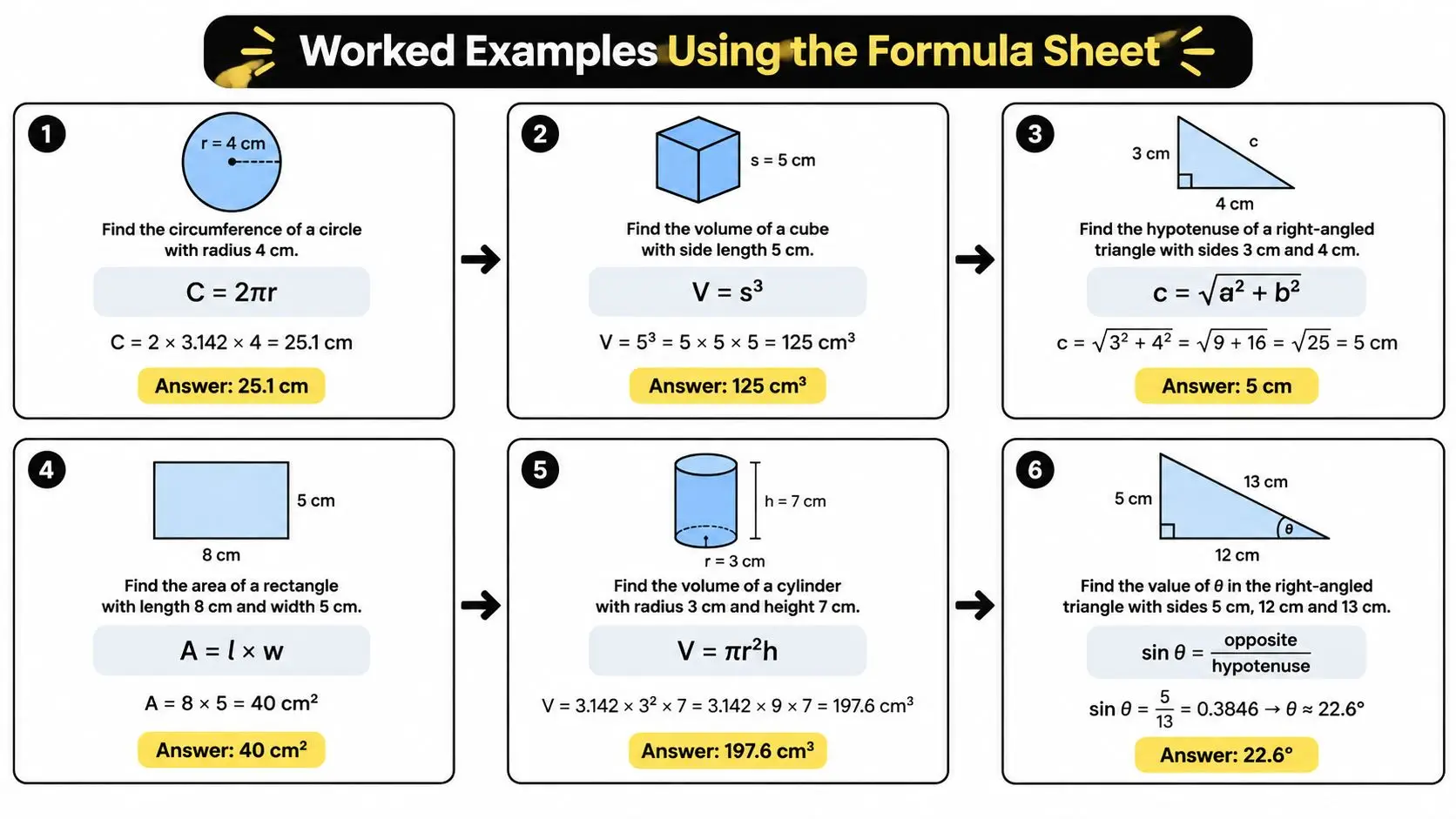
A formula becomes useful when you can connect its symbols to the information in a question. The examples below show the routine: name the formula, copy it accurately, substitute values and check the units.
Six short exam-style examples
1. Circumference: Find the circumference of a circle with radius (4) cm. Use (C=2pi r). Therefore, (C=2pi(4)=8pi), so (Capprox25.1text{ cm}).
2. Cylinder volume: Find the volume of a cylinder with radius (3) cm and height (8) cm. Use (V=pi r^2h). (V=pi(3^2)(8)=72pi), so (Vapprox226.2text{ cm}^3).
3. Compound interest: An amount of £500 grows by (4%) each year for three years. Use (A=P(1+r/100)^n). (A=500(1.04)^3), so (Aapprox£562.43).
4. Sine rule: In a triangle, (A=30^circ), (a=6) cm and (B=45^circ). Find (b). Use (frac{a}{sin A}=frac{b}{sin B}). (b=frac{6sin45^circ}{sin30^circ}), so (bapprox8.49text{ cm}).
5. Cosine rule: Two sides are (7) cm and (5) cm, with included angle (63^circ). Find the opposite side (a). (a^2=7^2+5^2-2(7)(5)cos63^circ). Thus (a=sqrt{42.2}), so (aapprox6.50text{ cm}).
6. Quadratic formula: Solve (x^2+3x-1=0). Here (a=1), (b=3), (c=-1). (x=frac{-3pmsqrt{3^2-4(1)(-1)}}{2(1)}), giving (xapprox0.30) or (xapprox-3.30).
If equations appear inside graphs or coordinate problems, practising equations from graphs can help you decide which information belongs in the formula. A worked example is only useful when you understand why that formula was selected, so the next priority is preventing the slips that happen under pressure.
Common Mistakes Students Make With These Formulas
Most formula errors aren't signs that a student can't do maths. They happen when a familiar-looking question is handled too quickly.
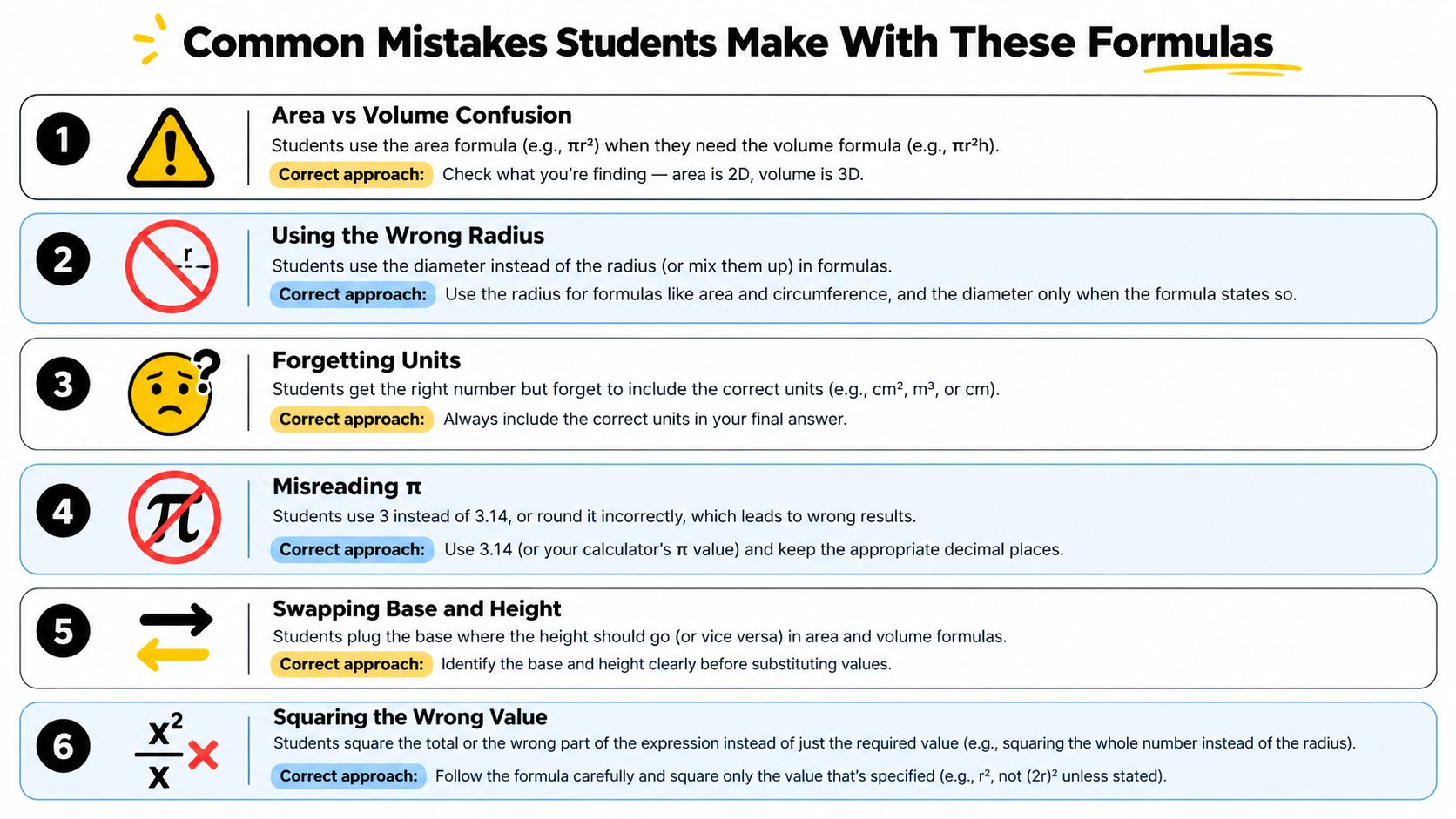
- Cylinder area versus volume: A student uses (pi r^2h) for a circular area or forgets the height in a volume question. The units expose the difference. Say: “Area is square units, volume is cubic units.”
- Dropping the half: In (frac{1}{2}absin C), missing the (frac{1}{2}) doubles the result and costs accuracy marks. Say: “Two sides and the included angle still need half.”
- Forgetting the square root: Pythagoras first gives a squared length, and the quadratic formula gives solutions after the radical is evaluated. Say: “If I've found (x^2), I haven't found (x) yet.”
- Swapping sine and cosine rules: Non-right-angled triangles don't all use the same rule. Check the known sides and opposite angles before choosing. Say: “Match sides to opposite angles.”
- Calling circumference perimeter: Circumference is the distance around a circle. Area measures the inside. Say: “Around is circumference, inside is area.”
- Treating the sheet as revision: Reading a formula without practising its use creates false confidence. Say: “I'm learning the decision, not just the symbols.”
Before submitting an answer, look for the quiet clues: units, a missing square root, a degree-mode setting or a radius that was a diameter. These checks are small, but they protect marks you've already worked hard to earn.
Exam Room Tips for Using the Sheet With Confidence
The formula sheet should feel like a safety net. It shouldn't be the first thing you reach for on every question, because searching can interrupt your mathematical thinking.
Read the front cover and formula list before the paper starts, but don't spend the reading time trying to memorise every line. During the exam, circle the quantities named in the question and underline what you need to find. Those marks often reveal the correct formula before you turn a page.
A calm lookup routine
- Identify the target. Write what the question asks for, such as area, volume, speed or a missing angle.
- Check the diagram. Confirm whether a labelled length is a radius, diameter, perpendicular height or slant length.
- Find the relationship. Use the topic headings rather than scanning randomly.
- Copy the full formula. Substitute values straight away and show chronological working.
- Check the result. Look at units and estimate whether the answer is sensible.
- Return later if needed. Don't spend too long hunting for a formula when you can bank marks elsewhere.
| Situation | Best action |
|---|---|
| The method is familiar | Write it from understanding and use the sheet to verify it later. |
| The formula won't come to mind | Look it up, copy it carefully and continue. |
| The question has several steps | Label intermediate answers and keep units visible. |
| The answer seems unreasonable | Estimate, check the calculator mode and review the substitution. |
| You have five or six minutes left | Verify equations and units rather than beginning a long search. |
Keep angles in degrees unless the question indicates radians. A car travelling at ninety metres per second may be a warning that you've misread a conversion, while a negative length usually means you need to check the model or calculation. This AQA mathematics page is useful when checking the qualification materials and specification context.
Print, Annotate and Practise With the Sheet
Use only the current formula sheet issued by your exam board, then make a working copy for revision. Print it at 100 per cent, check that symbols are clear and place it beside a blank page during practice so folds or notes don't hide important details.
You can underline topic headings, add a topic number beside a formula or highlight symbols you often confuse. Don't cover definitions or essential information. Folding the sheet into bands for number, algebra, geometry and statistics can make searching quicker, while a ruler helps you track across a crowded line.
Practise one paper with the official sheet beside you, then complete another without it. Mark every lookup with a small dot. Frequent dots show where retrieval practice matters most.
A laminator may make a copy easier to reuse, but loose annotations are often more flexible as your understanding changes. Before the exam, check the ink, remove damaged edges and pack your equipment safely. Don't attach unofficial notes unless your school has confirmed that they're allowed.
Revision Resources and Where to Go Next
Build revision around the sheet instead of collecting disconnected formula lists. Start with your exam board's official specification, complete topic booklets and use past papers under timed conditions. When you lose a mark, record the precise reason, such as a missing unit, incorrect substitution or a confused formula.
Maths Genie, Corbettmaths and your school's learning platform can provide targeted questions, videos and worked solutions. Your teacher can clarify tier boundaries and paper arrangements, especially when a resource uses notation from another board.
For a parent, a useful routine is to ask your child to explain one formula, demonstrate an example and then teach the method back to you. If independent study feels disorganised, this guide on how to study for exams effectively offers broader planning ideas. You can also use a focused resource on how to revise for maths GCSE to build a regular routine around retrieval, practice and feedback.
Personalised online tutoring can help when particular topics or exam techniques remain difficult. Look for syllabus-matched questions, clear feedback on working and support that respects the student's tier and confidence, rather than focusing only on final answers.
Queens Online School offers live, interactive British-curriculum teaching with subject-specialist support, recorded lessons and personalised pathways for GCSE learners, including students who need additional SEN or SEMH support. Visit Queens Online School to explore flexible online learning that can help your child prepare for GCSE maths with structure, feedback and confidence.