


You're doing the school run in your head while your child is still at the laptop, the live lesson just ended, and you're trying to work out whether the quiet means they're fine or too tired to say they're not. That's the parent teacher communication problem in an online British curriculum school. Families don't need more noise, they need clearer signals, calmer handovers, and a way to stay involved without hovering over every lesson.
Good communication gives a child emotional steadiness as much as academic support. The right message can reassure a parent, help a teacher spot a pattern early, and keep a young person from feeling like school only notices them when something has gone wrong. It also stops parents from turning into amateur detectives, scrolling through platforms, trying to interpret every absence, slow reply, or half-finished task.
A useful place to start is getting your notes and contacts in order. If you're the sort of parent who ends up with screenshots, email threads, and login reminders spread across different places, a practical organiser such as the Family Folder school document guide can help you keep the paperwork side less chaotic. That matters because calm communication is easier when you can find the thing you're referring to.
The Quiet Worry Every Online School Parent Knows
The day starts well enough. Your child logs into the lesson, participates, then closes the laptop with the sort of shrug that tells you nothing and everything at once. You ask, “How was it?”, and they answer, “Fine,” which is usually the least useful word in the English language.
That moment is where a lot of online school parenting gets emotionally messy. You're not standing in the corridor at pickup, so you lose the little social clues that come with a physical school day. You can't overhear the chatter, see who looked drained, or catch the teacher for a quick word at the gate. You're left with fragments, and fragments invite anxiety.
This is why parent teacher communication can't be treated like admin. It has to help a parent understand the child's day, not just the school's system. It should answer three basic questions. What is my child learning, what support do they need, and what should I do at home without stepping on their independence?
Practical rule: if a message doesn't help a parent understand their child better, it's just noise.
The best online school communication feels human. It names the child's effort, flags any concern early, and leaves the parent feeling included rather than managed. That's especially important when a family is trying to build trust in a British curriculum school from a distance, where the home becomes part of the learning environment and the emotional line between support and interference can get blurred.
What Good Parent Teacher Communication Actually Looks Like
Strong parent teacher communication is specific, timely, child-centred, and two-way. That is the standard to hold school contact against. The Education Endowment Foundation's evidence review links high-quality parental engagement with around +4 months of additional progress for pupils, and it stresses that communication works best when it is specific, actionable, and linked to learning rather than generic updates (EEF evidence review). In practice, that means every message should help a parent understand what is happening, what matters next, and how to respond without crowding the child.
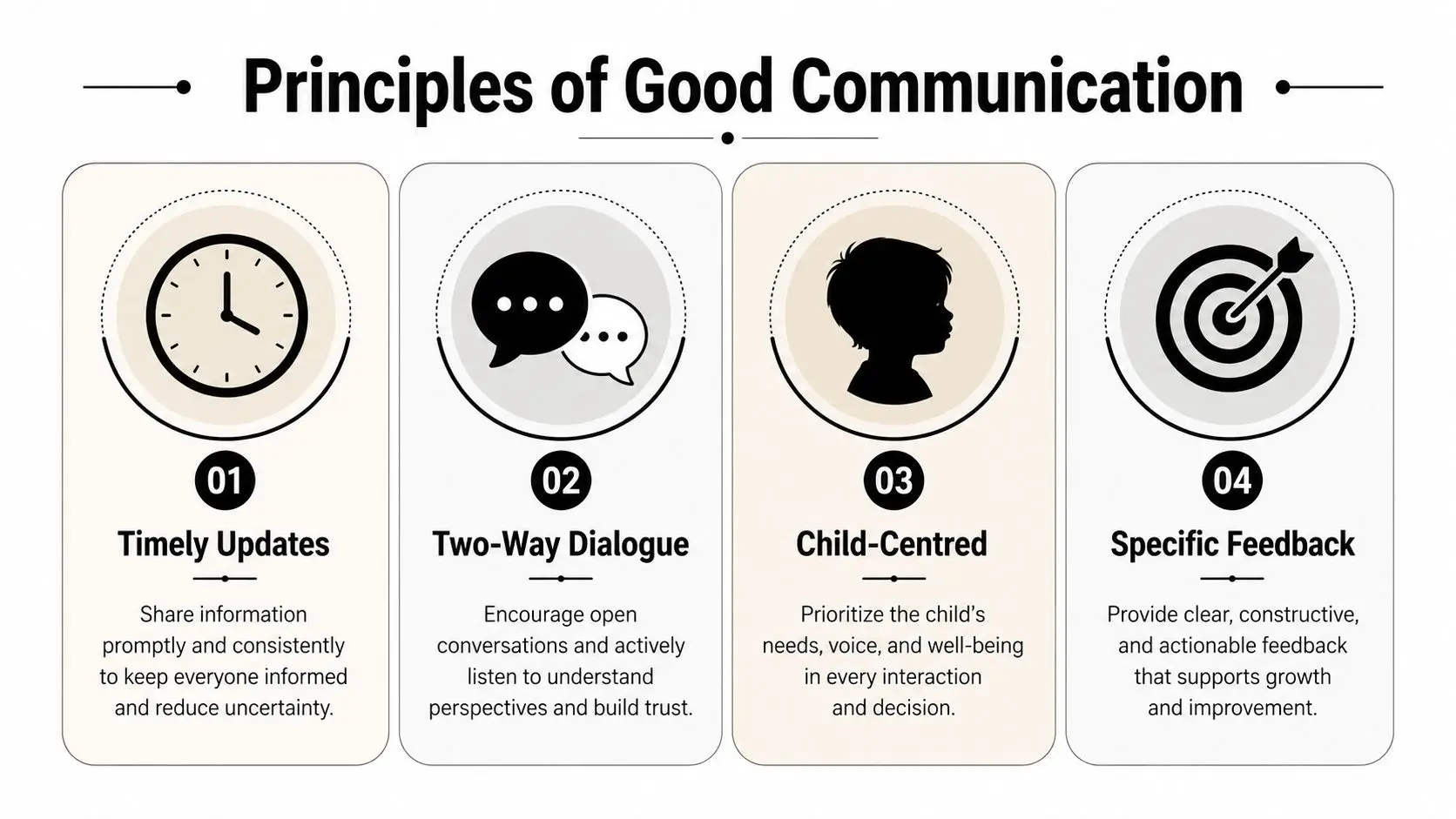
Good communication does three things at once. It tells a parent what the child is doing, it makes clear what support is needed, and it points to the next step. In an online school, that might look like a tutor explaining that a child is finishing work quickly but rushing written explanations, the parent being asked to check one piece of homework each week, and the school agreeing a follow-up point to review progress.
The three markers worth insisting on
- What the child is doing now. You need a clear picture of strengths, gaps, and behaviour, not a vague “all fine”.
- What you can do at home. A parent needs one or two actions they can carry out, not a lecture.
- What happens next. A follow-up date or next step keeps the exchange from disappearing into the void.
The UK context matters too. A UK study, 2024 found that family-school communication depends less on whether schools say they value it and more on how effectively it is carried out, with school type, teacher perceptions, and accessible contact channels shaping engagement. That matches what experienced pastoral staff see every term. Parents do not want more messages for the sake of it. They want better ones.
A good message leaves a parent able to do something useful that evening.
If your current contact with school mostly tells you what has already happened, it is weak. If it helps you respond to the child's actual learning, it is doing its job.
Setting the Tone in the First Two Weeks
A child who is anxious, shy, or still settling into an online British curriculum school will show you what they need very early. So will the parent. If the first contact only happens after something has gone wrong, everyone arrives guarded. Open early, keep it brief, and speak like a partner. That is how trust starts.
Send a short introductory message to the form teacher or tutor, and keep it grounded in the child's real working habits. Share a one-page note on what they are good at, what unsettles them, and what tends to bring out the best in them. There is no need for a family biography or a polished sales pitch. Staff need enough to see the child as a person, not as a username on a screen.
A useful opening email might sound like this.
“Hello, I'm keen to stay in touch this term and support [child's name] well from home. They settle best when instructions are clear and they know what ‘done' looks like. They enjoy challenge, but can go quiet if they feel they've got something wrong, so a gentle check-in helps.”
That kind of message gives staff something practical to use straight away. It is especially helpful for quieter children who do not volunteer much in class, because it flags what may be happening beneath the surface without turning the child into a problem to solve.
The next message should set the rhythm. Ask how the school prefers contact, what kind of updates you should expect, and whether there is a sensible point each term to review progress. Do not ask for lots of messages. Ask for clarity.
- For hesitant parents: “I'm new to online schooling and want to get this right. Could you let me know the best way to reach you if I need to share something about [child's name]?”
- For shy children: “My child often knows more than they say out loud. If you notice that they're quiet but engaged, I'd appreciate a brief note so I can reinforce that at home.”
- For a first contact: “Please let me know the best rhythm for updates so I'm supportive without adding pressure.”
A relationship built in those first exchanges should be steady, not noisy. Families do better when they can reach a teacher easily, hear from them without chasing, and understand what the school is watching for. That approach matches the broader direction seen in recent research on family-school communication, which found that engagement depends more on how communication is carried out than on declarations of intent, with school type, teacher perceptions, and access to contact channels all shaping how well families take part. Early contact is not overstepping. It is the practical way to protect the child's emotional reality while keeping parents informed without pushing them into micromanagement.
Running a Parent Teacher Meeting That Actually Helps Your Child
A Year 8 parent sits down for a maths meeting and already feels the tension in their shoulders. The child is doing fine in most subjects, but concentration has dipped in maths and homework keeps arriving half-finished. The parent wants reassurance, the teacher wants a plan, and the child needs neither blame nor vague sympathy.
The meeting goes better when it has shape. Teacher-communication guidance recommends setting a clear agenda in advance, reviewing the student file before the meeting, opening with a positive comment, explicitly making room for parent input, and ending with a written summary and follow-up plan (ERIC guidance). That structure matters because meetings drift fast when nobody anchors them.
Start with a calm opening. Ask how the child has settled, then invite the teacher to name one strength before the concern. If you're worried about concentration, ask for one or two specific examples rather than a general impression. “When does this happen?” is a better question than “What's wrong?”
A workable meeting rhythm looks like this:
- Agree the goal. “I'd like to understand what's behind the maths drift and what we can do this half-term.”
- Share observations. The teacher gives examples, the parent adds what happens at home.
- Plan the next steps. One or two actions, not a pile of good intentions.
- Write it down. End with who is doing what, and when you'll check in again.
Three questions help when you freeze in the middle of the conversation:
- “What would success look like by the next check-in?”
- “What should I reinforce at home, specifically?”
- “Can we agree what you'll do and what I'll do?”
That last part is where trust is built. Parents often leave meetings feeling vaguely informed but not equipped. A written summary changes that. It keeps the child at the centre and stops the same issue being re-argued in three different emails.
For a practical example of how teachers frame child-centred next steps, the language around strengths, concerns, and follow-up is worth seeing in a simple school-facing summary such as Queen's Online School's formative assessment overview. That sort of language works because it makes the child's learning visible without turning the conversation into a verdict.
If you only remember one thing from a meeting, remember this. A good meeting ends with fewer assumptions and more clarity than it started with.
Adapting Communication for SEN and SEMH Needs
When a child has SEN or SEMH needs, communication has to coordinate, not just report. Parents are often carrying the emotional load at home, so the school has to be precise, steady, and consistent rather than scattergun. One thread of information should sit across home, the form teacher, and whoever leads support, so nobody is guessing what has already been agreed.
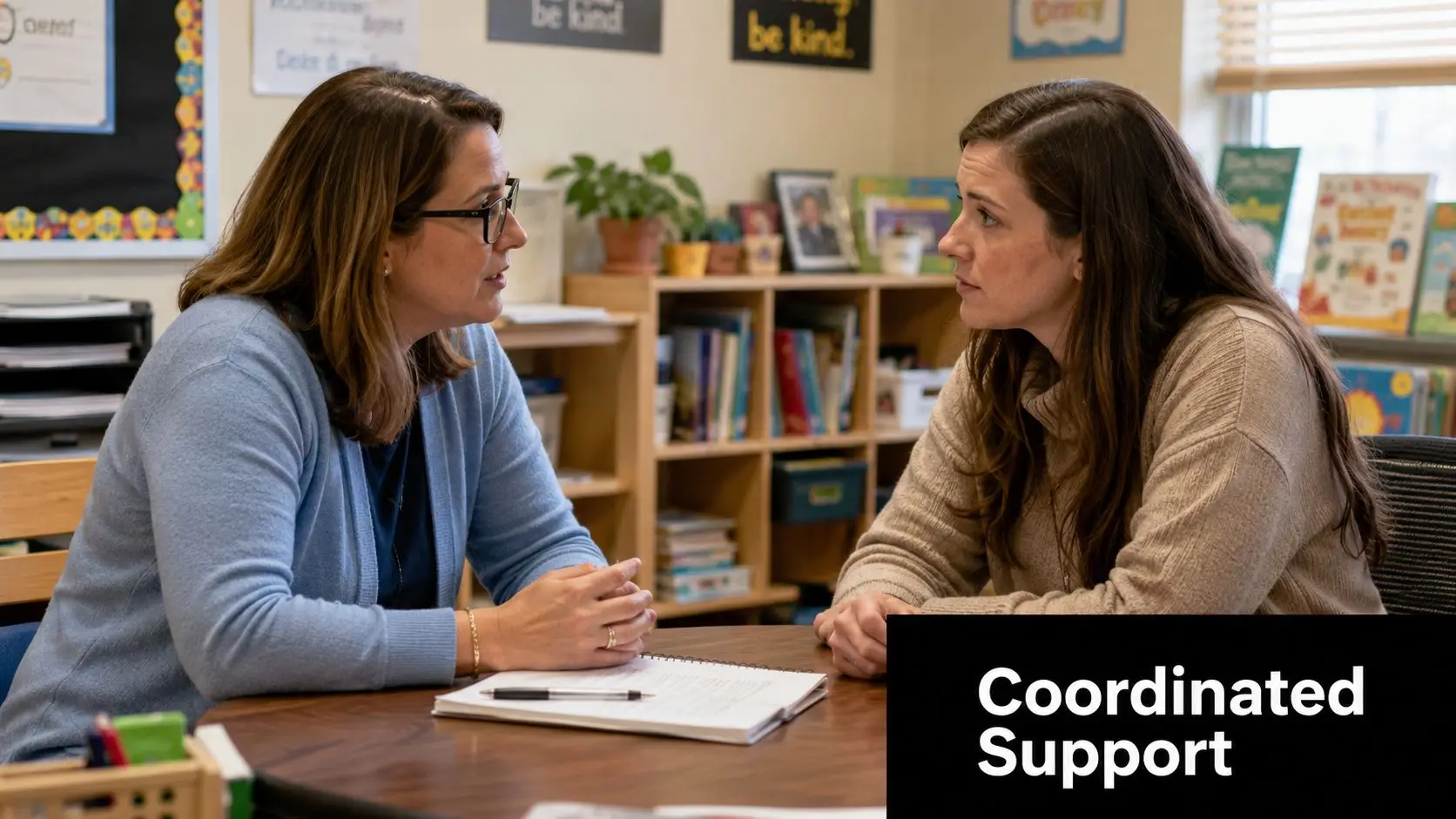
A useful rule is to share what matters, not everything that happened. If your child becomes overloaded by too much speaking in live lessons, say that plainly and ask for the adjustment to be written down. If anxiety makes them avoid unmuting, the school needs to know what support reduces the barrier, and the parent needs to know what the school will do versus what the home will reinforce.
For example, a child who gets overwhelmed by background noise may need a shorter verbal check-in, chat-based responses, or a predictable warning before being asked a question. A child who freezes when attention lands on them may do better with advance notice, a written option, or a teacher who checks in privately after the lesson. Those are not special favours. They are access conditions.
Keep one clear record
- Record agreed adjustments in writing. Don't rely on memory after a busy call.
- Name the responsibility split. Who does what at home, and what the school will monitor.
- Use a single point of contact. One lead teacher or support lead keeps the picture coherent.
That single source of truth matters more than parents realise. If one teacher is told one thing and another teacher hears something slightly different, the child feels the inconsistency first. Families can avoid that by sending one concise note after any supportive conversation: what the issue is, what's been agreed, and when it will be reviewed.
If you want a school-level explanation of support roles, Queen's Online School's SEN support page is a useful reference point for the language schools use around coordinated help. The right tone is calm and practical, not dramatic.
Practical rule: when emotions are running high, reduce the message to the child's need, the agreed adjustment, and the next check-in.
That's how you protect the child without turning every conversation into a crisis.
The Secondary and Sixth Form Years When Stepping Back Matters
The hardest shift in parent teacher communication comes in GCSE and A-level years. Parents still need to know what's happening, but they can't run the whole show without crowding out the teenager's growing ownership of their own work. The aim is presence, not surveillance.
Recent research points in the same direction. A Harvard working paper found that weekly one-sentence teacher messages about a child's schoolwork increased academic success (Harvard working paper). The lesson is straightforward. Brief, regular, content-rich contact matters more than long, rare, formal contact.
So stop obsessing over volume. A sixth form parent doesn't need endless updates. They need a rhythm, and they need to hear about attendance, workload, wellbeing, and exam readiness in language that the student can also live with. If the student is part of the conversation, the message usually lands better and feels less like secret monitoring.
A sensible approach looks like this:
- Agree a minimum rhythm. A short update at meaningful milestones is usually enough.
- Ask for data-rich summaries. “How are deadlines, effort, and attendance looking?” is more useful than a general “How is she doing?”
- Include the student where appropriate. Let them see the message, reply, or join the discussion when it helps build ownership.
Parents also need to know when to step back. During mock exams, coursework deadlines, or university application season, the temptation is to hover. Resist that. Keep the contact focused, keep the tone calm, and make sure the young person is still the one leading their own work.
For families thinking about the transition into these years, Queens Online School's sixth form information is a useful benchmark for how an online British curriculum frames independence alongside support. That balance is the point. Teenagers do not need to be left alone, but they do need room to become accountable.
The best line in this stage is often the simplest one. “I'm here, I'm informed, and I'm not going to crowd you.”
Following Up, Escalating, and Keeping the Relationship Warm
A meeting only matters if the follow-up happens. A short message after the conversation, confirming the main actions and the next review date, keeps everybody honest without sounding formal or cold. If the teacher said they would monitor attendance, or you agreed to change the home routine, write it down while the details are still fresh.
If nothing changes after the agreed follow-up, escalate thoughtfully. Start with the teacher, then move to the head of year, SENCO, or senior leader if the issue needs broader oversight. Bring the dates, the actions already tried, and the child-centred concern, not a rant. That keeps the relationship intact while signalling that you're serious.
A simple escalation ladder works well.
- First step: reply to the original teacher with a brief recap and request for review.
- Second step: if there's no movement, contact the relevant pastoral or support lead.
- Third step: if the problem involves coordination, safeguarding, or unmet support, take it to the senior layer with a clear timeline.
Keep the tone warm even when you're frustrated. The point is not to “win” a complaint. The point is to make life steadier for the child. Warm greetings, relaxed check-ins, regular updates, and a visible willingness to work together do more for trust than slick wording ever will (parent engagement guidance).
Make one commitment this term. Send the follow-up note every time. That tiny habit changes the whole relationship.
If you want a school that treats parent teacher communication as part of a child's everyday support rather than a box-ticking exercise, speak to Queens Online School and ask how its teachers, tutors, and support teams keep families informed while still giving learners space to grow.