

You may be sitting at the kitchen table with a quiet worry that's hard to name. Your child says school was “fine”, but something feels off. Perhaps they finish work too quickly and come home switched off. Perhaps they're trying hard but seem more tired, more anxious, or less sure of themselves each week.
Most parents don't want a clever system. They want something simpler than that. They want their child to be known. They want a teacher to notice when confidence dips, when boredom sets in, when a small struggle is about to become a much bigger one.
That's where data driven education can help, if it's used well. Not as a cold spreadsheet exercise, and not as a way to reduce children to marks on a screen. At its best, it's a way of paying closer attention. It helps adults spot patterns, respond earlier, and shape learning so a child feels seen, understood, and supported.
Is My Child Truly Being Seen at School
A parent once described her son to me like this: “He's not causing trouble, so he disappears.” That sentence stays with you.
He was polite, bright, and quiet. In class, he completed the work, rarely asked for help, and never drew attention to himself. On paper, everything looked acceptable. In reality, he was confused in maths, under-stretched in English, and increasingly convinced that school was a place where nobody really noticed how he learned.
That isn't a criticism of teachers. Most teachers are working hard, holding many needs at once, and doing their best in busy classrooms. The challenge is structural. When one adult is tracking many children, subtle signs can be easy to miss. A child who masks anxiety. A child with SEN who copes until the task changes. A child with SEMH needs who seems fine one day and shut down the next.
When quiet doesn't mean settled
Parents often look for dramatic signs. Refusal to attend. Falling grades. Tears at bedtime. But the first clues are often gentler than that. A child may stop talking about school. They may say a subject is “boring” when the issue is that it's too easy or too hard. They may look lazy when they're overwhelmed.
A child doesn't need louder behaviour to need closer attention.
Data driven education becomes far more human than the name suggests. It gives teachers extra ways to notice. Not just test scores, but patterns in participation, confidence, consistency, and response. It can help answer questions such as: When does this child engage most? Which tasks lead to hesitation? Are they avoiding a topic, or do they need it explained differently?
A more compassionate way of noticing
Think of it as giving teachers better lenses, not bigger clipboards. The purpose isn't to label a child. The purpose is to understand them more accurately.
For younger children especially, support and safety always come first. Parents who are thinking about how schools notice risk, distress, and emotional shifts may also find this Nursery Advice safeguarding guidance helpful. It offers a clear reminder that children thrive when adults pay attention to small signals early.
When schools use information well, a child is less likely to slip into the category of “doing fine” when they are anything but. That matters deeply. A child who feels recognised is more likely to trust the adults around them, ask for help, and believe that learning can fit them rather than force them.
What Data Driven Education Really Means for Your Child
The phrase can sound technical, but the idea is simple. Data driven education means using the clues a child's learning creates to make teaching fit that child better.
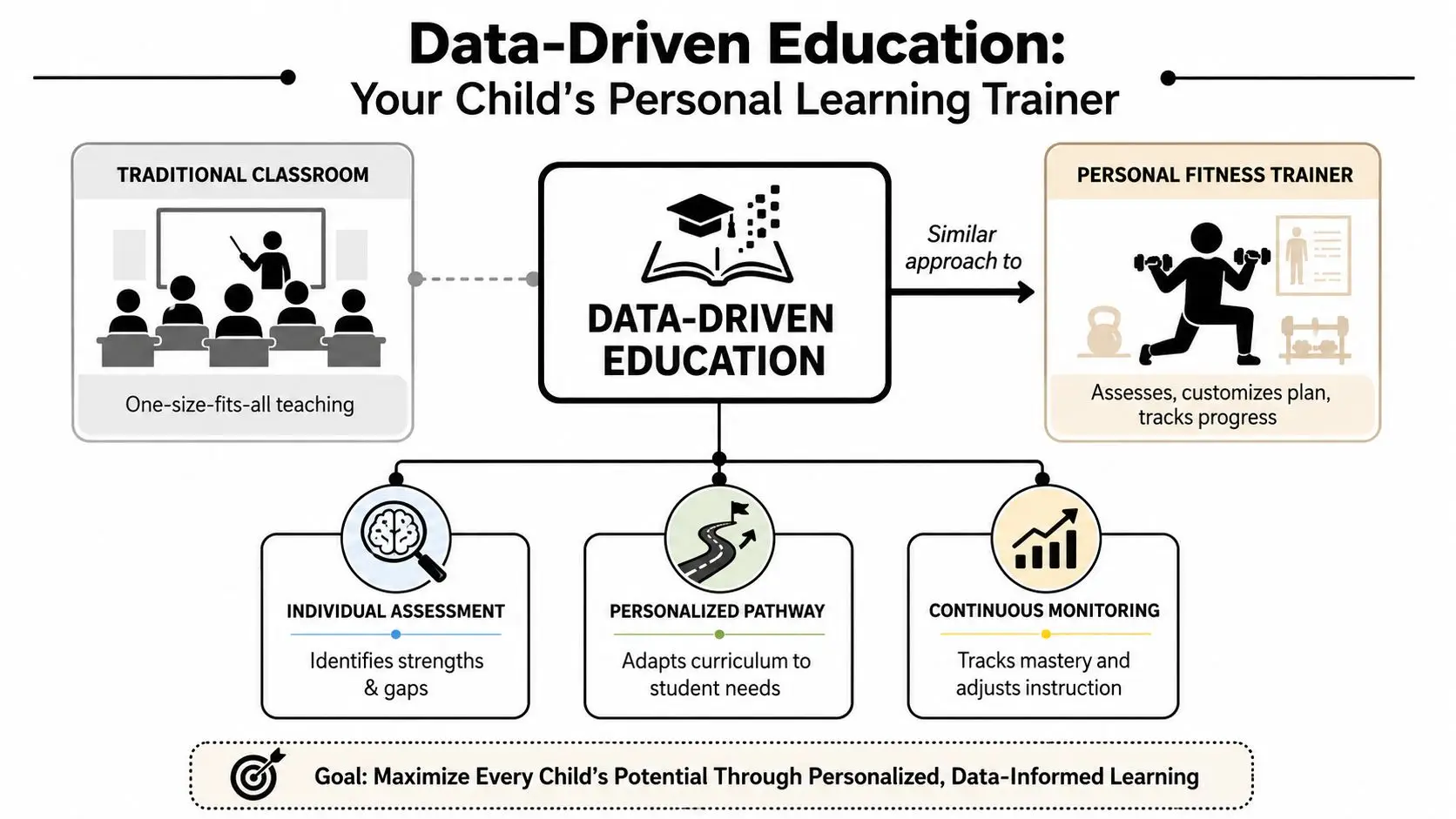
A useful analogy is a personal fitness trainer. A good trainer doesn't hand the same exercise sheet to everyone in the gym. They watch how you move, ask how the last session felt, notice what motivates you, and adjust the plan. If one exercise causes strain, they change it. If you're ready for more challenge, they increase it.
That's much closer to good teaching than many people realise.
The gym class versus the trainer
In a one-size-fits-all gym class, everybody moves at the same pace. Some people are left behind. Others barely break a sweat. Nobody gets a plan built around their actual needs.
In learning, the same thing happens. One child needs more time to secure a concept. Another has already mastered it and is ready to go further. A third understands the idea but freezes in timed conditions. If all three get the same task in the same way for the same length of time, someone loses out.
A more personalised model uses information from everyday learning to adapt. That could include:
- Short quizzes: These can show which part of a topic has clicked and which part still feels shaky.
- Class participation: A teacher may notice that a child can explain an idea aloud but struggles to write it independently.
- Question patterns: The kind of questions a child asks often reveals how they think.
- Learning habits: Some children need visual examples. Others need discussion, repetition, or a quieter pace.
Parents exploring personalized digital learning often find it helpful to understand how adaptive learning works, because it shows how teaching can respond to a learner rather than deliver content at them.
It's not about testing more
Parents often grow nervous at this point. They hear the word “data” and picture endless assessment. That's not the aim.
The best use of data comes from normal learning activity. A child completes a task, joins a discussion, watches a lesson again, leaves a comment, or tells a teacher what felt difficult. Those small moments create a picture over time. The teacher then uses that picture to decide what to reteach, what to enrich, and where to offer reassurance.
Practical rule: If the information collected doesn't help a teacher support a child better, it probably isn't worth collecting.
That is the heart of it. Data driven education isn't about listening to numbers. It's about listening to children more carefully through the evidence their learning leaves behind.
The Human Benefits of Using Educational Data
Parents rarely ask for “better data”. They ask for signs that their child is happier, calmer, more confident, and making progress without feeling crushed by the process. That's why the benefits of data driven education are human before they're academic.

Personalised pace changes how a child feels
Consider a child who adores history. In discussions, they light up. They make thoughtful links between topics and remember details with ease. But lesson after lesson, they're asked to wait while the class revisits material they already understand.
At first, that child looks compliant. Then they begin to drift. They stop putting full effort into tasks because effort no longer feels necessary. Over time, boredom can look a lot like disengagement.
When a school notices that pattern through classroom responses, completed work, and the level of challenge a child consistently handles, it can act. The teacher might offer a richer source text, a deeper comparison task, or a more open-ended project. The point isn't to pile on extra work. The point is to protect curiosity.
Earlier support for SEN and SEMH learners
For children with SEN or SEMH needs, small patterns matter enormously. A child with dyslexia may understand a lesson fully in discussion but struggle when the same knowledge has to be processed through dense text. A child with anxiety may attend every lesson but participate less when uncertainty creeps in. A child with emotional regulation difficulties may appear oppositional when the underlying issue is overload.
Good educational use of data helps adults spot those patterns earlier. Not with suspicion, but with care.
A teacher might notice that a learner does well in live explanation, hesitates during written independent tasks, and avoids submitting work when instructions are text-heavy. That can lead to a simple, gentle change. More audio support. Clearer chunking. A check-in before frustration becomes shame.
Parents who want to think more about how schools move beyond end-point grades may appreciate this discussion of rethinking assessment for education, because it reflects the same child-centred principle.
Online learners need this even more
One common fear about online education is that a child can be present but invisible. That fear is understandable. A camera on doesn't always mean engagement. A quiet child can look settled while feeling lost.
In a strong online setting, the feedback loop can be much richer than parents expect. Teachers can notice who joins in polls, who revisits explanations, who contributes confidently in chat, and who starts well but fades when a topic becomes more demanding. Used properly, that information helps adults respond quickly and kindly.
This short video gives a useful overview of the wider thinking behind personalised learning in digital spaces.
When a child learns online, attention has to be more intentional. The best teachers don't wait for a problem to become obvious.
For families exploring online education, that can be very reassuring. The right systems don't create distance. They create more chances for a child to be noticed, encouraged, and brought back in before they feel they've failed.
Understanding the Clues Your Childs Learning Creates
The word data often sounds bigger than it is. In schools, it usually means ordinary information gathered from everyday learning. If you think of your child's education as a puzzle, data is the set of pieces adults use to see the full picture more clearly.
Some pieces tell us what your child knows. Others show how they learn. A third group points towards how they're feeling as they work. None of these pieces should stand alone. Together, they help adults respond with more precision and more empathy.
Three simple categories parents can understand
| Data Type | What It Measures | Example for Your Child |
|---|---|---|
| Academic Data | What your child understands and can do in a subject | A quiz shows they can solve fractions confidently but still mix up the wording in problem questions |
| Engagement Data | How your child interacts with learning activities | They replay the science explanation, answer the live poll, but stop contributing when the task becomes open-ended |
| Wellbeing Data | How your child seems to feel during learning | A teacher notes rising frustration in writing tasks, or your child reports feeling nervous before speaking in class |
That's the broad picture. The details matter because each category answers a different question.
Academic data shows the learning itself
This is the category parents usually know already. Classwork, short assessments, longer assignments, and teacher feedback all sit here. It helps answer questions such as: Has the concept landed? Is there a gap? Does the child need consolidation, extension, or a different explanation?
Many schools use short, ongoing checks rather than waiting for a major test. If you'd like a clearer sense of that approach, this guide to formative assessment is a helpful place to start.
Engagement and wellbeing tell the rest of the story
A child can get answers wrong because they don't understand. They can also get answers wrong because they rushed, panicked, switched off, or misunderstood the instruction. That's why engagement and wellbeing matter.
Schools may look at clues such as:
- Participation habits: Does your child volunteer ideas, stay silent, or contribute only in certain formats?
- Lesson behaviour patterns: Do they focus well at the start but fade later when tasks become less structured?
- Feedback signals: Do they say “I can't do this” quickly, or do they persevere and ask for help?
- Teacher observations: Does your child appear confident in discussion but tense in independent work?
Data should never be used to watch children more closely than necessary. It should be used to understand them better than was previously possible.
This distinction matters. Thoughtful schools aren't trying to monitor every movement. They're trying to notice enough to support learning without losing sight of the whole child. For parents, that's the key question to keep in mind. Is the information helping adults respond with care, clarity, and good judgement?
How Queens Online School Creates Personal Journeys
A hypothetical example can make this easier to see.
Amelia is bright, thoughtful, and articulate. She enjoys literature and contributes confidently in discussion. In STEM subjects, though, she hesitates. Not because she lacks ability, but because she's frightened of getting things wrong in front of others. At home, her parent sees the pattern clearly. Before maths, she looks tense. After science, she says, “I'm just not good at that sort of thing.”
In a large, less responsive setting, Amelia might be labelled underconfident. The deeper issue could be missed. In an online school with live lessons, specialist teaching, and small classes, the picture is easier to build.
What the adults notice
During live classes, Amelia answers low-stakes polls correctly when no spotlight is on her. In chat, she gives brief but accurate responses. On the learning platform, she completes practice tasks, yet pauses longer when questions require multi-step reasoning. In spoken discussion, she withdraws just when the class reaches the concept she finds most fragile.
None of those clues alone tells the full story. Together, they suggest something important. Amelia may understand more than she believes she does, but confidence is interfering with performance.
The teacher responds in a way that feels personal, not public. Amelia receives a different style of explanation through a recorded walkthrough she can replay privately. The next live lesson includes a carefully chosen moment for her to lead a short explanation on a topic she does know well. She succeeds. Her classmates respond warmly. A small shift begins.
Why the journey matters
This is what personalised support often looks like in practice. Not dramatic intervention. Thoughtful adjustment.
A school with strong online systems can combine several things at once:
- Live class insight: Teachers see hesitation, confidence, and participation in real time.
- Platform patterns: Completed tasks and revisited lessons reveal where independent learning flows and where it catches.
- Specialist teaching: Subject experts can distinguish between a knowledge gap and a confidence barrier.
- Small group opportunities: Children get safer spaces to practise without feeling swallowed by the room.
There's a close parallel here with language learning. Families interested in how individualized pathways can foster confidence may enjoy this article on unlocking Irish fluency. The subject is different, but the principle is similar. Progress becomes more likely when teaching adapts to the learner rather than asking the learner to adapt alone.
Some children don't need more pressure. They need the right doorway into the learning.
For Amelia, the goal wasn't just improved work in maths and science. It was a restored sense of self. Once a child stops saying “I'm bad at this” and starts saying “I'm getting there”, everything changes.
Your Role as a Partner in Your Childs Education
Parents sometimes assume data belongs to schools and experts. It doesn't. The most helpful use of educational information happens when families and teachers work together around the same child.
You know things a dashboard never will. You know when your child dreads a subject the night before. You know whether homework ends in tears, avoidance, or quiet pride. You know whether “fine” means fine. When you bring that knowledge into conversation, the school gets a fuller picture.
Questions worth asking a school
You don't need technical language. Clear questions are enough.
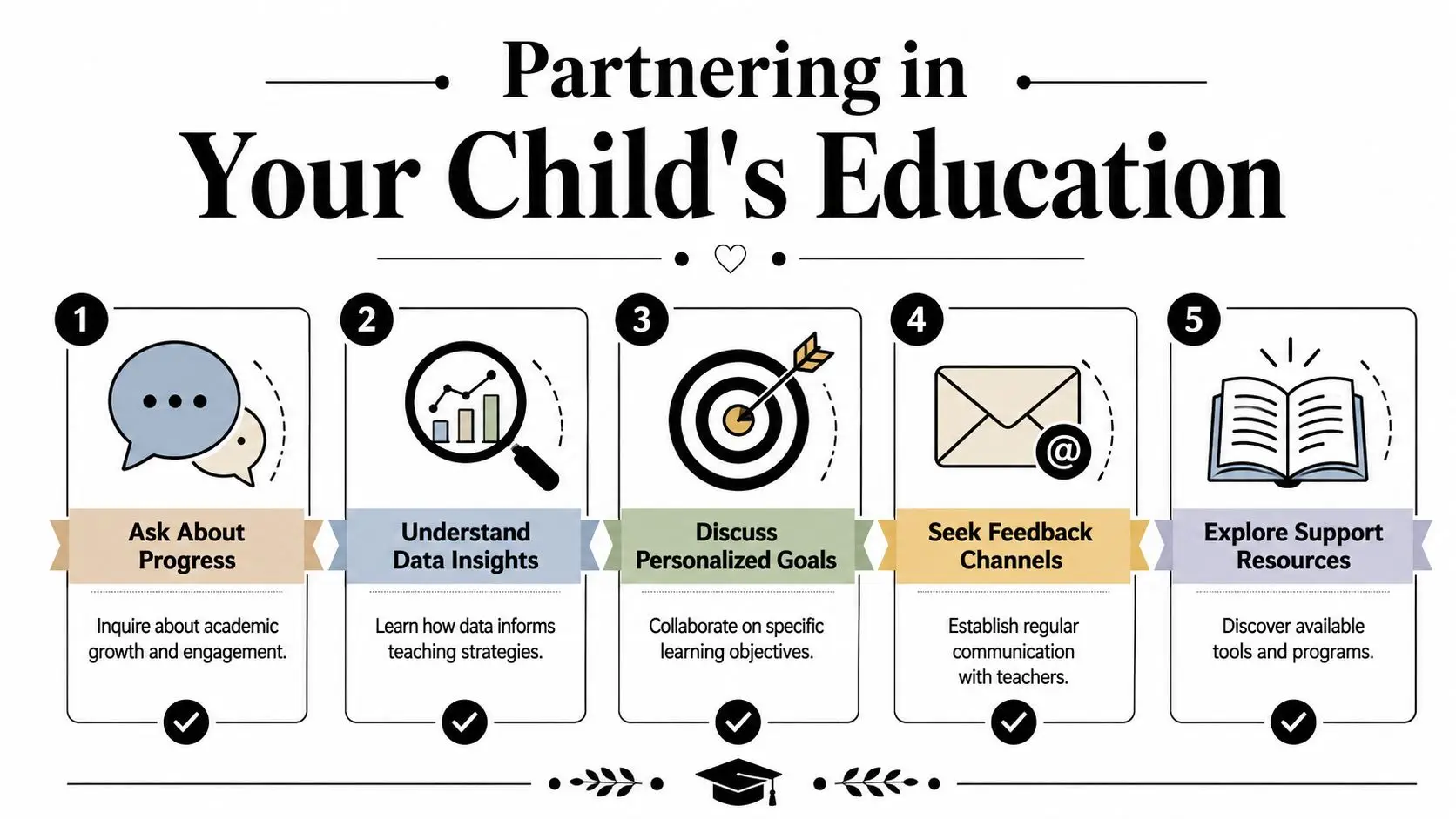
- Ask about engagement, not just grades: “How do you notice when my child is drifting, even if attainment still looks acceptable?”
- Ask for an example of adaptation: “Can you share a time when teaching was adjusted because of a student's learning pattern?”
- Ask how SEN or SEMH needs are spotted early: “What clues help your staff recognise when a child needs support before confidence drops further?”
- Ask how online participation is understood: “How do you tell the difference between a quiet child who is secure and a quiet child who is lost?”
- Ask what communication looks like: “How will you share concerns, progress, and next steps with me?”
Privacy matters and schools should answer plainly
Parents are right to ask where information is stored, who can see it, and what it's used for. A reputable school should welcome those questions.
What you want to hear is simple. Your child's information is used to support learning and wellbeing, not to watch them unnecessarily. Access is limited to relevant staff. The school follows clear data protection processes and explains them in language families can understand. In a UK context, that includes GDPR-aware practice and responsible handling of pupil information.
A healthy response from a school sounds calm and specific, not defensive.
A good sign: Staff can explain not only what they collect, but why it helps your child and where they draw ethical boundaries.
The parent-school partnership your child feels
Children notice when the adults around them are working together. They feel it when school feedback matches what home has observed. They feel it when support arrives before a struggle becomes a label.
Your role isn't to become an analyst. It's to stay curious, share what you're seeing, and expect schools to use information in service of a child's dignity and growth. When that happens, data stops being a technical word. It becomes one more way of saying, “We're paying attention, and your child matters.”
Frequently Asked Questions About Data Driven Learning
Will my child just become a number or a statistic
Not if the approach is healthy. Poor practice reduces children to outputs. Good practice does the opposite. It helps teachers see the person behind the pattern. If a child's participation drops, the right response isn't “the data changed”. It's “something may be going on here, let's understand it.”
Is this only for children who are struggling academically
No. It helps children who are racing ahead, children who are coasting, children who are anxious, and children whose needs are easy to miss because they're quiet or inconsistent. A learner who needs more challenge deserves just as much thoughtful attention as a learner who needs more support.
How can I tell if a school is using data effectively
Look for signs of lived personalisation. Teachers should be able to describe your child's learning habits, not just their attainment. Feedback should feel specific. Support should change when a pattern appears. If a school can explain how it notices confidence, engagement, and barriers to learning, that's encouraging. If all it can discuss is scores, the picture may be too narrow.
Parents don't need to be data specialists to ask strong questions. They only need to keep returning to the same central test. Does this approach help my child feel known, safe, challenged, and supported?
That's the promise of data driven education when it is done with wisdom and heart.
If you're looking for a school that combines live teaching, personal attention, and a flexible British curriculum online, Queens Online School is worth exploring. Its approach is built around helping each child learn at the right pace, with specialist support, small classes, and an emphasis on confidence, belonging, and progress.