


You watch your child hesitate over a page that looks simple to everyone else. They might be bright, curious, funny, full of questions about space or animals or how machines work. Yet homework turns into tears, spelling tests feel impossible, and maths facts vanish the moment they need them. You may have been told to “give it time” or “they'll catch up”. Still, something in you says your child isn't lazy, and this isn't just a phase.
That instinct matters.
Many parents arrive here carrying two worries at once. One is practical: Who do I speak to? What does the school need from me? How do assessments work? The other is personal: Will my child feel ashamed? Will they start believing they're not clever? Can school become a place of confidence again, instead of dread? Both worries deserve attention. Your child's learning and your child's wellbeing can't be separated.
Your Journey Starts Here
A mother once described it to me like this: “He can build the most complicated Lego model without instructions, but he freezes when he has to read one paragraph out loud.” That contrast is often the first clue. A child can be capable in so many ways and still struggle with a specific part of learning.
If that sounds familiar, you're not overreacting. You're noticing a pattern. That's how support often begins.
In the UK, approximately 1.5 million people have a learning disability, including an estimated 349,000 children according to Mencap's overview of how common learning disability is. That doesn't make your child's experience small. It does mean your family is not alone, and there are routes to help.
What parents often notice first
Sometimes the first sign isn't low attainment. It's effort without progress.
- Reading takes too much energy. Your child may guess words from pictures, avoid reading aloud, or say they're tired after a short task.
- Writing feels like a traffic jam. They know what they want to say but can't organise it onto paper.
- Maths creates panic. Number facts don't stick, or a child understands one day and seems to forget the next.
- School confidence drops. They start saying “I'm stupid” or “I hate school”.
You don't need a formal label before you take your concerns seriously.
That matters because families are often pushed into waiting. Waiting for the next term. Waiting for the next teacher. Waiting for the child to “mature”. Sometimes a little time helps. Often, clear support helps more.
What helps right now
Start with what you already know about your child.
Ask yourself:
- When do they struggle most. Reading instructions, copying from the board, timed tasks, written homework?
- When do they shine. Talking, problem-solving, practical tasks, art, memory for facts, kindness with younger children?
- What changes the picture. More time, verbal instructions, movement breaks, smaller chunks of work?
Those details are useful. They turn a vague worry into something a teacher or specialist can act on. Above all, they keep your child at the centre. This isn't about fitting them into a system. It's about understanding how they learn.
Understanding Learning Disabilities
A learning disability is easiest to understand if you think of it as a different operating system for learning. The child's brain is working. It may be working very hard. But it processes certain kinds of information in a different way.
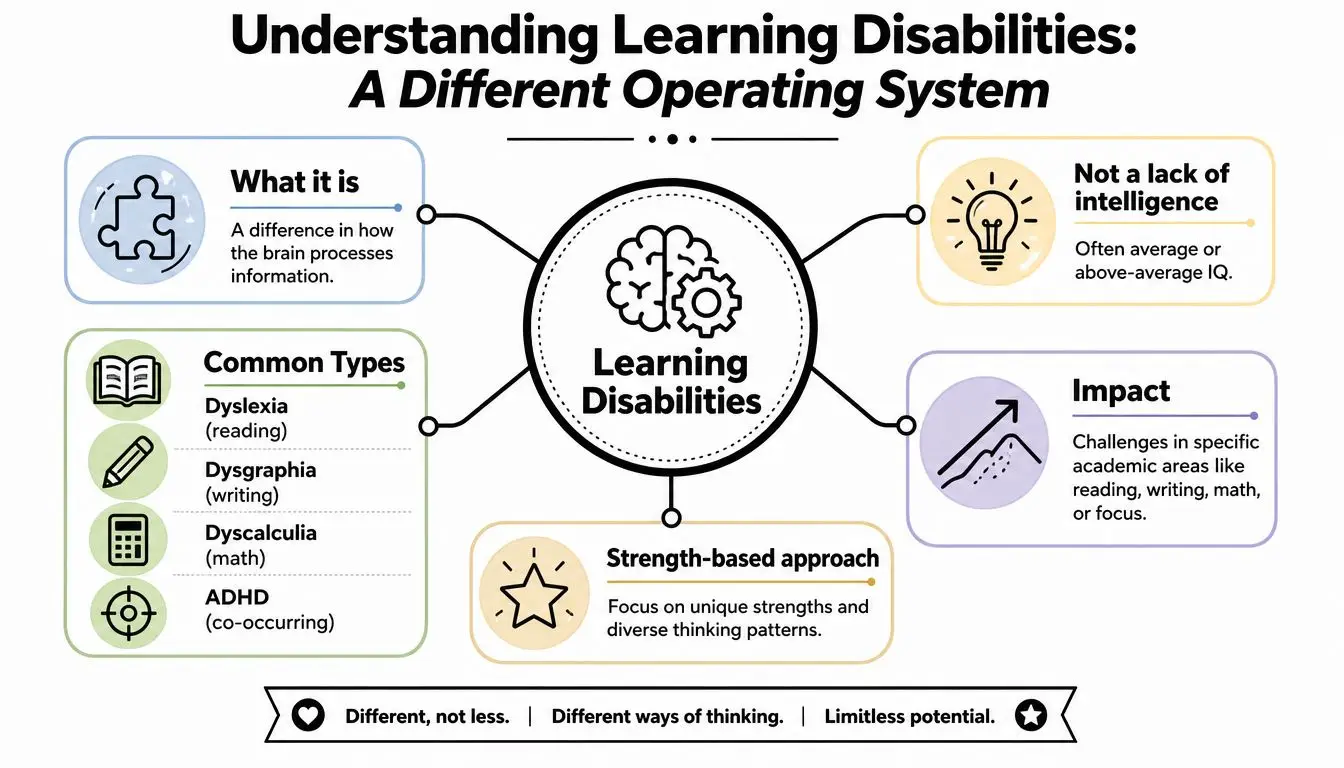
That's why a child can be articulate in conversation and still find writing painfully slow. Or they can understand a science concept perfectly when it's explained aloud, then struggle to read the worksheet about it. The issue isn't effort. It's how the brain takes in, stores, and retrieves information.
What a learning disability is and isn't
A learning disability is not the same as low intelligence. It's also not the same as poor teaching, although poor teaching can make the difficulty feel worse. And it isn't solved by telling a child to try harder.
A useful comparison is this:
| Area | What it can look like |
|---|---|
| Learning disability | The child has a specific difficulty with reading, writing, maths, or processing information |
| Lack of opportunity | The child hasn't had enough teaching, practice, or the right kind of instruction |
| Attention difficulty | The child may know the skill but struggles to sustain focus or organise themselves |
| Emotional stress | Anxiety, bullying, grief, or exhaustion can reduce performance |
Children can experience more than one of these at once. That's one reason parents sometimes feel confused. If you're trying to untangle attention concerns as well, this explanation of support for ADD and ADHD confusion can help put language around what you may be seeing.
Common patterns you might notice
Some children struggle mainly with reading. They may find it hard to connect letters and sounds, decode unfamiliar words, or read fluently enough to understand what they've just read.
Others struggle with writing. They may have strong ideas but lose them while trying to spell, form letters, or structure sentences.
Some find maths especially hard. Number bonds may not become automatic. Place value may feel slippery. Word problems can become overwhelming because they require both language processing and mathematical reasoning.
Practical rule: Look at the pattern, not one bad day. Learning difficulties tend to show up repeatedly across time.
Dyslexia is the most common learning disability in the UK, affecting around 10% of the population. When it isn't identified and supported early, it contributes to a school dropout rate of 18% for children with learning disabilities, as noted in this dyslexia and learning disability statistics summary. That's why early understanding matters. Not to alarm you, but to underline that support should start when concerns start.
A strengths-based lens changes everything
A child with a learning difference may also show powerful strengths. They may think visually, speak persuasively, solve practical problems, empathise strongly, or spot patterns other children miss.
That strengths-based lens matters at home and at school.
- Instead of “He never finishes written work.”
Try “He explains ideas well verbally. He needs help getting them onto paper.” - Instead of “She's behind in maths.”
Try “She understands concepts best when they're concrete and step-by-step.” - Instead of “He avoids reading.”
Try “Reading is effortful for him. He needs access to text in a different format too.”
Learning disabilities support works best when adults stop asking, “What's wrong with this child?” and start asking, “What does this child need in order to learn safely and well?”
Early Signs and Your Path to Assessment
Some parents notice concerns in nursery. Others don't see a clear pattern until Key Stage 2, when reading demands increase and written tasks become longer. Neither timeline means you've missed your chance. It only means your child's needs became visible at a certain point.
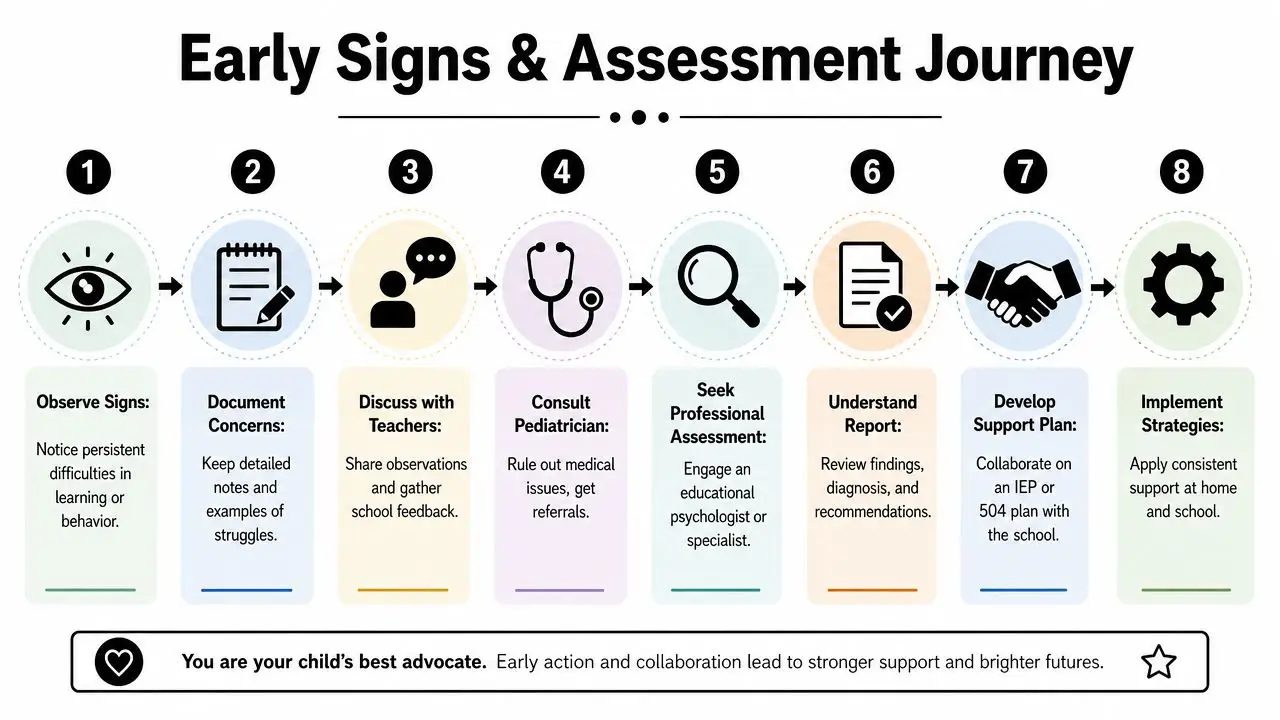
Early signs by stage
In younger children, you might notice difficulty with rhyming, remembering sequences, learning letter sounds, or following multi-step instructions. In primary school, concerns often become clearer through persistent spelling problems, slow reading, weak recall of number facts, or distress around homework. In secondary school, the gap can widen when pupils are expected to read more independently, manage deadlines, and write at length in several subjects.
These signs are clues, not proof. The aim isn't to diagnose your child yourself. The aim is to gather enough clear information that the right professionals can help.
A calm route through assessment
The UK system can feel bureaucratic, so it helps to treat it as a sequence rather than one huge task.
Write down what you're seeing
Keep a simple record for a few weeks. Note what the task was, what happened, and what helped. “Cried during spelling homework” is less useful than “Needed each word read aloud, then could complete two sentences confidently.”Speak to the class teacher or form tutor
Ask what they're noticing in school. Keep the conversation specific. “He's finding reading hard” is a start. “He reads slowly, avoids unfamiliar words, and loses the meaning of the sentence” is stronger.Ask to involve the SENCO
The Special Educational Needs Coordinator helps schools identify needs and plan support. They can advise on observations, interventions, and next steps.See your GP if needed
A GP can help rule out factors such as hearing, vision, sleep, or broader developmental concerns. This can also support onward referrals.
Only 23% of adults in England who are estimated to have learning disabilities are identified on GP registers, despite an estimated 1.2 million people in England having learning disabilities, according to the Foundation for People with Learning Disabilities statistics page. That gap is one reason parents' early, careful observations matter so much.
What specialist assessment may involve
An educational psychologist may look at how your child learns, not just what they can't do. They may explore memory, processing, literacy, numeracy, and how your child responds to different kinds of support.
You don't need to walk into that process already fluent in the language of assessment. You only need a clear picture of your child. If dyslexia is one of your concerns, this practical guide on how to help a child with dyslexia can help you prepare questions and recognise helpful supports.
Bring examples to meetings. A photo of a homework page, a spelling sample, or a note about how long a task took can say more than a general description.
Reports can be dense. Read them slowly. Highlight recommendations that can be used in everyday teaching, such as extra processing time, overlearning, verbal scaffolds, or reduced copying.
Navigating School Support and Your Child's Rights
Once a school recognises that a child needs extra help, parents often expect a neat plan to appear. In reality, support can be patchy unless you know what to ask for and how to follow up.
SEN support in plain English
Most children begin with SEN support inside school. That usually means the school identifies a need, puts strategies or interventions in place, reviews them, and adjusts if needed. Support might include small-group teaching, changes to classroom instructions, help with organisation, or access to specialist advice.
If you want a clearer picture of how that works in practice, this explanation of what SEN support means in school is a useful starting point.
A good question for school meetings is not “Are you supporting my child?” It's “What support is in place this week, who is delivering it, and how will we know if it's helping?”
When an EHCP may come into the picture
Some children need more coordinated support across education, health, and care. That's where an Education, Health and Care Plan, often called an EHCP, may be relevant.
An EHCP is not just a label on paper. For a child, it should translate into specific provision. That could mean speech and language input, specialist teaching, therapeutic support, or a more suitable educational placement. The wording matters. “Regular support” is vague. “Weekly specialist literacy intervention” is easier to monitor.
If a plan can't be pictured in a real school day, it's probably too vague.
What to ask for in meetings
Parents are often told what the school can offer in general. Your job is to bring the conversation back to your child.
Try questions like these:
- In lessons. What changes help my child access the task independently?
- In written work. Can they record ideas verbally first, type instead of handwrite, or use sentence starters?
- In reading-heavy subjects. Are instructions read aloud and key vocabulary pre-taught?
- In tests and exams. What access arrangements might be appropriate if this need continues?
For older pupils, exam access arrangements can make a real difference. Schools usually need evidence of normal way of working, so it helps if support is used consistently in daily lessons, not only mentioned near GCSEs.
The Local Offer and the transition gap
There's another part of the UK system that many families hear about only after they're already overwhelmed. Every local authority in England publishes a Local Offer detailing SEND support, as explained by the Local Government Association's guidance on moving on from children's services. In theory, this should help families see what services exist locally.
In practice, many parents still struggle, especially as their child moves towards adulthood. Services can change, thresholds can shift, and support that felt familiar at school can suddenly become more difficult to manage. That's why continuity matters. Children with learning differences don't just need a plan for this term. They need a path that keeps their strengths, emotional health, and future independence in view.
Practical Strategies for Home and the Classroom
Formal support matters. Daily life matters just as much. A child spends far more time living with a difficulty than sitting in a meeting about it.
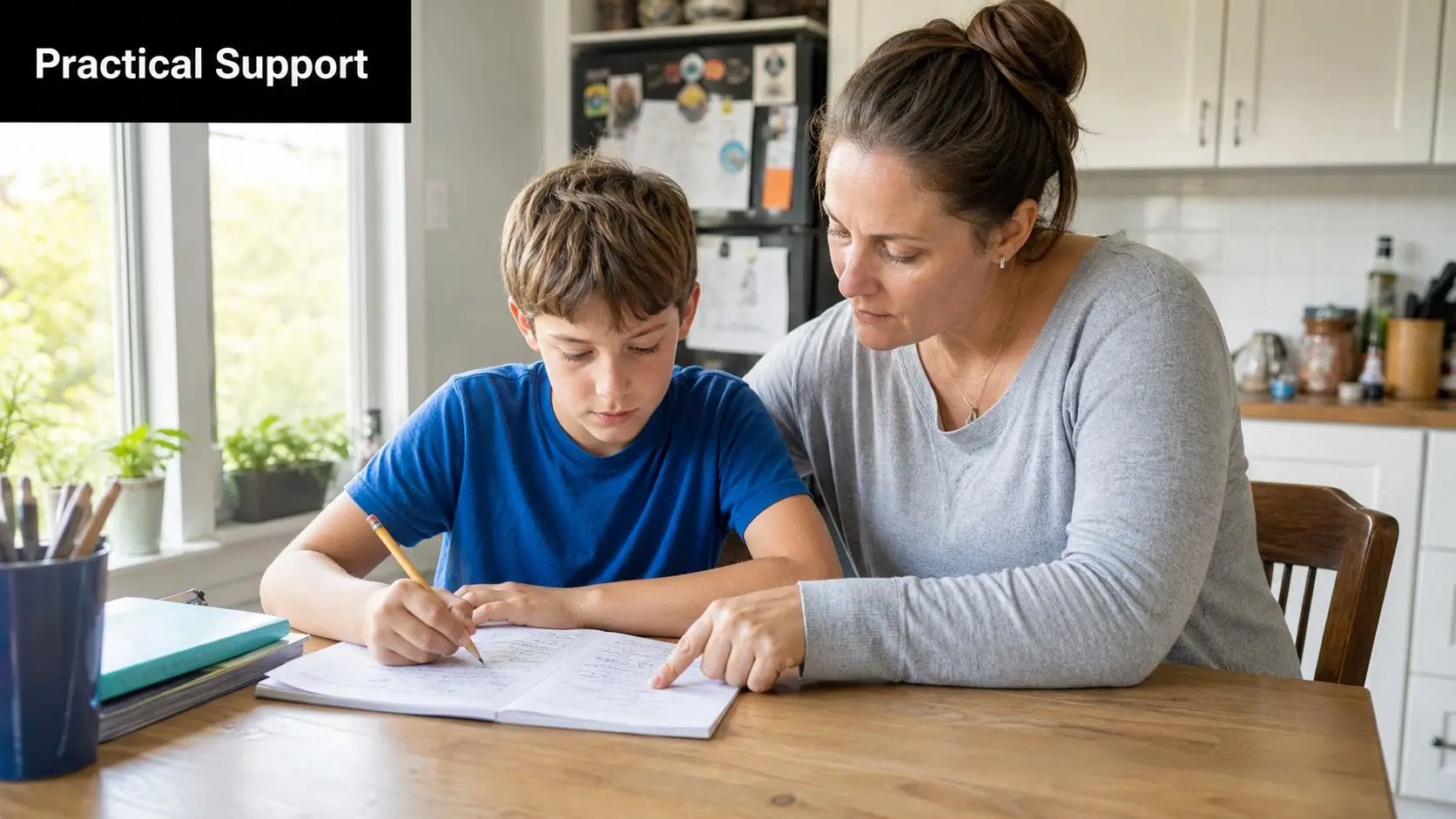
Make work feel possible again
When children feel defeated, the first job is often reducing friction.
- Break tasks into tiny steps. Instead of “Finish your homework”, say “Read the first question with me, then answer just one.”
- Use a timer kindly. Ten focused minutes can feel safer than an open-ended task.
- Alternate effortful and easier tasks. For example, one reading activity followed by an oral discussion.
- Let the child show knowledge in different ways. Speaking answers, drawing a diagram, using magnetic letters, or typing all count.
A Year 5 child who resists writing may manage far more if you scribe their first sentence, then ask them to continue. A secondary pupil revising history may recall more by recording voice notes than by rewriting pages of notes.
Build confidence while you teach
Children notice very quickly whether adults focus only on mistakes. Try to name the process you want to strengthen.
| Situation | Less helpful response | More helpful response |
|---|---|---|
| Child misreads a word | “No, that's wrong again” | “Good try. Let's break that word into parts” |
| Child avoids homework | “You're being difficult” | “This feels hard. Let's start with the part you can do” |
| Child panics in maths | “You know this” | “We'll use the method that helps your brain remember” |
Home truth: A calm adult nervous system is one of the most powerful supports a child can have.
That doesn't mean you have to be endlessly patient. It means creating enough safety that your child can stay engaged. Sometimes that looks like a snack before homework, a clear routine, and permission to stop before frustration becomes shutdown.
Use assistive technology in practical ways
Assistive technology sounds technical, but often it means using tools that reduce unnecessary barriers. Text-to-speech can help a child access age-appropriate content without all their energy going into decoding. Speech-to-text can help a child get ideas down before spelling gets in the way. Audiobooks, overlays, simplified layouts, and typed checklists can all help.
A gap remains between what families want and what schools consistently provide. Despite 78% of parents requesting it, only 34% of UK schools with students who have severe learning difficulties have fully embedded assistive technology into daily lessons, according to the Department for Education figure cited in this guide to support for severe learning difficulties.
You can still start small at home and then ask school to mirror what works. If readability is part of the problem, this guide to accessible fonts for WCAG compliance can help you choose clearer print styles for worksheets, revision notes, and homework sheets.
Keep home and school aligned
A simple message to school can go a long way: “We've found he manages better when instructions are chunked and read aloud. Could this be used in class too?”
Consistency helps the child more than any single strategy. If adults use similar language, similar routines, and similar expectations, the child spends less energy decoding the environment and more energy learning.
Could Supportive Online Schooling Be the Answer
For some children, the issue isn't just the curriculum. It's the environment in which they're expected to learn. Noise, pace, social pressure, transitions between classrooms, and the fear of getting things wrong in front of peers can drain a child before the lesson has even properly begun.

That's why some families start looking beyond a traditional setting. Supportive online schooling can offer a different rhythm. A child may work from a calmer space, revisit recorded material, and learn in smaller live classes where teachers can spot confusion earlier. For students with SEN or SEMH needs, that can reduce the daily load that gets in the way of learning.
What to look for in an online option
Not every online school will suit a learner with additional needs. The key question is whether the environment is designed for personalised learning, rather than merely delivering the same content through a screen.
Look for features such as:
- Small class sizes so teachers can notice hesitation, not just completed work
- Subject-specialist teachers who can adapt explanation, pace, and task design
- Real-time feedback so a child doesn't practise errors for days before anyone corrects them
- Flexible access including recorded sessions when fatigue or anxiety affects attendance
- A clear pastoral system so emotional wellbeing is supported alongside academic progress
One option some families consider is online school for dyslexia support, where live British curriculum teaching, smaller classes, and personalised pathways can better match the needs of children who haven't thrived in a mainstream pattern.
A short introduction can help families picture how online learning feels in practice.
When online schooling may fit particularly well
A child might benefit from this model if they are academically able but emotionally overwhelmed in school, if bullying or sensory stress is undermining attendance, or if they need a pace and structure that's hard to secure in a larger classroom.
This isn't about avoiding challenge. It's about finding the right conditions for challenge to be productive rather than crushing. A child who feels safe is more likely to attempt, persist, and recover from mistakes. For many families, that shift is the turning point.
Your Next Steps and Finding Your Community
By the time parents seek learning disabilities support, many are exhausted. They've explained the same worries more than once. They've watched their child dread school. They've tried sticker charts, extra reading practice, firmer routines, gentler routines, and late-night internet searches. If that's where you are, make the next steps smaller.
A manageable checklist
Write down three specific concerns
Keep them concrete. “Reads very slowly”, “forgets multi-step instructions”, “melts down before written homework”.Write down three strengths
This keeps your child visible as a whole person. “Great verbal vocabulary”, “kind with younger children”, “strong practical reasoning”.Book one school conversation
Ask for a meeting with the teacher and, if possible, the SENCO.Take examples with you
A workbook page, an email trail, a homework sample, or a short note about how long tasks take.Ask one forward-looking question
“What will school try next, and when will we review it?”
Community matters more than parents expect
The practical system matters, but so does emotional survival. Families often feel calmer once they meet other parents who understand the strange mix of love, grief, pride, and advocacy this journey can bring.
Useful places to start include Mencap, the British Dyslexia Association, local parent-carer forums, and your local authority's SEND network. If you need a reminder that growth can still happen in difficult seasons, these insights on positive personal growth may feel encouraging in a week that has been heavy.
Your child does not need to become someone else to succeed. They need support that fits who they already are.
That's the heart of it. Clear information helps. Good teaching helps. The right accommodations help. But the deepest change often comes when a child realises the adults around them understand that their struggle is real, their strengths are real too, and they don't have to face school feeling broken.
If you're exploring a more flexible path, Queens Online School offers a fully online British curriculum with live teaching, small classes, and personalised support that may suit learners who need a calmer, more customized environment.