


Results day can turn a house upside down in minutes. One child opens the envelope and laughs with relief. Another goes quiet. A parent looks at a grade they weren't expecting and feels two things at once: protectiveness and panic.
If that's where you are, start here. A disappointing result feels personal, but the next steps need to be practical. The child in front of you needs calm more than instant analysis. They need to hear that one grade, even an important one, doesn't decide their worth, their intelligence, or their future. Then, once the first shock settles, you can work through whether there's a real basis to challenge the result and how to do it properly.
That Feeling When the Envelope Opens
A common scene plays out the same way every summer. A teenager has spent weeks trying to prepare themselves for every possible outcome. They say they're “fine”. Then the result arrives, and the room changes. Sometimes it's tears. Sometimes it's anger. Sometimes it's that flat, stunned silence that worries parents most.
When a child says, “That can't be right,” it's tempting to jump straight into action. Call the school. Search the rules. Draft an email. Those things may matter later, but the first job is emotional containment. If your son or daughter is overwhelmed, they won't be able to think clearly about what happened or what comes next.
What helps in the first hour
Keep the conversation small and steady.
- Name the feeling: “I can see this has knocked you.”
- Avoid instant judgement: Don't say they were “definitely robbed” and don't say they “must accept it” either.
- Lower the temperature: Get them some water, food, and a quiet space before discussing appeals.
- Protect them from an audience: If relatives are messaging for updates, hold them off.
A parent once described it perfectly to me: the grade felt like a verdict on her child. It wasn't. It was a result that now needed checking, understanding, and, if justified, challenging.
Practical rule: Don't discuss appeals as a battle to be won. Discuss them as a process for checking whether something went wrong.
What to say to a child with SEN or SEMH needs
For pupils with autism, ADHD, anxiety, or other SEN or SEMH needs, the upset can be sharper and longer-lasting. The issue may not be only disappointment. It may be sensory overload, shame, panic about letting people down, or spiralling thoughts about the future.
Use simple language. Keep questions concrete. Instead of “How do you feel about your academic profile now?”, ask, “Do you want to sit quietly, talk, or have me handle the calls for now?”
If your child is already highly stressed, it may help to pause and use some practical techniques for calming exam-related anxiety before tackling the paperwork. Queen's has a useful guide on how to reduce exam stress that many families find helpful in exactly this moment.
The key message is this: your child doesn't have to carry the whole problem alone. You can hold the process while they recover enough to take part in it.
Before You Appeal What to Do Right Now
The first day matters. So does the second. Missing a deadline because everyone was too distressed to act is one of the saddest and most avoidable problems I see.
For parents in England, the official appeals process opens on Tuesday, 6 August at 9:00 am, and schools must submit priority appeals by Tuesday, 26 August 2025 at 11:59 pm for students with conditional university places, according to the GOV.UK guide to appealing a qualification result. If a place depends on the grade, treat that as urgent.
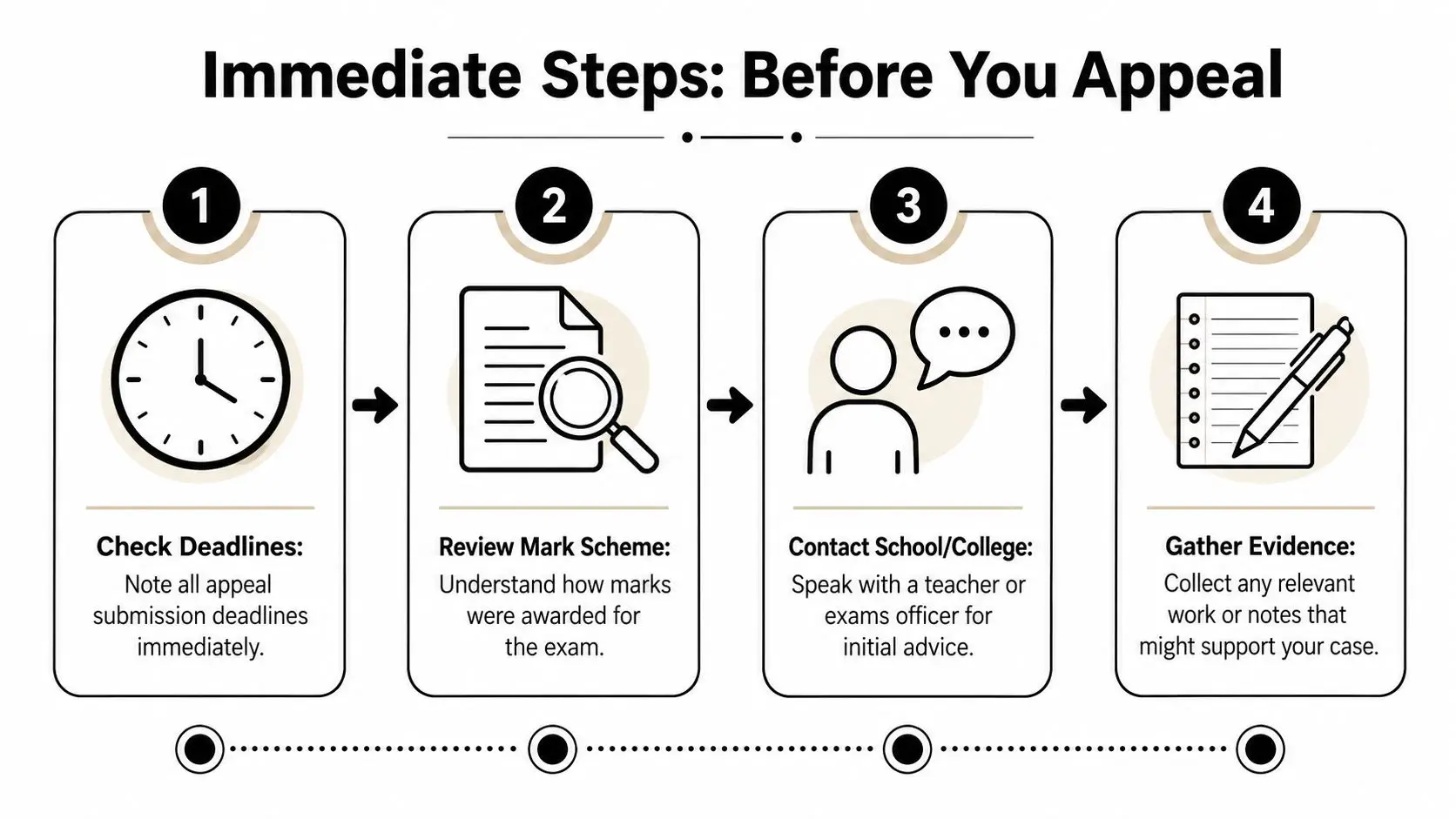
The first 24 to 48 hours
Don't start by arguing with the exam board. Start with the school or exam centre.
Contact the exams officer
Ask for the exact post-results route available for your child's qualification. The exams officer usually knows the internal process, deadlines, required forms, and what the centre will or won't support.
Speak to the subject teacher or head of department
Ask one direct question: does the mark look out of line with the child's demonstrated standard? You're not asking for comfort. You're asking for professional judgement.
Clarify whether a priority case applies
If your child has a conditional university or college place, say so immediately. Centres often handle these cases differently because time matters.
Ask what evidence the school needs from you
This may include details about access arrangements, what happened in the exam room, or why the result appears inconsistent.
What to ask the school
A short checklist often keeps stressed families focused:
- What is the internal deadline? School deadlines are often earlier than board deadlines.
- What service are you recommending first? In most cases, a review comes before any formal appeal.
- Who submits it? In many cases, the school acts as the gateway.
- What can my child expect while waiting? This matters emotionally as much as administratively.
Get names, dates, and written confirmation. Appeals go wrong when families rely on verbal assurances.
Keep perspective while acting fast
There's a difference between urgency and panic. A rushed, vague complaint rarely helps. A precise request does.
Some families find it useful to compare how assessment rules work in other systems to understand why weighting, marking, and technical criteria matter so much. If you want a simple example of how exam structures shape outcomes, this explainer on English weightage for PSLE exam is a useful contrast. Not because the systems are the same, but because it shows how important it is to understand exactly how marks are built before challenging the result.
If your child is distressed, let one adult lead the admin. The child should be informed, not burdened with every phone call.
Is an Appeal the Right Path for Your Child
Not every disappointing grade should become an appeal. That sounds blunt, but it protects families from pouring energy into a route that doesn't fit the facts.
The strongest cases usually involve something specific: a clerical mistake, a problem in the marking process, or a failure in procedure. The weakest cases start with “my child worked hard” or “this doesn't feel fair”. Those feelings are real. They just aren't always appeal grounds.
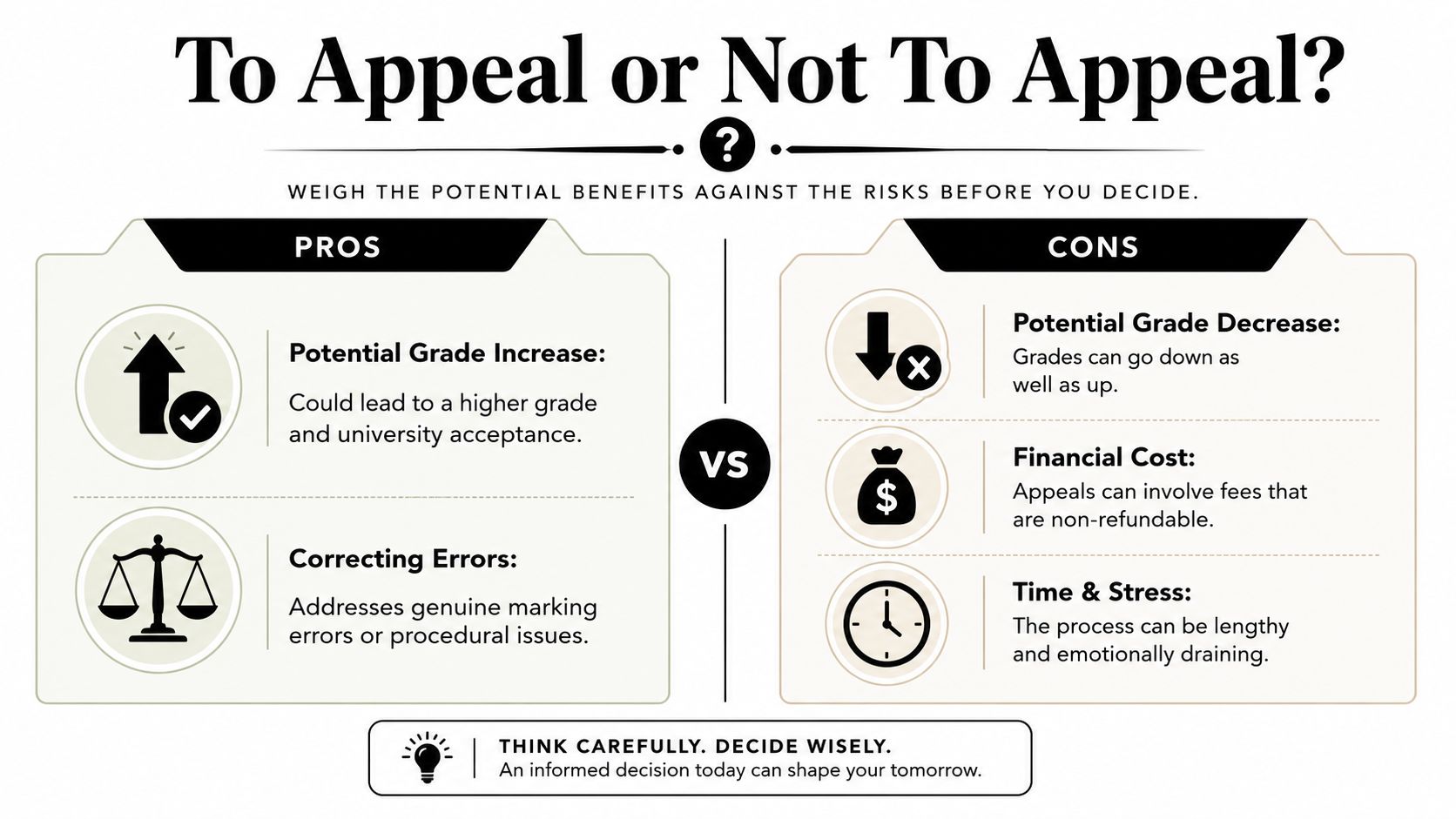
Cases that may justify action
A useful way to think about this is to separate disappointment from discrepancy.
| Situation | Usually worth exploring | Why |
|---|---|---|
| The grade is far below the child's consistent performance | Sometimes | It may indicate a marking or procedural issue, but it needs evidence |
| Marks may have been added or recorded incorrectly | Yes | That's a concrete error |
| Agreed exam access arrangements were not provided | Yes | That can be framed as a centre failure, not just poor performance |
| The child thinks the examiner “didn't like the answer” | Maybe not | It needs a clear mark scheme issue, not a general disagreement |
| The child was upset on the day | Only in certain cases | Distress alone usually isn't enough without a linked procedural failure |
The SEN and SEMH distinction that many guides miss
This matters enormously for some families. In the UK, 15% of students have Special Educational Needs, and 22% of them fail to achieve expected grades due to exam environment stress, but standard appeals don't usually cover distress on its own. Where there may be a stronger route is when the centre failed to provide agreed access arrangements or failed to deliver conditions your child was entitled to receive.
That changes the framing. The appeal isn't “my child was too anxious to perform”. It becomes “the exam was not conducted with the agreed support or conditions that were required”.
A practical example: a pupil with autism had noise sensitivity recorded and had agreed adjustments in place, but sat the paper in a busier room than planned. If the child then underperformed, the argument is not merely emotional upset. It's possible procedural failure by the centre.
Parents of SEN or SEMH pupils often instinctively describe the outcome in emotional terms first. That's understandable, but the formal process usually responds better to documented failures in arrangements.
What about suspected teacher bias
This is one of the hardest conversations because families often feel something unfair happened but can't fit it into the official categories. Guidance commonly treats genuine errors differently from differences of academic judgement. That means a concern about teacher bias in a subjective piece of work may feel morally serious but still be difficult to appeal through the usual route.
If that is your concern, ask the school two separate questions:
- Is there an appeals route for a marking or procedural error?
- Is there a separate complaints route for staff conduct or unfair treatment?
Those are not the same thing, and trying to force one into the other often wastes precious time.
The Two-Stage Journey Review and Appeal
Most families want to leap straight to the final decision-maker. The system doesn't work like that. In practice, you can't usually begin with a formal appeal. The first step is typically a review through the school or college, and only after that can the matter move forward if there's still a valid reason.
The broad shape of the UK process has been built around a two-stage model. A review of marking comes first, followed by a formal appeal if the issue remains unresolved. Schools are often the gatekeepers, and students usually don't bypass them on day one.
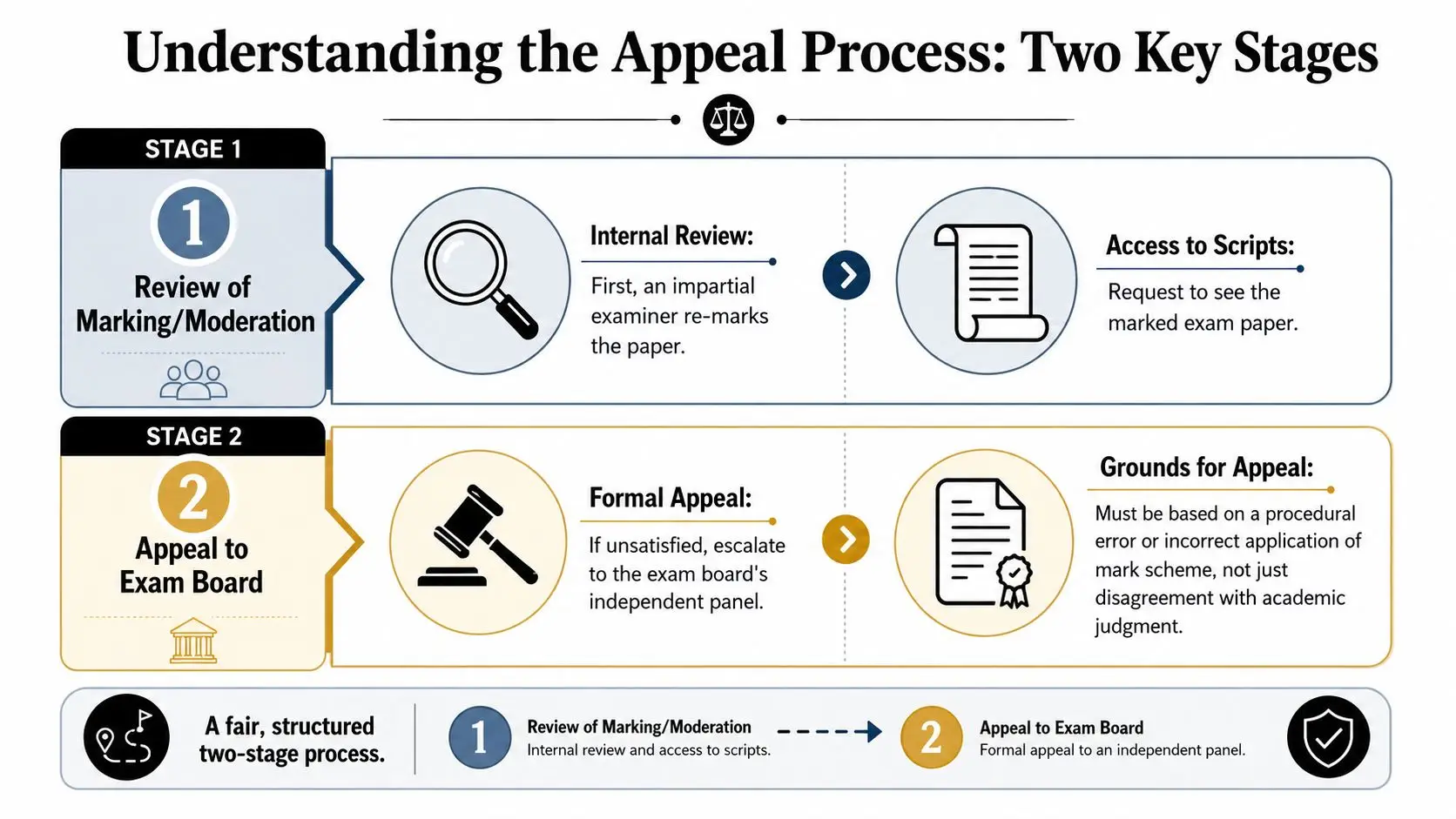
Stage 1 Review of marking
Most cases begin with the school or college submitting the request. You should ask the exams officer exactly which post-results service applies to your child's paper and what the centre requires from you in writing.
For Scottish qualifications, the appeals service opens on results day, Tuesday, 4 August at 9:00 am, with priority appeals from learners due by Tuesday, 11 August at 11:59 pm and school submissions due by Thursday, 20 August at 5:00 pm, according to the Qualifications Scotland appeals guidance. The principle is the same across the UK. Timing is tight, and the school's role is central.
A review is not the same as saying, “Please read it again and be kinder.” It is a structured check for marking accuracy and process.
A sample email to the school
You don't need legal language. You need clarity.
Subject: Request for review of marking for [subject and qualification]
Dear [Exams Officer/Head of Year],
I am writing to request a review of marking for [student name], [qualification and subject], following the result issued on [date].
We are concerned because [brief factual reason: for example, the result is significantly out of line with consistent assessed performance / agreed access arrangements were not provided / there may have been a specific issue during the exam].
Please confirm the internal deadline, the form or evidence required, and whether this should be treated as a priority case due to a conditional place.
Kind regards,
[Name]
Stage 2 Formal appeal
If the review outcome still leaves a genuine issue unresolved, the case may proceed to a formal appeal. Many families encounter difficulty at this stage, as the paperwork becomes technical. A successful appeal usually needs precision, not emotion.
For Pearson/Edexcel pathways in particular, technical compliance matters. The JCQ 2025 report found that 68% of failed appeals came from candidates not citing the specific Question Number and Mark Scheme Reference in their submission. That tells you something important. General complaints rarely carry weight.
Later in the process, if your child is on an Edexcel qualification, it helps to understand how that board structures assessment and review practice. This guide to the Edexcel exam board gives a helpful overview for families trying to decode board-specific language.
A short explainer can also make the system less intimidating:
What works and what doesn't
What tends to work:
- Specific references: Identify the exact question and the mark scheme point in dispute.
- Documented procedural issues: For example, agreed access arrangements not delivered.
- Professional tone: Calm, factual writing is more persuasive than angry accusation.
What usually fails:
- Generic frustration: “This grade doesn't reflect my child's ability.”
- Long emotional narratives without evidence
- Requests that amount to re-mark everything and see what happens
For some Pearson or Edexcel examinations, there are also board-specific administrative steps and fees in certain routes, so always check the exact qualification rules before filing. Don't assume one board's process is identical to another's.
What to Expect Costs Timelines and Outcomes
Parents cope better when they know what the process can and can't do. Uncertainty is often harder on a child than bad news, especially if they're checking their phone every ten minutes and reading every delay as a disaster.
The first reality is that appeals are not designed to rescue every borderline case. They are designed to correct identifiable problems. That's why expectations need to be steady, not bleak, but steady.
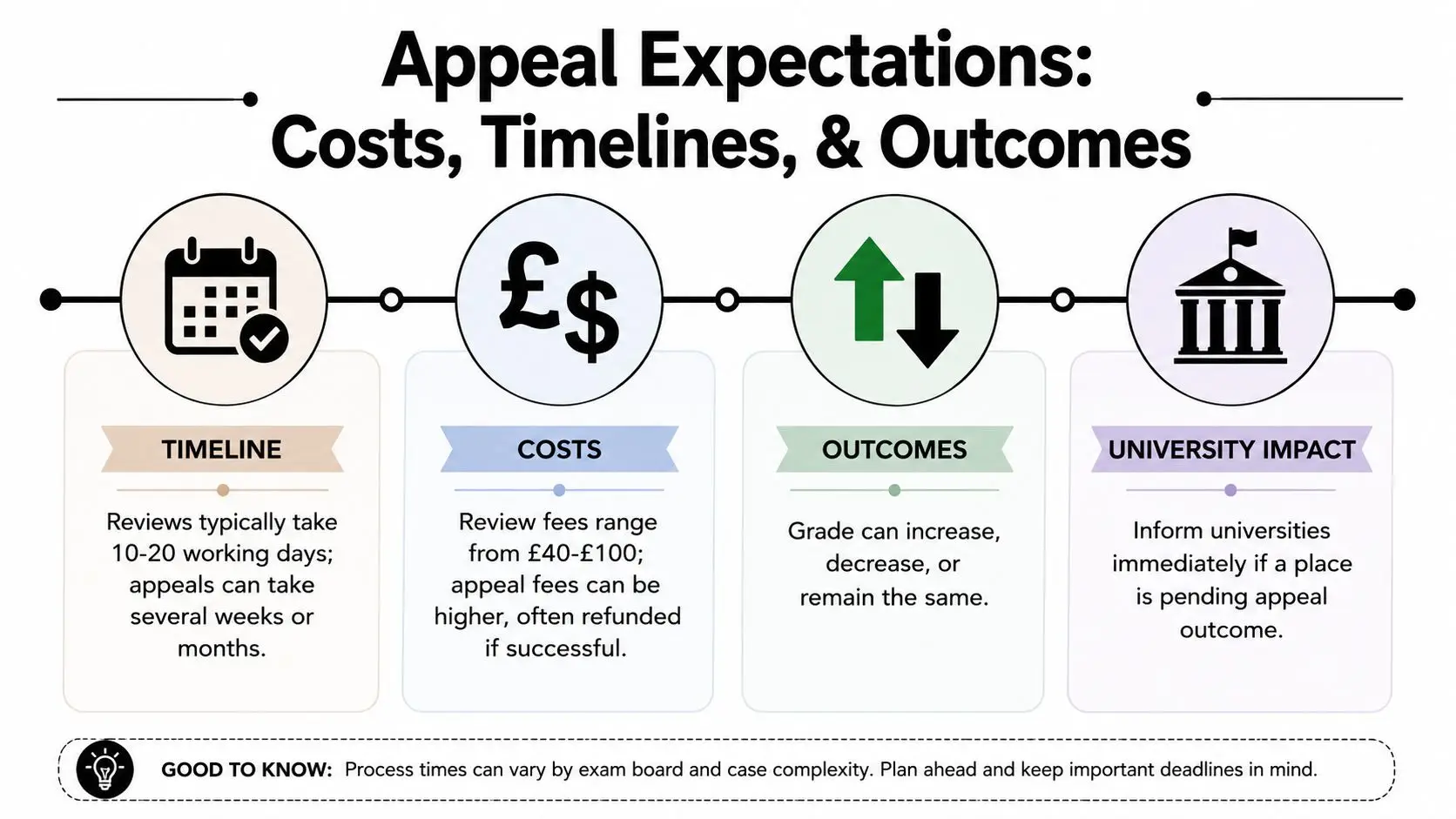
The likely outcomes
Official data from 2023 shows that about 65% of review of marking requests lead to no grade change, and 15% of formal appeals that move to the next stage succeed in altering grades. That means the process is more effective at correcting clear procedural problems than shifting marginal marks.
That doesn't mean your child's case is hopeless. It means you should prepare them for all three outcomes: the grade may go up, stay the same, or, in some pathways, be reconsidered in a way that doesn't guarantee improvement.
A sensible conversation with a teenager sounds like this: “We're doing this because there may be a valid issue, not because we can promise a different result.”
Costs and waiting time
The cost depends on the qualification and route. For standard GCSE and A-level frameworks under the SQA and Ofqual approach, the formal appeal route is described as free in the verified guidance. Some Pearson or Edexcel-related routes and professional exam pathways can involve administrative fees, sometimes refunded if the outcome changes. That's why families should ask the centre one very direct question before submitting anything: what will this cost in this exact qualification, and when is any fee refunded?
Timeframes also vary. Verified guidance notes that final reports are generally issued within weeks of lodgement, and some boards are required to provide a written response within a defined period for formal appeal routes. Priority cases move faster because university admissions timetables don't wait.
If your child's next step depends on grade thresholds, it can also help to understand how narrow some boundaries are in practice. This overview of A-level grade boundaries is useful for explaining why even small marking issues can matter, but also why not every near miss becomes a successful appeal.
A waiting period needs managing like part of the process, not dead time. Encourage your child to keep options open while the appeal is being considered.
A realistic family plan
While waiting, do three things in parallel:
- Keep the destination informed: If a college or university place is affected, update them promptly through the correct channel.
- Preserve routine: Sleep, meals, exercise, and reduced doom-scrolling matter more than parents sometimes realise.
- Prepare Plan B: Looking at alternatives doesn't mean giving up on the appeal. It means protecting the child from feeling trapped.
That balance is one of the healthiest things a family can do. Hope for a fair correction. Prepare calmly for a different answer.
Looking Beyond the Appeal Resits and Next Steps
If the appeal succeeds, there's relief. If it doesn't, there may be grief, anger, or exhaustion. Both outcomes need handling carefully because the child still has to live with the emotional aftermath.
A result, even an unfair one, isn't the whole story of a young person's education. I've seen pupils regroup through resits, course changes, different sixth form pathways, foundation routes, and alternative study settings that suit them far better than their previous environment did.
When a resit may be the healthier option
Sometimes an appeal is technically possible but not the strongest route. Sometimes the better answer is to rebuild. That can be especially true if the original exam sitting was tangled up with panic, poor health, bullying, or inadequate support needs management.
For a student with SEN or SEMH needs, a resit plan should never be framed as “try harder next time”. It should begin with practical questions:
- What conditions need changing?
- What access arrangements must be secured in writing?
- What teaching format helps this child stay regulated and engaged?
Protect the child's sense of self
Children often hear a failed appeal as confirmation that they were wrong about themselves. Parents need to actively interrupt that story.
Say plainly what remains true:
- they worked hard
- they deserve support
- one result doesn't erase their strengths
- there is still a route forward
If your child is struggling emotionally, don't wait for things to get worse before seeking support. Childline and YoungMinds can both be valuable starting points for families who need mental health guidance during results season.
What matters most is that your child comes through this with their confidence recoverable. The appeals process should serve the student, not consume them.
If your child needs a more flexible, supportive route after results day, Queens Online School offers a British curriculum online with live teaching, personalised support, and an inclusive environment for learners including those with SEN and SEMH needs. For families considering resits, a fresh start, or a calmer way to study towards GCSEs and A-levels, it's worth exploring a setting built around both achievement and wellbeing.