

You may be reading this after another difficult school morning. Your child is bright, funny, full of ideas, and yet something still isn't clicking. Perhaps they come home drained. Perhaps homework ends in tears. Perhaps they've started saying they're “bad at maths” or “not good at school”, and you know that isn't the whole truth.
I've spoken with many parents in that exact place. They're not looking for a shortcut. They're looking for a setting where their child can breathe, feel known, and learn without spending every day in survival mode. For some families, Key Stage 2 online learning becomes that fresh start.
The most important lesson from the pandemic years was simple. Technology on its own doesn't teach children. Teaching does. The UK's move into remote education showed that quality matters most, and structured online programmes with live, interactive lessons and specialist teachers can provide strong academic support for primary-age pupils, as noted in national remote learning evidence.
If you're exploring this for the first time, it's normal to feel unsure. Parents often ask whether online school is “real school”, whether children can still make friends, and how to tell the difference between thoughtful education and polished marketing. Those are the right questions.
What matters most is not whether learning happens in a brick building or through a screen. What matters is whether your child is taught well, cared for properly, and given a chance to grow in confidence.
Your Child's Education Reimagined
A parent once described their child to me like this: “She still loves learning. She just doesn't love school any more.” That sentence stays with me, because it captures something painful and hopeful at the same time. The curiosity is still there. It needs the right environment.
For many children, a traditional classroom works well. For others, it can feel too fast, too noisy, too socially demanding, or too rigid. A child who needs a little longer to process a reading task, a quieter space to think, or more direct encouragement can start to believe they're falling behind when really they're mismatched with the setting.
That's why some families now look at Key Stage 2 online learning not as a fallback, but as a deliberate educational choice. Done well, it can offer routine, warmth, and personal attention. A child logs in, sees a familiar teacher, joins classmates, answers questions out loud, and receives feedback in the moment. It can feel less like being lost in a crowd and more like being properly taught.
Hope looks practical
Hope on its own isn't enough. Parents need something concrete.
A strong online primary experience usually includes:
- Live teaching: Children need a real teacher, not just a bank of videos.
- Interaction: They should be able to ask, answer, discuss, and practise.
- Routine: Predictable days help children feel secure.
- Pastoral care: Emotional wellbeing must sit alongside academic progress.
A happy child doesn't always need easier work. Often, they need clearer teaching, calmer routines, and adults who notice when they're struggling.
If your child has started shrinking themselves to fit an environment that doesn't suit them, it's worth asking whether school could look different. Not lower in standards. Different in shape.
Demystifying Key Stage 2 The Foundation for Future Learning
Key Stage 2 covers children aged 7 to 11, usually Years 3 to 6, and ends with national curriculum tests. In 2023, 59% of pupils in England met the expected standard in reading, writing, and maths combined, according to the national curriculum framework and related government information. That figure matters because it reminds us that these years aren't casual preparation. They form the academic base children carry into secondary school.
Parents often hear “KS2” and think of SATs. I'd encourage you to think of something bigger. Think of Key Stage 2 as the years when children build the floor they'll stand on later.
Think of it like building a house
If a house has weak foundations, the problem may not show at first. The walls go up, the rooms look fine, and then cracks appear later. Learning works in much the same way.
In Key Stage 2, children are building:
- Reading strength: Understanding vocabulary, retrieving information, making sense of what they read
- Writing control: Spelling, grammar, punctuation, sentence structure, and expressing ideas clearly
- Mathematical fluency: Number facts, calculation, reasoning, and confidence with problem-solving
Science matters too, of course, but English and maths often act as the tools children use across nearly every other subject. If reading is shaky, history becomes harder. If number sense is insecure, science investigations become more frustrating.
Why the end of Year 6 matters
The Year 6 assessments can sound intimidating, but their basic purpose is straightforward. They check whether the foundation is secure enough for the next stage. They are not a verdict on your child's worth, personality, or future.
A calm way to explain it to a child is this: “These tests help adults see what you know well and what still needs practice.” That's much healthier than treating them as a giant judgement day.
For parents exploring online education, this is where curriculum alignment matters. If an online school says it offers Key Stage 2, it should be teaching towards the actual national curriculum, not a vague version of “primary learning”. Daily lessons should build steadily towards the knowledge and skills children need by the end of Year 6.
You can see how a structured remote primary curriculum is typically organised in these online primary school lessons.
What good KS2 teaching feels like to a child
Children rarely say, “I'm benefiting from a well-sequenced curriculum.” They show it in simpler ways.
They start saying things like:
- “I get it now.”
- “Can I try one more?”
- “I know what to do first.”
- “I'm not scared of this any more.”
That's the core work of Key Stage 2. Not just covering content, but helping children feel capable.
Practical rule: If a school can't explain how it teaches reading, writing, and maths step by step across Years 3 to 6, keep asking questions.
Inside the Virtual Classroom A Day in the Life
When parents hear “online school”, many picture a child sitting alone at a laptop for hours, clicking through worksheets. High-quality Key Stage 2 online learning shouldn't look like that at all. It should feel active, social, and carefully paced.
This visual gives a useful sense of the rhythm of the day.
A typical morning often starts with a simple check-in. Children arrive, greet their teacher, and settle into the day. That matters more than many adults realise. Young learners need emotional arrival time, not just academic start time.
What lessons actually look like
In a live English lesson, a teacher might share a short text on screen, read part of it aloud, and ask the class to spot clues about a character's feelings. One child answers verbally. Another types in the chat. A third needs a prompt and gets one. The teacher corrects misunderstandings there and then.
In maths, the teacher may model column subtraction, work through one example slowly, then ask children to try the next one while watching for who hesitates. That pause is useful. It tells the teacher who needs another explanation before a wobble becomes a gap.
This is why effective online KS2 programmes need more than streamed content. They need frequent, data-driven assessment and direct teacher-student interaction so children stay on track in core areas such as spelling, grammar, and arithmetic, as outlined in the digital learning playbook for structured remote teaching.
A realistic weekly rhythm
Below is a simple example of how a Year 4 week might be organised. Different schools structure this differently, but the key is balance. Live teaching, independent practice, movement, and support all need a place.
| Time | Monday | Tuesday | Wednesday | Thursday | Friday |
|---|---|---|---|---|---|
| 8:45 | Registration and wellbeing check-in | Registration and wellbeing check-in | Registration and wellbeing check-in | Registration and wellbeing check-in | Registration and wellbeing check-in |
| 9:00 | English live lesson | Maths live lesson | English live lesson | Maths live lesson | English live lesson |
| 10:00 | Break | Break | Break | Break | Break |
| 10:15 | Maths practice | Reading group | Maths practice | Writing workshop | Reading discussion |
| 11:00 | Topic lesson | Science | Topic lesson | Science | Assembly or celebration |
| 12:00 | Lunch | Lunch | Lunch | Lunch | Lunch |
| 1:00 | Independent task | Art or computing | Independent task | Project work | Quiz and review |
| 2:00 | Teacher support slot | PE or movement | Small-group support | Club or enrichment | Reflection and planning |
A timetable like this works because it recognises a child's attention span. Young learners need changes of pace. They need to move. They need moments of success built into the day.
It shouldn't feel lonely
One of the most common worries I hear is, “But will my child be isolated?”
That depends on the school. In a well-run virtual classroom, children still laugh together, show their work, take turns, join clubs, and build friendships. They may work in breakout groups on a story opening, compare science observations, or share book recommendations. Social connection doesn't vanish online. It has to be designed on purpose.
If you want a clearer picture of the systems behind live teaching, parent communication, and classroom tools, it helps to understand the virtual learning environment a school uses.
A short overview can also help make the experience feel more tangible for first-time parents.
The end of the day matters too
Good online schools don't just stop when the final lesson ends. They close the day well. Children review what they've learned, note any next steps, and leave with some sense of completion.
That matters for family life. A child who knows what they've done and what comes next is more likely to finish the day feeling steady rather than overloaded.
Weighing Your Options The Benefits and Challenges
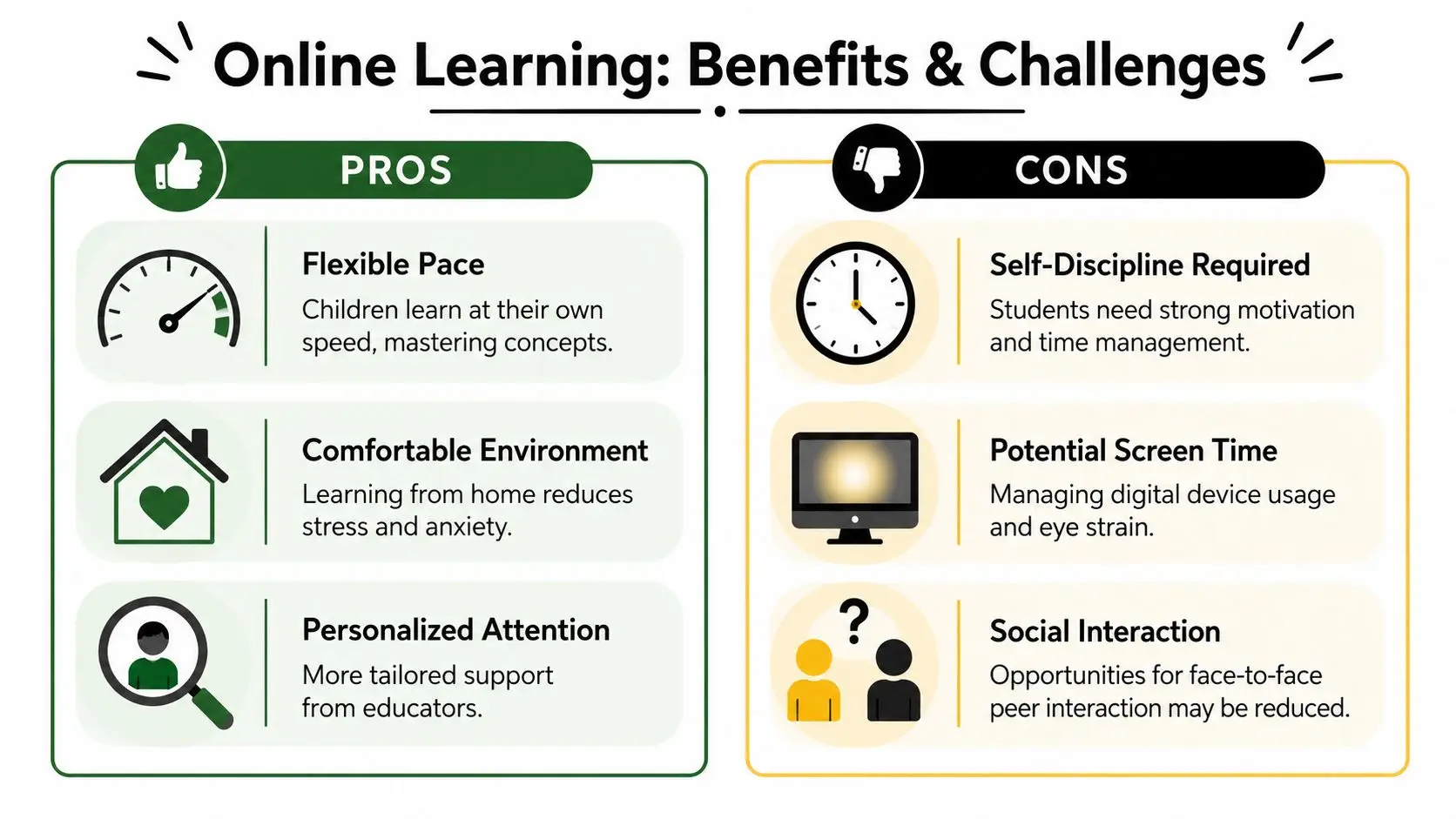
Online learning can be a genuine relief for some children. It can also be the wrong fit for others. Parents deserve honesty about both.
National attainment data show a modest improvement in recent Key Stage 2 outcomes. In 2025, 62% of pupils met the expected standard, up from 61% in 2024, while over 840,000 pupils have failed to meet that benchmark across the post-pandemic period, according to revised Key Stage 2 attainment statistics. To me, that underlines a simple point. Many children still need more targeted support than a one-size-fits-all model provides.
Where online learning can help
Some benefits are easy to spot once you see a child in the right environment.
- Flexible pace: A child who panics when the whole class moves on too quickly can feel calmer when teaching is structured more responsively.
- Comfortable setting: Home can remove some of the stress linked to noise, transitions, peer friction, or long travel days.
- More visible learning: Parents often gain a clearer view of what and how their child is being taught.
A practical example is a child who knows the answer but never puts up their hand in a busy classroom. Online, they may type in chat first, then grow confident enough to speak. That small shift can change how they see themselves as a learner.
The concerns parents raise are valid
It's right to ask hard questions.
Screen time worries many families. The answer isn't to pretend screens don't matter. It's to ask how the day is designed. Quality online schools break up learning with discussion, offline writing, reading away from the screen, movement, and regular pauses.
Friendships are another concern. Children do need connection. The strongest online schools create space for it through clubs, class discussion, collaborative tasks, and informal community moments. A quiet child may even find socialising easier when the environment feels more controlled.
Parental involvement can feel daunting too. Most parents don't want to become full-time teachers, and they shouldn't have to. Your role should be closer to guide, encourager, and organiser of routine, rather than delivering the curriculum yourself.
If an online school relies on the parent to do most of the teaching, it isn't offering school. It's outsourcing the hard part.
A balanced comparison
| Consideration | Potential benefit | Potential challenge | What to check |
|---|---|---|---|
| Learning pace | More room for personalised support | Some children may drift without structure | Ask how teachers monitor engagement |
| Home environment | Less pressure and fewer distractions for some | Home can also contain distractions | Ask what routines they recommend |
| Social life | Friendships can still form intentionally | Less spontaneous face-to-face contact | Ask about clubs, assemblies, group work |
| Confidence | Children may participate more readily | Some feel shy on camera at first | Ask how teachers help children settle |
| Family role | Greater visibility into learning | Requires routine and communication | Ask what support parents receive |
The right question isn't “Is online school good or bad?” The right question is “What kind of child thrives here, and does that sound like mine?”
Finding the Perfect Fit Your Guide to Evaluating Online Schools
Many parents struggle to make a choice. Websites look polished. Prospectuses use the same warm words. Everyone says they are nurturing, ambitious, and child-centred.
The harder task is working out whether a school can teach your child well.
A real difficulty for families is that information on educational quality is often vague. A government-linked discussion of remote education highlighted that many schools lacked consistent remote assessment plans, which is one reason parents should push for transparency about curriculum design and teacher expertise when comparing options, as discussed in this overview of gaps in remote assessment planning.
Look past the homepage
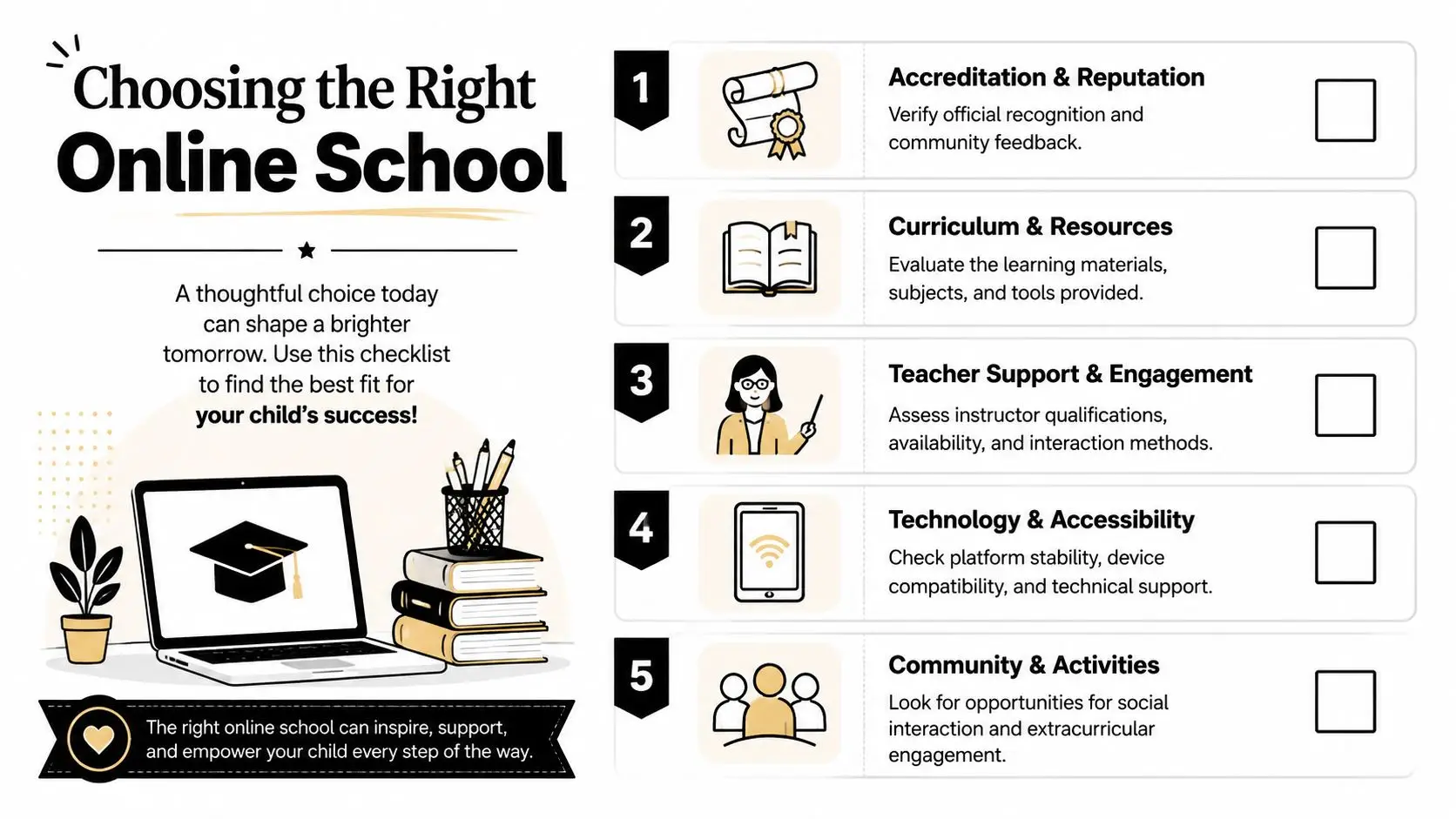
A beautiful homepage tells you almost nothing about daily teaching. You need to ask what happens between log-in and log-out.
Start with these areas.
Curriculum delivery
Ask how lessons are planned across the week and term. A strong school should be able to explain how it sequences reading, writing, maths, and foundation subjects so that children build knowledge in the right order.
Useful questions include:
- What does a Year 4 English week look like?
- How do you teach writing, not just assign it?
- How do you make sure the curriculum matches Key Stage 2 expectations?
If the answers stay vague, that's revealing. A genuine school can describe real teaching.
Teacher expertise
Primary children need warmth, but they also need skill. Ask who teaches the lessons. Are they qualified teachers? Are core subjects taught by people with clear subject knowledge? Who supports children when they fall behind?
One option in this space is Queens Online School, which offers the British curriculum online from primary through sixth form with live classes and subject-specialist teaching. Whether you look there or elsewhere, the same standards should apply.
Assessment practice
This is the area parents most often overlook, yet it tells you a great deal.
You want to know:
- How is progress checked week by week?
- What happens if my child doesn't understand a concept the first time?
- Will I see feedback that is specific, or just general comments?
A good answer mentions regular checks for understanding, targeted support, and clear reporting against curriculum expectations. A weak answer focuses only on end results.
Ask to see an example of marked work or a sample progress report. Schools that assess well are usually comfortable showing how they do it.
Safeguarding and pastoral care
Online learning still requires strong safeguarding. In some ways, it requires even more intentional systems because the environment is digital.
Ask direct questions:
- How are live lessons supervised and recorded?
- What are the rules around communication between staff and pupils?
- Who do children go to if they're upset or worried?
- How do you support attendance, belonging, and emotional wellbeing?
You are not being difficult by asking these things. You are being a careful parent.
Technology and access
The platform doesn't need to be flashy. It needs to work. Children should be able to log in without stress, find their lessons, submit work, and get help if something goes wrong.
Look for clarity around:
- Device requirements
- Technical support for families
- Access to recorded lessons if a child is unwell
- Simple navigation for younger pupils
A simple parent checklist
Here is the framework I'd suggest keeping beside you during admissions calls:
| Area | Strong sign | Warning sign |
|---|---|---|
| Curriculum | Clear explanation of what is taught and why | Generic promises with no detail |
| Teachers | Named qualifications and teaching roles | Unclear staffing information |
| Assessment | Frequent checks and specific feedback | Heavy focus on marketing language |
| Safeguarding | Concrete policies and procedures | Reassurance without detail |
| Pastoral care | A named system for wellbeing support | “We care deeply” with no process |
When parents use this kind of framework, the decision becomes much less foggy. You stop asking, “Do I like the website?” and start asking, “Can this school teach and support my child properly?”
A Place to Belong Supporting Children with SEN and SEMH Needs
For some children, online learning is not merely convenient. It can feel safer.
Children with SEN or SEMH needs often spend huge amounts of energy coping with the environment around learning rather than the learning itself. Noise in corridors, crowded classrooms, sudden transitions, social uncertainty, and sensory overload can all drain a child before the first maths question even appears.
Why the environment matters
A calmer home setting can remove several barriers at once. A child who struggles with sensory overload may concentrate better in a quiet room with familiar objects. A child who feels anxious in large groups may be more willing to join in from a predictable space where they know they can pause, breathe, and try again.
That doesn't mean online learning is automatically easy. It means the environment can be shaped more carefully around the child.
For example:
- A child with attention difficulties may benefit from shorter chunks of teaching and clear visual instructions.
- A child with anxiety may feel reassured by seeing the lesson routine in advance.
- A child with processing needs may need recorded lessons to revisit explanations later.
- A child with emotional regulation needs may need permission to step away briefly without feeling watched or judged.
Support should be planned, not assumed
Parents of children with additional needs are often experts through necessity. You already know what can trigger distress and what helps your child feel secure. A good online school listens to that.
It should ask practical questions such as:
- What helps your child settle at the start of the day?
- How do they show when they're overwhelmed?
- What adjustments make participation easier?
- How should staff communicate when a wobble begins?
A useful starting point for families exploring individualized provision is this explanation of SEN support.
The best support rarely starts with “How do we make this child fit?” It starts with “What does this child need in order to feel safe enough to learn?”
Belonging comes before progress
Children learn best when they feel understood. That's especially true for pupils who have spent too long feeling “too much”, “too behind”, or “too difficult”.
When the environment is calmer, relationships are consistent, and adults respond without judgement, many children begin to show the abilities that were there all along. Their wellbeing improves first. Their confidence follows. Academic progress becomes more possible because the child no longer has to spend the entire day defending themselves from the setting.
Your Questions Answered and Next Steps with Queens
Some practical questions tend to come up near the end of a parent's search, and they matter.
Can my child return to mainstream school later
In many cases, yes. What matters is that the child keeps learning within a clear curriculum and has a record of progress. If you think a future return might be likely, ask how the school documents attainment and supports transitions.
How are subjects like art and PE handled
These subjects usually look different online, not absent. Art may involve guided practical tasks using simple materials at home. PE may include structured movement sessions, fitness routines, or teacher-led activities children can follow safely in their own space.
What if my child misses a lesson
That depends on the school's systems. Many online schools provide recorded access or follow-up support, which can be especially helpful after illness or appointments. Ask how missed learning is picked up quickly, before a small gap grows larger.
How do I know the platform is accessible
Accessibility matters enormously in online education, especially for younger children and pupils with additional needs. Parents who want a broader sense of what thoughtful digital design involves may find this guide to achieving compliant eLearning modules useful. It gives a helpful lens for thinking about usability, clarity, and inclusive access.
A school's online presence can also give you a first impression of how clearly it communicates with families.
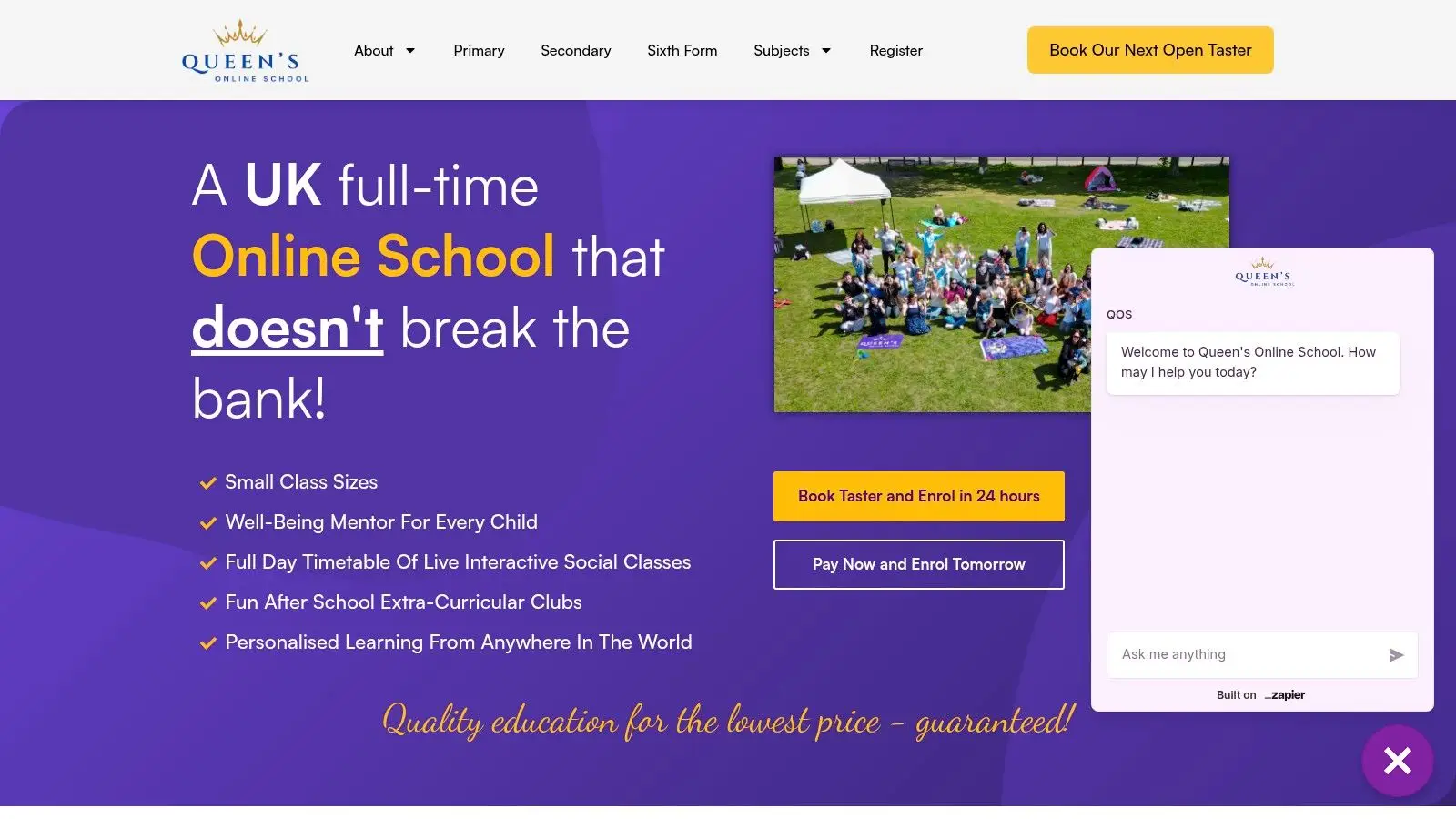
When you're ready to move from research to real conversations, ask for specifics. Ask to see a timetable. Ask how a struggling Year 5 reader would be supported. Ask who notices if your child goes quiet. Those answers will tell you far more than any slogan ever could.
If you'd like to explore whether online primary education could suit your child, Queens Online School is a practical next step. You can review the school's approach, look at how the curriculum is delivered, and speak with the team about your child's needs, pace, and wellbeing before making any decision.