

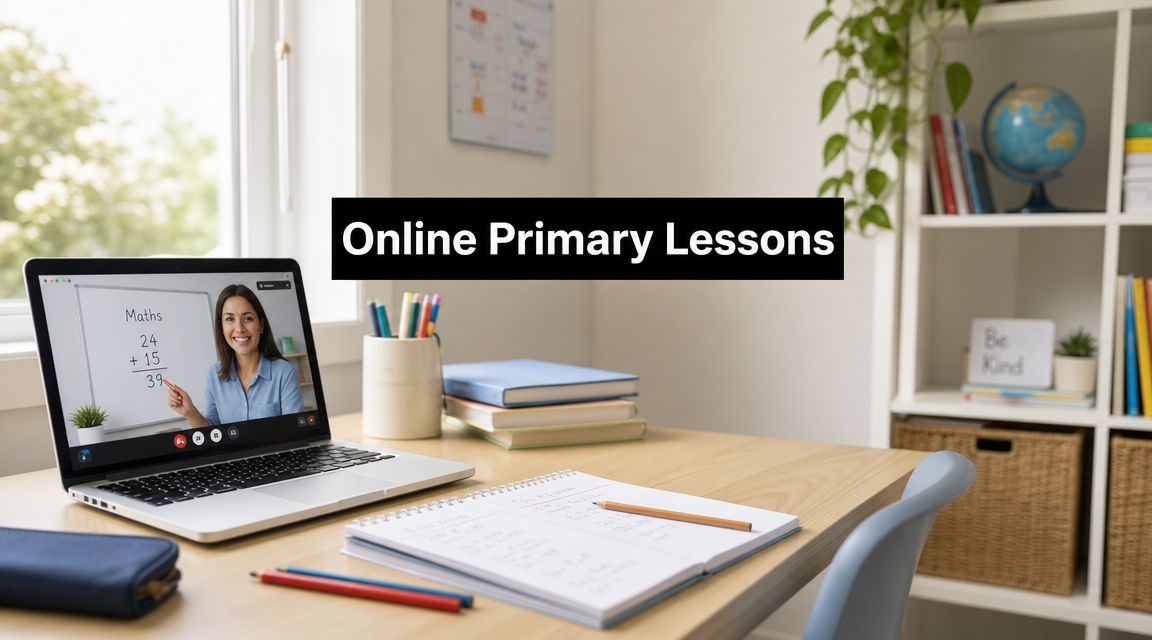
You may be reading this after another difficult morning. Your child dragged their feet getting ready, came home flat and exhausted yesterday, or seems bright and capable but oddly diminished by school. Or perhaps your family life feels permanently organised around the school run, uniform laundry, pickup logistics, and a routine that no longer fits the child you have.
That's often the moment parents start looking at online primary school lessons.
Not because they've given up on education. Because they care enough to ask a better question. Not “Is online school good or bad?” but “Is this right for my child?” That's the only question that matters. A schooling model isn't successful because it sounds modern or flexible. It's successful if your child feels safe, learns well, stays connected, and can get through the week without everything becoming a battle.
Thinking About a Different Path for Your Child
A parent usually doesn't arrive here casually. It often starts with a niggling sense that something isn't working.
Your child may be managing on paper but struggling underneath. They might be anxious before school, bored by the pace, overwhelmed by the noise, recovering from illness, or not flourishing in a crowded classroom. I've spoken to many families in that position. Their concern isn't laziness or lack of resilience. It's that their child's spark is fading.

Online learning isn't a fringe idea anymore. During the spring 2020 COVID-19 disruption, 77% of U.S. public schools moved classes online, and before that only 21% of public schools offered any courses entirely online, according to NCES data on distance learning in schools. Those figures are U.S.-based, but they show something important. What once looked unusual became a serious educational option very quickly.
When parents start asking different questions
The first change is emotional. Parents stop asking, “Can we cope with school as it is?” and start asking, “What kind of school setting helps my child feel steady, curious, and capable?”
For one child, that might mean fewer sensory demands. For another, it might mean more challenge, more direct teaching, or less social pressure. For a family managing health issues, travel, bullying concerns, or a child who is worn out by the school day, online primary school lessons can offer breathing room.
Sometimes the most responsible decision is not to push a child harder into a setting that keeps proving it doesn't fit.
This is a decision about fit, not fashion
I'm direct about this. Online primary education is not automatically better. It is better for some children.
If your child needs calmer mornings, clearer routines, more personalised attention, or stronger adult support during learning, it may be worth serious consideration. If your child thrives on constant physical activity, spontaneous playground interaction, and very hands-on classroom energy, you'll need to look carefully at how an online school provides balance.
That doesn't make the decision frightening. It makes it honest.
Understanding What Online Primary Lessons Really Look Like
Many parents hear “online school” and picture a child left alone with worksheets and videos. Sometimes that does happen. It shouldn't be accepted as the standard.
There are really two different models, and the difference matters. Consider this analogy: One is a live concert. The other is listening to a recording later. Both involve music, but the experience is not remotely the same.

Live lessons and flexible lessons are not equal
With live online primary school lessons, a teacher is present in real time. Children answer questions, join discussions, get corrected immediately, and feel part of a group. There's structure to the day. Someone notices if a child looks confused, quiet, or distracted.
With self-paced lessons, children usually watch recorded content and complete tasks in their own time. That can suit some families, especially where schedules are unusual. But for many primary-aged children, it places a heavy burden on independence that they haven't developed yet.
Here's the difference side by side:
| Model | What it feels like for the child | Best suited to |
|---|---|---|
| Live online lessons | Real-time teaching, routine, class interaction, immediate feedback | Children who need structure, teacher contact, and accountability |
| Self-paced learning | Flexible timing, recorded content, more independent working | Children who are confident working alone, or families who need timetable flexibility |
| Blended approach | Some live teaching plus some flexible tasks | Families wanting structure without every minute being scheduled |
A helpful starting point is understanding the platform itself. If you're new to the idea, this explanation of a virtual learning environment gives a clear sense of how lessons, resources, and communication usually work.
Interaction is what makes the difference
A 2022 study of primary school students found that teacher–student interaction was the key factor linked to satisfaction and effectiveness in online learning. The same study found that only 12.8% preferred online learning overall, which tells you something telling. Children don't automatically enjoy learning through a screen. The quality of the relationship and lesson design decides whether it works. You can read that in the Frontiers study on primary students and online learning.
That fits what I've seen in practice. Young children don't engage because a platform is sleek. They engage because a teacher knows their name, notices hesitation, invites them in, and keeps the lesson moving.
Practical rule: If a school cannot explain how teachers actively interact with children during lessons, assume the burden will fall back on you at home.
Which model suits which child
A lively, chatty child may do very well in live sessions where they can speak and contribute. A thoughtful child who needs processing time may still do well live, provided the teacher gives space and gentle prompts. A child recovering from burnout may benefit from a blended model with shorter live sessions and carefully chosen independent tasks.
The question isn't “Which model sounds more advanced?” It's “Which one helps my child stay engaged without constant parental rescuing?”
A Typical Week in an Online Primary School
Parents often ask the most sensible question of all. “What will my child do all day?”
The answer should be concrete. A good online primary week has rhythm. It doesn't feel like endless screen time, and it doesn't feel like educational improvisation. Children need live teaching, movement, reading, writing, creative tasks, and breaks that are protected rather than treated as optional.
A sample weekly timetable
Below is a simple example of what a Key Stage 2 week might look like. Schools vary, but this gives you a realistic picture.
Sample Weekly Timetable for a Key Stage 2 Learner
| Time | Monday | Tuesday | Wednesday | Thursday | Friday |
|---|---|---|---|---|---|
| 8:45 to 9:00 | Registration and morning check-in | Registration and morning check-in | Registration and morning check-in | Registration and morning check-in | Registration and morning check-in |
| 9:00 to 9:45 | English | Maths | English | Maths | English |
| 9:45 to 10:00 | Movement break | Movement break | Movement break | Movement break | Movement break |
| 10:00 to 10:45 | Maths | Science | Maths | Topic | Maths investigation |
| 10:45 to 11:00 | Snack and screen break | Snack and screen break | Snack and screen break | Snack and screen break | Snack and screen break |
| 11:00 to 11:45 | Guided reading | Writing workshop | Science | Guided reading | Class discussion |
| 11:45 to 12:15 | Independent task | Independent task | Practical activity | Independent task | Project work |
| 12:15 to 1:00 | Lunch and outdoor time | Lunch and outdoor time | Lunch and outdoor time | Lunch and outdoor time | Lunch and outdoor time |
| 1:00 to 1:40 | Topic | Art | Computing | PSHE | Music |
| 1:40 to 2:00 | Break | Break | Break | Break | Break |
| 2:00 to 2:40 | PE or movement | Group task | Library or reading | Presentation work | Celebration assembly |
| 2:40 to 3:00 | Review and home task briefing | Review and home task briefing | Review and home task briefing | Review and home task briefing | Weekly reflection |
What the week feels like in practice
The strongest online primary school lessons don't try to copy a classroom minute for minute. They shorten what needs shortening and protect what matters most. A live English lesson may be followed by offline handwriting practice. Science may involve a simple experiment using kitchen items. Reading may happen curled up on the sofa away from the screen.
That's healthier for the child and usually more sustainable for the family.
A typical week should include:
- Clear starts and finishes so the day feels contained
- Regular movement breaks so children don't become frazzled or sluggish
- Independent tasks with a purpose rather than busywork
- Adult check-ins from school staff, not just from parents
- Creative work such as art, storytelling, model-making, music, or presentations
Homework looks different when home is the classroom
For many families, reassurance is essential. “Homework” in an online setting shouldn't mean extra hours after a full day on screen. It should usually be light, purposeful, and age-appropriate. Reading, spellings, a maths game, finishing a short written task, or preparing something to share the next day is enough for most primary children.
If the school day already leaves your child drained, adding a heavy evening workload is poor planning, not rigour.
Watch your child at the end of a week. Are they still curious? Can they tell you what they learned? Do they seem calmer, or more brittle? That tells you more than any glossy brochure.
The Teachers and Support Your Child Deserves
If I had to reduce this entire decision to one point, it would be this. The quality of the adults matters more than the quality of the software.
Children remember how a teacher made them feel about learning. In online primary school lessons, that becomes even more important. A good teacher online doesn't just deliver content. They draw children in, notice confusion early, build trust, and create a class culture where participation feels safe.
What to look for in the teaching team
Ask direct questions. Are teachers qualified? Do they understand the primary years, not just the subject matter? Can they explain how they adapt teaching for children who are anxious, distracted, dyslexic, autistic, or new to online learning?
You're looking for adults who can do three things at once:
- Teach clearly so your child knows what to do
- Read the room even through a screen
- Respond personally when a child is stuck, wobbly, or falling behind
One practical area often overlooked is accessibility. For online lessons to be inclusive, they must meet standards such as WCAG 2.2, which means things like captions, transcripts, and keyboard-operable controls matter. They aren't nice extras. They are part of whether some children can participate at all, as outlined in this guidance on accessibility in online learning.
Support should be built in, not bolted on
For children with SEN, SEMH needs, health concerns, or uneven confidence, support has to be visible in the daily life of the school. It should not depend on a parent fighting for it every week.
A school should be able to tell you:
- How lessons are adapted when a child struggles with attention, processing, reading, or anxiety
- Who monitors wellbeing and how concerns are followed up
- What happens if a child disengages from lessons or starts avoiding work
- How staff create routines that help children feel secure
If you want a useful wider read on classroom habits that support calm and consistency, this piece on fostering organized learning environments is worth your time because many of the same principles matter online.
For families specifically comparing how schools approach difference and access, inclusive education practices in online settings can help you frame the right questions.
Pastoral care still matters online
A child must still feel known. They need greetings, encouragement, routines, and adults who notice when they're not themselves. If a school talks only about curriculum and never about relationships, I'd be wary.
The right online school doesn't ask your child to fit a system coldly. It builds a system that leaves room for your child to be human.
Setting Up Your Home for Learning Success
Most families don't need a perfect home setup. They need a workable one.
Parents often worry they need a spare room, expensive equipment, or a Pinterest-worthy desk. They don't. Your child needs a calm corner, a reliable device, materials they can reach easily, and a routine that doesn't begin in chaos.

Start with the basics that actually matter
Research on remote learning identifies unreliable internet, lack of suitable devices, and technical difficulties as recurring barriers. That's why sensible schools design lessons that work across different connection speeds and hardware, as discussed in this research on barriers in online remote learning.
That matters because your child can't learn well while battling frozen screens, glitchy audio, or a device that won't hold charge.
Set up these essentials first:
- A dependable device your child can use comfortably for lessons
- Headphones if helpful especially in a busy household
- A charger within reach so lessons aren't interrupted
- A simple workspace with good light and limited background distraction
- A backup plan for brief internet trouble, such as downloaded materials or teacher instructions
Make the space child-friendly, not showroom-perfect
A dining table can work. So can a small desk in the corner of a bedroom. What matters is consistency. Children settle better when they know, “learning takes place here.”
Keep the setup practical. Pencil pot. Water bottle. Exercise books. Device. Reading book. Nothing more than they need.
If you want ideas that are tidy without becoming fussy, this Blu Monaco student desk organization guide offers sensible prompts you can adapt to a real family home.
A good learning space lowers friction. It doesn't have to impress anyone.
Build routines that reduce drama
The home setup is not only physical. It's also behavioural. Lay clothes out the night before. Keep login details in one place. Start the day with the same sequence. Breakfast, wash, dress, lesson materials ready.
Children cope better when the morning doesn't feel negotiable.
A short visual guide can help if you're planning your setup and daily rhythm:
If your home is small, don't be discouraged. Use a tray that comes out at lesson time. Store books in a basket. Let the school space disappear when the day is over if it has to. Plenty of families make online primary school lessons work without dedicated schoolrooms. Calm beats perfection every time.
How to Choose the Right Online School for Your Child
You do not need the school with the slickest website. You need the school that fits your child's temperament, learning style, and daily reality.
That means looking past marketing and asking blunt questions. Who teaches? How often do children interact live? What happens when a child struggles? How much falls back on the parent? Those answers matter far more than polished slogans.

The checks I'd make first
Use this shortlist when comparing providers:
- Teaching model. Is instruction live, self-paced, or mixed? Primary children usually need more real-time teaching than providers admit.
- Curriculum. Does it follow a recognised pathway that makes sense for your family's plans?
- Safeguarding. Can the school explain attendance monitoring, online conduct expectations, and how concerns are escalated?
- Support. Is there pastoral care, SEN support, and technical help?
- Community. Are there clubs, group projects, assemblies, or social opportunities that help children feel they belong?
One factual point deserves careful attention. Some online programmes rely heavily on parents to act as learning coaches. Given that 7% of adults in the UK had very low digital skills in 2024, it's sensible to choose a model where qualified teachers lead instruction rather than shifting the educational load onto the family. That issue is raised in this overview of online elementary learning and parent support.
Match the school to the child in front of you
Ask yourself these questions truthfully:
| Child trait or need | What to prioritise in a school |
|---|---|
| Needs routine and reassurance | Live daily lessons, clear timetable, regular teacher contact |
| Easily overwhelmed socially | Small groups, gentle participation, strong pastoral support |
| Bright but under-stretched | Flexible grouping, extension work, responsive teachers |
| Needs adult encouragement to keep going | Visible teacher feedback, close monitoring, simple systems |
| Managing health or anxiety | Recorded access where appropriate, calm pacing, compassionate communication |
If you're weighing online schooling against home education or a hybrid arrangement, this guide to being home schooled online can help clarify the difference between parent-led and school-led models.
One provider to consider among your options
For families seeking a British curriculum with live teaching, Queens Online School is one example of a provider offering online primary education with real-time lessons and subject teaching within a full school structure. That may suit families who want a school-led model rather than a mainly self-directed one.
Choose the school that asks, “What does this child need to thrive?” If they only talk about systems, they may not see your child clearly enough.
Next Steps and Common Questions Answered
Once you've narrowed your options, don't rush the decision. A careful choice now prevents a painful mismatch later.
Start by booking a conversation with the school. Ask to see the platform. Ask what a normal week looks like. Ask who helps when a child stops engaging. If possible, attend a virtual open event and listen closely to how staff speak about children. You can tell a lot from tone alone.
Take these next steps
Write down your child's actual needs
Not the ideal child. Your child. Include academic strengths, anxieties, health concerns, social needs, and how much structure they need day to day.List your family realities
Work schedules, available supervision, device access, home space, and whether your child can manage transitions calmly.Ask every school the same core questions
That makes comparison easier and stops glossy presentation from clouding judgement.Trial the feel, not just the facts
A school can look excellent on paper and still feel wrong for your child.
Frequently Asked Questions
| Question | Answer |
|---|---|
| How is safeguarding handled in online primary education? | A good school should have clear attendance systems, monitored platforms, behaviour expectations, staff oversight, and a clear route for parents to raise concerns. Ask for specifics, not general assurances. |
| What happens if my child is ill and misses a lesson? | Schools vary. Some provide recordings, lesson notes, or follow-up support. Ask how absence is managed and how children rejoin without stress or falling into a backlog. |
| Will my child still have chances to socialise? | They should. Look for class discussion, partner work, clubs, assemblies, projects, and age-appropriate community events. Social connection needs planning in an online setting. It should never be treated as an afterthought. |
If you feel torn, that's normal. Parents who care often need time to decide. But don't dismiss your instincts. If your child is unhappy, depleted, or not being well served, exploring another path is not overreacting. It's parenting.
If you're exploring a school-led British curriculum delivered online, Queens Online School is one option to review. It offers live online lessons for primary learners within a structured school environment, which can be helpful for families who want qualified teachers to lead the day rather than relying on a largely parent-run model.