

You may be sitting with a knot in your stomach, replaying the same worries. Your child is bright, funny, curious at home, but school has become a place of strain. Maybe mornings end in tears. Maybe homework takes far longer than it should. Maybe the reports say “doing fine” while your child's confidence slowly slips.
That gap between what your child can do and what school seems able to see is exhausting for parents. It can also feel lonely, even though it isn't.
Your Child Deserves to Belong The Promise of Inclusive Education
A parent often notices the problem before anyone else does. It might start small. A child who used to chat about their day now says almost nothing. A teenager who understands the material verbally freezes when asked to write. A pupil with anxiety begins to dread noise, transitions, or group work. None of that means your child is failing. It often means the environment isn't fitting the child.
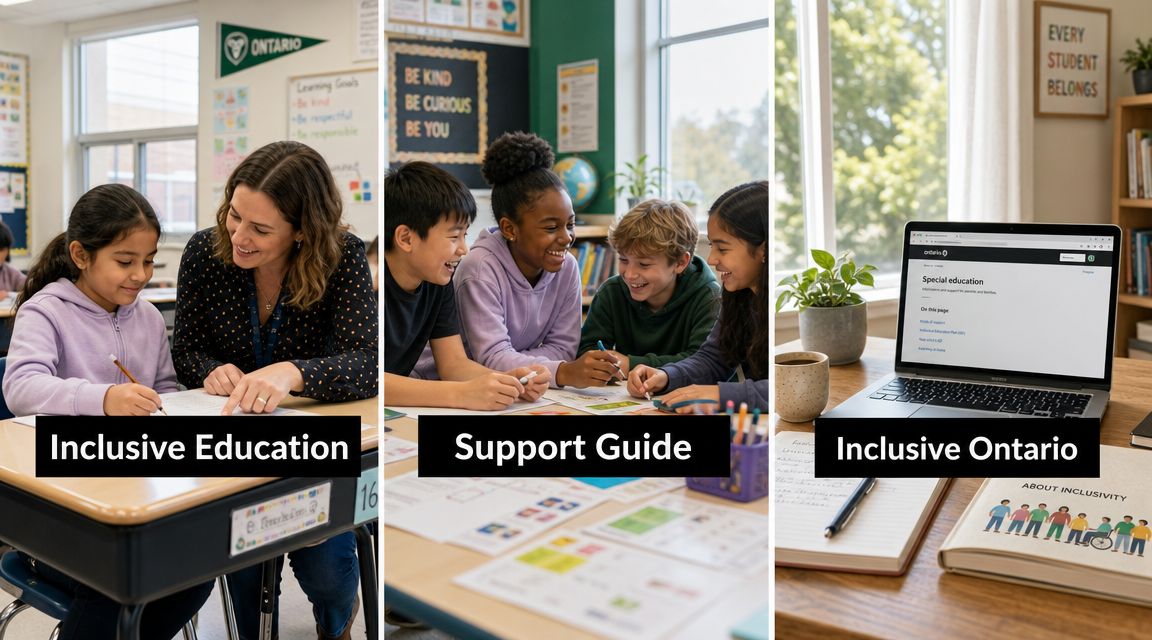
That is where inclusive education ontario matters. At its best, inclusion is not a slogan. It is a promise that a child should be able to learn, participate, and feel safe without having to hide who they are.
Ontario families are far from alone in needing support. In 2019 to 2020, 17.6% of students in Ontario's publicly funded school system received special education programmes and/or services, according to research summarising Ontario data. For many parents, that number brings relief. Extra support is not unusual. It is part of everyday school life for a substantial share of children.
What belonging looks like in real life
Belonging is practical. It looks like a child being allowed to use voice-to-text because handwriting blocks their ideas. It looks like a calm check-in at the start of the day for a student with anxiety. It looks like teachers expecting progress while also adjusting the route.
Sometimes it helps to think beyond the classroom. The same principle sits behind Kidzspace's perspective on inclusive play. Children don't benefit from being invited into a space that was never built with them in mind. They benefit when the space itself is designed so they can participate from the start.
The same is true in school.
If you want a simple grounding in the concept before dealing with school meetings and paperwork, this guide to what inclusive education means in practice is a useful starting point.
Your child does not need to earn inclusion by coping in silence.
Why parents often feel stuck
Many parents tell me the hardest part is not caring. It is not knowing what to ask for, who decides what, or whether their concerns will be taken seriously. Schools use acronyms. Policies sound reassuring but vague. Meetings move quickly. Meanwhile, your child still has to get through tomorrow.
That is why it helps to translate policy into plain language. Once you understand what Ontario says schools should do, it becomes much easier to spot the difference between a temporary bump and a support system that is working effectively.
Ontario's Framework A Blueprint for a Welcoming School
Ontario's approach starts with a basic idea. A welcoming school does not happen by accident. It has to be designed, built, reviewed, and repaired when something isn't working. Think of the province's framework as a blueprint for a house where every child should be able to enter, move around, and feel they belong.
In 2009, Ontario launched its Equity and Inclusive Education Strategy to identify and remove discriminatory biases and systemic barriers. It also required every school board to have an equity policy so students are welcomed, respected, and supported in a culture of high expectations, as outlined in Ontario's equity and inclusive education framework summary.

The front door must open for everyone
A good house starts with access. In school terms, that means a child should not face hidden barriers because of disability, race, language, family background, faith, gender identity, or mental health needs.
Parents usually notice these barriers in ordinary moments:
- Morning entry: A child who is overwhelmed by noise at arrival may need a quieter transition.
- Class participation: A student who knows the answer may still need extra processing time before speaking.
- Assessment pressure: A pupil may understand the subject but struggle with the format of the test.
These are not side issues. They affect whether a child can use the “house” at all.
Every room has to work, not just one
Ontario's framework is not meant to sit in one office with one special education teacher. It is supposed to shape the whole setting. Curriculum, assessment, relationships, discipline, safety, and communication with families all matter.
That is why I tell parents to listen carefully for the difference between these two responses:
“We can try to help in this class.”
Helpful, but limited.“We are reviewing how the school environment, teaching approach, and supports are affecting your child.”
That sounds much closer to inclusion.
A school can say warm things about equity while still leaving the hard parts untouched. Standardised testing is one example. If your child struggles with timed assessments or performance pressure, it helps to understand the context around navigating standardised tests in Ontario, because school accountability can shape classroom decisions in ways families don't always see.
Practical rule: If a school talks about inclusion but only offers one-off fixes, ask how inclusion shows up in teaching, assessment, school climate, and communication with parents.
What this means for you as a parent
You do not need to become a policy expert. You do need to know the language well enough to ask grounded questions. For example:
- What barriers do you think are affecting my child most right now?
- What changes can be made in the classroom, not just outside it?
- How will the school review whether those changes are helping?
Those questions move the conversation away from blame and towards design. That is where real progress usually starts.
Common Accommodations and Supports for Your Child's Needs
Parents often hear a long list of terms without anyone explaining what they mean in the school day. The most useful distinction is simple.
Accommodations change how a child learns or shows learning.
Modifications change what a child is expected to learn.
That difference matters because many children do not need lower expectations. They need better access.
What the law means in practice
Ontario's human rights guidance is clear. Education providers must accommodate disability-related needs to the point of undue hardship, and that includes supports such as differentiated instruction and assistive technology, as explained in the Ontario Human Rights Commission policy on accessible education.
These supports are not a favour a school grants when staffing is comfortable. They are part of a child's right to equal access.
In practice, that could mean a student with dyslexia receives text-to-speech software. A child with ADHD may need chunked instructions and movement breaks. A pupil with anxiety may need alternative ways to present learning without speaking in front of the whole class.
Examples of Common Supports and Accommodations
| Type of Need | Instructional (How it's taught) | Environmental (Where it's taught) | Assessment (How it's tested) |
|---|---|---|---|
| Reading difficulty such as dyslexia | Teacher provides audio versions of texts, pre-teaches vocabulary, uses clear visual structure | Quiet reading area, reduced visual clutter | Text-to-speech, extra time, oral responses |
| Attention and executive functioning needs such as ADHD | Shorter task chunks, checklists, one instruction at a time, teacher check-ins | Preferential seating, movement breaks, fewer distractions | Extended time, supervised breaks, smaller assessment setting |
| Writing difficulty | Voice-to-text, sentence starters, graphic organisers, reduced copying from board | Access to keyboard or tablet | Typed answers, oral explanation instead of long handwritten response |
| Autism-related needs | Visual timetable, predictable routine, explicit social expectations | Calm workspace, sensory supports, advance notice of changes | Alternative demonstration of learning, extra processing time |
| Anxiety or SEMH needs | Gentle scaffolding, clear reassurance, flexible participation methods | Low-stimulation area, trusted adult check-in | Smaller room, staggered timing, reduced performance pressure |
| Processing or memory challenges | Repetition, modelling, worked examples, recorded instructions | Consistent classroom layout | Shorter sections, more time, step-by-step prompts |
What works and what doesn't
Some supports sound good on paper but fail in real classrooms.
What tends to work:
- Specific tools: voice-to-text, text-to-speech, visual schedules, checklists, guided notes.
- Predictable routines: children who feel unsafe or overloaded often do better when they know what is coming.
- Regular review: a support that helped in October may not be enough by February.
What often does not work:
- Vague promises: “We'll keep an eye on it.”
- Support only in crisis: waiting until a child melts down or refuses school.
- One-size-fits-all plans: two children with the same label can need very different things.
Families seeking broader understanding after diagnosis often appreciate practical resources such as Haven Medical's overview of autism and ADHD post-diagnostic support. It helps parents connect school accommodations with the child's wider day-to-day needs.
A useful parent question
If you are in a meeting and feel overwhelmed, ask this:
- What will this look like at 10.30 on a Tuesday in my child's class?
That question forces everyone to move from theory to action. It often reveals quickly whether the support is concrete, realistic, and understood by the people who must deliver it.
Navigating the Evaluation Process From Concern to IEP
The evaluation process often feels more intimidating than it needs to. Acronyms can make families feel as though they have joined a conversation halfway through. It helps to follow the journey in ordinary terms.
Take a fictional example. Maya is bright and thoughtful, but her teacher notices that written tasks take much longer than expected. At home, her parent sees the same pattern. Homework that should be manageable leaves Maya exhausted and upset. Her ideas are strong when she speaks, but on paper she freezes.
That is usually where the process begins. Not with a committee. With a concern that repeats often enough to matter.

The first conversation
Maya's parent asks for a meeting with the classroom teacher. Instead of saying only “she struggles”, the parent brings examples:
- Written work: “She explains ideas clearly aloud but shuts down when writing.”
- Time pattern: “A short task can take the whole evening.”
- Emotional signal: “She says she feels stupid, which is not how she talks about other activities.”
This level of detail helps the school distinguish a passing issue from a pattern.
After that, the school may begin gathering information. That can include classroom observations, work samples, team discussions, and sometimes referrals for further assessment. If concerns continue, families may hear about IPRC, the Identification, Placement, and Review Committee. This committee considers whether a student should be formally identified with an exceptionality and what placement best supports learning.
The IEP is where support becomes real
Whether a child is formally identified or not, the practical document many parents care about most is the IEP, or Individual Education Plan. That is where needs, goals, strategies, and accommodations should become specific.
For parents who want to see what that can look like in practice, these individualised education plan examples can make the paperwork feel much less abstract.
A short explainer can also help if the process feels unfamiliar:
Questions to bring into the meeting
Parents' role is not confined to approving a school-written document. They are part of the process.
Try questions like these:
- What strengths should be written into the plan first?
- Which accommodations are essential every day, not only when staff remember?
- How will progress be reviewed, and who will update me if the plan isn't working?
- What will happen during transitions, supply-teacher days, or assessment periods?
A strong IEP should describe support clearly enough that another adult could step in and still understand what your child needs.
Trade-offs to watch
Not every evaluation leads quickly to clarity. Some children fit neatly into school processes. Others do not. A child may be struggling significantly without ticking every box for formal identification. That can be painful for families, especially when need is obvious at home.
When that happens, stay focused on function. Ask less about labels and more about barriers, access, and what support can start now. Children should not have to wait for perfect paperwork before adults respond.
Choosing the Right School In-Person vs Online Learning
Some children flourish in a busy school building. Others spend so much energy coping with noise, transitions, social pressure, or sensory overload that little is left for learning. The right setting depends less on tradition and more on your child's actual day-to-day needs.
That is especially important because recent research notes that generic inclusion policies do not always close experience gaps for all students, especially those with intersecting needs, as discussed in recent research on underserved learners within inclusive education. In practical terms, parents need to ask each school for concrete evidence of support rather than relying on broad statements about inclusion.

When an in-person school may fit better
A physical school can be the right choice when a child benefits from immediate face-to-face interaction, hands-on facilities, and the social rhythm of a shared day.
That may suit children who:
- Seek connection: They gain energy from peers and regular in-person collaboration.
- Need external structure: Fixed timetables and physical routines keep them grounded.
- Enjoy campus resources: Science labs, sports, music spaces, and in-person clubs matter to their engagement.
Still, parents should look carefully at whether the environment remains supportive once demands increase. A welcoming school in theory may still feel chaotic or inaccessible to one child.
When online learning may fit better
Online learning can work well for students who need a calmer setting, greater flexibility, or more control over pacing. This is often relevant for learners with SEN or SEMH needs, especially if attendance, fatigue, overload, or bullying have made school feel unsafe.
Child-centred questions help here:
- Does my child learn better in a quiet space than in a crowded room?
- Do transitions drain them before lessons even begin?
- Would recorded lessons or flexible timing reduce stress?
- Can they participate more confidently online than in front of a full class?
An online environment is not automatically inclusive. It still has to be designed well. Children need teacher interaction, clear routines, opportunities for connection, and support that is visible in lessons.
A side-by-side way to think about it
| Consideration | In-person learning | Online learning |
|---|---|---|
| Daily sensory load | Often higher, with noise, movement, and transitions | Often easier to manage in a home setting |
| Social experience | Direct and immediate | Structured virtually, often less intense |
| Flexibility | Usually limited by the school day | Often more adaptable around energy and need |
| Support delivery | Depends on school staffing and classroom conditions | Depends on platform design, teacher practice, and family setup |
| Fit for anxious or overloaded learners | Can help some, can overwhelm others | Can reduce pressure if interaction is thoughtfully managed |
The key is not whether a school calls itself inclusive. The key is whether your child can access learning, feel safe, and stay emotionally available enough to grow.
How Queen's Online School Fosters True Inclusion
When families start looking beyond the local default, they often want to know what inclusion looks like in an online setting when it is built deliberately rather than added later.

A good online model usually stands or falls on a few practical points. Are classes small enough for teachers to notice when a child is confused, withdrawn, or overloaded? Are lessons live and interactive, not just uploaded content? Can the school adapt pace, format, and support for different learners? Is the environment emotionally safer for pupils who have struggled socially in mainstream settings?
Those are the kinds of practices described in these inclusive education approaches used in online schooling.
What this can look like for one student
Consider a student who has strong academic potential but has stopped thriving in a physical classroom. In school, the corridors are loud, group work is draining, and the child spends more time managing stress than engaging with ideas. Work is missed, confidence drops, and adults start talking more about attendance than learning.
In a carefully structured online setting, the same child may have:
- Live lessons with clearer turn-taking
- Recorded access to review content at a calmer pace
- More predictable routines
- Fewer sensory and social disruptions
- Space to participate through chat, audio, or other formats
That does not solve everything. Some children still need direct help with organisation, motivation, or emotional regulation. But it can remove major barriers that were blocking access in the first place.
One option among several
Queen's Online School offers a fully online British curriculum with live teaching, subject-specialist staff, small classes, and flexibility around pacing and access. For some families, especially those seeking a calmer environment for learners with SEN or SEMH needs, that kind of structure can be a practical alternative to a school experience that has become too stressful or inconsistent.
Inclusion works best when the environment adapts before the child reaches crisis point.
The test is simple. Can the child learn, participate, and feel known? If the answer becomes yes in an online environment after repeated no's elsewhere, that matters.
Your Next Steps in Advocating for Your Child
Parents often wait too long because they don't want to seem difficult. In reality, calm, specific advocacy usually helps everyone. You know your child in a way no report can capture. That knowledge is useful, not disruptive.
If you are trying to move from worry to action, keep it simple.
A practical checklist for this week
- Write down patterns: note what your child struggles with, when it happens, and what seems to help.
- Collect examples: keep samples of work, emails, report comments, or observations from home.
- Request a meeting: ask the teacher or school team for a focused conversation about barriers and supports.
- Ask for specifics: if a support is suggested, ask how it will look in class and who will monitor it.
- Draft your priorities: identify the two or three changes that would most improve your child's daily experience.
- Keep the child at the centre: ask not only “Are they achieving?” but also “Do they feel safe enough to learn?”
Good resources to keep nearby
A few documents and organisations can help you stay grounded:
- Ontario Human Rights guidance: useful when you need clarity on accommodation rights.
- Your school board's equity and special education information: helpful for local processes and contacts.
- People for Education: a well-known Ontario education advocacy organisation that many parents use for broader system understanding.
The most important mindset shift
Try not to measure success only by whether the school agrees with you immediately. Measure it by whether the conversation becomes clearer, more specific, and more responsive to your child's real needs.
You are not asking for special treatment. You are asking for access, dignity, and the chance for your child to learn without being diminished by the environment.
If your child needs a more flexible, calmer way to learn, Queens Online School is one option to explore. Families looking for live online lessons, a recognised British curriculum, and support for different learning profiles can review whether its approach fits their child's academic and emotional needs.