

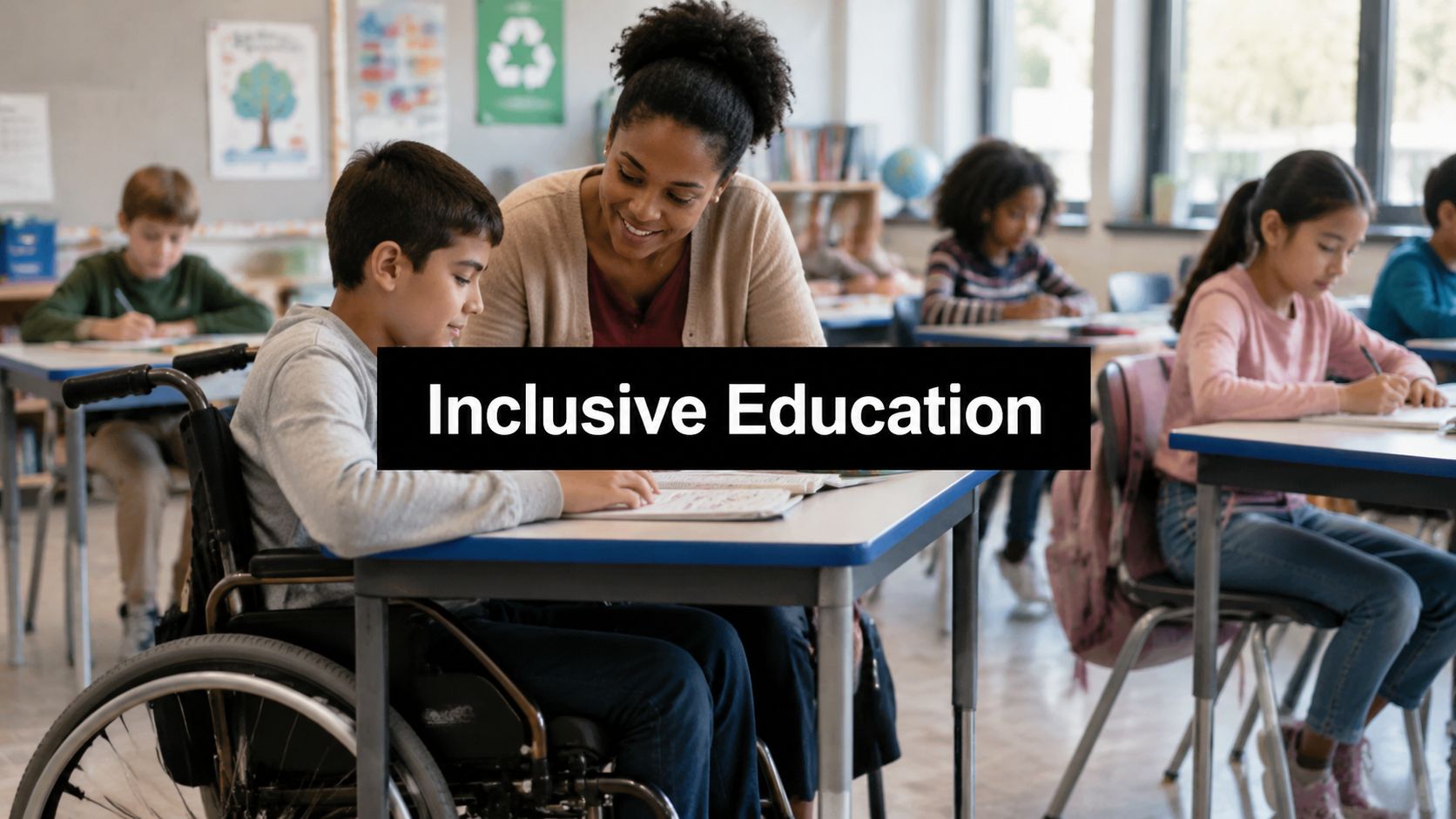
You may be reading this after another difficult school day. Your child came home exhausted, quiet, or angry. They were technically in class all day, yet somehow still left out of the meaningful learning, the friendships, or the sense of safety that every child deserves.
That hurts in a very specific way as a parent. You can see your child trying. You can see what others miss. And when people say, “They're included,” while your child is anxious, misunderstood, or falling behind, the word can start to feel hollow.
Inclusive education for students with disabilities should never mean placing a child in a room and hoping for the best. It should mean your child can access learning, join in, build confidence, and feel that they belong.
More Than a Place in a Classroom
A child can sit in the same classroom as everyone else and still feel alone. That's often the part families find hardest to explain. On paper, the child is present. In reality, they may not understand the lesson, may dread group work, may struggle with noise, or may spend the day masking distress.

I've spoken with many parents who say the same thing in different words. “My child is there, but no one really sees them.” That might look like a pupil who never puts a hand up because processing takes longer. It might be a child who loves science but can't cope with the busy transitions between lessons. It might be a teenager who appears compliant in school and then falls apart at home.
What inclusion should feel like
Real inclusion feels different. Your child knows what's expected. They can access the work. They have a fair way to show what they know. Adults notice when something isn't working and adjust early, not after a crisis.
It also means emotional safety. A child learns better when they aren't spending all their energy trying to survive the environment.
Inclusion starts with a simple question. “What does this child need in order to take part with dignity?”
This isn't a niche issue affecting only a handful of families. In January 2024, 1.64 million pupils with SEND in England represented 18.4% of all pupils. Of these, 1.18 million received SEN support and 462,300 had an EHC plan, according to official figures on students with disabilities. Needing extra support is part of everyday school life in England.
What worried parents often get told
Parents are often told to wait. To give it time. To trust that things will settle. Sometimes they do. But sometimes a child is telling us, through tears, refusal, headaches, shutdown, or behaviour, that the current setup isn't working.
When that happens, your concern isn't overreacting. It's information.
A useful way to think about inclusion is this:
- Belonging matters: Your child shouldn't feel like a visitor in their own classroom.
- Access matters: If the teaching method blocks learning, the child isn't included.
- Participation matters: Joining in looks different for different children, and that's fine.
- Well-being matters: Progress that comes at the cost of mental health isn't success.
From Segregation to Inclusion A Journey of Belonging
For many families, the language around disability and education can feel dense. So let's make it simple.
Think of school as a party.
Segregation is not being invited at all.
Integration is being invited, but then left standing alone in the corner, expected to cope with everything exactly as it is.
Inclusion is being welcomed in, shown where things are, introduced to others, and asked to dance in a way that works for you.
That difference matters. A great deal.

The old model and the better one
Older systems often treated disability as a reason to separate children from their peers. The child was expected to fit the system, even if the system clearly didn't fit the child.
A more humane approach asks a different question. Instead of “Can this child manage our environment?” it asks, “How do we adapt the environment so this child can learn and belong?”
That shift sits underneath much of modern inclusive education for students with disabilities.
What the law expects schools to do
In the UK, schools have duties that involve more than offering a place. The Equality Act 2010 requires schools to make reasonable adjustments so disabled pupils are not placed at a substantial disadvantage. That includes accessible materials and adapted teaching methods, as outlined in guidance on inclusive practices.
In practical terms, that can mean:
- Changing the format: A worksheet may become audio, enlarged text, or a chunked digital task.
- Changing the route: A child may answer verbally instead of in long written form.
- Changing the environment: A pupil may need quieter conditions, movement breaks, or reduced sensory load.
- Changing the pace: Some learners need more time to process before they respond.
If a child can only access learning by battling constant barriers, the problem isn't the child alone. The setup needs attention too.
Inclusion is participation, not optics
Parents often get stuck on one painful contradiction. Their child is in mainstream school, yet they don't feel included. That contradiction makes sense when we separate placement from participation.
A child might be physically present but still excluded from the full experience if:
| Situation | What it looks like | What true inclusion would change |
|---|---|---|
| Whole-class teaching moves too fast | Your child stops trying or copies others | Tasks are scaffolded and instructions are broken down |
| Group work feels socially unsafe | Your child is left out or given token roles | Adults structure roles and teach peers how to collaborate |
| The classroom is overwhelming | Your child dysregulates before lunch | Sensory adjustments and calm routines are built in |
True inclusion isn't about making a child look settled from the outside. It's about making sure they can learn, connect, and keep their self-respect.
Your Child's Rights in the UK Education System
When you're worried about your child, legal terms can feel cold. But rights matter because they give you something solid to stand on when instinct tells you your child needs more support.
In England, the move towards educating children with disabilities in mainstream settings has a long history, including the 1981 Education Act. That direction continued through later reforms, including the Children and Families Act 2014, with support often delivered through Education, Health and Care plans. The principle is clear. Inclusion should be backed by actual provision, not just kind words.
What these rights mean in daily school life
For a parent, this usually comes down to practical questions.
Is my child's difficulty recognised?
Is support written down clearly?
Is anyone checking whether it's working?
If your child needs extra help but doesn't have an EHCP, school-based support may still be available. If you want a clearer picture of how that works in practice, this guide to SEN support in schools explains the basics in parent-friendly language.
An EHCP should do more than describe need. It should help shape provision. That means teaching approaches, specialist input where required, support with communication or emotional regulation, and a learning environment your child can use.
Why parents often feel let down
This is the hard truth. Rights on paper don't always become support in real classrooms.
The gap can be stark. In 2023/24, 6.9% of pupils in England with an EHC plan achieved grade 5 or above in GCSE English and maths, compared with 65.4% of pupils with no identified SEN, as discussed in this analysis of the right to learn and the gap between promise and action. That doesn't mean children with disabilities can't achieve. It means placement alone is not enough. Support has to fit the child.
Many parents already know this in their bones. They've watched their child lose confidence while everyone insists the current placement is “appropriate”.
A practical test: Ask not only “Is my child in school?” Ask “Can my child access learning, make progress, and get through the week without constant distress?”
What you can reasonably ask for
You are allowed to ask direct questions. In fact, it often helps.
Try questions like these in meetings:
- What barriers are you seeing day to day? This moves the conversation from labels to lived reality.
- Which adjustments are already in place? You need specifics, not general reassurance.
- How will we know whether the support is working? Look for concrete examples of access, participation, and well-being.
- What happens if this plan doesn't help enough? Good teams plan the next step before things deteriorate.
A parent who asks for clarity isn't being difficult. You're doing your job. Your child needs someone to keep the focus where it belongs, on what helps them learn safely and meaningfully.
Making Inclusion Work in the Classroom and Online
Good inclusion is designed. It doesn't happen because a teacher is kind, though kindness matters. It happens because adults build lessons, routines, and environments that expect learner differences from the start.
Research reviews have found that when inclusion is implemented with curriculum adaptations, teacher training, and appropriate support, it is associated with stronger academic and social outcomes for students with disabilities, while non-disabled peers tend to experience neutral to positive effects, according to a review of inclusive education evidence.

What effective support looks like in a real lesson
Take a history lesson on the Victorians. The class is learning the same core idea, but not every child has to prove understanding in the same way.
One pupil writes a short essay. Another creates a storyboard with captions. A third records a spoken response. All three are working towards the same learning goal. The teacher hasn't lowered expectations. The teacher has removed unnecessary barriers.
That approach often draws on ideas parents may hear called Universal Design for Learning or differentiated instruction. The language matters less than the practice. The key is that the lesson offers more than one way to take in information, more than one way to stay engaged, and more than one way to respond.
Here's a helpful visual summary before we go further.
Helpful strategies parents can look for
- Clear chunking of information: Teachers break work into smaller steps rather than delivering long verbal instructions.
- Choice in response: A child can type, speak, annotate, draw, or use supportive software where appropriate.
- Pre-teaching and vocabulary support: New words or concepts are introduced early so the lesson feels less like a wall of confusion.
- Assistive technology: Text-to-speech, speech-to-text, screen readers, magnification, captions, and visual organisers can all widen access.
For children with visual needs, families sometimes need help choosing the right equipment at home as well as in school. A practical guide on how to choose the right video magnifier can help parents understand one type of support tool more clearly.
Classroom and online settings compared
Both mainstream classrooms and online environments can support inclusion. The question is which barriers are easier to reduce in each setting for your child.
| Setting | Often helpful for | Possible challenge | What support can do |
|---|---|---|---|
| Mainstream classroom | Peer interaction, hands-on routines, immediate adult presence | Noise, transitions, sensory overload, social pressure | Seating, visuals, scaffolded tasks, sensory planning |
| Online learning | Reduced sensory load, flexible pacing, easier use of digital tools | Screen fatigue, home distractions, less informal social contact | Shorter chunks, live check-ins, captions, recorded lessons |
Some children thrive in the pace and energy of a physical classroom when support is strong. Others do far better when the environment is calmer and more predictable.
One option families sometimes explore is inclusive online learning support, where live teaching, recorded lessons, and flexible participation methods can reduce barriers that are hard to remove in crowded settings.
A child who struggles in one environment is not a child without potential. Often, they simply need a different route in.
Fair Assessment and Celebrating Every Milestone
Assessment can become a source of dread for families. A child may understand far more than they can show under pressure, in noisy conditions, or through one narrow format. That mismatch can damage confidence very quickly.
Inclusive education for students with disabilities asks a better question. Not “Can this child perform in the standard way?” but “What is the fairest way for this child to show their learning?”

What fair assessment can look like
For some children, fair assessment includes formal reasonable adjustments. That might mean extra time, rest breaks, a reader, a scribe, enlarged materials, or a quieter room. These adjustments do not give an unfair advantage. They reduce barriers that would otherwise distort the result.
But fairness also matters long before exam season. In daily school life, teachers can learn far more about a child through varied assessment than through repeated written tests alone.
A pupil might show understanding through:
- A portfolio of work: drafts, corrected pieces, and finished tasks that show growth over time
- A spoken explanation: especially helpful when writing speed masks deeper understanding
- A project outcome: such as a model, presentation, or visual display
- A short recorded response: useful for pupils who need time to plan and replay their ideas
Why small wins matter so much
Parents sometimes feel guilty for celebrating progress that seems “small” compared with other children. Please don't.
For one child, success is writing a strong paragraph independently. For another, it's entering the lesson without panic. For another, it's asking for help instead of shutting down. These are not minor things. They are building blocks.
Progress is not only a grade. It can be regulation, confidence, stamina, self-advocacy, or the first moment a child says, “I think I can do this.”
A calmer way to measure success
When schools look only at final scores, they can miss the story of the child. A broader view helps everyone respond more wisely.
Consider this simple frame:
| Area of progress | What a parent might notice |
|---|---|
| Academic access | Your child understands instructions more often |
| Independence | They begin tasks with less adult prompting |
| Emotional well-being | Fewer meltdowns, shutdowns, or school refusal signs |
| Communication | They can explain what helps and what doesn't |
That broader lens often relieves pressure. It doesn't lower ambition. It makes ambition humane.
Building Your Child's Support Team
No parent should have to carry this alone. Yet many do. They become the memory bank, the advocate, the interpreter, the crisis manager, and the person trying to hold home life together after school has taken too much out of their child.
A stronger model is to build a genuine support team around the child. In that team, you are not a passive observer. You are the person who knows your child across settings, across time, and across stress levels. That knowledge is vital.
Think like the team lead
You don't need to know every legal term to lead well. You need a clear picture of your child and the confidence to keep bringing adults back to that picture.
Before meetings, it helps to prepare a one-page summary with:
- What your child enjoys and does well: strengths help staff connect and teach more effectively
- Known triggers or barriers: noise, handwriting load, transitions, unstructured social time, fast verbal instruction
- What helps: visual schedules, movement breaks, reduced language, check-ins, predictable routines
- Your current priorities: for example attendance, regulation, reading confidence, friendships, or exam access
This often changes the tone of meetings. It moves the focus from labels alone to your actual child.
Questions that make meetings more productive
Some questions open doors better than others.
Instead of “Why isn't this working?” you might ask, “At what points in the day does my child seem least able to access learning?”
Instead of “Can't someone do more?” you might ask, “Which specific adjustment will be trialled next, and who will review it?”
That kind of language encourages shared problem-solving.
School staff see your child in one setting. You see the before, the after, and the recovery time. Both views matter.
What good collaboration feels like
A healthy support team doesn't require everyone to agree instantly. It requires honesty, follow-through, and shared focus.
You should expect:
- Clarity: people say what is happening, not just what should be happening
- Specificity: support is described in actions, not vague reassurances
- Review: adults check whether interventions are helping
- Respect: your observations are treated as evidence, not emotion to be managed
In online settings, collaboration can sometimes become simpler because communication leaves a clearer trail. Teachers can share lesson observations quickly. Parents can notice patterns at home. A therapist or specialist can often contribute advice with less disruption to the child's day. When that happens, the child experiences adults pulling in the same direction instead of working in silos.
Is Inclusive Online Schooling Right for My Child?
For some families, online schooling becomes a thoughtful choice after a long period of watching their child cope rather than thrive. For others, it feels like a big leap. Both reactions are understandable.
The right question isn't whether online learning is automatically better. It's whether it removes the barriers that currently stand between your child and learning.
Will online learning help with sensory needs or anxiety
It can. A home environment may offer more control over noise, lighting, transitions, uniform stress, crowded corridors, and social intensity. For a child with sensory sensitivities or school-based anxiety, that can free up energy for actual learning.
That said, online learning still needs structure. Clear routines, predictable lesson formats, camera and participation flexibility where appropriate, and regular adult check-ins all matter.
What does SEN support look like in a live online lesson
It should still be visible and practical. Support might include chunked instructions, visual prompts, use of chat instead of speaking, extra processing time, recorded lessons for review, scaffolded tasks, and direct communication between staff and home.
The technology behind the learning environment matters too. Schools need reliable systems that support accessibility, communication, and continuity. For families who want to understand the wider infrastructure that helps schools maximize learning with IT services, that overview gives useful context.
Can an EHCP be supported in an online setting
In principle, yes. The important issue is whether the provision named for your child can be delivered meaningfully in that setting. Some needs can be met very well online. Others may require a blended arrangement or additional therapies outside lesson time. The decision should always come back to fit.
If you're weighing up specialist online provision, these online courses for students with SEN show the sort of structure some families look for, including flexible pacing and live teaching.
How do I know whether my child is suited to it
Look at your child's barriers, not assumptions about what school “should” look like.
Online schooling may be worth serious consideration if your child:
- Learns better in calmer spaces
- Needs flexible pacing or frequent review
- Finds busy school environments overwhelming
- Benefits from digital accessibility tools
- Shows stronger engagement when social pressure is reduced
It may need more thought if your child relies heavily on physical prompting, finds screens very difficult, or needs highly intensive in-person therapies during the school day.
For many families, the biggest relief is simple. Their child is no longer spending every day bracing themselves.
If you're trying to find a school setup that supports both learning and well-being, Queens Online School offers a British curriculum in a live online format with small classes, recorded lessons, and support designed to help pupils access learning more flexibly. For families exploring what inclusion could look like when the environment fits the child more closely, it may be a useful next step to consider.