

Amira is in Year 12, taking Chemistry, Maths and Psychology. At the kitchen table, she asks whether her AS results will count towards her final grades, while her parent wonders when exams need booking and whether university offers depend on grades or points. Neither needs another acronym. They need a clear plan that makes room for Amira's ambitions, confidence and wellbeing.
What A2 Means and How It Differs From AS
A2 means the second-year content of an A Level, usually studied in Year 13. It isn't normally a separate qualification under England's current linear A-level arrangements. Students take their final assessments at the end of the course, covering learning from across the full A Level.
For Amira, that means her first-year Chemistry knowledge doesn't disappear when she starts A2. She'll use it to tackle more demanding explanations, calculations and unfamiliar problems. Searching for A2 A Level courses should therefore involve checking the whole qualification, not just the second-year timetable.
A checkpoint rather than part of the final score
Think of AS as a checkpoint on a long walk. It recognises progress through the earlier content, while completing A2 takes the learner towards the full A-level finish line. Under linear arrangements, AS is a stand-alone qualification, and its grade doesn't contribute to the final A-level result.
The distinction matters emotionally as well as academically. A disappointing AS result doesn't mathematically reduce Amira's eventual linear A-level grade, although it can help her teacher identify gaps that need attention.
AS and A2 compared
| Feature | AS | A2 (Year 13 content) |
|---|---|---|
| Usual timing | End of Year 12 | End of Year 13 with the full A Level |
| Counts toward final A-level grade | No, stand-alone under linear A levels | Yes, assessed within the full A-level grade |
| UCAS tariff value for a grade A | 20 points | 48 points for the completed A Level, not A2 alone |
| Assessment | Separate exams for AS content | Exams for the second-year content taken at the end of the course |
These arrangements describe linear A levels in England. International and other qualification routes can use different structures, including units that contribute towards the final award. The qualification title, examination board and specification matter more than the informal label A2.
Your choice: ask the school whether the course is linear and whether any AS exams are being sat along the way. Get the answer in writing alongside the assessment timetable, so your child enters Year 13 knowing what counts.
UCAS Tariff Points for Every A2 Grade
UCAS tariff points by grade
| Grade | A-level points | AS points |
|---|---|---|
| A* | 56 | No A* grade at AS |
| A | 48 | 20 |
| B | 40 | 16 |
| C | 32 | 12 |
| D | 24 | 10 |
| E | 16 | 6 |
UCAS tariff points translate qualification grades into a numerical total. For A2 learners, the relevant figure is normally the tariff for the completed A Level, not an additional award for the second-year content. Don't add an AS result to the full A Level in the same subject when calculating the total.
Turn a prediction into a useful comparison
Take a hypothetical student predicted AAA. Their total is 144 points, while ABB gives 128 points, a gap of 16 points. That can distinguish points-based offers, but matching a total doesn't automatically meet a requirement for a particular grade in Chemistry or Maths.
Many courses express offers through grades and named subjects rather than a tariff total. A course requiring particular subject grades isn't interchangeable with another course asking for the equivalent points. Treat the UCAS tariff points calculator as a checking tool, not an admissions decision.
For context, Ofqual's qualification results for England show that, across 814,335 A-level results issued in summer 2025, 28.2% were graded A or above and 77.7% were graded C or above. Those results put broad achievement and the narrower top-grade benchmark into perspective without predicting what any individual child can achieve.
Practical rule: a tariff total helps you compare offers, but the course's subject requirements determine whether your combination fits.
Try a short exercise with your child:
- Record predictions: write down the predicted grade beside each subject, without turning it into a judgement of ability.
- Calculate the total: convert the grades and check the addition.
- Compare realistic options: examine three target courses, including their subject requirements and any additional selection conditions.
Your choice: select courses using their own published wording. If your child prefers a course that specifies grades, plan around those grades rather than chasing an attractive points total.
How A2 Exams Are Assessed and Graded
A difficult paper can leave a teenager convinced they've lost their university place before anyone has marked their work. Listen to that fear without confirming the prediction. Feeling shaken after an exam isn't reliable evidence of the final outcome.
Ofqual's results analysis explains that the standard of work required for a particular A-level grade remains comparable from year to year; changes in the numbers achieving grades reflect differences in performance rather than a change in the expected standard. Its summer 2025 analysis also records 6,845 18-year-olds achieving A in every A Level they took*, with only 35 of those students taking five or more.
What contributes to the result
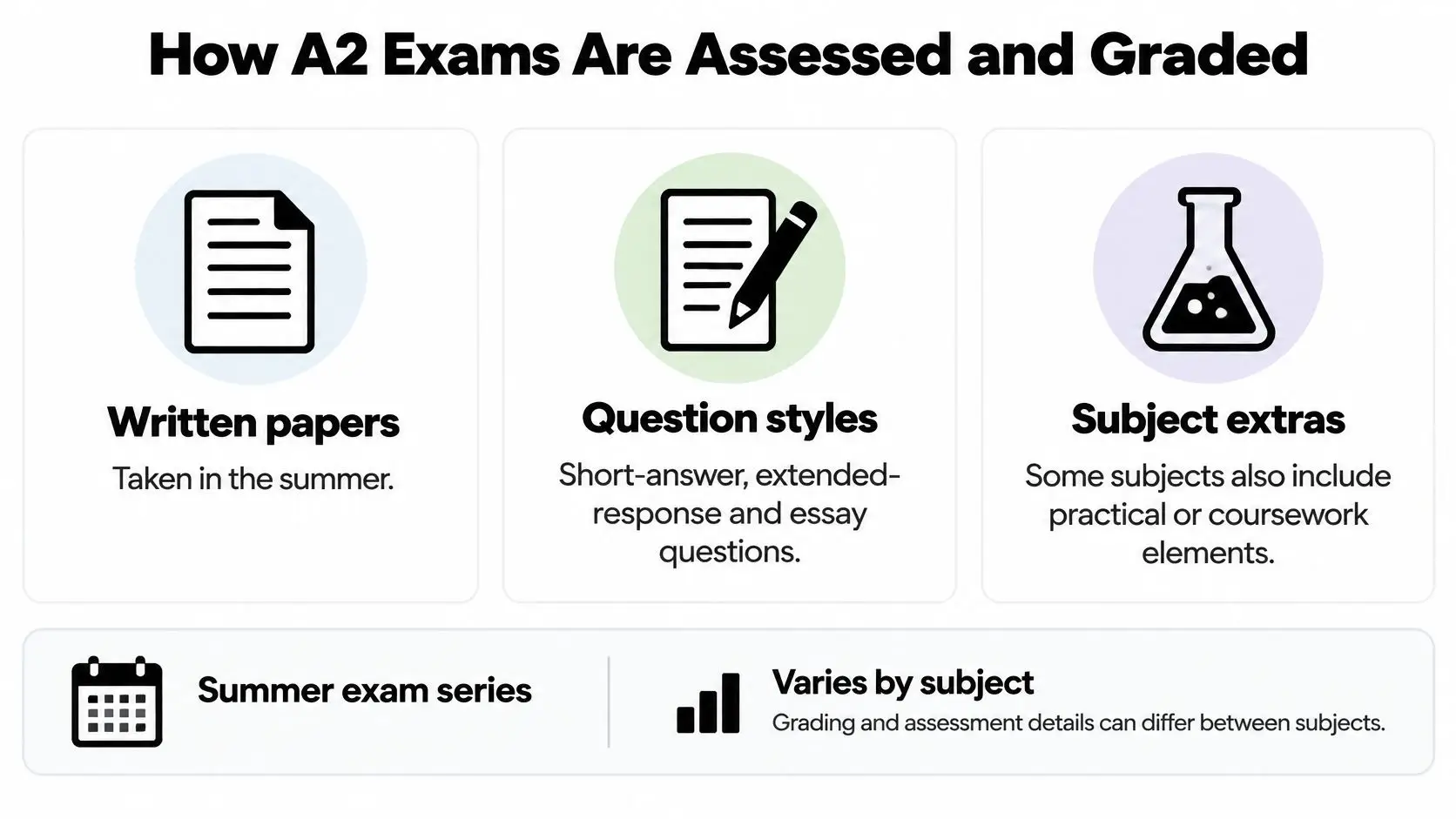
Written papers typically include short-answer questions, extended responses, essays or calculations, according to the subject. Some qualifications also include coursework or practical assessment. In relevant science qualifications, a practical endorsement may be reported separately, so check the exact specification rather than assuming every component contributes marks in the same way.
The assessment overview helps separate these elements.
Exam boards set grade boundaries after considering the assessment and evidence about standards. A harder paper doesn't automatically mean a lower grade for the same quality of achievement, nor does it guarantee a particular boundary.
The full scale is A to E for graded passes*. U means unclassified, indicating that the work fell below the E threshold. A U can feel devastating, but it describes an assessment outcome, not the student's worth or capacity to progress.
Responding to a disappointing result
Separate immediate emotional support from technical decisions. After a paper, help your child prepare for what remains rather than repeatedly reconstructing answers with classmates.
Once results and appropriate materials are available:
- Read the evidence: examine the grade report and ask a teacher to interpret component marks.
- Identify the difficulty: use the official mark scheme and, where available, the marked script to distinguish missing knowledge from weak evaluation, misread commands or unfinished answers.
- Check review options: ask the exam centre about consent, costs, deadlines and the possible outcomes of a review of marking, including a lower mark.
The exceptional-results example doesn't justify piling on subjects. It supports a calmer conversation about concentrating effort where it serves the child's goals.
Your choice: read the result with a teacher before deciding whether to request a review, accept an available place or plan further study. Don't let the first frightened reaction make the decision.
Choosing A2 Subjects and Combinations
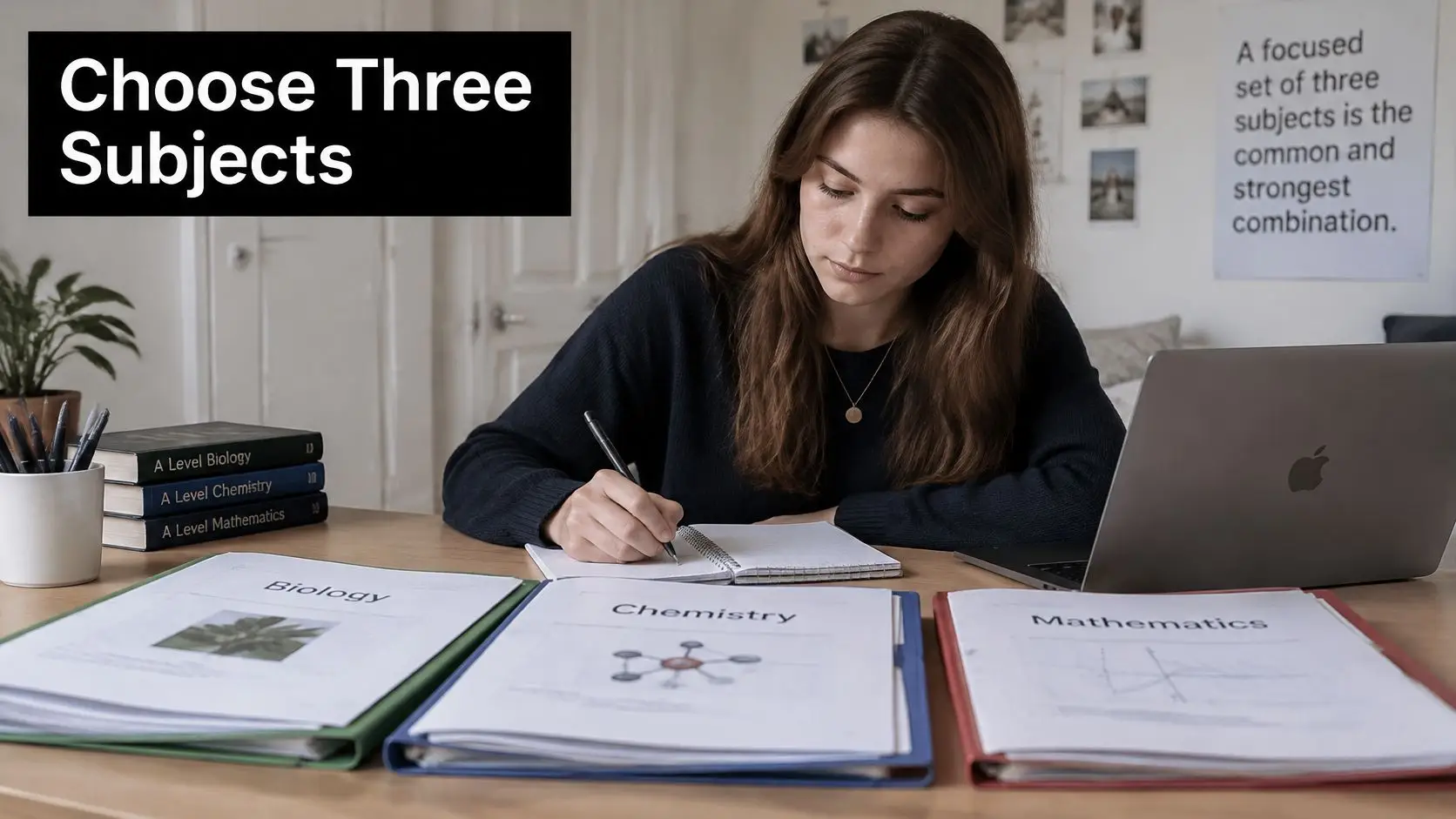
A focused programme is normal. Ofqual's A-level infographics show that among 18-year-olds taking A levels in England in summer 2025, 186,945 students, or 66.3%, took three subjects, compared with 49,795, or 17.7%, taking two, and 30,320, or 10.8%, taking one. The same publication records mathematics as the largest subject by results, with 104,630, followed by psychology with 72,930 and biology with 65,355.
Subjects taken at A level in England, 2025
| Subjects taken | Students | Share |
|---|---|---|
| Three | 186,945 | 66.3% |
| Two | 49,795 | 17.7% |
| One | 30,320 | 10.8% |
A possible science combination looks straightforward on a desk, but the right choice starts with the learner and their intended destination.
Work backwards from the destination
Say Jordan wants to study medicine, and his shortlisted courses require Chemistry and Biology. His remaining choice should meet those courses' rules while making sensible use of his strengths in mathematical reasoning or writing. An unrelated interest needn't be dismissed, but it shouldn't displace a required subject.
Compare combinations against actual admissions requirements using the A-level subject combinations guide. Popularity alone won't tell Jordan whether he'll enjoy the content or manage the assessment style.
Use this video as a prompt for a discussion about subject choices.
Before committing, take a short checklist to a teacher or guidance adviser:
- Course fit: does the combination satisfy every shortlisted course's subject and grade requirements?
- Teaching format: can the learner access the required practical work, coursework supervision and assessment?
- Sustainable workload: can study fit around health, caring responsibilities and family commitments?
- Genuine interest: does your child want to engage with the content throughout the course, not merely gain the qualification?
More subjects don't guarantee stronger grades. If the timetable removes sleep, recovery or necessary support, reconsider the load rather than asking the child to absorb the strain.
Your choice: agree a sustainable combination, then use the final decision sequence to turn it into an admissions and study plan.
Studying A2 Online and Sitting Exams at an Approved Centre
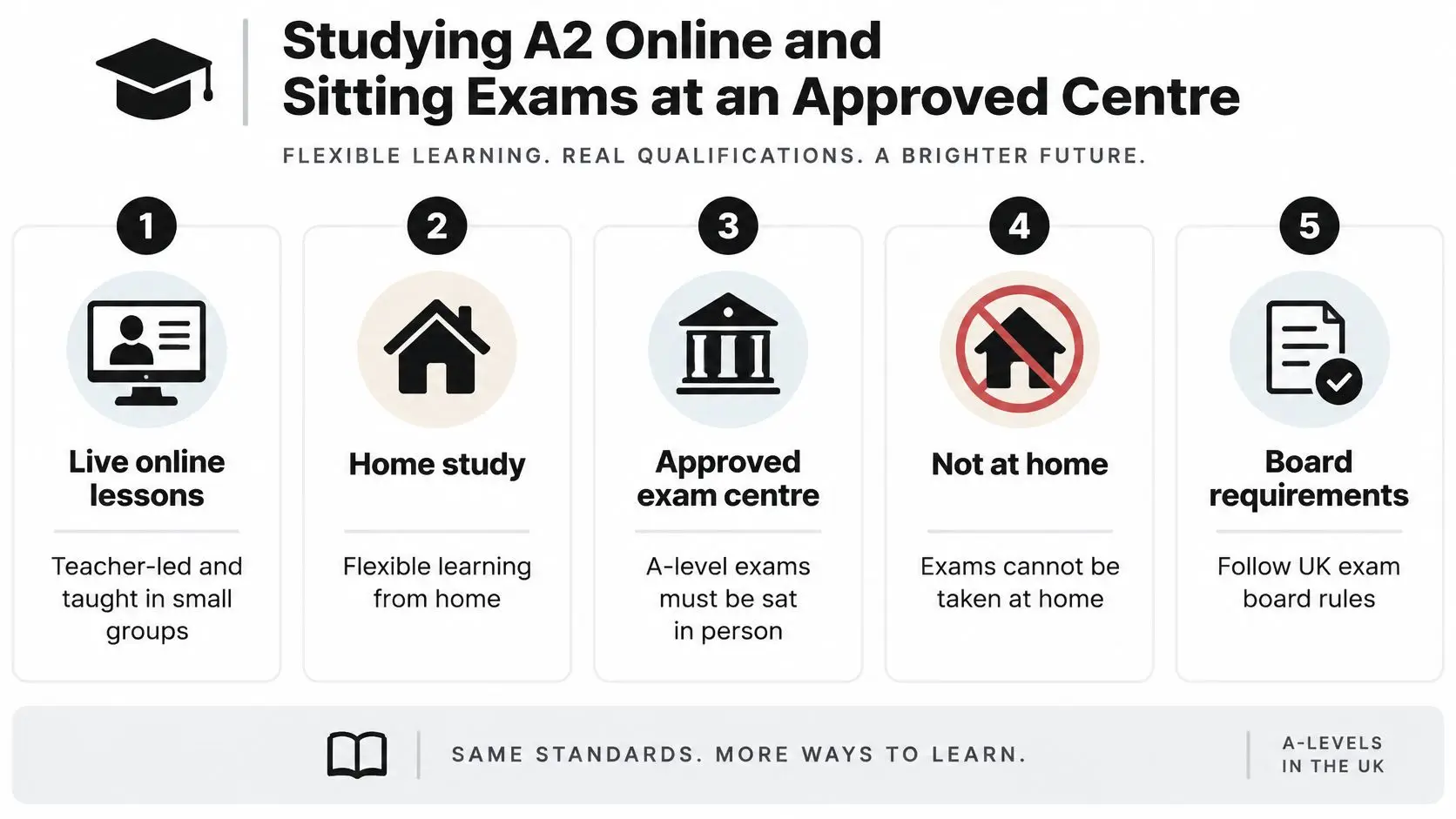
Online study can include live, teacher-led lessons in small groups, with independent work completed at home. The teaching location and examination location are separate decisions. Our GCSE, International GCSE and A Level exams are sat at approved exam centres rather than at home, in line with UK examination board requirements.
Qualifications are awarded by established UK boards, including Pearson Edexcel. Our recognised qualifications are accepted by universities, colleges and employers in the UK and internationally, although applicants still need to satisfy the requirements of their chosen course.
This overview shows how home learning connects with formal examinations.
Arrange support before it becomes urgent
Online learning doesn't automatically remove examination barriers. Ofqual's access-arrangements update explains that its official GCSE, AS and A-level access-arrangements statistics covering 2014 to 2024 were withdrawn following significant recording and reporting problems. Families should therefore avoid assumptions about how common an adjustment is and focus on the individual application.
Access arrangements must reflect the candidate's normal way of working and satisfy the relevant rules. Classroom adaptations, such as flexible explanations or recorded lessons, don't automatically establish entitlement to extra time or supervised rest breaks.
Say Leila has social, emotional and mental health needs and wants supervised rest breaks. She gathers school evidence, asks her online school to clarify responsibilities early, and identifies an approved centre near home that can assess and administer the requested arrangement. Approval isn't automatic, and moving centres can require careful transfer of evidence.
For home revision, a learner who enjoys visual explanation could create videos with LunaBloom AI, using a teacher-checked script to explain a topic. That's an optional study activity, not a substitute for specialist support or formal access arrangements.
Keep an exam and evidence file
- Centre confirmation: identify an approved centre that accepts the qualification and candidate entry.
- Exam details: confirm subject codes, dates, entry deadlines and any practical or coursework requirements.
- Support evidence: retain relevant assessments, teacher observations and records of the learner's normal way of working.
- Named contacts: agree who handles each subject, exam entries and access-arrangements applications.
Your choice: settle the examination route and support responsibilities before committing to a study timetable. Leila needs to know not only where she'll learn, but how she'll be supported when she demonstrates that learning.
How to Build a Revision Plan for A2 Exams
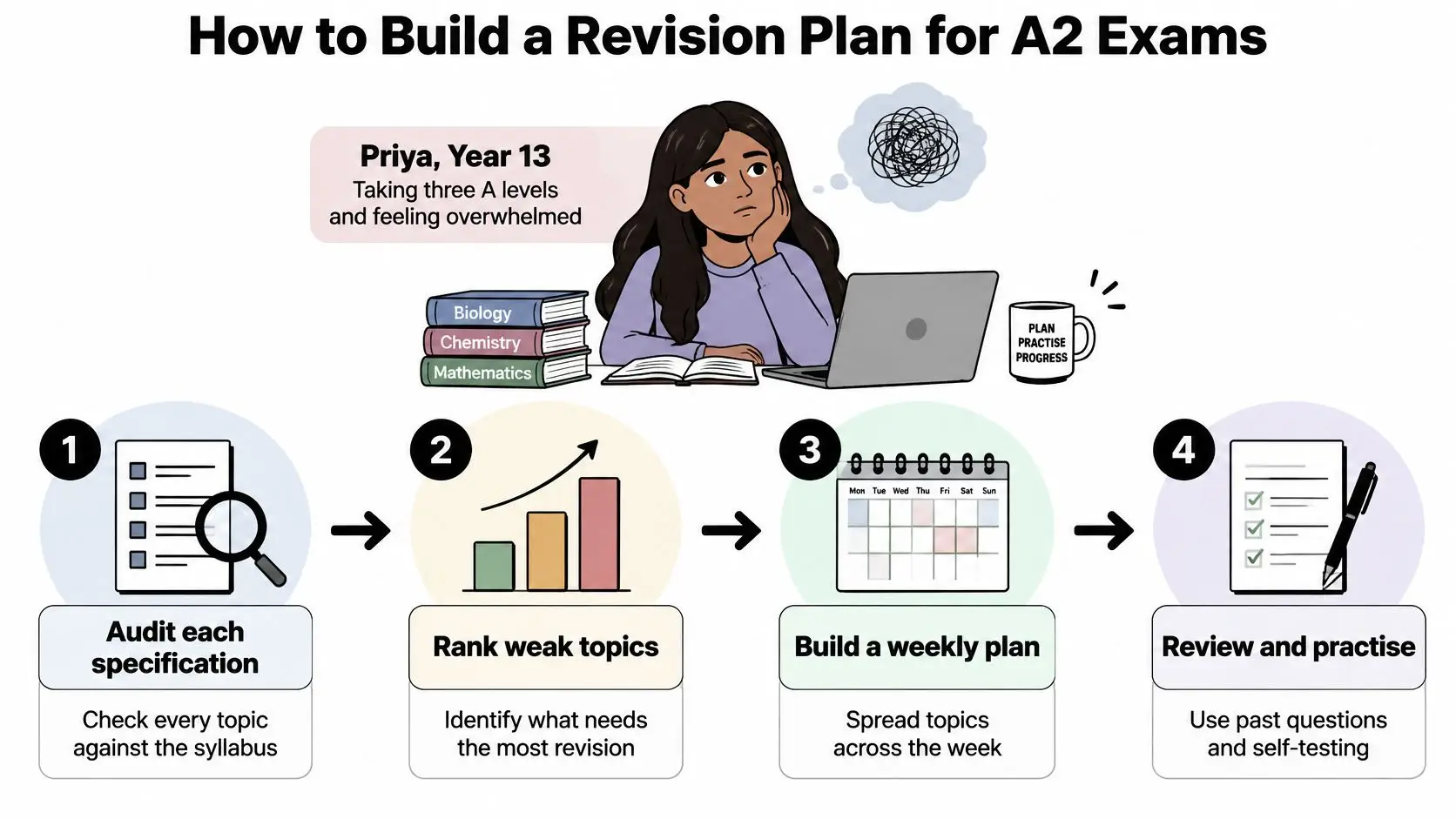
Priya is in Year 13, taking three A levels, and every folder seems to contain something she hasn't mastered. Her first task isn't to work later into the evening. It's to turn an undefined worry into a manageable set of decisions.
This revision overview gives her a starting point.
Build a routine around evidence
Audit the specification. Download the correct examination-board specification and match each topic against what you've covered. Mark topics you can explain, topics needing practice and topics you don't yet understand.
Spread the remaining work. For example, Priya could build a plan across about twelve weeks, allocating more sessions to difficult topics. Leave space for illness, teacher feedback and work that takes longer than expected.
Practise under time pressure. In this example, she schedules a timed past paper every fortnight. Use papers for the correct qualification and specification so the question styles are relevant.
Mark before moving on. Apply the official mark scheme and record where marks were lost. Ask a teacher about answers you can't confidently assess, especially essays and extended explanations.
Keep an error log. Separate knowledge gaps from mistakes such as misreading a command word, omitting units or running out of time. Give each recurring error a corrective action, not just a cross.
Retrieve before rereading. Priya might begin a session with ten minutes of closed-book recall, then check her explanation against reliable notes. The aim is to reveal what she can produce independently.
Protect recovery. Set an evening stop time and include rest days. If the plan routinely displaces sleep or leaves your child distressed, reduce and reorganise it with their teacher.
Notice progress without demanding perfection
A useful routine produces more than completed timetable boxes. Priya should become able to explain weak topics aloud, recognise familiar errors and show fewer repeated mistakes in her log. The A-level revision guide can help families turn those observations into practical study sessions.
A revision plan should tell a worried student what to do next, not remind them of everything they haven't done.
If panic rises before an exam, pause, breathe slowly and read the instructions carefully. Start with a question you can answer confidently where the paper's structure permits, while keeping track of compulsory sections.
Your choice: keep the routine that produces understanding and manageable stress. A child who can explain what they'll practise next is making more useful progress than one who reports hours spent studying.
From Results Day to a Clear A2 Decision
Access to university isn't evenly distributed. Times Higher Education's admissions reporting records 439,180 applicants accepted to UK higher education in 2025, including 40,360 from the most deprived areas, a 6% increase, while 43.4% of 18-year-olds in London secured a place compared with 24.9% in the North East. It also reports that 74,000 students found places through Clearing in 2024, showing why Clearing belongs in a considered admissions strategy rather than being treated solely as a response to missed grades.
Location doesn't determine your child's future, but travel, accommodation, affordability and access to guidance affect the choices a family can realistically make. Results day is therefore a decision point, not merely a score announcement.
When grades fall short of an offer
Start by checking the university's decision rather than assuming rejection. Admissions teams may still consider an applicant, but families shouldn't rely on flexibility that hasn't been confirmed.
A contextual offer may recognise an eligible applicant's circumstances, but it isn't an automatic reduction negotiated after results. A foundation year can provide a preparatory route, subject to its own admissions rules, costs and progression conditions.
A resit may suit a student who remains committed to a particular destination and has a credible improvement plan. Clearing can help identify suitable vacancies, including for students reconsidering their original choice. If someone mentions Adjustment, don't assume a separate service is available; check current UCAS procedures for changing course after stronger-than-expected results.
Make the decisions in a workable order
- Shortlist three target courses. Record subject requirements, grades, selection tasks and practical considerations such as travel and accommodation.
- Confirm a suitable subject combination. Check that the proposed three subjects satisfy all shortlisted requirements, adjusting the course list if necessary.
- Establish the qualification structure. Record whether it's linear and whether AS exams form part of the planned route.
- Complete the exam-centre arrangements. Use the exam and evidence checklist to record the centre and subject dates.
- Start the support process. Where access arrangements are needed, assign responsibility for the evidence file and applications.
- Set the first four weeks of revision. Choose initial priorities with the student, then arrange a teacher review.
Queen's Online School is one option among others. We offer GCSE, International GCSE and A Level qualifications, with our Key Stage 5 Sixth Form for ages 16–18 including English Literature, Biology, Chemistry and Physics. Students completing A Levels or International GCSEs can apply to universities in the UK and internationally, with our Guidance Team supporting the UCAS application process.
Your choice: agree the next practical action with your child rather than deciding everything for them. A clear decision now can protect their wellbeing and free them to focus on learning.
Queens Online School offers online A-level study with subject-specialist teaching and guidance through the UCAS application process. Visit Queens Online School to discuss your child's subject choices, qualification route and support needs, and build a sixth-form plan around their goals and wellbeing.