

A child gives a one-word answer, then goes quiet. Another has an idea but hesitates because they're worried it might be wrong. Is the problem really a lack of knowledge, or are we asking questions that leave too little room to think?
Effective critical thinking questions do more than test whether a learner remembers a fact. They invite children to investigate, explain, imagine, empathise and make decisions. They also give teachers valuable insight into confidence, confusion and emotional readiness. A thoughtful question can turn “I don't know” into “I'm not sure yet, but I notice…”
The ten prompts below progress from accessible Key Stage 2 questioning to the deeper analysis expected at GCSE and A-Level. Each can be adapted across subjects, online lessons, SEN and SEMH support, and exam preparation. The aim isn't to make every child speak immediately. It's to create conditions in which each learner can think safely, respond in a suitable format and gradually develop independent judgement.
That approach matters in the UK. History is statutory across Key Stages 1, 2 and 3 in England, and government guidance connects it with questioning the past, thinking evidentially and contextually, and evaluating historical interpretations. The UK curriculum guidance and related history review therefore position critical thinking as a long-standing part of schooling, not an optional extra. At Queen's Online School, live small-group teaching and personalised support can help learners think aloud without feeling exposed, while recorded lessons give them another opportunity to revisit ideas at their own pace.
1. The Wonder Question What If Scenarios
“What if?” gives a child permission to explore an idea before they've perfected it. The question changes the classroom from a place where learners must retrieve the teacher's answer into a space where they can predict, imagine and reconsider.
Start with something concrete. In Romeo and Juliet, ask, “What if Romeo and Juliet had spoken to each other before the tragedy?” A younger learner might identify one altered event. An older student could trace how the change affects character motivation, dramatic tension and Shakespeare's message about conflict.
The same structure works beyond literature:
- Science: “What if we removed one organism from this ecosystem?”
- History: “What if this historical figure had made a different decision?”
- Mathematics: “What if we changed this number? How would the answer shift?”
Scaffolding the thought experiment
For Key Stage 2, use a picture, object, story card or simple diagram. Offer sentence starters such as “I think ___ might happen because ___.” For GCSE and A-Level learners, require a chain of reasoning and ask which outcome is most plausible, rather than accepting every possibility as equally likely.
Online, a shared idea board can make participation less exposing than speaking first. A teacher might record the discussion, with appropriate consent and safeguarding arrangements, so pupils can revisit their predictions and reflect on how their thinking changed. Visual aids, typed chat and paired discussion also support learners who need more processing time or find spontaneous speaking difficult.
Practical rule: Treat the idea as worth examining before judging whether it's correct. Emotional safety encourages intellectual risk-taking.
With SEN or SEMH needs, keep the scenario familiar and avoid forcing personal disclosure. A child can explore what a fictional character might do without being asked to explain their own experiences. Notice effort, curiosity and revision of ideas, not just originality.

2. The Evidence Hunt How Do You Know Investigation
“How do you know?” helps learners separate an assertion from the support behind it. The wording should sound curious rather than accusatory. A child shouldn't hear, “Prove that you're right.” They should hear, “Help me understand what led you there.”
In English, a pupil might compare two sources used in a research essay and ask which writer has stronger evidence. In science, they could examine whether an experiment demonstrates causation or only shows that two things occurred together. In history, they might compare a primary source with a later interpretation. For current affairs, they could investigate a claim in an online article by checking its author, evidence and context.
The critical-thinking skills guidance from Queen's Online School also uses direct prompts such as who created online content and why it was made. These questions are particularly useful when children encounter persuasive videos, advertisements or posts that present opinion as fact.
Make reliability visible
Give pupils a source evaluation checklist with plain-language prompts:
- Author: Who created this, and what might they know?
- Evidence: What supports the claim?
- Purpose: Is the source informing, selling, entertaining or persuading?
- Missing information: What hasn't the source told us?
- Corroboration: Can another reliable source support or challenge it?
Model your thinking aloud: “I'm wondering whether this is reliable because the writer gives evidence, but I can't see where the information came from.” In a live online lesson, breakout rooms can let pupils compare sources collaboratively before returning to the main group. A shared annotation tool can help them highlight claims and evidence without requiring constant verbal contributions.
The emotional reward matters too. Celebrate the moment a learner spots a reliable source or notices a weakness. Finding an answer independently can build confidence, especially for a child who often assumes adults or websites are automatically correct.
For SEN and SEMH learners, use two clearly contrasted sources first and limit the amount of text on screen. Allow spoken, typed or recorded responses. At GCSE and A-Level, move towards evaluative language such as “This evidence is useful because…” and “Its limitation is…”

A short video can provide a shared claim for the class to test, but pause before discussion so learners have time to notice details rather than accepting the presenter's conclusion.
3. The Similarity-Difference Detector What's the Pattern and What Breaks It
Comparison is an accessible route into analysis. A young learner can identify that two animals both have feathers, while an A-Level student can compare the assumptions, methods or implications within two complex arguments.
Ask, “What do these things have in common?” Then add, “What's different about this one?” The second question matters because learners can become overconfident when they notice only a shared feature. Critical thinking requires them to search for the exception, limitation or detail that changes the conclusion.
Subject examples make the process concrete:
- Biology: Which animals have similar features, and what's different about this species?
- Mathematics: What pattern do these numbers follow, and what breaks that pattern?
- Literature: How are these characters similar, and what makes this one different?
- Geography: What do these countries have in common, and what's unique about this one?
Build from visible to structural
Begin with colour, shape, setting or an obvious numerical sequence. Then ask learners to compare purpose, relationship, cause or effect. A Venn diagram supports younger pupils and many learners with SEN because it makes relationships visible. A comparison matrix can help GCSE and A-Level students organise evidence before writing a paragraph.
Some autistic and ADHD learners may respond particularly well to predictable patterns and clearly defined categories, although teachers should avoid assuming that every learner with a particular profile will prefer the same method. Offer choice. A pupil might draw the comparison, move digital cards, speak to a partner or write a short explanation.
In an online class, pairs can build a shared Venn diagram in a breakout room. Give each pair a different comparison focus, such as form, purpose or effect, then bring the groups together. This creates a reason to listen to others rather than treating comparison as a race to find the first answer.
If a child becomes distressed by an apparent contradiction, slow down. Say, “You've noticed something that doesn't fit yet. Let's examine it together.” That response protects confidence while teaching that exceptions are valuable evidence, not failures.
4. The Cause-and-Effect Chain Why Did This Happen and Then What
A single cause rarely explains a complex event. The question “Why did this happen, and then what?” helps learners move from a simple explanation to a chain of connected consequences.
In history, pupils might begin with the Industrial Revolution and explore how industrial growth contributed to urbanisation, which then affected housing, health and working life. In science, they could consider how deforestation changes habitats and how those changes may affect other organisms. In literature, a character's betrayal might trigger a response that produces another decision and a later conflict. In economics, changing prices can influence consumer choices and create further effects.
Start with short chains
For younger learners, use two or three linked steps and draw arrows between them. A flowchart might show:
Event → immediate effect → possible later effect
Ask the child to explain each arrow. If they can't, the chain is too complex or the evidence needs strengthening. For GCSE and A-Level work, add questions about relative importance: “Which cause mattered most?”, “Was this consequence intended?” and “What evidence supports the link?”
Recorded online lessons work well for visual mapping. The teacher can build a mind map slowly, pause after each step and invite learners to add a possible consequence through chat, audio or an annotation tool. A consequence prediction activity can make a passive lesson more active, particularly when pupils explain why they expect a particular outcome.
Some chains are uncertain. That's an important lesson, not a weakness. Use language such as “might”, “could” and “is more likely if” so learners understand that reasoning can include probability and limits.
For SEMH learners, avoid framing every consequence as a catastrophe. Ask about positive, negative and neutral outcomes, and let the child choose a manageable scenario. A trusted adult can help the learner pause if the task becomes overwhelming. The UK rapid evidence review on SEMH support describes an assess, plan, do and review approach, alongside strategies such as choice, praise, discussion opportunities, hands-on activity and relaxation. Those mechanics can make demanding causal reasoning more accessible.
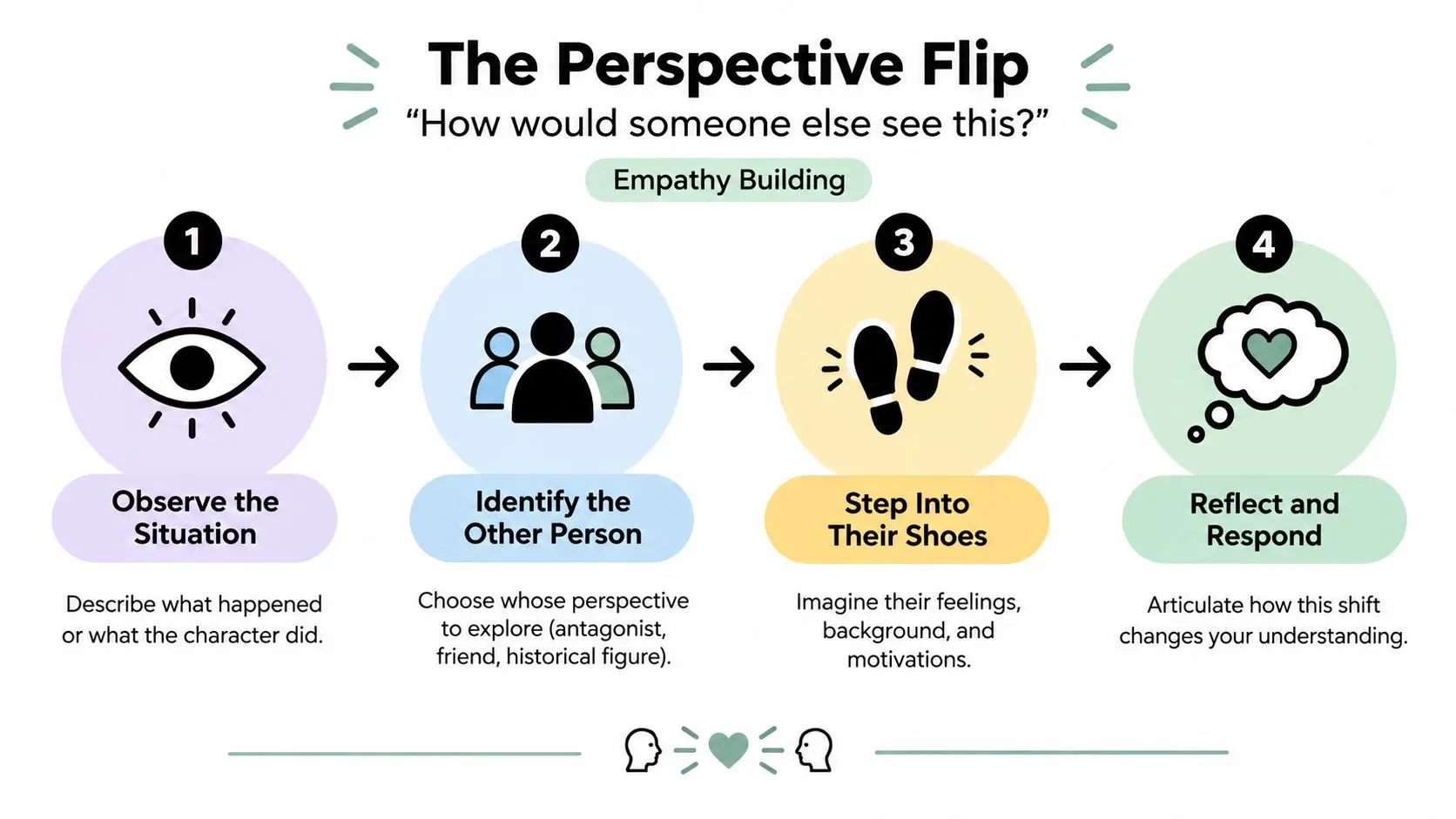
5. The Perspective Flip How Would Someone Else See This
A learner may understand an event differently once they stop looking at it from only one position. “How would someone else see this?” develops empathy, interpretation and the ability to recognise that people act from different information, experiences and priorities.
In a novel, ask, “How would the victim feel about the main character's actions?” In history, consider what concerns a person from that period might have had. In science, explore why someone might initially resist a new discovery. During conflict resolution, ask what the other person may think is happening, without suggesting that every perspective is equally accurate or acceptable.
Protect the learner while widening the view
Role-play can make perspective-taking memorable. A class might conduct a character interview, with one pupil answering questions as a historical figure or fictional character. In an online lesson, learners can submit questions in chat or use an anonymous response form before anyone speaks. This gives a child who feels exposed a way to participate without performing vulnerability in front of the group.
Mindfulness or a short grounding pause can help before sensitive discussion. The teacher might invite learners to notice their breathing, place both feet on the floor and choose whether they'd like to respond aloud, in writing or through a drawing. These choices don't reduce the intellectual challenge. They reduce unnecessary pressure.
With SEN and SEMH needs, use fictional or clearly bounded scenarios before asking about real disagreements. Avoid telling a child to “put themselves in someone else's shoes” if the phrase feels abstract. Instead, offer a prompt card: “What might this person know?”, “What might they fear?”, and “What might they want to change?”
At GCSE and A-Level, connect perspective with interpretation and evidence. A strong response should explain how a viewpoint is shaped by context, not merely label a character or group as good or bad. The teacher can praise an “aha” moment when a learner revises their first interpretation. Changing your mind after considering new information is a sign of thinking, not inconsistency.
6. The Assumption Challenge What Are We Taking for Granted
Every argument rests on ideas that may be stated openly or left hidden. Asking “What are we taking for granted?” teaches learners to search beneath the surface.
An advertisement might assume that a particular product will make someone happier. A scientific explanation may depend on an assumption that an earlier measurement was accurate. A novel may reflect assumptions about gender, class or authority. A social policy may rely on beliefs about behaviour that aren't supported by enough evidence.
The question can sound difficult, so begin with everyday examples. Show a picture of a crowded bus and ask, “What might we be assuming about the people in this image?” Then distinguish between an observation and an assumption. “There are several people standing” is visible. “They're all travelling to work” is an interpretation that needs support.
Make hidden thinking visible
An assumption iceberg works well. The stated claim appears above the water, while the beliefs underneath remain partly hidden. For example:
- Claim: This advert presents a product as a route to happiness.
- Visible clue: People in the advert are smiling.
- Possible assumption: Owning the product creates social belonging.
- Challenge: What other explanation could account for the smiles?
Model your own uncertainty. A teacher might say, “I assumed this source would be reliable because it looked professional. I need to check the author and evidence.” This shows learners that recognising bias isn't an admission of failure. It's a way to improve judgement.
Identity-based assumptions require particular care. Establish respectful discussion rules, allow anonymous contributions and don't ask a child to represent an entire group. If a learner becomes uncomfortable, offer an exit card, a quiet pause or a change of task. UK guidance on SEMH support includes practical measures such as visual prompts, short tasks, breaks, a trusted key person and problem-solving support. Those adjustments can preserve challenge while reducing anxiety.
For GCSE and A-Level preparation, ask students to identify assumptions in an extract or argument, explain how they influence the conclusion and evaluate whether they're justified. That movement from spotting to evaluating turns a discussion prompt into exam-ready reasoning.
7. The Values Detective What Does This Reveal About What Someone Cares About
Actions often reveal priorities more clearly than statements. “What does this reveal about what someone cares about?” invites learners to infer values from choices while recognising that one action rarely tells the whole story.
In literature, a character's sacrifice may suggest loyalty, justice, family commitment or a desire for recognition. In history, a decision may reveal beliefs about power, security or national identity. In current affairs, activism can indicate a commitment to equality, environmental protection or community responsibility. In personal development, pupils can reflect on what their own choices suggest about their priorities, but they should never be pressured to disclose private information.
Separate evidence from judgement
Use values cards with words such as fairness, freedom, safety, belonging, achievement and responsibility. Give groups a short scenario and ask them to choose which values appear most visible, then identify the behaviour that led them there. The point isn't to discover one authorised answer. It's to explain an interpretation respectfully.
A child might say, “The character values loyalty because they keep a promise.” A stronger response adds qualification: “However, the decision also protects their reputation, so the motive may be mixed.” This teaches moral reasoning without presenting people as simple or predictable.
Online, learners can drag values into a shared workspace, journal privately or contribute through a poll before discussion. Different cultural and family values should be treated with respect. Teachers can connect discussion with school values such as belonging, and excellence, while making clear that learners may interpret those ideas differently.
For SEN and SEMH learners, use a visual scale rather than demanding abstract explanation immediately. Ask, “Which value seems strongest here?” and “What detail makes you think that?” Give thinking time and avoid correcting a child's emotional interpretation too quickly. If the text raises difficult feelings, acknowledge them: “That choice feels unfair to you. Let's identify what makes it feel that way.”
At A-Level, students can examine tensions between values. A decision may protect security while limiting freedom. That tension creates the basis for a nuanced judgement, grounded in evidence rather than personal attack.
8. The Problem Reframing What If We Looked at This Differently
Reframing changes the question without pretending the difficulty isn't real. Ask, “What if we looked at this differently?” A mathematics problem that resists one method may invite another approach. A failed project may reveal an overlooked opportunity. A research question may become clearer when viewed from the opposite angle.
A pupil struggling with an equation could ask, “If this method isn't working, what else could I try?” In project-based learning, a group whose original plan failed might identify what the failure has taught them about time, resources or audience. In science, students could examine whether changing the question produces a more useful investigation. In personal development, they might ask what strength a difficulty could help them practise.
The problem-solving guidance from Queen's Online School can sit alongside this questioning routine, particularly when learners need to move from noticing a challenge to choosing a workable response.
Reframe without dismissing
A child who has lost confidence may hear “look on the bright side” as criticism. Begin by acknowledging the problem: “This is frustrating, and the first plan didn't work.” Then widen the view: “What have we learned, and what can we change?”
Use a perspective zoom. Zoom in to one detail, such as the step where a calculation went wrong. Then zoom out to the wider aim, such as choosing an efficient method. A “failure autopsy” can be gentle and factual: what happened, what was expected, what contributed and what could be tried next.
For online learners, offer a private whiteboard or typed response if public discussion feels risky. For SEMH needs, allow a break before asking for reflection. A discreet “Help me” card, exit card or visual timetable can help a learner communicate distress without abandoning the lesson.
GCSE and A-Level students can reframe essay questions by testing alternative interpretations. Ask, “What would change if we treated this as a question about power rather than motivation?” They still need evidence and a clear conclusion, but reframing helps them avoid repeating the first obvious line of argument.
9. The Consequences Compass Who Is Affected and How
A decision can affect people who aren't visible in the original problem. “Who is affected, and how?” develops ethical thinking by making those ripple effects easier to see.
In environmental science, learners might ask who experiences the greatest effects of climate change and why. In economics, they could consider how a policy affects different socioeconomic groups. In history, they might explore who benefited from an event and who suffered. In a school community scenario, they could examine the ripple effects of someone leaving a friendship group, including people who weren't part of the original disagreement.
Map impact and agency together
Concentric circles make consequences tangible. Put the immediate decision in the centre, then add circles for:
- Direct impact: Who experiences the first effect?
- Community impact: Who responds or adapts?
- Distant impact: Who may be affected later or elsewhere?
- Unintended impact: What might nobody have predicted?
Ask learners to include positive consequences as well as negative ones. This prevents ethical reasoning from becoming a search for disaster. Then add agency: “What could someone do to reduce harm or strengthen a positive outcome?”
For younger pupils, use a story about sharing resources or resolving a playground disagreement. For GCSE and A-Level work, require students to compare the scale, duration and distribution of impacts. A strong answer might explain why one group experiences an immediate cost while another gains a longer-term benefit.
Children with SEN or SEMH needs may become overwhelmed by large social issues. Start with a small, familiar decision and use icons for people, feelings and outcomes. A learner can point, draw or select from options before producing a written explanation. Be alert to frustration caused by unequal access to online learning. Ofcom's 2024 UK media literacy report reports that 34% of parents of school-aged children said their child didn't have continuous access to a device for online schoolwork, compared with 28% in 2021, while 96% of children aged 8 to 17 went online in 2023. A thoughtful lesson should never treat device access, quiet space or fast connectivity as universal.
10. The Source of Knowledge How Do We Know What We Know
This question takes learners beyond checking one claim. “How do we know what we know?” asks them to examine how knowledge is created, tested, preserved and sometimes revised.
In science, a class could investigate how an experiment tested a theory and why researchers designed it in a particular way. In history, pupils might ask which sources historians use and what those sources leave out. In literature, they could explore who decided that a book was important or valuable. In current affairs, they might consider how different communities learn about the same issue and why their accounts may differ.
The Critical Thinking Online parent guide from Queen's Online School provides a useful family language for this work, including questions such as who made something, why it was made, what's missing and how it makes the viewer feel.
Develop intellectual humility
Introduce several ways of knowing, including scientific investigation, observation, personal experience, tradition and testimony. Then examine their strengths and limits. Personal experience can be meaningful but may not represent everyone. A scientific method can provide strong evidence for a defined question but may not answer a moral or cultural question by itself.
For Key Stage 2, ask children to trace the journey of a simple fact from observation to recording to sharing. For GCSE, connect the process with source utility, provenance and interpretation. At A-Level, ask whose knowledge has been valued, whose has been marginalised and how that affects the conclusions people draw.
AI tools make this question particularly important. The Open University's 2026 learning report argues that critical thinking and human agency should remain central as AI-driven tools increasingly shape what learners see and how they learn. That is a projection about the educational environment described in the report, not a reason to reject technology. Ask learners to examine an AI-generated answer, identify claims that need checking and explain what the tool cannot decide for them.
Give children permission to say, “I don't know yet.” Intellectual humility isn't passive uncertainty. It's the willingness to identify what evidence is missing and decide how to investigate it.
10 Critical Thinking Question Types Compared
| Prompt / Strategy | Implementation Complexity (🔄) | Resource Requirements (⚡) | Expected Outcomes (📊) | Ideal Use Cases (💡) | Key Advantages (⭐) |
|---|---|---|---|---|---|
| The Wonder Question: "What if…?" Scenarios | 🔄 Low–Medium, open‑ended facilitation | ⚡ Low, discussion tools, idea board | 📊 Increased creativity, perspective‑taking | 💡 Cross‑subject brainstorming; remote live sessions; early years | ⭐ Encourages divergent thinking; inclusive engagement |
| The Evidence Hunt: "How do you know?" Investigation | 🔄 Medium, models source evaluation | ⚡ Medium, access to sources, checklists, time for research | 📊 Stronger media literacy and research skills | 💡 Research essays, current events, science investigations | ⭐ Builds verification skills and academic integrity |
| Similarity‑Difference Detector: Pattern Analysis | 🔄 Low, structured comparison tasks | ⚡ Low–Medium, Venn diagrams, visuals | 📊 Improved pattern recognition and categorisation | 💡 Maths patterns, classification, visual learners & neurodivergent students | ⭐ Quick wins; easily adaptable across subjects |
| Cause‑and‑Effect Chain: Deep Diving | 🔄 Medium–High, multi‑step scaffolding needed | ⚡ Medium, mapping tools, guided steps | 📊 Enhanced systems thinking and causal reasoning | 💡 History timelines, environmental systems, complex problems | ⭐ Promotes deep understanding and prediction skills |
| Perspective Flip: "How would [someone else] see this?" | 🔄 Medium, requires emotional facilitation | ⚡ Low–Medium, role‑play, mindfulness, safe protocols | 📊 Heightened empathy and reduced conflict | 💡 SEMH support, literature, conflict resolution | ⭐ Strengthens social‑emotional learning and belonging |
| Assumption Challenge: "What are we taking for granted?" | 🔄 High, sensitive facilitation required | ⚡ Medium, visuals, protocols, moderator support | 📊 Greater bias awareness and critical questioning | 💡 Media literacy, social studies, ethics discussions | ⭐ Reduces susceptibility to misinformation; fosters critical consciousness |
| Values Detective: Values‑Based Reasoning | 🔄 Medium, nuanced discussion and moderation | ⚡ Low–Medium, values cards, journalling time | 📊 Better moral reasoning and cross‑cultural understanding | 💡 Literature, history, personal development, global citizenship | ⭐ Deepens moral awareness and community connection |
| Problem Reframing: "What if we looked at this differently?" | 🔄 Medium, balance reframing with validation | ⚡ Low, mindset prompts, failure autopsies | 📊 Increased resilience and creative problem‑solving | 💡 Project‑based learning, STEM challenges, personal setbacks | ⭐ Fosters growth mindset and alternative strategies |
| Consequences Compass: "Who is affected and how?" | 🔄 High, systemic/ethical complexity | ⚡ Medium–High, mapping tools, guided reflection | 📊 Stronger ethical reasoning and systemic empathy | 💡 Environmental studies, policy analysis, social justice topics | ⭐ Builds social responsibility and intersectional awareness |
| Source of Knowledge: Epistemological Inquiry | 🔄 High, abstract concepts need careful framing | ⚡ Medium, historical cases, philosophical resources | 📊 Intellectual humility and research literacy | 💡 Advanced science, history, critical thinking seminars | ⭐ Promotes academic rigour and resistance to pseudoscience |
Turn Better Questions Into Confident Thinking
Teachers and families don't need to use all ten prompts in one lesson. Choose one question that fits the subject and the learner's current readiness. A child who is tired, anxious or overwhelmed may still be capable of thought, but they may need a quieter route into it.
Use a simple adaptation routine:
- Choose one prompt. Select the question that matches the lesson's purpose. Use “What if?” for prediction, “How do you know?” for evidence, “What's the pattern?” for comparison, or “Who is affected?” for impact.
- Match the language to the learner. A Key Stage 2 pupil might hear, “What changed?” A GCSE student might hear, “Which factor best explains the change?” An A-Level learner might need to evaluate competing interpretations.
- Add a visible support. Use a picture, timeline, Venn diagram, flowchart, source grid, values cards or concentric circles. Visual structure reduces the memory load without reducing the thinking.
- Offer a sentence starter. “I notice…”, “I think this because…”, “One limitation is…” and “A different person might…” give learners a safe beginning.
- Allow thinking time. Silence is not evidence that a learner has nothing to say. Give children time to process, write, draw, rehearse with a partner or revisit the source.
- Provide response choice. Spoken answers, chat, a private message, a voice recording, annotations and short written paragraphs can all reveal reasoning.
- Finish with emotional reflection. Ask, “What felt easy?”, “What felt difficult?”, “When did your thinking change?” and “What support helped you participate?”
This routine supports progression. Learners often begin by observing and comparing. They then move towards evidence, cause and effect, perspective, assumptions and consequences. The final prompt, “How do we know what we know?”, adds epistemological analysis and helps students question the reliability, limits and origins of knowledge.
SEN and SEMH support should reduce unnecessary pressure, not remove intellectual challenge. A trusted key person, visual rules, short tasks, frequent breaks, transition support and an agreed exit option can help a child remain engaged. In England's early years framework, personal, social and emotional development is described as essential to healthy, happy lives and fundamental to cognitive development. The guidance expects children to understand feelings, manage emotions, persist, build confidence and direct attention, all of which affect how safely they can participate in demanding discussion. Development Matters guidance from the Department for Education also connects learning with friendship, cooperation and peaceful conflict resolution.
Critical thinking questions have a direct place in exam preparation. UK pupils once took a dedicated GCE A-Level in Critical Thinking, with 1,878 students taking the full A-Level in 2011 and 18,819 taking the AS-only qualification, as recorded in the Lords Library review of teaching history in schools. That history shows that critical thinking has been assessed nationally rather than treated only as enrichment. A Cambridge Assessment study of more than 2,000 students matched on prior GCSE attainment also found higher average A-Level scores among students who achieved an A or B in Critical Thinking AS, with the pattern appearing across subjects including Biology, Chemistry, Physics, Maths, Geography, Economics, Psychology and English. The Durham University thesis containing the study provides the relevant subject comparisons.
The classroom implication is practical. Ask students to explain why an answer is justified, evaluate the strength of evidence, identify an assumption and make a balanced judgement. These are the habits behind strong GCSE explanations and A-Level evaluation. A UK higher-education intervention reported a 62% increase in the use of critical-thinking and metacognitive skills and a 63% increase in successful use in intervention classes compared with control groups, according to the published higher-education case study. The figures shouldn't be treated as a promise that one question will create the same result for every learner. They do show why explicit teaching of reasoning can produce observable academic behaviours.
Parents also have a useful role. During a video, ask who made it and what they wanted viewers to believe. During homework, ask which detail supports the answer. When a child feels stuck, ask whether the problem can be divided into smaller parts rather than immediately supplying the solution. Keep the tone warm. Curiosity works better than interrogation.
Try one question in the next live or recorded lesson. Watch what helps the child participate: a visual, a pause, a private response, a partner, a sentence starter or reassurance that uncertainty is welcome. Then keep that support and adjust the prompt slightly. Confidence grows when learners experience themselves thinking, not merely when adults tell them they're capable.
Queen's Online School offers live, interactive British curriculum lessons from Primary through Sixth Form, with subject-specialist teaching, small classes, personalised support and recorded sessions. For learners who need flexible participation, SEN or SEMH-aware support, or preparation for recognised GCSE and A-Level qualifications, visit Queens Online School to explore how its online learning community could support confident critical thinking.